

Latest approaches like big 5 factor theory.
Official Syllabus: Paper I · Unit 11 Personality
“Five robust factors of personality.”
— Norman (1963), on replicating the structure that became the Big Five
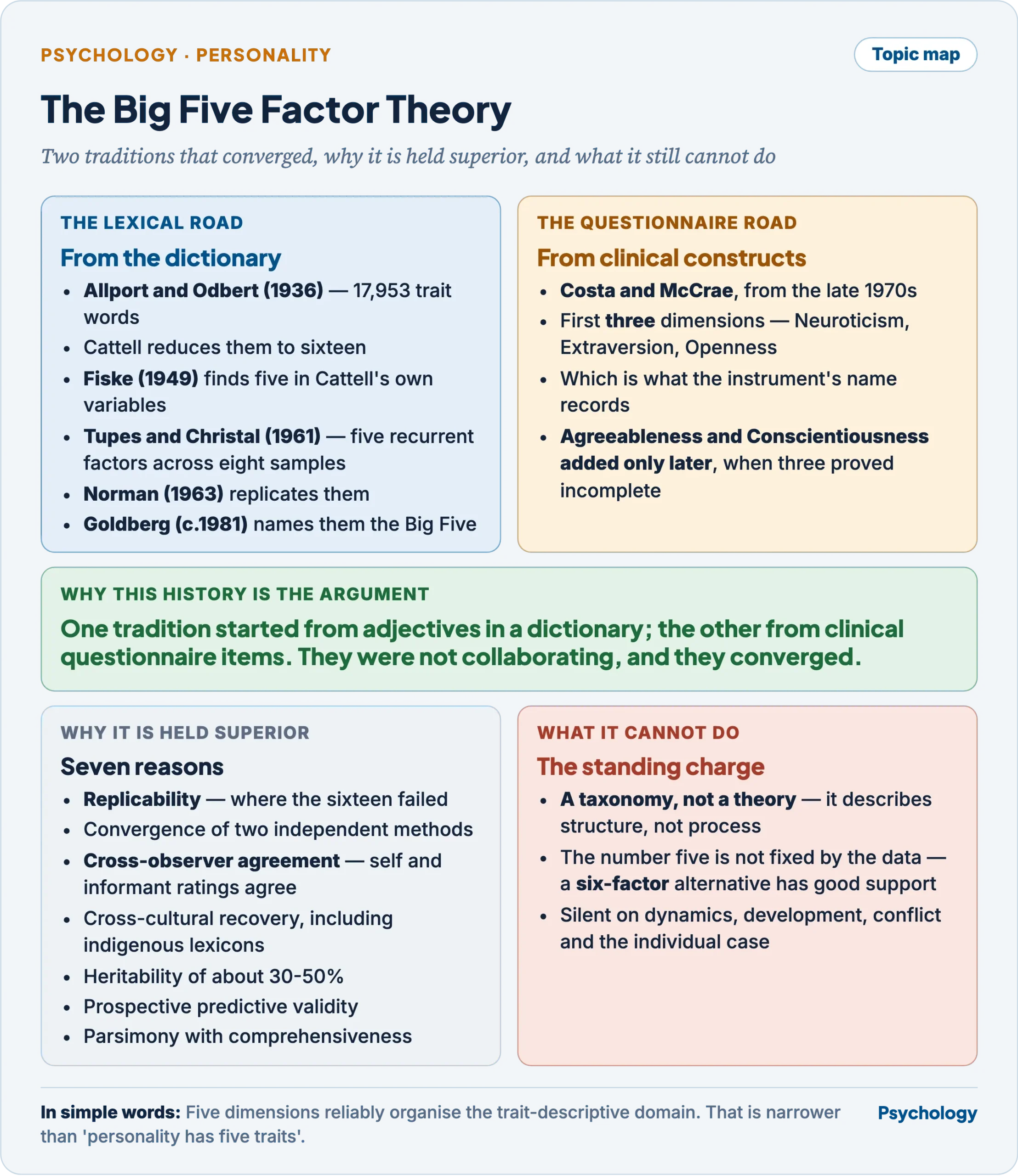
The five-factor model is the nearest thing personality psychology has to a settled result, and its authority rests on an unusual fact: two research traditions that began from different data, with different methods, in pursuit of different questions, arrived at the same five dimensions. That convergence, rather than any single study, is the argument.
The five dimensions
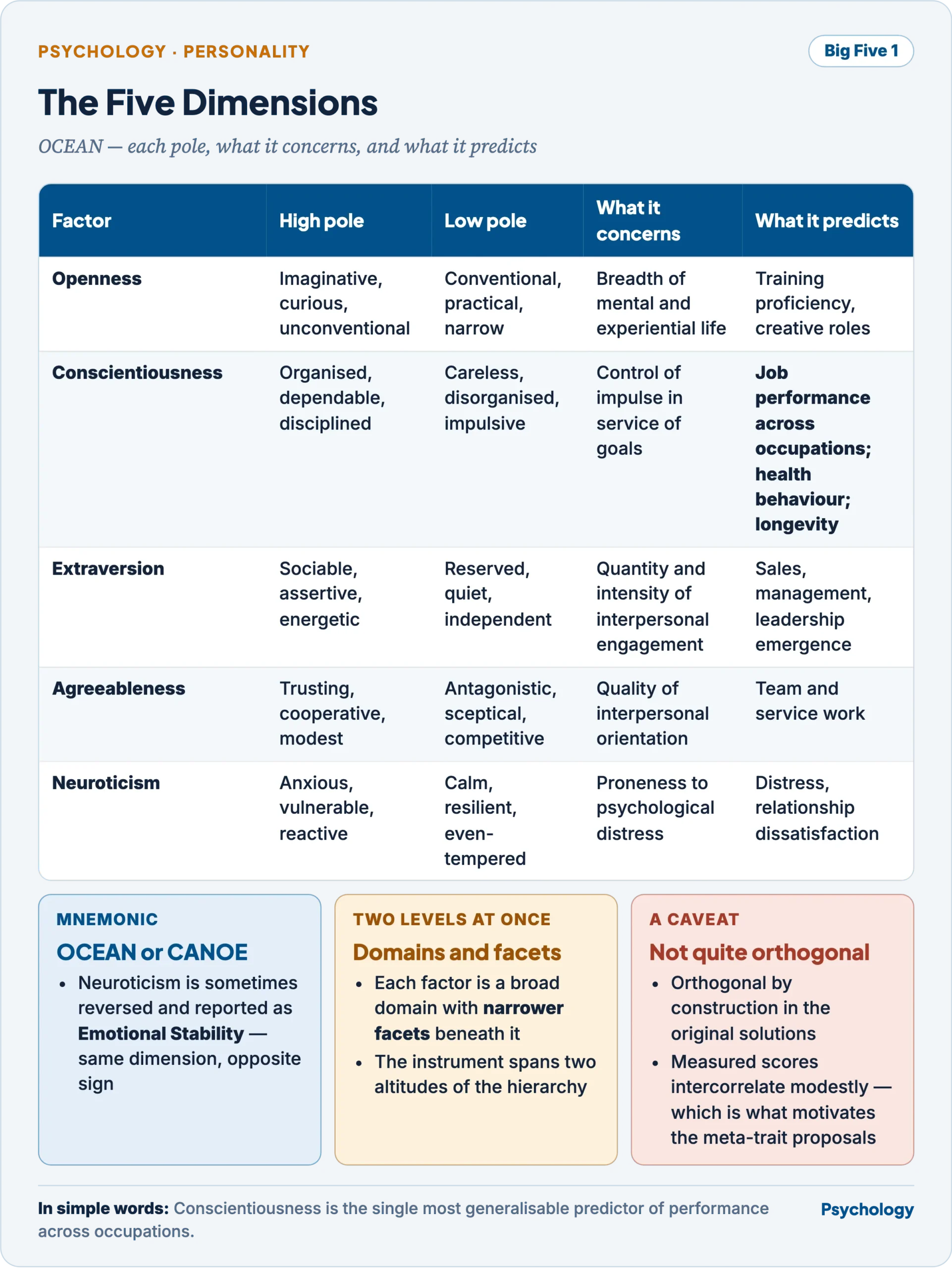
| Factor | High pole | Low pole | What it concerns |
|---|---|---|---|
| Openness to Experience | Imaginative, curious, unconventional, aesthetically sensitive | Conventional, practical, narrow in interests | Breadth and depth of mental and experiential life |
| Conscientiousness | Organised, dependable, disciplined, achievement-striving | Careless, disorganised, impulsive | Control of impulse in the service of goals |
| Extraversion | Sociable, assertive, energetic, positive in affect | Reserved, quiet, independent | Quantity and intensity of interpersonal engagement |
| Agreeableness | Trusting, cooperative, modest, considerate | Antagonistic, sceptical, competitive | The quality of interpersonal orientation |
| Neuroticism | Anxious, vulnerable, self-conscious, emotionally reactive | Calm, resilient, even-tempered | Proneness to psychological distress |
- The initials spell OCEAN or CANOE, which is how the set is usually remembered. Neuroticism is sometimes reversed and reported as Emotional Stability, which changes the sign and not the dimension.
- Each factor is a broad domain with narrower facets beneath it. The widely used inventory reports facet scores under each of the five, so the instrument spans two levels of the hierarchy at once — a point that matters for the comparison with Cattell below.
- The factors are orthogonal by construction in the original solutions, though in practice measured scores show modest intercorrelations, which is one of the standing criticisms.
Where the five came from
- The lexical hypothesis is the starting premise: the individual differences that matter in human affairs become encoded in ordinary language, so the dictionary is a reasonable sampling frame for the whole domain. Allport and Odbert (1936) extracted 17,953 trait-relevant terms, and everything that follows is an attempt to reduce that list to its structure.
- Cattell reduced the list by clustering and factor-analysing it, arriving at his sixteen primary factors — the first serious attempt, and the one whose number later workers could not replicate.
- The five emerged from re-analysis, repeatedly and independently. Fiske (1949) found a five-factor structure in Cattell’s own variables. Tupes and Christal, working with United States Air Force data in the late 1950s and reporting in 1961, found five recurrent and strong factors across eight different samples, which they labelled Surgency, Agreeableness, Dependability, Emotional Stability and Culture. Norman (1963) replicated them, after which the set was known for some years as the Norman Five.
- The work was then largely ignored for two decades, through the period when Mischel’s critique had made the trait concept disreputable, and was recovered in the early 1980s. Goldberg coined the name Big Five around 1981 — “big” referring to the breadth of the factors, not their importance.
- The second tradition arrived independently. Costa and McCrae, working from questionnaire data rather than the lexicon and beginning in the late 1970s, first identified three dimensions — Neuroticism, Extraversion and Openness, which is what the instrument’s name records. Agreeableness and Conscientiousness were added only in the later revisions, when it became clear their three-factor solution was incomplete and matched the lexical researchers’ five once extended.
- That history is the strongest single argument for the model. One tradition started from adjectives in a dictionary and the other from questionnaire items written to measure clinical and developmental constructs. They were not collaborating, and they converged.
Why it is held to be superior to earlier factor theories
- Replicability, which is where Cattell’s sixteen failed. The five recover across independent samples, across raters, across instruments, and across time.
- Convergence of methods, set out above: lexical and questionnaire traditions, from different data, reaching the same structure.
- Cross-observer agreement. Self-ratings and ratings by spouses, friends and colleagues agree substantially on all five — which a structure that existed only in self-perception could not achieve.
- Cross-cultural recovery. The structure appears in translations across a very wide range of languages, and in several studies that analysed indigenous lexicons rather than translated instruments.
- Heritability. Twin studies place the genetic share of the five dimensions in the region of 30 to 50 per cent — Jang, Livesley and Vernon (1996) — with the characteristic behaviour-genetic pattern of negligible shared environment.
- Temporal stability: rank-order consistency is high in adulthood, and mean-level change follows the lawful pattern of the maturity principle.
- Predictive validity, prospectively and over long intervals: Conscientiousness predicts job performance across occupations and predicts health behaviour and longevity; Neuroticism predicts psychological distress and relationship dissatisfaction; the set predicts academic attainment, and does so incrementally over ability.
- Parsimony with comprehensiveness — five dimensions, which is few enough to be usable and broad enough that most trait descriptors load somewhere.
The five-factor model against the sixteen-factor model
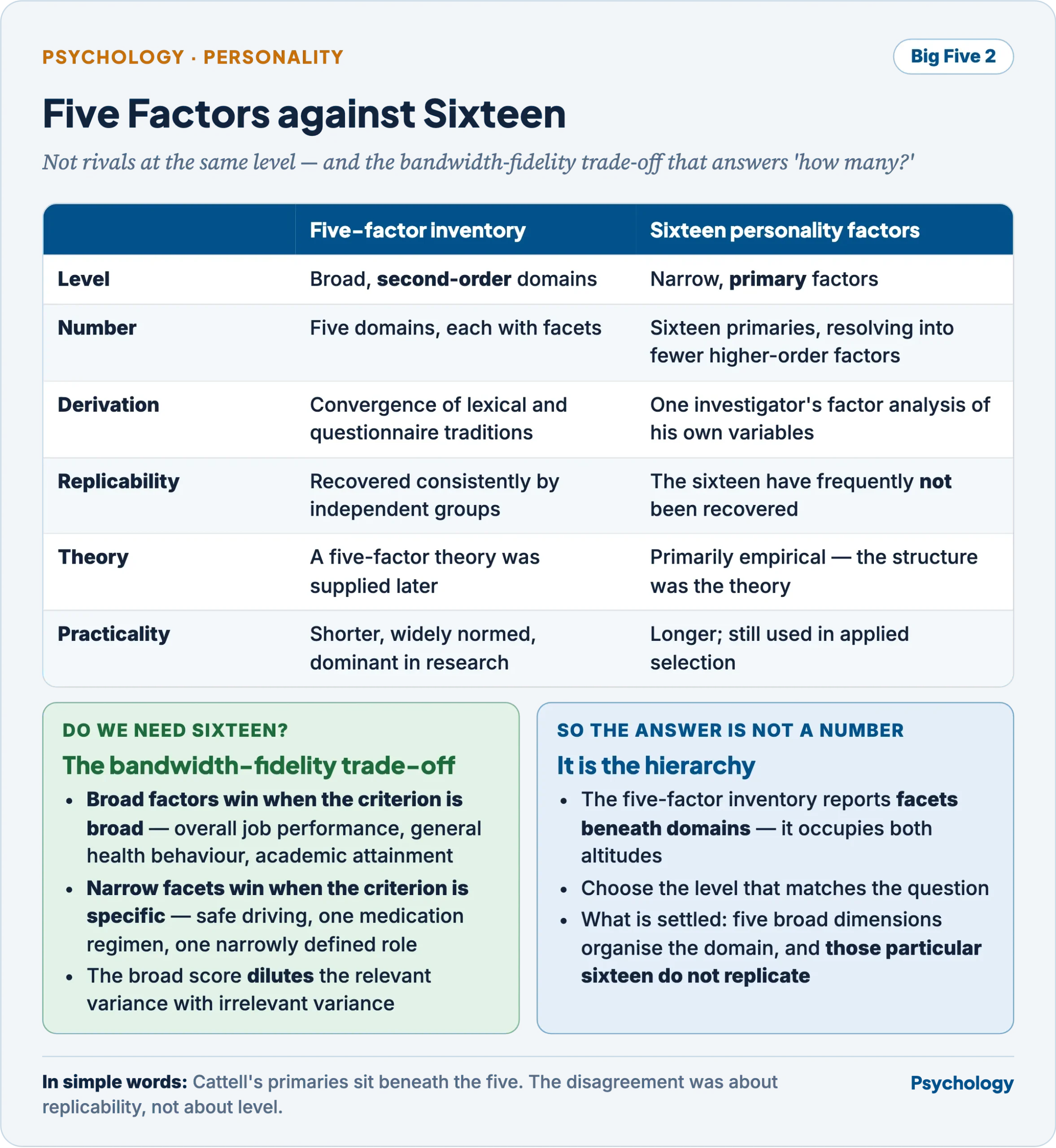
| Five-factor inventory | Sixteen personality factors | |
|---|---|---|
| Level of the hierarchy | Broad, second-order domains | Narrow, primary factors |
| Number | Five domains, each with facets | Sixteen primaries, resolving into fewer higher-order factors |
| Derivation | Convergence of lexical and questionnaire traditions | One investigator’s factor analysis of his own variable set |
| Replicability | Recovered consistently by independent groups | The sixteen have frequently not been recovered; fewer factors emerge |
| Theoretical backing | An explicit five-factor theory was later supplied | Primarily empirical; the structure was the theory |
| Data sources | Self-report and observer forms | L-data, Q-data and T-data, sampled deliberately |
| Reporting | Domain scores plus facet profile | A sixteen-point profile |
| Practicality | Shorter; widely normed; dominant in research | Longer; still used in applied selection work |
- The decisive point is that they are not rivals at the same level. Cattell’s sixteen are primary factors; the five are second-order. Factor-analysing the sixteen yields a smaller set of higher-order dimensions, and the most robust of these correspond to extraversion and anxiety — which is to say, to two of the five. The two instruments measure the same hierarchy at different altitudes, exactly as Eysenck’s three and Cattell’s sixteen do.
- The substantive disagreement is about replicability, not about level. The charge against sixteen is not that primary factors are the wrong unit but that those particular sixteen have not been reliably recovered, including from Cattell’s own data. That is an empirical failure, and it is the reason the field moved.
Do we need sixteen factors?
- The question has a precise answer, and it is not a number. It is the bandwidth-fidelity trade-off: for a fixed amount of measurement, one can have a few broad constructs that predict many things moderately, or many narrow constructs that predict specific things well. Neither is superior in the abstract.
- Broad factors win when the criterion is broad. Overall job performance, general health behaviour, academic attainment across subjects — here Conscientiousness as a single domain predicts about as well as its components, and is simpler.
- Narrow facets win when the criterion is specific. Predicting safe driving, or adherence to one medication regimen, or performance in one narrowly defined role, a specific facet — such as deliberation or dutifulness — outpredicts the broad domain that contains it, because the broad score dilutes the relevant variance with irrelevant variance.
- So the hierarchy is the answer, not either level. The five-factor inventory’s own design concedes this: it reports facets beneath domains, which is to say it occupies both altitudes. A researcher chooses the level that matches the question; a practitioner selecting for one job may legitimately want the narrow scores.
- What is genuinely settled is narrower than the question implies: not that five is the right number of personality traits, but that five broad dimensions reliably organise the trait-descriptive domain, and that Cattell’s particular sixteen do not replicate.
A critical examination of the conceptual basis
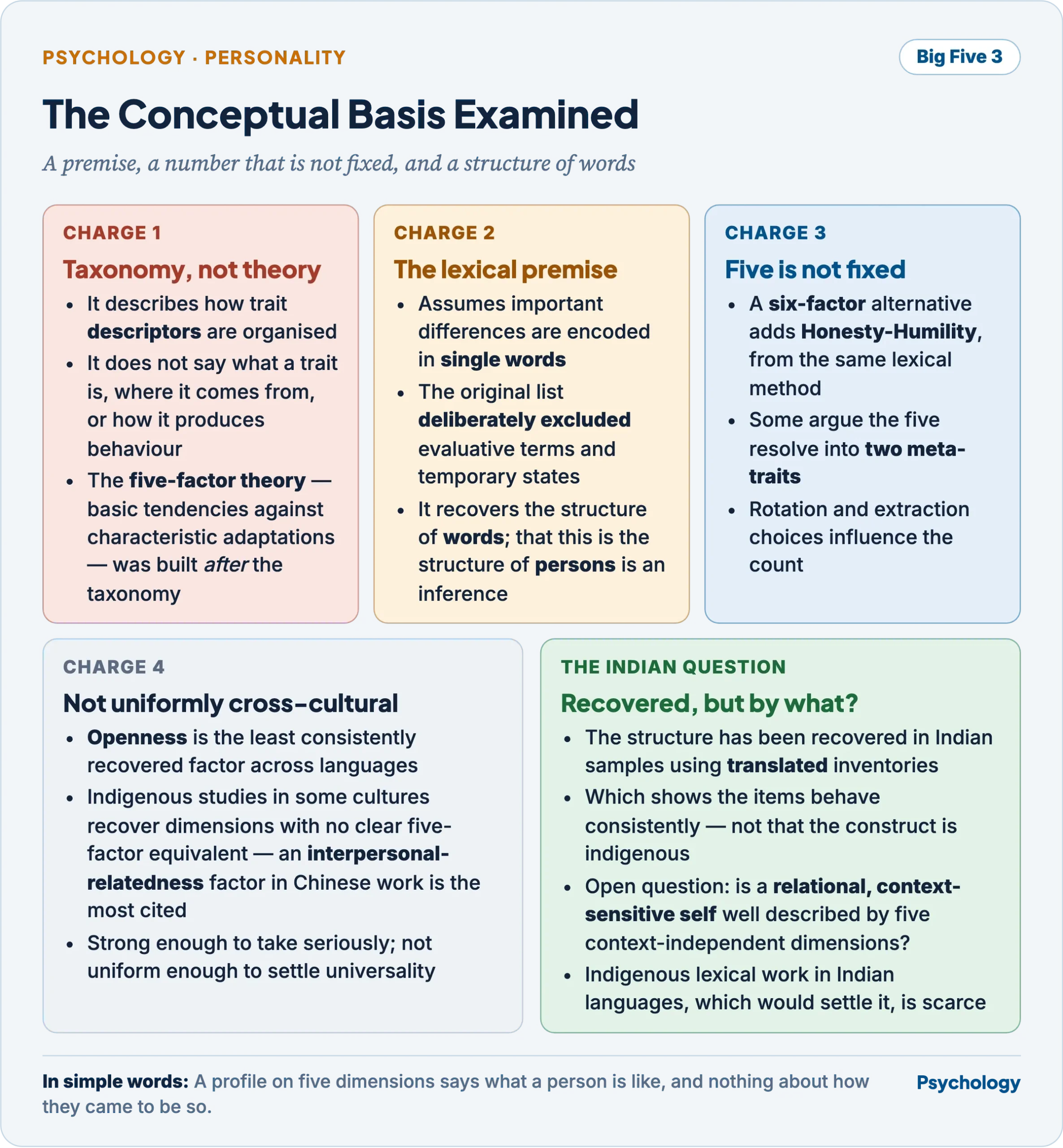
- It is a taxonomy, not a theory. The model describes how trait descriptors are organised; it does not say what a trait is, where the dimensions come from, or by what process they produce behaviour. McCrae and Costa later supplied a five-factor theory distinguishing basic tendencies — the biologically based dispositions — from characteristic adaptations, the habits, roles and self-concept through which they are expressed. The distinction is useful, and it was built after the taxonomy rather than generating it.
- The lexical hypothesis is a premise, and it has consequences.
- It assumes important differences are encoded in single words, so anything a language expresses only in phrases is invisible to the method.
- The original word list deliberately excluded purely evaluative terms and temporary states, which is a theoretical decision made at the outset and inherited by everything downstream.
- It recovers the structure of trait descriptors. Whether the structure of the words is the structure of persons is an inference, not a finding.
- The number five is not fixed by the data. Rotation and extraction decisions influence it, as they do in any factor analysis.
- A six-factor alternative adds Honesty-Humility and has good support from indigenous lexical studies in several languages — which is a serious challenge, since it was derived by the same lexical method that produced five.
- Some argue the five resolve further into two meta-traits, often called stability and plasticity; others have proposed a single general factor of personality, which is contested and may be an artefact of evaluative response bias.
- The factors are not fully independent. Measured scores intercorrelate modestly, which sits awkwardly with an orthogonal solution and is part of what motivates the meta-trait proposals.
- Cross-cultural recovery is good but not uniform. Openness is the least consistently recovered factor across languages, and indigenous studies in some cultures recover dimensions with no clear five-factor equivalent — an interpersonal-relatedness factor in Chinese studies is the most-cited instance. The replication is strong enough to take seriously and not so uniform as to settle universality.
- It is silent on what personality psychology most wants to know: dynamics, development, conflict, the individual case, and how a person changes. A profile on five dimensions says what a person is like and nothing about how they came to be so or what they might become.
- It is a model of normal-range variation, and extending it to disorder — as the dimensional models of personality pathology attempt — requires assumptions the original structure does not supply.
Applications, and the Indian question
- Selection and work. Conscientiousness is the single most generalisable predictor of job performance across occupations, and Emotional Stability adds to it; the other three predict in specific roles — Extraversion in sales and management, Agreeableness in team and service work, Openness in training proficiency and creative roles. The practical caution is that applicant faking raises scores on the socially desirable poles, which is why the operational use of self-report in high-stakes selection remains contested.
- Clinical application has moved furthest. Dimensional models of personality disorder, including those now in the diagnostic manuals as alternative schemes, are substantially the five factors with the poles rotated towards maladaptive variants — negative affectivity for neuroticism, detachment for low extraversion, antagonism for low agreeableness, disinhibition for low conscientiousness, with psychoticism added.
- Health and longevity. Conscientiousness predicts health behaviour, adherence to treatment and length of life, with the mechanism running through behaviour rather than through any direct physiological path.
- The Indian evidence is thinner than the citation count suggests. The five-factor structure has been recovered in Indian samples using translated inventories, which demonstrates that the instrument’s items behave consistently rather than that the construct is indigenous. The open question is the one indigenisation raises: whether a relational, context-sensitive self is well described by five context-independent dimensions, or whether the method recovers five factors here because five factors are what the instrument was built to find. Indigenous lexical work in Indian languages, which would settle it, is scarce.
Criticisms and limitations
- Description without explanation is the central charge, and the five-factor theory added later is a framework rather than a mechanism.
- The factor number is defensible rather than demonstrated, with the six-factor alternative the strongest competitor on the same method.
- Self-report dominates the evidence, with the usual exposure to social desirability and limited self-knowledge, partly mitigated by observer agreement.
- The method cannot find what the lexicon does not encode, so the claim to comprehensiveness is a claim about language.
- Facet structure is less well established than domain structure, and facet scales are shorter and less reliable.
- It gives no account of situations, so the interactionist settlement reached in the person-situation debate is acknowledged rather than incorporated.
- Indian applications rest largely on translated instruments, and the question whether a relational self-construal is adequately described by five context-independent dimensions is open rather than answered.
Previous Year Questions
- 2022Do we need 16 factors to describe human personality? Illustrate your answer in the light of big five-factor theory of personality.
- 2019How is NEO Five-Factor Theory different from 16 Personality Factors Theory? Explain.
- 2015State the components of Big-5 factor theory of personality. Why is it considered superior to other factor theories of personality?
- 2010What are the ‘big five’ personality factors? Critically examine their conceptual basis.