

Theories of personality (humanistic).
Official Syllabus: Paper I · Unit 11 Personality
“The organism has one basic tendency and striving — to actualize, maintain and enhance the experiencing organism.”
— Rogers (1951)
Humanistic psychology was named the third force because it defined itself against the other two. Psychoanalysis studied the sick and found drives; behaviourism studied the controllable and found conditioning; both, on this reading, had produced a psychology in which the person does not appear. The humanistic claim is that the subject’s own experience is the proper datum, that the organism tends towards growth when conditions permit, and that a psychology built only on pathology and on rats cannot describe a human life.
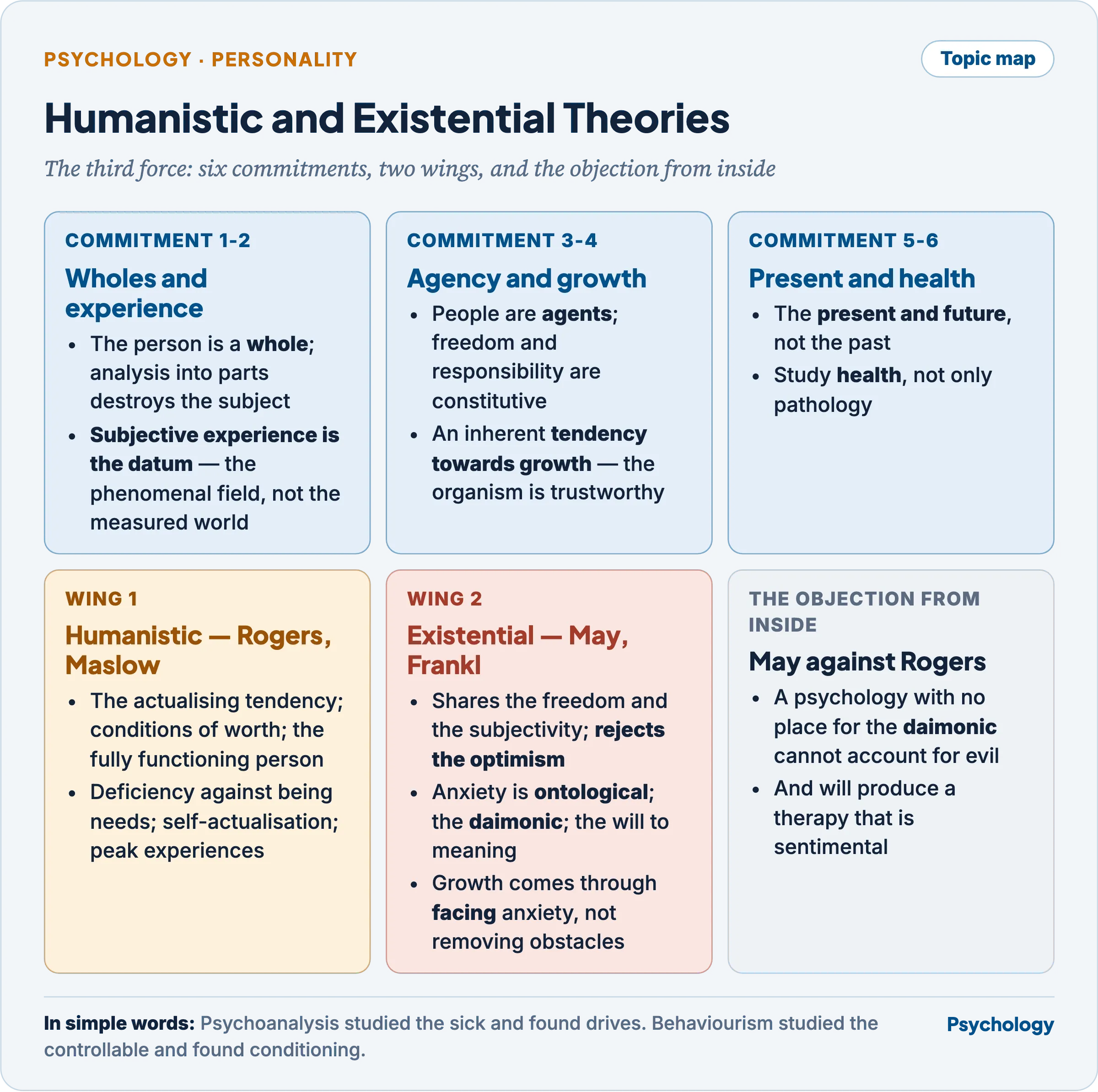
What “humanistic” means
- Six commitments define the term, and a theory is humanistic to the extent that it holds them.
- The person is a whole, not a sum of drives, traits or responses. Analysis into parts destroys the subject matter.
- Subjective experience is the datum. What matters is the person’s own phenomenal field — the world as they perceive it — not the world as an observer measures it. Behaviour is intelligible only from the inside.
- People are agents. Freedom and the responsibility that comes with it are constitutive, not illusions produced by ignorance of the real causes.
- There is an inherent tendency towards growth. The organism is fundamentally trustworthy and moves towards the realisation of its capacities when it is not obstructed.
- The present and the future, not the past. A person is explained by what they are becoming and the choices in front of them, not by what happened in infancy.
- Psychology should study health. Building a theory of personality on patients produces a theory of pathology; the healthy, creative and mature person is the proper object.
- The movement was organised rather than merely intellectual, with the founding of an association and a journal in the early 1960s, and Maslow, Rogers, May and Bugental as its principal figures.
- The existential wing is distinct and darker. It shares the emphasis on freedom, responsibility and subjective experience, and rejects the optimism: for May and Frankl, freedom brings anxiety, the confrontation with meaninglessness and death is unavoidable, and growth comes through facing these rather than through removing obstacles to a benign nature.
Rogers: the self and its conditions
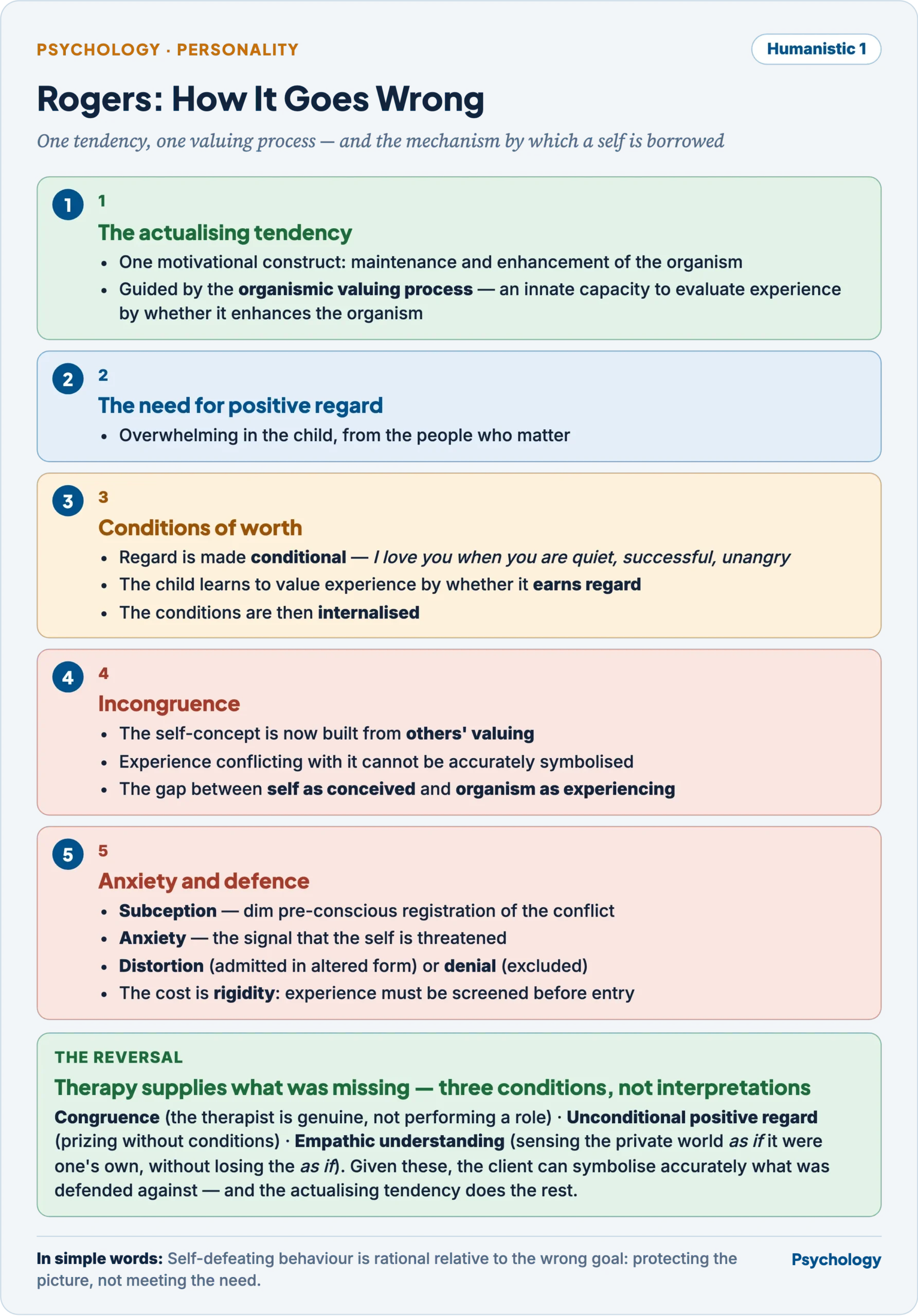
- The actualising tendency is the single motivational construct — one tendency, operating in the whole organism, towards maintenance and enhancement. Rogers needs no other motive, which is the formal contrast with Freud’s dualism and Maslow’s hierarchy.
- The organismic valuing process is its guidance system: an innate capacity to evaluate experience by whether it maintains and enhances the organism. The infant has it and uses it; the adult commonly does not.
- The self-concept is the organised, consistent set of perceptions of I and me, together with the values attached to them. It is learned and it is a perception, which means it can be inaccurate. Alongside it is the ideal self, what the person would like to be.
- Conditions of worth are the mechanism by which it all goes wrong. The child has an overwhelming need for positive regard from the people who matter. When that regard is made conditional — I love you when you are quiet, successful, unangry — the child learns to value experience not by the organismic process but by whether it earns regard. Those conditions are then internalised, and the person applies them to themselves whether or not anyone else is watching.
- Incongruence follows. The self-concept is now built out of others’ valuing, so experiences that conflict with it cannot be accurately symbolised in awareness. The gap between the self as conceived and the organism as experiencing is incongruence, and it is the single source of psychological difficulty in this system.
- Anxiety and defence are what incongruence produces.
- Subception is the organism’s dim, pre-conscious registration that an experience is incongruent with the self-concept.
- Anxiety is the tension that registration produces — the felt signal that the structure of the self is under threat.
- Defence follows: distortion, in which the experience is admitted to awareness in an altered form that makes it fit — I did badly because the examiner was unfair — and denial, in which it is excluded altogether.
- The cost is rigidity. Defence preserves the self-concept and narrows the person, since experience must be screened before it is allowed in. Where incongruence is great and defences fail suddenly, the result is disorganisation.
- Therapy reverses the process, and does so by supplying what was missing. The three conditions are congruence — the therapist is genuine and transparent, not performing a role; unconditional positive regard — prizing the client without conditions; and empathic understanding — sensing the client’s private world as if it were one’s own, without losing the as if. Given these, the client can begin to symbolise accurately what was defended against, and the actualising tendency does the rest. The therapist supplies conditions, not interpretations.
The fully functioning person
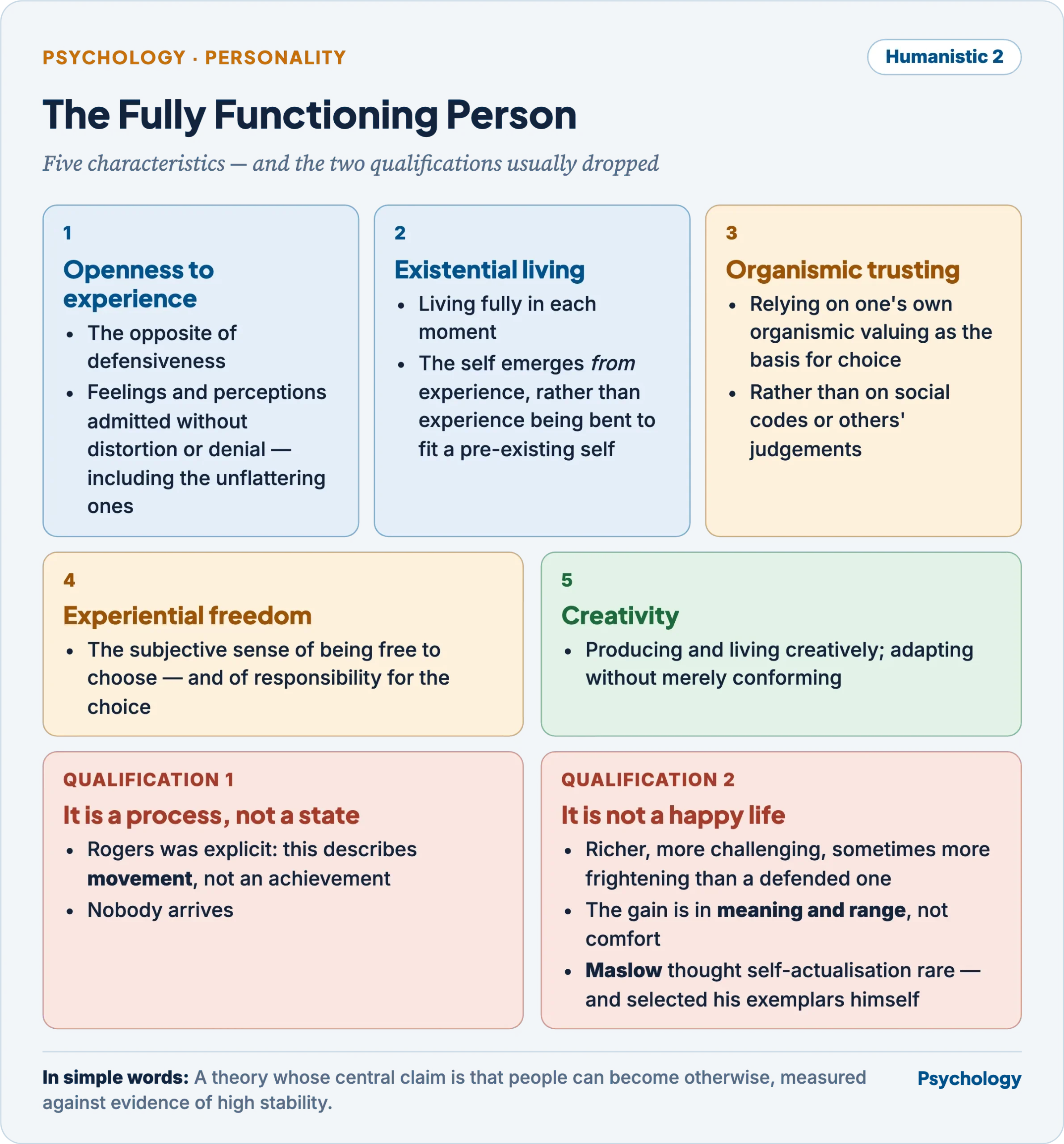
- It is a direction, not a destination. Rogers was explicit that this describes a process rather than a state — the person is not fully functioning but becoming so, and the construct is a description of movement.
- Five characteristics define it.
- Openness to experience — the opposite of defensiveness. Feelings and perceptions are admitted to awareness without distortion or denial, including those that are unflattering.
- Existential living — living fully in each moment, so that the self and the personality emerge from experience rather than experience being bent to fit a pre-existing self.
- Organismic trusting — relying on one’s own organismic valuing as the basis for choice, rather than on social codes or others’ judgements.
- Experiential freedom — the subjective sense of being free to choose, and of responsibility for the choice.
- Creativity — producing and living creatively, adapting without merely conforming.
- The fully functioning person is not a happy person, and Rogers said so. The life described is richer, more challenging and sometimes more frightening than a defended one; the gain is in meaning and in range, not in comfort.
Self-defeating behaviour, explained from this perspective
- The humanistic explanation is specific, and it runs entirely through incongruence rather than through conflict or reinforcement.
- Conditions of worth produce a self-concept built out of others’ valuing rather than the organism’s own.
- That self-concept must then be protected, because it is the person’s only basis for positive self-regard.
- Protecting it requires screening out experience that would disconfirm it — which means the person acts to preserve the image rather than to meet the need.
- The actions that preserve the image are frequently the ones that damage the person’s actual interests. The behaviour is not irrational; it is rational relative to the wrong goal.
- Three worked examples make the mechanism visible.
- A student whose self-concept is I am brilliant delays work until there is no time to do it properly. Failure can then be attributed to the delay rather than to ability, and the self-concept survives. Accurate symbolisation — I might be ordinary — is what the behaviour exists to prevent.
- A person whose conditions of worth taught I am lovable only when useful rejects affection offered without demand, because accepting it would require revising a self-concept on which everything else rests.
- A person who was permitted anger only as illness experiences conflict as physical symptoms, which is distortion in Rogers’ precise sense: the experience is admitted in an altered form that the self-concept can accept.
- The contrast with the other accounts is the point. A psychoanalytic reading finds unconscious conflict and a superego exacting punishment; a behavioural reading finds a reinforcement history in which the self-defeating act was once rewarded or avoided something worse; the humanistic reading finds no hidden motive and no learning history, only a person defending a borrowed picture of themselves. The therapeutic implication differs accordingly: interpret, recondition, or provide the conditions under which the picture can safely be revised.
Maslow: self-actualisation
- Deficiency and being needs is the structural distinction. D-needs — physiological, safety, belongingness, esteem — operate by deficit: they are activated by lack, and satisfying them removes the tension. B-needs, chiefly self-actualisation, operate by growth: engaging them increases rather than reduces the motivation.
- Self-actualisation is the realisation of one’s potential — what a man can be, he must be. Maslow studied it by selecting people he judged to have achieved it, from history and from his acquaintance, and describing what they had in common: accurate perception of reality, acceptance of self and others, spontaneity, problem-centredness rather than self-centredness, a need for privacy, autonomy, continued freshness of appreciation, deep but few relationships, democratic character, an unhostile sense of humour, creativeness, and resistance to enculturation.
- Peak experiences — moments of intense joy, wonder and absorption in which the sense of self dissolves — occur more often in self-actualisers, and Maslow treated them as glimpses of the B-realm available to anyone. He later added self-transcendence, a level beyond self-actualisation oriented to something outside the self.
- The Jonah complex is his name for the fear of one’s own greatness — the evasion of growth because realising potential is frightening and carries responsibility.
- A correction worth carrying: Maslow never drew the pyramid. The triangular diagram universally used to present his hierarchy does not appear in his work; scholarship tracing its origin finds it introduced by others, and attributes the first such depiction to a consulting psychologist writing for a management audience. Maslow’s own text is considerably more flexible than the diagram — he allowed reversals of order, partial satisfaction at every level simultaneously, and exceptions. The rigidity everyone criticises is the pyramid’s, not his. The fuller treatment of the hierarchy as a theory of motivation belongs with the motivation topics.
May and the existential tradition
- Anxiety is ontological, not merely clinical. May defined it as the apprehension cued off by a threat to some value the person holds essential to their existence as a self — so anxiety is the experience of the threat of non-being, and it is unavoidable rather than pathological.
- Normal against neurotic anxiety is his central clinical distinction. Normal anxiety is proportionate to the threat, does not require repression, and can be confronted constructively. Neurotic anxiety is disproportionate, involves repression and other blocking, and is destructive — and it arises precisely from the failure to face normal anxiety earlier.
- The daimonic is May’s deliberate corrective to Rogers. It is any natural function with the power to take over the whole person — sex, anger, the craving for power — and it is the source of both creativity and destructiveness. May held that a psychology which has no place for it, and which treats the organism as simply benign, cannot account for evil and will produce a therapy that is sentimental.
- Freedom and destiny are held together: the person is free, and freedom is always exercised within a destiny — the givens of body, culture, historical moment and death — which cannot be chosen but can be related to.
- Frankl’s will to meaning is the other major existential contribution. Where Freud posited a will to pleasure and Adler a will to power, Frankl posited a need for meaning, and argued from his own extremity that meaning can be found even in unavoidable suffering through the attitude one takes towards it. Logotherapy is the resulting treatment, and the existential vacuum — the experience of meaninglessness — his diagnosis of a characteristically modern complaint.
Can human beings be fully functioning and self-actualised?
- The humanistic answer is yes, with two qualifications that are usually omitted.
- It is a process, not an achievement. Rogers’ fully functioning person is a direction of movement; nobody arrives. The question “can a person be fully functioning” slightly misstates the claim.
- Maslow thought it was rare — he estimated that very few people reach it, and his method of studying it was to select exceptional individuals by his own criteria, which builds the rarity into the finding.
- The conditions are social, not merely personal. Both theorists make actualisation conditional on an environment that does not impose conditions of worth, which in practice means it is unevenly available — a point the theories state and their popular versions ignore.
- The psychoanalytic answer is no, and the disagreement is about human nature rather than about evidence.
- Conflict is constitutive. The id’s demands and civilisation’s requirements are permanently incompatible, so renunciation is the price of social life and cannot be lifted.
- Defences are permanent features, not obstacles to be removed. A person without defences would be overwhelmed, not liberated.
- The aim of treatment is modest by design — the conversion of neurotic misery into ordinary unhappiness, which is deliberately not flourishing.
- The death instinct, for those who accept it, makes destructiveness intrinsic rather than a result of frustrated growth.
- The existential position sits between them and is arguably the strongest. Growth is possible and it is not a matter of removing obstacles to a benign nature: the person must confront anxiety, the daimonic and the fact of death, and what is achievable is authenticity rather than happiness or completion.
- The honest adjudication is that this is a disagreement about premises. Both accounts are internally consistent; what separates them is whether the organism, left to itself, is trustworthy. Neither side has the kind of evidence that would settle it, which is why the dispute has outlived both men.
Criticisms and limitations: the optimistic conclusions examined
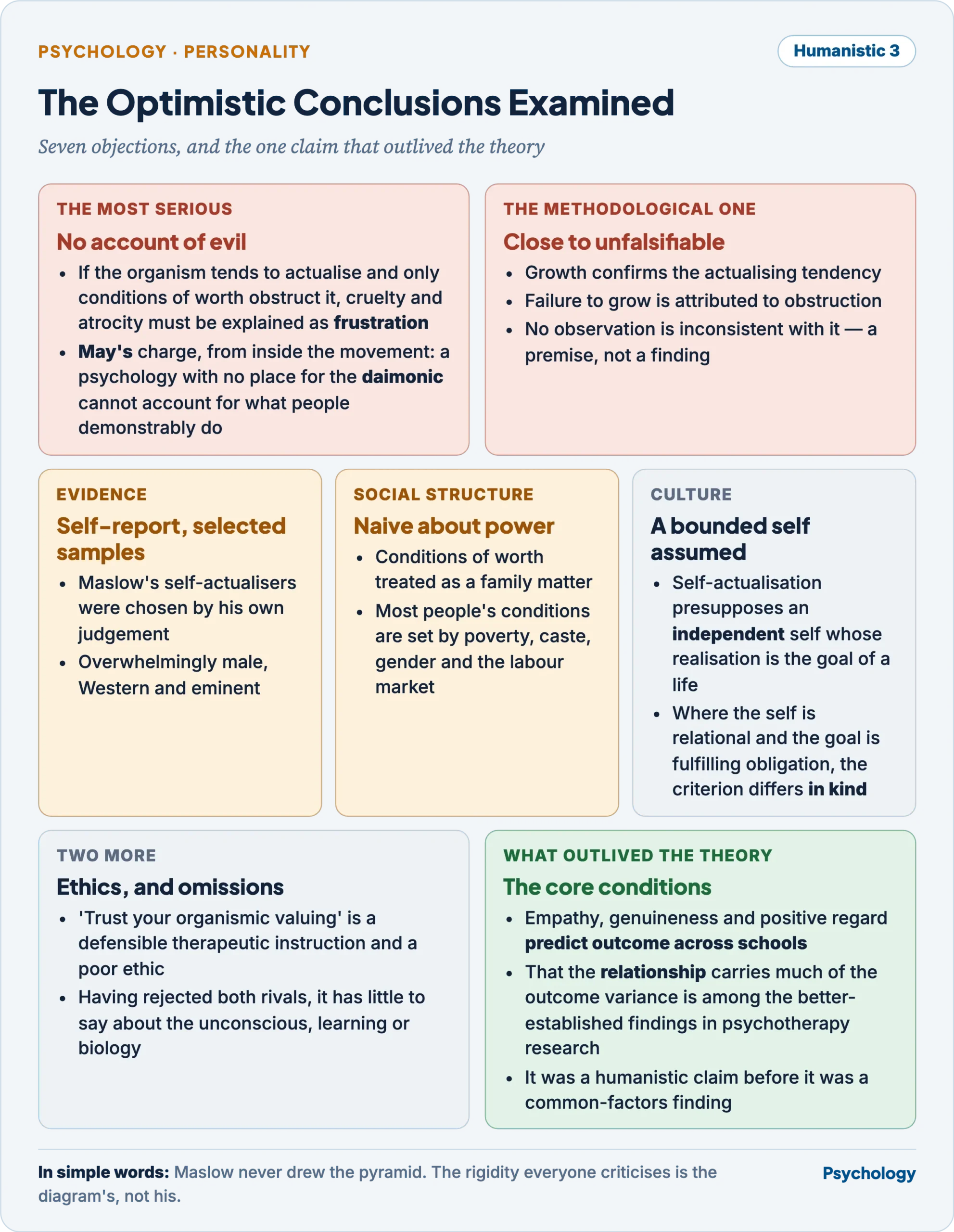
- It has no account of evil, and this is the most serious objection — pressed, notably, from inside the movement. If the organism tends towards actualisation and only conditions of worth obstruct it, cruelty, atrocity and organised destruction have to be explained as frustration. May’s charge was that Rogers’ psychology, having no place for the daimonic, could not account for what human beings demonstrably do.
- The actualising tendency is close to unfalsifiable. Growth confirms it; failure to grow is attributed to obstruction. No observation is inconsistent with it, which makes it a premise rather than a finding.
- The evidence is self-report, gathered from people who have chosen therapy or have been selected by the investigator, and interpreted by the investigator. Maslow’s list of self-actualisers was assembled by his own judgement of who qualified, and his sample was overwhelmingly male, Western and eminent.
- It is naive about social structure. Conditions of worth are treated as a family matter, when the conditions under which most people live are set by poverty, caste, gender and the labour market. A theory whose remedy is a relationship offering unconditional regard has little to say to constraints of that kind.
- It is culturally specific. Self-actualisation presupposes a bounded, independent self whose realisation is the goal of a life. Where the self is construed as relational and the goal is the fulfilment of obligation, the criterion of a good life is different in kind, not merely in content — which makes the theory’s claim to describe human nature a claim about one culture’s conception of it.
- The individualism can license selfishness. “Trust your own organismic valuing” is a defensible therapeutic instruction and a poor ethic, and the popular descendants of this literature have often dropped the therapeutic context.
- It ignores the unconscious and the body. Having rejected psychoanalysis, it has little to say about motives the person cannot see, and having rejected behaviourism, little about learning or biology.
- And yet the therapeutic claims have held up better than the theory. The core conditions — empathy, genuineness, positive regard — predict therapeutic outcome across schools, and the finding that the relationship carries much of the outcome variance is among the better-established results in psychotherapy research. It was a humanistic claim before it was a common-factors finding.
Relevance in the modern era
- The common-factors literature vindicated the central practical claim: what the therapist does matters less than most schools supposed, and the quality of the relationship matters more.
- Motivational interviewing took the person-centred stance — evoking the client’s own reasons for change rather than supplying them — into health behaviour, addiction and chronic disease management, and has a substantial trial base. It is the most successful humanistic export.
- Emotion-focused therapy supplied the Rogerian conditions with a specific technology for working with emotion, and is among the better-evidenced humanistic treatments.
- Person-centred practice in medicine and education — shared decision-making, the patient’s own account of their illness, learner-centred teaching — descends from this tradition even where it is not named.
- Positive psychology pursues the humanistic agenda with nomothetic methods: measurement, trials and replication applied to well-being, strengths and flourishing. The relationship is uneasy, since positive psychology defined itself partly against humanistic psychology’s methodological looseness while adopting its questions.
- The corrective worth noting is that the self-esteem movement, which drew on this literature, did not survive examination: programmes raising global self-esteem produced little improvement in outcomes, and the field moved to self-efficacy, self-compassion and growth mindset — constructs that are specific and measurable where self-esteem was neither.
- In organisations, the lineage runs through participative management, job enrichment and the current language of autonomy, mastery and purpose, which is Maslow’s growth-need argument in applied form.
Previous Year Questions
- 2025When psychologists label their perspective ‘humanistic’, what does this term mean to you? What is its relevance in the modern era?
- 2022Can human beings be fully functioning and self-actualized? Evaluate it from humanistic and psychoanalytic perspectives of personality.
- 2018Compare the trait perspective and humanistic perspective on personality.
- 2017How do we explain self-defeating behaviour of a person from the Humanistic perspective?
- 2002Elucidate Rogers’ concept of a ‘fully functioning person’. Indicate the importance of self-concept and anxiety in his account of human personality.
- 2000Critically examine the optimistic conclusions of humanistic theories regarding human nature and existence.