

Theories of personality (behaviouristic).
Official Syllabus: Paper I · Unit 11 Personality
“A self is a repertoire of behavior appropriate to a given set of contingencies.”
— Skinner (1974)
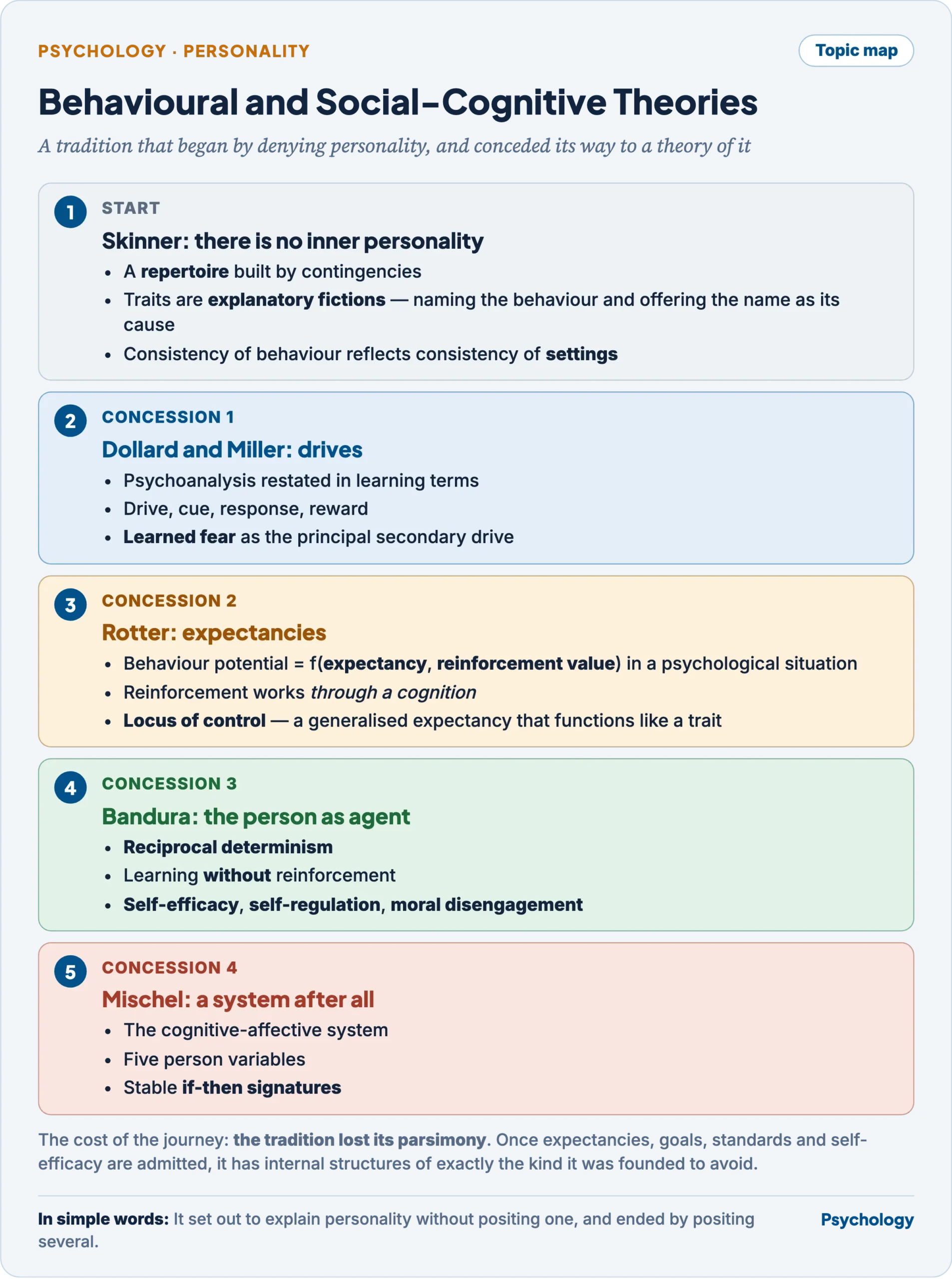
This tradition begins by denying its own subject matter. If behaviour is controlled by its consequences, then there is no inner personality producing it — only a history of contingencies and the repertoire that history has built. Everything interesting in the tradition comes from the successive concessions made to that austere starting point: first drives, then expectancies, then the person’s own thought, until what emerged was a theory of personality after all.
The radical behaviourist position
- Personality is a repertoire, not a structure. For Skinner, what we call personality is the collection of behaviours a person has acquired under particular contingencies of reinforcement. Consistency of behaviour reflects consistency of contingencies, not an inner constancy.
- Traits are explanatory fictions. To say a person is sociable because they are extraverted is to name the behaviour and then offer the name as its cause. The explanation lies outside the organism, in the environment’s history of consequences.
- The self is multiple. Because different settings carry different contingencies, a person acquires different repertoires — a “self” for work, another for the family. Skinner regarded the apparent unity of personality as an artefact of the consistency of the settings most people inhabit.
- The practical consequence is that change is a matter of changing contingencies, not of insight. Behaviour therapy, token economies and behaviour modification descend directly from this.
- The objection that drove the whole subsequent development is that this leaves no way to explain why two people with similar histories behave differently, and no account of learning that occurs without the learner being reinforced at all.
Dollard and Miller: the bridge
- The project was translation. Dollard and Miller set out to restate psychoanalytic insights in the language of learning theory, so that Freud’s clinical observations could be studied experimentally. The result is the most serious attempt ever made to reconcile the two traditions.
- Four components of learning organise the account: drive (a stimulus strong enough to impel action), cue (the stimulus that signals what to do), response, and reward (reinforcement). “Learning is a matter of wanting something, noticing something, doing something and getting something.”
- Learned drives are the key move. Primary drives are biological; fear is the principal secondary drive, acquired by association and able to motivate behaviour as powerfully as hunger. Most of what psychoanalysis called neurotic motivation becomes learned fear.
- Approach-avoidance conflict is their best-known contribution. When one goal carries both attraction and fear, the two gradients can be plotted: the avoidance gradient is steeper than the approach gradient, so a person advances towards the goal until the gradients cross, then stops and vacillates at that point. This gives a formal account of why people get stuck — and it generates testable predictions about how to shift the stalemate, by lowering fear rather than by raising the incentive.
- Repression becomes learned not-thinking. Stopping a thought reduces fear; fear reduction reinforces the stopping; so the person is trained, by relief, not to think. The mechanism is ordinary learning, and it requires no censor.
Rotter: expectancy and locus of control
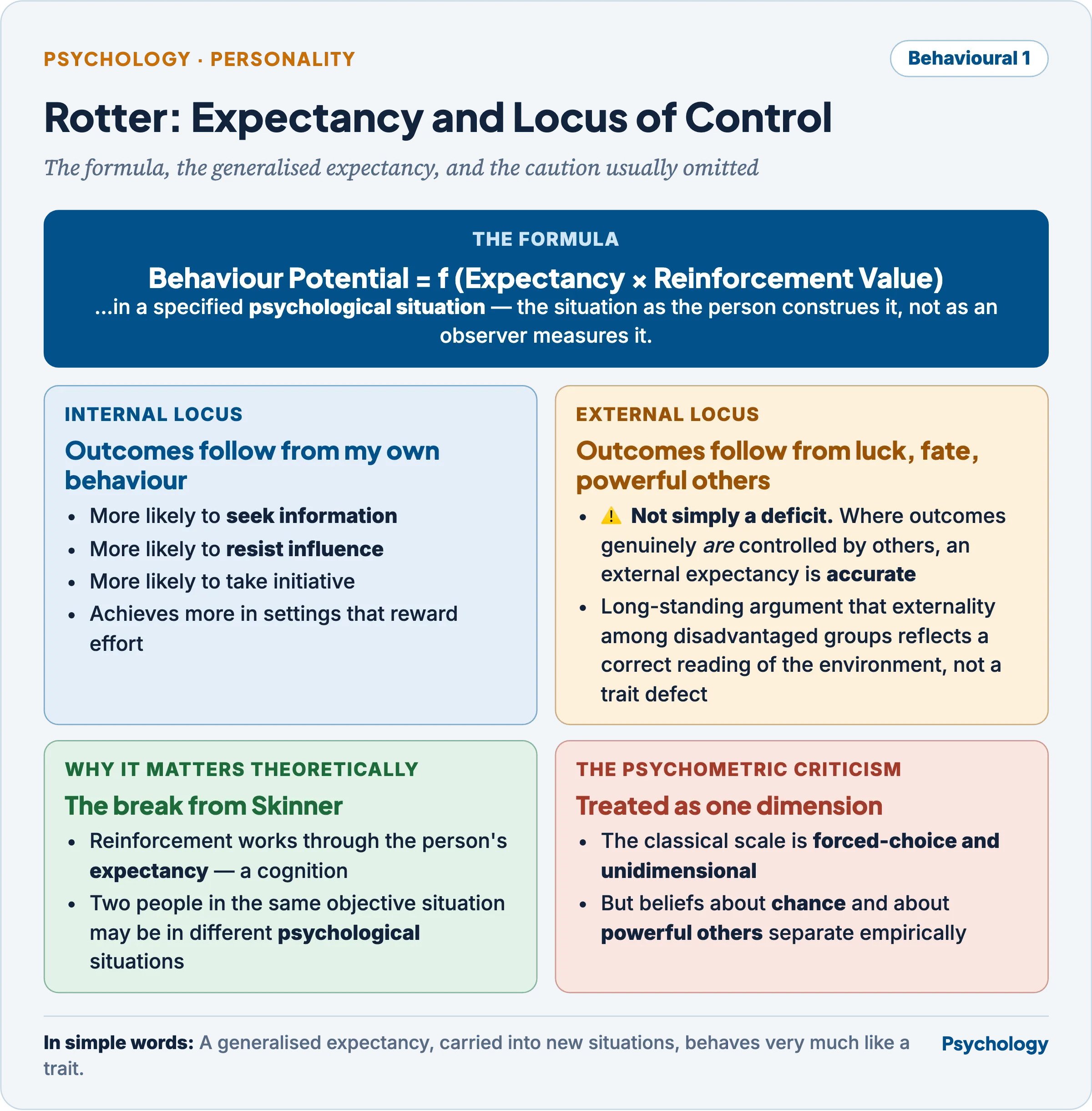
- Behaviour potential is a joint function of expectancy and reinforcement value, in a specified psychological situation. The formula is deliberately explicit: how likely a behaviour is depends on how strongly the person expects it to produce a given outcome, and on how much they value that outcome — as they construe the situation.
- This is the decisive break from radical behaviourism. Reinforcement works through the person’s expectancy, which is a cognition. Two people in the same objective situation may be in different psychological situations and behave accordingly.
- Generalised expectancies are those built up across many situations and are carried into new ones. They function very much like traits — which is how a learning theory ends up with personality variables.
- Locus of control is the generalised expectancy that made the tradition’s reputation: the degree to which a person expects outcomes to follow from their own behaviour — an internal locus — or from luck, chance, fate and powerful others — an external locus.
- Internals are more likely to seek information, to resist influence, to take initiative and to achieve in settings that reward effort.
- Externality is not simply a deficit. Where outcomes genuinely are controlled by others, an external expectancy is accurate, and there is a long-standing argument that externality among disadvantaged groups reflects a correct reading of the environment rather than a trait defect.
- It is measured by a forced-choice scale, which treats the construct as unidimensional — the main psychometric criticism, since control beliefs about chance and about powerful others separate empirically.
Bandura: the social-cognitive account
- Reciprocal determinism replaces one-way environmental causation. Behaviour, personal factors (cognition, affect, biology) and the environment each influence the other two continuously. The person is neither driven by inner forces nor buffeted by stimuli, but is an agent who partly makes the environment that shapes them.
- Observational learning breaks the reinforcement requirement: behaviour can be acquired by watching, with no performance and no reinforcement to the learner. The mechanics of modelling, the four processes and the Bobo doll studies belong with the learning topics; what matters here is the consequence for personality — most of what a person is, they acquired without ever being reinforced for it.
- Self-efficacy is the construct with the widest reach: the belief in one’s capability to execute what a situation requires. It is domain-specific rather than global, which distinguishes it from self-esteem, and it predicts what people attempt, how long they persist and how they respond to failure. Its sources are mastery experience, vicarious experience, social persuasion, and the reading of one’s own physiological and affective states.
- Self-regulation makes the person their own source of reinforcement: people set internal standards, monitor their behaviour against them, judge it, and respond with self-satisfaction or self-censure. This is what allows behaviour to persist in the absence of any external reward, which radical behaviourism could not explain.
- Moral disengagement is the mechanism by which self-regulation is selectively switched off — through euphemistic labelling, displacement of responsibility, diffusion of responsibility, dehumanisation of the victim and advantageous comparison. It is this tradition’s answer to a question the humanists could not handle: how ordinary people do harm without self-censure.
Mischel: from critique to a system
- The critique came first. Mischel’s (1968) finding that trait measures correlated with behaviour in specific situations at around .30 nearly ended the trait tradition, and is treated with the trait approaches.
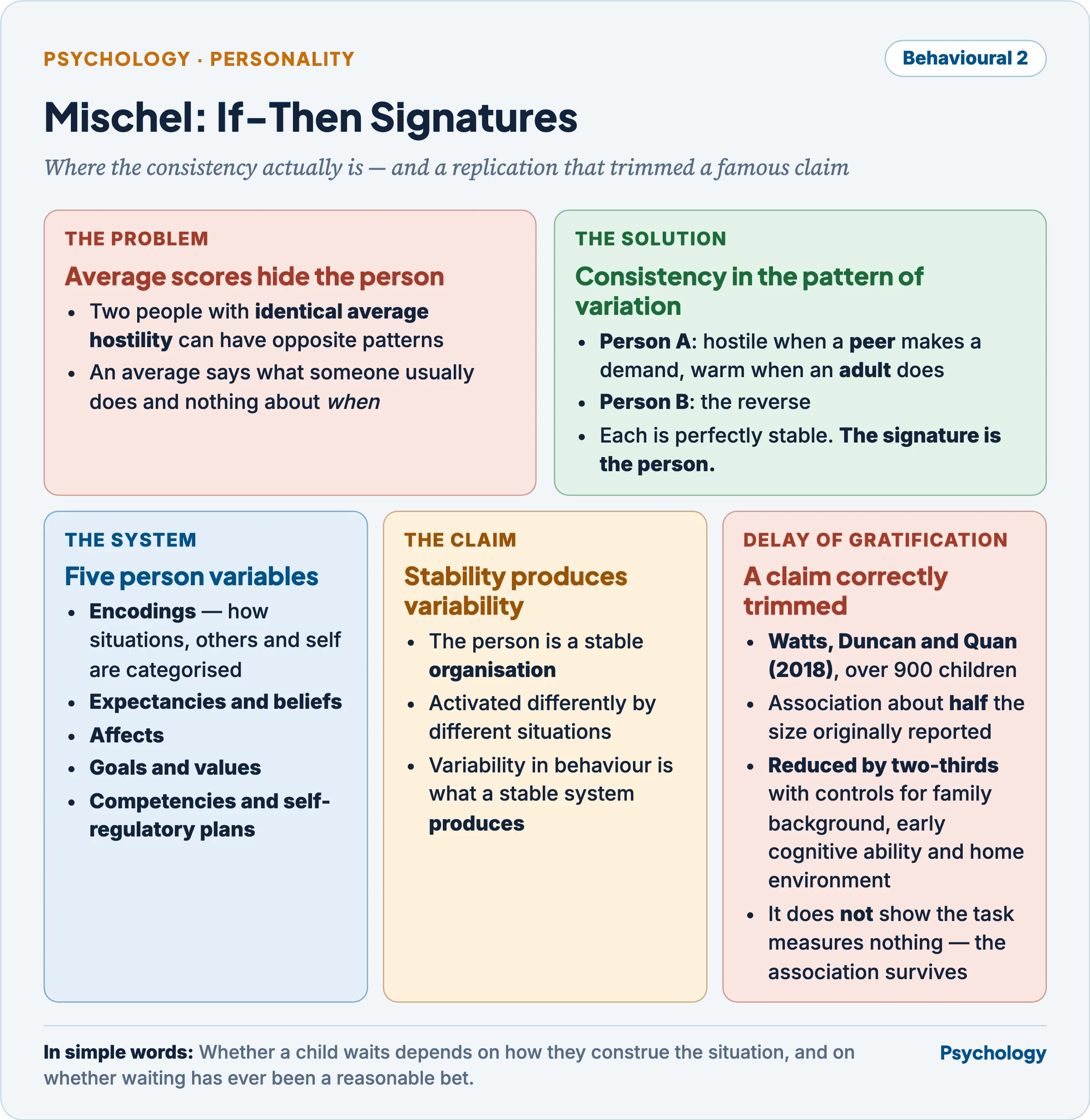
- The constructive answer took three decades and arrived as the cognitive-affective personality system. Its proposal: the person is a stable organisation of cognitive and affective units, which is activated differently by different situations. Stability lies in the system; variability in behaviour is what a stable system produces.
- Five person variables compose it: encodings (how one categorises situations, others and oneself), expectancies and beliefs, affects, goals and values, and competencies and self-regulatory plans.
- If-then signatures are the observable consequence, and the key idea. A person’s consistency is not in their average level of a behaviour but in a stable profile — this person becomes hostile when a peer makes a demand, and warm when an adult does. Two people with identical average hostility can have opposite signatures, and the signature is the person.
- Delay of gratification is Mischel’s best-known experimental line, and it requires a careful statement now. The original studies found that pre-schoolers who waited longer for a larger reward showed better outcomes in adolescence and adulthood. A later conceptual replication — Watts, Duncan and Quan (2018), with a much larger and more diverse sample of over nine hundred children — found the association about half the size reported originally, and reduced by roughly two-thirds once family background, early cognitive ability and the home environment were controlled.
- What this does and does not show. It does not show that the task measures nothing; the association survives, and among children of less-educated mothers an extra minute of waiting still predicted about a tenth of a standard deviation in later achievement. It does show that the headline claim was inflated by a small, highly selected original sample, and that much of the predictive power belongs to the circumstances that produce both the waiting and the later outcome.
- It also illustrates the tradition’s own point: whether a child waits depends on how they construe the situation and on whether their experience has made waiting a reasonable bet — which is a statement about expectancies, not about willpower as a trait.
Kelly: personal construct theory
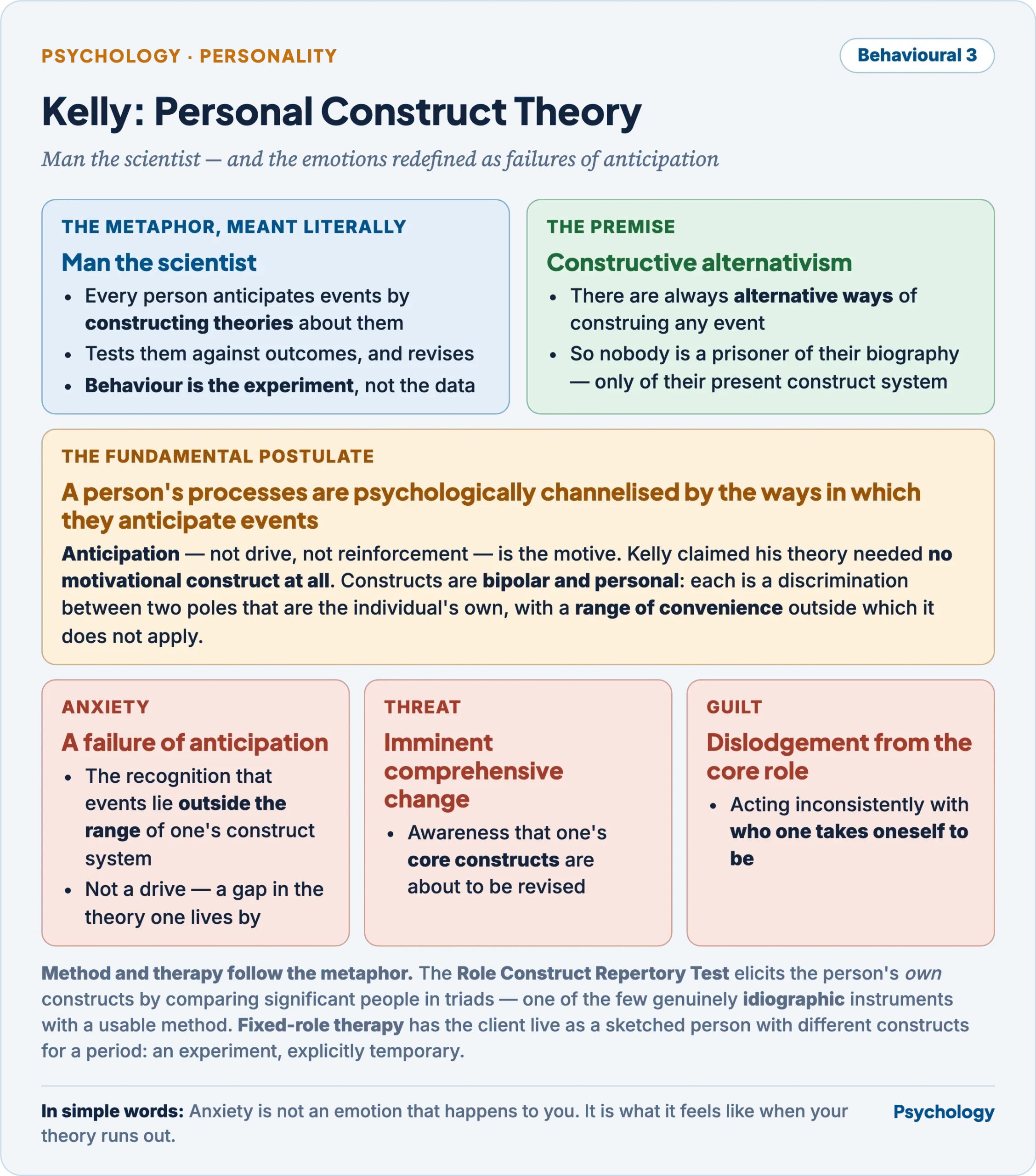
- Man the scientist is the organising metaphor, and it is meant literally. Every person is engaged in anticipating events by constructing theories about them, testing those theories against outcomes, and revising them. Behaviour is the experiment, not the data.
- Constructive alternativism is the philosophical premise: there are always alternative ways of construing any event, so no one is a prisoner of their biography — only of their present construct system.
- The fundamental postulate: a person’s processes are psychologically channelised by the ways in which they anticipate events. Anticipation, not drive or reinforcement, is the motive; Kelly claimed his theory needed no motivational construct at all.
- Constructs are bipolar and personal. Each is a discrimination between two poles — kind against cruel, safe against exciting — and the poles are the individual’s own, which is why two people using the same word may be making different discriminations. Each construct has a range of convenience outside which it does not apply.
- The Role Construct Repertory Test elicits a person’s own constructs rather than imposing the investigator’s, by having them compare significant people in triads and say how two are alike and differ from the third. It remains one of the few genuinely idiographic instruments with a usable method.
- The emotions are redefined in construct terms, which is the system’s most elegant feature. Anxiety is the recognition that events lie outside the range of one’s construct system — not a drive, but a failure of anticipation. Threat is the awareness of imminent comprehensive change in one’s core constructs. Guilt is the perception that one has been dislodged from one’s core role structure — acting in a way inconsistent with who one takes oneself to be.
- Fixed-role therapy follows from the metaphor: the client is given a sketch of a person with different constructs and asked to live as that person for a period — an experiment, explicitly temporary, designed to show that alternative constructions are available.
Socialisation and the social learning theories
- The relation is one of outcome to mechanism. Socialisation names the process by which a person acquires the behaviour, values, norms and roles of their group. Social learning theory supplies the mechanism by which that acquisition happens, which earlier accounts of socialisation had largely left unspecified.
- Four mechanisms, in increasing order of what they explain.
- Direct reinforcement and punishment — the family shapes behaviour by its consequences. True, and far too slow to account for the sheer volume of what children acquire.
- Observational learning — the child acquires whole patterns by watching, without performing them and without reinforcement. This is what makes the volume intelligible, and it explains the transmission of behaviour nobody intended to teach.
- Vicarious reinforcement — seeing a model rewarded or punished changes the observer’s likelihood of imitation, so children learn the contingencies of their culture without undergoing them.
- Self-regulation — once internal standards are adopted from models, the person maintains the behaviour in the absence of any external agent. This is the step at which socialisation becomes internalisation, which is what the word is supposed to mean.
- Symbolic models matter as much as live ones, which extends socialisation beyond the family to whatever a culture transmits through narrative and media.
- Reciprocal determinism complicates the one-way picture. The child is not a recipient: a child’s temperament and behaviour evoke different responses, so children partly select and shape the socialising environment they then appear to be shaped by.
- The hardest challenge comes from behaviour genetics. If shared environment contributes little to adult personality, then whatever parents do by modelling does not make their children alike — which is difficult for a simple parental-modelling account of socialisation. Two replies are available and both are partial: that the relevant models are peers rather than parents, and that the shared-environment estimate concerns variance between individuals and is silent on what families transmit to all their children in common, such as language, religion and values.
Criticisms and limitations
- The radical behaviourist account cannot handle what is acquired without reinforcement, which is most of what they acquire; the tradition’s own development is the admission.
- The cognitive turn cost the tradition its parsimony. Once expectancies, beliefs, goals, standards and self-efficacy are admitted, the theory has internal structures of exactly the kind it was founded to avoid — and little principled basis for choosing among them.
- Self-efficacy is close to circular when inferred from the same behaviour it is used to explain, and its separation from the ability it reports on is not always clean.
- Locus of control is treated as unidimensional by the classical scale when the evidence supports at least a separation between chance and powerful-others beliefs.
- Kelly’s system has had little empirical uptake outside the repertory grid, and its claim to need no motivational construct is contested rather than demonstrated.
- The tradition under-weights biology and temperament, which the behaviour-genetic evidence makes difficult to sustain.
- It is weak on the unconscious. Dollard and Miller’s learned not-thinking is an elegant translation of repression, and the tradition has otherwise little to say about motives the person cannot report.
- What survived is substantial: reciprocal causation, self-efficacy, self-regulation, if-then signatures and the situational analysis of behaviour are now part of the mainstream rather than of a school.
Previous Year Questions
- 2013What is the situationalist critique of trait psychology?
- 1997Is there any relation between process of socialization and the social learning theories of personality?