

Theories of personality (trait and type approaches).
Official Syllabus: Paper I · Unit 11 Personality
A trait is “a generalized and focalized neuropsychic system… with the capacity to render many stimuli functionally equivalent, and to initiate and guide consistent forms of adaptive and expressive behaviour.”
— Allport (1937)
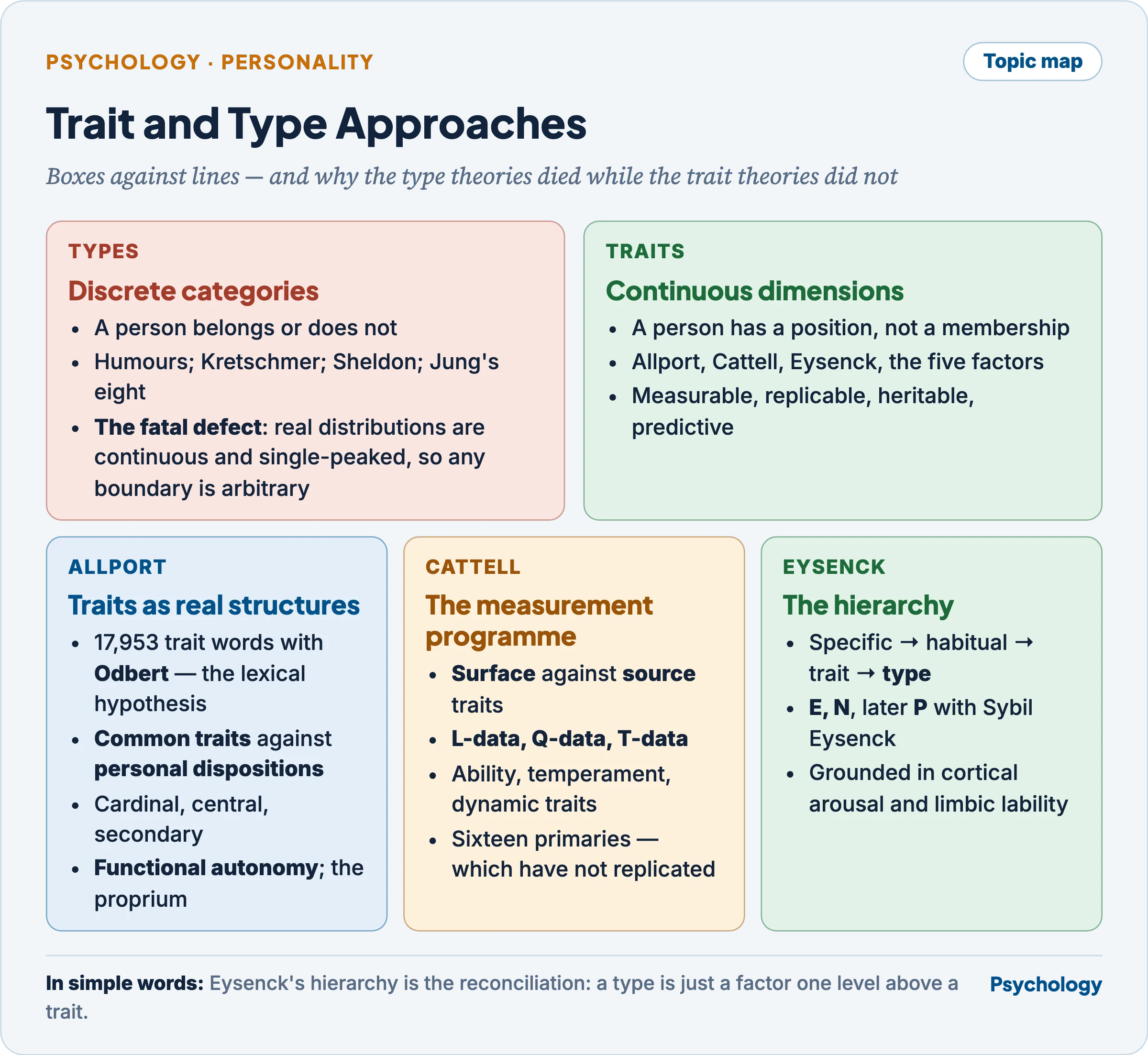
A type sorts people into boxes; a trait places them on a line. That single difference generates everything else in this tradition — what can be measured, what can be predicted, what counts as evidence, and why the type theories died while the trait theories did not.
Types: the older idea and why it failed
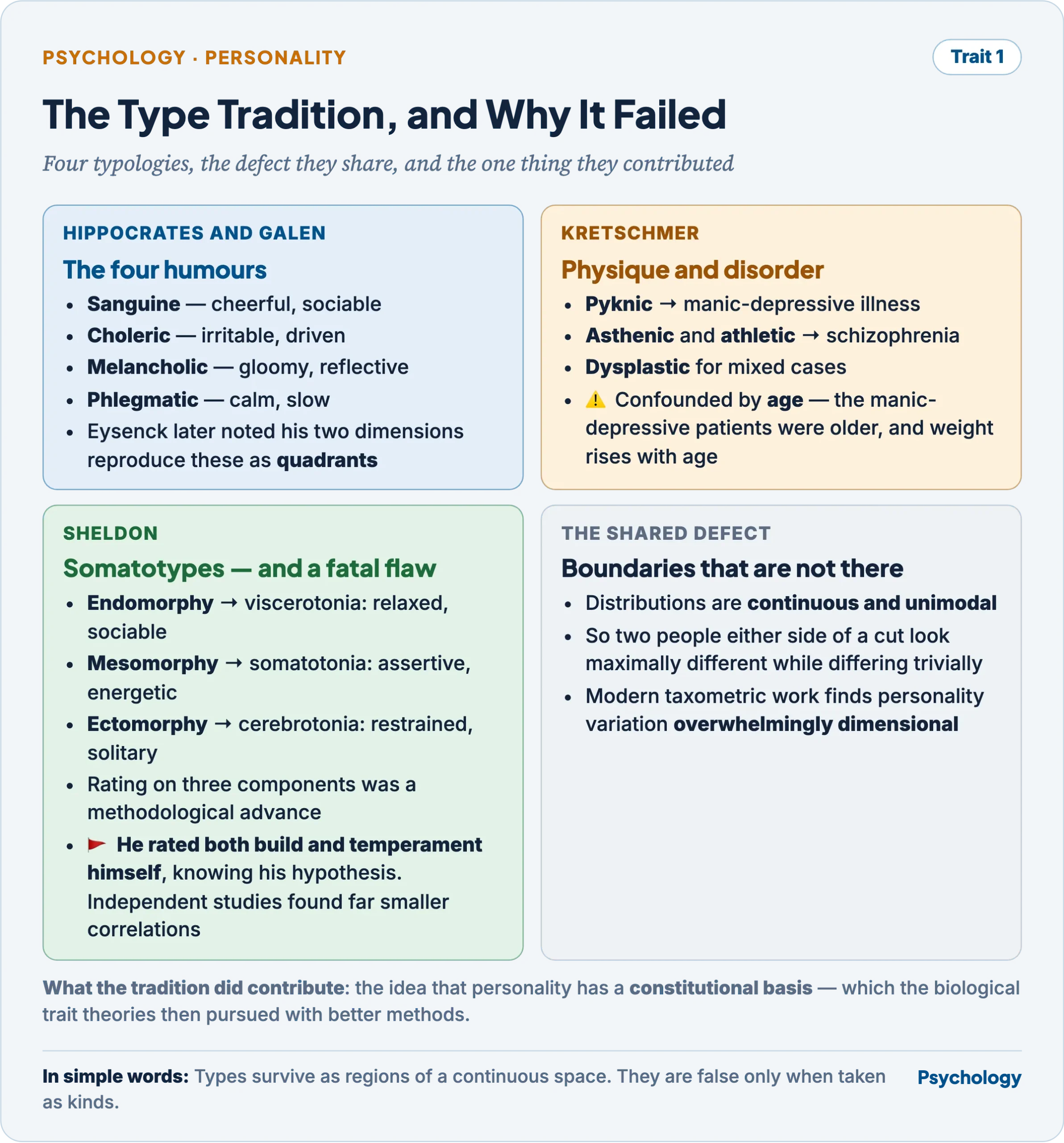
- A type is a discrete category to which a person either belongs or does not. The appeal is obvious — it is how people naturally think about each other — and the defect is equally so: real distributions of personality characteristics are continuous and single-peaked, with most people in the middle, so any boundary drawn to make categories is arbitrary.
- The humoral typology of Hippocrates, systematised by Galen, is the ancestor of the whole tradition: four temperaments — sanguine (cheerful, sociable), choleric (irritable, driven), melancholic (gloomy, reflective) and phlegmatic (calm, slow) — each attributed to the predominance of one bodily humour. The physiology was wrong and the descriptive scheme outlived it; Eysenck later observed that his own two dimensions reproduce the four temperaments as quadrants.
- Kretschmer proposed a constitutional typology linking physique to disorder: the pyknic build to manic-depressive illness, the asthenic or leptosomic and the athletic to schizophrenia, with a dysplastic category for mixed cases. The correlation he reported was confounded by age — manic-depressive patients were older, and weight rises with age.
- Sheldon replaced categories with ratings on three components, which was a methodological improvement: endomorphy (soft, round) with viscerotonia (relaxed, sociable, food-loving); mesomorphy (muscular) with somatotonia (assertive, energetic, risk-taking); ectomorphy (thin, fragile) with cerebrotonia (restrained, inhibited, solitary). He reported very high correlations between build and temperament — and the fatal objection is that he rated both himself, knowing his own hypothesis. Independent studies found correlations far smaller.
- The classical Indian typology, the doctrine of the three gunas, is a genuine type theory of considerable sophistication and is treated with the Indian approach.
- What the type tradition contributed, despite failing: the idea that personality has a constitutional basis, which the biological trait theories later pursued with better methods.
Jung’s typology
- Two attitudes, four functions, eight types. The attitudes are the direction in which psychic energy flows: introversion inward, towards the subject’s own inner world, and extraversion outward, towards objects and people. Crossed with these are four functions.
- The rational or judging functions, which evaluate: thinking decides by logic and impersonal truth, feeling by worth and personal value. Feeling in Jung’s sense is a form of judgement, not an emotion — the commonest misreading of his scheme.
- The irrational or perceiving functions, which take in without evaluating: sensation registers what is present through the senses, intuition registers possibilities and relations not given in the senses.
- The eight types are the product — introverted thinking, extraverted thinking, introverted feeling, and so on through sensation and intuition.
- The structure within a person is what makes the scheme dynamic rather than a filing system. One function is superior — the most differentiated and relied upon; one or two are auxiliary; and its opposite is the inferior function, undeveloped, unconscious and primitive, which erupts under stress. Integrating the inferior function is a central task of individuation.
- The weaknesses are specific and serious.
- It was derived from clinical intuition, not data. Jung produced the taxonomy from his reading and his patients; no factor analysis or other empirical procedure generated the eight types.
- The categories are dichotomous and the data are not. Scores on introversion-extraversion are continuous and unimodal, so assigning people to one side produces an arbitrary cut that makes two people either side of the line look maximally different when they differ trivially.
- The best-known operationalisation inherits the problem. The instrument built on Jung’s types reports a four-letter category; its test-retest classification is unstable, with a substantial proportion of people changing at least one letter on re-testing within weeks, and its predictive validity for outcomes such as job performance is weak. The dimensions it measures correlate respectably with four of the five-factor dimensions — which suggests the underlying information is real and the dichotomising is what destroys it.
- The inferior-function doctrine is untestable in its present form.
- It describes without explaining. There is no account of why these functions exist or what produces individual differences in them.
- What survives is the introversion-extraversion dimension itself, which Jung named and which every subsequent trait system has recovered — in Eysenck’s model, in Cattell’s higher-order factors, and in the five-factor structure.
Allport: traits as real structures in the person
- Allport’s starting point was the lexical hypothesis in its original form. With Odbert, he extracted 17,953 trait-relevant words from an unabridged English dictionary, on the premise that what matters in human differences gets encoded in ordinary language. Every later trait taxonomy, including the five-factor one, descends from that list.
- Common traits against personal dispositions is his central distinction and the one most often lost. Common traits are dimensions on which people can be compared — the nomothetic unit. Personal dispositions are the trait structures as they actually exist in one individual, which may be unique to that person and may not correspond to any common dimension. Allport held that the second is what personality really consists of, and that comparing people on common traits is a convenience.
- Three levels of personal disposition, by pervasiveness. A cardinal disposition dominates a life so thoroughly that almost every act expresses it, and is rare. Central dispositions are the five to ten characteristics one would use to describe a person in a reference. Secondary dispositions are narrower and situation-bound — preferences and habits visible only in particular settings.
- Functional autonomy is his answer to the psychoanalytic claim that adult motives are disguised childhood ones. A motive that began as a means to something else can become independent of its origin and self-sustaining: the person who first worked for money comes to work for its own sake. He distinguished perseverative functional autonomy — simple repeated habits and addictions — from propriate functional autonomy, which concerns the person’s values and self-image.
- The proprium is Allport’s term for the self — not a homunculus but the set of functions central to a sense of identity, developing through seven aspects from bodily sense in infancy to self as knower.
- The criticism is that he produced a careful descriptive vocabulary and very little research programme. His insistence on the idiographic case left the approach difficult to pursue with the nomothetic methods the field then developed.
Cattell: the factor-analytic programme
- Cattell’s ambition was to make personality psychology a measurement science, and his method was factor analysis applied to the broadest possible sampling of behaviour.
- Surface traits against source traits is the distinction factor analysis produces. Surface traits are clusters of behaviours that go together on the surface and may be produced by several underlying causes. Source traits are the factors themselves — the underlying structures that generate the surface clusters — and they are the real units.
- Three kinds of data, sampled deliberately so that factors recovered in one could be checked in another.
- L-data — life record data: ratings and observations of behaviour in real settings.
- Q-data — questionnaire data: the person’s self-report.
- T-data — objective test data: performance on tasks whose purpose the testee cannot guess, which is the kind he regarded as least falsifiable and the kind least used since.
- Three classes of source trait, by what they do: ability traits determine how effectively a goal is reached; temperament traits concern the style and speed of response; dynamic traits concern motivation, organised into ergs (innate drives) and sentiments (acquired).
- The sixteen primary factors of his inventory are the best-known product, reported as bipolar dimensions such as reserved against outgoing, and concrete against abstract reasoning. They are not the end of the hierarchy: the primaries intercorrelate and resolve into a smaller number of higher-order factors, of which the most robust correspond to extraversion and anxiety.
- The specification equation was the practical point of all of it: behaviour in a situation is predicted as a weighted sum of the person’s trait scores, with the weights set by how relevant each trait is to that situation. It is an explicit interactionist formula, and it predates the person-situation debate by decades.
- The criticism is that sixteen factors have proved hard to replicate. Independent analyses of his data have frequently recovered fewer, and the number has been a standing argument against him — which is the opening the five-factor tradition used.
Eysenck: the hierarchy, and the reconciliation of type with trait
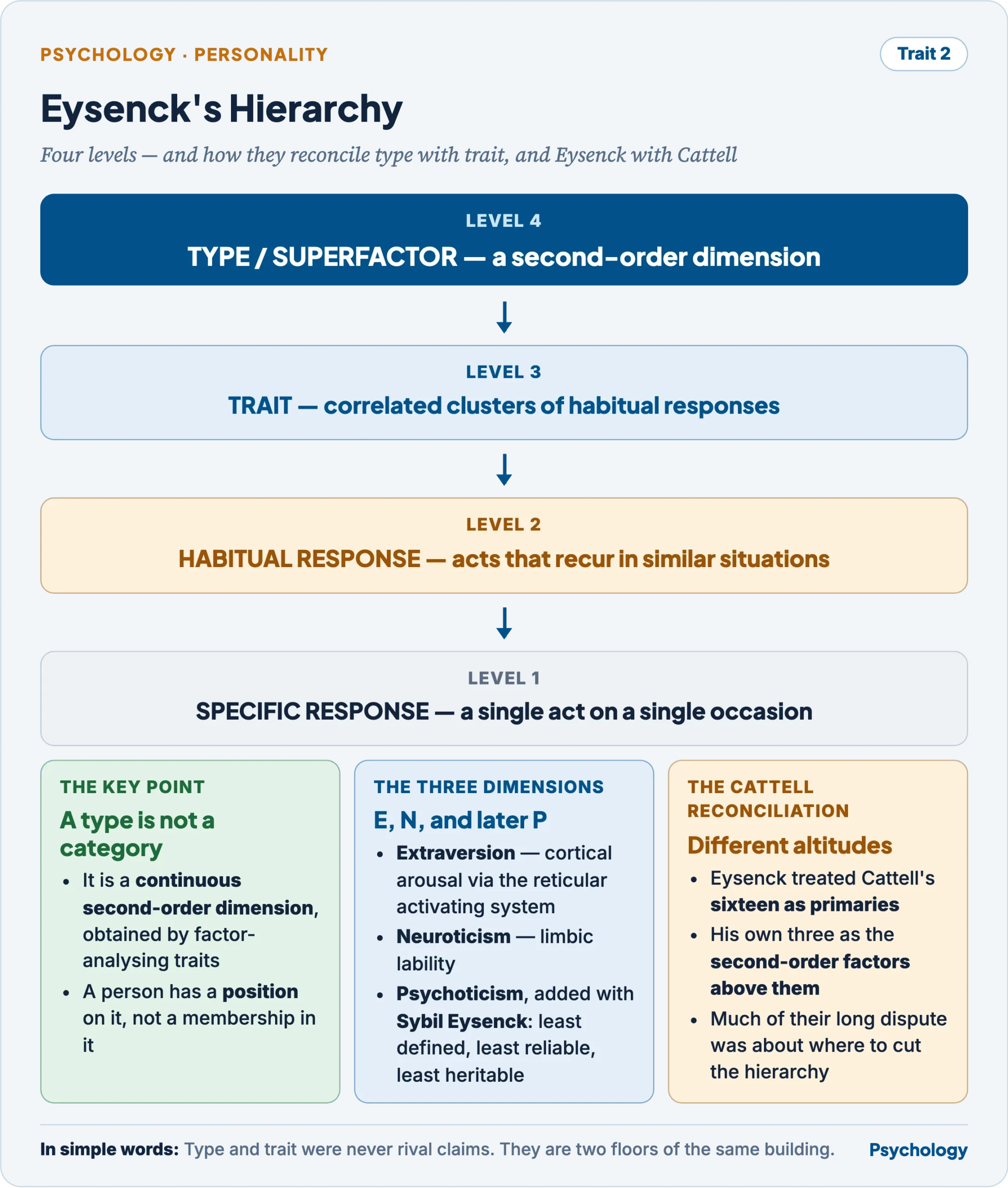
- Eysenck’s model is explicitly four-levelled, and the hierarchy is the key to the whole type-against-trait question.
- Specific responses — a single act on a single occasion.
- Habitual responses — acts that recur in similar situations.
- Traits — correlated clusters of habitual responses, such as sociability or impulsiveness.
- Types, or superfactors — correlated clusters of traits, which is the highest level.
- So “type” in Eysenck’s usage is not a category at all. It is a second-order dimension: a continuous variable obtained by factor-analysing the correlations among traits. A person has a position on it, not a membership in it.
- The three dimensions. Extraversion-introversion and neuroticism-stability came first, and reproduce the Galenic quadrants when crossed. Psychoticism — tough-mindedness, aggression, impulsivity, a disregard for others — was added later, with Sybil Eysenck, and is the weakest of the three: least clearly defined, least reliably measured and least heritable.
- The biological grounding is what distinguishes him from the purely descriptive trait theorists. Extraversion he attributed to cortical arousal regulated by the ascending reticular activating system — introverts chronically more aroused, therefore avoiding stimulation; extraverts chronically under-aroused, therefore seeking it. Neuroticism he attributed to the lability of the limbic system. The claims are testable and have been tested, with mixed but non-trivial support.
- Is there a reconciliation in Eysenck? Yes, and it is structural rather than rhetorical.
- Type and trait are not rival claims — they are different levels of one hierarchy. What the type theorists called a type is what emerges when traits are factored; what the trait theorists measure sits one level below.
- It also reconciles Eysenck with Cattell. Eysenck treated Cattell’s sixteen factors as primary traits and his own three as the second-order factors above them. The two men were measuring the same structure at different altitudes, and much of their long dispute was about where to cut the hierarchy, not about what was in it.
- The modern evidence completes the reconciliation. Taxometric work — which tests statistically whether a construct is categorical or continuous — finds personality variation to be overwhelmingly dimensional. So types survive as regions of a continuous space, useful for description and communication, and false if taken as kinds.
The folk-psychology objection
- The charge is that trait psychology merely formalises common sense: its units are the words ordinary people already use, so its findings cannot be more than folk intuition in a lab coat.
- The first thing to concede is that the resemblance is by construction. The lexical hypothesis starts from the dictionary. Allport and Odbert’s list is where the whole taxonomy begins, so of course the factors look like folk categories.
- But the hypothesis is a defensible premise, not an accident. Its logic is that individual differences important enough to matter in social life get encoded in language, so the lexicon is a reasonable place to look for a comprehensive sampling of the domain. A sampling frame is not a theory, and using one does not make the results it yields folk psychology.
- And the theoretical developments have taken it well beyond its starting point.
- The structure replicates across languages and cultures when the analysis is run on indigenous lexicons rather than on translations — which folk intuition in one language could not produce.
- The dimensions are substantially heritable — Jang, Livesley and Vernon (1996) put the genetic share at roughly 30 to 50 per cent across the five-factor scales — and show the characteristic behaviour-genetic signature. Folk categories have no reason to be heritable.
- They have identifiable biological correlates, which is what Eysenck’s and Gray’s programmes were for.
- They predict outcomes prospectively — attainment, job performance, health, longevity, relationship stability — over long intervals, which description alone cannot do.
- They show lawful developmental change, the maturity principle, replicated across cultures.
- And the field has moved from description to explanation, asking what a trait is — a density distribution of states, with the explanatory work done by the processes that generate them.
- The honest residue of the objection is that trait psychology remains stronger at structure than at process. It says reliably how people differ and much less about the mechanisms producing the differences, and that is a real limitation rather than a rhetorical one.
The situationist critique
- Mischel (1968), in Personality and Assessment, reviewed the evidence relating trait scores to behaviour in specific situations and found correlations rarely above about .30 — the personality coefficient — concluding that behaviour is far more situationally specific than trait theory assumes. The critique nearly ended the tradition and reoriented it permanently.
- Three replies answered it. Aggregation: a single act is an unreliable measure, and averaging across occasions raises consistency coefficients substantially, exactly as classical test theory predicts. Interaction: behaviour is a joint function of person and situation, and strong situations suppress individual differences while weak ones reveal them. Reconceptualisation: Mischel and Shoda later located the consistency in stable if-then signatures — characteristic patterns of how a person varies across situations — rather than in context-free averages.
- The settled position is that traits predict aggregated behaviour well and single acts poorly, which is what a dispositional construct should be expected to do. The fuller treatment of the consistency question, with the stability evidence, belongs with the concept of personality.
Trait against humanistic approaches
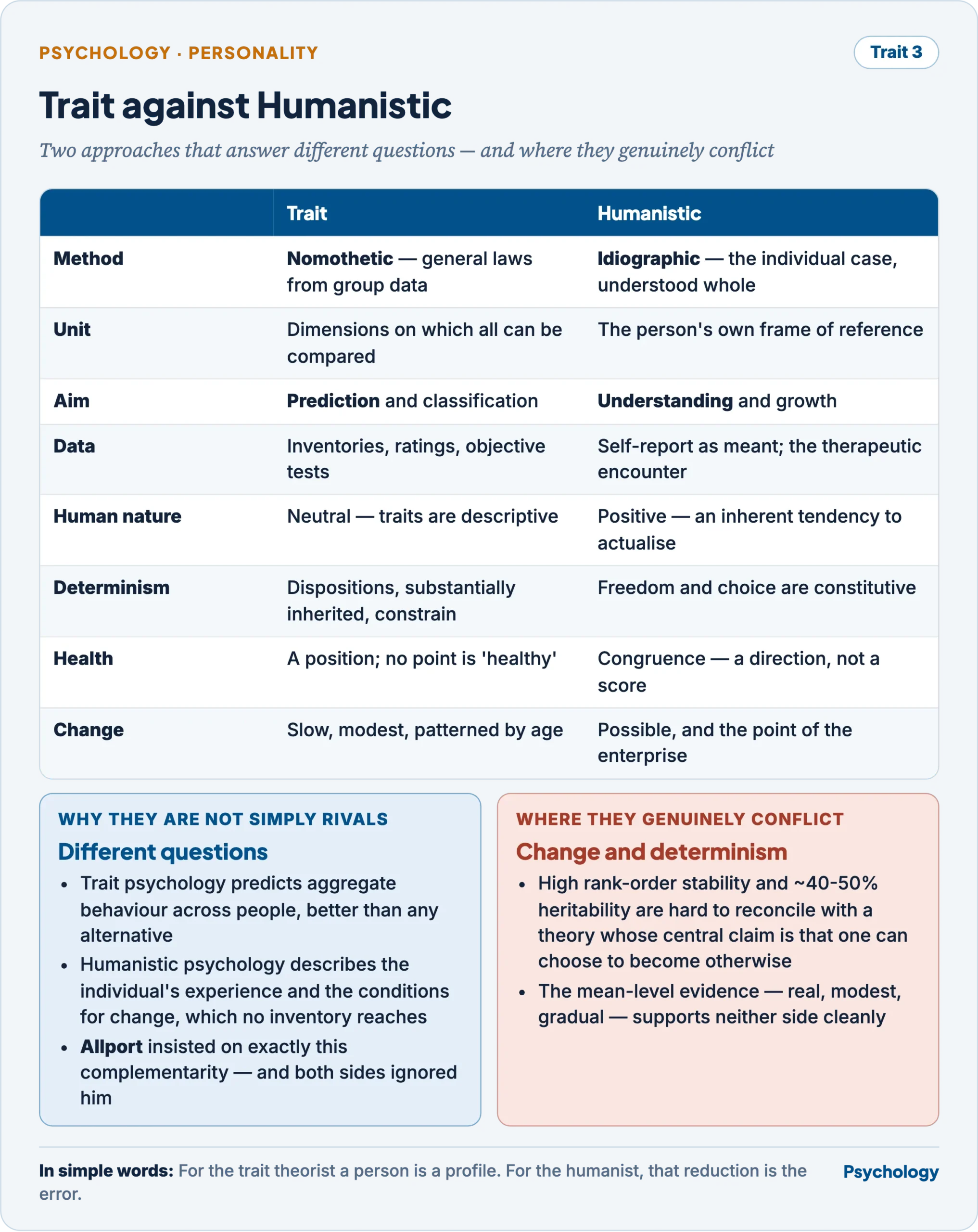
| Trait | Humanistic | |
|---|---|---|
| Method | Nomothetic — general laws from group data | Idiographic — the individual case, understood whole |
| Unit | Dimensions on which all people can be compared | The person’s own frame of reference |
| Aim | Prediction and classification | Understanding and growth |
| Data | Inventories, ratings, objective tests | Self-report taken as the person means it; the therapeutic encounter |
| Human nature | Neutral; traits are descriptive, not evaluative | Positive; an inherent tendency towards actualisation |
| Determinism | Dispositions, substantially inherited, constrain behaviour | Freedom and choice are constitutive |
| Time | Stability across years is the central finding | Present experience and becoming |
| Health | A position on dimensions; no point is “healthy” | Congruence between self and experience; a direction, not a score |
| Change | Slow, modest, patterned by age | Possible, and the point of the enterprise |
- The deepest difference is about what a person is. For the trait theorist a person is a profile — a set of standings on dimensions that exist independently of them. For the humanist, reducing a person to a profile is precisely the error: what matters is the organised, subjective whole, and a score on neuroticism says nothing about what this life means to the one living it.
- They are not straightforwardly rivals, since they answer different questions. Trait psychology predicts aggregate behaviour across people and does it better than any alternative; humanistic psychology describes the individual’s experience and the conditions for change, which no inventory reaches. Allport, who belongs to the trait tradition, insisted on exactly this complementarity and was ignored by both sides.
- Where they genuinely conflict is on change and on determinism. A literature showing high rank-order stability and substantial heritability is hard to reconcile with a theory whose central claim is that the person can choose to become otherwise — and the trait evidence on mean-level change, which is real but modest and gradual, supports neither position cleanly.
Criticisms and limitations
- Traits describe rather than explain. Saying a person behaves sociably because they are extraverted is close to circular until the mechanism producing extraversion is specified.
- The number of factors is set by the analyst, through choices about extraction and rotation, which is why sixteen, five and three have all been defended from similar data.
- Self-report carries the usual threats — social desirability, limited self-knowledge, response sets — and the objective-test data Cattell preferred has largely been abandoned as impractical.
- Type theories reified categories that the distributions do not support, and the most popular surviving type instrument continues to do so.
- The approach is weak on the individual case, which is Allport’s own complaint about what the field did with his distinction.
- Cross-cultural generality is contested at the level of the specific structure, even where the broad dimensions replicate, and the lexical method presupposes that the important differences are encoded in single words.
- The situation is under-theorised. Even after the interactionist settlement, trait psychology has no taxonomy of situations comparable in quality to its taxonomy of persons.
Previous Year Questions
- 2018Compare the trait perspective and humanistic perspective on personality.
- 2015Describe the trait and type approaches to personality. Highlight Jung’s typology with its weaknesses.
- 2013What is the situationalist critique of trait psychology?
- 2007The scientific theories of traits have an intuitive appeal because their basic unit of analysis, personality traits, are very similar to simple nonscientific folk understandings of personality. Critically evaluate this statement in the light of theoretical developments in the trait approach of personality.
- 2004State the trait and type approaches to personality. Is there a reconciliation in the two in Eysenckian approach?
- 2003Is personality consistent? Give your answer with the support of relevant studies.
- 1995Factorial approach to the study of personality.