

Psychological and physiological basis of motivation and emotion; Measurement of motivation and emotion.
Official Syllabus: Paper I · Unit 9 Motivation and Emotion
“An emotion is an episode of interrelated, synchronized changes in the states of all or most of the five organismic subsystems, in response to the evaluation of an external or internal stimulus event as relevant to major concerns of the organism.”
— Scherer (2005)
Emotion is a multi-component episode, and this is not a definitional nicety: it is why the measurement of emotion is hard. The components — appraisal, bodily change, expression, action tendency and felt experience — are only loosely coupled, so a measure of one is a poor measure of the others, and the physiological indices that look most objective turn out to track how aroused a person is rather than which emotion they are having.
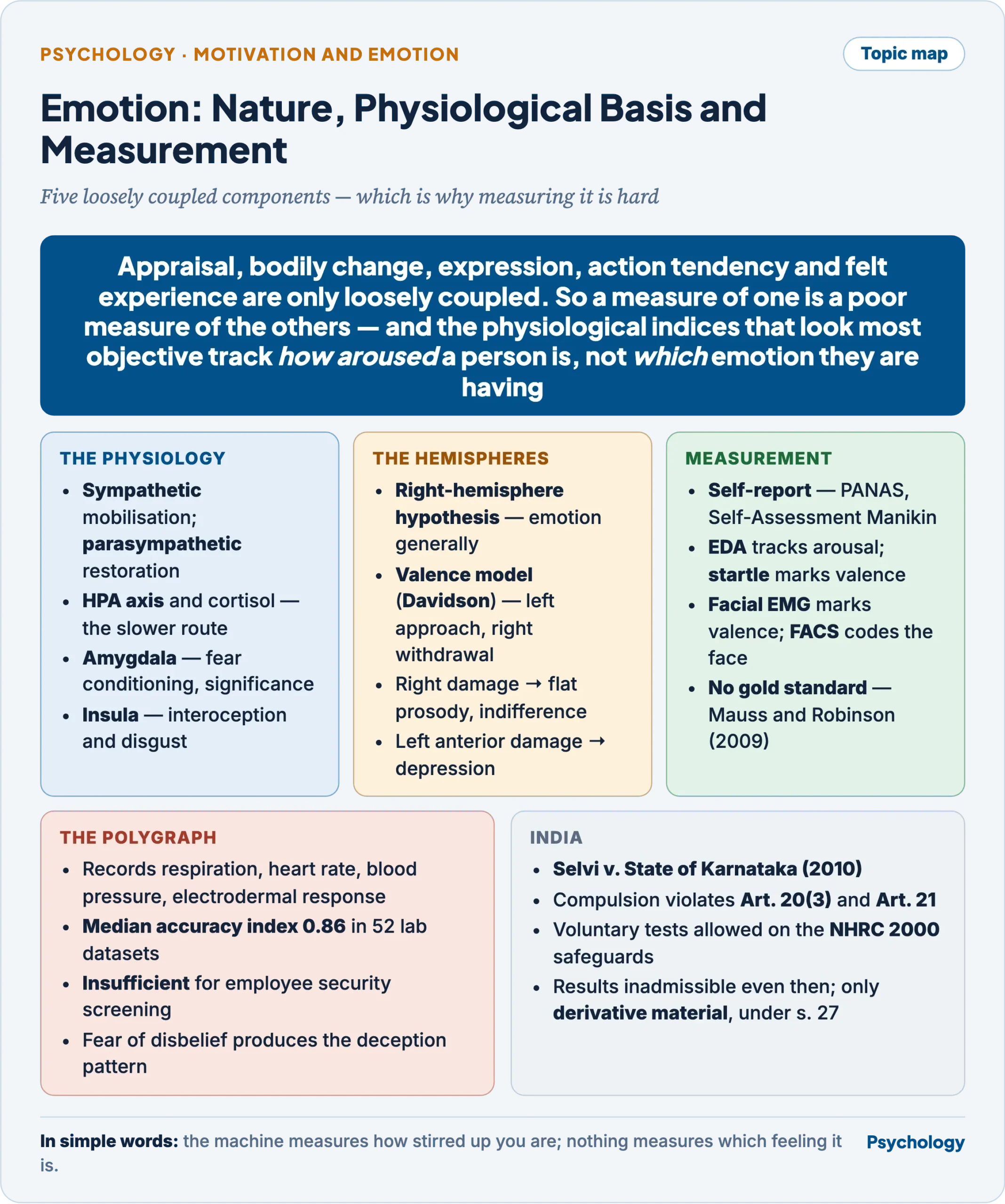
The nature of emotion: components and distinctions
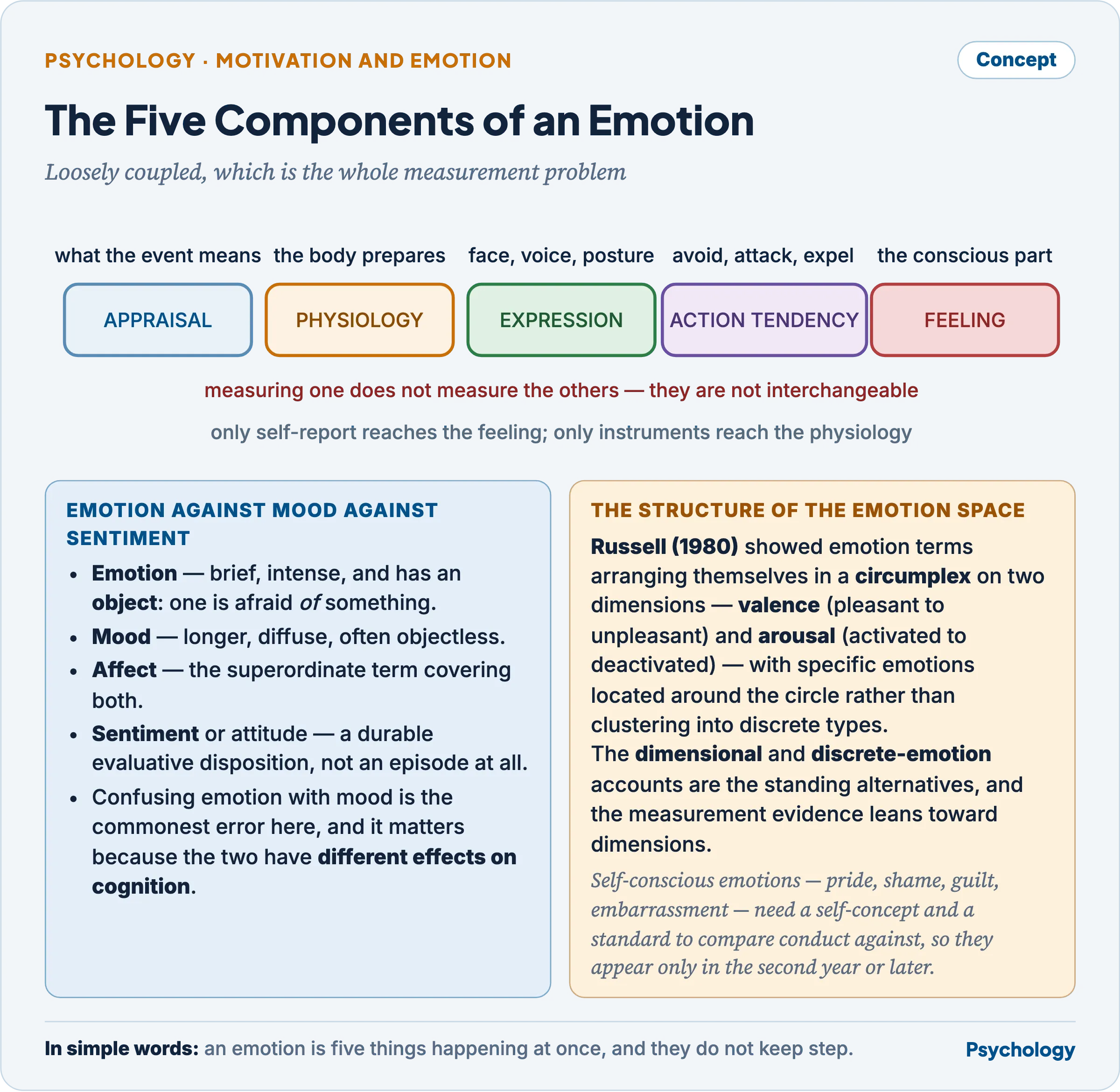
- The cognitive component — the appraisal of the event’s significance for one’s concerns, including whether it is relevant, consistent with one’s goals, who caused it, and whether one can cope with it. Appraisal is what makes the same event produce fear in one person and anger in another.
- The physiological component — autonomic, endocrine and neural changes preparing the body to act.
- The motor expression component — face, voice, posture and gesture, which carry the emotion’s social signal.
- The action tendency component — the state of action readiness that biases the behavioural repertoire: avoid, attack, expel, approach.
- The subjective feeling component — the conscious experience, which is the part a person can report and the part that develops last in a child.
- Emotion, mood, affect and sentiment are distinct. An emotion is brief, intense and has an object — one is afraid of something. A mood is longer, more diffuse and often objectless. Affect is the superordinate term covering both. A sentiment or attitude is a durable evaluative disposition toward an object, not an episode at all. Confusing emotion with mood is the commonest error in this literature, and it matters because they have different effects on cognition.
- Dimensional structure — Russell (1980) showed that emotion terms arrange themselves in a circumplex defined by two dimensions, valence (pleasant–unpleasant) and arousal (activated–deactivated), with specific emotions located around the circle rather than clustering into discrete types. The dimensional and the discrete-emotion accounts of emotion’s structure are the standing alternative to each other.
- Primary and complex emotions — Primary emotions are held to be universal, early-appearing and physiologically distinct; complex or self-conscious emotions — pride, shame, guilt, embarrassment — require a self-concept and the comparison of one’s conduct with a standard, and therefore appear only in the second year or later.
The physiological basis of emotion
- The autonomic nervous system. The sympathetic division produces the mobilisation pattern — raised heart rate, blood pressure and respiration, pupil dilation, sweating, redistribution of blood to muscle, inhibited digestion — through direct innervation and through adrenaline and noradrenaline from the adrenal medulla. The parasympathetic division restores the resting state, and some emotions, notably disgust and certain forms of sadness, involve parasympathetic rather than sympathetic activation.
- The endocrine route — The hypothalamic–pituitary–adrenal (HPA) axis releases cortisol on a slower timescale, which is why the hormonal signature of an emotional episode outlasts the episode.
- The limbic circuit — Papez (1937) proposed a circuit through hypothalamus, anterior thalamus, cingulate and hippocampus as the mechanism of emotion; MacLean extended it into the limbic system, adding the amygdala and the orbitofrontal cortex. The limbic concept is now regarded as too loose to be anatomically useful, since its structures serve many functions and the emotional ones are distributed beyond it — but it is the historical frame the literature is written in.
- The amygdala is the best-established emotional structure. It is necessary for fear conditioning, receives both a fast subcortical and a slower cortical input, and modulates attention, vigilance and memory consolidation for emotional material. Bilateral amygdala damage impairs the recognition of fear in faces and the acquisition of conditioned fear, and the Klüver–Bucy syndrome following temporal lobe ablation in monkeys includes loss of normal fear and aggression. The current reading is that the amygdala computes biological significance rather than producing the feeling of fear.
- The hypothalamus organises the integrated expression of emotion. Bard showed that decorticate cats display sham rage — a full, well-coordinated rage display triggered by trivial stimuli — demonstrating that the pattern is organised subcortically while cortical control over when it is released is lost.
- Other structures with specific roles. The insula supports interoception, the sensing of the body’s internal state, and is central to disgust. The anterior cingulate is involved in the affective dimension of pain and in conflict monitoring. The ventromedial and orbitofrontal prefrontal cortex integrate emotional value into decision making, and their damage leaves reasoning intact while destroying the ability to choose well. The periaqueductal grey organises defensive behaviour.
- Neither component alone suffices. Autonomic arousal without appraisal gives an unlabelled state; appraisal without arousal gives what has been called a “cold” emotion, recognised but not felt. This is the substance of the theoretical dispute about emotion and is treated with the theories.
The left and right hemispheres in emotional experience
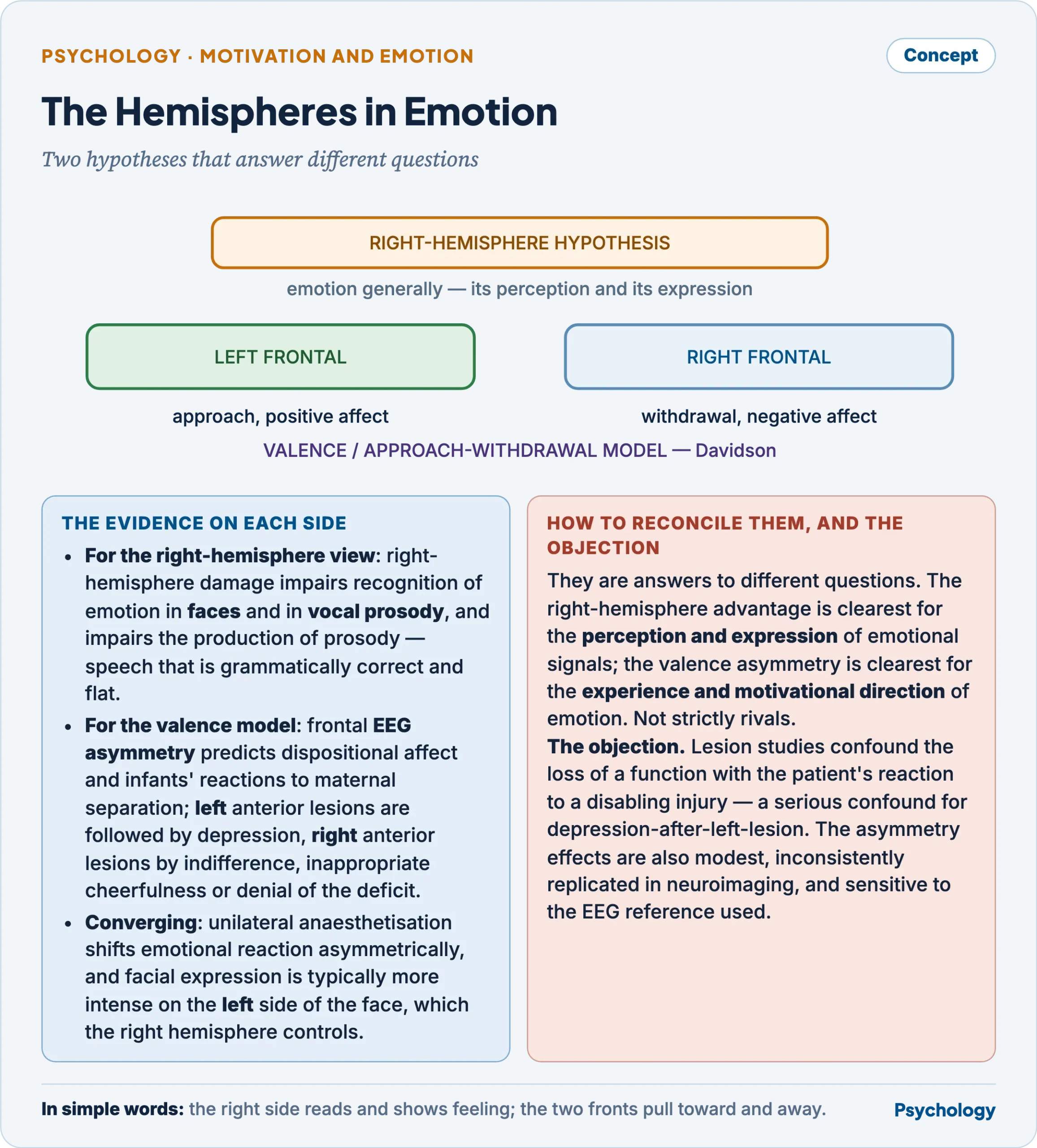
Two hypotheses compete, and the useful answer is that they are answers to different questions.
- The right-hemisphere hypothesis — the right hemisphere is specialised for emotion generally — its perception, expression and experience. The evidence is largely from lesions: right-hemisphere damage impairs the recognition of emotion in faces and in vocal prosody, and impairs the production of emotional prosody, producing speech that is correct and flat.
- The valence or approach–withdrawal model, associated with Davidson, holds instead that the hemispheres differ by the kind of emotion. The left frontal region supports approach-related and positive affect; the right frontal region supports withdrawal-related and negative affect. The evidence is frontal EEG asymmetry, which predicts dispositional affect and infants’ reactions to maternal separation, and the clinical pattern that left anterior lesions are followed by depression while right anterior lesions are followed by indifference, inappropriate cheerfulness, or denial of the deficit.
- Converging evidence. Unilateral anaesthetisation of a hemisphere alters emotional reactions asymmetrically, chemical inactivation of one hemisphere shifts mood, and the facial expression of emotion is typically more intense on the left side of the face, which is controlled by the right hemisphere.
- Reconciling them. The right-hemisphere advantage is clearest for the perception and expression of emotional signals, while the valence asymmetry is clearest for the experience and motivational direction of emotion. They are therefore not strictly rivals.
- Objection. Lesion studies confound the emotion with the patient’s reaction to a disabling injury, which is a serious confound for the depression-after-left-lesion finding. The asymmetry effects are also modest in size, inconsistently replicated in neuroimaging, and sensitive to the EEG reference used, so the frontal-asymmetry literature is weaker than its prominence suggests.
Measurement of emotion
| Self-report | Physiological | Expressive and behavioural | |
|---|---|---|---|
| Instruments | PANAS, adjective checklists, Self-Assessment Manikin, experience sampling | EDA, heart rate, blood pressure, respiration, facial EMG, startle eyeblink, cortisol | FACS, vocal analysis, posture, observed behaviour |
| Accesses | The felt component | The bodily component | The expressive component |
| Strength | The only route to subjective experience | Continuous, covert, not voluntarily faked | Observable without the subject’s report |
| Weakness | Demand characteristics, poor insight, memory bias, language | Indexes dimensions, chiefly arousal, not discrete emotions | Expression can occur without emotion and emotion without expression |
- Self-report remains indispensable, because the subjective feeling has no other access route. The PANAS (Watson and Clark, 1988) measures positive and negative affect as separate dimensions; the Self-Assessment Manikin (Bradley and Lang, 1994) uses non-verbal figures to rate valence, arousal and dominance and so works across languages and with children; experience sampling asks for reports in real time and avoids retrospective distortion.
- Electrodermal activity rises systematically and nearly linearly with the rated arousal of a stimulus and is largely indifferent to valence, which makes it an excellent arousal index and a poor emotion index.
- Heart rate shows directional fractionation — it can fall while other sympathetic measures rise, as in attentive orienting — so a single cardiac measure cannot be read as “more arousal”.
- Facial EMG over the zygomatic and corrugator muscles tracks valence reliably and discrete emotions poorly.
- Startle eyeblink modulation is a valence marker: the blink reflex to a loud noise is reliably larger during high-arousal negative states and smaller during high-arousal positive ones. It is the cleanest covert index of valence available.
- Expressive coding. The Facial Action Coding System (Ekman and Friesen, 1978) scores the face in terms of anatomically defined action units, which allows description without assuming which emotion a configuration means. Vocal measures track arousal well through pitch and intensity.
- The central limitation. Mauss and Robinson (2009), reviewing the field, concluded that there is no gold-standard measure of emotional responding; that experiential, physiological and behavioural measures “cannot be assumed to be interchangeable”; that they are not strongly related to one another; and that across response systems the evidence favours measures reflecting dimensions rather than discrete states. The idea that each discrete emotion has a distinct autonomic signature has not fared well. The practical consequence is that a study’s conclusion about which emotion was present is usually carried by the self-report, whatever else was recorded.
Physical indicators of emotion and the polygraph test
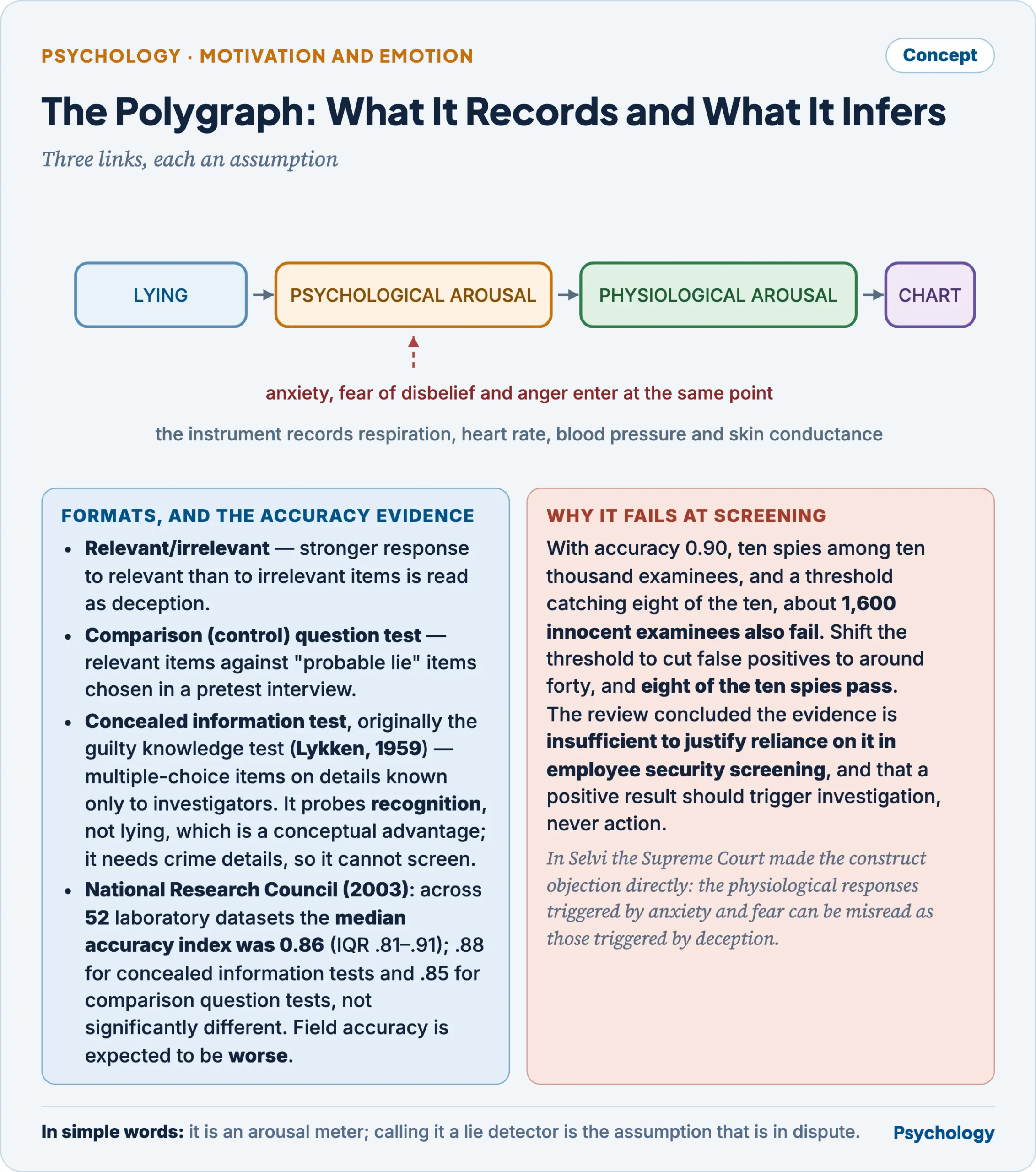
- What the instrument records. A polygraph records respiration (strain gauges at chest and abdomen), heart rate and relative blood pressure, and electrodermal response, the skin’s electrical conductance. It records physiology; it does not detect lies.
- The presumed causal chain: lying produces psychological arousal, which produces physiological arousal, which the instrument records. Each link is an assumption.
- The question formats.
- Relevant/irrelevant technique — stronger responses to relevant than to irrelevant questions are read as deception.
- Comparison (control) question test — responses to relevant questions are compared with responses to “probable lie” comparison questions chosen in a pretest interview, the format Reid introduced. A deceptive examinee is expected to show greater concern, and therefore stronger responses, on the relevant items.
- Concealed information test, originally the guilty knowledge test (Lykken, 1959) — multiple-choice items on details known only to investigators and those present at the event. Responding most strongly to the correct option indicates concealed information. It probes recognition, not lying, which is a conceptual advantage; but it requires crime details and so cannot be used for screening.
- The accuracy evidence. The National Research Council (2003) review concluded that specific-incident polygraph testing of examinees untrained in countermeasures “can discriminate lying from truth telling at rates well above chance, though well below perfection”. Across 52 laboratory datasets the median accuracy index was 0.86, with an interquartile range of 0.81 to 0.91; the median was 0.88 for concealed information tests and 0.85 for comparison question tests, a difference that was not statistically significant. The committee stressed that laboratory estimates are likely higher than field accuracy.
- The base-rate argument, which is why this is not good enough for screening. With an assumed accuracy index of 0.90, ten spies among ten thousand examinees, and a threshold set to catch eight of the ten, about 1,600 innocent examinees also fail; moving the threshold to cut false positives to around forty lets eight of the ten spies through. The committee concluded the evidence “is insufficient to justify reliance on its use in employee security screening”, and that a positive result should trigger investigation rather than action. Accuracy for screening is “almost certainly lower” than for specific-incident testing.
- The construct objection: fear, not deception. Physiological arousal accompanies many states, and the stimuli that elicit electrodermal responses are, as the review put it, too numerous to isolate a specific psychological antecedent. An innocent examinee frightened of being disbelieved produces the pattern the examiner reads as lying. The Indian Supreme Court put the objection concisely in Selvi: the physiological responses triggered by anxiety and fear can be misread as those triggered by deception.
- Countermeasures — mental and physical techniques to alter one’s own responses — may seriously degrade accuracy, and whether they defeat experienced examiners is unresolved.
- Brain-based alternatives. The P300-based concealed information test uses an event-related potential elicited by a recognised, task-relevant rare stimulus, and performs well in the laboratory; its problems are prior exposure to the probe items through media or investigators, and vulnerability to countermeasures, which prompted the development of more complex protocols. Demonstrating that someone recognises a detail does not establish how they came to know it — a bystander and a perpetrator both recognise the scene.
The legal position in India
- Selvi v. State of Karnataka (2010) is the controlling authority, delivered by a three-judge bench of the Supreme Court on narcoanalysis, polygraph examination and the Brain Electrical Activation Profile test.
- Compulsory administration is unconstitutional. It violates Article 20(3), the right against self-incrimination, whose protection extends to the investigative stage and covers accused persons, suspects and witnesses; the Court held that the results of these tests bear a testimonial character and cannot be reclassified as material evidence.
- It also violates Article 21. Forcing the techniques on a person fails the standard of substantive due process, constitutes an “unjustified intrusion into the mental privacy of an individual”, amounts to cruel, inhuman or degrading treatment by the standard of evolving human rights norms, and conflicts with the right to a fair trial. The Court held that an appeal to compelling public interest cannot justify diluting the right against self-incrimination.
- Voluntary tests are permitted with safeguards, but — the part most often stated wrongly — even a voluntary test’s results are not admissible in themselves, because the subject does not exercise conscious control over the responses. Only information or material subsequently discovered with the help of voluntary test results may be admitted, under Section 27 of the Indian Evidence Act, 1872.
- The safeguards are the National Human Rights Commission’s 2000 guidelines, which the Court directed be strictly followed: consent, with an option to refuse; access to a lawyer and an explanation of the physical, emotional and legal implications; consent recorded before a Judicial Magistrate with the person represented by counsel; a clear statement that the result will have the status of a statement to the police and not a confession to a magistrate; judicial consideration of the circumstances of detention; recording by an independent agency such as a hospital in the presence of a lawyer; and a full medical and factual narration on record.
- On reliability, the Court noted the scope for error from examiner qualifications, physical conditions, question framing and countermeasures, the suggestibility of a drugged subject in narcoanalysis, and the absence of rigorous independent study of the brain-based technique — concluding that the questionable scientific reliability of these methods conflicts with proof beyond reasonable doubt. It also observed that those who develop such techniques are perceived to have an interest in promoting them.
Effects of emotion on behaviour
- Attention narrows onto the emotional object, which produces weapon focus in eyewitnesses — the weapon is remembered and the face is not.
- Memory for the central material of an arousing event is enhanced and for peripheral detail impaired; Cahill and McGaugh showed the enhancement is abolished by beta-adrenergic blockade, locating it in amygdala-modulated consolidation.
- Judgement uses the current feeling as information about the judged object. Schwarz and Clore (1983) found reported life satisfaction tracking the weather, and the effect disappearing once the interviewer mentioned the weather and so revealed the feeling’s real source.
- Decision making is guided by anticipatory bodily signals: Bechara, Damasio and colleagues (1994, 1997) found healthy participants on the Iowa gambling task generating skin-conductance responses to risky decks before they could identify them, while patients with ventromedial prefrontal damage generated none and chose badly while describing the task correctly.
- Performance follows the inverted-U of arousal, with the optimum lower for complex tasks, and anxiety additionally consumes the working memory a skilled performance requires.
Criticisms and limitations
- Loose coupling. The components are loosely coupled, so there is no single referent for “the emotion”, and findings from one measure do not generalise to another.
- Physiological specificity is unproven. Discrete autonomic signatures for discrete emotions have not been demonstrated, and physiological measures index arousal and valence better than they identify emotions. A claim that an instrument “measured fear” overstates what the data support.
- Laboratory emotion is mild. Films, pictures, music and mild stressors produce brief, weak states in volunteers who usually know what is being studied, and the generalisation to terror, grief and rage is an inference the designs do not license.
- The lesion literature confounds the loss of a function with the patient’s reaction to the injury, which is most acute for the hemispheric-asymmetry findings.
- Polygraph research is mostly laboratory mock-crime work with volunteers who face no real consequence, which is why the field estimates are expected to be worse than the laboratory ones, and the research base the review examined was judged of limited quality.
- Reverse inference in neuroimaging. Observing amygdala activation does not establish that fear was present, since the structure responds to a wide range of significant stimuli.
- Culture is under-measured. Self-report instruments depend on an emotion lexicon that differs across languages, and translated scales assume equivalences that are rarely tested.
Previous Year Questions
- 2022What do you understand by physical indicators of emotion? How are they relevant in polygraph test?
- 2021Discuss the physiological basis of emotion and its measurement.
- 2020Describe physiological and cognitive components of emotions.
- 2014Discuss the role of various neural and physiological processes in emotional experiences.
- 2013Bring out the role of left and right hemispheres in emotional experience.
- 2012How would you measure emotion of an individual? Discuss the effect of emotion on behaviour.