

Psychological and physiological basis of motivation and emotion; Measurement of motivation and emotion.
Official Syllabus: Paper I · Unit 9 Motivation and Emotion
“A need is a potentiality or readiness to respond in a certain way under certain given circumstances.”
— Murray (1938)
Achievement motivation is the one motive with a measurement problem severe enough to have become part of the theory. It is assessed from stories people tell about ambiguous pictures, a procedure whose reliability is poor by any ordinary psychometric standard and whose defenders argue the poor reliability is a consequence of how the motive works rather than a defect of the test. Everything in this topic — including the claim that achievement motivation drives economic growth — depends on how that dispute is resolved.
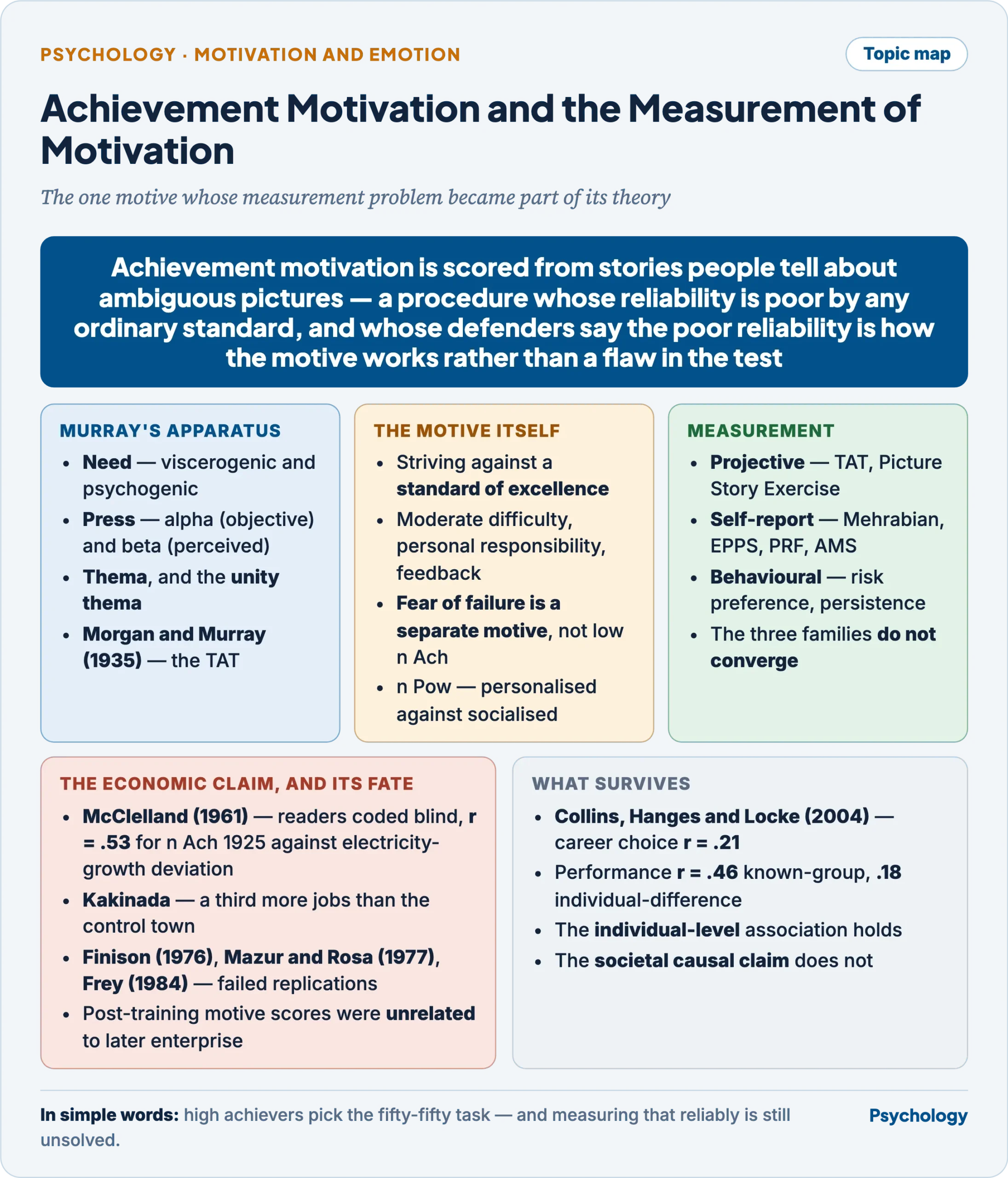
Murray’s framework: need, press and thema
Murray (1938) built the apparatus the whole literature uses.
- Need — a force in the brain region that organises perception, apperception and action so as to transform an unsatisfying situation. Needs are inferred from the trend of behaviour, the objects sought, and the expressions of satisfaction.
- Viscerogenic (primary) needs arise from organic states and fall into groups: intake (air, water, food), output (sex, lactation, urination, defecation), and avoidance (harmavoidance, heatavoidance, coldavoidance, noxavoidance).
- Psychogenic (secondary) needs are derived from the viscerogenic needs but are no less determining of behaviour — achievement, affiliation, dominance, nurturance, aggression, autonomy, order, play and the rest. Murray’s own list of psychogenic needs is commonly given as around twenty, with sources differing on the exact count.
- Press — the environment’s power to help or obstruct a need. Alpha press is the environment as it objectively is; beta press is the environment as the person perceives it, and Murray held beta press to be the more consequential of the two.
- Thema — the recurring combination of a need and the press it meets, which is the unit of a life history. The unity thema is the single need–press pattern formed in early childhood that best characterises the individual across life.
- Need–press congruence — the fit between a person’s needs and their environment, which Murray held to predict satisfaction better than either term alone.
- The limitation. The taxonomy is a classification, not a theory: it names what people want and does not derive the list from any principle, so there is no way to decide whether a proposed need belongs on it. Its lasting contribution is less the list than the method, since Morgan and Murray (1935) introduced the Thematic Apperception Test to measure the needs the taxonomy posited.
Achievement motivation
The need for achievement (n Ach) is the disposition to strive for success against a standard of excellence — not for reward, status or approval, but for the accomplishment itself. McClelland and Atkinson established the concept and its measurement in the 1950s.
- The behavioural profile of high n Ach, as the research found it:
- Preference for moderate difficulty, where the outcome is genuinely informative about one’s own competence, rather than easy tasks that tell one nothing or very hard tasks whose failure means nothing.
- Personal responsibility for the outcome — high achievers avoid situations where luck or someone else decides the result.
- A demand for concrete feedback, which is why business attracts them and why vague appraisal demotivates them.
- Persistence in the face of obstacles, and heightened performance when conditions are difficult, with no advantage over low achievers when the task is easy and conditions relaxed.
- A preference for working alone or with other high achievers rather than with congenial colleagues.
- Fear of failure is a separate motive, not the low end of n Ach. McClelland and Atkinson (1953) found the two statistically independent: a person can be high on both, low on both, or high on one. This is the point most often lost, and the whole of Atkinson’s model depends on it.
- The need for power (n Pow) is the disposition to have impact on others. McClelland later split it into personalised power, directed at dominance for its own sake and associated with impulsive and self-destructive behaviour where responsibility is low, and socialised power, directed at organisational goals, which is the form that predicts managerial effectiveness.
- The need for affiliation (n Aff) is the disposition to establish and maintain warm relationships. McClelland found high n Aff predicting conformity to group norms and a preference for cooperation over competition, and in managers predicting worse decisions where those decisions are unpopular.
Atkinson’s risk-taking model
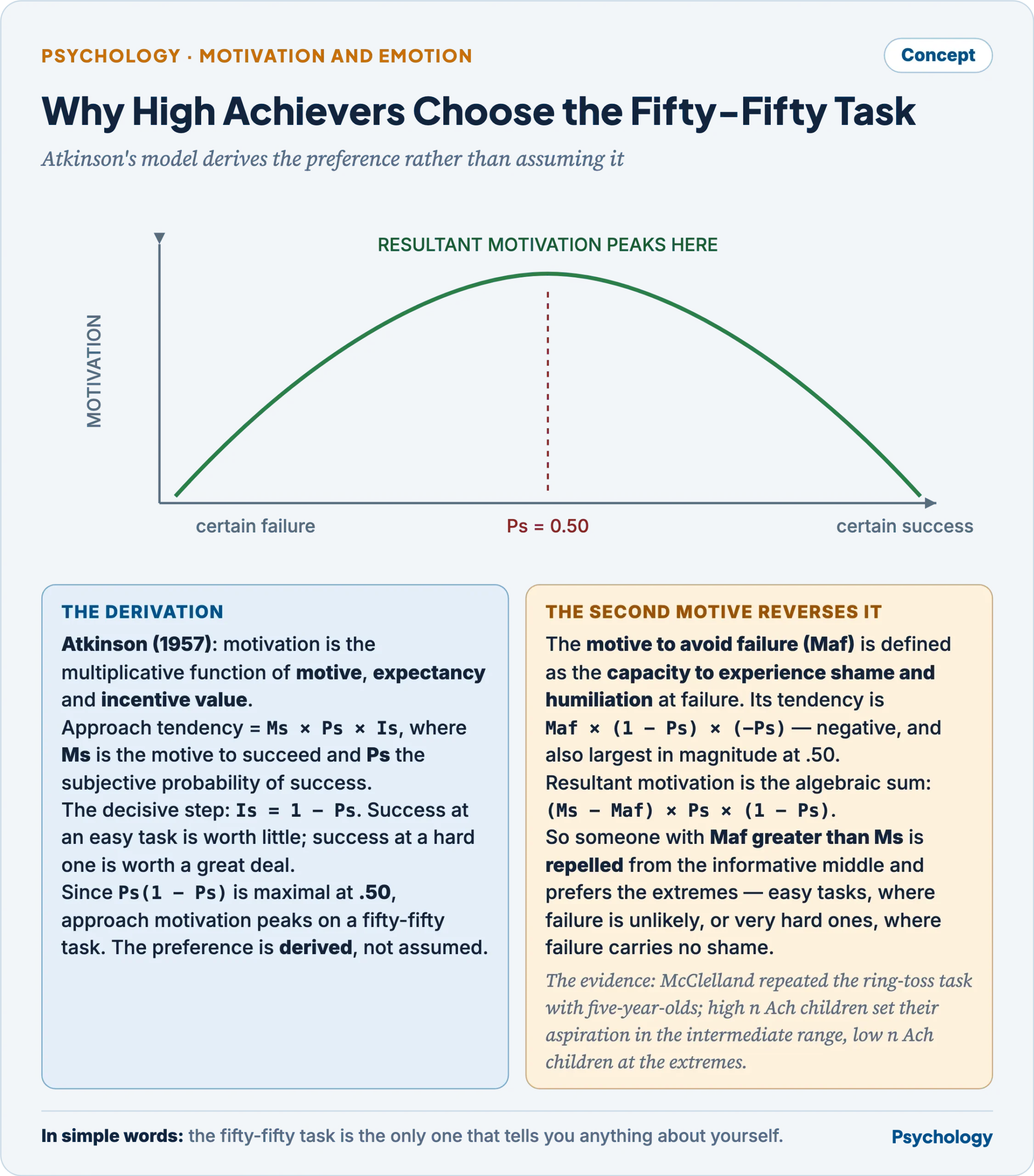
Atkinson (1957) made the theory quantitative, and it is the only part of this literature with a clean, confirmed, counter-intuitive prediction.
- Motivation is a multiplicative function of the motive, the expectancy — the subjective probability that the act will produce the incentive — and the incentive value.
- The tendency to approach success is therefore `Ms × Ps × Is`, where Ms is the motive to succeed, Ps the subjective probability of success, and Is the incentive value of success. Atkinson’s decisive step was to define `Is = 1 − Ps`: success at an easy task is worth little and success at a hard one a great deal, so incentive value is the complement of probability.
- Because `Ps × (1 − Ps)` is maximal at Ps = 0.50, approach motivation peaks at tasks the person judges a fifty-fifty prospect. This is the model’s famous prediction, and it is derived rather than assumed.
- The motive to avoid failure (Maf) is defined as the disposition to avoid failure and the capacity to experience shame and humiliation at it. Its tendency is `Maf × (1 − Ps) × (−Ps)`, which is also maximal in magnitude at Ps = 0.50 and is negative.
- Resultant motivation is the algebraic sum, giving `(Ms − Maf) × Ps × (1 − Ps)`. So a person with Ms greater than Maf is drawn to intermediate difficulty, while a person with Maf greater than Ms is repelled from it and prefers the extremes — very easy tasks, where failure is unlikely, or very hard ones, where failure carries no shame. Avoidance of the informative middle is the signature of fear of failure.
- The evidence. McClelland repeated the classic level-of-aspiration ring-toss task with five-year-olds, using a non-verbal index of achievement motive strength: children high in n Ach more often set their aspiration in the intermediate range and took more shots from a modest distance, while those low in n Ach chose disproportionately at the extremes. Atkinson’s own risk-preference data came from a constrained-performance and task-choice paradigm in the same study.
- Objection. The model treats the motives as fixed and the probabilities as given, ignores the information value of the task to the person, and has little to say about what happens after success or failure — which is the gap Weiner (1985) filled with an attributional account, making the consequences of an outcome depend on whether its cause is seen as internal or external (locus), enduring or temporary (stability), and within the person’s control (controllability).
Measurement of motivation

| Projective (implicit) | Self-report (explicit) | Behavioural | |
|---|---|---|---|
| Instrument | TAT, Picture Story Exercise | Mehrabian’s scale, EPPS, PRF, Achievement Motives Scale | Risk preference, persistence, choice of difficulty |
| Assumes | Motives operate outside awareness and appear in fantasy | The person can report their own motive strength | The motive shows in what is chosen and sustained |
| Scored by | Trained coders applying a content-analysis system | Item keys | Observed choice |
| Reliability | Poor — often below .60 | Good — .80 and above | Variable |
| Main weakness | Low internal consistency; coder-dependent | Social desirability; self-insight required | Confounded by ability and by situational constraint |
- The projective method. A respondent writes a story about an ambiguous picture — what is happening, what led to it, what will happen — and trained coders score the story for achievement imagery: a stated standard of excellence, unique accomplishment, long-term involvement, instrumental activity, anticipation of success or failure, obstacles, and affect about the outcome. The logic is projection: the motive is assumed to shape fantasy and to be inaccessible to direct question.
- Why its reliability is poor, and the dispute about what that means. Reviews find both internal consistency and test–retest reliability of the TAT as a motive measure frequently below .60 (Fineman, 1977). Atkinson, Bongort and Price (1977) argued that this is a necessary consequence of the response process rather than a flaw: story production is dynamic, and having expressed a motive in one story the writer is less likely to express it in the next, so low inter-item correlation is predicted by the theory and is not evidence of unreliability. The dispute is live rather than settled, and a candidate who treats low reliability as a simple defect has taken one side of it without noticing.
- Implicit and explicit measures do not agree. Spangler (1992), meta-analysing the literature, found an average correlation of about .09 between TAT-based and self-report achievement measures — effectively unrelated. Nor do the self-report measures agree well with each other. Two bodies of research therefore use the same name for different variables.
- The self-report instruments. Mehrabian (1969) produced the first widely used achieving-tendency scale, later revised to 38 items. The Edwards Personal Preference Schedule (Edwards, 1959) measures fifteen needs drawn directly from Murray’s system, using a forced-choice format designed to control social desirability. Jackson’s Personality Research Form (Jackson, 1967) measures twenty Murray needs plus infrequency and desirability controls. The Achievement Motives Scale, in the ten-item revision of Lang and Fries (2006), resolves the construct into two factors — hope of success and fear of failure — which is Atkinson’s distinction made psychometric.
- Behavioural and performance measures use what the person does: level of aspiration after success and failure, choice of task difficulty, persistence after interruption, and in organisations, observed initiative and goal setting. They avoid self-report bias and confound motive with ability and with opportunity.
- Does the measure matter? Collins, Hanges and Locke (2004), meta-analysing 69 data points on 9,032 people, found achievement motivation related to entrepreneurial career choice at r = .21 and to performance at r = .46 in known-group studies and .18 in individual-difference studies — and found no significant advantage for any measurement method, with mean correlations of .16 for the TAT, .19 for questionnaires and .20 for a sentence-completion measure. The methods disagree with each other and predict about equally well, which is a more awkward result than either camp’s position.
- The honest summary. There is no gold-standard measure of motivation. The projective method has the stronger theoretical rationale and the weaker psychometrics; self-report has the reverse; and the two are not interchangeable, so a finding is uninterpretable without naming the instrument.
Achievement motivation and economic development
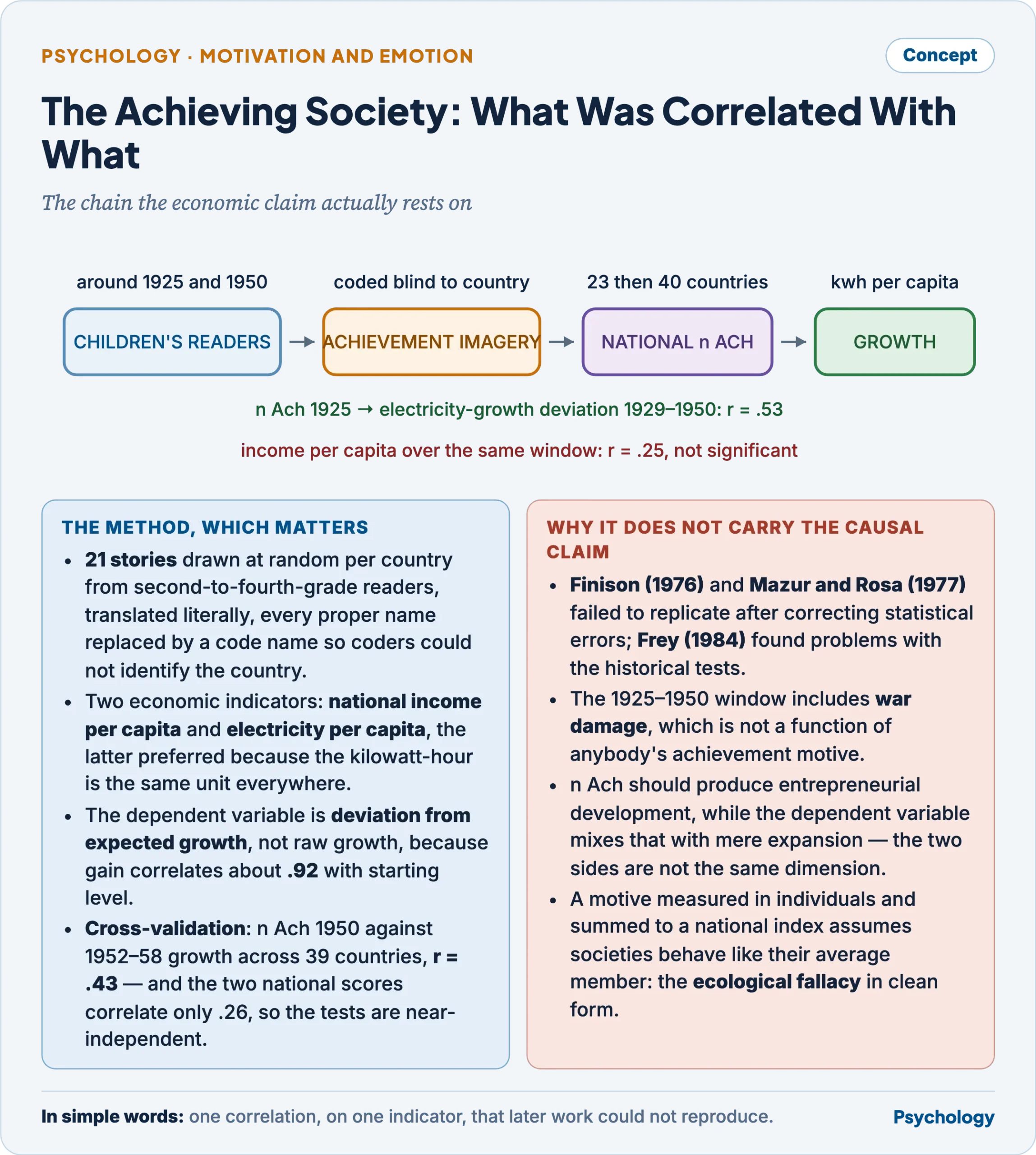
McClelland (1961) argued that the achievement motive, aggregated across a population, is a cause of economic growth, and he tested it in a way worth knowing in detail, because the question asked of this literature is whether the test supports the claim.
- The measure of a nation’s n Ach. Content analysis of children’s school readers — stories from second to fourth grade readers in wide use around 1925 and around 1950. Twenty-one stories were drawn at random per country, translated literally, with every proper name replaced by a code name so that coders could not tell which country a story came from. The final samples were 23 countries for the earlier period and 40 for the later.
- The economic measure. Two indicators: national income per capita in international units, and electricity produced per capita in kilowatt-hours, the latter preferred because the kilowatt-hour is the same unit everywhere and needs no currency conversion. Crucially, the dependent variable was not raw growth but deviation from expected growth — gain regressed on initial level — because a country’s gain correlates about .92 with where it started.
- The actual result. The 1925 reader scores predicted the 1929–1950 electricity gain at r = .53, significant; they predicted income gain at only r = .25, not significant. The 1950 scores did not predict earlier growth, which is the right direction for a causal claim. A cross-validation on the later period — 1950 n Ach against 1952–1958 electricity growth across 39 countries — gave r = .43, and the two tests are near-independent, since the 1925 and 1950 national scores correlate only about .26. Winter’s extension to 1967 gave r = .39. The book added studies of preliterate cultures using folk tales, and historical analyses of Ancient Greece, medieval Spain and pre-industrial England using literary material.
- The applied test: the Kakinada experiment. McClelland and Winter (1969) trained small businessmen in Kakinada, Andhra Pradesh, on the premise that underdeveloped economies could be helped more effectively by addressing the motivational basis of entrepreneurship than by capital and technology transfer. The core was a two-week programme of self-awareness exercises, instruction in the achievement-imagery coding system, and the drafting of a personal action plan — participants learnt, in effect, to think, feel, talk and act like someone high in n Ach. Trained participants subsequently worked longer hours, invested more and started more new ventures than untrained controls; two years on, Kakinada had almost a third more jobs than a comparable control town in the region; and the cost per job created compared favourably with state employment schemes. Mehta (1968) ran school-based achievement-motivation training in India, and Varga (1977) followed up the question of who gains from such training.
Is the conceptualisation adequate to explain India’s economic development?
The defensible answer is that it is not adequate, while not being empty, and the reasons divide into three.
- The national-level finding has not held. Finison (1976) and Mazur and Rosa (1977) failed to replicate McClelland’s results after correcting statistical errors and using the 1950 n Ach scores to predict growth through 1971, and Frey (1984) found problems with the historical tests. A correlation that does not survive replication cannot carry a causal claim about a nation’s development.
- The method is contestable at every joint. Children’s readers are an indirect index of a population’s motive; electricity output is a proxy for growth that McClelland himself conceded was poor for 1929; deviations from a regression line are not the same quantity as growth; and the 1925-to-1950 window includes war damage, which is not plausibly a function of anybody’s achievement motive. A contemporary reviewer made the deeper point that n Ach should produce entrepreneurial development while the dependent variable mixes that with mere expansion, so the two sides of the correlation are not the same dimension.
- The Kakinada result does not demonstrate the mechanism. This is the sharpest criticism and the most useful one. McClelland held motives to be stable dispositions, which makes a two-week change implausible on his own theory; the post-training rise in TAT scores is uninterpretable, since participants had been taught the coding system and so had learnt to write stories that score high; and, decisively, the post-training motive scores were unrelated to participants’ subsequent entrepreneurial activity. Something in the programme worked, and the achievement motive was not shown to be it. Neither group was a probability sample, and the group sizes were small.
- What survives. The individual-level association is robust: Collins, Hanges and Locke (2004) found entrepreneurs scoring higher in achievement motivation than people in other careers, and the motive predicting venture performance. Indian survey work reaches the same place — studies of MSME entrepreneurs find need for achievement and internal locus of control predicting firm competitiveness and performance, and a study of 700 women entrepreneurs found achievement motivation among the significant predictors of success alongside financial and socio-cultural factors. These are correlational designs and support association, not causation.
- What the account leaves out for India, which is the substance of the objection: Access to credit and collateral, the licensing and compliance environment, infrastructure and market access, education and skill levels, caste- and kin-based business networks that allocate opportunity independently of motive, and the gendered constraints on women’s enterprise. Development economics moved decisively towards institutional explanations of growth and away from trait explanations of this kind — the “culture hypothesis” is explicitly rejected in that literature — so a psychological variable can at best be one term in a multi-causal account. Treating India’s development as a function of its population’s achievement motive inverts the likely direction of much of the causation, since opportunity structures shape which motives are worth having.
- The practical descendant of this work in India is not motive training as such but enterprise development and entrepreneurship training, now delivered through institutional channels, in which the motivational component sits alongside finance, skills and market linkage rather than in place of them.
Criticisms and limitations
- The measurement problem is not resolved, and the two measurement traditions correlate near zero, so “achievement motivation” names two variables.
- Coder dependence. Projective scoring requires trained coders and inter-rater agreement that is achievable but costly, and small differences in coding systems change scores.
- Cultural specificity of the construct. Achievement defined as individual accomplishment against a standard of excellence is a culturally particular formulation; where achievement is socially defined, the TAT stories and the self-report items both misread the motive. The Indian evidence of socially embedded achievement goals is a direct instance.
- Aggregation. A motive measured in individuals and summed to a national index assumes that societies behave like their average member, which is the ecological fallacy in a particularly clean form.
- McClelland’s own objection to his critics was that they overgeneralised the construct, which he described as a specific and rather rare drive focused on efficiency. That defence narrows the claim considerably, and a narrow claim cannot explain national development.
- Failure avoidance got little attention in the applied work. Atkinson’s second motive is the better predictor of avoidance of challenge, and the training programmes were built almost entirely around raising the approach motive.
Previous Year Questions
- 2019What is achievement motivation? Discuss the projective technique as a method for assessing achievement motivation.
- 2010Discuss the concept of NAch and different methods which have been used to measure it.
- 2001Is it correct to state that the theoretical conceptualization of achievement motivation is not adequate enough to describe the economic development of India?