

Psychological and physiological basis of motivation and emotion.
Official Syllabus: Paper I · Unit 9 Motivation and Emotion
“Motivation refers to the contemporary (immediate) influence on direction, vigor, and persistence of action.”
— Atkinson (1964)
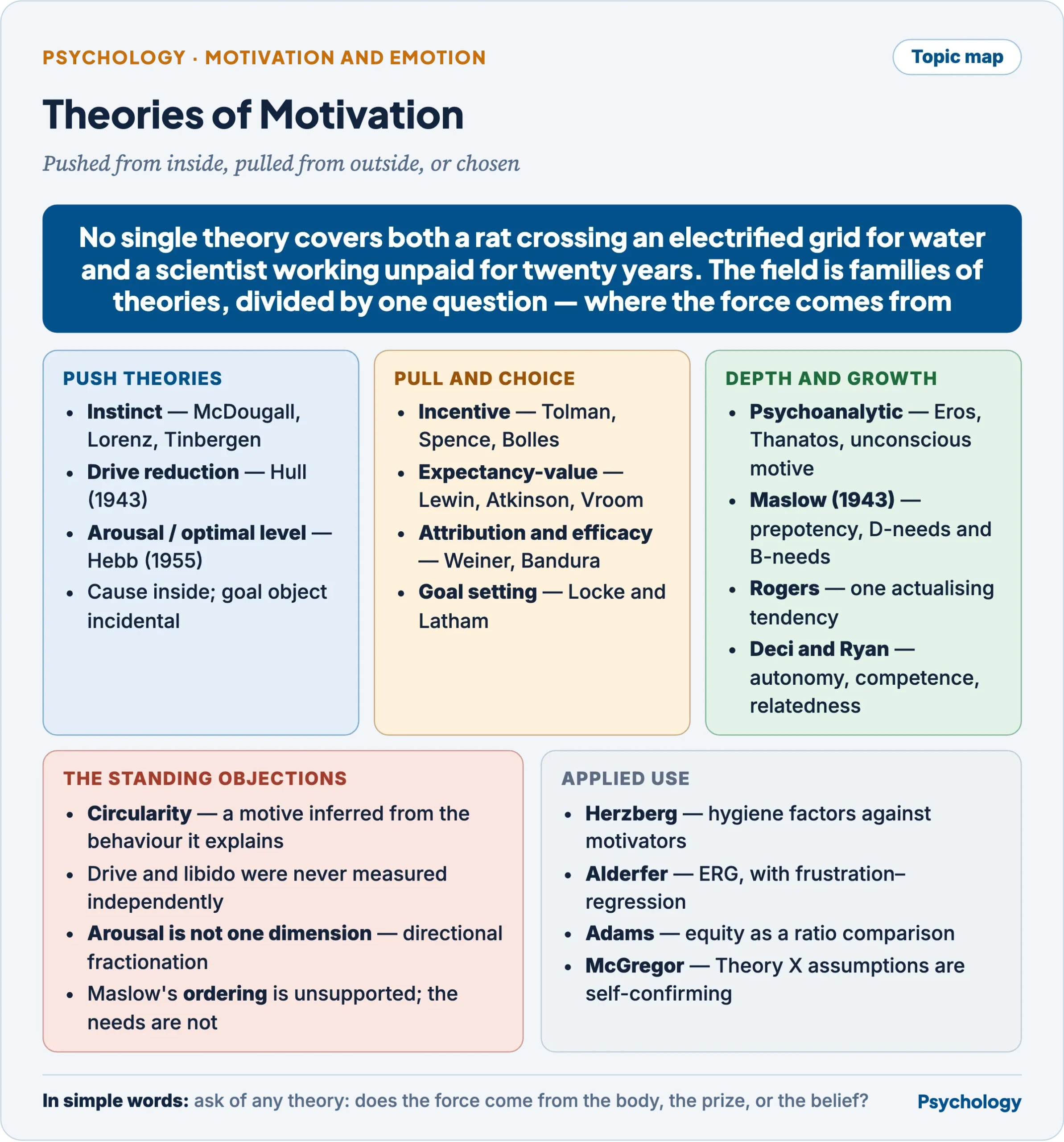
No single theory of motivation accounts for both a rat crossing an electrified grid for water and a scientist working unpaid for twenty years on one problem. The field therefore consists of families of theories, each built on a different answer to one question — whether behaviour is pushed from inside, pulled from outside, or chosen on the basis of what the actor expects.
The families and what divides them

| Instinct | Drive-reduction | Arousal | Incentive | Cognitive | |
|---|---|---|---|---|---|
| Source of motivation | Inherited programme | Internal tissue deficit | Distance from optimal arousal | External goal object | Expectations and beliefs |
| Direction of force | Push | Push | Push or pull | Pull | Chosen |
| Behaviour aims to | Discharge the instinct | Reduce stimulation | Reach an optimum, up or down | Obtain the incentive | Maximise expected value |
| Learning’s role | None | Supplies the habit | Limited | Supplies incentive value | Central |
| Explains well | Species-typical patterns | Hunger, thirst | Curiosity, boredom, stress | Choice among rewards | Human achievement and work |
| Fails on | Human variability; circular | Exploration; anticipation | Arousal is not unitary | Why valued at all | Routine and biological motives |
The table carries the most frequently required contrast. Instinct, drive and arousal theories are all push theories, locating the cause inside the organism and treating the goal object as incidental; incentive theory is a pull theory, locating it in the goal and treating the internal state as a modifier of the goal’s attractiveness. The decisive difference is predictive: a push theory says a deprived organism will act, while a pull theory says an organism will act when a valued object is available, whether deprived or not — and the second is what is observed when a satiated animal eats a novel palatable food.
Instinct theories
- Mechanism. Behaviour is driven by inherited, species-universal, unlearnt patterns released by specific stimuli. Darwin’s work on continuity between species licensed the extension to humans, and McDougall (1908) built a social psychology on a list of human instincts, each paired with a characteristic emotion. The ethologists made the concept precise: a fixed action pattern is a stereotyped sequence released by a sign stimulus, which Lorenz and Tinbergen documented in detail.
- Evidence. Genuine for species-typical behaviour — nest building, imprinting, the egg-rolling of greylag geese — and the gene-knockout and twin studies now establish real hereditary contributions to motivated behaviour.
- Objection. The theory collapsed on circularity: aggression was explained by an aggressive instinct, whose evidence was aggression. By the 1920s the literature contained thousands of proposed instincts, with no principle for deciding which existed, and Bernard (1924) made the point by cataloguing them. Instincts also cannot explain variability — why humans with identical biology differ so widely — or learnt motives. What survives is not instinct theory but evolutionary psychology, which makes narrower and testable claims.
Drive-reduction theory
- Mechanism. Hull (1943) proposed that a tissue need produces a drive, a general energising state; behaviour that reduces the drive is reinforced and becomes habitual. Formally, the strength of a response is the product of drive (D) and habit strength (sHr), so drive supplies energy with no direction of its own and habit supplies direction with no energy. Drive is general: hunger energises whatever response is dominant, not only eating. Secondary drives are acquired by association with primary drive reduction, which is how the theory reaches money and approval.
- Evidence. Deprivation reliably raises activity and the vigour of learnt responses, and consumption terminates them. The theory’s precision was its strength: it generated quantitative predictions and dominated the field for two decades.
- Objection, and it is fatal as a general theory. Behaviour routinely increases stimulation. Harlow, Harlow and Meyer (1950) found monkeys dismantling mechanical puzzles with no reward, and performance got worse when food reward was added; Butler (1953) found monkeys pressing a lever for nothing but a brief look through a window; and animals will work for saccharin, which has no nutritional value and reduces no deficit. Eating begins before deficits and ends before correction. Adding a “curiosity drive” to patch this restores the circularity that sank instinct theory. Drive also turned out not to be general: hunger does not energise thirst-related responses as the theory requires.
Arousal and optimal-level theories
- Mechanism. Hebb (1955) proposed that organisms act to maintain an optimal level of arousal rather than to minimise stimulation. Below the optimum they seek stimulation, which explains curiosity, exploration and the aversiveness of boredom; above it they reduce it. Arousal theory therefore absorbs the findings that broke drive reduction, because a single principle produces both seeking and avoiding of stimulation.
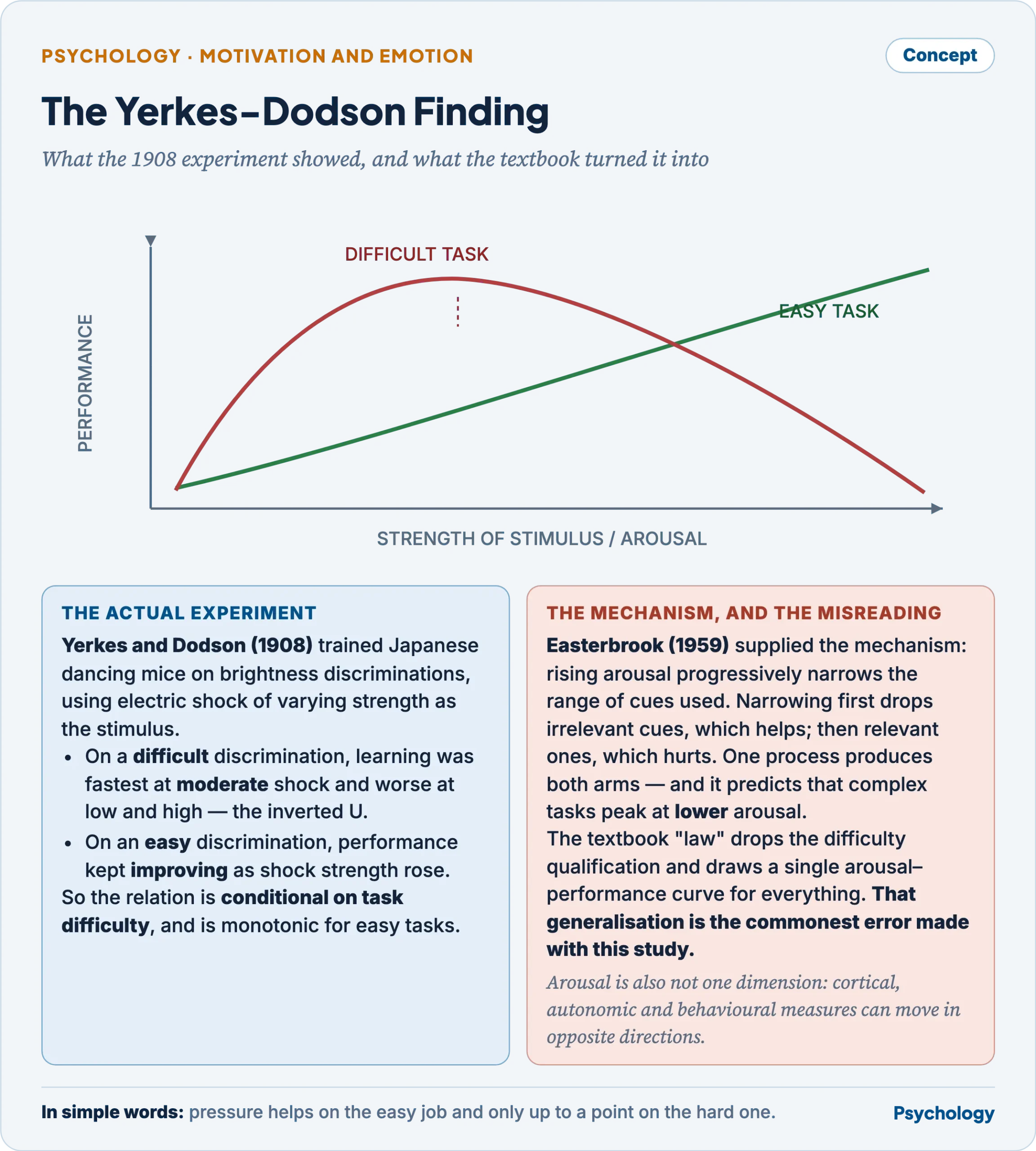
- The inverted-U, and what the original study actually showed. Yerkes and Dodson (1908) trained Japanese dancing mice on brightness discriminations using electric shock of varying strength. For a difficult discrimination, learning was fastest at moderate shock and worse at low and high; for an easy discrimination, performance kept improving as shock strength rose. The real result is therefore conditional — the inverted U appears with task difficulty and the relation is monotonic for easy tasks — whereas the textbook “law” generalises it into a single arousal–performance curve for everything. The task-difficulty qualification is the finding, and dropping it is the commonest error made with this study.
- The mechanism of decline. Easterbrook (1959) proposed cue utilisation: rising arousal progressively narrows the range of cues used. Narrowing first excludes irrelevant cues, which helps, and then begins excluding relevant ones, which hurts — so one mechanism generates both arms of the curve, and it predicts that complex tasks, which need more cues, peak at lower arousal.
- Individual differences. Zuckerman‘s work on sensation seeking treats the optimal level as a stable trait, measured by the Sensation Seeking Scale and predicting risky occupations, novel experience and substance use.
- Objection. Arousal is not a single dimension. Measures of cortical, autonomic and behavioural arousal correlate only loosely and can move in opposite directions — the phenomenon of directional fractionation reported in Lacey’s psychophysiological work — so “level of arousal” has no unambiguous referent. “Optimal level” is also usually inferred after the fact from the performance it is meant to explain, which is circular unless arousal is measured independently.
Incentive theories
- Mechanism. Motivation resides in the pull of the goal object. An incentive has incentive value — how much it is wanted — which is partly learnt and partly a function of current state. Tolman made purpose and the expected goal central; Spence added an incentive factor to Hull’s equation, so performance became a function of drive, habit and the magnitude of reward; Bolles argued the organism learns stimulus–outcome expectancies rather than drive-reducing responses.
- Evidence. Reward magnitude affects performance independently of deprivation; animals shift their behaviour immediately when reward size changes, which habit strength built over trials cannot do; and incentive value is state-dependent, which is why the same meal is differently attractive before and after eating.
- Three cases the pull account handles and the push account does not. A person who has just finished a full meal eats dessert, because the incentive value of a novel palatable food is independent of any deficit. An employee who needs no more money works harder for a bonus, because the incentive’s value is set by what it signifies rather than by a tissue state. A rat that has learnt a runway for a large reward slows down abruptly when the reward is reduced — the depression effect — even though its deprivation is unchanged, which shows behaviour tracking the goal’s value rather than the internal state.
- Objection. Incentive theory explains choice between known rewards and does not explain why anything is rewarding in the first place, so it needs a theory of value that it does not contain. Alone it also cannot explain behaviour in the absence of any incentive, which is where the push theories still work.
Cognitive and expectancy theories
- Expectancy as the core idea. Tolman established that animals learn what leads to what and act on expectancies rather than on strengthened responses. Lewin formalised the human case in field theory: behaviour is a function of the person and the environment together, and goals have valence, positive or negative, within a psychological field of forces.
- Atkinson’s achievement model. The tendency to approach a task is the product of the motive to succeed, the subjective probability of success and the incentive value of success — and because incentive value rises as probability falls, the product peaks at intermediate difficulty, which is the model’s distinctive and confirmed prediction. A separate motive to avoid failure acts in the opposite direction, so a person high in fear of failure prefers very easy or very hard tasks, both of which protect self-esteem.
- Expectancy-value in work settings. Vroom (1964) made motivational force the product of expectancy (effort leads to performance), instrumentality (performance leads to the outcome) and valence (the outcome is wanted). Because the terms multiply, motivation fails if any one is near zero — which is the theory’s practical payoff, since it tells a manager which of three quite different problems to fix.
- Beliefs about control and cause. Rotter (1966) distinguished internal from external locus of control. Weiner (1985) showed that what follows success or failure depends on how it is explained, along the dimensions of locus, stability and controllability — so attributing failure to stable lack of ability produces hopelessness, while attributing it to unstable low effort preserves motivation. Bandura (1977) identified self-efficacy, the belief that one can execute what is required, as the strongest single cognitive determinant of effort and persistence.
- Goal setting. Locke and Latham established that specific and difficult goals produce higher performance than vague or easy ones, provided the person accepts the goal and receives feedback, with the mechanisms being direction of attention, effort, persistence and strategy search. It is among the best-supported findings in the field.
- The cognitive approach to emotion runs on the same principle. Just as motivation is made a function of what the actor expects, emotion is made a function of how the actor appraises the event — whether it is relevant to a goal, who caused it, and whether it can be coped with. The two halves share the claim that the determining variable is the interpretation and not the stimulus, which is why the same reward motivates two people differently and the same event frightens one and angers another. The appraisal literature and the cognition-and-arousal experiments belong with the theories of emotion.
- Objection. Cognitive theories assume a deliberating actor and therefore fit considered human choice and fit habit, impulse and biological motives badly. They also rely heavily on self-report of beliefs that may be rationalisations, and the multiplicative forms are rarely tested as multiplicative.
The psychoanalytic account of motivation
- Mechanism. All behaviour is driven by instinctual energy arising in the id and seeking discharge. Freud reduced the instincts to two classes: Eros, the life or sexual instincts whose energy is libido, and Thanatos, the death or aggressive instincts. The pleasure principle governs the id, which seeks immediate tension reduction; the reality principle governs the ego, which delays discharge until a safe object is available. Where direct expression is impossible, energy is redirected by defence mechanisms, of which sublimation — discharge into socially valued activity — is the one that converts drive into art, science and work.
- Why it counts as motivation theory. Its distinctive claims are that the real motive is usually unconscious, that the stated reason is often a rationalisation, and that motives conflict rather than queue. No other family of the period said any of this.
- Evidence. Clinical, which is the problem: case material is interpreted by the theory it is meant to test. The claim has partial independent support from a different direction — implicit motive measures predict outcomes that self-report measures do not, which is consistent with motives operating outside awareness.
- Objection. The energy model is not physiologically realisable and libido was never measured. The theory is close to unfalsifiable, since any behaviour and its opposite can be derived through the defences. It is also radically incomplete as an account of motivation: it offers nothing for hunger regulation, nothing for curiosity, and nothing for competence striving. Its reduction of all motives to two is the point most often attacked, and the neo-Freudians abandoned it.
Humanistic theories: Maslow’s need hierarchy
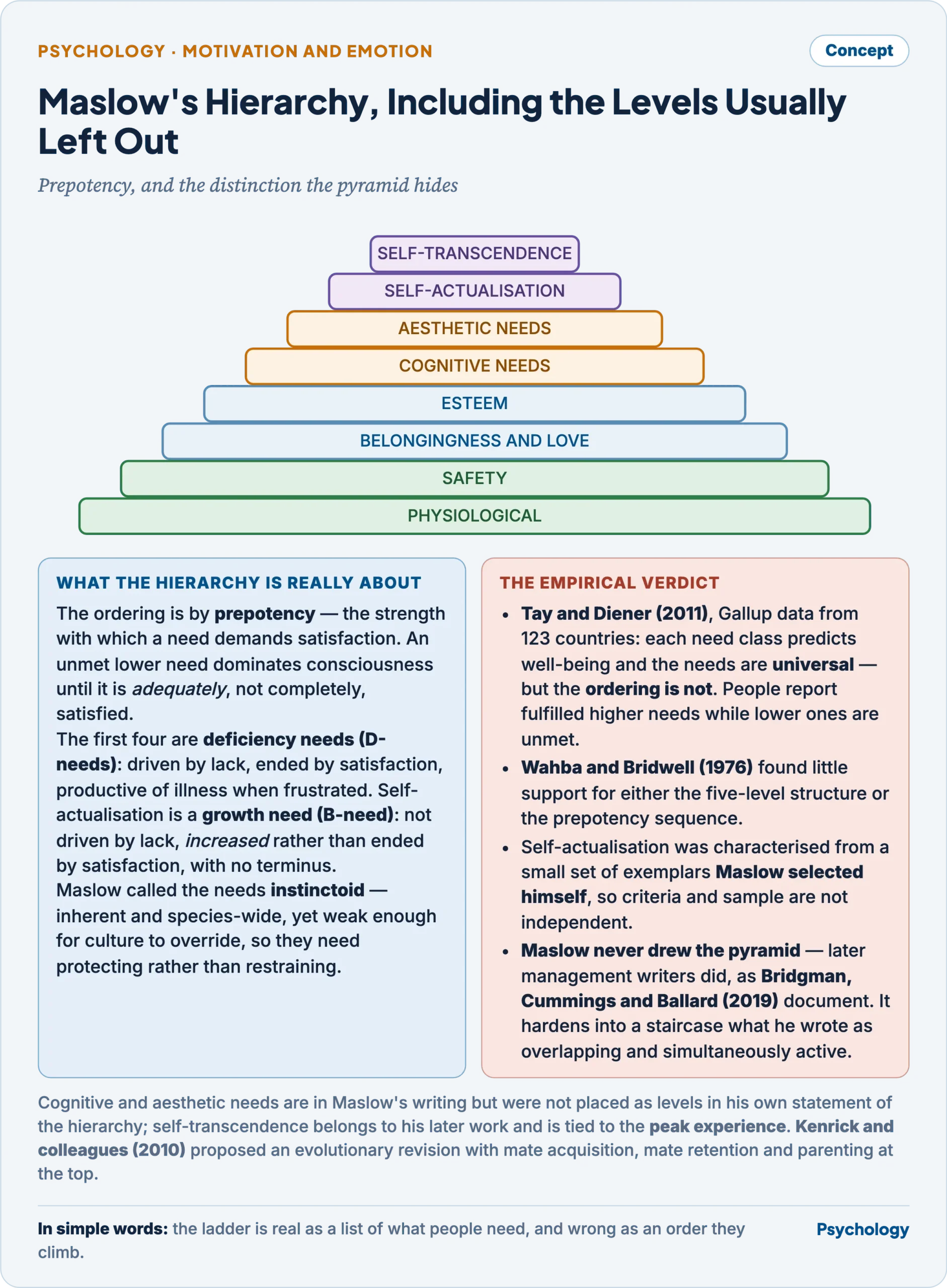
Maslow (1943) proposed that human needs are arranged by prepotency — the strength with which they demand satisfaction — so that a lower need, when unmet, dominates consciousness and organises behaviour until it is adequately, not completely, satisfied.
- Physiological needs — hunger, thirst, sleep, warmth. The most prepotent: a chronically hungry person’s whole philosophy of the future is organised around food.
- Safety needs — security, stability, order, predictability, freedom from fear.
- Belongingness and love needs — affection, intimacy, acceptance by a group.
- Esteem needs — in two forms, achievement, mastery and competence from within, and recognition, status and reputation from others.
- Self-actualisation — the realisation of one’s potential, “to become everything that one is capable of becoming”.
- Cognitive and aesthetic needs — the desires to know and understand, and for beauty, order and form. Maslow discussed these but did not place them as levels in his own statement of the hierarchy.
- Self-transcendence — added in his later work, directed beyond the self, and linked to the peak experience, a momentary, unifying, ego-transcending state.
The distinction the hierarchy is really about: The first four are deficiency needs (D-needs): they are driven by lack, their satisfaction ends the tension, and their frustration produces illness. Self-actualisation is a growth need (B-need, for Being): it is not driven by lack, satisfaction increases rather than ends it, and it has no terminus. Maslow called the needs instinctoid — inherent and species-wide, yet weak enough to be overridden by culture and habit, which is why they need protection rather than restraint.
- Supporting evidence. The needs themselves are found across cultures, and Tay and Diener (2011), using Gallup data from 123 countries, confirmed that each of Maslow’s need classes predicts subjective well-being, and that the needs are universal.
- The objection the same study makes. The ordering is not supported. People report fulfilment of higher needs while lower ones are unmet, and need satisfaction is largely independent across levels rather than sequential. Wahba and Bridwell (1976), reviewing the then-available research, found little support for either the five-level structure or the prepotency sequence.
- Other objections. The theory is largely untestable as stated, since “adequately satisfied” is unquantified and no causal link from need state to specific behaviour is specified. Self-actualisation was characterised from a small, non-random set of people Maslow himself selected as exemplars, so the criteria and the sample are not independent. The hierarchy is culturally loaded, placing individual self-realisation at the summit where collectivist traditions would place duty or relatedness. And Maslow never drew the pyramid: it was supplied by later management writers, as Bridgman, Cummings and Ballard (2019) document, and it hardens into a staircase what Maslow wrote as overlapping and simultaneously active. Kenrick and colleagues (2010) proposed a revised version grounded in evolutionary functions, with mate acquisition, mate retention and parenting at the top in place of self-actualisation.
- Applying the hierarchy to enterprise. On Maslow’s own terms the entrepreneur is high on esteem needs in their internal form — achievement, mastery, competence and independence rather than status or fame — and on self-actualisation, since founding a venture is the realisation of a capacity rather than the correction of a lack. The diagnostic point is safety: enterprise requires accepting insecurity of income and outcome, so the entrepreneur must be a person for whom safety needs are relatively weak or tolerably unmet, which is precisely what the strict prepotency sequence says should be impossible. The hierarchy therefore both locates the entrepreneur and is embarrassed by them. The better-evidenced answer to the same question is McClelland’s need for achievement, which was built for it and which predicts entrepreneurial career choice and venture performance directly.
- Rogers’ parallel account posits a single actualising tendency rather than a hierarchy, with growth requiring unconditional positive regard; it shares the humanistic premise and avoids the sequencing problem by having nothing to sequence.
Approaches used in organisations
The applied field selects from the families above on the basis of what managers can change, which is why content theories and goal-based theories dominate practice.
- Herzberg’s two-factor theory separates hygiene factors — pay, conditions, supervision, policy — whose absence causes dissatisfaction but whose presence does not motivate, from motivators — achievement, recognition, the work itself, responsibility, advancement — which produce satisfaction. The practical consequence is job enrichment rather than improved conditions. The criticism is methodological: the two-factor split follows from the critical-incident method used, because people attribute success internally and dissatisfaction externally.
- Alderfer’s ERG theory compresses the hierarchy to existence, relatedness and growth, drops the strict sequence, and adds a frustration–regression hypothesis: a blocked higher need intensifies a lower one. It fits the data better than the five-level hierarchy precisely because it abandons prepotency.
- Adams’s equity theory makes motivation depend on the perceived ratio of one’s own outcomes to inputs compared with a referent other. Perceived inequity produces tension and attempts to restore balance — changing effort, changing perception, or leaving. It explains why an absolute pay rise can demotivate.
- Goal setting is the most directly usable: specific, difficult, accepted goals with feedback.
- Expectancy theory is used diagnostically, to locate whether the failure is in effort–performance, performance–reward or reward value.
- McGregor’s Theory X and Theory Y describe the manager’s assumptions rather than the employee’s needs, and matter because the assumption is self-confirming: supervision designed for Theory X employees produces them.
- Sustaining motivation therefore means, in this literature: enrich the work rather than only the conditions, keep rewards perceived as equitable and contingent on performance, set specific goals with feedback, protect autonomy and competence so that intrinsic motivation is not displaced, and treat pay as a factor whose absence damages more than its presence helps.
Criticisms and limitations
- No integration. The families answer different questions about different behaviours, and the field has no superordinate theory. The honest statement is that motivation is a domain, not a single construct, which is why a question asking whether one approach can explain motivation has only one defensible answer.
- Measurement. Drive, arousal, libido and need strength are all inferred from the behaviour they explain unless measured independently, and the historical theories mostly did not measure them.
- Species and setting. The push theories were built on deprived animals in restricted environments; the cognitive theories on undergraduates and employees. Neither sample generalises to the other.
- Culture. The content theories encode assumptions about what people want. Hierarchy summits, achievement motivation and the autonomy premise all read differently in collectivist settings, and the evidence is of universal need classes with culturally varying expression and ordering.
- Static accounts of a dynamic process. Most theories describe the determinants of an action at a moment, not how motivation changes during pursuit of a goal, where volition, self-regulation and persistence under obstacles live.
Previous Year Questions
- 2025“Motivation is a complex process and cannot be explained by a single approach.” Evaluate the statement with the help of arousal, drive and expectancy theories by citing relevant examples.
- 2021Which approaches to motivation are more commonly used in an organization? How these approaches might help to sustain or increase motivation?
- 2017Which needs should one be high on to be a successful entrepreneur? Explain on the basis of Maslow’s Hierarchy of Needs.
- 2011How does arousal theory explain human motivation?
- 2005How are instinct, drive and arousal theories of motivation different from incentive theory? Describe incentive theory of motivation giving at least three relevant examples.
- 2004State the various psychological explanations of human motivation. Explain in detail the cognitive approach to motivation and emotion.
- 2002‘Human behaviour is elicited by expectations of desirable outcomes.’ Discuss this statement to bring out the cognitive aspects of human motivation.
- 1996Give a complete psychoanalytic account of human motivation. Is it adequate, in your opinion?
- 1995Discuss the need-hierarchy theory and comment on its relevance and utility today in understanding human behaviour.