

Psychological and physiological basis of motivation and emotion.
Official Syllabus: Paper I · Unit 9 Motivation and Emotion
“The bodily changes follow directly the perception of the exciting fact, and our feeling of the same changes as they occur IS the emotion.”
— James (1884)
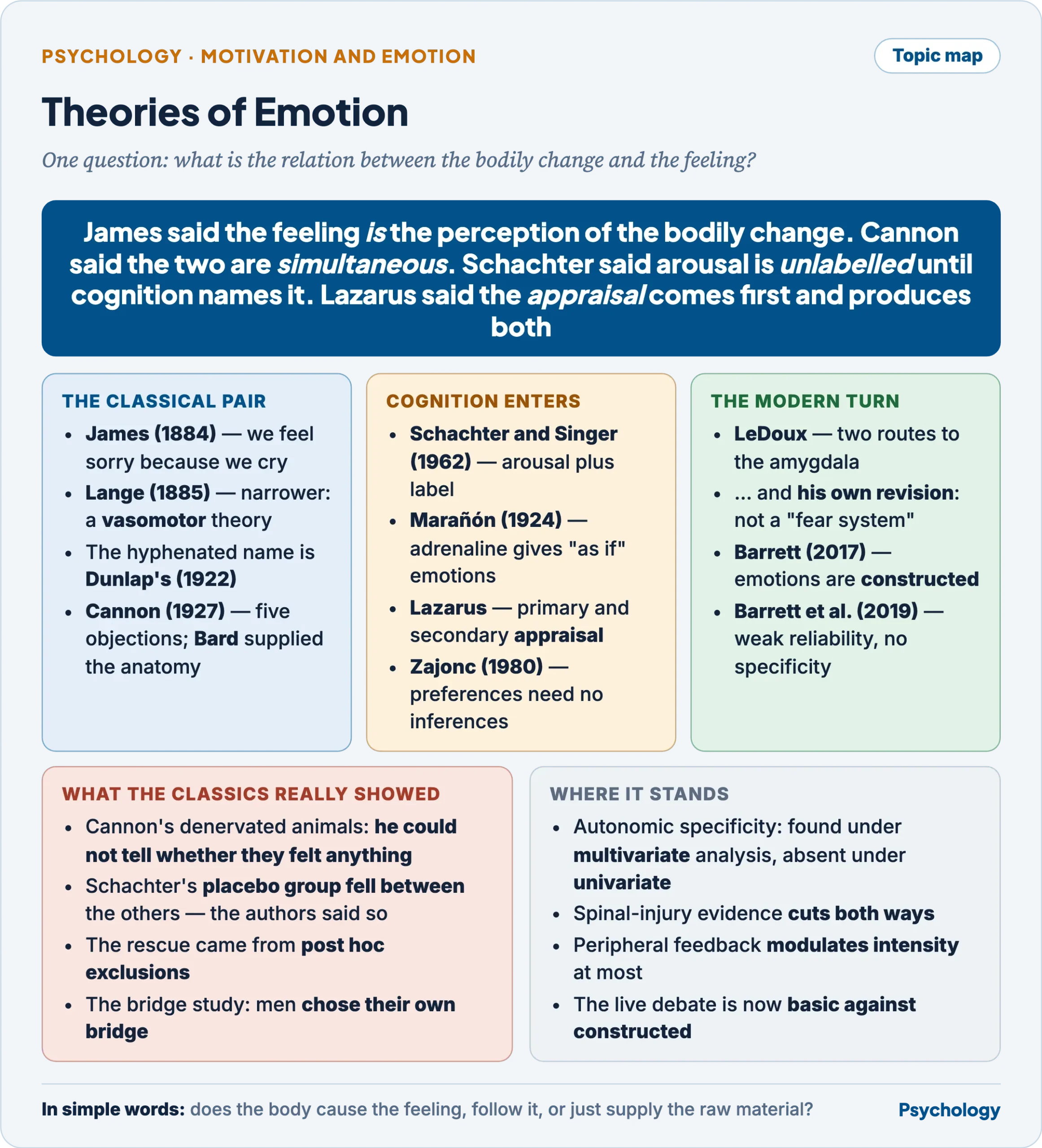
Every theory of emotion is an answer to one question: what is the relation between the bodily change and the feeling? James said the feeling is the perception of the bodily change. Cannon said the two are simultaneous products of a central mechanism. Schachter said arousal is unlabelled until cognition names it. Lazarus said the appraisal comes first and produces both. The sequence of answers is the history of the field.
The James–Lange theory
- The claim, stated exactly. James (1884) inverted the common-sense order. Common sense says we meet a bear, feel afraid, and tremble. James said we meet a bear, tremble, and the feeling of trembling is the fear. His formulation: “we feel sorry because we cry, angry because we strike, afraid because we tremble.” Strip away the bodily sensations and what remains is “purely cognitive in form” — one could judge the bear dangerous without feeling any fear at all.
- Lange’s version is narrower. Lange (1885), working independently in Denmark, reduced emotional phenomena to disturbances of vascular innervation: dilation of the blood vessels and the consequent blood supply to the organs are the primary effect, and everything else — motor changes, altered sensation, disturbed secretion — is secondary to it. So Lange is a vasomotor theory while James is a general bodily-feedback theory, and the two are not the same claim.
- The compound name. They never collaborated. The hyphenated “James–Lange theory” comes from Dunlap (1922), who reprinted James’s paper and the first English translation of Lange in one volume and proposed the joint name for what he called the organic theory. Dunlap also named a third independent originator, Alexander Sutherland in Australia, who is always dropped. Because they are amalgamated, each is routinely read through the other’s claims, and critics have argued the composite misrepresents both.
- What it got right — it made emotion a subject for physiology, it identified bodily feedback as a real contributor to feeling, and its central intuition — that the body is not a bystander — survives in modern work on interoception and on the insula’s role in subjective feeling states.
- Where the two lines of descent separated. James’s claim, and Cannon’s attack on it, generated the experimental programme traced through the rest of this article — denervation studies, spinal-injury interviews, the search for autonomic specificity. Lange’s narrower claim, that emotion reduces to a graded state of bodily activation, fed instead into the activation theories: Duffy argued that emotion is not a distinct category of behaviour at all but a region on a continuous dimension of energy mobilisation, and Lindsley (1951) gave that dimension a neural form in his activation theory, identifying emotional intensity with the degree of cortical arousal produced by the ascending reticular activating system and readable in the EEG. On this descent the question stops being which emotion and becomes how much activation — which is why the arousal literature, the inverted-U and the dimensional models of affect all trace back to Lange rather than to James.
Cannon’s criticism and the Cannon–Bard theory
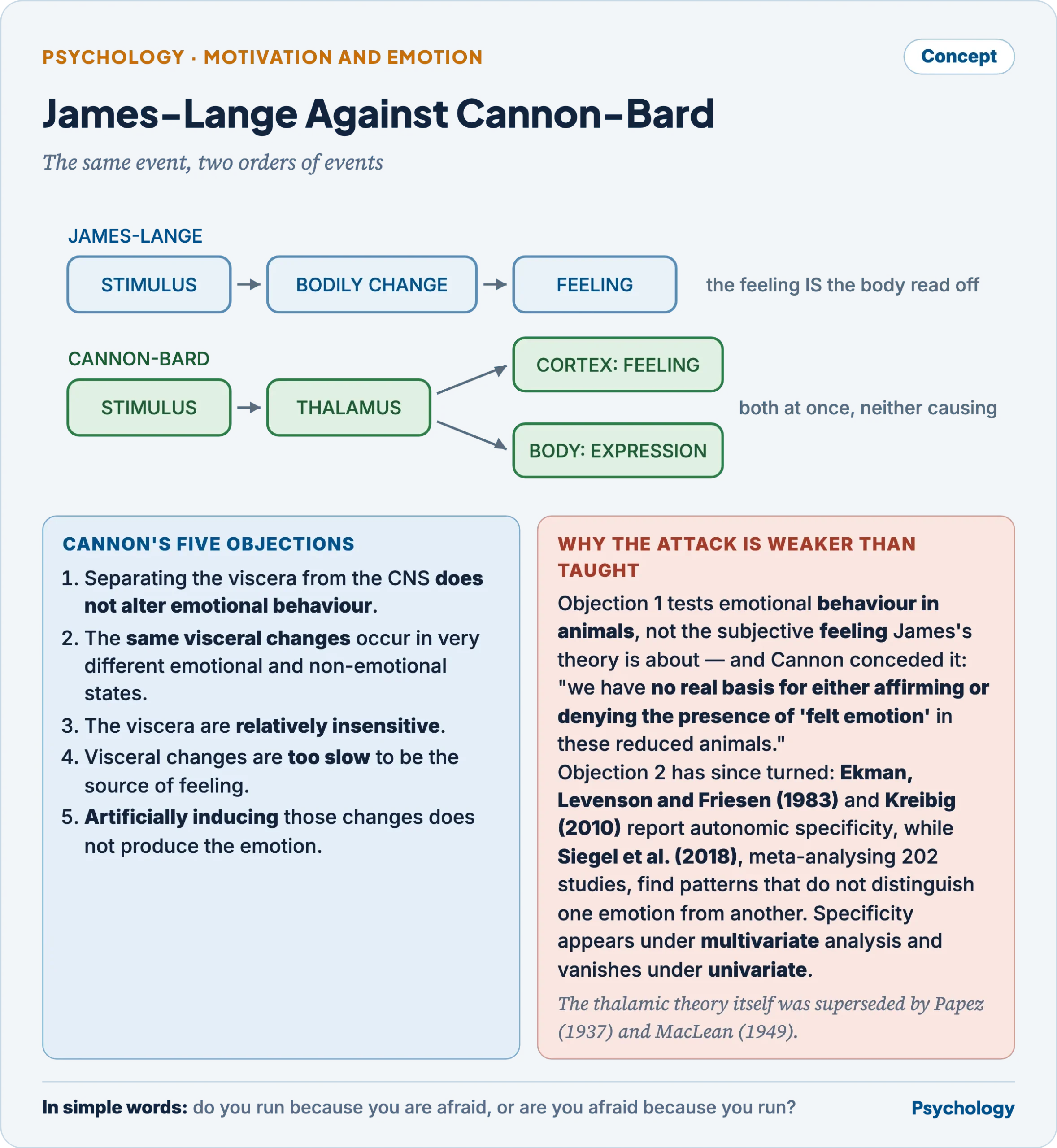
Cannon (1927) mounted the attack that defined the next half-century. His five objections:
- Total separation of the viscera from the central nervous system does not alter emotional behaviour.
- The same visceral changes occur in very different emotional states and in non-emotional states.
- The viscera are relatively insensitive structures.
- Visceral changes are too slow to be a source of emotional feeling.
- Artificial induction of the visceral changes typical of strong emotions does not produce them.
- The evidence — objection 1 rested on Sherrington’s (1900) dogs with spinal transection and vagotomy, and on Cannon’s own sympathectomised cats, which showed “no lessening of the intensity of emotional display”. Objection 5 rested on adrenaline injection producing bodily symptoms without emotion.
- The positive theory — Cannon proposed that emotional expression results from subcortical centres and that thalamic processes are a source of affective experience: sensory input reaches the thalamus, which discharges upward to the cortex, producing the feeling, and downward to the hypothalamus and periphery, producing the bodily change. The two are therefore simultaneous rather than sequential, and the bodily change is a parallel consequence of the feeling rather than its cause. Cannon’s image is that the peripheral sensations are “pale, colorless”, and the thalamic disturbance “contributes glow and color”.
- Bard’s contribution — Bard (1928, 1934) supplied the anatomy with progressive transections in cats: sham rage — a full, coordinated rage display released by trivial stimuli — survived removal of the entire cortex but disappeared when the posterior hypothalamus was disconnected. The rage pattern is therefore organised subcortically, with the cortex supplying inhibition rather than the pattern. The clean division of labour that textbooks attribute to “Cannon–Bard” is this synthesis, not Cannon’s 1927 text, which speaks loosely of “the thalamic region”.
- Is the criticism as decisive as it is taught? No, and Cannon conceded the central point himself. His own words about the denervated animals: “we have no real basis for either affirming or denying the presence of ‘felt emotion’ in these reduced animals”, and his conclusion to the first objection says the operations leave the animals behaving as angrily and as fearfully as ever. Objection 1 therefore tests emotional behaviour in animals, not the subjective feeling James’s theory is about — a point Angell (1916) had made before Cannon, and which Cannon answers rather than refutes.
- Objection 2 has turned, and is contested. Ekman, Levenson and Friesen (1983) found autonomic activity distinguishing not only positive from negative emotions but among the negative ones, and Kreibig (2010), reviewing 134 publications, reported considerable autonomic response specificity. Against them, Siegel and colleagues (2018), meta-analysing 202 studies, found reliable autonomic increases but a pattern of effect sizes that “did not clearly distinguish one emotion category from another”. The asymmetry is methodological: specificity shows up under multivariate pattern analysis and disappears under univariate effect-size analysis.
- The human test of objection 1 ran both ways. Hohmann (1966) interviewed 26 men with spinal cord lesions and found decreases in reported anger, fear and sexual excitement, with the decrease larger the higher the lesion — which supports James. The replications did not hold: Chwalisz, Diener and Gallagher (1988) concluded that the perception of autonomic arousal “may not be necessary” for emotional experience, with their one significant difference running the opposite way, and later work found no reduction in emotional experience in spinal-injured samples. The settled reading is that peripheral feedback modulates the intensity of feeling at most, and that Hohmann’s result is confounded with the severity of the disability itself.
- The thalamic theory is superseded twice over, — anatomically by Papez (1937), who relocated experience to the cortex, and by MacLean (1949, 1952), who introduced the limbic system; and conceptually, in that the thalamus is now treated as a sensory relay rather than the generator of feeling.
Schachter and Singer’s two-factor theory
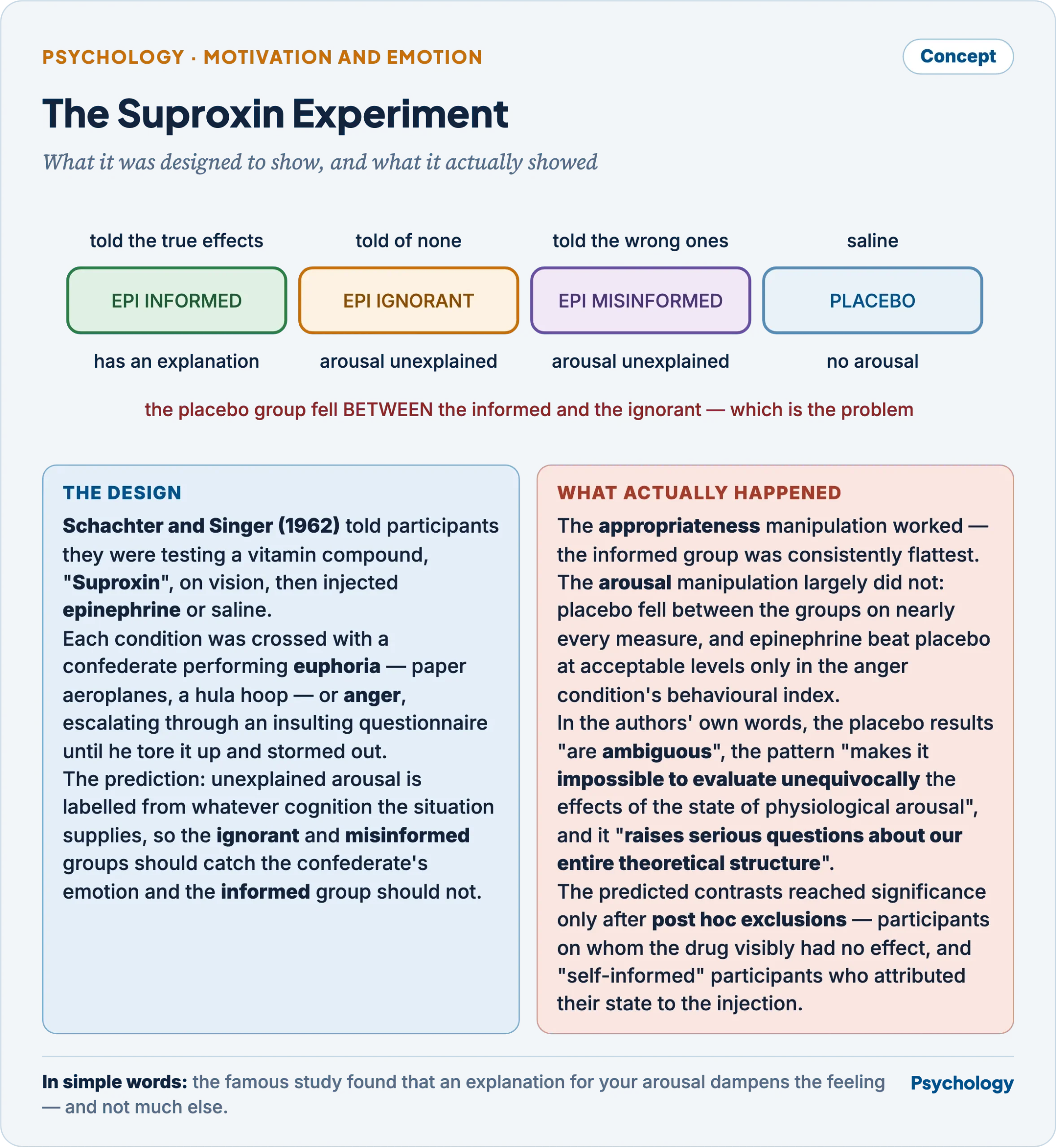
Schachter and Singer (1962) proposed that emotion requires both general physiological arousal and a cognitive label for it, and that where the arousal has no obvious cause the person will label it from whatever cognitions the situation supplies.
- Three propositions. Given arousal with no immediate explanation, a person will label it using available cognitions. Given arousal with an appropriate explanation, no such labelling need arises. Given the same cognitions, a person reacts emotionally only to the extent that they are physiologically aroused.
- The design. Participants were told they were testing a vitamin compound, “Suproxin”, on vision, and were injected with epinephrine or a saline placebo. The epinephrine groups were informed of the true side effects, left ignorant of them, or misinformed (told to expect numbness and itching). Each was then left with a confederate performing either euphoria — flying paper aeroplanes, playing with a hula hoop — or anger, escalating through an insulting questionnaire until he tore it up and stormed out. The misinformed condition was not run with anger.
- What happened. The appropriateness manipulation worked: the informed participants, who could attribute their arousal to the injection, were consistently the least emotional. The arousal manipulation largely did not: the placebo group fell between the ignorant and informed groups on nearly every measure, and the difference between placebo and epinephrine reached significance only in the anger condition’s behavioural measure.
- The authors said so themselves. They wrote that the placebo results “are ambiguous”, that the pattern “makes it impossible to evaluate unequivocally the effects of the state of physiological arousal”, and that it “raises serious questions about our entire theoretical structure”.
- The rescue was post hoc. Participants for whom the epinephrine visibly had no effect were excluded, and so were “self-informed” participants who spontaneously attributed their state to the injection. Only after these exclusions did the predicted contrasts become significant. The exclusions are defensible on the theory’s own logic and they were not planned, which is the standard criticism and the reason the study’s status is contested rather than canonical.
- The precursor — Marañón (1924) had injected adrenaline into patients and found most reporting bodily symptoms with no emotion, and a minority describing what they called “as if” or cold emotions — “I feel as if I were afraid”. Full emotion appeared only when an affectively charged memory was suggested. Arousal without a cognition is not an emotion, which is the two-factor claim in embryo.
- Misattribution of arousal — Dutton and Aron (1974) found men who had crossed a high, swaying suspension bridge produced more sexual imagery in response to a female interviewer, and telephoned her more often, than men on a low stable bridge. The study is more fragile than its fame suggests: men chose their own bridge in the main study, so sensation-seeking is confounded with the manipulation; the source of the arousal was obvious rather than ambiguous, which violates the Schachterian precondition the account requires; and Kenrick, Cialdini and Linder (1979) reported four failures to replicate, in which participants correctly attributed the arousal to the situation.
Appraisal theory
- The claim. Lazarus (1966), elaborated in Lazarus and Folkman (1984), made emotion the product of an evaluation of the event’s significance for one’s own well-being. Primary appraisal asks what is at stake, and yields harm or loss (damage already done), threat (anticipated harm) or challenge (demands one expects to master). Secondary appraisal asks what can be done — what coping options exist and how likely they are to succeed. The emotion follows from the pair.
- Appraisal is not deliberation. Lazarus insisted that appraisal “is not coextensive with consciousness, deliberateness, and rationality” and that emotion generation “is often automatic rather than deliberate”. The frequent objection that appraisal theory makes emotion too intellectual attacks a position he explicitly disowned.
- The film experiments. Lazarus and colleagues (1962, 1964) showed participants films that reliably produce distress — a series of subincision rites, and a workshop-safety film containing fatal industrial accidents — with soundtracks that manipulated the appraisal. A denial commentary (“these accidents were staged”) and an intellectualising commentary (“this is an anthropological study of aboriginal customs”) markedly lowered both self-reported distress and physiological stress measured by heart rate and skin conductance, while a threat commentary raised them. Lazarus and Alfert (1964) found the commentary more effective still when played before the film began — the same stimulus, different emotion, with only the appraisal changed.
- A complication. In the same work, participants high on a denial measure reported less affective disturbance while showing greater autonomic reaction, which is a dissociation between the components and a caution against reading either measure as the emotion.
- Objection. Appraisals are usually measured by self-report after the emotion, which makes the causal direction hard to establish; the number and identity of appraisal dimensions differ between theorists with no agreed resolution; and if appraisal can be unconscious and automatic, the theory becomes difficult to distinguish empirically from a non-cognitive account.
The Zajonc–Lazarus debate
- Zajonc (1980) argued for the primacy of affect: affective reactions “can occur without extensive perceptual and cognitive encoding”, and preferences “need no inferences”. His evidence was the mere exposure effect — participants preferred stimuli shown to them earlier even when they could not recognise having seen them — and his structural claim was that affect and cognition are separate systems that interact.
- Lazarus (1982, 1984) replied that cognition in his sense means meaning-appraisal, not deliberate thought, and on that definition it is both necessary and sufficient for emotion; even simple organisms make elemental evaluations of harm, threat and benefit.
- The dispute is definitional, and Zajonc conceded as much: Lazarus “includes purely sensory processes in his definition of cognitive functions, whereas others reserve the term for symbolic processes”. What survives the terminology is the empirical point that evaluative responses can precede identification.
Neural and constructionist accounts
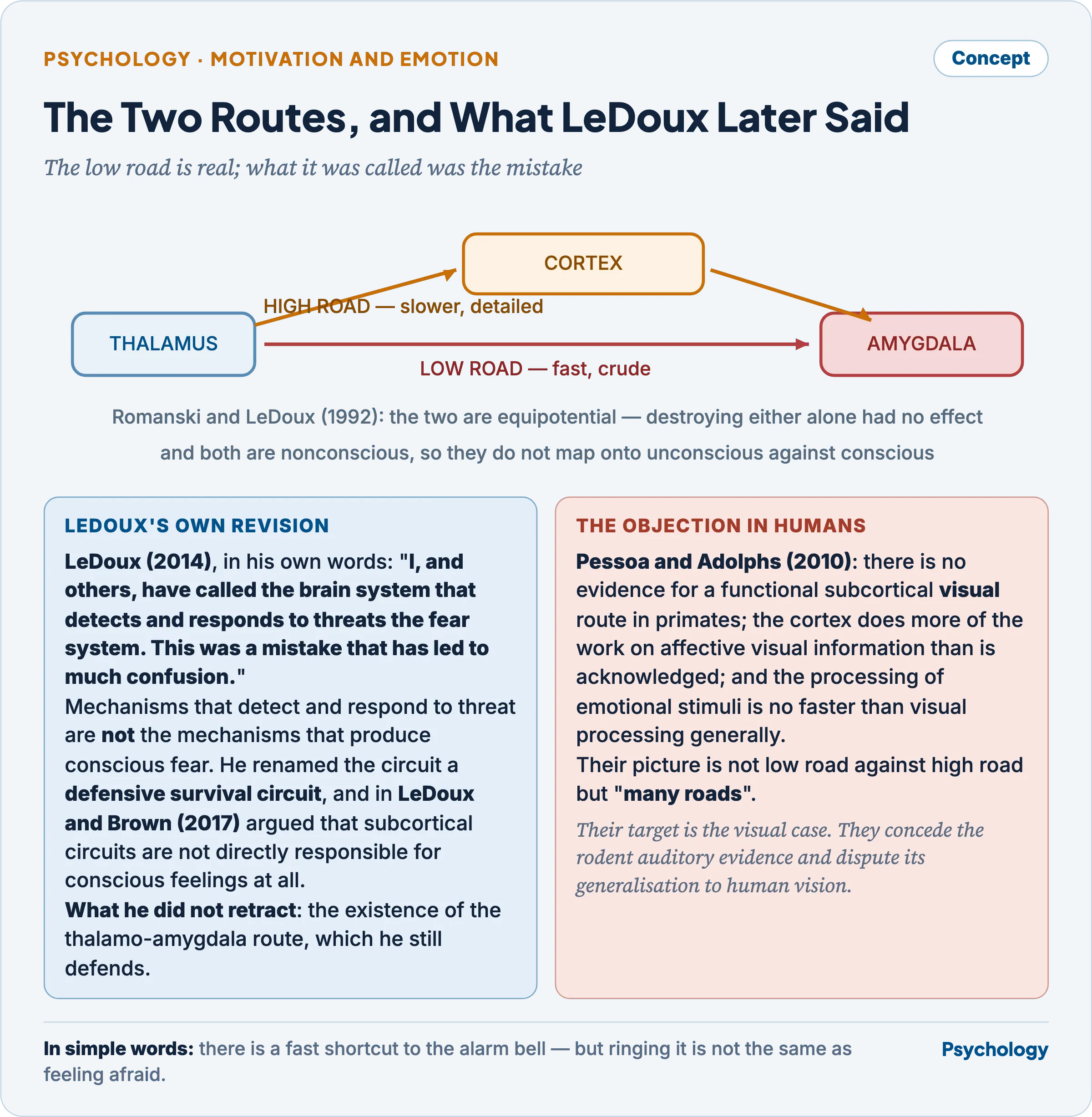
- LeDoux’s two routes came from work on auditory fear conditioning in rats established a subcortical pathway from thalamus directly to amygdala alongside the thalamo-cortico-amygdala route — the low road and high road of LeDoux (1996), the first fast and crude, the second slower and detailed. An important detail usually lost: Romanski and LeDoux (1992) found the two routes equipotential — destroying either alone had no effect on conditioning, and only destroying both disrupted it.
- LeDoux’s own revision, which textbooks omit. In LeDoux (2014) he wrote: “I, and others, have called the brain system that detects and responds to threats the fear system. This was a mistake that has led to much confusion.” Mechanisms that detect and respond to threat are not the mechanisms that produce conscious fear; he renamed the circuit a defensive survival circuit, and in LeDoux and Brown (2017) argued that subcortical circuits are not directly responsible for conscious feelings at all. He also revised the contrast itself: both routes are nonconscious, so they do not map onto unconscious against conscious processing. He has not abandoned the thalamo-amygdala route’s existence, which is a distinction worth keeping straight.
- The objection to the low road in humans. Pessoa and Adolphs (2010) argued there is no evidence for a functional subcortical visual route in primates, that cortical processing of affective visual information is faster and larger than acknowledged, and that the picture should be of “many roads” rather than two. Their target is the visual case; they concede the rodent auditory evidence and dispute its generalisation.
- Constructed emotion. Barrett (2017) argues that emotions are not natural kinds with dedicated circuits. An instance of emotion is constructed when a predictive brain categorises interoceptive and sensory input — core affect, meaning valence plus arousal — using learned, culturally transmitted emotion concepts; emotion, cognition and perception share the same domain-general machinery, and an emotion category is a population of variable instances rather than a prototype.
- Its strongest support. Barrett and colleagues (2019), reviewing the evidence that facial movements reveal emotion against four criteria — reliability, specificity, generalisability and validity — concluded that the hypothesised configurations occur with weak reliability, that specificity is largely unknown and evidence for it lacking in almost all research domains, and that the strongest supporting data “does not show robust generalizability”. Their headline conclusion: “it is not possible to confidently infer happiness from a smile, anger from a scowl, or sadness from a frown”.
- Objection. It explains variability well and the reliable regularities less well; conceptual knowledge is invoked to do a great deal of work without being independently measured; and it is easier to state what the theory denies than what it predicts.
Comparing the theories
| James–Lange | Cannon–Bard | Two-factor | Appraisal | Constructionist | |
|---|---|---|---|---|---|
| Order of events | Stimulus → bodily change → feeling | Stimulus → thalamus → feeling and bodily change together | Arousal → label → emotion | Stimulus → appraisal → emotion | Core affect + concept → categorised instance |
| Bodily change is | The cause of feeling | A parallel consequence | Necessary but undifferentiated | A component of the response | Input to be categorised |
| Emotions are differentiated by | Different bodily patterns | Different thalamic patterns | The cognitive label | The appraisal | The concept applied |
| Key evidence | Interoception; spinal-injury reports | Sham rage; denervation studies | The Suproxin experiment | The film-soundtrack studies | Weak specificity of expression and physiology |
| Main weakness | Autonomic specificity is contested | Tests behaviour, not feeling; thalamus superseded | The placebo condition failed | Direction of causation; appraisal dimensions unagreed | Hard to falsify; underexplains regularity |
Criticisms and limitations
- The theories are not strictly rivals. They answer different questions — about the sufficiency of bodily feedback, about neural architecture, about what differentiates one emotion from another — and the field’s habit of lining them up as competitors obscures that.
- The classic evidence is weaker than its status. Cannon’s animal studies address behaviour rather than feeling, the Schachter–Singer placebo condition did not come out as predicted, and the Dutton and Aron bridge study has failed to replicate under controlled conditions.
- Arousal is not one thing. Claims about “undifferentiated arousal” and about specificity turn on which measures are taken and how they are analysed.
- Self-report carries the identification of the emotion in nearly all of this research, which means the theories are tested largely against what people say they feel.
- Culture is under-theorised in the classical accounts and central to the constructionist one, which is a large part of why that debate is now the live one.
- Little of this literature is Indian. The appraisal and construction accounts both predict that the emotion lexicon and the available concepts matter — a prediction the Indian material on emotion terms is well placed to test and has not been used to test.
Previous Year Questions
- 2024What are the main differences between James-Lange and Cannon-Bard theories of emotion? Explain.
- 2014What is the role of cognitive factors in determining emotional functioning? Discuss.
- 2010Discuss the role of cognition in experiencing emotion in the light of experimental studies.
- 2001Elaborate the statement that James’s theory of emotion, followed by its criticism by Cannon, stimulated a great deal of empirical research while Lange’s theory of emotion influenced the activation theories of emotion.