

Psychological and physiological basis of motivation and emotion.
Official Syllabus: Paper I · Unit 9 Motivation and Emotion
“Motivation is the process of arousing action, sustaining the activity in progress, and regulating the pattern of activity.”
— P. T. Young (1961)
Motivation is never observed. What is observed is that an organism deprived of food searches, that the search stops when food is found, and that the same organism fed will walk past the food it was searching for an hour earlier. Motivation is the construct inferred to explain that pattern, and the physiological basis of motivation is the attempt to find, for each such pattern, the bodily state and brain circuit that produces it.
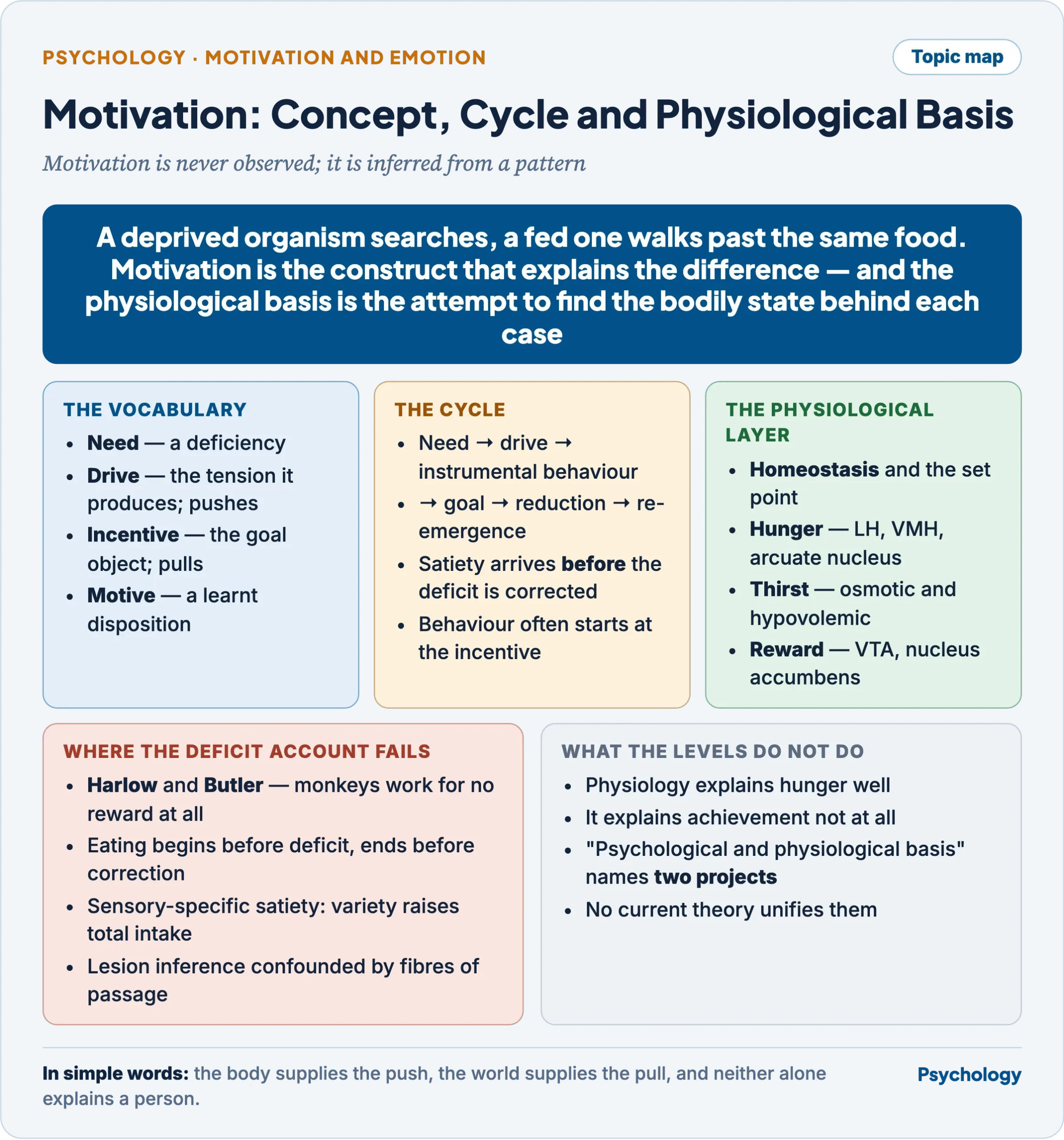
The concept: need, drive, incentive and motive
The vocabulary is used loosely in ordinary speech and precisely in the literature, and the distinctions carry the whole explanation.
- Need — a state of deficiency, physiological or psychological. A tissue deficit of water is a need whether or not the organism is aware of it.
- Drive — the state of internal tension or arousal that a need produces, and which pushes the organism into activity. Introduced as a technical term by Woodworth (1918) to replace the instinct vocabulary.
- Incentive — an external object or event that pulls the organism toward or away from it. Food is an incentive; hunger is a drive. Drives push from inside, incentives pull from outside, and most behaviour is the joint product.
- Motive — a learnt, relatively enduring disposition to pursue a class of goal, such as the achievement motive. Motives are inferred from consistency across situations.
- Motivational strength is not simply the size of the deficit: a thirsty animal with no water available shows no drinking behaviour, and a satiated one shown a highly palatable food eats again.
Classifications of motive.
- Primary (biological) motives — unlearnt, tissue-based, common to the species: hunger, thirst, sleep, temperature regulation, pain avoidance, elimination, sex. Sex is conventionally listed here although it serves species survival rather than individual survival.
- Secondary (psychosocial) motives — learnt and socially shaped: achievement, power, affiliation, approval, security, curiosity.
- General (unlearnt but non-homeostatic) motives — curiosity, exploration, manipulation, activity and contact comfort. They are neither tissue deficits nor learnt, and they are the group that the deficit theories could not accommodate.
- Intrinsic and extrinsic motivation cuts across the above and is treated separately, since the question of what happens when an intrinsically motivated activity is rewarded has its own literature.
Salient features of motivated behaviour
- It is cyclical. Need, activity, goal attainment, quiescence, and the re-emergence of need. Nothing about motivation is a single event.
- It is goal-directed, which is what distinguishes it from reflex and from random activity: the behaviour varies while the endpoint stays fixed. A rat whose usual route to food is blocked takes another, which is why the goal and not the movement is the unit of description.
- It is energising — it raises general activity level — and directive, selecting among possible actions. Early theory treated these as separable, drive supplying energy and habit supplying direction.
- It is selective and persistent. A motivated organism attends to goal-relevant stimuli and ignores others, and resumes interrupted activity.
- It is inferred, not observed, from the antecedent condition and the consequent behaviour together. Inferring a motive from the behaviour it was invoked to explain is the circularity that destroyed instinct theory.
- It varies in strength, and the relation of strength to performance is not linear.
- Motives can conflict and be unconscious, so the strongest motive is not always the one the person reports.
The motivational cycle
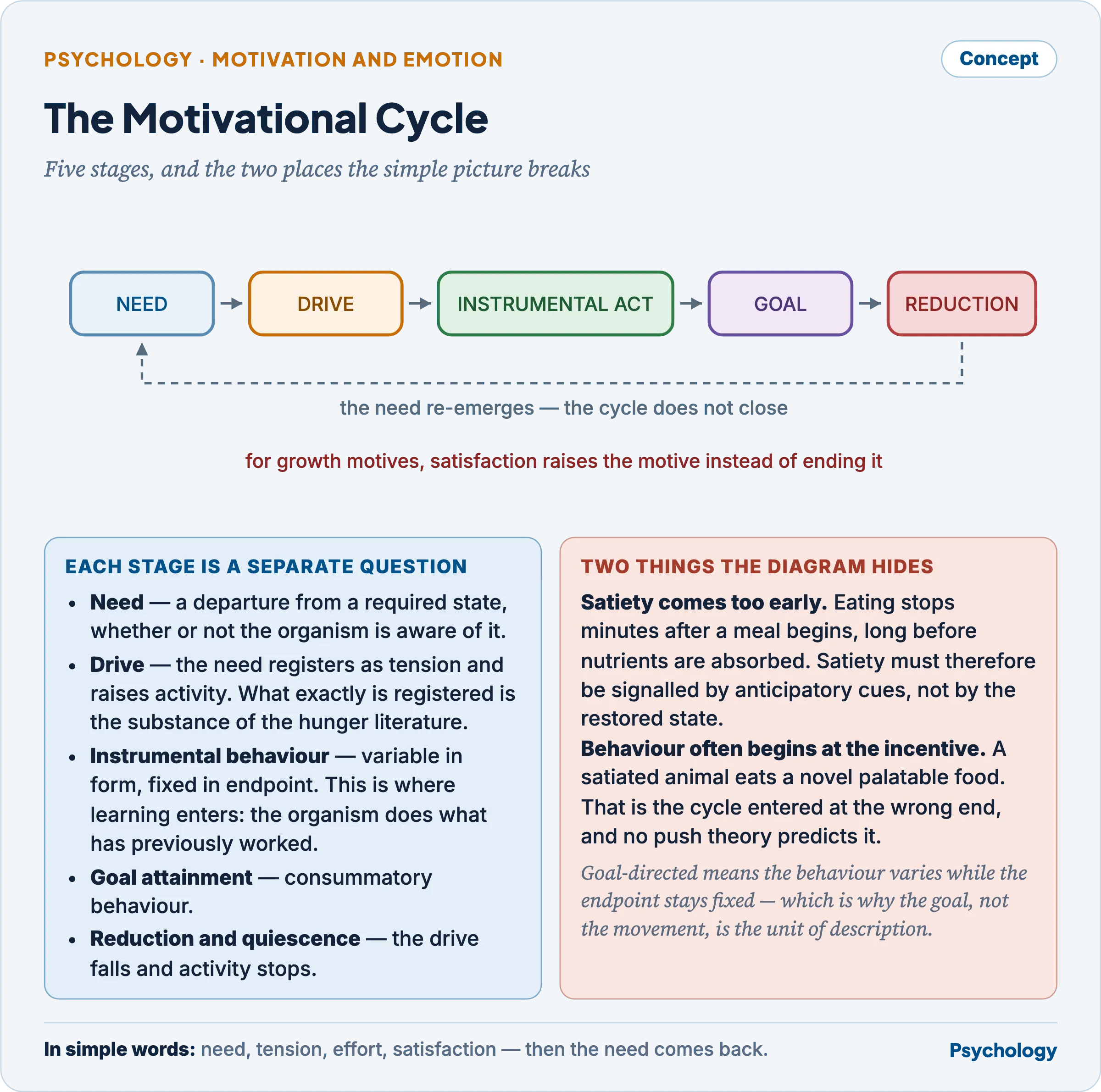
The cycle is the standard analytic frame and each stage is a distinct empirical question.
- Need (deficiency) — a departure from the body’s required state, or an unmet psychological requirement.
- Drive (arousal) — the need registers as tension and raises activity. Whether the registering is of the deficit itself or of a signal correlated with it is the substance of the hunger literature.
- Instrumental behaviour — goal-directed activity, variable in form, directed at the incentive. This is where learning enters: the organism performs what has previously worked.
- Goal attainment (consummatory behaviour) — the incentive is reached and consumed.
- Need reduction and quiescence — the drive falls and activity ceases.
- Re-emergence. The cycle is not closed: satisfaction is temporary for biological motives and, for growth motives, satisfaction can raise rather than lower the motive.
Two complications the simple cycle hides. Consummatory behaviour often stops before the deficit is corrected — eating ends minutes after a meal begins, long before nutrients are absorbed — so satiety must be signalled by anticipatory cues rather than by the restored state. And behaviour frequently begins with the incentive rather than the need, which is a cycle entered at the wrong end.
The psychological basis of motivation
The physiological account explains hunger well and achievement not at all, which is why the psychological layer is not optional.
- Cognitive determinants. What a person does depends on what they expect. Vroom (1964) made motivation the multiplicative product of expectancy (effort will produce performance), instrumentality (performance will produce the outcome) and valence (the outcome is wanted) — so motivation collapses if any one term approaches zero. Goals, self-efficacy beliefs and causal attributions all operate here.
- Learnt motives. Achievement, power and affiliation are acquired through socialisation, which is why their strength varies across families and cultures while hunger does not.
- Unconscious determinants. The psychoanalytic claim is that the behaviour’s stated reason and its actual motive differ, and that defence mechanisms stand between them.
- Growth motivation. The humanistic claim is that a motive can be for becoming rather than for correcting a deficiency, which no deficit model generates.
- Need-based accounts. Murray (1938) located motivation in a taxonomy of needs interacting with environmental press, the fit between them being need–press congruence. Deci and Ryan identified autonomy, competence and relatedness as basic psychological needs whose satisfaction is required for optimal functioning.
- Approach and avoidance systems. Gray (1991) proposed a behavioural activation system (BAS), sensitive to reward signals and generating approach and positive affect, and a behavioural inhibition system (BIS), sensitive to punishment signals and generating inhibition, avoidance and anxiety. The two are dissociable and map onto left and right frontal asymmetry, which is where the psychological and physiological accounts meet.
Homeostasis and the homeostatic models
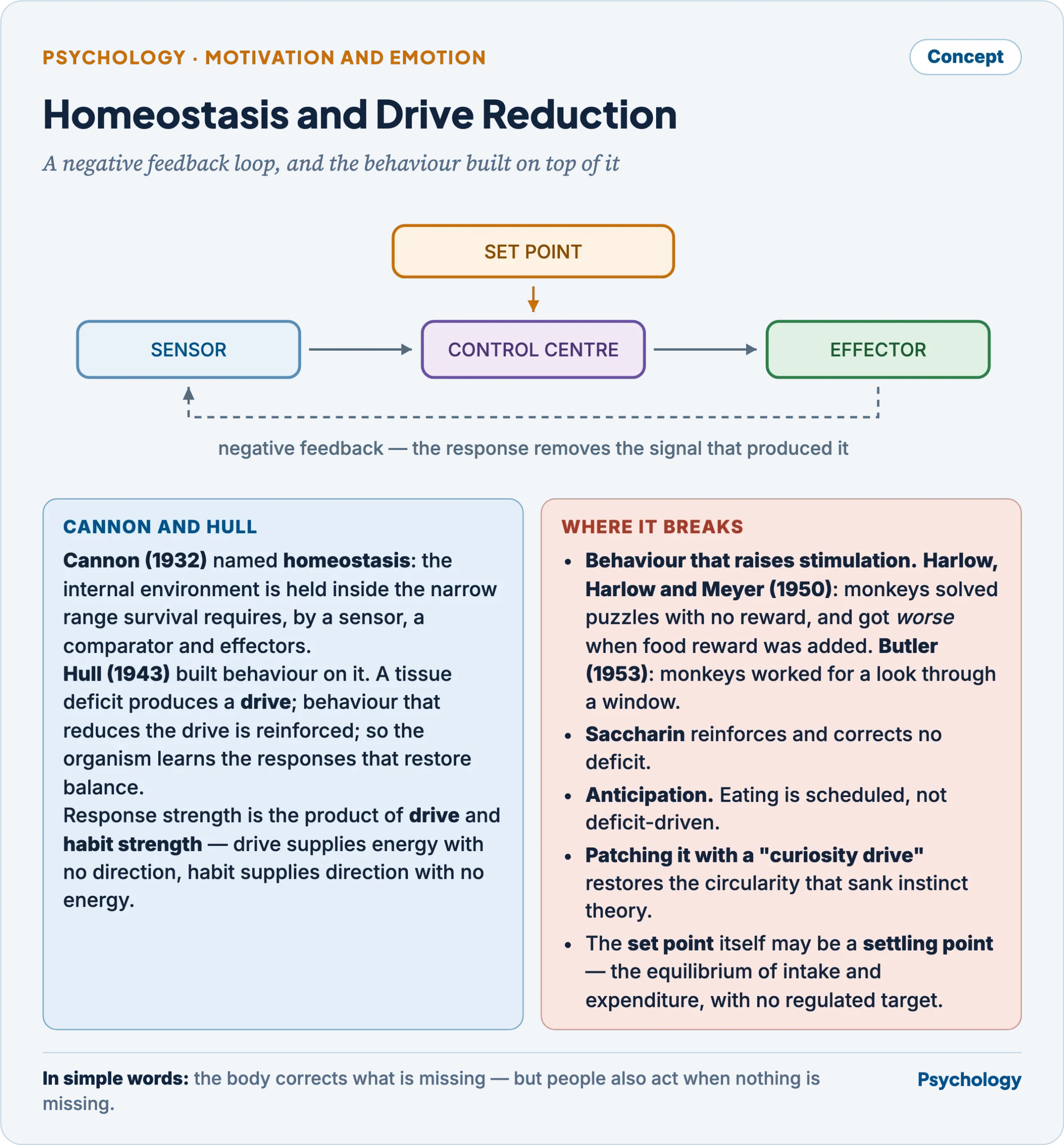
Cannon (1932) named homeostasis — the maintenance of the internal environment within the narrow range that survival requires. A homeostatic system needs three components: a sensor detecting departure from the set point, a control centre comparing the reading to the set point, and effectors restoring the value. Correction is by negative feedback: the response reduces the signal that produced it.
Hull (1943) built a theory of behaviour on it. A tissue deficit produces a drive that energises behaviour; behaviour that reduces the drive is reinforced; the organism therefore learns the responses that restore homeostasis. Hull’s formulation made performance the product of drive and habit strength, so drive supplies no direction of its own, only energy. Drive-reduction theory is the strongest version of the claim that all motivation is deficit correction.
What the homeostatic models explain, and what they do not:
- They handle thirst, temperature regulation and oxygen debt accurately, predicting what Hull’s (1943) own deprivation experiments found — that hours of deprivation raise both activity and consumption, and that consumption ends them.
- They fail for non-homeostatic motives. Harlow, Harlow and Meyer (1950) found monkeys solving mechanical puzzles repeatedly with no reward and with performance impaired by adding food reward; Butler (1953) found monkeys working for nothing but the chance to look out of a window. Drive reduction cannot explain behaviour whose consequence is to increase stimulation.
- They fail for anticipatory behaviour. Animals and people eat on schedule, before any deficit, and stop before any deficit is corrected.
- The set point itself is contested: a settling point account explains stable body weight as the equilibrium of intake and expenditure without requiring a regulated target, and it accounts better for weight change under altered food environments.
Hunger: the physiological basis
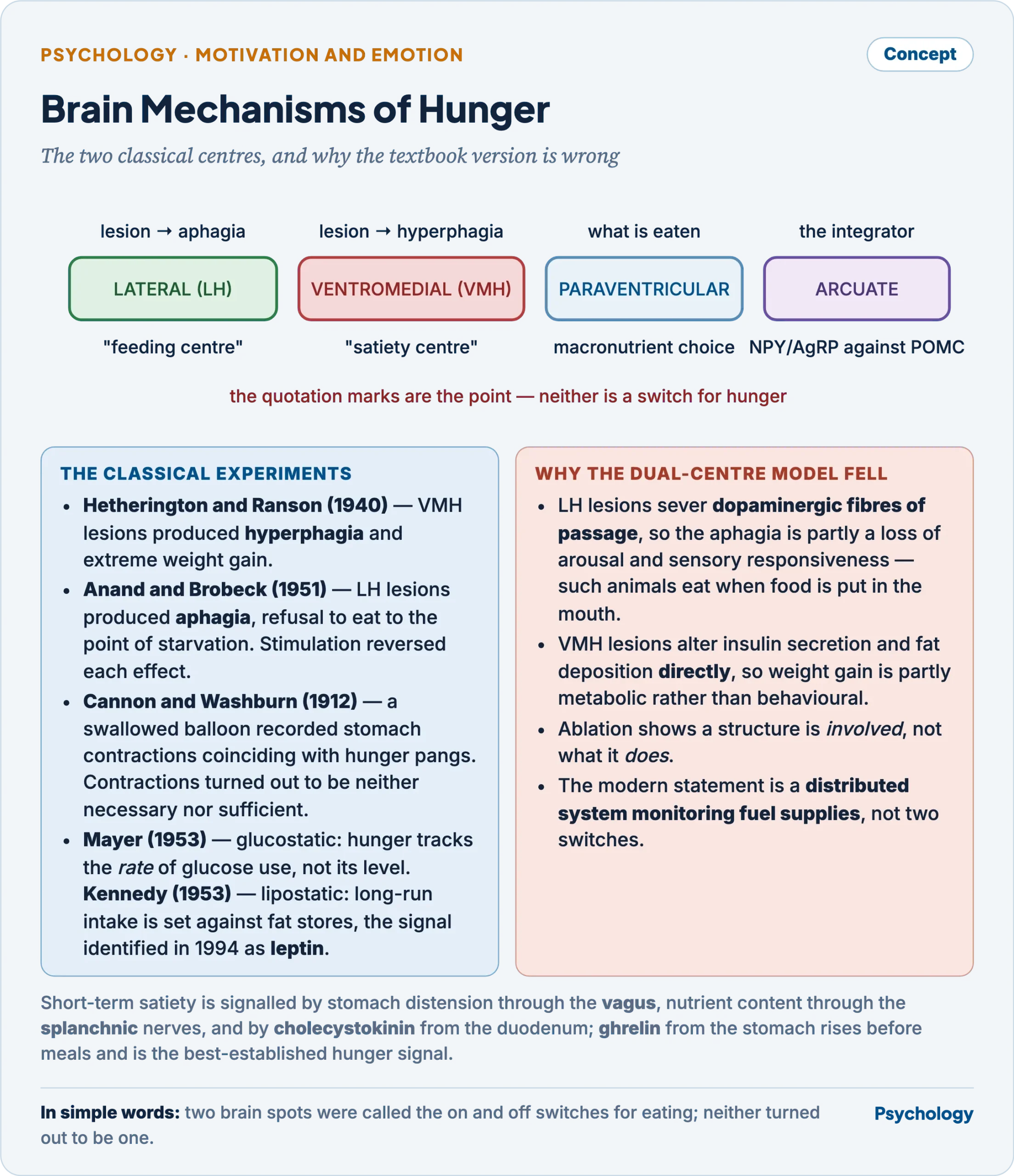
- Peripheral cues. Cannon and Washburn (1912) had a participant swallow a balloon that recorded stomach contractions, and found contractions coinciding with reported hunger pangs. The inference that contractions cause hunger did not survive: animals and patients whose stomachs are removed or whose vagus is cut still regulate intake, so gastric contraction is neither necessary nor sufficient. It remains a genuine signal of a correlated state.
- Glucostatic hypothesis (Mayer, 1953) — hunger tracks the rate of glucose utilisation rather than blood glucose level, detected by glucoreceptors in the liver and hypothalamus. This explains why diabetics with high blood glucose feel hungry.
- Lipostatic hypothesis (Kennedy, 1953) — long-term intake is regulated against stored fat. The signal was identified in 1994 as leptin, secreted by adipose tissue in proportion to fat mass and acting on the hypothalamus; leptin-deficient mice are massively obese and leptin injection corrects them, while most human obesity involves leptin resistance rather than deficiency, which is why leptin failed as a treatment.
- Satiety signals. Distension of the stomach wall signalled by the vagus nerve; nutrient content signalled by the splanchnic nerves; and cholecystokinin (CCK), released by the duodenum when food arrives, which reduces meal size when administered and is the clearest short-term satiety hormone. Ghrelin, from the stomach, rises before meals and is the best-established hunger signal.
- The hypothalamic centres. Hetherington and Ranson (1940) produced hyperphagia and extreme weight gain by lesioning the ventromedial hypothalamus (VMH); Anand and Brobeck (1951) produced aphagia — refusal to eat to the point of starvation — by lesioning the lateral hypothalamus (LH). Stimulation reversed each effect. The dual-centre reading followed: LH as feeding centre, VMH as satiety centre.
- The revision. The dual-centre model is now known to be too simple, and this matters more than the textbook version of it. LH lesions damage dopaminergic fibres passing through, so the aphagia is partly a general failure of arousal and sensory responsiveness rather than a loss of hunger — such animals eat normally when food is placed in the mouth. VMH lesions disrupt the ventral noradrenergic bundle and alter insulin secretion and fat deposition directly, so weight gain is partly metabolic rather than behavioural. The paraventricular nucleus governs macronutrient selection, and the arcuate nucleus, with its opposing NPY/AgRP and POMC neuron populations, is now treated as the principal integrator. The modern statement is of a distributed system monitoring fuel supplies, not of two switches.
Environmental and learnt determinants of hunger. The physiological account is incomplete, and the gap is large enough to be the main finding.
- Palatability and sensory-specific satiety — appetite for the food just eaten declines while appetite for a different food does not, so variety increases total intake. This alone shows that intake is not regulated against a deficit.
- Portion size, availability and unit size raise consumption without raising reported hunger, an effect Wansink demonstrated repeatedly — although several of those demonstrations were later retracted for data problems, so the effect is better supported by the wider literature than by his studies.
- Learnt cues. Time of day, places, and company all become conditioned signals for eating; classically conditioned anticipatory insulin release is measurable before a scheduled meal.
- Externality. Schachter (1971) argued that obese eaters are relatively more responsive to external food cues and less to internal state than normal-weight eaters — a claim later qualified, since the external-internal difference turns out to be a dimension of eating style found at all weights rather than a correlate of obesity.
- Stress and affect shift intake in both directions, and the shift is towards energy-dense palatable food.
Thirst and the other biological motives
- Thirst has two distinct causes, the double-depletion hypothesis. Cellular-dehydration (osmotic) thirst follows a rise in the osmotic pressure of extracellular fluid drawing water out of cells; it is detected by osmoreceptors in the organum vasculosum of the lamina terminalis (OVLT) adjoining the third ventricle, which triggers drinking and the release of vasopressin (ADH) to conserve water. Hypovolemic thirst follows a fall in blood volume, detected by baroreceptors and by the subfornical organ; falling pressure makes the kidney release renin, generating angiotensin II, which acts on the brain to induce drinking and a craving for salt. The two causes predict different behaviour, and animals in hypovolemic thirst prefer saline to pure water.
- Sexual motivation differs from the other biological motives on three counts: it is not required for individual survival, it is not initiated by a tissue deficit, and in humans it is driven far more by incentives and cognition than by hormone level. Hormones are necessary but permissive: in males, testosterone above a threshold enables sexual behaviour and further increases do not raise it proportionally; in human females the relation of the menstrual cycle to desire is weak and inconsistent, unlike the estrus of lower species, where high oestrogen controls receptivity directly. The medial preoptic area of the hypothalamus governs male copulatory behaviour and the ventromedial nucleus female receptivity.
- Aggression is regulated by the hypothalamus and the periaqueductal grey, modulated by the amygdala, and inhibited by the ventromedial prefrontal cortex, whose reduced activity is associated with impulsive violence. Low central serotonin turnover is the most consistent neurochemical correlate of impulsive aggression; testosterone correlates with aggression across species, but in humans the correlation is modest and bidirectional, since winning raises testosterone as much as testosterone produces winning.
- Nurturance is governed substantially by oxytocin and prolactin, which is the clearest case of a social motive with a direct hormonal basis.
The reward system
- Olds and Milner (1954) found rats would press a lever thousands of times an hour for electrical stimulation of the septal area and medial forebrain bundle, to the exclusion of food. The discovery established that motivation has a dedicated neural substrate rather than being only deficit correction.
- The pathway is the mesolimbic dopamine system: cell bodies in the ventral tegmental area (VTA) projecting to the nucleus accumbens, amygdala and prefrontal cortex. Every drug of addiction increases dopamine in the nucleus accumbens.
- The important correction. Dopamine was initially read as the pleasure signal. Berridge and Robinson showed it is not: dopamine-depleted animals still show normal hedonic reactions to sweet taste — they still like it — but will not work for it. Dopamine codes incentive salience, the wanting, and liking depends on opioid systems. This dissociation of wanting from liking is the basis of the incentive-sensitisation account of addiction, in which craving grows while pleasure does not.
- Dopamine neurons fire to reward prediction error — better than expected, not reward as such — which makes the system a learning signal rather than a hedonic readout.
Criticisms and limitations
- Circularity is the standing danger. A motive inferred from the behaviour it explains adds nothing, which is what emptied instinct theory; the requirement is an independent specification of the antecedent condition.
- Drive-reduction theory fails as a general theory. Exploration, curiosity, manipulation, play, sensation-seeking and anticipatory eating all increase stimulation or occur without deficit, and the attempt to rescue the theory by positing a “curiosity drive” restores the circularity.
- Lesion inference is weaker than it looks. Damage to a nucleus damages fibres of passage, and ablation shows that a structure is involved, not what it does. Much of the classical hypothalamic story has been revised on exactly this ground.
- Animal models transfer imperfectly. The human case is dominated by cognitive and social determinants that the rat preparation is designed to exclude.
- Homeostasis models regulation, not choice. It cannot say why a person skips a meal to finish work, which is the normal human case.
- The levels are not integrated. The physiological literature on hunger and the psychological literature on achievement are both strong and are not parts of one theory; “psychological and physiological basis” names two projects rather than one, and no current account unifies them.
Previous Year Questions
- 2026What do you mean by ‘motivational cycle’? Analyze and answer with reference to psychological and physiological basis of motivation.
- 2023What do you understand by psychological and physiological basis of motivation? Discuss them giving suitable examples.
- 2019How do environmental factors determine the sensation of hunger? Illustrate with examples.
- 2016Explain motivational concepts with reference to homeostatic models.
- 2015Discuss the brain mechanisms underlying hunger motive.
- 2003“Motivation is a goal-directed behaviour.” Discuss the statement highlighting the steps involved in the process of motivation.
- 2000Illustrate and discuss the salient features of motivated behaviour.
- 1999State and evaluate the Drive-reduction theory of motivation. Has it any relevance to homeostasis?