

Factors influencing decision making and judgment; Recent trends.
Official Syllabus: Paper I · Unit 8 Thinking and Problem Solving
“People rely on a limited number of heuristic principles which reduce the complex tasks of assessing probabilities to simpler judgmental operations.”
— Amos Tversky and Daniel Kahneman (1974), in the paper that founded the field
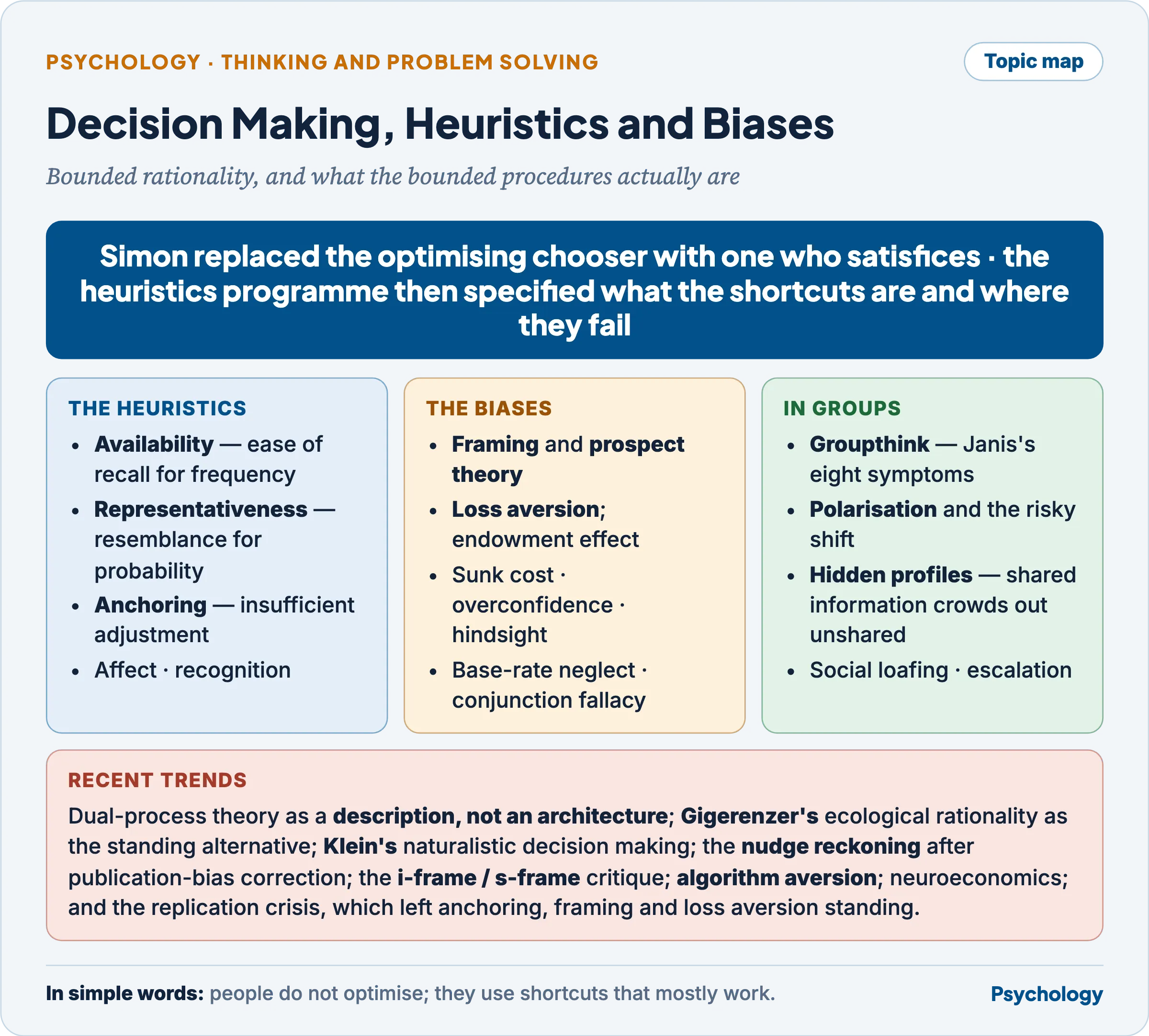
Decision making is choosing among alternatives under uncertainty; judgement is the estimation on which the choice rests. Classical economics assumed both were optimal — that people hold consistent preferences and maximise expected utility. Herbert Simon replaced this with bounded rationality: real decision makers have limited information, limited computation and limited time, and therefore satisfice, accepting the first option that meets a threshold rather than searching for the best. The heuristics-and-biases programme then specified what the bounded procedures are and where they go wrong.
The major heuristics
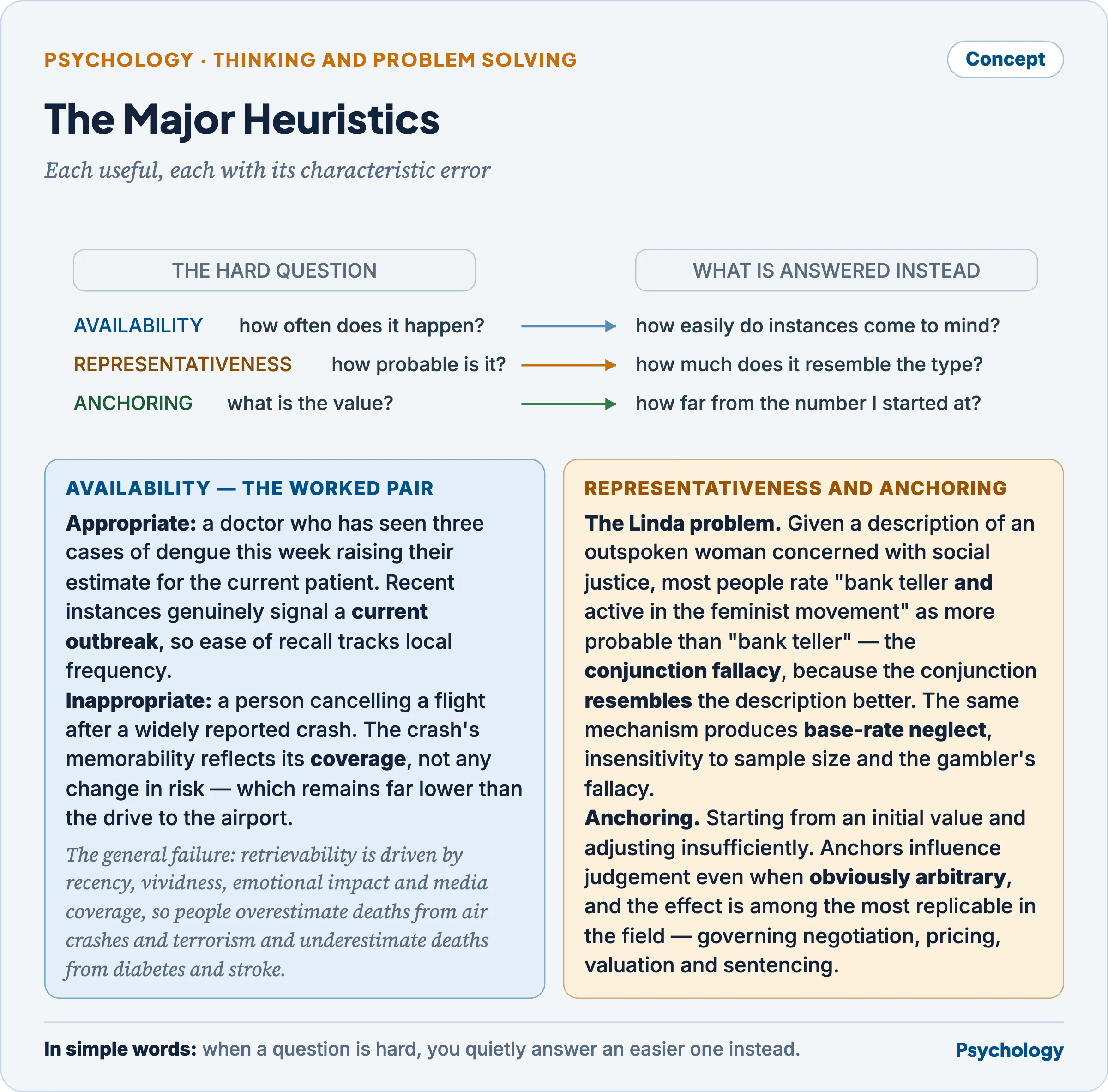
A heuristic is a mental shortcut that substitutes an easy question for a hard one. Each is useful, and each produces a characteristic error.
- Availability. Judging the probability of an event by how easily instances come to mind. The substituted question is “how readily can I recall this?” for “how often does it occur?”
- It works where frequency genuinely drives retrievability, which it often does: common things are encountered more and so recalled more easily.
- It fails where retrievability is driven by something else — recency, vividness, emotional impact or media coverage. People overestimate deaths from air crashes, terrorism, shark attacks and homicide, and underestimate deaths from diabetes, stroke and road accidents, in a pattern that tracks news coverage rather than statistics.
- A worked pair, since the contrast is the point. Appropriate: a doctor who has seen three cases of dengue this week raising their estimate of dengue in the current patient — recent instances genuinely signal a current outbreak, so ease of recall tracks local frequency. Inappropriate: a person who cancels a flight after a widely reported crash — the crash’s memorability reflects its coverage, not any change in the risk of flying, which remains far lower than the drive to the airport.
- Tversky and Kahneman’s demonstration: asked whether English words more often begin with k or have k as the third letter, most people say the first, because words beginning with k are easier to retrieve. Words with k third are in fact about twice as common.
- Representativeness. Judging probability by how much something resembles a prototype.
- The Linda problem is the standard demonstration: given a description of a woman who is outspoken and concerned with social justice, most people rate “Linda is a bank teller and active in the feminist movement” as more probable than “Linda is a bank teller”. This is the conjunction fallacy — a conjunction cannot be more probable than either of its parts — and it occurs because the conjunction resembles the description better.
- Base-rate neglect is the same mechanism: told that a person is described as shy and tidy and asked whether they are a librarian or a farmer, people ignore how many of each there are.
- It also produces insensitivity to sample size, the gambler’s fallacy, and misjudgement of randomness, since a short random sequence does not look representative of randomness.
- Anchoring and adjustment. Starting from an initial value and adjusting, with the adjustment reliably insufficient. Anchors influence judgement even when they are obviously arbitrary — a spun wheel, an irrelevant number — and the effect is among the most replicable in the field. It governs negotiation, pricing, valuation and sentencing.
- The affect heuristic. Judging by the feeling an option evokes, which produces the systematic finding that activities judged beneficial are also judged low-risk and vice versa, although benefit and risk are logically independent.
- The recognition heuristic. Where one of two options is recognised and the other is not, infer that the recognised one has the higher value on the criterion. Surprisingly accurate in domains where recognition correlates with the criterion, and the basis of the less-is-more effect, in which people who know less sometimes judge better.
Framing, and the other influences on choice
- Framing. Logically equivalent descriptions produce opposite choices. In the Asian disease problem, a programme described as “saving 200 of 600 lives” is preferred, while the identical outcome described as “400 of 600 will die” is rejected in favour of a gamble. Prospect theory explains this: people evaluate outcomes as gains and losses from a reference point rather than as final states; the value function is concave for gains and convex for losses, producing risk aversion for gains and risk seeking for losses; and losses loom larger than equivalent gains — loss aversion. The reference point is set by the framing, so changing the frame changes the domain and therefore the risk attitude.
- Loss aversion also produces the endowment effect, in which people demand more to give up an object than they would pay to acquire it, and status quo bias.
- Sunk-cost effect — continuing to invest because of what has already been spent, which is irrelevant to future consequences.
- Overconfidence, in judgement of one’s own accuracy, which is pervasive and largest where competence is lowest.
- Hindsight bias — “I knew it all along” — which corrupts learning from outcomes by making past uncertainty invisible.
- Emotion and affect, including incidental mood unrelated to the decision.
- Time pressure, cognitive load and fatigue, which push choice toward heuristic processing.
- Individual and cultural differences in risk tolerance, time preference and the weight given to collective consequences.
Group decision making, and its errors
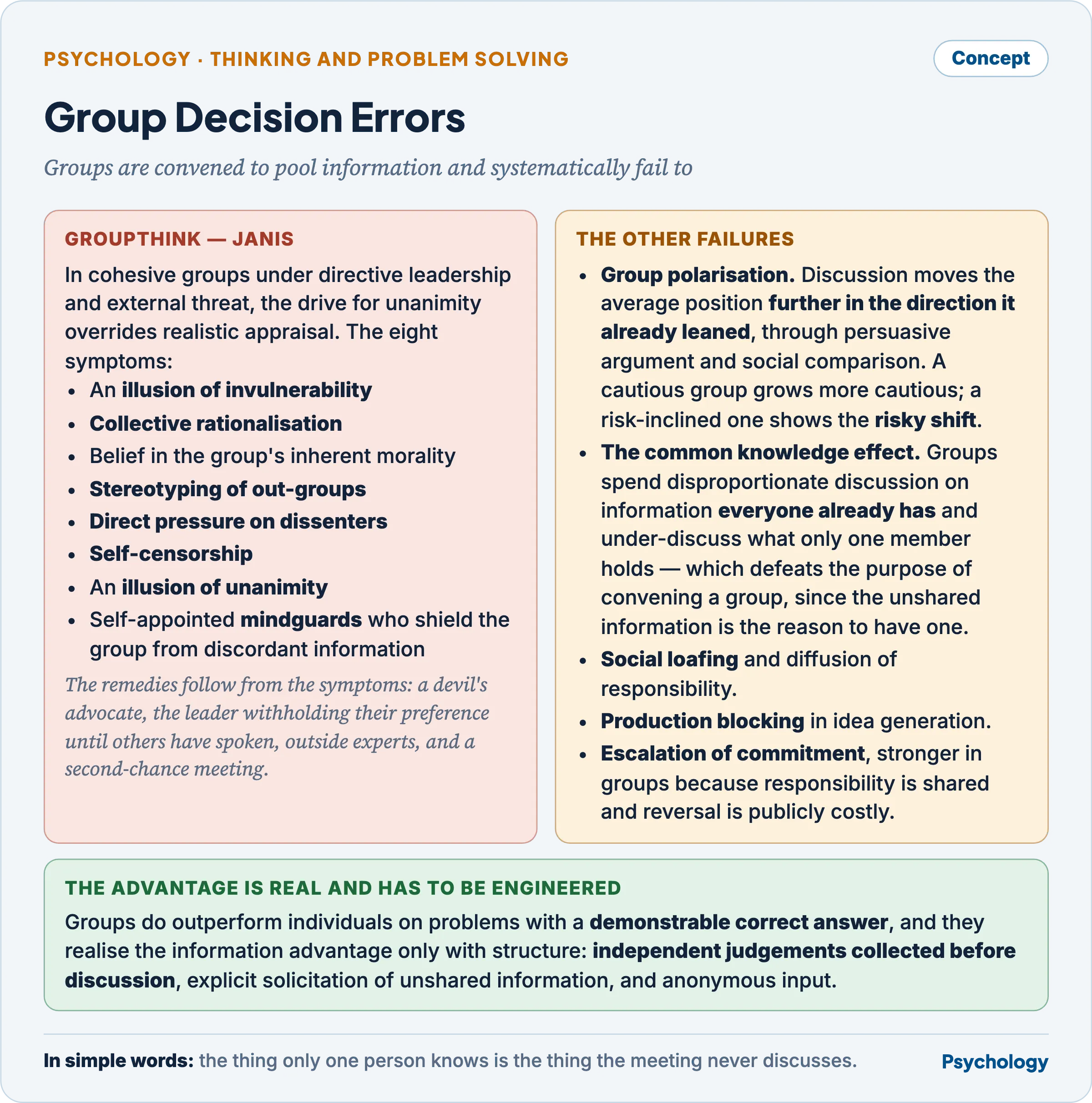
Groups are used because they pool information, and they introduce failures of their own.
- Groupthink (Janis). In cohesive groups under directive leadership and external threat, the drive for unanimity overrides realistic appraisal. Its symptoms: an illusion of invulnerability, collective rationalisation, belief in the group’s inherent morality, stereotyping of out-groups, direct pressure on dissenters, self-censorship, an illusion of unanimity, and self-appointed mindguards who shield the group from discordant information. The remedies follow from the symptoms — assign a devil’s advocate, have the leader withhold their preference until others have spoken, invite outside experts, and run a second-chance meeting.
- Group polarisation. Discussion moves a group’s average position further in the direction it already leaned, through persuasive argument and social comparison. A cautious group becomes more cautious; a risk-inclined one shows the risky shift.
- The common knowledge effect (hidden profiles). Groups spend disproportionate discussion on information everyone already has and under-discuss information held by only one member — which defeats the purpose of convening a group, since the unshared information is the reason to have one.
- Social loafing and diffusion of responsibility, which reduce individual effort and the ownership of outcomes.
- Production blocking in group idea generation: only one person can speak at a time, and waiting degrades the ideas held.
- Escalation of commitment, which is stronger in groups than in individuals because responsibility is shared and reversal is publicly costly.
- The shared information advantage is real, and realised only with structure: independent judgements collected before discussion, explicit solicitation of unshared information, and anonymous input.
Recent trends
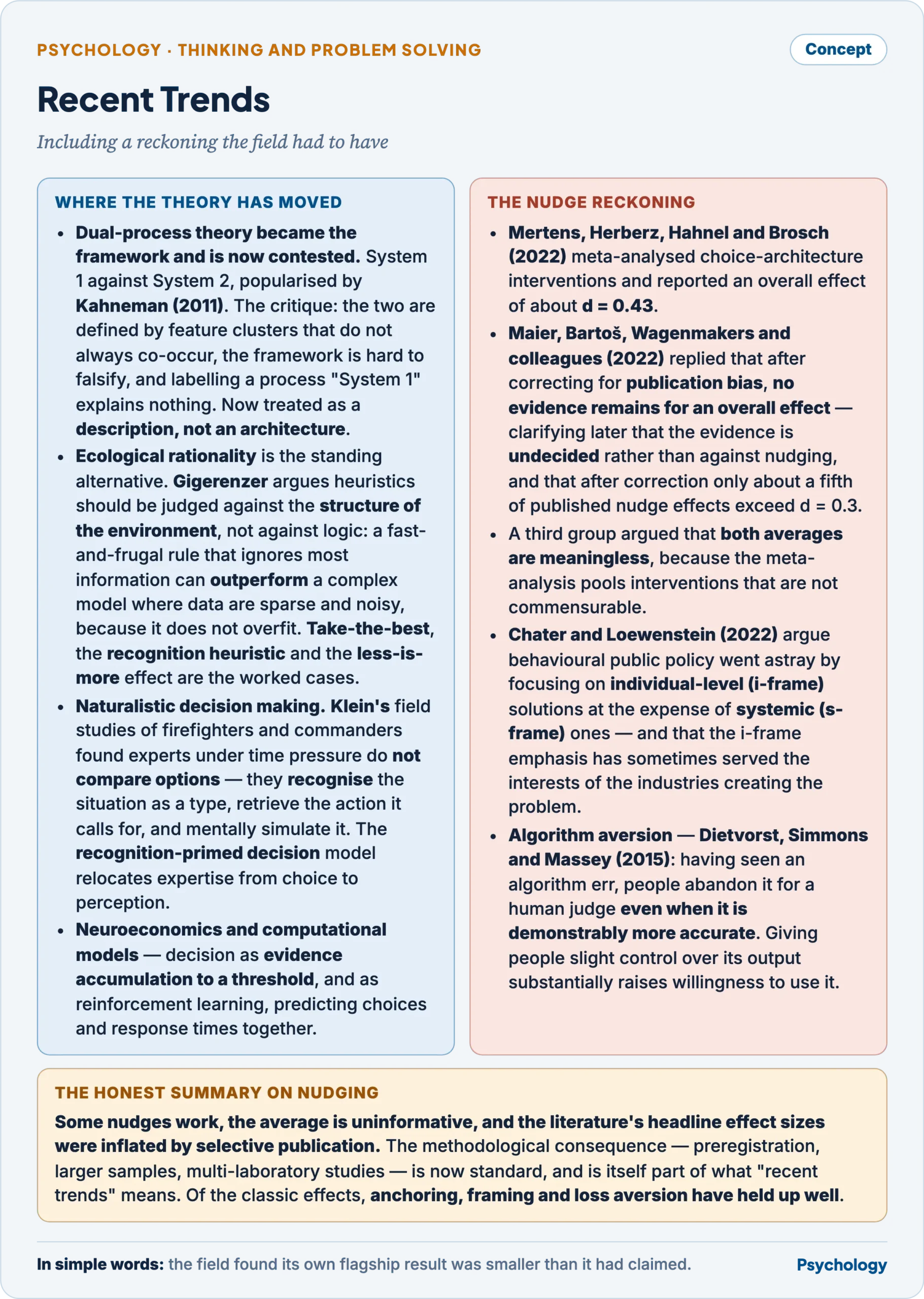
The field has moved substantially since the classical heuristics work, and in several directions at once.
- Dual-process theory became the organising framework and is now contested. System 1 — fast, automatic, associative, effortless — against System 2 — slow, deliberate, rule-governed, effortful — was popularised by Kahneman (2011). The critique is that the two systems are defined by clusters of features that do not always co-occur, that the framework is difficult to falsify, and that labelling a process “System 1” explains nothing. The current position treats it as a useful description rather than an architecture.
- The ecological rationality programme is the standing alternative. Gigerenzer argues that heuristics should be judged against the structure of the environment rather than against logic: a fast-and-frugal heuristic that ignores most information can outperform a complex model where data are sparse and noisy, because it does not overfit. Take-the-best and the recognition heuristic are the worked examples, and the less-is-more effect is the signature result. The disagreement with the heuristics-and-biases programme is genuine and substantive: one treats heuristics as the source of error, the other as the reason human judgement works as well as it does.
- Naturalistic decision making. Klein’s field studies of firefighters, commanders and nurses found that experts under time pressure do not compare options. They recognise the situation as a type, retrieve the action that type calls for, and mentally simulate it — the recognition-primed decision model. This relocates expertise from choice to perception, and connects decision making to the expertise literature.
- Behavioural public policy, and its reckoning. Nudge — altering choice architecture while preserving freedom of choice — moved from theory to government practice through behavioural insight units worldwide. The evidence then came under serious scrutiny. Mertens, Herberz, Hahnel and Brosch (2022) meta-analysed choice-architecture interventions and reported an overall effect of about d = 0.43. Maier, Bartoš, Wagenmakers and colleagues (2022) replied that after correcting for publication bias no evidence remains for an overall effect — clarifying subsequently that the evidence is undecided rather than against nudging, and that after correction only about a fifth of published nudge effects exceed d = 0.3. A third group argued that both averages are meaningless, because the meta-analysis pools interventions that are not commensurable. The honest summary is that some nudges work, the average is uninformative, and the literature’s headline effect sizes were inflated by selective publication.
- The i-frame and the s-frame critique. Chater and Loewenstein (2022) argue that behavioural public policy went astray by focusing on individual-level (i-frame) interventions — nudges to recycle, save, eat better — at the expense of systemic (s-frame) ones such as regulation and taxation, and that the i-frame emphasis has sometimes served the interests of the industries creating the problem, by relocating responsibility onto consumers. This is the most pointed criticism the field has faced from inside.
- Algorithmic and AI-assisted decision making. As statistical and machine models enter clinical, judicial, lending and hiring decisions, the psychological question becomes how people use advice from a machine. Dietvorst, Simmons and Massey (2015) established algorithm aversion: having seen an algorithm err, people abandon it in favour of a human judge even when the algorithm is demonstrably more accurate, because confidence in it falls faster after error. Later work finds algorithm appreciation in other conditions, and the practical finding is that giving people even slight control over an algorithm’s output substantially raises their willingness to use it.
- Neuroeconomics and computational models. Decision making is increasingly modelled as evidence accumulation to a threshold — the drift-diffusion family — and as reinforcement learning, with value signals identified in striatal and prefrontal circuits. This gives process-level models that predict response times and choices together, which the heuristics tradition did not.
- The replication crisis reached the field. Several much-cited effects have weakened under replication, while anchoring, framing and loss aversion have held up well. The methodological consequence — preregistration, larger samples, multi-laboratory studies — is now standard, and is itself part of what “recent trends” means.
- The WEIRD critique. The evidence base is overwhelmingly from Western, educated, industrialised, rich and democratic samples, and the generality of risk preferences and time preferences across cultures is now treated as an open empirical question rather than an assumption.
Criticisms and limitations
- Demonstrations are not a theory. The heuristics-and-biases programme catalogued errors brilliantly and specifies the conditions under which each heuristic is triggered far less well.
- The “bias” label presupposes a normative standard, and whether classical probability is the right one for everyday inference is exactly what the ecological rationality programme disputes.
- Laboratory tasks use hypothetical choices, small stakes and students. Several effects shrink with real incentives, feedback and expertise, and shrink most where they matter most.
- Heuristics are usually adaptive, and a literature organised around their failures gives a systematically misleading picture of how well human judgement works.
- Group-decision findings depend heavily on the task: groups outperform individuals on problems with a demonstrable correct answer and underperform on judgemental ones.
- Indian evidence is limited, and the applied work that exists — on financial decisions, agricultural risk and health choices — suggests that framing and loss aversion replicate while the weight given to family and community consequences differs from the individual-choice assumption built into most of these paradigms.
Previous Year Questions
- 2026What kind of heuristics is used by the people while making decisions? Also, discuss the errors and biases in group decision making.
- 2025Give two examples of the use of the availability heuristic in everyday life — one example when it would be appropriate and another example when it might not be. Explain why your examples are illustrative of availability heuristic.
- 2018Explain the use of availability heuristic and representativeness heuristic in problem solving with the help of research studies.
- 2023Discuss recent trends in the field of decision-making.
- 2010Discuss the role of heuristics in reasoning.