

Reasoning and problem solving.
Official Syllabus: Paper I · Unit 8 Thinking and Problem Solving
“Logic is not the psychology of reasoning; it is the standard against which the psychology of reasoning is measured, and the gap between them is the subject.”
— the position that emerged from fifty years of finding people violate the rules they endorse
Reasoning is drawing conclusions from information — moving from what is given to what follows. It is the part of thinking most directly comparable with a formal standard, because logic specifies what ought to follow, and the systematic ways in which people depart from that standard are what the psychology of reasoning studies. The modern field dates from Peter Wason (1968), whose selection task showed that people with no difficulty endorsing a logical rule reliably fail to apply it, and from Johnson-Laird’s (1983) mental models account, which explained those failures by the number of possibilities a problem requires a reasoner to hold in mind.
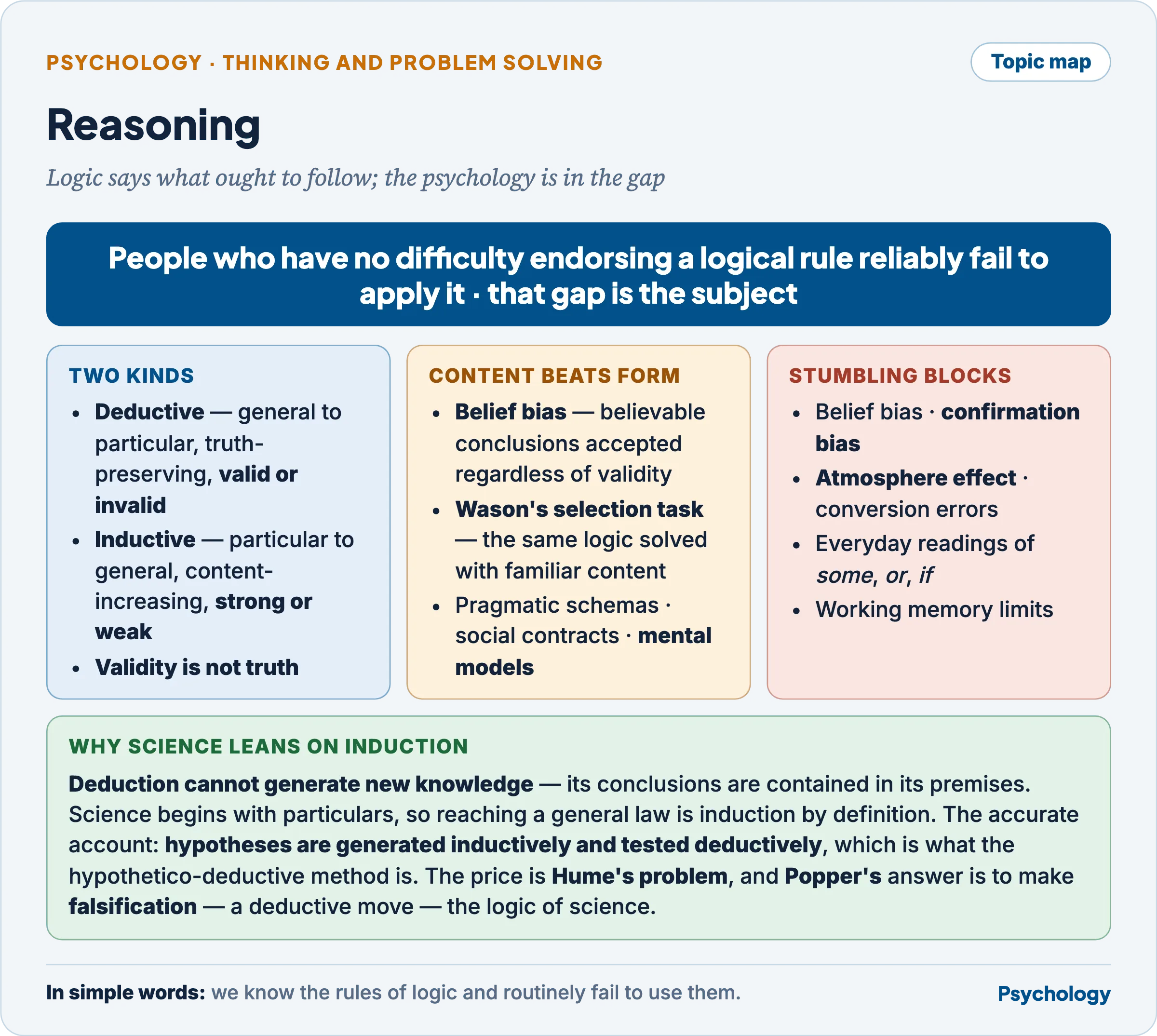
Deductive and inductive reasoning
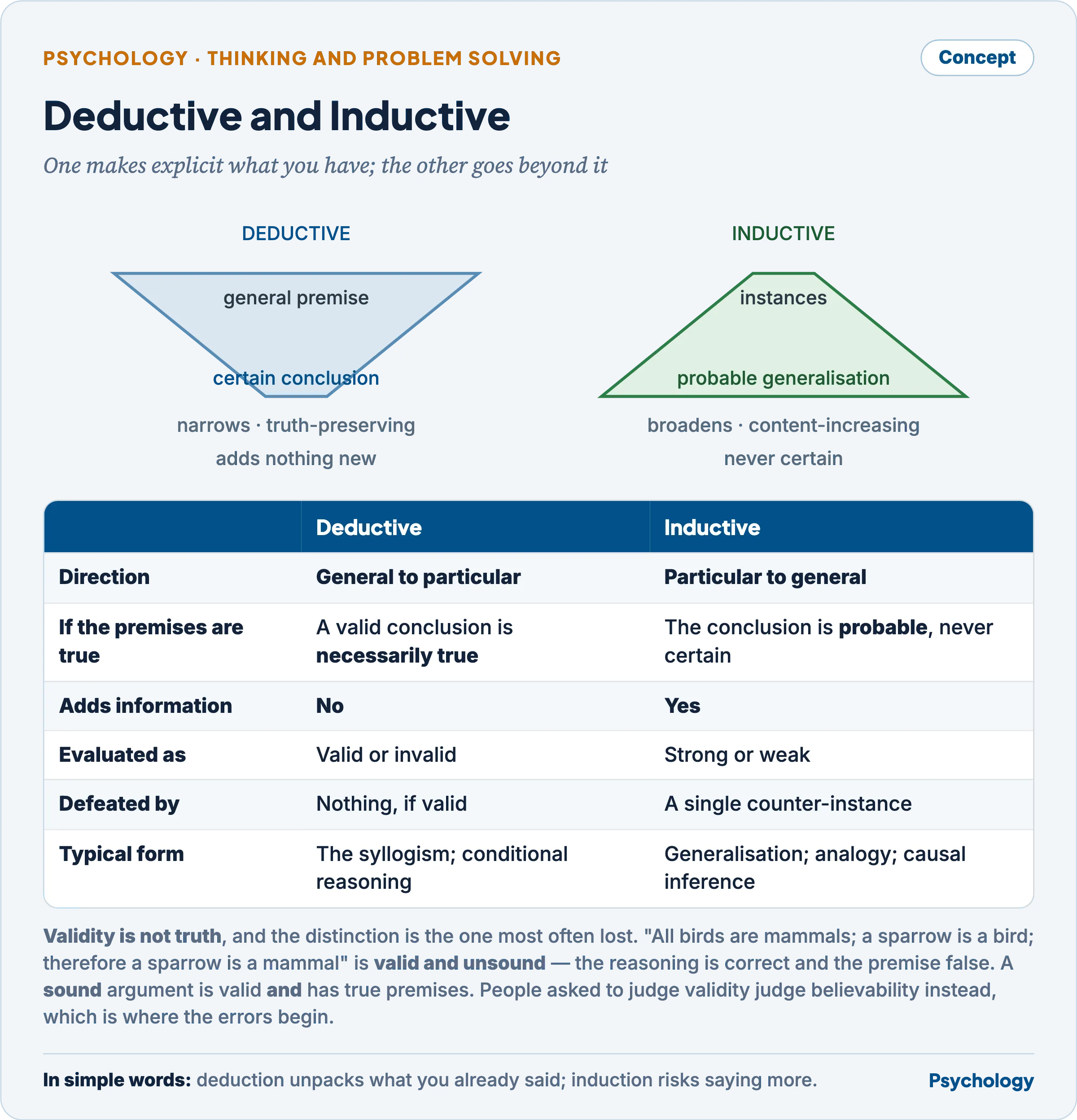
| Deductive | Inductive | |
|---|---|---|
| Direction | General to particular | Particular to general |
| What the conclusion does | Makes explicit what the premises already contain | Goes beyond the premises |
| If the premises are true | A valid conclusion is necessarily true | The conclusion is probable, never certain |
| Adds new information | No — it is truth-preserving, not content-increasing | Yes |
| Evaluated as | Valid or invalid | Strong or weak |
| Defeated by | Nothing, if valid | A single counter-instance |
| Typical form | The syllogism; conditional reasoning | Generalisation; analogy; causal inference |
| Example | All men are mortal; Socrates is a man; therefore Socrates is mortal | Every swan observed is white; therefore all swans are white |
Validity is not truth, and the distinction is the one most often lost. An argument is valid if the conclusion follows from the premises, whatever their truth. “All birds are mammals; a sparrow is a bird; therefore a sparrow is a mammal” is valid and unsound — the reasoning is correct and the premise is false. A sound argument is valid and has true premises. People asked to judge validity judge believability instead, which is where the errors begin.
Forms of inductive reasoning worth distinguishing: generalisation from a sample to a population; analogical reasoning, transferring structure from a known case to a new one, which is the engine of scientific hypothesis and of most everyday insight; causal inference; and hypothesis formation.
Why scientists lean on induction
The question is a good one because the obvious answer — that science is deductive — is wrong in an instructive way.
- Deduction cannot generate new knowledge. Its conclusions are contained in its premises. A science that reasoned only deductively could elaborate what it already believed and never discover anything.
- Science begins with observations, which are particulars. Moving from them to a general law is induction by definition.
- Empirical generalisations are inductive, and so is every statistical inference from a sample to a population — the whole machinery of significance testing is formalised induction.
- Hypotheses are generated inductively and tested deductively. This is the accurate account: induction supplies the candidate law, deduction derives the predictions that follow from it, and observation checks them. The hypothetico-deductive method is a marriage of the two, not a victory for either.
- The price is Hume’s problem of induction: no number of confirming instances establishes a universal, because the next instance may differ. Popper’s response is to deny that induction confirms at all and to make falsification — a deductive move — the logic of science, since one counter-instance validly refutes a universal. Scientists in practice behave as though confirmation accumulates, which is why Popper’s account describes the logic better than the sociology.
The usable formulation: science prefers induction because it is the only way to reach a general claim from evidence, and compensates for its uncertainty by deductive testing, replication and the willingness to be refuted.
How knowledge shapes deduction
Formally, the content of a syllogism is irrelevant to its validity. Psychologically, content dominates.
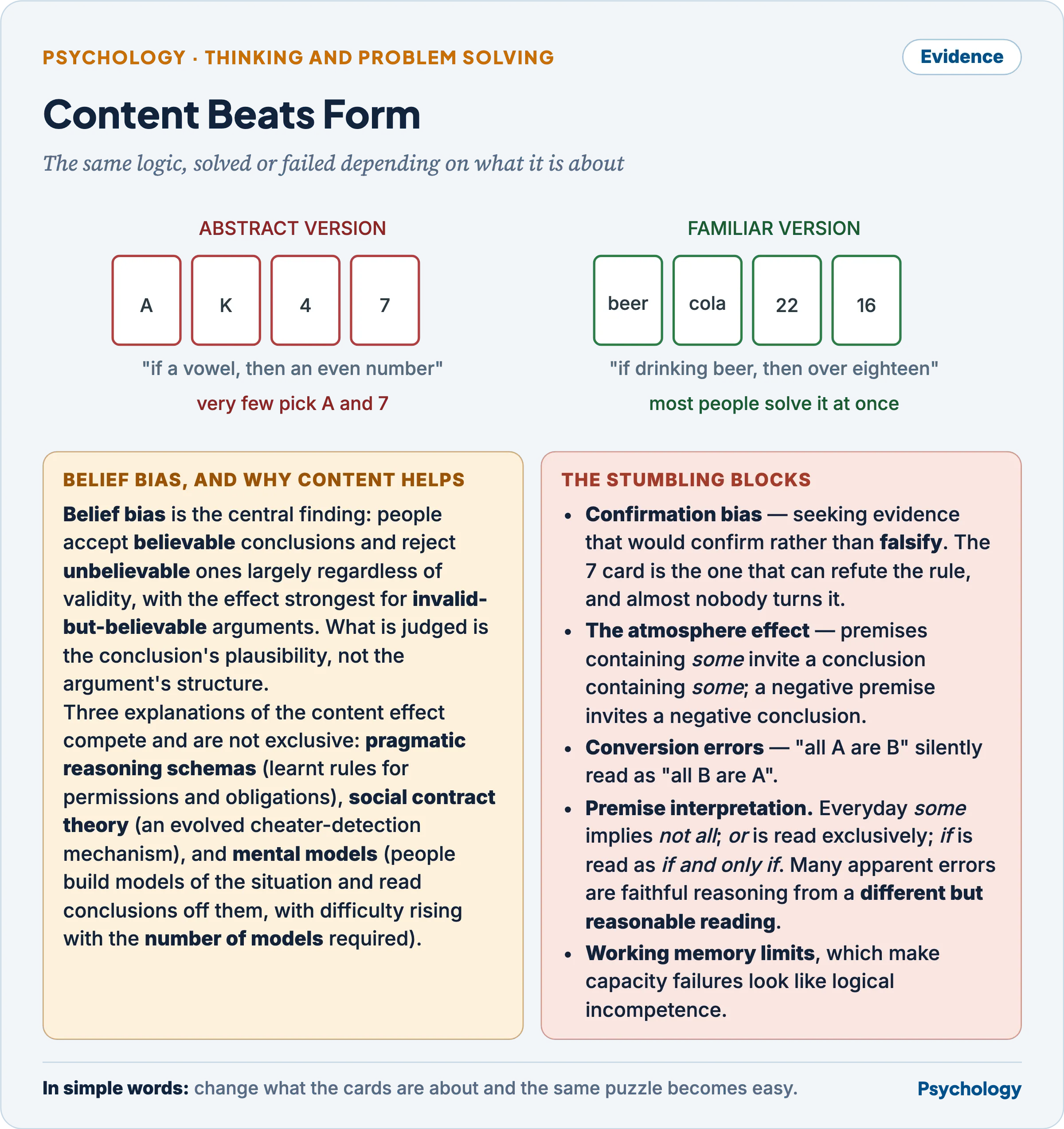
- Belief bias is the central finding. Asked to judge whether a conclusion follows, people accept believable conclusions and reject unbelievable ones, largely regardless of validity. The effect is strongest for invalid-but-believable arguments, which are accepted at high rates, and for valid-but-unbelievable ones, which are rejected. What is being judged is the conclusion’s plausibility, not the argument’s structure.
- The Wason selection task shows the same thing from the other side. Given four cards showing A, K, 4 and 7 and the rule “if a card has a vowel on one side it has an even number on the other”, very few people select the logically required cards — the A and the 7. Recast with the same logical structure in a familiar social context — “if a person is drinking beer, they must be over eighteen”, with cards showing beer, cola, 22 and 16 — and most people solve it immediately. The logic is identical; only the content changed.
- Why content helps. Three explanations compete and are not exclusive. Pragmatic reasoning schemas hold that people reason with learnt rule-schemas for permissions and obligations rather than with abstract logic. Social contract theory holds that an evolved cheater-detection mechanism makes the beer version easy. Mental models theory holds that people construct models of the situation described and read conclusions off them, with familiar content making the right models easier to construct — and it predicts the key result that difficulty rises with the number of models a problem requires.
- The practical consequence. Knowledge helps where it supplies the right structure and hurts where the conclusion to be evaluated conflicts with what is believed. The remedy is procedural: consider whether the same argument form with different content would be accepted, and look specifically for a case that makes the premises true and the conclusion false.
The stumbling blocks
- Belief bias, as above — the most consequential of all.
- Confirmation bias. People seek evidence that would confirm a hypothesis and neglect evidence that could falsify it. The Wason selection task is partly a demonstration of this: the 7 card is the one that can refute the rule, and almost nobody turns it.
- The atmosphere effect. The quantifiers and negations in the premises create an “atmosphere” that biases which conclusion feels right: premises containing some invite a conclusion containing some; a negative premise invites a negative conclusion, whatever validity requires.
- Conversion errors. “All A are B” is silently read as “all B are A”, which is the commonest single source of invalid syllogistic conclusions.
- Premise interpretation. Everyday “some” implies “not all”, while logical “some” does not exclude “all”; “or” is usually read exclusively; “if” is read as “if and only if”. Many apparent reasoning errors are faithful reasoning from a different but reasonable reading of the premises.
- Emotional and motivated reasoning, where the conclusion’s desirability determines the scrutiny the argument receives.
- Working memory limits. Problems requiring several mental models exceed capacity, and the errors look like logical incompetence while being capacity failures.
- Base-rate neglect and other probabilistic errors, which dominate inductive reasoning and are treated with the heuristics in the note on decision making.
Reasoning in problem solving
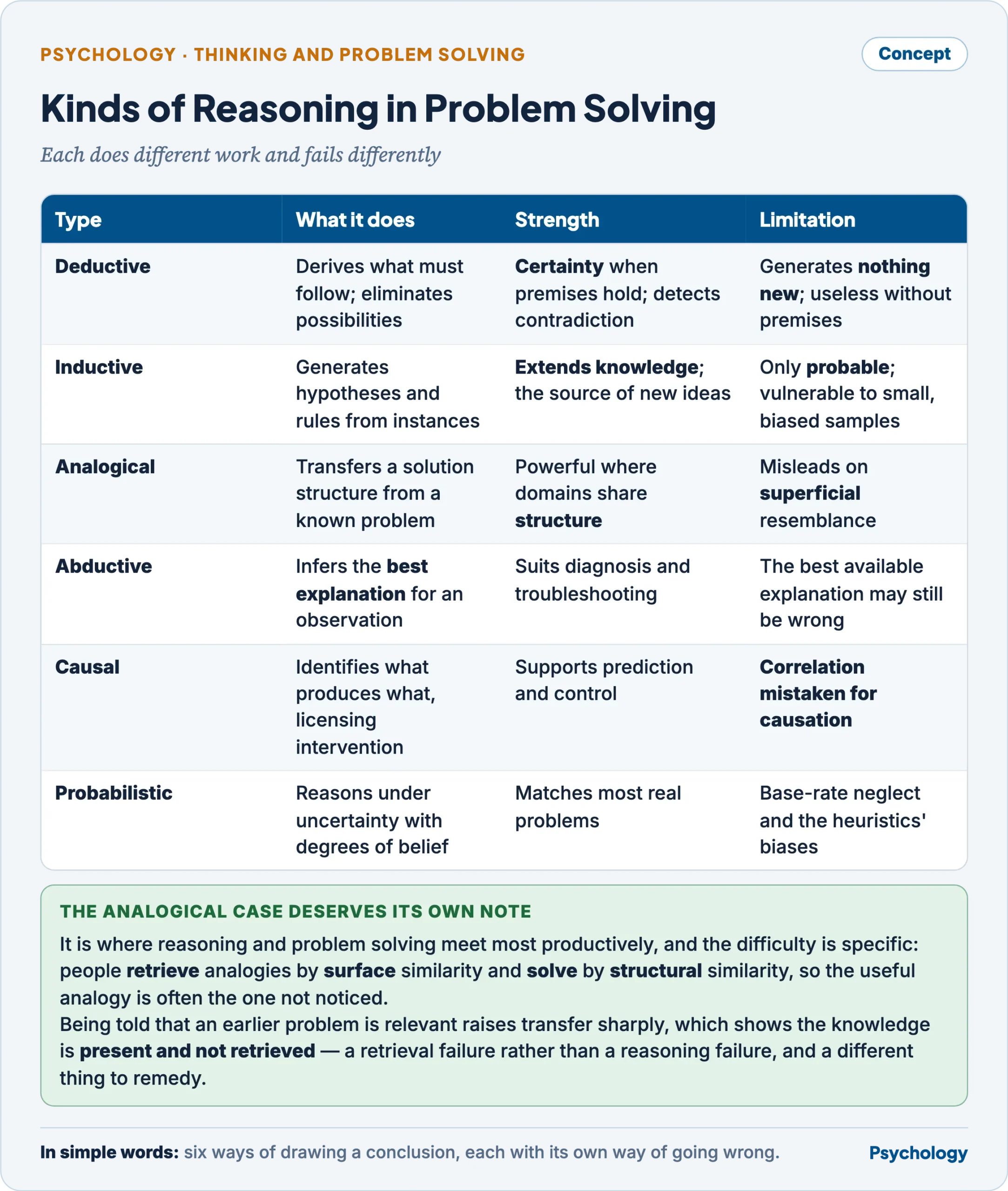
Different kinds of reasoning do different work, and each has a characteristic failure.
| Type | What it does in problem solving | Strength | Limitation |
|---|---|---|---|
| Deductive | Derives what must follow from what is known; eliminates possibilities | Certainty when premises hold; detects contradiction | Generates nothing new; useless where premises are unavailable |
| Inductive | Generates hypotheses and general rules from instances | Extends knowledge; the source of new ideas | Conclusions only probable; vulnerable to small and biased samples |
| Analogical | Transfers a solution structure from a known problem | Powerful where domains share structure; the source of much invention | Misleads when the analogy is superficial; people notice surface similarity and miss structural |
| Abductive | Infers the best explanation for an observation | Suited to diagnosis and troubleshooting | The best available explanation may still be wrong; favours the familiar |
| Causal | Identifies what produces what, licensing intervention | Supports prediction and control | Correlation mistaken for causation; confounds |
| Probabilistic | Reasons under uncertainty with degrees of belief | Matches most real problems, which are uncertain | Subject to base-rate neglect and the heuristics’ biases |
The analogical case deserves its own note, because it is where reasoning and problem solving meet most productively. The difficulty is that people retrieve analogies by surface similarity and solve by structural similarity, so the useful analogy is often the one not noticed. Being told that an earlier problem is relevant raises transfer sharply, which shows the knowledge is present and not retrieved — a retrieval failure rather than a reasoning failure.
Criticisms and limitations
- The normative standard is contested. Calling a response an error presumes classical logic is the right benchmark. On a probabilistic account of everyday reasoning, several “errors” are rational responses to uncertain premises, and the field’s catalogue of fallacies partly reflects its choice of standard.
- Laboratory tasks are unrepresentative. Abstract syllogisms and card-turning problems have no counterpart in ordinary life, where premises are uncertain, conclusions are revisable and reasoning is interested.
- The deduction–induction dichotomy is too clean. Most real reasoning is defeasible — conclusions drawn tentatively and withdrawn on new information — which is neither classical deduction nor simple generalisation.
- Dual-process accounts risk circularity, with the fast system invoked whenever an error occurs and the slow one whenever it does not, unless the two are independently specified.
- Content and culture are not noise. Schooling in formal reasoning strongly predicts performance on these tasks, which raises the question of whether they measure a universal competence or familiarity with a particular literate tradition.
- Evidence is heavily from students solving brief problems for no stake, which is the weakest basis for claims about how people reason about things that matter to them.
Previous Year Questions
- 2025Distinguish between deductive and inductive reasoning and throw light on stumbling blocks of reasoning.
- 2026How does knowledge influence deductive reasoning? Give suitable examples.
- 2017Explain different types of reasoning processes used in problem solving with their strengths and limitations.
- 2011Differentiate between inductive and deductive reasoning, and give reasons for the preference of scientist towards inductive reasoning.