

Reasoning and problem solving; Methods of problem solving.
Official Syllabus: Paper I · Unit 8 Thinking and Problem Solving
“Problem solving is a search through a problem space, from an initial state to a goal state, by the application of operators.”
— Allen Newell and Herbert Simon (1972), in Human Problem Solving
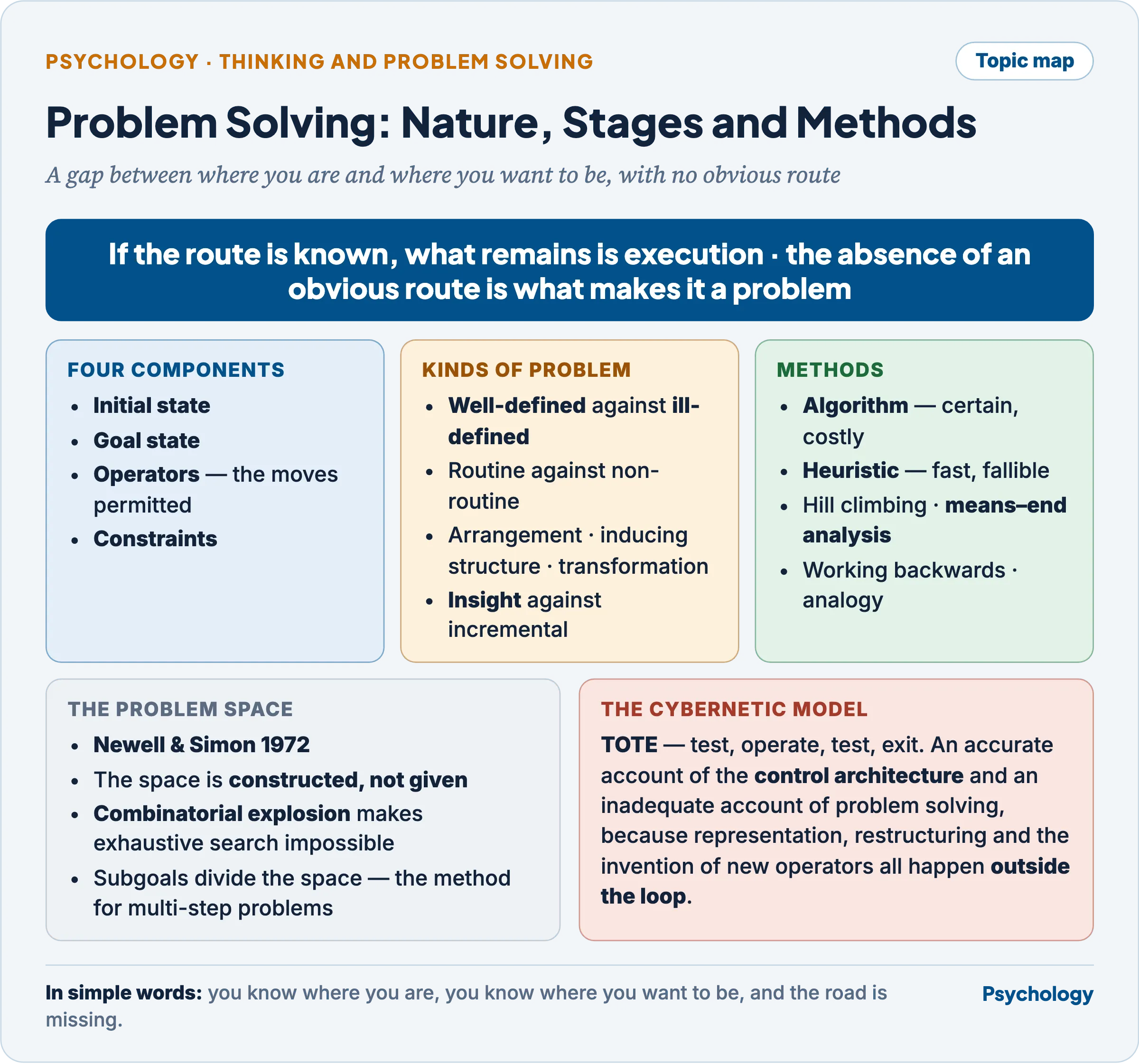
A problem exists when there is a gap between a present state and a desired state, and the means of closing it is not immediately obvious. The last clause is what makes it a problem rather than a task: if the route is known, what remains is execution. Problem solving is the goal-directed cognitive activity that finds the route.
The nature of problems
Every problem has four components, and naming them is what makes the activity analysable.
- The initial state — the situation as it stands, including what is known.
- The goal state — the situation sought, which may be specified precisely or only by a criterion.
- The operators — the moves permitted, each transforming one state into another.
- The constraints — restrictions on when operators may be applied.
Kinds of problem, and the classification matters because different kinds demand different methods.
- Well-defined problems have a clear initial state, a clear goal and known operators — a chess puzzle, a quadratic equation, the Tower of Hanoi. Ill-defined problems have one or more of these missing: writing a good essay, improving a city’s traffic, choosing a career. Most problems that matter are ill-defined, and most research has studied well-defined ones, which is the field’s standing bias.
- Routine problems are solved by a procedure already held; non-routine problems require one to be constructed.
- By structure, following Greeno: problems of arrangement (anagrams — rearrange elements to satisfy a criterion), of inducing structure (analogies and series completion — find the relation), and of transformation (Tower of Hanoi — reach a goal state by legal moves).
- Insight problems, solved by a sudden restructuring, against non-insight problems solved by incremental steps. Metcalfe and Wiebe (1987) separated them empirically: asked to rate how close they felt to a solution at intervals, solvers of non-insight problems showed warmth rising steadily, while solvers of insight problems showed no rise until just before the solution arrived. The subjective suddenness is measurable, not merely reported after the fact.
Is problem solving a psychological process?
The question invites a yes, and the interest is in the grounds.
- It is goal-directed and internally mediated. What happens between the problem’s presentation and the solution is not visible in behaviour, and the same external situation produces different solutions depending on how it is represented internally.
- It draws on identifiable psychological systems. Perception frames the problem; attention selects what is relevant; working memory holds the current state and subgoals, and its capacity limits the problems that can be held at once; long-term memory supplies the concepts, operators and analogies; metacognition monitors progress and decides when to abandon an approach.
- Representation determines solvability. The nine-dot problem, the mutilated-checkerboard problem and the candle problem are all defeated by an initial representation and solved the moment it changes, which shows that what is being operated on is a mental construction, not the problem as given.
- Motivation and emotion participate. Arousal affects persistence and breadth of search; anxiety narrows it; the sense of being close sustains effort.
- There are stable individual differences — in working memory capacity, knowledge, strategy repertoire and tolerance for uncertainty — which a non-psychological account of problem solving could not accommodate.
The contrast that sharpens it: trial and error is behaviour; problem solving is thought. Thorndike’s cats escaped the puzzle box without, on his account, representing the problem at all. The human solver forms a representation, searches it internally, and acts once — which is precisely what saves them from having to make every mistake in the world.
The stages
Several schemes exist and they agree substantially.
| Stage | What happens | Where it fails |
|---|---|---|
| 1 · Problem identification | Recognising that a problem exists at all | Problems unnoticed are unsolved; experts notice earlier |
| 2 · Problem definition and representation | Deciding what the problem is, and encoding it | The most consequential stage. A poor representation makes a soluble problem insoluble |
| 3 · Strategy formulation | Choosing a method — analysis, synthesis, divergence, convergence | Choosing a familiar method for an unfamiliar problem |
| 4 · Organising information | Arranging what is known so the strategy can be applied | Missing relations among the givens |
| 5 · Allocating resources | Deciding how much time and effort to spend, and on what | Novices spend too little on representation and too much on execution |
| 6 · Monitoring | Checking progress against the goal while solving | Persisting with a failing approach |
| 7 · Evaluating | Checking the solution, and learning from the episode | Stopping at the first workable answer |
Dewey’s five steps of reflective thinking — felt difficulty, location and definition, suggestion of possible solutions, reasoning out the implications, and testing — is the older statement of the same sequence. Polya’s four steps for mathematical problems — understand the problem, devise a plan, carry out the plan, look back — adds the point that the final stage is routinely skipped and is where most of the learning is.
The sequence is cyclical, not linear. Failure at monitoring sends the solver back to representation, which is the most common and most productive loop.
The problem space
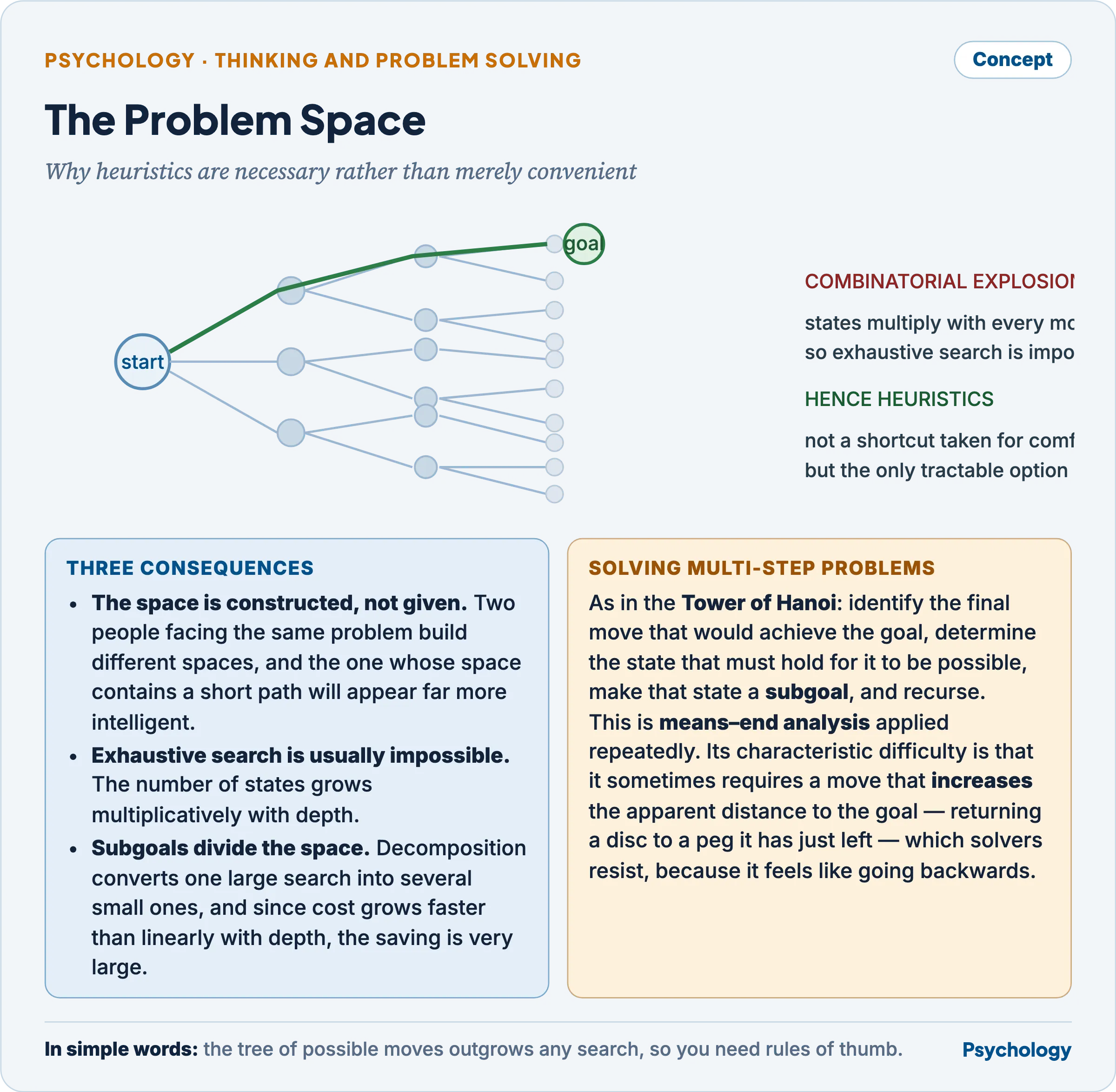
Newell and Simon (1972) gave the field its central formalism. A problem space is the solver’s internal representation of the problem: the set of all states reachable from the initial state by legal operators, the operators themselves, and the constraints. Solving is a search through this space for a path to the goal.
Three consequences follow, and they are the reason the formalism matters.
- The space is constructed, not given. Two people facing the same problem may build different spaces, and the one whose space contains a short path will appear far more intelligent.
- Exhaustive search is usually impossible. The number of states grows multiplicatively with the number of moves — the combinatorial explosion — so that chess or a moderately sized scheduling problem has more states than could be examined in any available time. This is why heuristics are necessary rather than merely convenient.
- Subgoals divide the space. Decomposing a problem into subgoals converts one large search into several small ones, and since search cost grows faster than linearly with depth, the saving is very large. This is the core technique for multi-step problems.
Solving multi-step problems, as in the Tower of Hanoi: identify the final move that would achieve the goal, determine the state that must hold for it to be possible, make that state a subgoal, and recurse. The method is means–end analysis applied repeatedly, and its characteristic difficulty is that it sometimes requires a move that increases the apparent distance to the goal — returning a disc to a peg it has just left — which solvers resist, because it feels like going backwards.
The methods
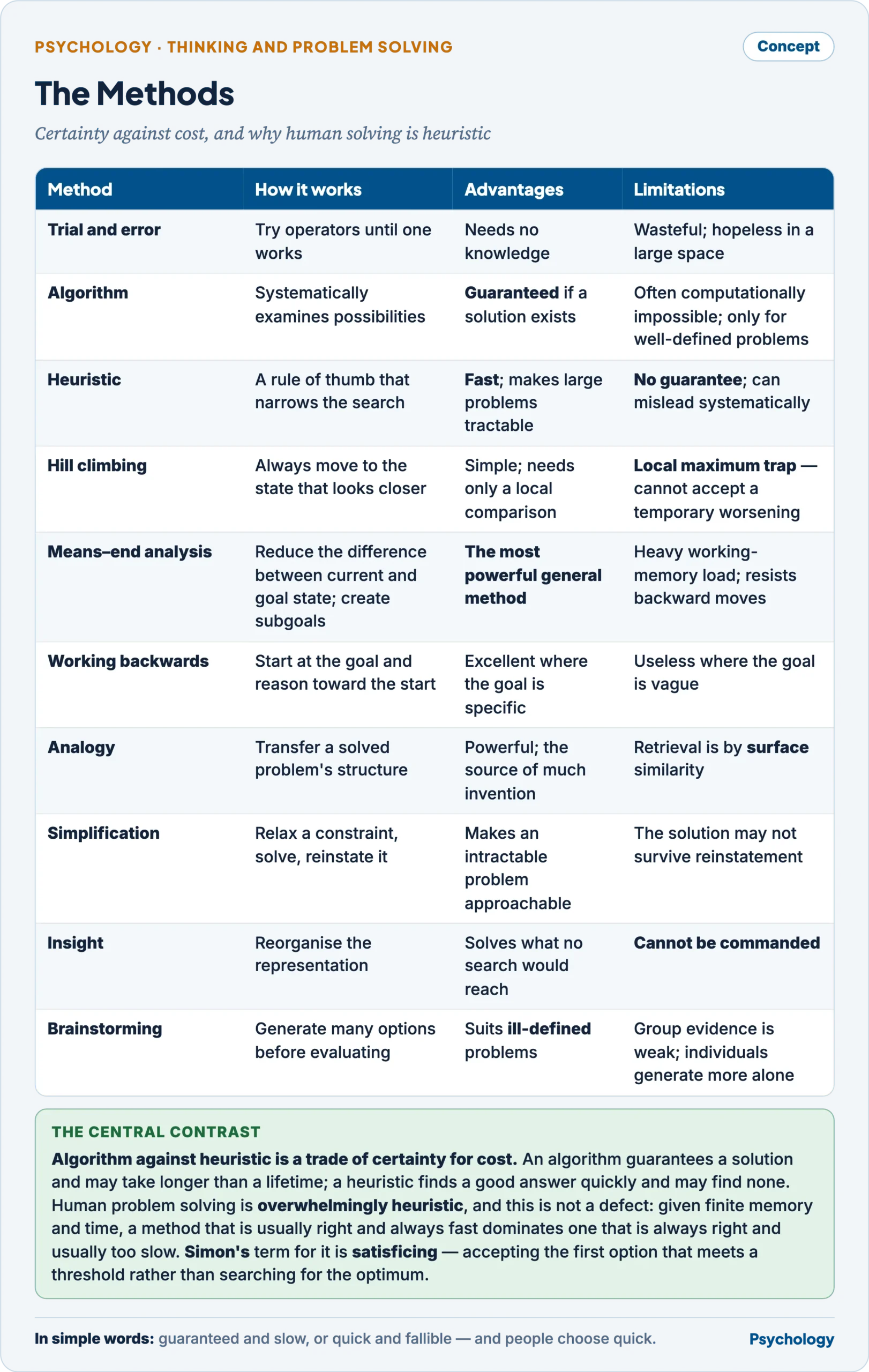
| Method | How it works | Advantages | Limitations |
|---|---|---|---|
| Trial and error | Try operators until one works | Needs no knowledge; works on simple problems | Wasteful; hopeless in a large space; no learning unless outcomes are tracked |
| Algorithm | A procedure that systematically examines possibilities | Guaranteed to find a solution if one exists | Often computationally impossible; exists only for well-defined problems |
| Heuristic | A rule of thumb that narrows the search | Fast; makes large problems tractable | No guarantee; can mislead systematically |
| Hill climbing | Always move to the state that looks closer to the goal | Simple; needs only a local comparison | Local maximum trap — cannot accept a step that temporarily worsens position |
| Means–end analysis | Identify the difference between current and goal state; apply an operator that reduces it; create subgoals where it cannot be applied | The most powerful general method; handles multi-step problems | Heavy load on working memory; resists moves that temporarily increase the difference |
| Working backwards | Start at the goal and reason toward the initial state | Excellent where the goal is specific and the start is diffuse | Useless where the goal is vague |
| Analogy | Transfer the solution structure of a solved problem | Powerful; the source of much invention | Retrieval is by surface similarity, so the apt analogy is often missed |
| Simplification | Relax a constraint, solve, then reinstate it | Makes an intractable problem approachable | The simplified solution may not survive reinstatement |
| Insight / restructuring | Reorganise the representation so the solution becomes apparent | Solves problems no search would reach | Cannot be commanded; unreliable |
| Brainstorming | Generate many options before evaluating any | Suits ill-defined problems; defers premature closure | Evidence for group brainstorming is weak; individuals generate more alone |
The algorithm–heuristic contrast is the central one, and it is a trade of certainty against cost. An algorithm guarantees a solution and may take longer than a lifetime; a heuristic finds a good answer quickly and may find none. Human problem solving is overwhelmingly heuristic, and this is not a defect: given finite memory and time, a method that is usually right and always fast dominates one that is always right and usually too slow. Simon’s term for this is satisficing — accepting the first option that meets a threshold rather than searching for the optimum.
The cybernetic model
The cybernetic account describes behaviour as goal-directed and feedback-controlled: a system compares its current state against a reference state, acts to reduce the discrepancy, and compares again. Miller, Galanter and Pribram (1960) gave it its psychological form as the TOTE unit — Test, Operate, Test, Exit: test the current state against the goal; if it differs, operate; test again; exit when the difference is gone. TOTE units nest, so that the “operate” phase of one may be a whole TOTE unit at a lower level.
What it explains well.
- It captures the control structure of problem solving exactly. Means–end analysis is a TOTE unit: test the difference, apply an operator to reduce it, test again. Hill climbing is the same with a simpler test.
- It accounts for goal-directedness without invoking purpose as a primitive, which was its historical appeal.
- It explains monitoring and termination — why solvers persist, and when they stop.
- It handles hierarchical structure through nesting, which matches the subgoal decomposition that multi-step problems require.
What it cannot explain.
- Where the goal state comes from. The model presupposes a reference value, and in ill-defined problems determining the goal is the problem.
- Representation and restructuring. The model operates within a given problem space and has no account of how the space is constructed or of why reconceiving it can dissolve a problem. Insight is invisible to it.
- The generation of new operators. Feedback can select among available actions; it cannot invent one.
- Creativity, which is not error-reduction toward a known target.
- The affective and motivational side, which determines how long the loop runs.
The verdict: the cybernetic model is an accurate account of the control architecture of goal-directed problem solving and an inadequate account of problem solving as a whole, because the interesting psychological work — building the representation, noticing the right analogy, restructuring — happens outside the loop it describes.
Human and machine problem solving
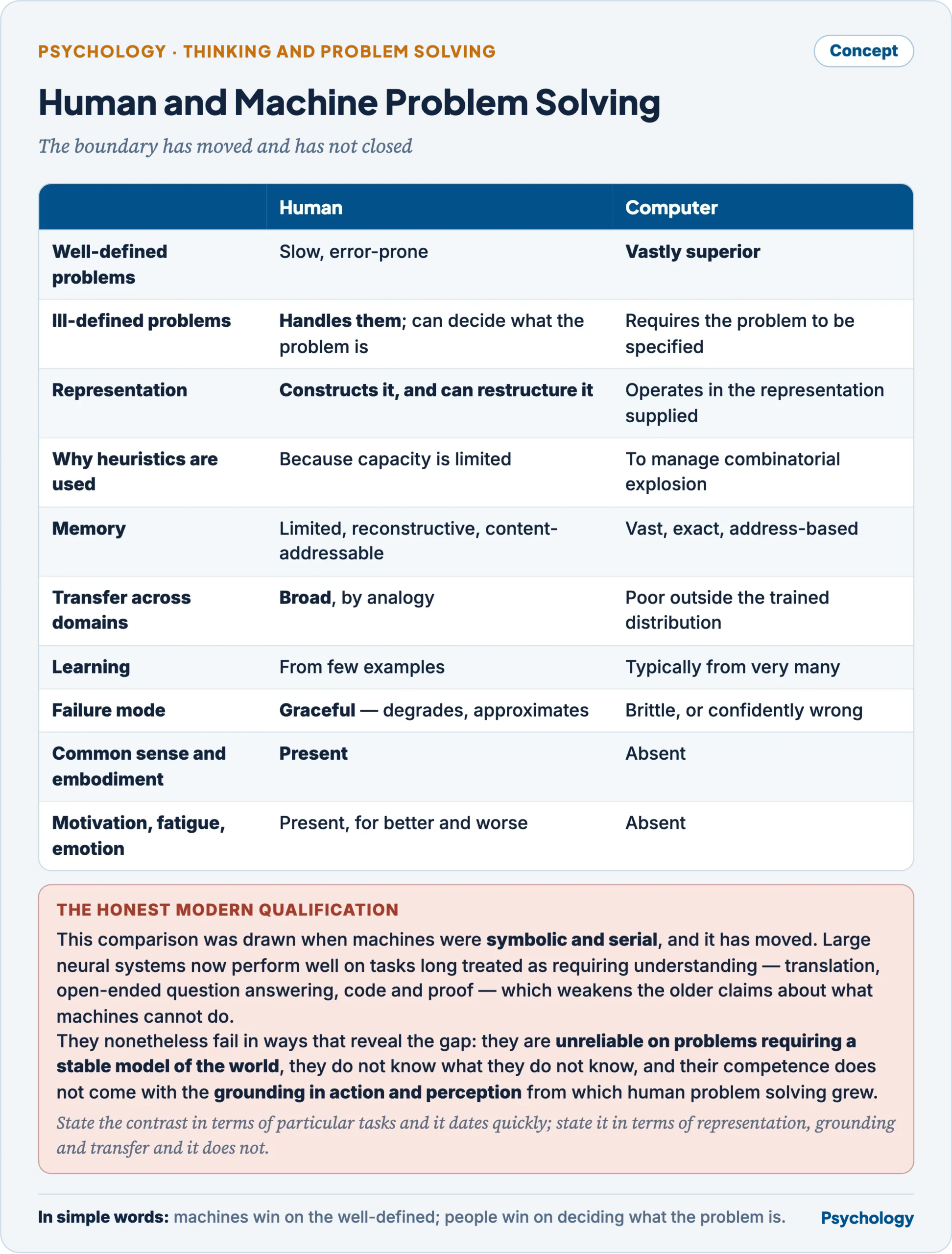
| Human | Computer | |
|---|---|---|
| Speed and accuracy on well-defined problems | Slow, error-prone | Vastly superior |
| Ill-defined problems | Handles them; can decide what the problem is | Requires the problem to be specified |
| Representation | Constructs it, and can restructure it | Operates in the representation supplied |
| Why heuristics are used | Because capacity is limited | To manage combinatorial explosion |
| Memory | Limited, reconstructive, content-addressable | Vast, exact, address-based |
| Transfer across domains | Broad, by analogy | Poor outside the trained distribution |
| Learning | From few examples | Typically from very many |
| Failure mode | Graceful — degrades, approximates | Brittle, or confidently wrong |
| Common sense and embodiment | Present | Absent |
| Motivation, fatigue, emotion | Present, for better and worse | Absent |
The honest modern qualification. This comparison was drawn when machines were symbolic and serial, and it has moved. Large neural systems now perform well on tasks long treated as requiring understanding — translation, open-ended question answering, code and proof — which weakens the older claims about what machines cannot do. They nonetheless fail in ways that reveal the gap: they are unreliable on problems requiring a stable model of the world, they do not know what they do not know, and their competence does not come with the grounding in action and perception from which human problem solving grew. The right conclusion is that the boundary has moved and not closed, and that stating the contrast in terms of particular tasks dates quickly, while stating it in terms of representation, grounding and transfer does not.
Criticisms and limitations
- The field studies the problems it can control. Tower of Hanoi, water jars and cryptarithmetic are well-defined, closed and meaningless, where real problems are open, consequential and embedded in a domain.
- The problem-space formalism assumes the space is fixed, which is exactly what insight denies.
- Stage models are descriptions of a cyclical process, and present an orderly sequence that solvers do not follow.
- Expertise findings sit awkwardly with general-method research: the more a solver knows, the less they search, so the general methods studied in the laboratory are what people use when they are least competent.
- Cultural and educational variation is under-studied, although what counts as a legitimate problem, an acceptable solution and a reasonable amount of persistence all vary.
Previous Year Questions
- 2022Is problem solving a psychological process? Illustrate your answer with the steps and methods involved in problem solving. Differentiate between human and computerized problem solving.
- 2012Enumerate various methods of problem solving. Critically evaluate their advantages and limitations also.
- 2005Explaining the nature of problem solving, discuss its strategies with the help of suitable examples.
- 2004Discuss the nature of problems and problem solving. Illustrate the process of problem-solving with appropriate examples.
- 2001Explain the concept of problem space and describe the methods in solving multi-step problems.
- 1997Can the Cybernetic model of behaviour explain problem solving behaviour?