

Facilitating and hindering factors in problem solving.
Official Syllabus: Paper I · Unit 8 Thinking and Problem Solving
“The chess master sees a position and the move comes to mind; the novice sees pieces and begins to search.”
— the finding, from de Groot (1946) onward, that expertise replaces search with recognition
Two solvers of equal intelligence facing the same problem routinely differ enormously in whether they solve it. The variables that produce that difference fall into three groups — what the solver brings, how the problem is represented, and what the situation permits — and the single largest of them is domain knowledge, which is why the study of expertise belongs with the study of factors.
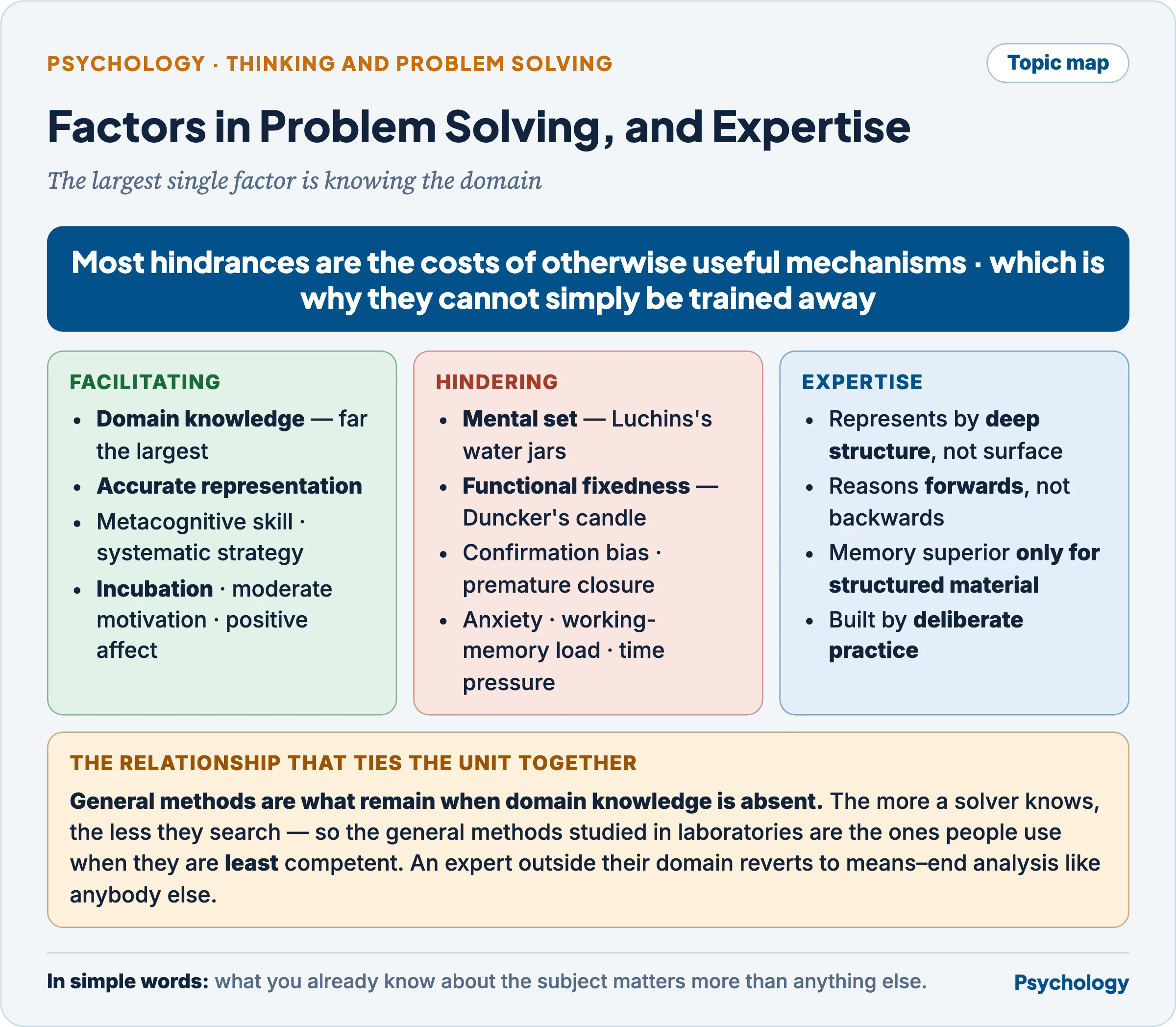
Facilitating factors
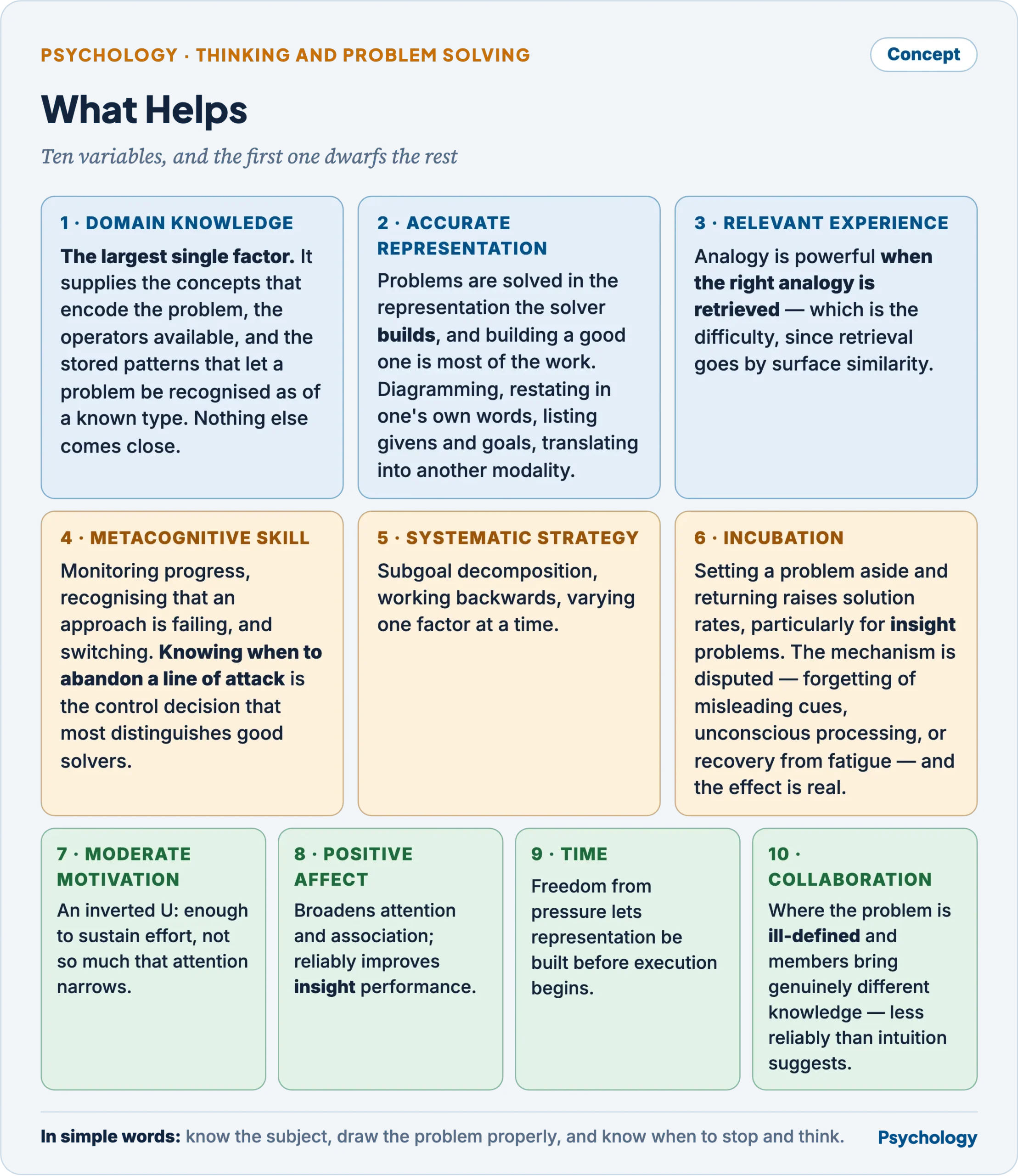
- Domain knowledge. The largest single factor. Knowledge supplies the concepts that encode the problem, the operators available, and the stored patterns that let a problem be recognised as of a known type. Nothing else in this list comes close.
- Accurate representation. Problems are solved in the representation the solver builds, and building a good one is most of the work. Diagramming, restating in one’s own words, listing givens and goals explicitly, and translating into a different modality all help.
- Relevant past experience, provided it is retrieved. Analogy is powerful when the right analogy comes to mind.
- Metacognitive skill — monitoring progress, recognising that an approach is failing, and switching. Treated below in its own right.
- Systematic strategy, including subgoal decomposition, working backwards and varying one factor at a time.
- Incubation. Setting a problem aside and returning to it raises solution rates, particularly for insight problems. The mechanism is debated — forgetting of misleading cues, unconscious processing, or simply recovery from fatigue — and the effect is real.
- Moderate motivation, following the inverted-U: enough to sustain effort, not so much that attention narrows.
- Positive affect, which broadens the scope of attention and association and reliably improves performance on insight problems.
- Time and freedom from pressure, which permit representation to be built before execution begins.
- Collaboration, where the problem is ill-defined and members bring genuinely different knowledge — though less reliably than intuition suggests.
Algorithms and heuristics as strategies
The two general classes of strategy differ in what they trade, and the contrast sets up everything that follows about where problem solving goes wrong.
| Algorithm | Heuristic | |
|---|---|---|
| What it is | A procedure that systematically examines possibilities | A rule of thumb that narrows the search |
| Guarantees a solution | Yes, if one exists | No |
| Cost | Often prohibitive — the search space explodes | Low |
| Needs | A well-defined problem and known operators | Only a plausible rule |
| Typical use | Machine computation; routine calculation | Almost all human problem solving |
| Characteristic failure | Takes longer than is available | Systematic, predictable error |
| Example | Trying every arrangement of the letters in an anagram | Trying likely letter combinations first |
Human solvers are overwhelmingly heuristic, and this is not a defect. Given finite memory and time, a method that is usually right and always fast dominates one that is always right and usually too slow — which is Simon’s point about bounded rationality and satisficing. The price is that heuristics fail in regular ways, and the most consequential of those failures is that a heuristic which has worked becomes the only one tried.
Hindering factors
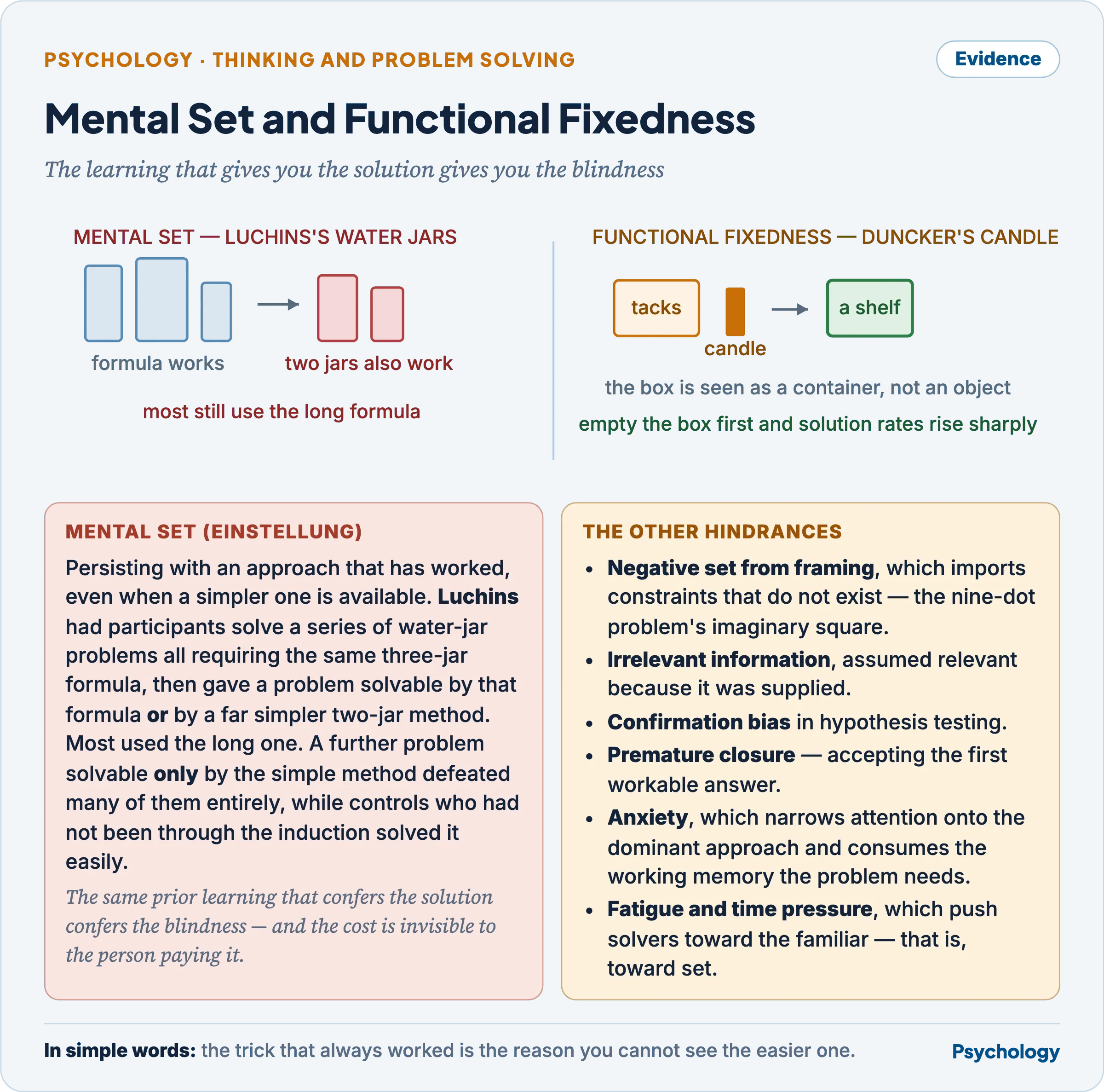
Mental set, or Einstellung, is the tendency to persist with an approach that has worked before, even when a simpler or better one is available.
- Luchins’s water-jar experiments are the classic demonstration. Participants solved a series of problems all requiring the same three-jar formula, then met a problem solvable either by that formula or by a far simpler two-jar method. Most used the long formula. A further problem was solvable only by the simple method, and many participants who had been through the induction sequence failed it entirely, while control participants who had not solved it easily.
- The result is the clean one in this literature: the same prior learning that confers the solution confers the blindness, and the cost is invisible to the person paying it.
- Mental set also operates in reasoning: a syllogism form answered repeatedly biases the response to a structurally different one, and a familiar problem framing suppresses the search for alternatives.
Functional fixedness is the special case in which an object’s customary function blocks perception of another use.
- Duncker’s candle problem is the standard task: given a candle, a box of tacks and matches, and asked to fix the candle to a wall so it burns without dripping, most people fail. The solution is to empty the box, tack it to the wall and use it as a shelf. Presenting the tacks beside the box rather than in it raises solution rates sharply, because the box is then seen as a container-and-possible-object rather than only as a container.
- Maier’s two-string problem makes the same point with pliers used as a pendulum weight rather than as a tool.
Other hindrances.
- Negative set from instructions or framing, where the way a problem is stated imports constraints that do not exist — the nine-dot problem’s imaginary square being the standard case.
- Irrelevant information, which solvers assume must be relevant because it was supplied.
- Confirmation bias in hypothesis testing, which leads solvers to seek confirming tests rather than the falsifying ones that are informative.
- Premature closure — accepting the first workable answer, which is satisficing in the cases where it costs.
- Excessive arousal or anxiety, which narrows attention onto the dominant and usually unhelpful approach, and consumes the working memory the problem needs.
- Working memory load, including the load imposed by badly designed instructions.
- Lack of relevant knowledge, which is the mirror of the first facilitating factor.
- Fatigue and time pressure, which push solvers toward familiar methods — that is, toward mental set.
The general shape: most hindrances are the costs of otherwise useful mechanisms. Set is the price of automaticity, fixedness the price of stable object knowledge, premature closure the price of satisficing. This is why they cannot simply be trained away, and why the practical remedies are procedural — restate the problem, list assumptions, deliberately seek a different representation, take a break.
Metacognition in problem solving
Metacognition is the solver’s monitoring of, and control over, their own solving, and it is what distinguishes effective from ineffective solvers at equal knowledge.
- Monitoring — judging how well the current approach is going, how close the solution is, and whether progress is real. The feeling-of-warmth evidence shows this judgement is accurate for incremental problems and useless for insight ones, which is a finding worth knowing: on insight problems, people are poor judges of their own closeness right up to the moment of solution.
- Control — allocating effort, deciding when to abandon an approach, deciding when to stop. Knowing when to give up on a line of attack is the control decision that most distinguishes good solvers, and persistence with a failing approach is the commonest form of metacognitive failure.
- Planning before execution. Experts spend proportionally more time on representation and planning and less on execution; novices reverse this and begin manipulating immediately.
- Strategy knowledge — knowing which methods exist and when each applies, which is useless without the monitoring to tell that the current one is failing.
The critical appraisal. Metacognition reliably predicts problem-solving success, and metacognitive training produces real but modest and narrowly transferring gains. The deeper objection is that metacognition cannot substitute for knowledge: monitoring tells a solver that an approach is failing and does not supply the one that would work, so a well-regulated novice remains a novice. Its measurement is also contested, resting largely on self-report and think-aloud protocols, which alter the process they record.
General strategies against domain-specific procedures
| General (weak) methods | Domain-specific (strong) methods | |
|---|---|---|
| Examples | Means–end analysis, hill climbing, working backwards, trial and error, analogy | A doctor’s diagnostic routine, a lawyer’s framework, a chess opening repertoire, an engineer’s standard calculation |
| Apply to | Any problem | One class of problem |
| Require knowledge | Little | A great deal |
| Power | Low — much search | High — little or no search |
| Called “weak”/”strong” because | Weak in power, strong in generality | Strong in power, narrow in scope |
| Used by | Novices, and by anyone in an unfamiliar domain | Experts, within their domain |
The relationship is the point. General methods are what remain when domain knowledge is absent, which is why expertise research and general-method research keep arriving at the same place from opposite directions: the more a solver knows, the less they search, and the general methods studied in the laboratory are the ones people use when they are least competent. An expert outside their domain reverts to means–end analysis like anybody else.
What experiments have shown about experts
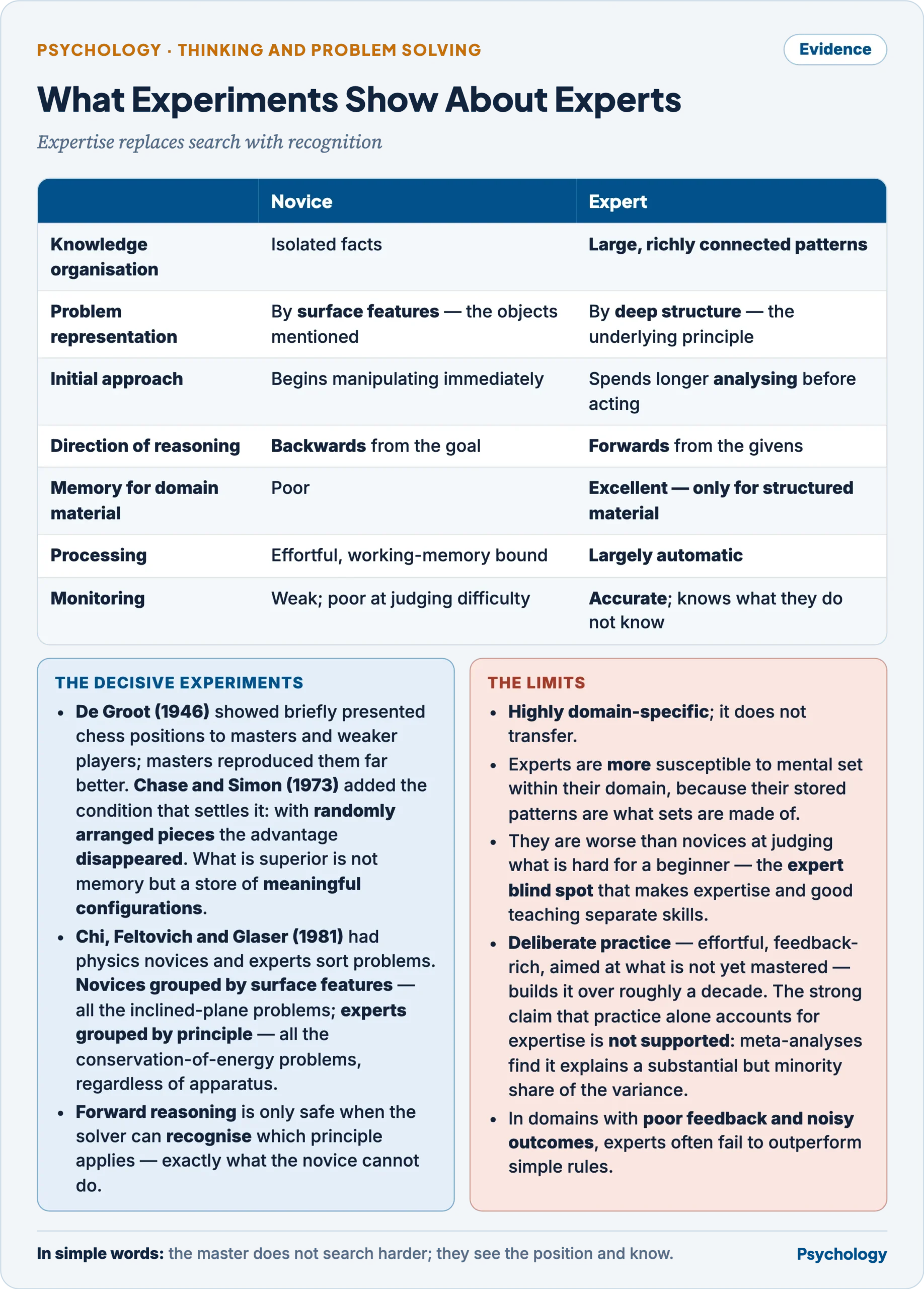
| Novice | Expert | |
|---|---|---|
| Knowledge organisation | Isolated facts | Large, richly connected patterns — many thousands of chunks |
| Problem representation | By surface features — the objects mentioned | By deep structure — the underlying principle |
| Initial approach | Begins manipulating immediately | Spends longer analysing before acting |
| Direction of reasoning | Backwards from the goal, by means–end analysis | Forwards from the givens to the solution |
| Memory for domain material | Poor | Excellent — but only for structured material |
| Processing | Effortful, serial, working-memory bound | Largely automatic, freeing capacity for the hard parts |
| Monitoring | Weak; poor at judging difficulty | Accurate; knows what they do not know |
| Speed and accuracy | Low | High within the domain only |
The decisive experiments.
- De Groot (1946) showed briefly presented chess positions to masters and weaker players. Masters reproduced them far better. Chase and Simon (1973) added the condition that settles the interpretation: with randomly arranged pieces, the master’s advantage disappeared. What is superior is not memory but a store of meaningful configurations, each recalled as a single chunk.
- Chi, Feltovich and Glaser (1981) had physics novices and experts sort problems into groups. Novices grouped by surface features — all the inclined-plane problems together; experts grouped by principle — all the conservation-of-energy problems together, regardless of apparatus. The categories are built by the knowledge, and the expert’s categories are the ones that determine the solution method.
- Forward reasoning. Experts in physics and medicine work forwards from the given data to the solution, while novices work backwards from the unknown. Forward reasoning is only safe when the solver can recognise which principle applies, which is exactly what the novice cannot do.
- The limits of expertise. It is highly domain-specific and does not transfer; experts are more susceptible to mental set within their domain, because their stored patterns are precisely what sets are made of; they can be overconfident; and they are worse than novices at judging what is hard for a beginner, which is the expert blind spot that makes expertise and good teaching separate skills.
- How it is acquired. Roughly a decade of deliberate practice — effortful, feedback-rich, directed at what is not yet mastered — rather than mere experience, which plateaus. The strong form of the claim, that practice alone accounts for expertise, is not supported: meta-analyses find deliberate practice explains a substantial but minority share of the variance, with the remainder in starting age, working memory, personality and opportunity.
Criticisms and limitations
- The classic demonstrations are single-task and artificial. Water jars, candles and two strings are convenient, and the generality of set and fixedness to consequential problems is assumed more than shown.
- Luchins’s effect weakens with instructions to consider alternatives, so set is not as obligatory as the demonstration suggests.
- Expertise research is concentrated in structured, rule-governed domains — chess, physics, medicine — where feedback is clear. In domains with poor feedback, long delays and noisy outcomes, experts often fail to outperform simple rules, which is the uncomfortable finding from the clinical-judgement literature.
- “Facilitating and hindering factors” is a list, not a theory. It says what helps and not why, and offers no account of how the factors interact.
- Incubation is real and poorly explained, with the competing mechanisms difficult to separate experimentally.
- Indian research is thin, and the one area where context clearly bears — how schooling that rewards reproduction over exploration shapes strategy repertoires and tolerance for ill-defined problems — is argued more often than measured.
Previous Year Questions
- 2024How do heuristic and algorithm differ as problem-solving strategies? Illustrate the role of mental set in reasoning with the help of experimental evidence.
- 2016Critically examine the metacognitive processes in problem solving. How do functional fixedness and mental set interfere in solving the problems effectively?
- 2020Give details of facilitating and hindering factors in problem solving. Answer the question by citing suitable example.
- 2023Discuss the factors facilitating in problem-solving.
- 2015What are the general strategies used in problem solving? How do these differ from domain-specific procedures?
- 2014What has been learned through experiments about the strategies and knowledge base of experts? Discuss.
- 2013How do novices differ from experts?