

Concept formation processes; Information processing.
Official Syllabus: Paper I · Unit 8 Thinking and Problem Solving
“To perceive is to categorize, to conceptualize is to categorize, to learn is to form categories.”
— Jerome Bruner, Jacqueline Goodnow and George Austin (1956), in A Study of Thinking
Thinking is the internal manipulation of symbolic representations — images, concepts and words — in the absence of, or in addition to, the things represented. It is what allows an organism to try an action out before performing it, and the capacity that makes planning, reasoning and invention possible. Its basic unit is the concept, because thought that could not group things into categories would have to treat every object as unique, and no inference would ever carry from one case to another.
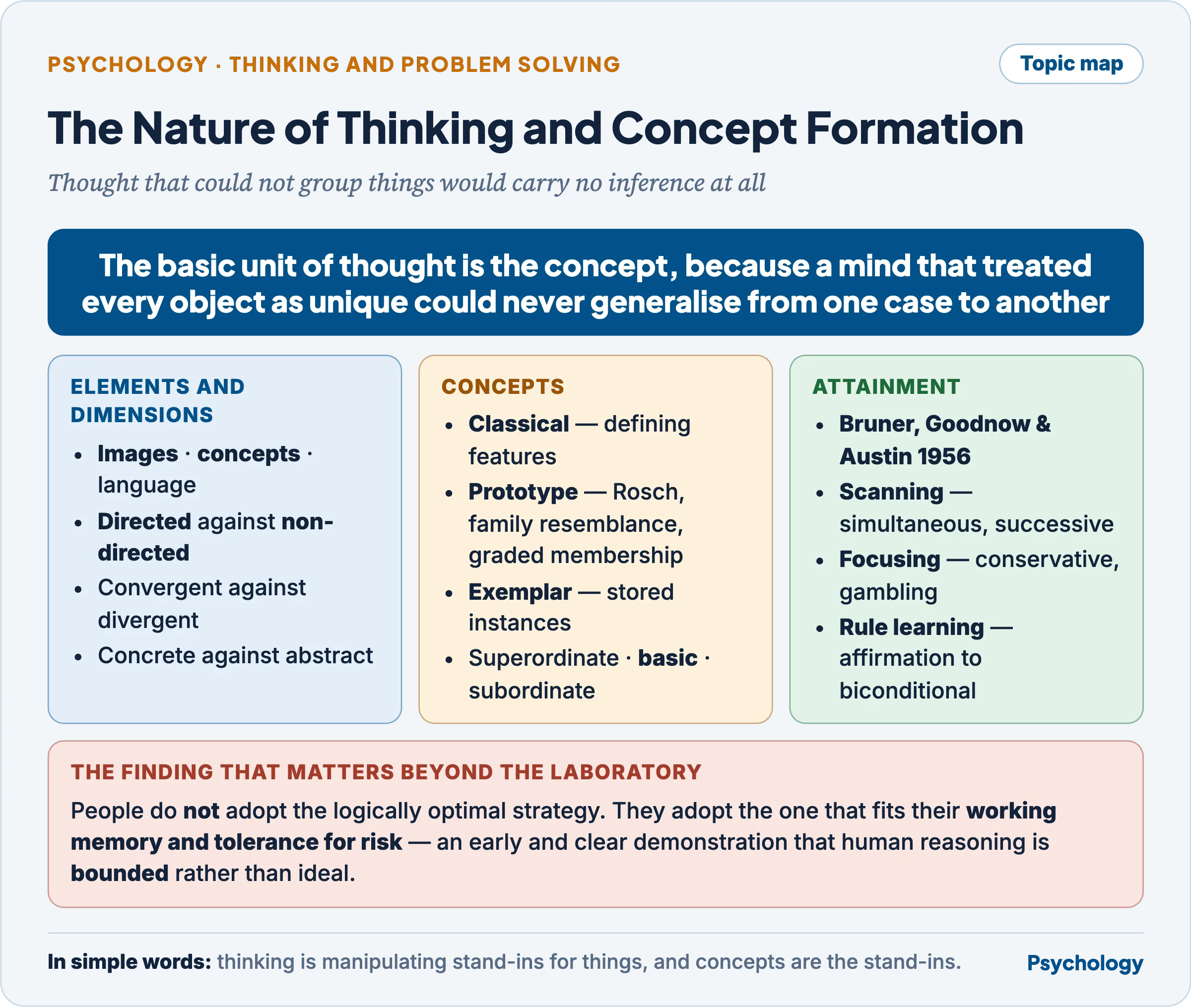
The elements and the dimensions of thought
The elements — what thinking is made of.
- Images — sensory representations standing in for absent objects, chiefly visual but available in every modality. Mental rotation studies show these are manipulated in ways that preserve spatial structure.
- Concepts — categories, the main economiser of thought.
- Language and symbols, which make abstraction, precision and transmission possible, and which carry thought that imagery cannot.
- Muscular responses. The behaviourist claim, associated with Watson, that thinking is subvocal speech is not sustainable — curare-induced paralysis abolishes all muscular activity and leaves thought intact — but covert motor activity does accompany some thinking, and the claim’s failure is instructive about what thought is not.
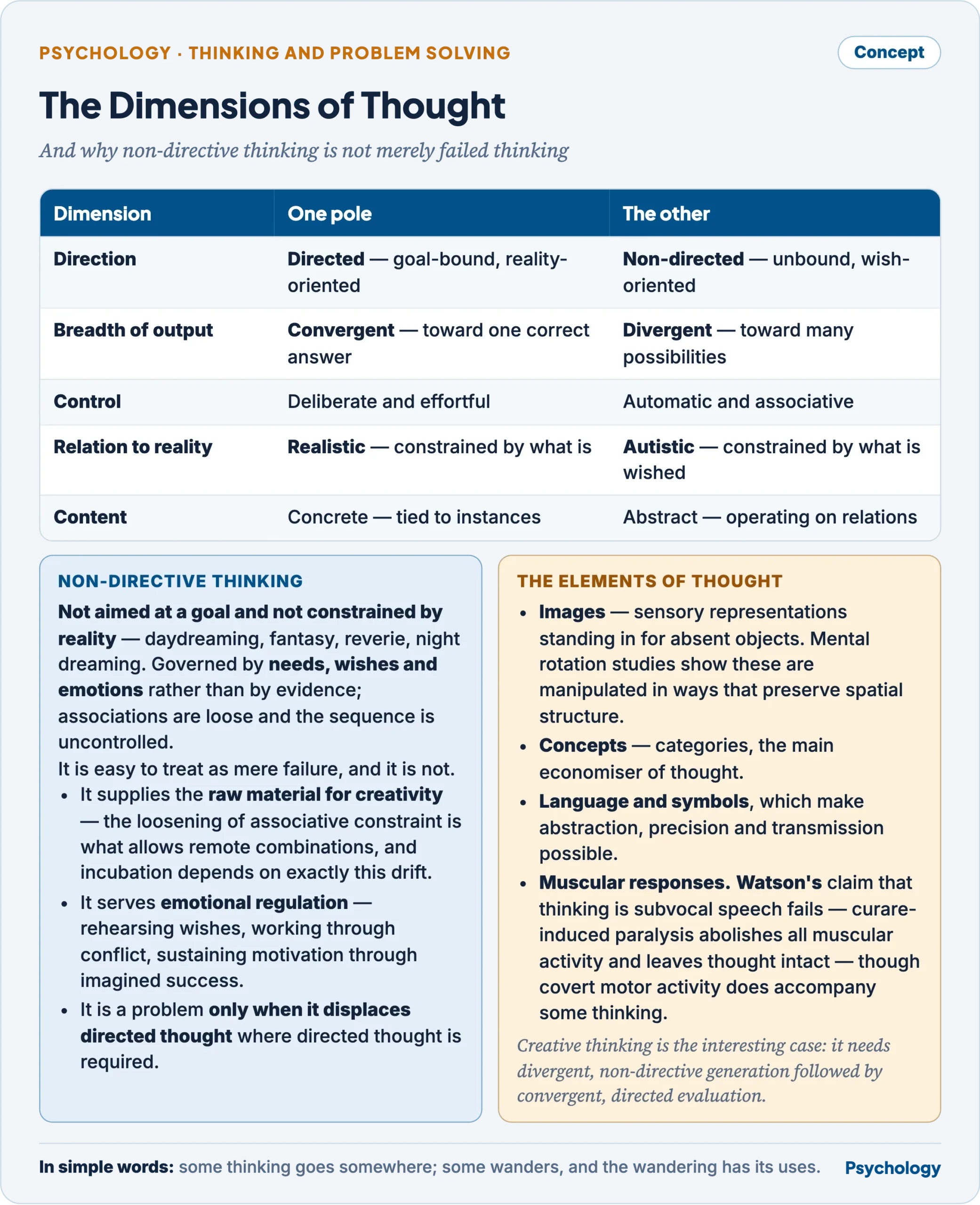
The dimensions, which are the categories a question on “dimensions of thought processes” is asking for.
| Dimension | One pole | The other |
|---|---|---|
| Direction | Directed — goal-bound, reality-oriented | Non-directed — unbound, wish-oriented |
| Breadth of output | Convergent — toward one correct answer | Divergent — toward many possibilities |
| Control | Deliberate and effortful | Automatic and associative |
| Relation to reality | Realistic — constrained by what is | Autistic — constrained by what is wished |
| Content | Concrete — tied to objects and instances | Abstract — operating on relations and symbols |
Non-directive thinking
Non-directive or autistic thinking is not aimed at a goal and not constrained by reality. It includes daydreaming, fantasy, reverie and night dreaming, and it is governed by the thinker’s needs, wishes and emotions rather than by evidence. Its associations are loose, its sequence is not controlled, and it is not evaluated against an external criterion as it proceeds.
It is easy to treat as mere failure, and it is not.
- It supplies the raw material for creativity. The loosening of associative constraint is what allows remote combinations, and the incubation phase of creative work depends on precisely this unconstrained drift. Divergent thinking and non-directive thinking overlap heavily, which is why a question can reasonably ask about thought processes in relation to concept and creativity in the same breath.
- It serves emotional regulation — rehearsing wishes, working through conflict, sustaining motivation through imagined success.
- It is a problem only when it displaces directed thought where directed thought is required, which is its clinical significance.
Directed thinking is the complement: goal-bound, sequential, reality-constrained and evaluated as it proceeds. Reasoning, problem solving, decision making and concept formation are all forms of it. Creative thinking is the interesting case, because it requires both — divergent, non-directive generation followed by convergent, directed evaluation.
Concepts
A concept is a mental category grouping objects, events or ideas that share common properties, which allows them to be treated as equivalent for the purposes of thought.
What concepts are for.
- Cognitive economy. They reduce an unmanageable diversity of particulars to a manageable number of classes.
- Inference. Knowing that something is a mammal licenses conclusions nobody has told you about this individual.
- Communication. A shared category makes a single word do the work of a description.
- Organisation of memory, since material is stored and retrieved by category.
- The units of problem solving, which is the role that makes them central to this unit.
Types of concept.
- By rule of combination: conjunctive (red and square), disjunctive (red or square), relational (larger than, between).
- By abstractness: concrete (chair, dog, defined by perceptible features) against abstract (justice, inflation, defined by relations).
- By origin: natural categories, acquired informally and with fuzzy boundaries, against artificial or formal ones, defined by explicit rules.
- By level: superordinate (furniture), basic (chair) and subordinate (armchair). The basic level is special — learnt first by children, named fastest, and the level at which category members share most features while remaining distinguishable from other categories.
How concepts are structured. The classical view holds that a concept is a set of necessary and sufficient defining features, with membership all-or-none. It fails for most natural categories: nobody can state defining features for game or furniture, and members are plainly not equal — a robin is a better bird than a penguin. Rosch’s prototype view replaces definition with family resemblance and a prototype, the central tendency of the category, with membership graded by similarity to it. The exemplar view dispenses even with the prototype, holding that categories are represented by stored instances. Prototype and exemplar accounts each explain part of the evidence, and the classical view survives only for formal categories such as odd number.
The processes of concept formation
- Abstraction — isolating the features common to the instances while disregarding the rest.
- Generalisation — extending the category to new instances sharing those features.
- Discrimination — excluding instances that lack them, which is what prevents over-extension.
- Hypothesis testing — forming a tentative rule and checking it against further instances, which is the active, strategic core of the process.
- Labelling — attaching a word, which stabilises the category and makes it communicable.
Bruner’s attainment strategies
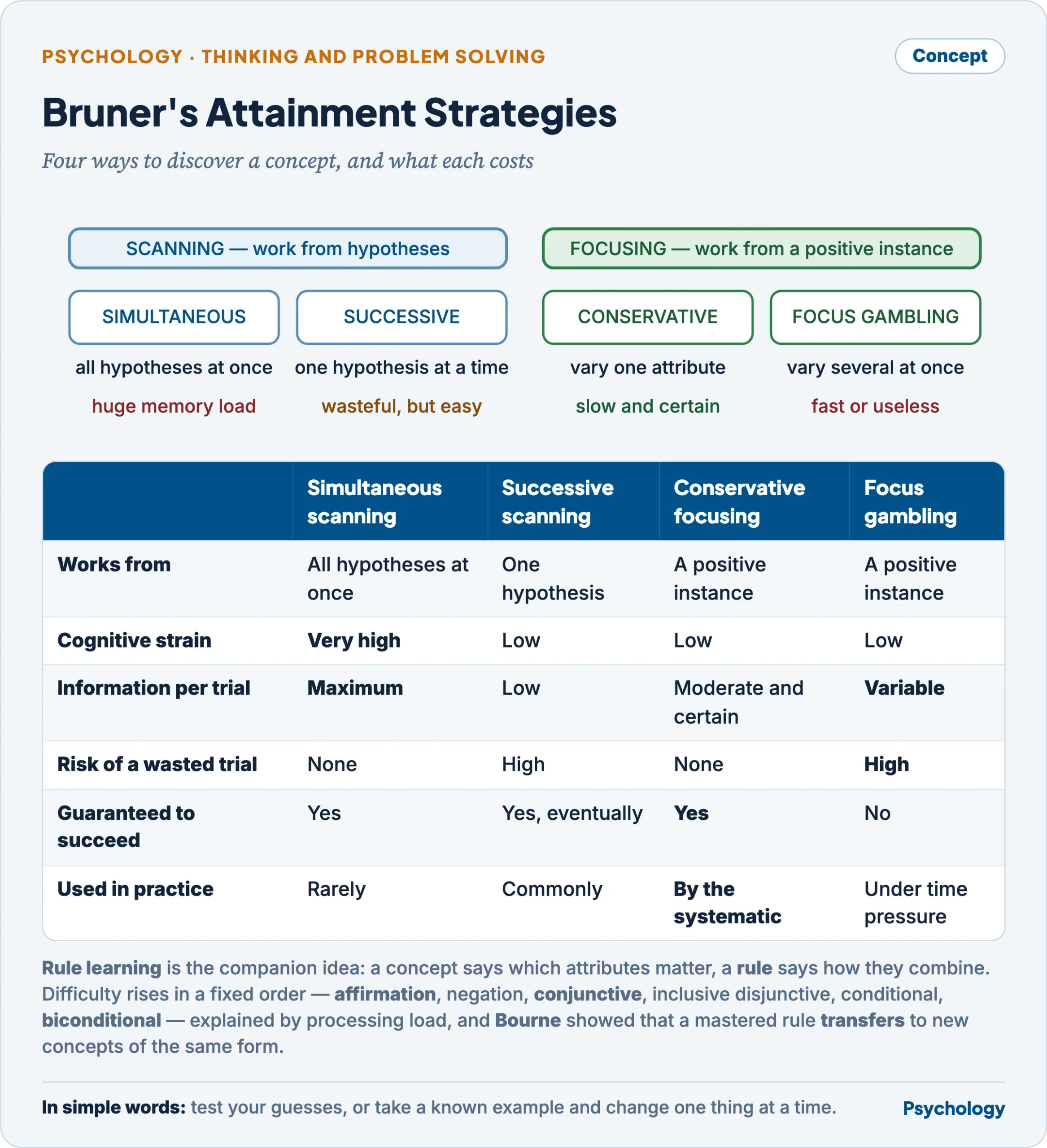
Bruner, Goodnow and Austin (1956) gave participants arrays of cards varying on several attributes and asked them to discover the experimenter’s concept by selecting cards and being told whether each was an instance. The strategies people used fall into two families, and the comparison between them is the substance of the topic.
Scanning strategies — working with hypotheses about the whole concept.
- Simultaneous scanning. The thinker holds all hypotheses still consistent with the evidence and eliminates those each new instance rules out. Logically the most efficient — every selection carries maximum information — and it places an enormous load on memory and inference, so it is rarely sustained in practice.
- Successive scanning. The thinker tests one hypothesis at a time, choosing instances that bear on it, and moves to another when it fails. Very low cognitive strain, intuitive, and wasteful: information that would have eliminated several hypotheses at once is discarded, so it takes many more trials.
Focusing strategies — working from a known positive instance rather than from hypotheses.
- Conservative focusing. Take a confirmed positive instance as the focus and alter exactly one attribute at a time. If the altered card is still an instance, that attribute is irrelevant; if not, it is part of the concept. Slow but certain, imposing little strain, and it cannot fail to reach the concept.
- Focus gambling. Alter more than one attribute at a time. If the result is still positive, several attributes are eliminated at a stroke and the solution arrives far faster; if negative, the trial is uninformative because it cannot be known which change mattered. A gamble in the exact sense: high variance, with an expected gain only if the risk pays.
| Simultaneous scanning | Successive scanning | Conservative focusing | Focus gambling | |
|---|---|---|---|---|
| Works from | All hypotheses at once | One hypothesis | A positive instance | A positive instance |
| Cognitive strain | Very high | Low | Low | Low |
| Information per trial | Maximum | Low | Moderate and certain | Variable |
| Risk of a wasted trial | None | High | None | High |
| Guaranteed to succeed | Yes | Yes, eventually | Yes | No |
| Used in practice | Rarely | Commonly | Commonly, by the systematic | By those under time pressure |
The finding that matters beyond the laboratory: people do not adopt the logically optimal strategy. They adopt the one that fits their working memory and tolerance for risk, which is an early and clear demonstration that human reasoning is bounded rather than ideal.
Rule learning
A concept specifies which attributes are relevant; a rule specifies how those attributes combine. Learning the attributes and learning the rule are separable, and a person may know that colour and shape matter without knowing whether the concept requires both or either.
| Rule | Form | Example concept | Relative difficulty |
|---|---|---|---|
| Affirmation | Has attribute A | All red cards | Easiest |
| Negation | Does not have A | All cards that are not red | Easy |
| Conjunctive | A and B | Red and square | Moderate |
| Inclusive disjunctive | A or B or both | Red or square | Hard |
| Conditional | If A then B | If red, then square | Harder |
| Biconditional | A if and only if B | Red exactly when square | Hardest |
The ordering is robust and is explained by processing load: a conjunctive rule requires holding two conditions that must both hold, while a biconditional requires checking both directions of an implication. Bourne’s work established that rule learning transfers — once a rule form is mastered, new concepts using the same form are learnt much faster, which shows the rule is acquired as an abstraction in its own right.
What influences concept formation, and how concepts serve problem solving
Influencing factors: the learner’s age and cognitive maturity; intelligence and working memory capacity; language, which supplies labels and so stabilises categories; prior knowledge, which determines what can be assimilated; the number and variety of positive instances, since variety is what permits the irrelevant features to be discarded; the availability of negative instances, which are more informative than learners believe and are systematically under-used; feedback; the salience of relevant attributes against the number of irrelevant ones; motivation and attention; and culture, which determines which distinctions are worth drawing at all.
In children, concepts develop from concrete to abstract. Vygotsky’s block studies describe the sequence: unorganised heaps, then complexes in which items are grouped by shifting and associative criteria rather than by one consistent attribute, then pseudoconcepts that look adult from outside while being built on perceptual similarity, and finally true concepts governed by a stable abstract rule. Word learning shows the same movement through over-extension (every man is “daddy”) and under-extension (only the family pet is a “dog”).
How concepts help problem solving. They reduce the problem’s complexity by replacing particulars with classes; they allow a new problem to be recognised as of a familiar type, which is the whole of expertise; they license inference, so that properties need not be rediscovered for each instance; they supply the units of the problem space; and they make transfer possible, since a solution attached to a category carries to every member of it. A problem solver without the relevant concepts is reduced to trial and error, which is precisely the novice’s position.
The information-processing view, and the computer analogy
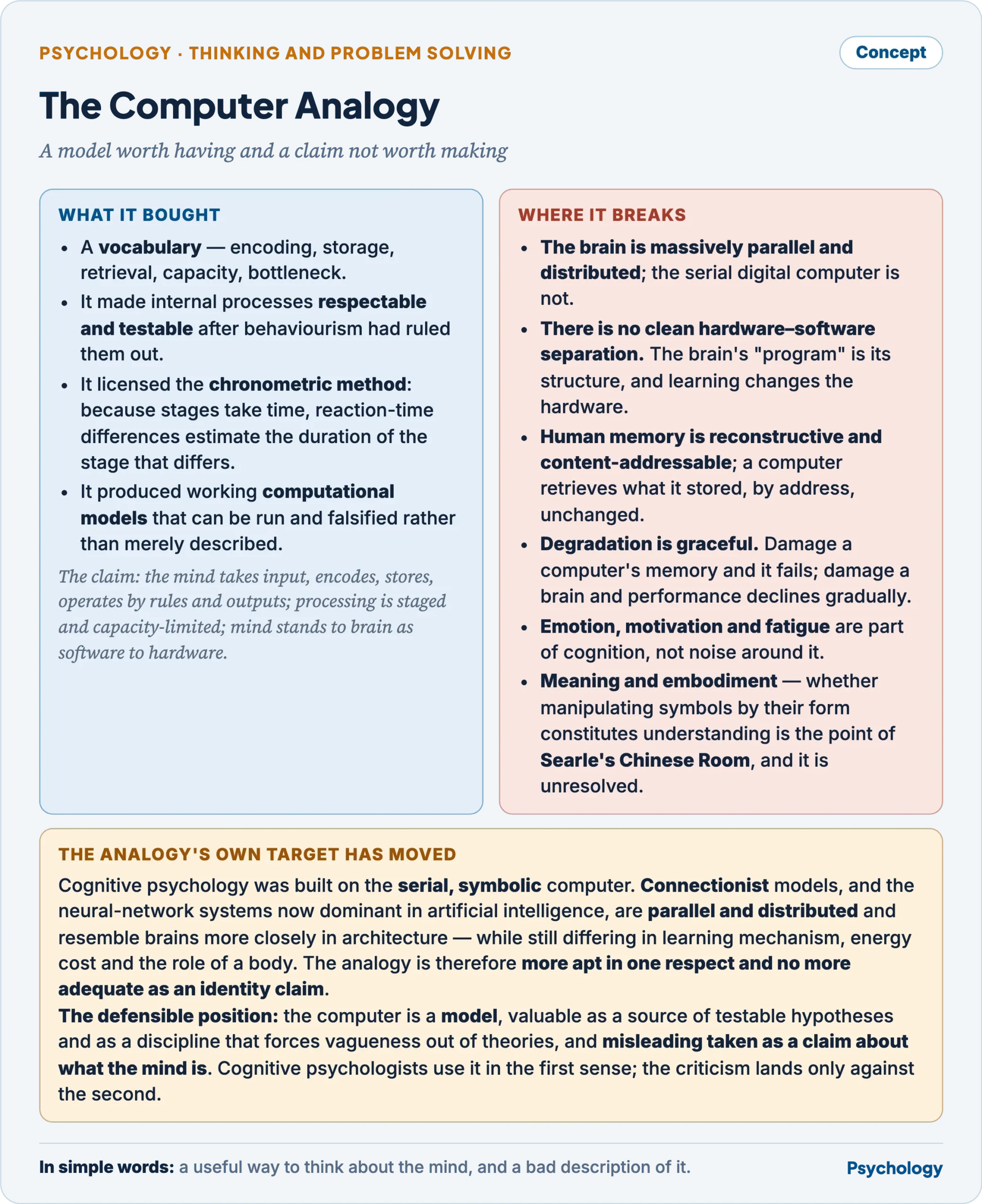
Cognitive psychology was built on the analogy between mind and computer, and evaluating it is a standing question.
What the analogy claims: that the mind takes in input, encodes it into a representation, stores it, operates on it by rules, and produces output; that processing occurs in identifiable stages with limited capacity; and that the mind stands to the brain as software to hardware, so that cognition can be described without describing neurons.
What it bought — and it was a great deal. It supplied a vocabulary of encoding, storage, retrieval and capacity; it made internal processes respectable and testable after behaviourism had ruled them out; it licensed the chronometric method, inferring stages from reaction times; and it produced working computational models that could be run and falsified rather than merely described.
Where it breaks, which is what a critical answer must supply.
- The brain is massively parallel and distributed; the serial digital computer is not. Representations are spread across populations of neurons rather than stored at addresses.
- There is no clean hardware–software separation. The brain’s “program” is its structure, and learning changes the hardware — a distinction the analogy depends on and biology does not respect.
- Human memory is reconstructive and content-addressable. A computer retrieves what it stored, by address, unchanged; people reconstruct, and reach memories by meaning and partial cues.
- Degradation is graceful. Damage a computer’s memory and it fails; damage a brain and performance declines gradually, which is what a distributed representation predicts.
- Emotion, motivation and fatigue are not noise around cognition but part of it, and the analogy has no place for them.
- Meaning and embodiment. A computer manipulates symbols by their form; the central question of whether that constitutes understanding is the point of Searle’s Chinese Room argument, and it is unresolved.
- The analogy’s own target has moved. Cognitive psychology was built on the serial, symbolic computer. Connectionist models, and the neural-network systems now dominant in artificial intelligence, are parallel and distributed and resemble brains more closely in architecture while still differing in learning mechanism, energy cost and the role of a body. The analogy is therefore more apt in one respect and no more adequate as an identity claim.
The defensible position: the computer is a model, valuable as a source of testable hypotheses and as a discipline that forces vagueness out of theories, and misleading when taken as a claim about what the mind is. Cognitive psychologists use it in the first sense; the criticism lands only against the second.
Criticisms and limitations
- The concept-attainment paradigm is artificial. Bruner’s cards have small numbers of clearly separable attributes, perfect feedback and an experimenter who knows the answer. Natural categories have fuzzy boundaries, correlated features, no feedback and no guarantee a rule exists.
- The classical view underlying rule learning is largely false for natural concepts, so an elegant literature describes a kind of concept people rarely form outside laboratories.
- “Thinking” is not one process. Grouping imagery, reasoning, concept formation and daydreaming under one heading groups phenomena with very different mechanisms.
- Non-directive thinking is under-researched relative to its likely importance, because it is hard to measure and harder to control.
- Culture is treated as a variable rather than as constitutive. Which categories are drawn, how abstraction is valued, and whether a formal rule is the expected answer all vary, and most of the paradigm’s evidence comes from schooled Western samples.
- Indian work is thin on concept attainment specifically, though the cross-cultural finding that categorisation by function against by taxonomy varies with schooling bears directly on how these tasks should be read in Indian settings.
Previous Year Questions
- 2019Define ‘concept’. Illustrate different types of concepts and processes involved in the formulation of the same.
- 2009What is non directive thinking? Discuss different dimensions of thought processes in relation to concept and creativity.
- 2014What is meant by rule learning? Describe some important rules along with description of the concepts related to each rule.
- 2012Discuss various dimensions of thought processes in relation to concept.
- 2016“Cognitive psychologists often use computer as an analogy to explain the relation between cognition and brain.” Discuss.
- 2007How do concepts help problem solving? Discuss the factors which influence concept formation.
- 1999Explain the scanning and the focusing strategies in attainment of concepts.
- 1998Highlight with examples the strategies of concept formation in children.