

Long term memory.
Official Syllabus: Paper I · Unit 7 Memory
“Episodic memory makes possible mental time travel through subjective time, from the present to the past, thus allowing one to re-experience one’s own previous experiences.”
— Endel Tulving (2002), on what distinguishes remembering from knowing
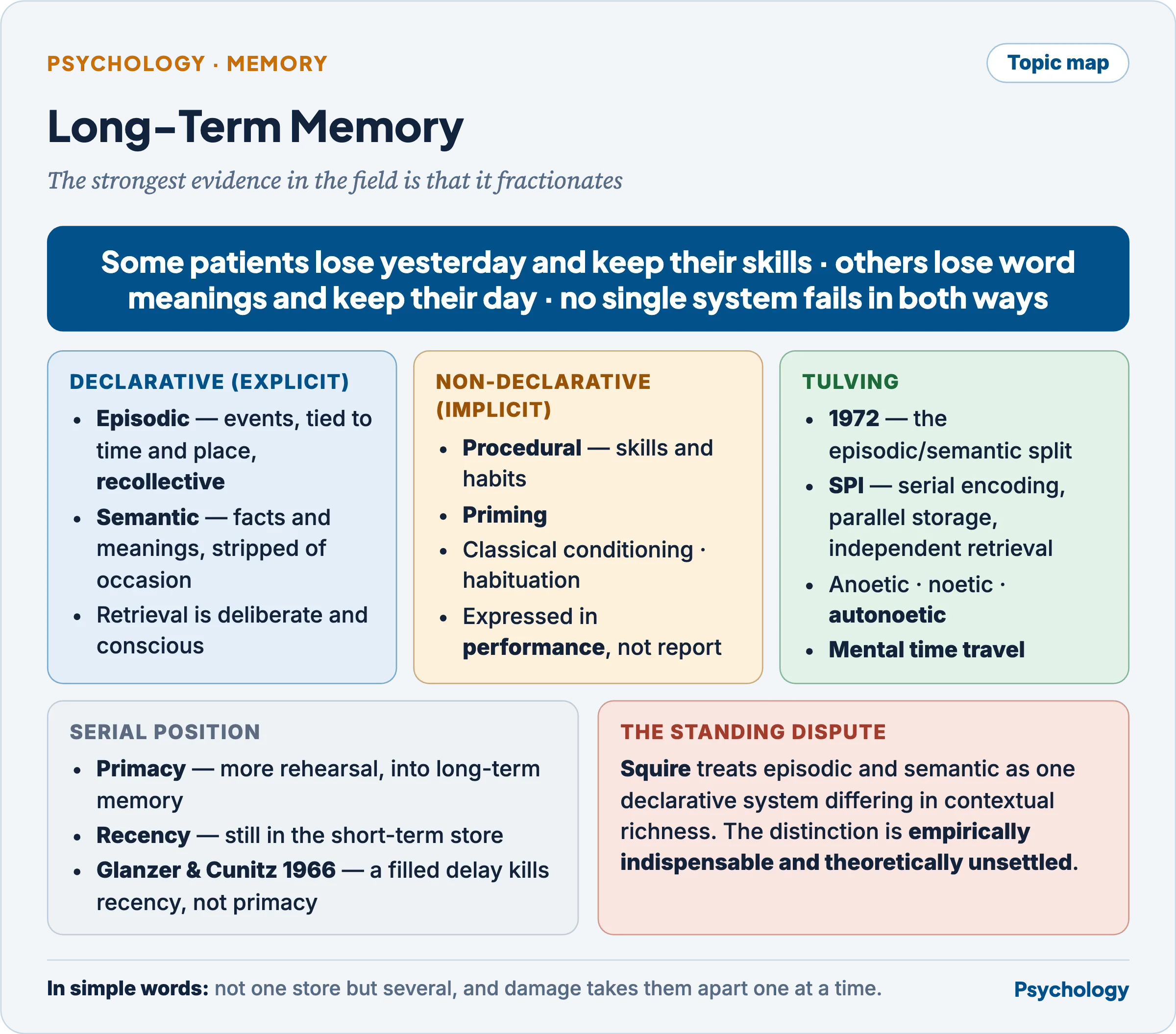
Long-term memory is not one store with one set of properties. The strongest evidence in the whole of memory research is that it fractionates: patients lose the ability to remember what happened yesterday while retaining the ability to acquire new skills, and others lose knowledge of what words mean while retaining the ability to recount their own day. No single system can be damaged in both those ways.
The taxonomy
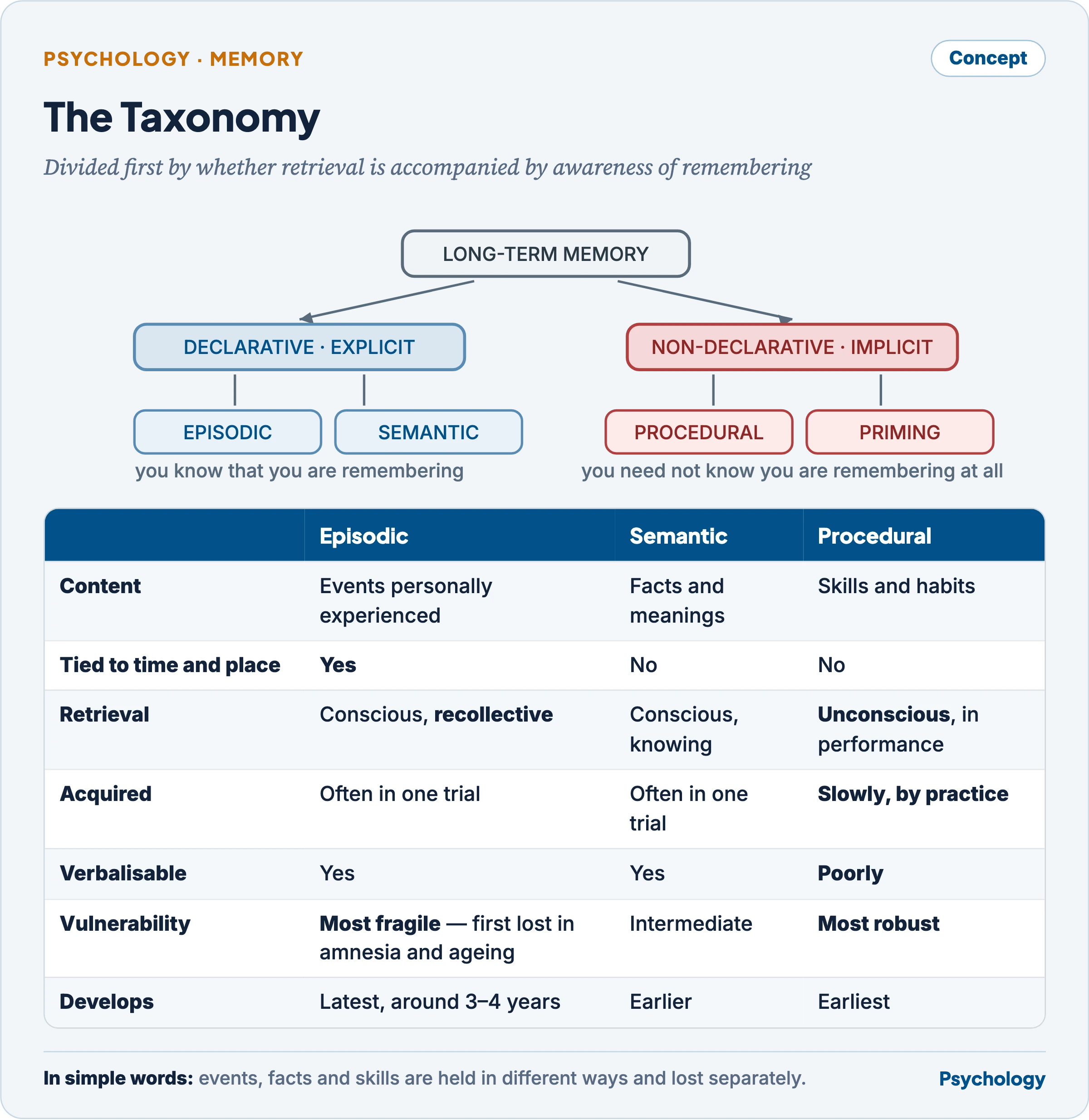
The primary division is by whether retrieval is accompanied by awareness of remembering.
- Declarative, or explicit, memory — knowledge that can be consciously brought to mind and stated. Retrieval is deliberate and the person knows they are remembering.
- Episodic memory — personally experienced events, bound to a time and a place. “I ate dal and rice at about one o’clock yesterday, at the table by the window.” Retrieval is recollective: one re-experiences rather than merely knows.
- Semantic memory — general knowledge, facts and meanings, stripped of the occasion on which they were acquired. “Delhi is the capital of India.” Almost nobody can say when or where they learnt this, which is precisely the point.
- Non-declarative, or implicit, memory — expressed through changed performance rather than through report. The person need not know, and often does not know, that they are remembering anything.
- Procedural memory — skills and habits: cycling, typing, playing an instrument. Characteristically slow to acquire, durable, and hard to verbalise; attending to the components of a practised skill typically degrades it.
- Priming — facilitated processing of a stimulus because of recent exposure. Having seen elephant, one completes ele___ with it, without any recollection of having seen it.
- Classical conditioning of simple responses, and non-associative learning such as habituation.
| Episodic | Semantic | Procedural | |
|---|---|---|---|
| Content | Events, personally experienced | Facts and meanings | Skills and habits |
| Tied to time and place | Yes | No | No |
| Retrieval | Conscious, recollective | Conscious, knowing | Unconscious, in performance |
| Acquired | Often in one trial | Gradually, often one trial too | Slowly, by practice |
| Verbalisable | Yes | Yes | Poorly |
| Vulnerability | Most fragile — first lost in amnesia and ageing | Intermediate | Most robust |
| Develops | Latest, around age 3–4 | Earlier | Earliest |
Tulving’s model, and the case for and against it
Tulving (1972) proposed the episodic–semantic distinction, and later developed it into a system in which three memory systems stand in a hierarchy — procedural, semantic and episodic — each building on the one below. His SPI model holds that encoding is serial (material passes through the earlier systems to reach episodic), storage is parallel, and retrieval is independent, so episodic memory can fail while semantic retrieval succeeds.
He attached to each a form of consciousness: anoetic (non-knowing) for procedural, noetic (knowing) for semantic, and autonoetic (self-knowing) for episodic — the capacity to place oneself in a remembered past, which he called mental time travel.
What supports the distinction.
- Amnesia. Amnesic patients characteristically lose the ability to form new episodic memories while retaining old semantic knowledge, and can sometimes acquire new facts without any recollection of learning them.
- The double dissociation with semantic dementia. Patients with semantic dementia progressively lose word meanings and general knowledge while retaining recent autobiographical episodes; classical amnesia shows the reverse. Two patterns in opposite directions are difficult to produce from a single system.
- Imaging and anatomy. Episodic retrieval engages the hippocampus and prefrontal regions more than semantic retrieval; semantic knowledge is associated with anterior temporal cortex.
- Development. Semantic learning is evident well before the third year; reliable episodic recollection emerges later, which fits the hierarchical ordering.
- Future thinking. Patients unable to recall their own past are also unable to imagine their personal future in any detail — a striking confirmation that the system is for constructing scenarios in subjective time rather than for storing records.
What tells against it.
- The systems are not independent. An episodic memory of a meal requires semantic knowledge of what dal is. Material almost never belongs cleanly to one system, so experimental separation is difficult and most tasks are impure.
- Squire’s alternative treats episodic and semantic as one declarative system with two expressions served by the medial temporal lobe, differing in content and in how much contextual detail survives rather than in kind. On this view the dissociations reflect the greater contextual richness of episodic material, which makes it more vulnerable, not a separate system.
- Remember–know judgements, used to operationalise the distinction, may index confidence or trace strength rather than two kinds of awareness, which would make much of the supporting evidence circular.
- Semantic memory may be residue. Repeated episodes, losing their distinguishing context, could simply become semantic knowledge — in which case the two are stages of one continuum.
- It classifies better than it explains. It specifies what the systems are and says comparatively little about how encoding, storage and retrieval actually work within each.
The defensible position: the episodic–semantic distinction is empirically indispensable and theoretically unsettled. Whether it marks two systems or two ends of one is open; that it marks a real and clinically visible difference is not.
Explicit and implicit memory as separate systems
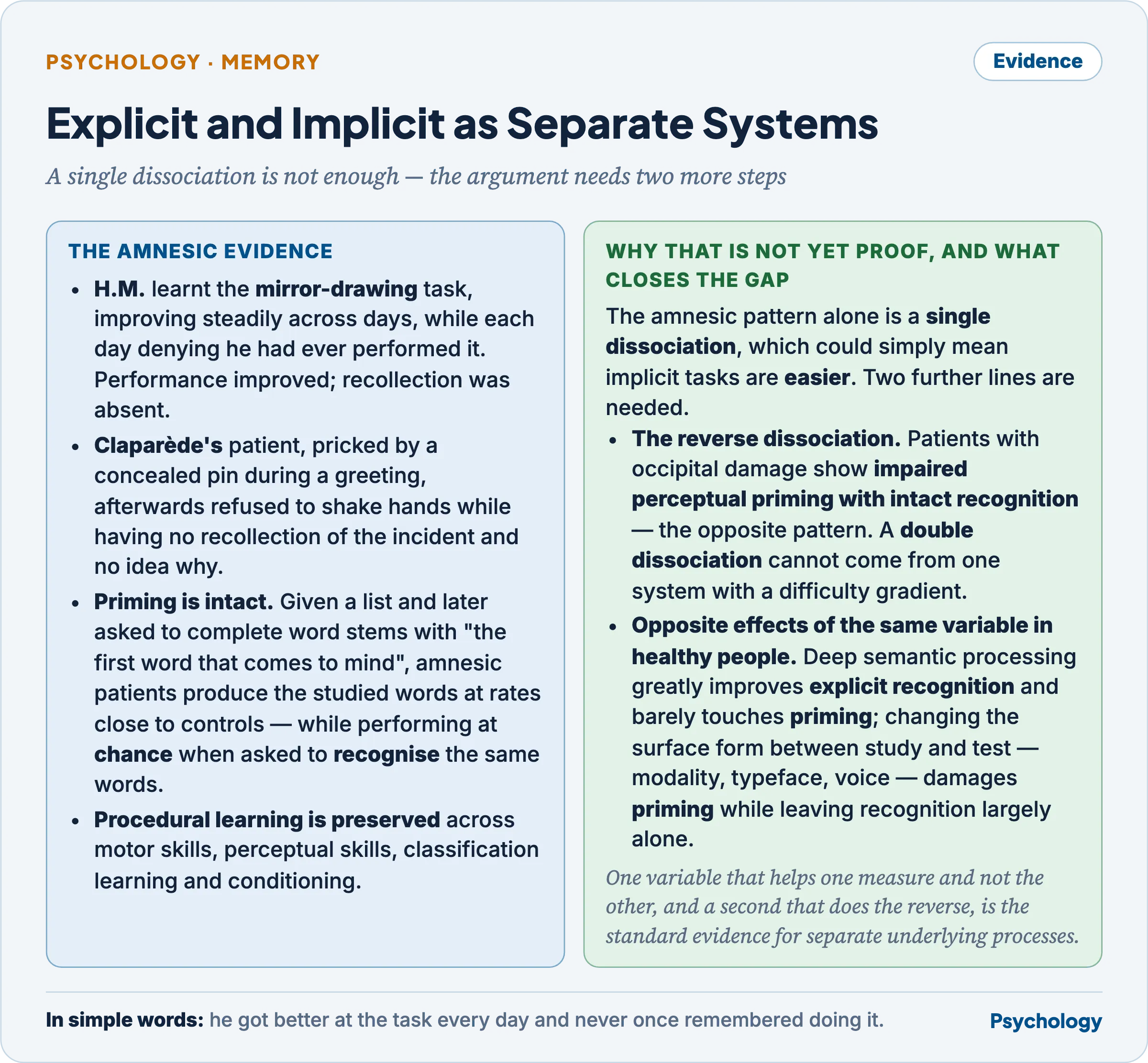
The evidence from amnesia is the clearest demonstration in the field that memory is not unitary.
- H.M. — Henry Molaison, whose medial temporal lobes including most of the hippocampus were removed bilaterally in 1953 to control intractable epilepsy — had profound anterograde amnesia for new facts and events. Yet he learnt the mirror-drawing task, improving steadily across days, while each day denying he had ever performed it before. Performance improved; recollection was absent.
- Claparède’s observation, long predating the modern framework, makes the same point: a patient with dense amnesia who was pricked by a concealed pin while being greeted subsequently refused to shake hands, while having no recollection of the incident and being unable to say why.
- Priming is intact in amnesia. Given a list of words and later asked to complete word stems with “the first word that comes to mind”, amnesic patients produce the studied words at rates close to controls — while performing at chance when asked to recognise the same words. The information is demonstrably stored and demonstrably unavailable to explicit retrieval.
- Procedural learning is preserved across a wide range: motor skills, perceptual skills, classification learning, and conditioned responses.
Why this shows the systems are separate. The amnesic pattern on its own is a single dissociation, which could be explained by implicit tasks simply being easier. Two further lines close that gap.
- The reverse dissociation. Patients with damage to occipital cortex show impaired priming with intact recognition — the opposite pattern. A double dissociation cannot be produced by one system with a difficulty gradient.
- Opposite effects of the same variable in healthy participants. Deep, semantic processing at study greatly improves explicit recognition and has little effect on perceptual priming; changing the surface form between study and test — modality, typeface, voice — damages priming while leaving explicit recognition largely unaffected. A variable that helps one measure and not the other, and another that does the reverse, is the standard evidence for separate underlying processes.
The serial position effect
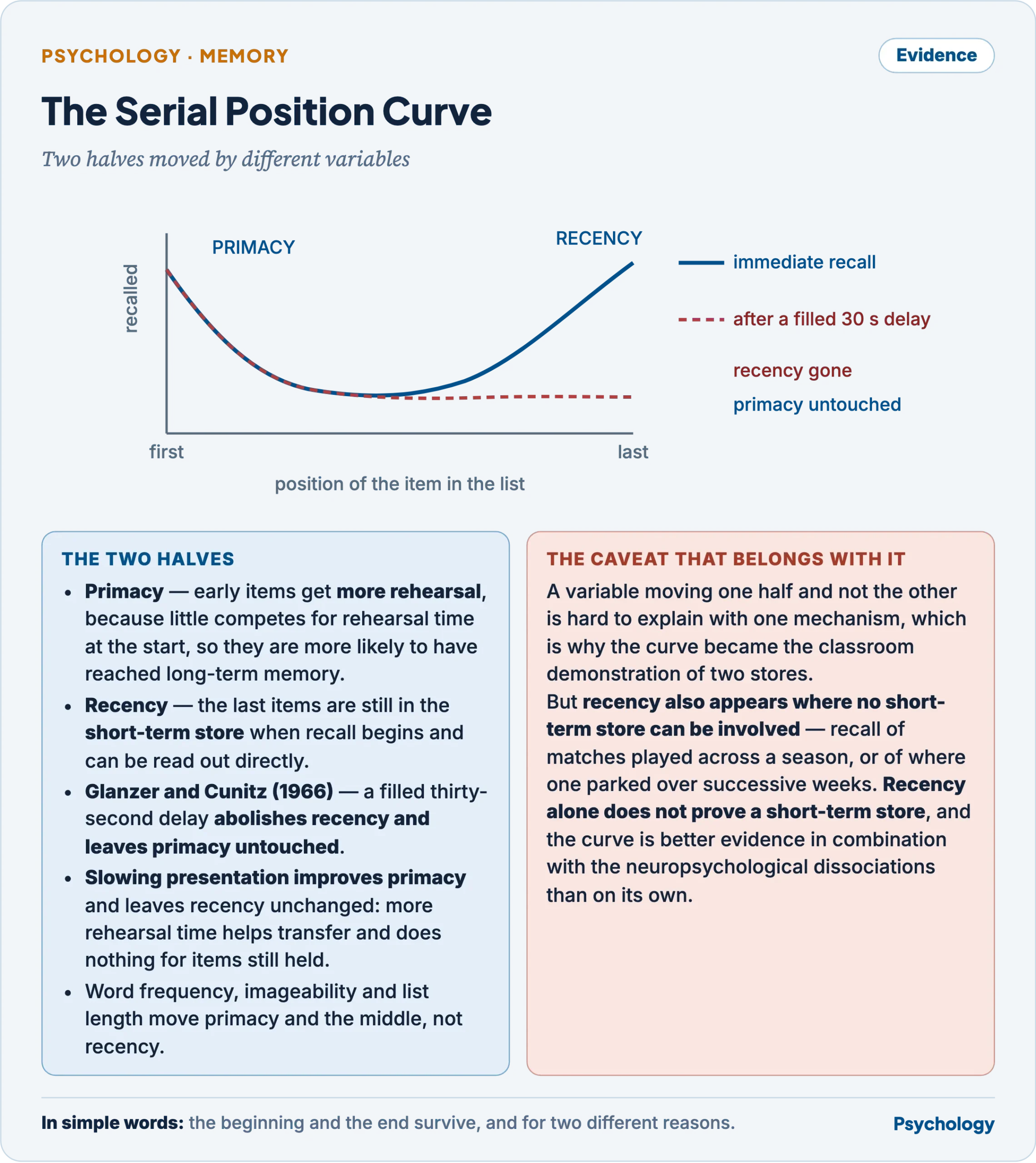
Free recall of a list produces a U-shaped curve: the first items and the last items are recalled better than those in the middle.
- Primacy — the advantage for early items. They receive more rehearsal, because at the start of the list there is little competing for rehearsal time, and so are more likely to have been transferred to long-term memory.
- Recency — the advantage for the last items. They are still in the short-term store at the moment recall begins, and can be read out of it directly.
The two effects are dissociated by different variables, which is what makes the curve evidence for two stores rather than one.
- Glanzer and Cunitz (1966) inserted a filled delay — counting backwards for thirty seconds — between the list and recall. Recency was abolished; primacy was untouched. The delay empties the short-term store and leaves long-term memory alone.
- Slowing presentation improves primacy and leaves recency unchanged, because more rehearsal time benefits transfer to long-term memory but does nothing for the final items still held in the short-term store.
- Word frequency, imageability and list length affect primacy and the middle of the curve, not recency.
A variable that moves one half of the curve and not the other is difficult to explain with a single mechanism, and the serial position curve became the standard classroom demonstration of the two-store architecture. The caveat belongs with it: recency also appears where no short-term store can be involved — recall of matches played across a season, or of where one parked over successive weeks — so recency alone does not prove a short-term store, and the curve is better evidence in combination with the dissociations than on its own.
Criticisms and limitations
- The taxonomy is a classification, not a theory. Naming five kinds of long-term memory describes what dissociates without explaining the mechanisms that differ.
- The number of systems is unsettled, ranging from two to five or more depending on the theorist, and new candidates are proposed whenever a new dissociation appears.
- Tasks are not process-pure. An “implicit” test can be contaminated by deliberate retrieval, and explicit tests can be supported by familiarity, which is why process-dissociation procedures were developed and why results differ with them.
- Most evidence is from patients, where damage is rarely confined to one structure and premorbid ability is unknown.
- Episodic memory in animals is contested precisely because autonoetic consciousness cannot be assessed behaviourally — the reason “episodic-like” is used for the animal findings.
- The cultural dimension is barely studied. What counts as a memorable personal event, how early childhood memories are rehearsed and valued within a family, and whether autobiographical narration is encouraged all vary considerably, and the age of the earliest reported memory differs across cultures — findings that sit uncomfortably with a purely structural account.
Previous Year Questions
- 2026Discuss various types of long-term memory. Explain how primacy and recency effect illustrate the serial position effect in transferring information from short-term memory to long-term memory.
- 2016Explain the phenomena of implicit and explicit memories. Also critically evaluate Tulving’s model of long-term memory.
- 2015Citing studies on amnesia show how the explicit and implicit memory systems are separate.