

The Multistore model.
Official Syllabus: Paper I · Unit 7 Memory
“The memory system is to be regarded as comprising three stores, with control processes under the subject’s command determining what passes between them.”
— Richard Atkinson and Richard Shiffrin (1968), introducing the model that organised the field
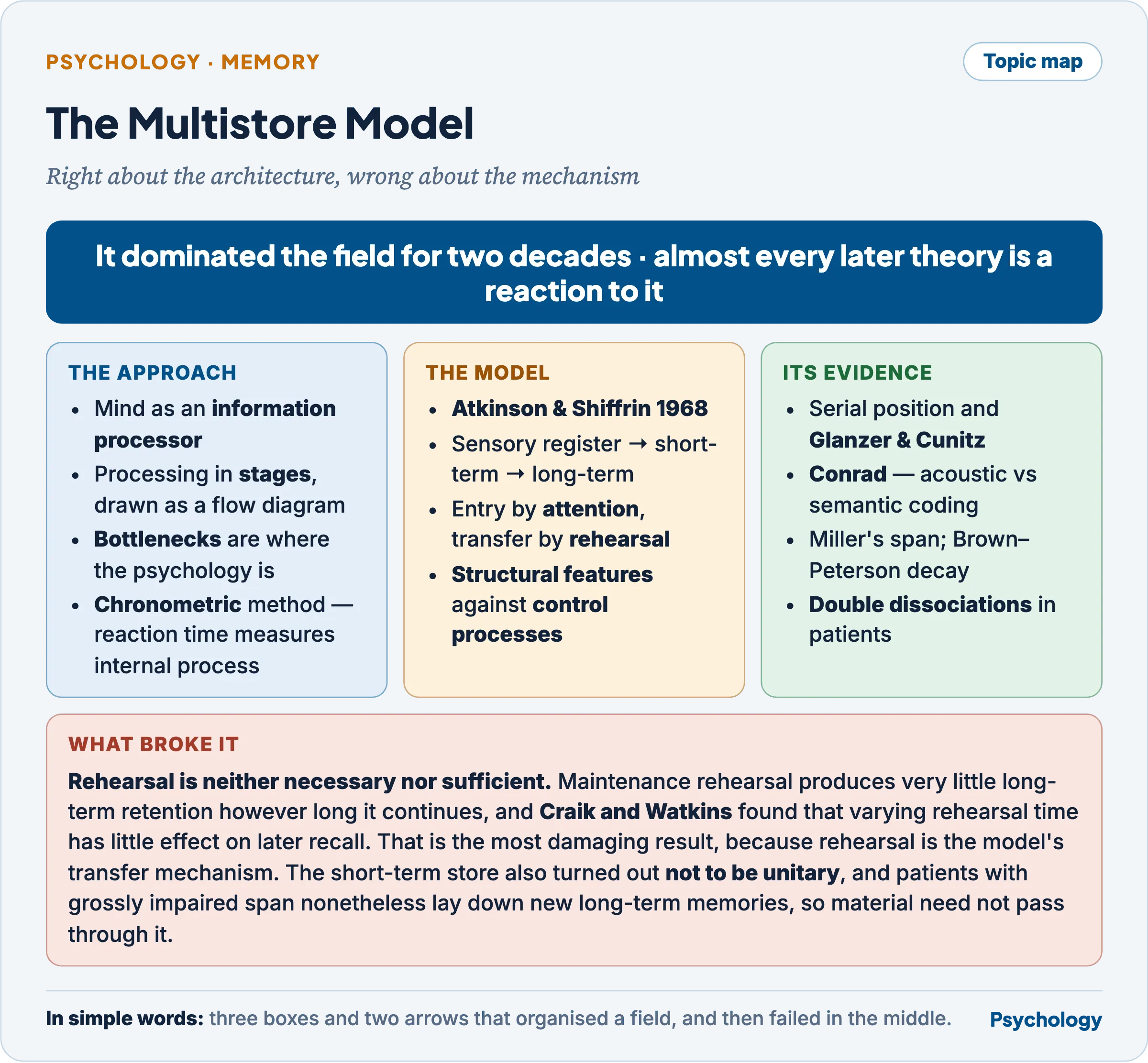
The information-processing approach treats the mind as a system that takes in information, transforms it through a series of stages, and produces output — the metaphor borrowed from the digital computer and from communication engineering. Applied to memory it produced the multistore model, which dominated the field for two decades and which almost every later theory is a reaction to.
The information-processing approach
- The mind is a system that processes information, describable in terms of the flow of information rather than of behaviour alone. Between stimulus and response lie stages that can be specified.
- Processing occurs in stages, each performing a transformation, so the whole can be drawn as a flow diagram with boxes and arrows. The stages were initially assumed serial — one completing before the next begins.
- Capacity is limited at identifiable points, and those bottlenecks are where the interesting psychology lies.
- The method is chronometric. Because stages take time, reaction time becomes a measure of internal process, and the difference between two conditions estimates the duration of the stage that differs.
- The mind is studied without its biology, at the level of the program rather than the hardware — which was both its liberation from behaviourism and the limitation later work had to repair.
How it differs from what preceded and what followed. Against behaviourism, it insists that what lies between stimulus and response is both real and specifiable, and it readmits internal representation as a scientific object. Against Gestalt psychology, it analyses into component stages rather than treating organisation as primary. Against the later connectionist approach, it assumes serial, symbolic processing where connectionism assumes parallel and distributed processing with no discrete stages and no separate stores. And against ecological approaches in Neisser’s later sense, it studies memory with impoverished laboratory materials rather than in the settings where memory is actually used.
The three stores
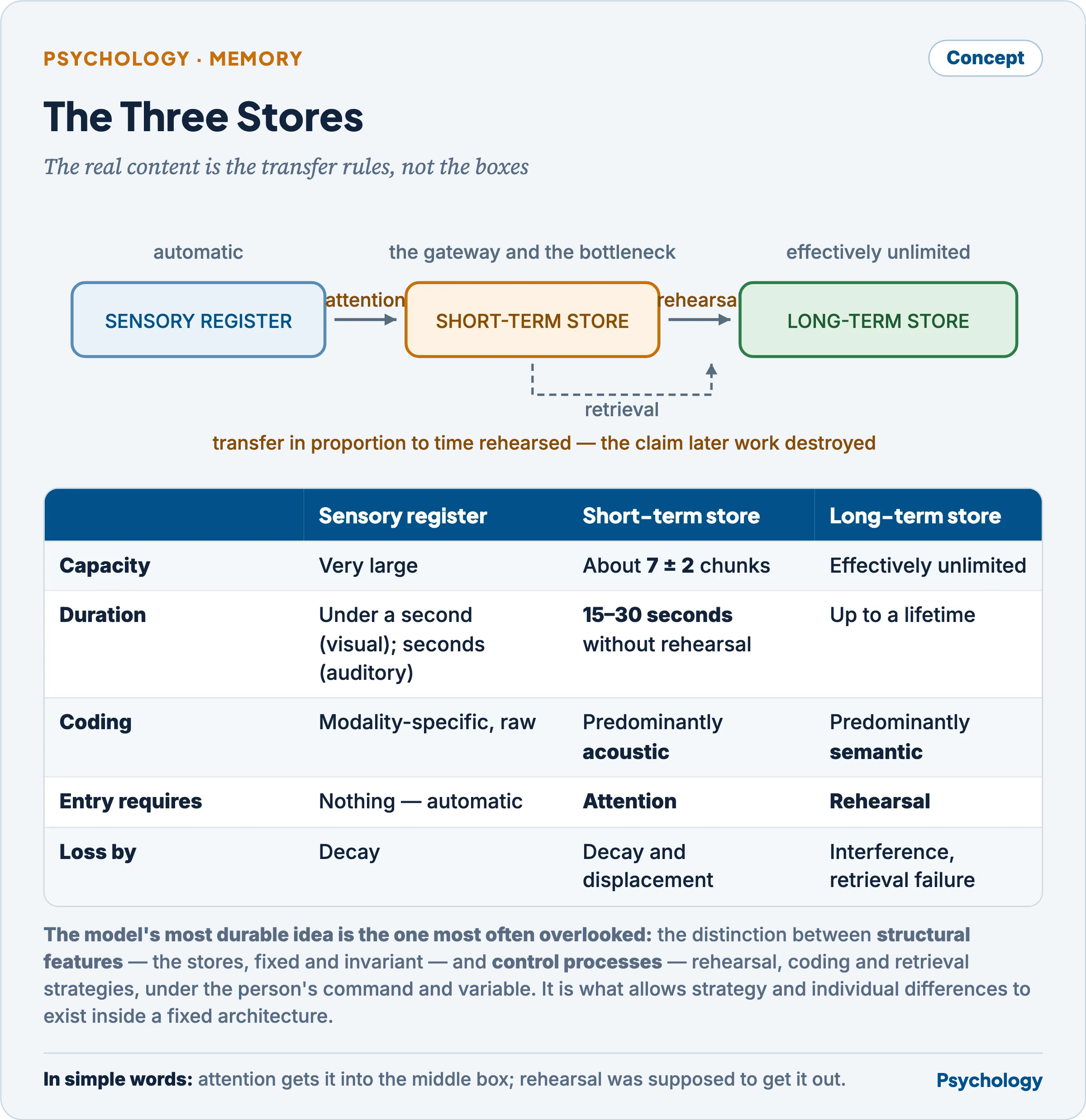
Atkinson and Shiffrin (1968) set out three structural components, with control processes operating on them.
| Sensory register | Short-term store | Long-term store | |
|---|---|---|---|
| Capacity | Very large | About 7 ± 2 chunks | Effectively unlimited |
| Duration | Under a second (visual); a few seconds (auditory) | 15–30 seconds without rehearsal | Up to a lifetime |
| Coding | Modality-specific, raw sensory | Predominantly acoustic | Predominantly semantic |
| Entry requires | Nothing — it is automatic | Attention | Rehearsal |
| Loss by | Decay | Decay and displacement | Interference, retrieval failure |
The model’s real content is the transfer rules: information enters the sensory register automatically, passes to the short-term store only if attended, and passes to the long-term store in proportion to how long it is rehearsed there. The short-term store is the gateway and the bottleneck, and rehearsal is the engine. This is the claim later work attacked.
The distinction between structural features — the stores, fixed and invariant — and control processes — rehearsal, coding, retrieval strategies, under the person’s command and variable — is often overlooked and is the model’s most durable idea. It is what allows individual differences and strategy to exist within a fixed architecture.
The evidence for it

- Serial position. The U-shaped free-recall curve has primacy from rehearsal into long-term memory and recency from the short-term store. Glanzer and Cunitz (1966) abolished recency with a filled thirty-second delay while leaving primacy intact; slowing presentation improves primacy and not recency. Different variables moving different parts of one curve is the model’s strongest single result.
- Coding differences. Conrad showed that errors in short-term recall of visually presented letters are acoustic; long-term errors are semantic. Two stores with different codes.
- Capacity and duration differences. Miller’s span of about seven, and the Brown–Peterson demonstration of loss within about eighteen seconds without rehearsal, give the short-term store properties the long-term store plainly lacks.
- Neuropsychological dissociations, which are the most compelling. Amnesic patients such as H.M. have a normal digit span and cannot form new long-term memories; patients with certain left parietal lesions show the reverse, a span of two items with normal long-term learning. A double dissociation of this kind is very hard to obtain from a single system.
The evidence against it
- Rehearsal is neither necessary nor sufficient. The model predicts that more rehearsal means better long-term memory. Maintenance rehearsal — rote repetition — produces very little long-term retention however long it continues, while a single instance of deep processing produces a great deal. Craik and Watkins showed that varying the time an item is held in rehearsal has little effect on later recall. This is the most damaging finding, because rehearsal is the model’s transfer mechanism.
- The short-term store is not unitary. Dual-task evidence shows verbal and spatial material interfering selectively, which a single box cannot explain. Baddeley and Hitch’s (1974) working memory replaces the box with a multi-component system, and the multicomponential account explains everything the unitary one does plus the selective interference.
- It is not simply a gateway. Patients with grossly impaired span nonetheless lay down new long-term memories, so material cannot have to pass through an intact short-term store on its way.
- Long-term recency. Recency effects appear over intervals of weeks, where no short-term store can be involved, so recency is not proof of one.
- It does not merely hold; it works. Reasoning, comprehension and arithmetic all require manipulation of held material, which the passive-store conception does not represent.
- Long-term memory is undifferentiated here, in the face of the episodic, semantic and procedural distinctions that later proved fundamental.
The McCrary–Hunter invariance hypothesis
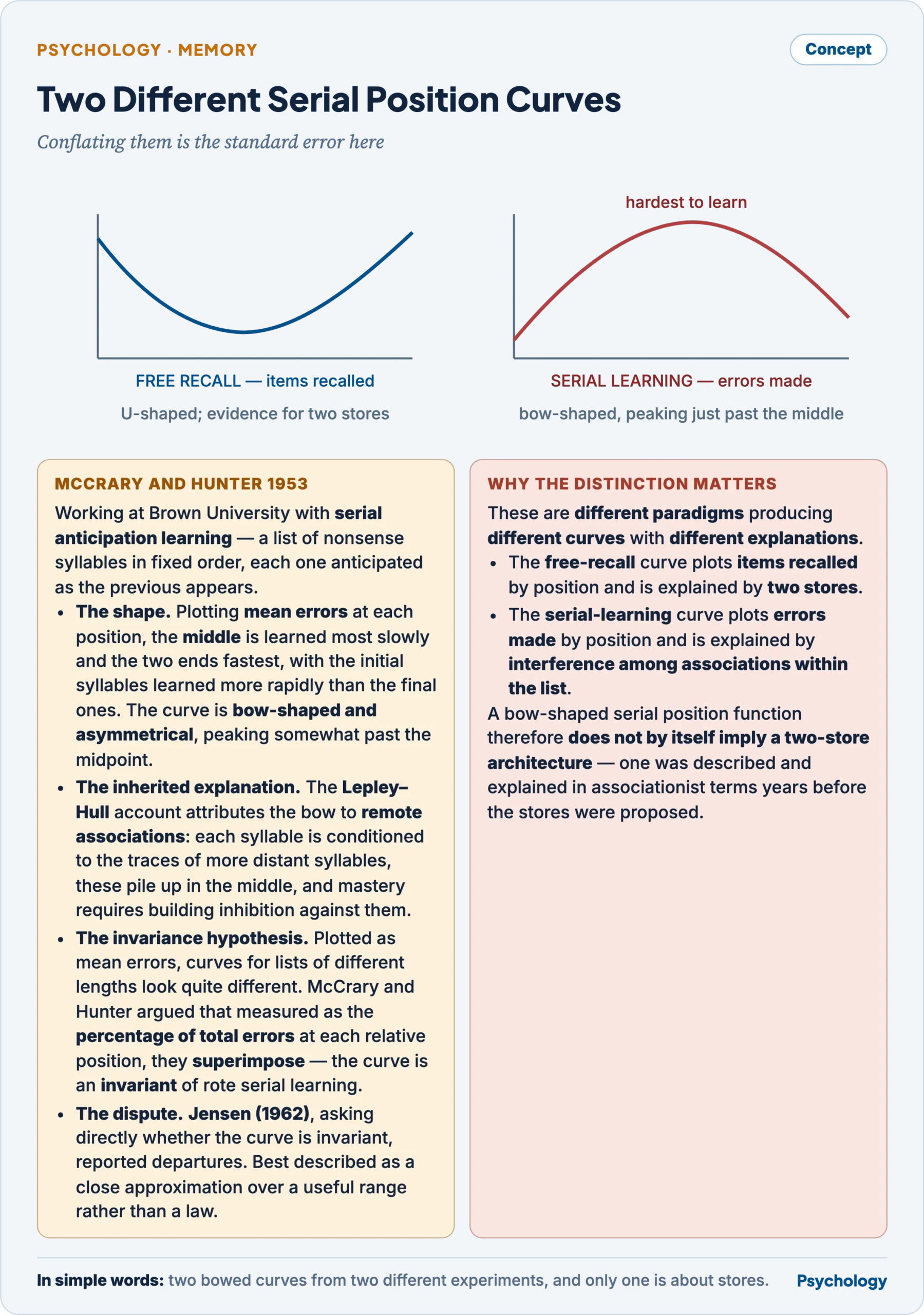
The serial position curve of free recall is the multistore model’s showpiece. A different and older serial position curve belongs to serial learning, and conflating the two is the standard error here.
McCrary and Hunter (1953), at Brown University, worked with serial anticipation learning: a list of nonsense syllables is presented in fixed order and the learner must anticipate each following syllable as the preceding one appears.
- The shape of the curve. Plotting mean errors at each serial position, the syllables in the middle of the list are learned most slowly and the two ends fastest, with the initial syllables learned more rapidly than the final ones. The curve is therefore bow-shaped and asymmetrical, with the maximum of errors somewhat past the midpoint of the list.
- The explanation they inherited. The Lepley–Hull account attributed the bow to remote associations: each syllable becomes conditioned not only to its neighbour but to the traces of more distant syllables, these remote excitatory tendencies pile up in the middle of the series, and mastery requires building inhibition against them. Inhibition is therefore concentrated in the middle, where errors are greatest.
- Their own contribution — the invariance hypothesis. Plotted as mean number of errors, curves for lists of different lengths and difficulties look quite different. McCrary and Hunter argued that if the unit of measurement is changed to the percentage of total errors occurring at each relative position, the curves superimpose. On that measure the serial position curve is an invariant property of rote serial learning — the same distribution of errors regardless of list length, material or difficulty.
- The dispute. The claim was tested repeatedly through the following decade, and Jensen (1962), asking directly whether the serial position curve is invariant, reported departures from it. The invariance is best described as a close approximation that holds over a useful range rather than as a law.
Why it matters for the multistore model. It is a different paradigm — serial anticipation rather than free recall — and a different curve, explained by interference among associations within the list rather than by two stores. Its existence is a reminder that a bow-shaped serial position function does not by itself imply a two-store architecture, since one was described and explained in associationist terms years before the stores were proposed.
Multistore against multicomponential: the standing assessment
- Right about the architecture, wrong about the mechanism. The evidence for distinct stores with different capacities, durations and codes has survived; the account of rehearsal as the transfer mechanism has not.
- Working memory supersedes it on the short-term store and explains everything multistore did in that region, plus selective interference, plus the correlation with reasoning and comprehension. On that component the multicomponential model is simply better.
- It is not a complete replacement. It says little about long-term memory, its central executive is underspecified, and the episodic buffer was added to absorb anomalies rather than predicted in advance.
- Levels of processing attacks a different flank — not how many stores there are but whether structure is the right question at all.
- Its lasting value is as a framework. The structural-versus-control distinction, the stage analysis and the vocabulary of encoding, storage and retrieval remain in use even among those who reject the boxes. It is best read as the organising scaffold of modern memory research rather than as a currently defended theory.
Criticisms and limitations
- The flow-diagram style invites over-literal reading. Boxes and arrows describe functional relations, and are easily taken for anatomical claims they were never meant to make.
- The serial assumption is false. Processing is substantially parallel and interactive, with later stages influencing earlier ones, which the strict stage model excludes.
- The computer metaphor misleads. Human memory is reconstructive, capacity-limited in ways a machine is not, and shaped by emotion and motivation that the model has no place for.
- Biology was excluded by design, and the neuropsychological evidence that now carries most of the argument had to be imported later.
- The evidence base is narrow — word lists, digits and nonsense syllables, tested immediately, in laboratories.
Previous Year Questions
- 2019“Multistore model of memory best explains the nature of memory.” Evaluate the statement in theoretical perspective and empirical evidences.
- 2013Describe and evaluate the modal model of short-term memory.
- 2012What is McCrary-Hunter ‘invariance hypothesis’? Discuss the shape and characteristics of serial position error curve in terms of ‘invariance hypothesis’.
- 2007Critically evaluate the efficacy of multi store and multi componential models of memory in the light of relevant experimental evidence.
- 1996Discuss the information-processing approach to the study of memory. How does it differ from other approaches? Describe the three interacting systems of memory implied in the approach.