

Short term memory; The Multistore model.
Official Syllabus: Paper I · Unit 7 Memory
“Working memory is not a store through which information passes, but a system for holding and manipulating information while performing complex tasks.”
— Alan Baddeley, on the difference between a box and a workspace
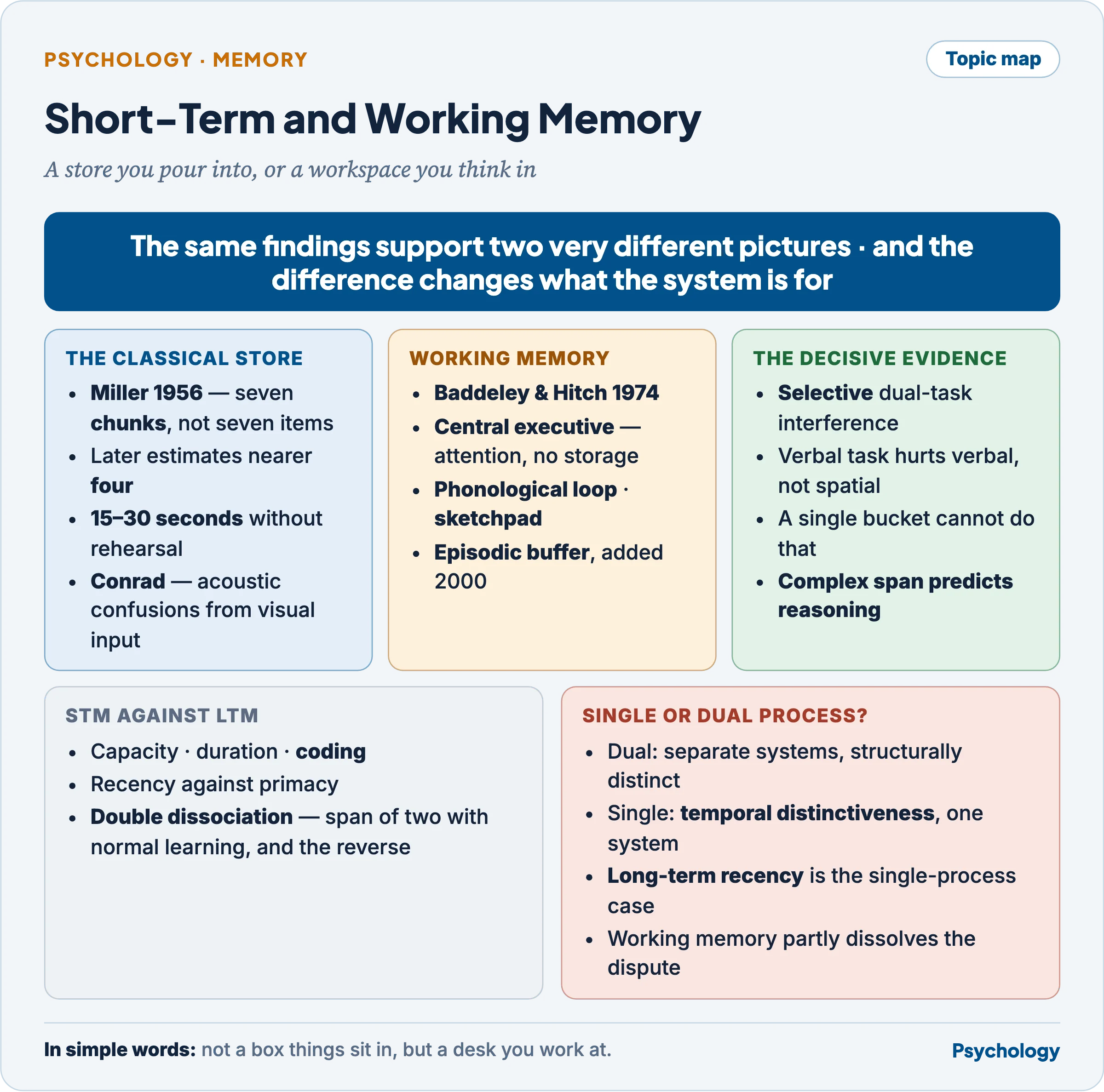
Short-term memory is the point at which the memory system is most obviously limited, and therefore the point at which its architecture shows most clearly. Two quite different accounts of it compete: one treats it as a store of small capacity from which material leaks away unless refreshed, and the other as a working system that holds and operates on material in the service of a current task. The difference is not a matter of emphasis; it changes what the system is for and what should be measured.
The classical short-term store
- Capacity. George Miller (1956), in The Magical Number Seven, Plus or Minus Two, observed that immediate memory span is about seven items across very different materials. The crucial move was that the unit is the chunk, not the item: a chunk is whatever the person treats as a single meaningful unit, so recoding raises capacity without any change in the store. A string of twelve digits is beyond span; the same digits as four familiar dates are not. Later estimates using methods that prevent chunking put true capacity closer to four units.
- Duration. Without rehearsal, material is lost in 15 to 30 seconds. The Brown–Peterson procedure demonstrates this: a trigram is presented, the participant counts backwards by threes to prevent rehearsal, and recall is tested after varying intervals. Performance falls sharply, with very little retained after about 18 seconds.
- Coding. Short-term memory codes material predominantly acoustically, even when it is presented visually. Conrad’s finding is the evidence: errors in recalling visually presented letters are acoustic confusions — B for V, P for T — rather than visual ones. Long-term memory, by contrast, codes semantically.
- Forgetting. Whether loss is by decay over time or by displacement and interference from incoming material is unsettled, and the Brown–Peterson result is open to both readings, since counting backwards both occupies time and introduces interfering material.
The leaky bucket against the working memory account
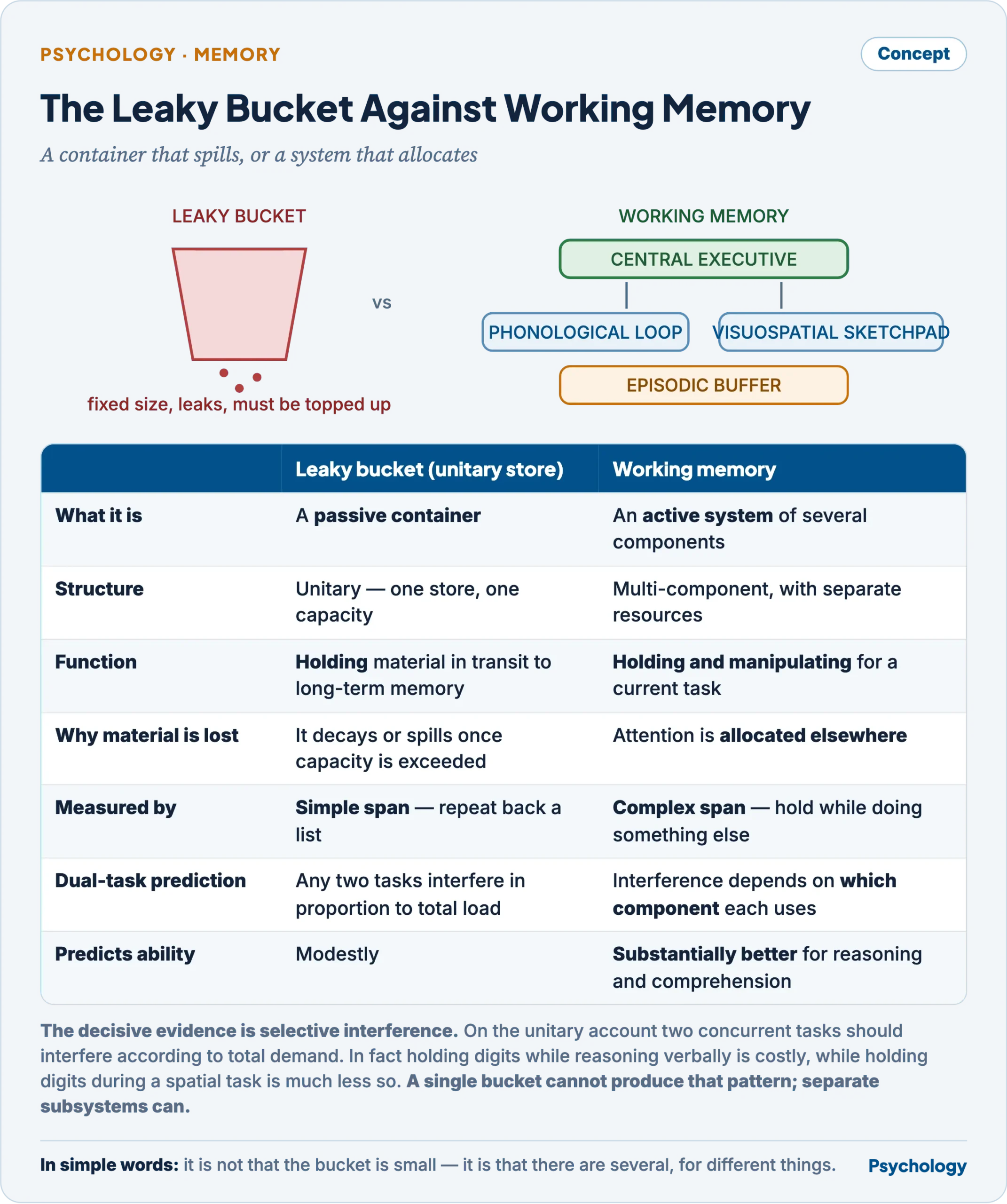
The “leaky bucket” is the classical picture made vivid: a container of fixed, small capacity into which information is poured, which leaks continuously, and which must be topped up by rehearsal if its contents are to be kept. Add more than it holds and something spills out.
| Leaky bucket (unitary store) | Working memory | |
|---|---|---|
| What it is | A passive container | An active system of several components |
| Structure | Unitary — one store, one capacity | Multi-component — separate subsystems with separate resources |
| Function | Holding material in transit to long-term memory | Holding and manipulating material for a current task |
| Why material is lost | It decays or spills once capacity is exceeded | Attentional resources are allocated elsewhere |
| Capacity measured by | Simple span — repeat back a list | Complex span — hold material while performing another task |
| Prediction on dual tasks | Any two tasks should interfere, in proportion to total load | Interference depends on which component each task uses |
| Relation to long-term memory | Material passes through it | It interacts with long-term memory continuously |
| Predicts cognitive ability | Simple span correlates only modestly with reasoning and comprehension | Complex span predicts reasoning and comprehension substantially better |
The decisive evidence is the dual-task finding. On the unitary account, two concurrent tasks should interfere according to how demanding they are in total. In fact interference depends on what kind of material each task uses: holding digits while reasoning verbally is costly, while holding digits and performing a spatial task is much less so. A single bucket cannot produce that pattern; separate subsystems can.
Baddeley and Hitch’s working memory
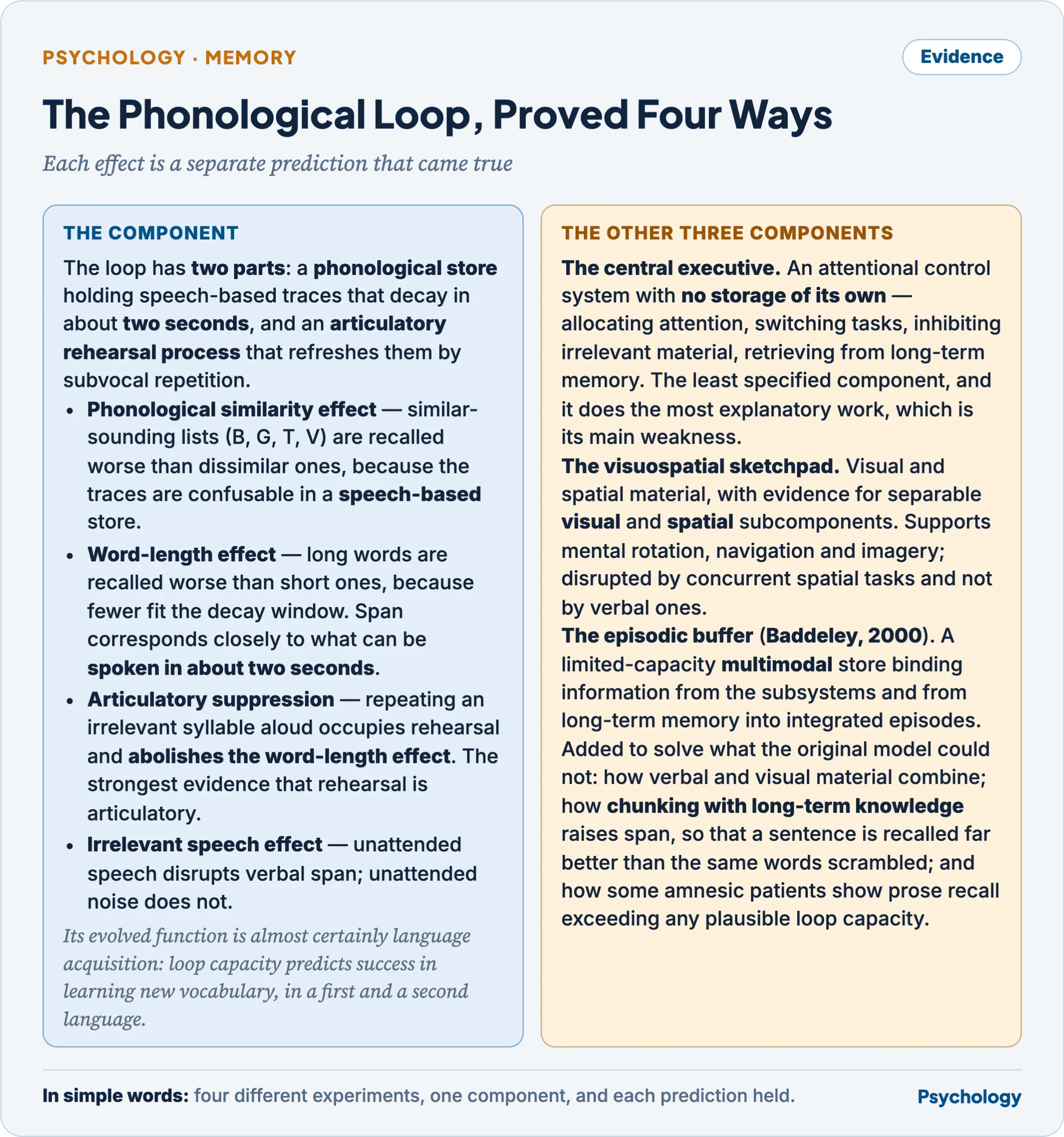
Baddeley and Hitch (1974) replaced the unitary store with a system of components, to which a fourth was added later.
- The central executive. An attentional control system, with no storage of its own. It allocates attention between subsystems, switches between tasks, inhibits irrelevant material and retrieves from long-term memory. It is the least specified component and does the most explanatory work, which is its main weakness.
- The phonological loop, holding speech-based material. It has two parts: a phonological store holding traces that decay in about two seconds, and an articulatory rehearsal process that refreshes them by subvocal repetition. Four findings establish it:
- The phonological similarity effect — lists of similar-sounding items (B, G, T, V) are recalled worse than dissimilar ones, because their traces are confusable in a speech-based store.
- The word-length effect — lists of long words are recalled worse than lists of short ones, because fewer can be rehearsed within the decay window. Span corresponds closely to what can be spoken in about two seconds.
- Articulatory suppression — repeating an irrelevant syllable aloud while reading occupies the rehearsal process and abolishes the word-length effect, which is the strongest evidence that rehearsal is articulatory.
- The irrelevant speech effect — unattended speech disrupts verbal span while unattended noise does not.
- Its evolved function is almost certainly language acquisition: phonological loop capacity predicts success in learning new vocabulary, in a first and a second language.
- The visuospatial sketchpad, holding visual and spatial material, with some evidence for separable visual (what and where things look like) and spatial (location and movement) subcomponents. It supports mental rotation, navigation and imagery, and is disrupted by concurrent spatial tasks but not by concurrent verbal ones.
- The episodic buffer, added by Baddeley (2000). It is a limited-capacity, multimodal store that binds information from the subsystems and from long-term memory into integrated episodes. It was introduced to solve problems the original model could not: how verbal and visual material are combined into a single coherent representation; how chunking with long-term knowledge raises span, as when a sentence is recalled far better than the same words scrambled; and how some amnesic patients show good immediate prose recall exceeding any plausible loop capacity.
Short-term against long-term memory
The grounds on which the two are distinguished, which is what the classical two-store view rests on.
| Short-term | Long-term | |
|---|---|---|
| Capacity | About four to seven chunks | Effectively unlimited |
| Duration | 15–30 seconds without rehearsal | Up to a lifetime |
| Coding | Predominantly acoustic | Predominantly semantic |
| Forgetting | Decay and displacement | Interference and retrieval failure |
| Access | Immediate; contents are in awareness | Requires retrieval; contents are not in awareness |
| Serial position | Supports recency | Supports primacy |
| Effect of a filled delay | Destroys recency | Leaves primacy intact |
| Effect of presentation rate | No effect on recency | Slower rate improves primacy |
| Neuropsychology | Impaired in conduction aphasia with intact long-term learning | Impaired in amnesia with intact span |
The last row carries the most weight. The double dissociation — patients with a digit span of two who learn and retain new material normally, and amnesic patients with normal span who retain nothing — cannot be produced by one system with two time constants.
Single-process and dual-process accounts
The distinction above is exactly what single-process theorists deny.
- The dual-process position holds that short-term and long-term memory are structurally separate systems, differing in capacity, duration, coding and mechanism of loss, with material transferred between them. The serial position curve, the coding difference and the neuropsychological dissociations are its evidence.
- The single-process position holds there is one memory system, and that the apparent differences reflect how recently and how deeply material was processed rather than where it resides. On this view, recency is not evidence of a separate store but of temporal distinctiveness: the most recent items stand out against their neighbours in time, as a near fencepost stands out against those receding behind it.
- The strongest single-process evidence is long-term recency. Recency effects appear where no short-term store can plausibly be involved — in recall of rugby matches played over a season, or of parking spaces used over weeks. If recency occurs without a short-term store, recency cannot be proof of one.
- The strongest dual-process evidence remains the dissociations, which a distinctiveness account has difficulty with: temporal distinctiveness does not explain why a patient with a span of two can lay down new long-term memories normally.
- The working memory model partly dissolves the dispute. It is not a separate store through which material passes but an activated subset of long-term memory, held in a focus of attention. That is a position between the two: structurally one system, functionally two states.
Why working memory matters outside the laboratory
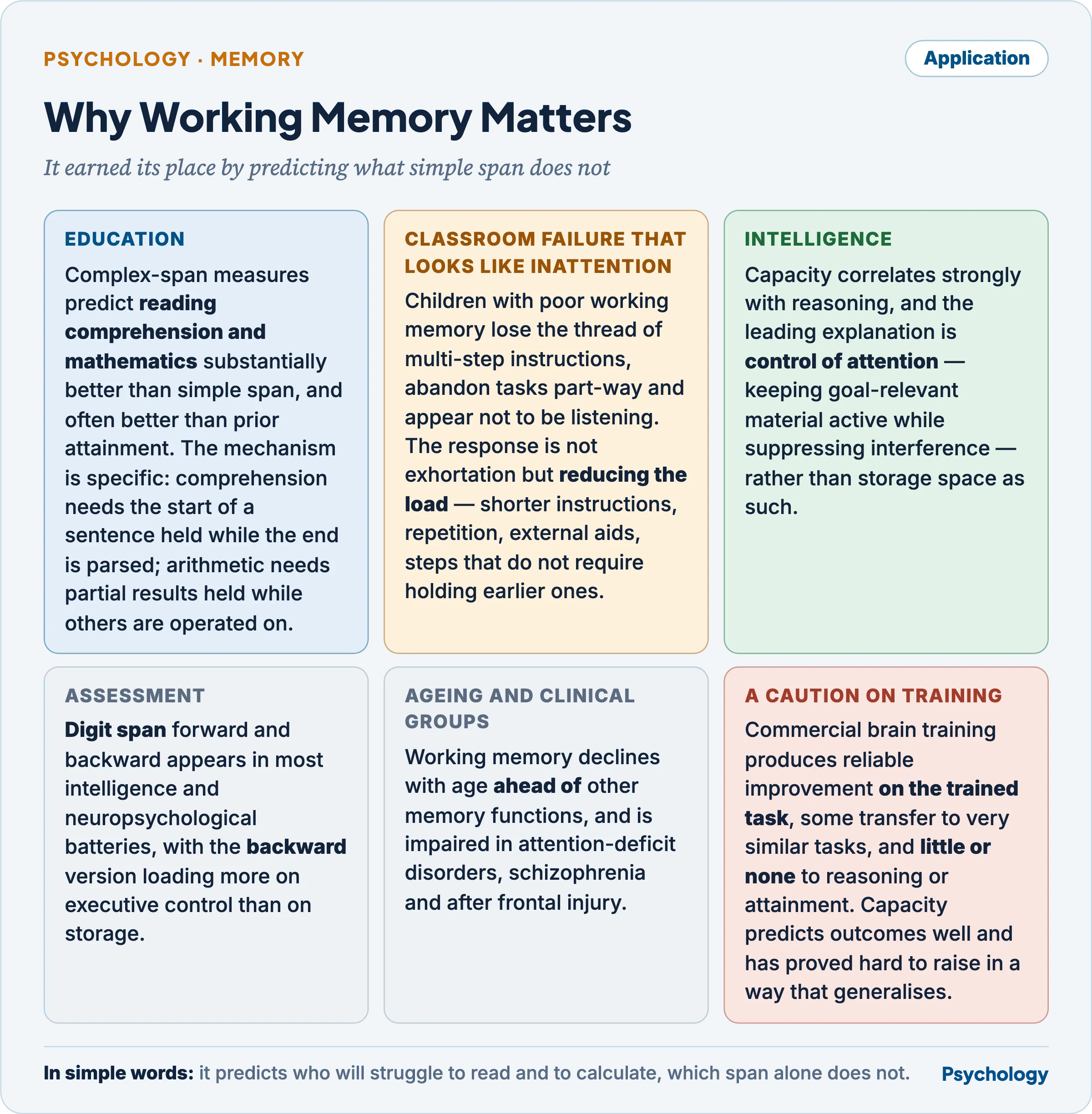
The construct earned its place by predicting things simple span does not.
- Academic attainment. Complex-span measures predict reading comprehension, mathematics and general scholastic attainment substantially better than simple span, and often better than measures of prior attainment. The mechanism is specific: comprehension requires holding the early part of a sentence while parsing the later part, and arithmetic requires holding partial results while operating on others.
- Classroom failure that looks like inattention. Children with poor working memory lose the thread of multi-step instructions, abandon tasks part-way, and appear not to be listening. The practical response is not exhortation but reducing the load — shortening instructions, repeating them, providing external memory aids, breaking tasks into steps that do not require holding earlier ones.
- Fluid intelligence. Working memory capacity correlates strongly with measures of reasoning, and the leading explanation is the control of attention — the ability to keep goal-relevant material active and suppress interference — rather than storage space as such.
- Assessment. Digit span forward and backward appears in most major intelligence and neuropsychological batteries, with the backward version loading more on executive control than on storage.
- Ageing and clinical groups. Working memory declines with age ahead of other memory functions, and is impaired in attention-deficit disorders, schizophrenia and after frontal injury.
- A caution on training. Commercial “brain training” built on working memory tasks produces reliable improvement on the trained task, some transfer to very similar tasks, and little or no transfer to reasoning or scholastic attainment. The honest statement is that working memory capacity predicts outcomes well and has so far proved difficult to raise in a way that generalises.
Criticisms and limitations
- The central executive is a homunculus. It is defined by what it does rather than by how it works, and any result the subsystems cannot explain is attributed to it. Attempts to fractionate it into distinct functions — inhibition, shifting, updating — are the serious response, and they are incomplete.
- The episodic buffer was added to absorb anomalies, and critics note it was specified more by the problems it solves than by independent evidence.
- The model says little about long-term memory, treating it largely as a source the executive consults.
- Capacity estimates have no agreed unit. Miller’s seven, Cowan’s four and span measured in articulatory time are different quantities, and a chunk is defined by the participant’s own knowledge rather than by the experimenter.
- Most evidence comes from verbal laboratory tasks, and the sketchpad is far less specified than the loop.
- The phonological similarity and word-length effects are robust and small, and some fail to replicate under particular scoring and timing conditions, so the model’s empirical base is narrower than its explanatory reach.
Previous Year Questions
- 2026How do the ‘leaky bucket’ and ‘working memory’ approaches differ in their explanation of the short-term memory?
- 2024Citing research evidence, explain the components of working memory.
- 2020Describe 3-stage model of memory with special emphasis on working memory.
- 2014Distinguish between single-process theory and dual-process theory of short-term memory.
- 2011On what grounds are STM and LTM distinguished?
- 2006How far is it correct to state that working memory presents the most complete description of a multicomponent nature of the Short-term memory? Describe the components of working memory with suitable examples.