

Sensory memory, Iconic memory, Echoic memory.
Official Syllabus: Paper I · Unit 7 Memory
“The icon is a brief visual representation that persists after the stimulus has gone, and from which information can be read out.”
— Ulric Neisser (1967), naming the store whose existence Sperling had demonstrated
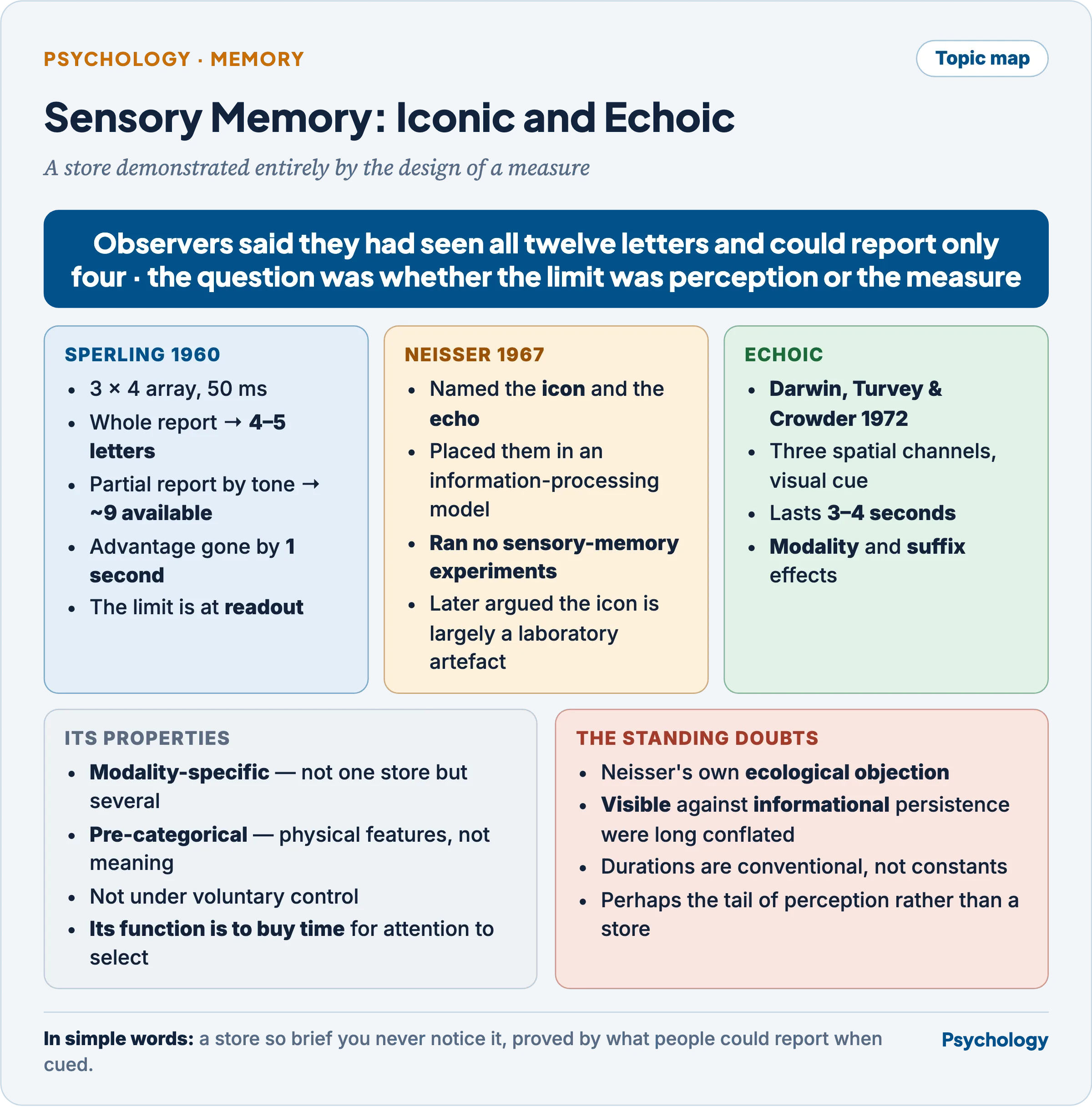
Sensory memory is the first stage of the memory system: a modality-specific, high-capacity, very brief store that holds the raw sensory record of a stimulus just long enough for selection to operate on it. It is easy to overlook because it is never introspectively available as memory — the experience is simply of perceiving. Its existence had to be demonstrated indirectly, and the experiment that did so is a model of how a psychological construct can be established by method alone.
The problem Sperling set out to solve
Briefly flash an array of twelve letters and ask an observer to report what they saw, and they report four or five. The natural conclusion is that only four or five were registered. But observers consistently reported something else: that they had seen all of them, and that the display faded while they were reporting.
The two accounts cannot be distinguished by whole report, because by the time the fifth letter is spoken the rest have gone. The limit might be perception, or it might be the measure. Sperling’s achievement was to design a measure that could tell the difference.
Sperling’s partial report technique
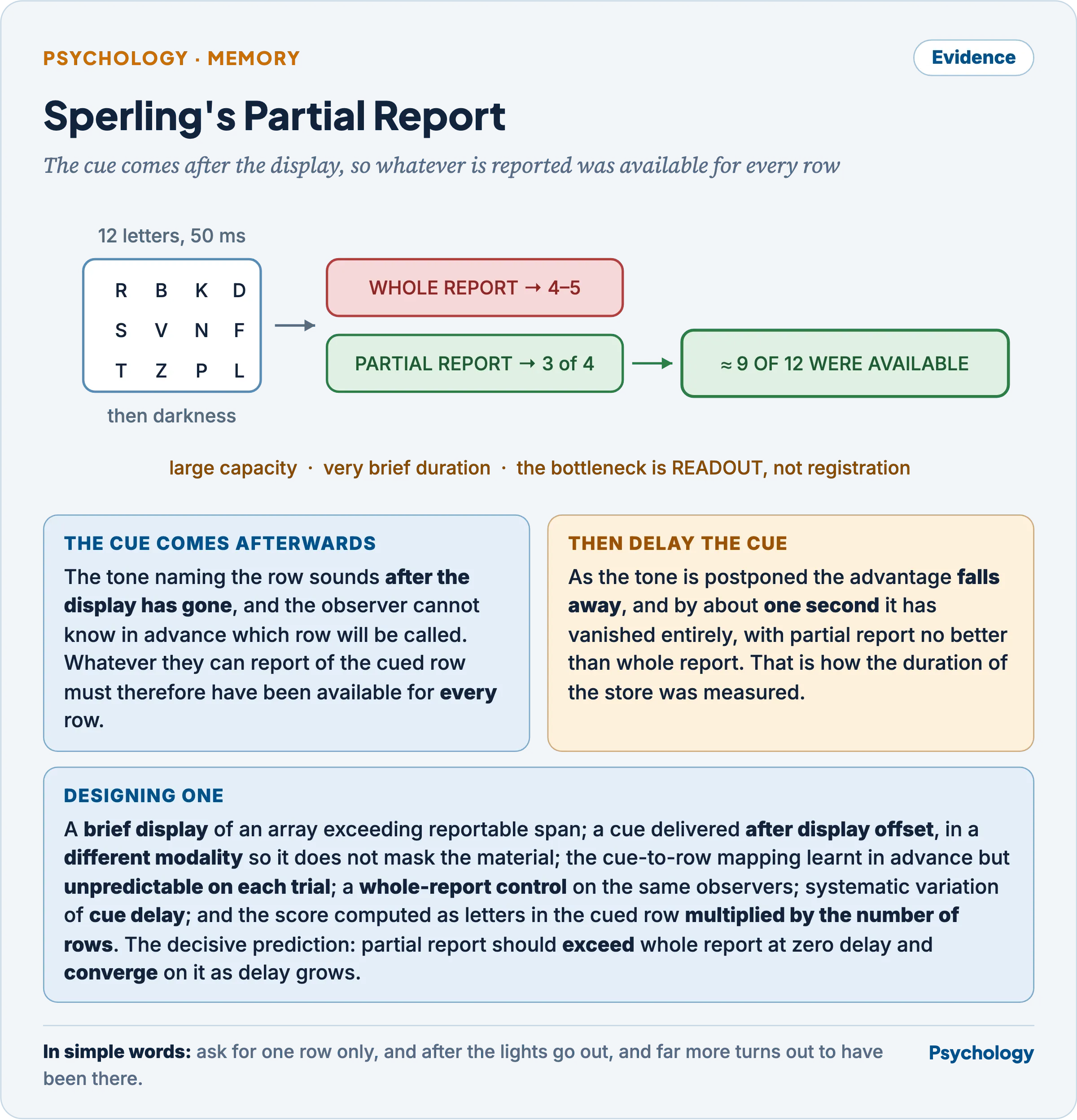
George Sperling (1960) presented a 3 × 4 array of twelve letters for 50 milliseconds and compared two conditions.
- Whole report. Report as many letters as possible. Observers averaged about four or five letters, as before.
- Partial report. Immediately after the display, a tone sounded — high, medium or low — indicating which one row was to be reported. Crucially, the observer could not know in advance which row would be called, so whatever they could report of the cued row must have been available for every row.
The result is the whole argument. Observers reported about three of the four letters in the cued row — roughly 75%. If three quarters of any row could be produced on demand, then about nine of the twelve were available at the moment the tone sounded, against the four or five the whole report had suggested.
Sperling then varied the delay of the tone. As the cue was postponed, the partial-report advantage fell away, and by about one second it had vanished entirely, with partial report no better than whole report.
Three conclusions follow, and together they define the construct.
- Capacity is large — effectively the whole display, far beyond what can be reported.
- Duration is very brief — on the order of a few hundred milliseconds, decaying to nothing within about a second.
- The limit is at readout, not at registration. The bottleneck is the rate at which material can be transferred into a durable form before the trace decays, not the amount taken in.
Designing such an experiment — which is the standard way the paradigm is set as a problem — requires these elements: a a brief display of an array exceeding reportable span; a cue delivered after display offset, in a different modality from the material so that it does not mask it; cue-to-row mapping learned in advance but unpredictable on each trial; a whole-report control run on the same observers; systematic variation of cue delay across trials; and the score computed as letters in the cued row multiplied by the number of rows, which is the estimate of total availability. The prediction that makes the design decisive is that partial report should exceed whole report at zero delay and converge on it as delay grows.
Neisser’s contribution, and a correction worth making
Ulric Neisser (1967), in Cognitive Psychology — the book that gave the discipline its name — supplied what Sperling’s data lacked: a theoretical place for the finding. He named the visual store the icon and its auditory counterpart the echo, and embedded both in an information-processing architecture in which sensory stores feed pattern recognition and attention.
The comparison usually demanded between the two men is therefore not a comparison of two sets of experiments, and this is where textbook accounts go wrong.
| Sperling (1960) | Neisser (1967) | |
|---|---|---|
| Nature of the work | Experimental — the partial-report demonstration | Theoretical and integrative — naming the stores and placing them in a model |
| What it established | That a large-capacity, rapidly decaying visual store exists, and that report, not perception, is the limit | What such a store is for: a buffer from which attention and pattern recognition select |
| Method | Tachistoscopic arrays, cued partial report, varied cue delay | Synthesis of existing findings into a framework |
| Terms introduced | None — he described the phenomenon | Iconic memory and echoic memory |
| Later position | Continued work on the parameters of the icon | Turned critic — argued the icon is largely an artefact of brief, static, dark-adapted laboratory displays, with little role in normal vision where the eyes move several times a second across a continuously present world |
Neisser did not run the auditory analogue either. The echoic counterpart of the partial-report procedure was carried out by Darwin, Turvey and Crowder (1972), who are the correct attribution for that experiment.
The honest formulation: Sperling showed that the store exists; Neisser named it, explained what it was for, and later questioned how much it matters. Both are necessary, and crediting Neisser with the experiments misdescribes how the construct was built.
Echoic memory
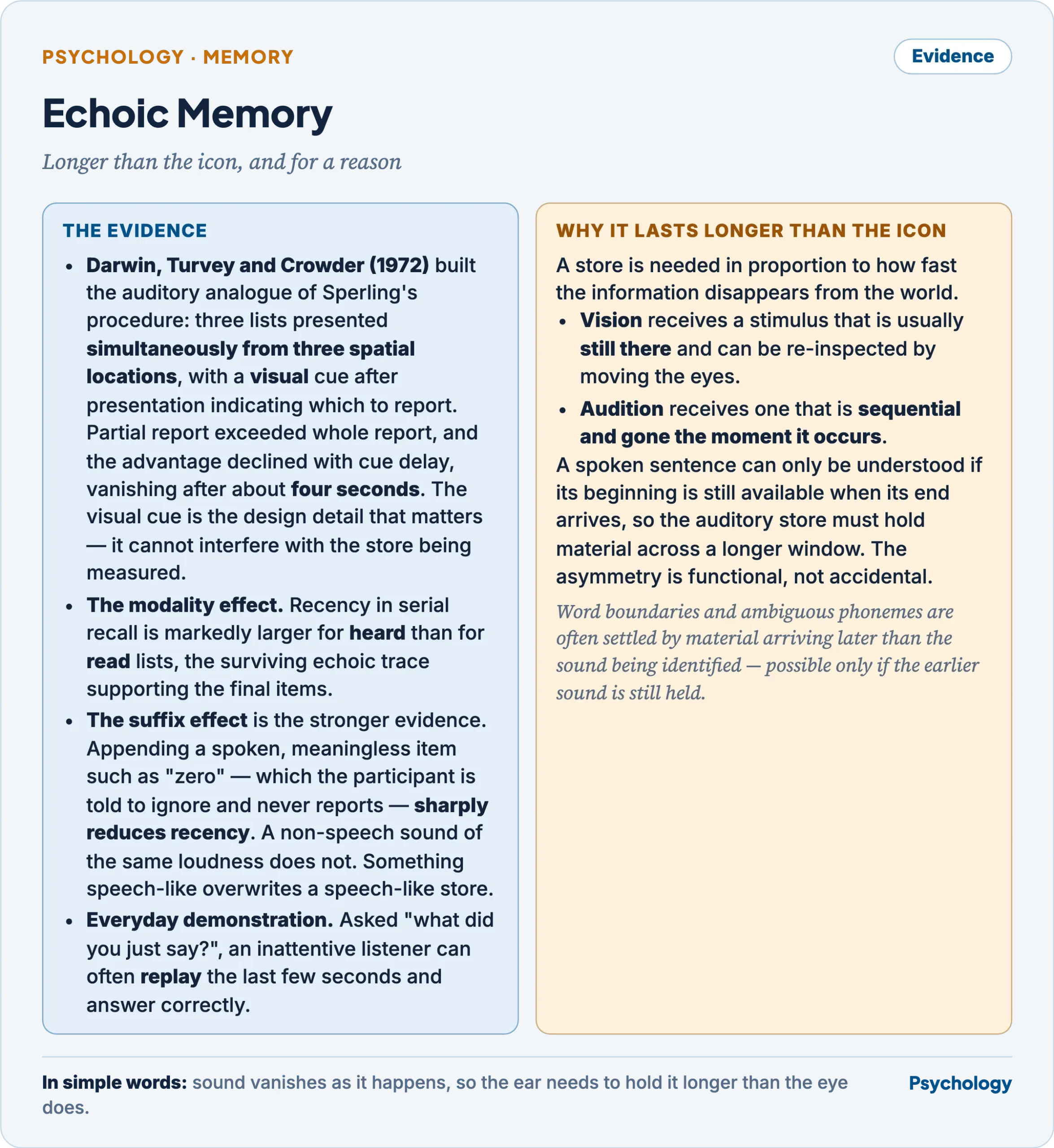
Echoic memory is the auditory sensory store: a brief, high-capacity, pre-categorical record of sound.
How long it lasts. The standard estimate is about three to four seconds — substantially longer than the icon, and the difference is functional rather than accidental. Vision receives a stimulus that is usually simultaneously present and can be re-inspected by moving the eyes; audition receives one that is sequential, and gone the moment it occurs. A spoken sentence can only be understood if its beginning is still available when its end arrives, so the auditory store must hold material across a longer window.
The experimental evidence.
- Darwin, Turvey and Crowder (1972) built the auditory analogue of Sperling’s procedure. Three lists of items were presented simultaneously from three spatial locations — left, right and centre — and a visual cue after presentation indicated which location to report. As in the visual case, partial report exceeded whole report, and the advantage declined as the cue was delayed, disappearing after about four seconds. The use of a visual cue for auditory material is the design detail that matters: it prevents the cue from interfering with the store being measured.
- The modality effect. In serial recall of a list, the recency advantage for the last items is markedly larger when the list is heard than when it is read — the surviving echoic trace supplying extra support for the final items.
- The suffix effect is the complement and the stronger evidence. Appending a spoken, meaningless item such as “zero” to the end of a heard list — one the participant is told to ignore and never has to report — sharply reduces recency. A non-speech sound of the same loudness does not. Something speech-like is overwriting a speech-like store, which is what a pre-categorical auditory record predicts.
- Everyday demonstration. Asked “what did you just say?” a listener who was not attending can frequently replay the last few seconds and answer correctly — reading the content out of a store whose contents had not been processed when they arrived.
Sensory memory within the memory system
- It is modality-specific. There is an iconic store, an echoic store, and good evidence for a brief tactile store; there is no single sensory memory.
- It is pre-categorical. It holds the physical properties of the stimulus — form, location, pitch, loudness — rather than its meaning. Sperling’s observers could report letters from a cued row but not, in the same way, from a cued category such as “the digits”, which is the evidence that the stored material has not yet been identified.
- It is not under voluntary control. Material enters automatically and decays whether or not it is wanted.
- Its function is to buy time. It holds the raw record long enough for attention to select and for pattern recognition to operate, which is what makes selective attention possible at all. Without it, anything not attended at the instant of arrival would be irrecoverable.
- Transfer to short-term memory requires attention. What is attended is passed on; the remainder decays, which is the first and most ruthless of the memory system’s several bottlenecks.
The two stores compared, and what they are for
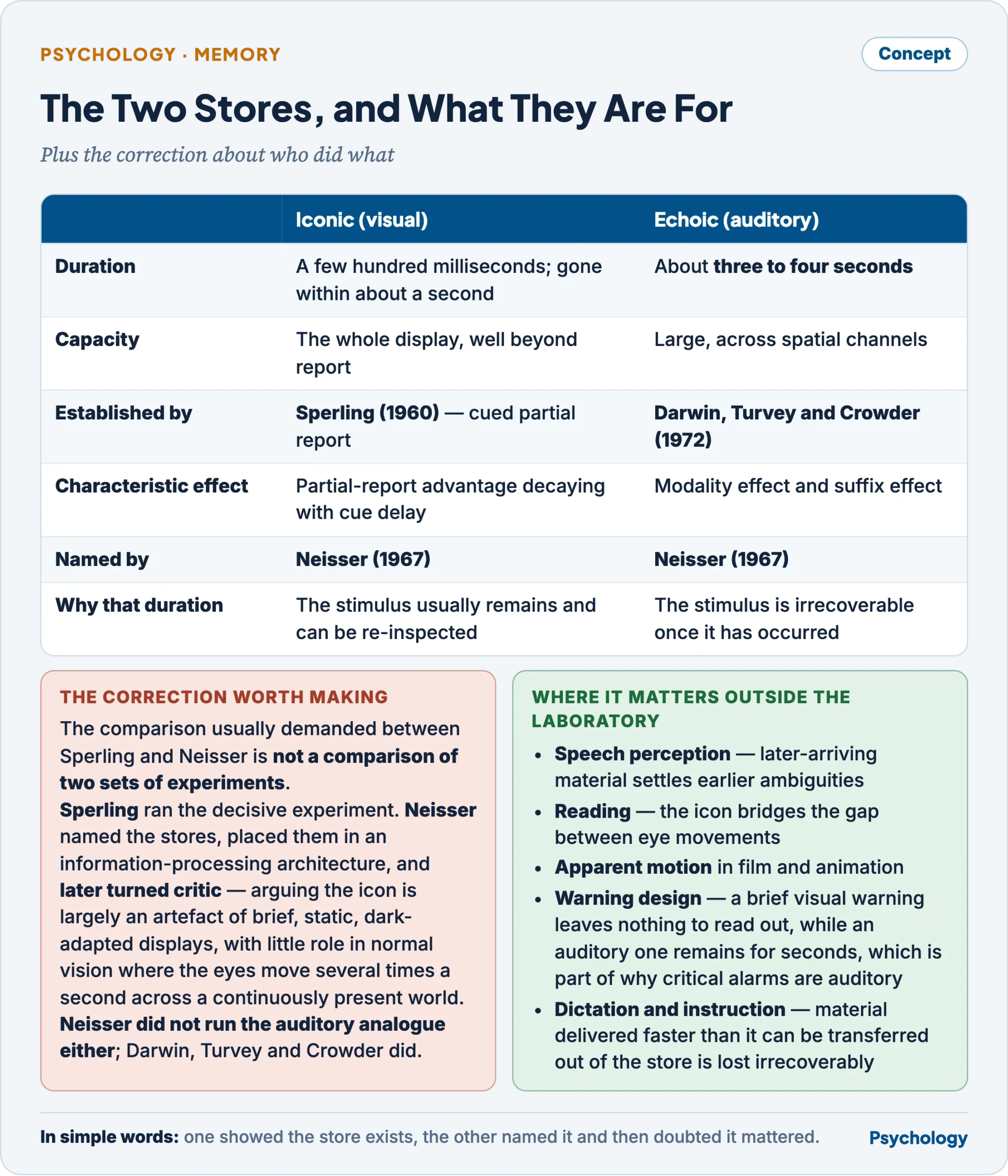
| Iconic (visual) | Echoic (auditory) | |
|---|---|---|
| Duration | A few hundred milliseconds; gone within about a second | About three to four seconds |
| Capacity | The whole display, well beyond report | Large, across spatial channels |
| Established by | Sperling’s cued partial report, 1960 | Darwin, Turvey and Crowder’s auditory analogue, 1972 |
| Characteristic effect | Partial-report advantage, decaying with cue delay | Modality effect and suffix effect in serial recall |
| Named by | Neisser, 1967 | Neisser, 1967 |
| Why the duration differs | The stimulus usually remains available and can be re-inspected by moving the eyes | The stimulus is sequential and irrecoverable once it has occurred |
The asymmetry is the interesting part. A store is needed in proportion to how fast the information disappears from the world, and sound disappears completely while sight generally does not.
Where it matters outside the laboratory
- Speech perception depends on it directly. Word boundaries, intonation and the identity of ambiguous phonemes are often settled by material that arrives later than the sound being identified, which is possible only if the earlier sound is still held. The listener who understands a garbled word on hearing the end of the sentence is reading it out of the echoic store.
- Reading uses the icon across the brief interval between eye movements, and the perception of a stable, continuous page rather than a series of jerky snapshots depends on persistence of some kind.
- Apparent motion in film and animation rests on visual persistence bridging the gap between frames.
- Display and warning design follows from the duration figures: a visual warning that flashes too briefly leaves nothing to read out, whereas an auditory one remains available for several seconds, which is part of why critical alarms are auditory.
- Instruction and dictation. Material delivered faster than it can be transferred out of the sensory store is lost irrecoverably, which is the mechanism behind the familiar failure to follow rapid spoken instructions.
Criticisms and limitations
- The ecological objection is Neisser’s own, and it is the serious one. The icon is demonstrated with brief, isolated, high-contrast displays against a dark field. Normal vision involves a continuously present scene, several eye movements a second and masking by the next fixation, and in those conditions a persisting icon may contribute little.
- “Visible persistence” and “informational persistence” are different things and were run together for years. The impression that the display is still there outlasts the stimulus by a very short time and shortens as display duration increases; the information available for readout behaves differently. Estimates of iconic duration that do not say which is being measured are not comparable.
- Duration estimates vary widely with method, luminance, masking and the measure used, so the figures quoted for both stores are conventional rather than constants.
- Whether sensory memory is a separate store at all is contested. An alternative view treats it as the tail of ordinary perceptual processing rather than a distinct structure, in which case the multistore model’s first box names a persistence effect rather than a memory system.
- Research is heavily visual. Echoic memory is far less studied, tactile memory barely at all, and almost nothing is known about the other modalities.
Previous Year Questions
- 2012Compare Sperling’s experiments with that of Neisser’s experiments in the study of sensory memory. What did these two experiments prove?
- 2009Prepare an experimental design following Sperling’s technique to study iconic memory. What does the experiment prove?
- 2008What is meant by ‘echoic memory’? How long does this memory last? Discuss with experimental evidence.