

Life span development — characteristics, development tasks, promoting psychological well-being across major stages of the life span.
Official Syllabus: Paper I · Unit 4 Development of Human Behaviour
“A new birth, for the higher and more completely human traits are now born.”
— G. Stanley Hall (1904), whose Adolescence introduced the stage to psychology and the phrase “storm and stress” with it
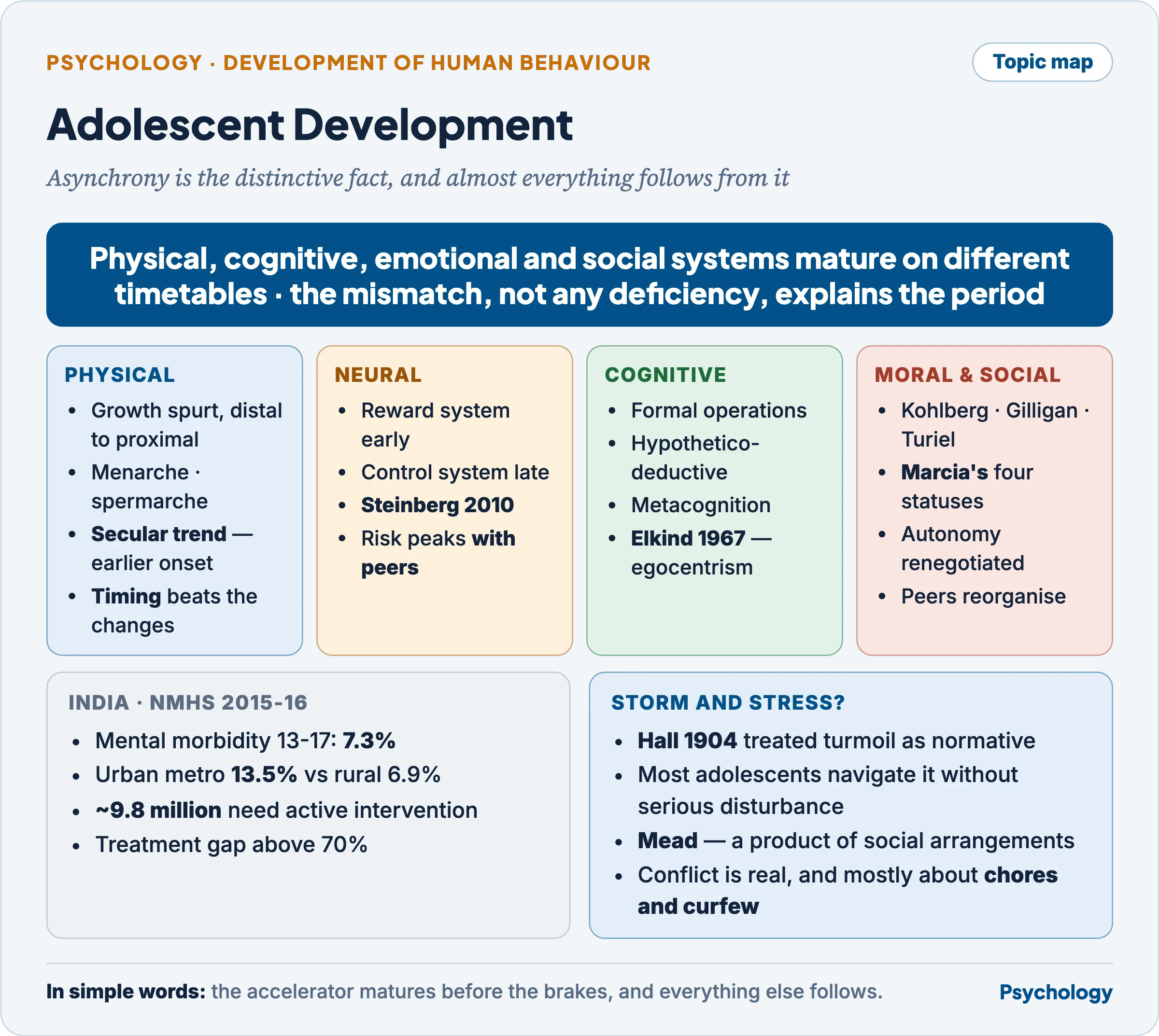
Adolescence is the transition from childhood to adulthood, beginning in a biological event and ending in a social one — which is why its onset can be dated and its conclusion cannot. The distinctive fact about it is asynchrony: the physical, cognitive, emotional and social systems mature on different timetables, and almost every characteristic feature of the period, including its risk-taking, follows from the mismatch rather than from any deficiency.
Physical changes
Puberty is the biological onset, initiated by a hypothalamic–pituitary signal that triggers gonadal hormone output.
- The growth spurt is the most visible change: a sharp acceleration in height and weight, occurring about two years earlier in girls than boys, and proceeding distally to proximally — hands and feet before limbs, limbs before trunk — which produces the temporary disproportion and clumsiness characteristic of the period.
- Primary sex characteristics are the maturation of the reproductive organs, marked by menarche in girls and spermarche in boys. Secondary sex characteristics are the non-reproductive signs: breast development, voice deepening, body and facial hair, changes in fat and muscle distribution.
- A secular trend has lowered the age of puberty across the last century, attributed to improved nutrition and reduced childhood disease. The consequence is that adolescence has lengthened at both ends — beginning earlier biologically and ending later socially as education extends — which is why it is now a longer stage in India than it was two generations ago.
- Timing matters more than the changes themselves. Early-maturing boys tend to gain in status, athletic standing and peer regard; early-maturing girls are at greater risk, facing attention they are not equipped to manage, earlier contact with older peers, and higher rates of body dissatisfaction, disordered eating and depression. Late-maturing boys fare worst on self-image. The effects run through social response to the body, not through hormones directly, which is why the same biological event has opposite consequences by sex.
Brain changes and why risk-taking peaks
The neural account replaced an older explanation that attributed adolescent recklessness to cognitive deficiency, and it is a substantial improvement because the older account was simply false: adolescents reason about risk about as well as adults when tested calmly.
The dual systems model holds that two neural systems mature on different schedules. An early-maturing socio-emotional incentive-processing system, centred on the limbic and striatal reward circuitry, increases sensitivity to reward, novelty and peer approval. A later-maturing cognitive control system, centred on the prefrontal cortex, develops the capacity to restrain impulses. The gap between them is the window of heightened risk.
Steinberg (2010) tested this directly in a socioeconomically and ethnically diverse sample of 935 individuals aged 10 to 30, using both self-report and behavioural measures. The predicted dissociation appeared: reward-seeking followed a curvilinear path, rising from preadolescence to mid-adolescence and declining thereafter, while impulsivity declined linearly from age 10 onward. Heightened risk-taking in middle adolescence is therefore the product of high reward inclination meeting still-maturing self-control. Shulman and colleagues (2016) reviewed the psychological and neuroimaging evidence accumulated since and reaffirmed the pattern.
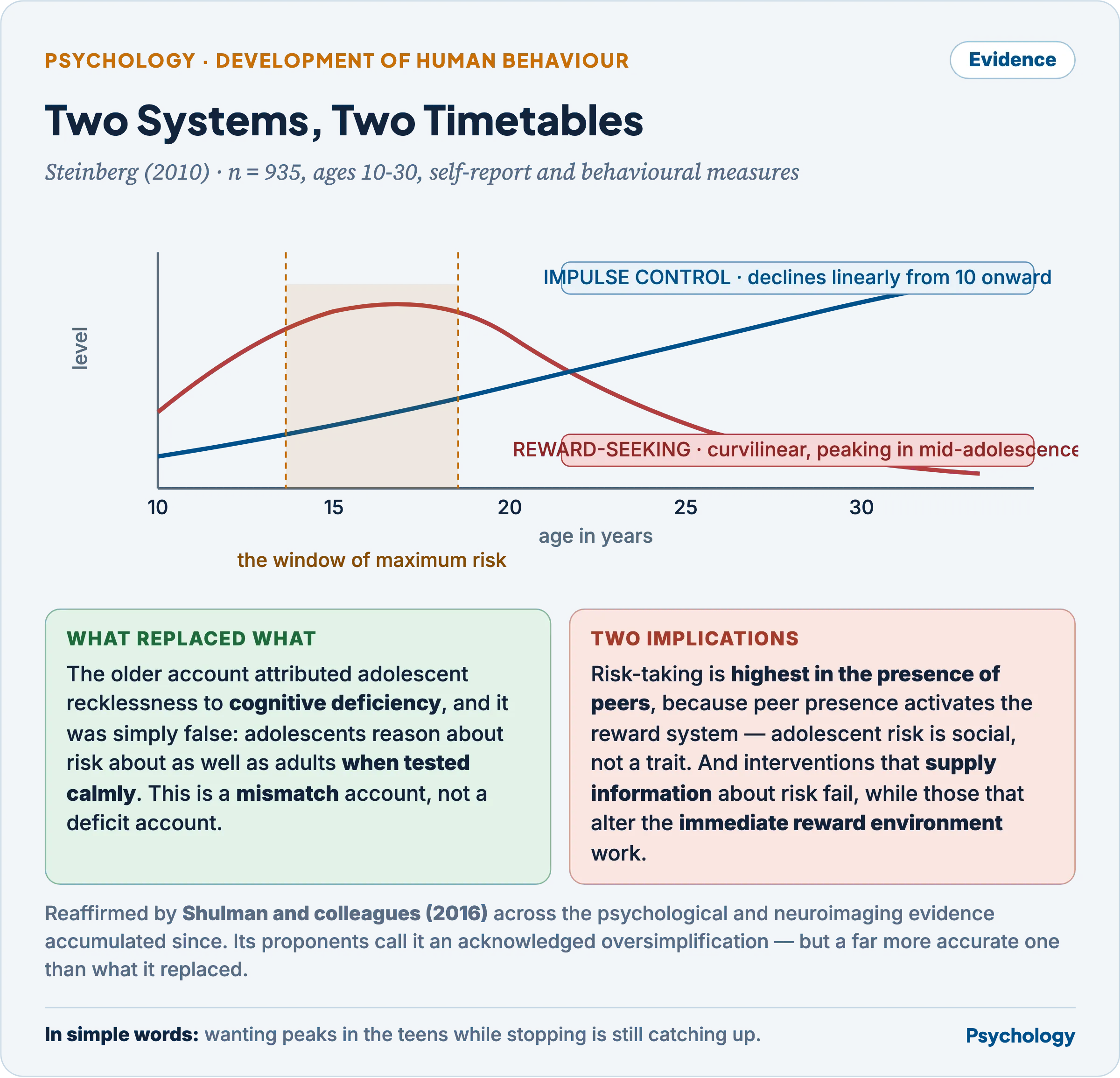
Two implications follow that are worth stating. Risk-taking is highest in the presence of peers, because peer presence activates the reward system — which is why adolescent risk is a social phenomenon and not an individual trait. And the model is a developmental mismatch account, not a deficit account, so interventions that supply information about risk fail while those that alter the immediate reward environment succeed.
Cognitive changes
- Formal operational thought, in Piaget’s scheme, is the central cognitive acquisition. Thinking becomes capable of operating on propositions rather than objects: the adolescent can reason about the hypothetical, the contrary-to-fact and the purely possible.
- Hypothetico-deductive reasoning is its signature. Faced with a problem, the adolescent generates a set of possible explanations and tests them systematically, where the concrete-operational child proceeds by trial and error on the instance in front of them.
- Propositional and combinatorial logic allow the systematic enumeration of possibilities and reasoning about the logical form of statements independent of their content.
- Metacognition develops substantially: the adolescent can think about their own thinking, monitor their comprehension, and deploy strategies deliberately — which is what makes genuinely independent study possible for the first time.
- Idealism and the critique of the actual follow directly from being able to imagine alternatives. Once the possible is thinkable, the actual can be measured against it, which is the cognitive basis of adolescent political and moral idealism and of the characteristic dissatisfaction with parents, school and society.
Adolescent egocentrism is Elkind’s (1967) account of the characteristic distortions that the new capacity produces before it is disciplined. The imaginary audience is the belief that one is the object of others’ constant attention and evaluation, which explains acute self-consciousness, hours before a mirror, and the intensity of embarrassment. The personal fable is the conviction that one’s experience is unique and that the ordinary probabilities do not apply — which contributes to risk-taking by way of a sense of invulnerability, and to the feeling that no one has ever felt this before.
Three corrections keep the cognitive account accurate. Formal operations are not universal: a substantial proportion of adults do not use formal reasoning consistently, and performance is strongly domain- and training-dependent, which is a problem for Piaget’s claim of a general structural stage. Information-processing accounts explain the same changes without stages, as improvements in processing speed, working-memory capacity, knowledge base and strategy use, and they fit the gradual data better. And the gains are uneven across domains: an adolescent may reason formally about physics and concretely about their own relationships, which is the asynchrony theme again.
Moral development
Kohlberg extended Piaget’s two-stage account of moral judgement — heteronomous morality, in which rules are fixed, external and absolute and intention is irrelevant, giving way at around ten to autonomous morality, in which rules are understood as agreements made by mutual consent and alterable by it — into three levels of two stages each, derived from how people reasoned about moral dilemmas rather than from what they concluded.
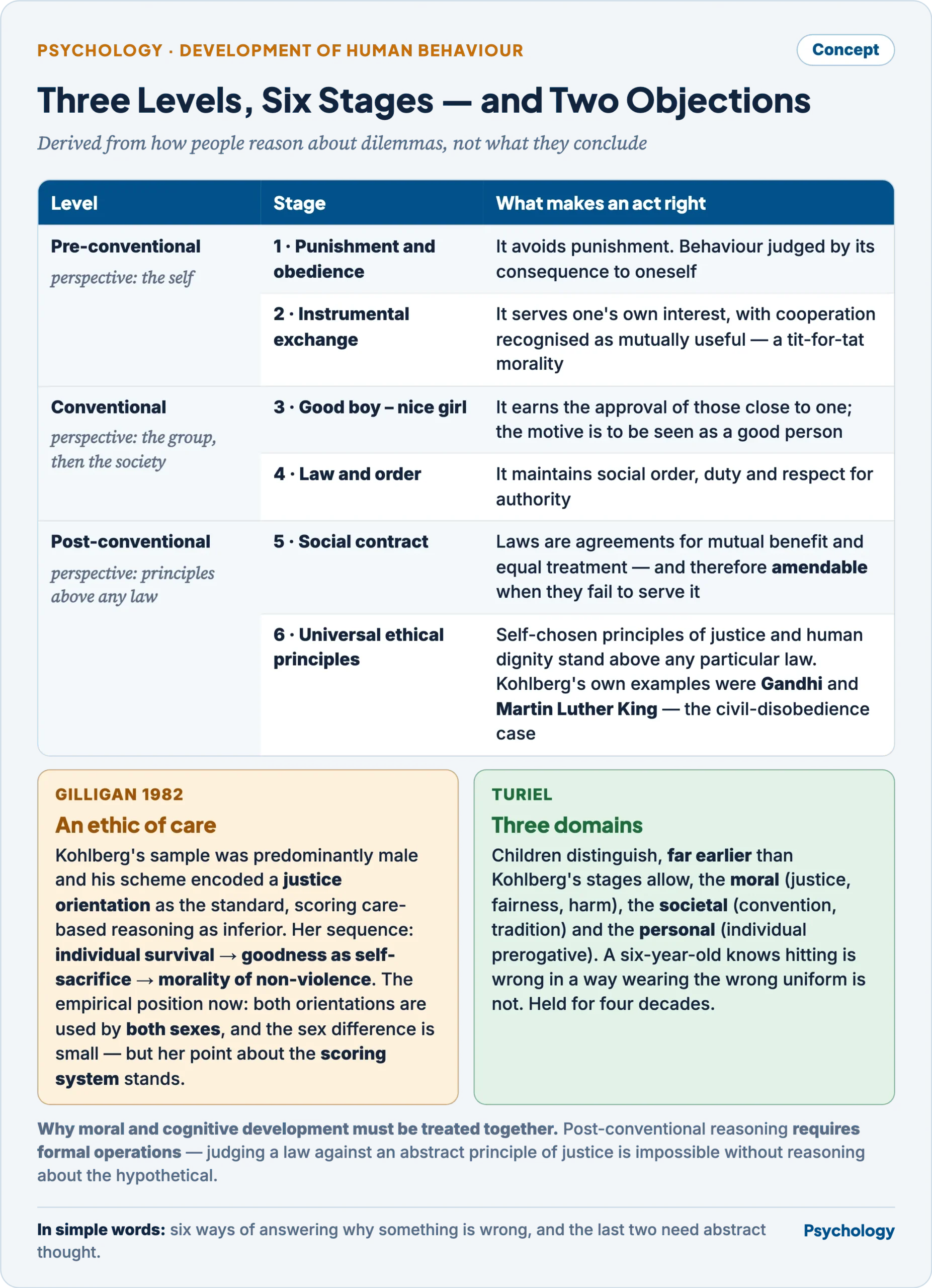
- Pre-conventional morality. Stage 1, punishment and obedience: right is what avoids punishment, and the perspective is egocentric. Stage 2, instrumental exchange: right is what serves one’s own interest, with a recognition that cooperation brings mutual benefit — a tit-for-tat morality.
- Conventional morality. Stage 3, good boy–nice girl: right is what earns the approval of those close to one, and the motive is to be seen as a good person. Stage 4, law and order: right is the maintenance of social order, duty and respect for authority, with the perspective now that of the society rather than the immediate group.
- Post-conventional morality. Stage 5, social contract: laws are understood as agreements serving mutual benefit and equal treatment, and therefore as amendable when they fail to. Stage 6, universal ethical principles: right is determined by self-chosen principles of justice and human dignity that stand above any particular law. Kohlberg held that very few people reach stage 6, and the figures he cited as examples were Gandhi and Martin Luther King — the civil-disobedience case, where breaking an unjust law is the moral act.
Adolescence is the period of transition into conventional morality and, for some, the first appearance of post-conventional reasoning — which is not accidental, because post-conventional reasoning requires formal operations. Judging a law against an abstract principle of justice is impossible without the capacity to reason about the hypothetical, which is why moral and cognitive development in adolescence must be treated together rather than separately.
Carol Gilligan (1982) objected that Kohlberg’s scheme was built on a predominantly male sample and encoded a justice orientation as the standard, scoring an ethic of care — reasoning organised around relationship, responsibility and the avoidance of harm — as developmentally inferior. Her alternative sequence runs from orientation to individual survival, in which the self is the sole object of concern, through goodness as self-sacrifice, in which responsibility to others is assumed and care of the self appears selfish, to the morality of non-violence, in which the claims of self and others are balanced and compassion regulates both. Her own transition between levels two and three she described as the move “from goodness to truth”. The empirical position is now that both orientations are used by both sexes, and meta-analyses find sex differences in moral orientation small — which weakens Gilligan’s claim about sex while leaving intact her more important point that Kohlberg’s scoring system privileged one of two legitimate moral languages.
Turiel’s social-domain theory supplies the most useful correction for practical purposes. Children distinguish, far earlier than Kohlberg’s stages allow, between the moral domain of justice, fairness and harm, the societal domain of convention and tradition, and the personal domain of individual prerogative. A child of six knows that hitting is wrong in a way that wearing the wrong uniform is not. This finding has held for four decades and shows Kohlberg’s stages to be an account of moral reasoning about dilemmas rather than of moral competence as such.
Identity and social changes
The social task of adolescence is identity, and Erikson named its crisis identity against role confusion with fidelity as its virtue, together with the idea of the psychosocial moratorium — a socially permitted period of experiment before adult obligations attach.
Marcia (1980) made this testable by crossing two dimensions, exploration of alternatives and commitment to a choice, which yields four identity statuses.
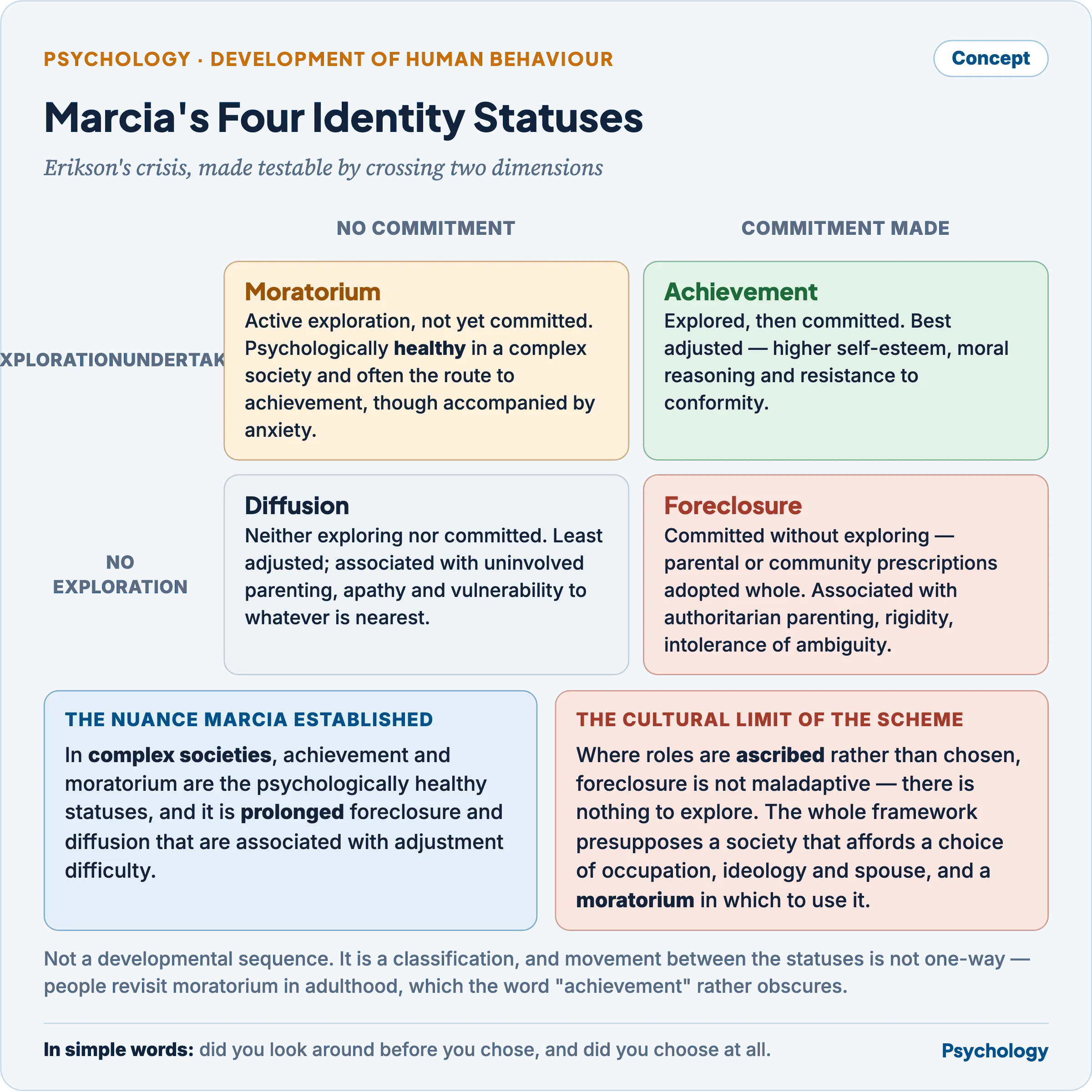
- Identity achievement — exploration undertaken and commitment made. The best-adjusted status, associated with higher self-esteem, moral reasoning and resistance to conformity.
- Moratorium — active exploration without commitment yet. Psychologically healthy in a complex society, and often the route to achievement, though accompanied by anxiety.
- Foreclosure — commitment without exploration, typically adopting parental or community prescriptions wholesale. Associated with authoritarian parenting, rigidity and intolerance of ambiguity.
- Diffusion — neither exploring nor committed. The least adjusted, associated with uninvolved parenting, apathy and vulnerability to peer influence.
The useful nuance, which Marcia’s own research established, is that in complex societies achievement and moratorium are the psychologically healthy statuses, while prolonged foreclosure and diffusion are the ones associated with adjustment difficulty. In societies where roles are ascribed rather than chosen, foreclosure is not maladaptive, because there is nothing to explore — which is the cultural limit of the whole scheme.
The other social changes are these.
- Autonomy must be renegotiated. The task is not separation from parents but a shift from unilateral authority to a more mutual relationship. Parent–adolescent conflict rises in early adolescence and typically concerns mundane matters — chores, dress, curfew, tidiness — rather than values, and it declines through late adolescence as the renegotiation settles.
- Peer relations reorganise. Same-sex cliques give way to mixed groups and then to pairs. Friendships become based on intimacy and self-disclosure rather than shared activity, and conformity to peer norms peaks in early adolescence and declines thereafter.
- Romantic relationships appear as a developmental domain, serving identity exploration and the rehearsal of intimacy before Erikson’s next stage requires it.
- Parents retain influence where it matters most. The evidence is that peers dominate surface and short-term choices while parents retain influence on educational aspiration, long-term values and moral commitments. The common claim that peers displace parents wholesale is not supported.
The developmental challenges, by domain
In the cognitive domain
- Reasoning capacity outruns experience. The new capacity for hypothetical thought arrives without the knowledge base or calibration to use it well, which produces confident reasoning from inadequate premises.
- Decisions must be made under reward pressure. The dual-systems gap means decisions are taken in exactly the conditions — peer presence, immediate reward, emotional arousal — in which adolescent judgement is least like its own calm performance. This is the central cognitive challenge, and it is not a failure of knowledge.
- Academic demands escalate as the stage begins. Abstract curricula, high-stakes examinations and irreversible subject choices arrive at the same time as the physical and social upheaval, and the choices foreclose options before identity exploration has run.
- Egocentric distortions interfere with judgement. The imaginary audience makes social evaluation feel constant and the personal fable makes risk feel inapplicable.
- Metacognitive skill is uneven, so the capacity to monitor one’s own understanding exists but is applied inconsistently, which is why adolescents commonly misjudge how well they have prepared.
- Idealism meets institutions. The ability to imagine a better arrangement produces disillusionment with family, school and society, and the challenge is converting critique into engagement rather than cynicism or withdrawal.
In the social domain
- Identity formation under constrained choice. The task presumes available alternatives; where occupation, marriage and residence are largely determined, the moratorium is unavailable and foreclosure is the likely outcome.
- Autonomy without rupture. Renegotiating authority while retaining the relationship is difficult for both parties, and failure at either extreme — premature independence or sustained control — carries costs.
- Managing conflicting reference groups. Parental and peer norms diverge, and the adolescent must act in both worlds with no way to satisfy each fully.
- Peer acceptance, rejection and bullying. Peer status has an outsized effect on well-being at this age, and exclusion is a substantial predictor of depression and school disengagement.
- Integrating the changed body and sexuality into the self-concept, in the absence — in most Indian settings — of any reliable source of information about either.
- Rising vulnerability to psychopathology. Most adult mental disorders have their onset in adolescence or early adulthood, which makes this the period where prevention has the highest return and where it is least often delivered.
The Indian adolescent
India has the largest adolescent population of any country, which makes the general findings above a matter of public policy rather than of theory.
- Mental health. The National Mental Health Survey (2015-16) found mental morbidity among 13–17 year olds at 7.3 per cent, near-identical between the sexes at 7.5 per cent male and 7.1 per cent female, but nearly twice as high in urban metros — 13.5 per cent against 6.9 per cent rural. The commonest conditions were depressive episode and recurrent depressive disorder at 2.6 per cent, intellectual disability at 1.7 per cent, autism spectrum disorder at 1.6 per cent, and phobic anxiety and psychotic disorder at 1.3 per cent each. The survey estimated that about 9.8 million Indians aged 13 to 17 need active intervention, against a treatment gap that for most disorders exceeds 70 per cent.
- A truncated moratorium. NFHS-5 (2019-21) records 23.3 per cent of women aged 20–24 as married before 18. For that group adolescence ends at marriage, and the identity exploration the stage is supposed to afford does not occur.
- Examination pressure is the characteristic Indian stressor, concentrating irreversible life consequences into a single assessment at exactly the age of maximum reward sensitivity and minimum control — and student suicide figures in NCRB data make this the clearest case for intervention.
- The digital environment has become a principal socialising agent, and access is itself unequal: NFHS-5 (2019-21) records 33.3 per cent of women having ever used the internet against 57.1 per cent of men.
- The policy response is substantial on paper. The Rashtriya Kishor Swasthya Karyakram provides adolescent-friendly health services and peer education across six domains including mental health; Ayushman Bharat school health and wellness ambassadors deliver health education; the National Education Policy 2020 mandates counsellors and reduces examination stakes through modular board examinations; Tele-MANAS provides a national mental-health helpline; and the Mental Healthcare Act 2017 establishes a right to treatment. The gap is in delivery, particularly in the availability of trained counsellors.
Criticisms and limitations
- “Storm and stress” is overstated. Hall’s (1904) characterisation, and the psychoanalytic accounts that followed, treated turmoil as normative. Systematic studies of ordinary adolescents find the large majority navigating the period without serious disturbance, and Margaret Mead’s cross-cultural work argued that the turmoil is a product of particular social arrangements rather than of puberty. Conflict is real but mostly concerns mundane matters, and treating disturbance as normal risks failing to recognise genuine disorder.
- Formal operations are not universal, which undermines Piaget’s claim that adolescence has a general cognitive stage of its own; performance is domain-specific and training-dependent.
- Four standing objections to Kohlberg. Stage 6 is almost never observed and was eventually dropped from his scoring manual; the dilemmas are hypothetical and verbal, so they measure articulacy as much as morality; moral reasoning predicts moral behaviour only modestly; and the scheme is culturally biased toward individualistic justice reasoning, which scores collectivist moral thought as conventional.
- An acknowledged oversimplification. Its proponents say so. Some real-world risk behaviours peak later than it predicts, which its defenders attribute to differential opportunity rather than neurobiology, and the model has been criticised for treating two broad systems as if they were anatomically discrete.
- Not a developmental sequence. They are a classification, and movement between them is not unidirectional; people revisit moratorium in adulthood, which the term “achievement” obscures.
- A Western, schooled, urban adolescent. Extended education, occupational choice and a permitted moratorium are presupposed throughout, which makes much of it a poor description of the majority of Indian adolescents, and especially of married adolescent girls and working adolescents.
- Misuse of brain-based accounts. The finding that the prefrontal cortex is still maturing has been deployed to argue both that adolescents cannot be held responsible and that they must be protected from their own choices, and neither follows from the evidence, which concerns average tendencies under particular conditions.
Previous Year Questions
- 2016Identify the most important changes that occur during adolescence.
- 2014Discuss the main aspects of cognitive and moral development during adolescence.
- 2013Bring out the key developmental challenges faced by adolescents in the cognitive and social domains.