

Life span development — characteristics, development tasks, promoting psychological well-being across major stages of the life span.
Official Syllabus: Paper I · Unit 4 Development of Human Behaviour
“Psychological well-being [consists of] self-acceptance, positive relations with others, autonomy, environmental mastery, purpose in life, and personal growth.”
— Carol Ryff (1989), specifying the six dimensions of eudaimonic well-being
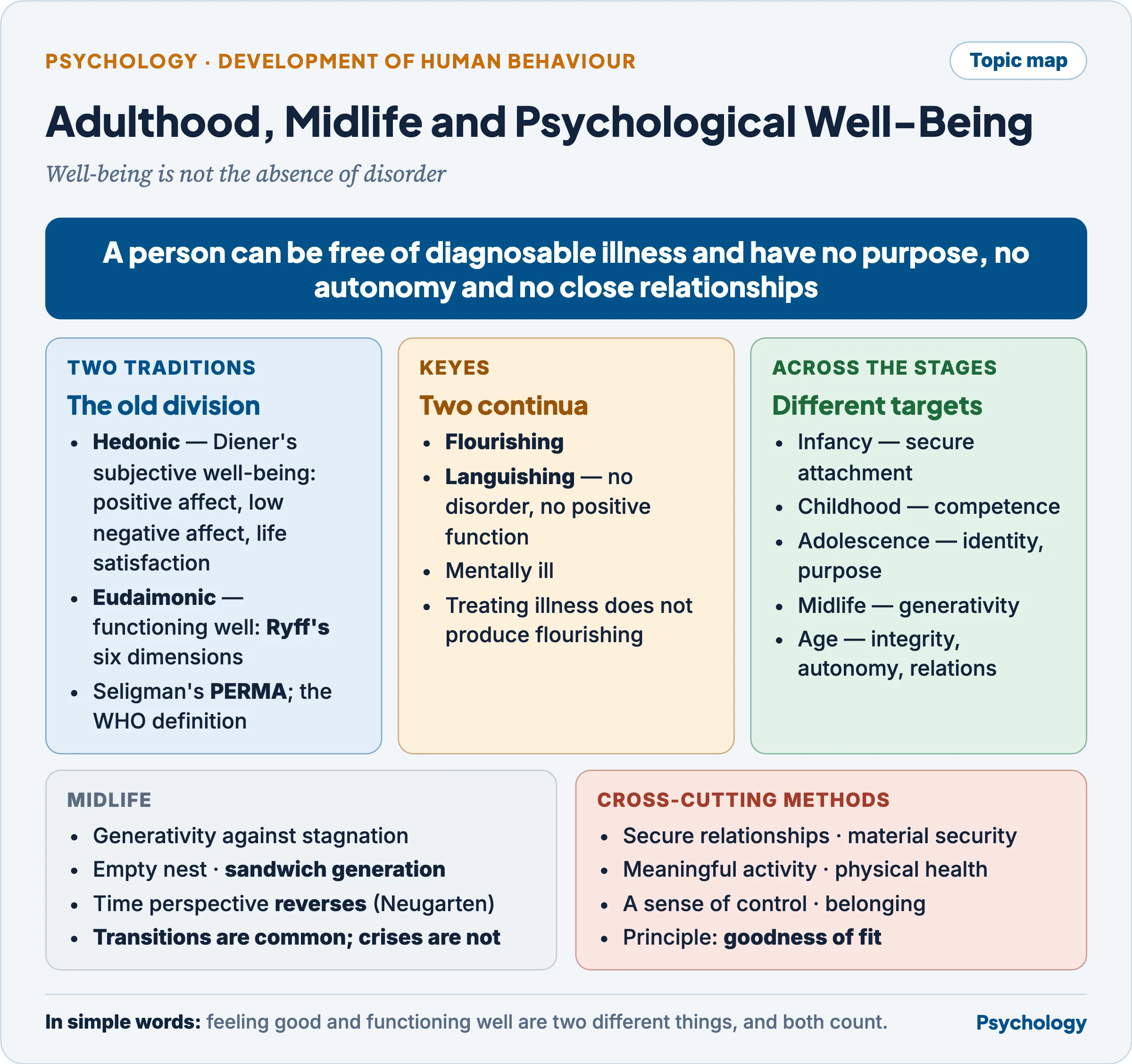
Well-being is not the absence of disorder, and treating it as such is the error that most answers on this topic make. A person can be free of diagnosable illness and have no purpose, no autonomy and no close relationships. Well-being is a positive state with its own structure, and because its components differ by life stage, promoting it requires different things at different ages rather than more of one thing throughout.
What psychological well-being is
The field divides along a distinction that goes back to Greek ethics, and naming it is the clearest way to open an answer.
- The hedonic tradition identifies well-being with pleasant experience and satisfaction. Diener’s subjective well-being is its operational form, with three separable components: high positive affect, low negative affect, and life satisfaction — a cognitive judgement about one’s life as a whole. The three are separable, which matters: a person may be satisfied with their life while experiencing little day-to-day pleasure.
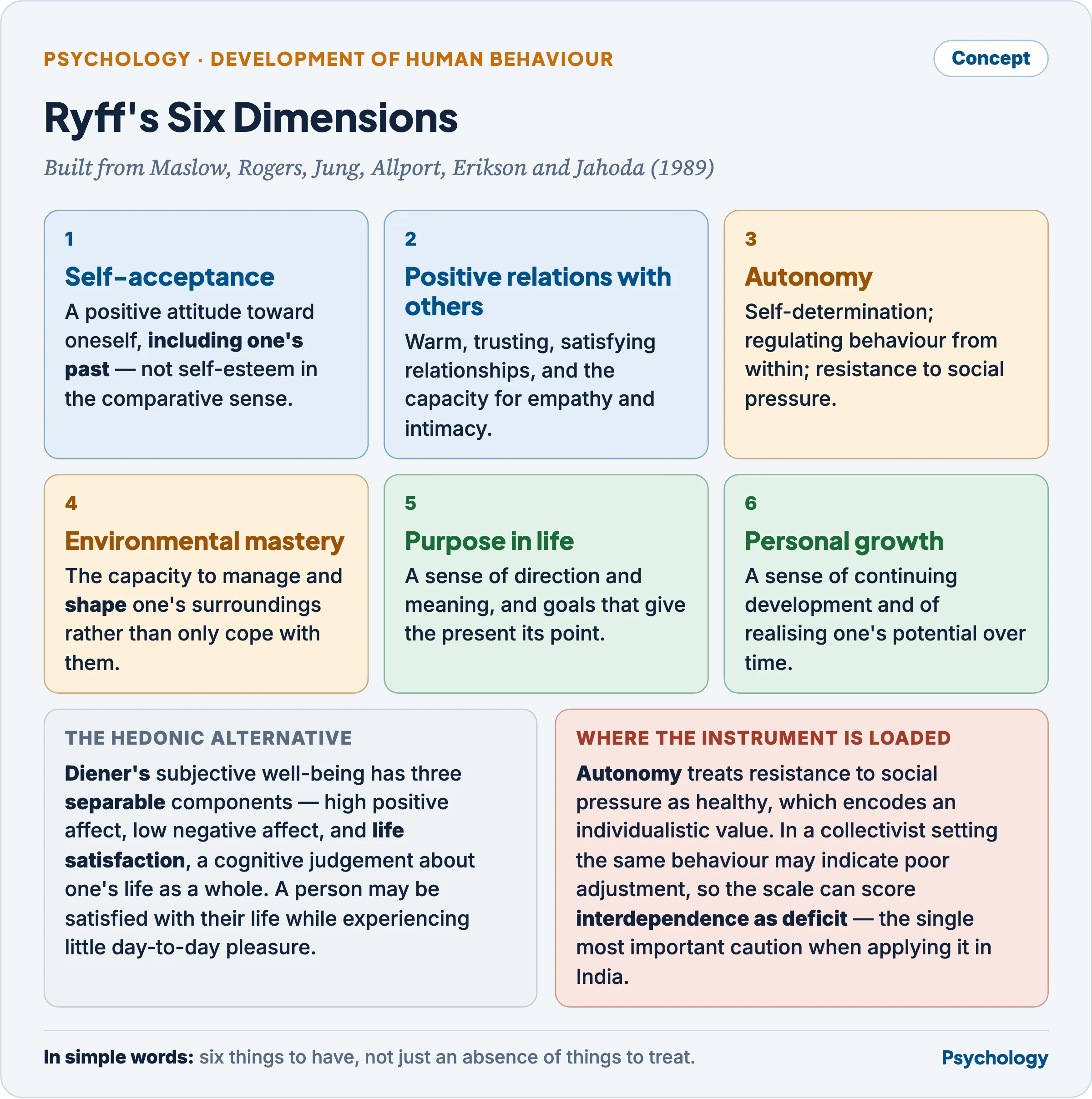
- The eudaimonic tradition identifies well-being with functioning well rather than feeling good. Ryff (1989) built the standard model from it, drawing on Maslow, Rogers, Jung, Allport, Erikson and Jahoda to derive six dimensions: self-acceptance, a positive attitude to oneself including one’s past; positive relations with others; autonomy, self-determination and resistance to social pressure; environmental mastery, the capacity to manage and shape one’s surroundings; purpose in life, a sense of direction and meaning; and personal growth, the sense of continuing development.
Two further frameworks are worth naming. Seligman’s PERMA model specifies positive emotion, engagement, relationships, meaning and accomplishment. And the World Health Organization’s definition of mental health as a state in which a person realises their abilities, copes with normal stresses, works productively and contributes to their community is eudaimonic in structure and is the definition most policy documents use.
Keyes’s distinction completes the picture: well-being and illness are two continua, not one. A person may be flourishing, languishing — free of disorder but without positive function — or mentally ill, and treating illness does not by itself produce flourishing. This is the conceptual basis for promotion as a distinct activity from treatment.
Promoting well-being across the stages of life
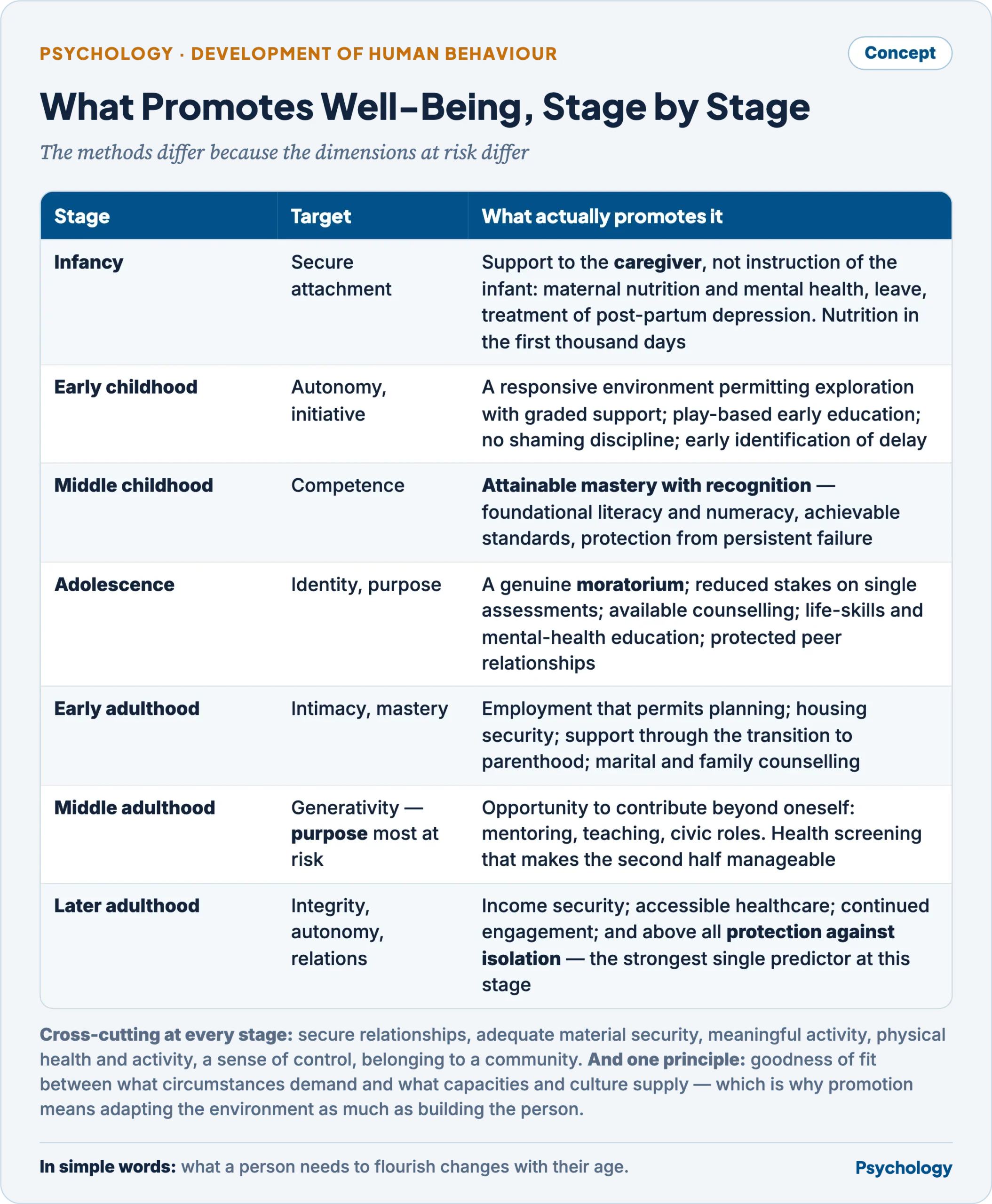
The methods differ by stage because the dimensions that are at risk differ by stage. This is the structure a question on promoting well-being across the life span requires, and a single list of general measures does not answer it.
- Infancy. The target is secure attachment, and the method is caregiver sensitivity. What promotes it is support to the caregiver rather than instruction of the infant: maternal nutrition and mental health, paid leave, treatment of post-partum depression, and arrangements that make responsive care possible. Nutritional adequacy in the first thousand days belongs here too, since cognitive capacity is being built.
- Early childhood. The targets are autonomy and initiative, and the method is a responsive environment that permits exploration with graded support — Vygotskian scaffolding, play-based early education, and the avoidance of shaming discipline. Early identification of developmental delay matters because the window is narrow.
- Middle childhood. The target is competence, and school is the principal instrument. What promotes well-being is attainable mastery with recognition: foundational literacy and numeracy, achievable standards, and protection from the experience of persistent failure, which is the commonest route to a settled sense of inferiority.
- Adolescence. The targets are identity and purpose. The methods are a genuine moratorium — time and permission to explore before commitment — reduced stakes on single assessments, available counselling, life-skills and mental-health education, and the protection of peer relationships, since peer rejection is a principal source of distress at this age.
- Early adulthood. The targets are intimacy and environmental mastery. The methods are employment that permits planning, housing security, support for the transition to parenthood, and the availability of marital and family counselling.
- Middle adulthood. The target is generativity and the dimension most at risk is purpose. What promotes it is opportunity to contribute beyond oneself — mentoring, teaching, community and civic roles — together with support through the characteristic transitions of the period, and the health screening that makes the second half of life manageable.
- Later adulthood. The targets are ego integrity, autonomy and continued relations. The methods are income security, accessible healthcare, opportunities for continued engagement and contribution, and above all protection against isolation, which is the strongest single predictor of poor well-being at this stage.
The cross-cutting methods — those that operate at every stage — are secure relationships, adequate material security, meaningful activity, physical health and activity, a sense of control, and belonging to a community. The cross-cutting principle is goodness of fit between what a person’s circumstances demand and what their capacities and culture supply, which is why promotion requires adapting the environment as much as building the person.
Early adulthood
The developmental concerns of early adulthood are, in Erikson’s terms, the achievement of intimacy on the basis of a settled identity, and in Havighurst’s, the concrete tasks of selecting a partner, starting a family, establishing an occupation and assuming civic responsibility.
- Marriage and partnership is the principal intimacy task. Marital satisfaction typically follows a U-shaped course, declining with the arrival of children and recovering after they leave — a pattern that holds across many studies and is explained by the competing demands on time and attention rather than by any decline in attachment.
- The transition to parenthood is the sharpest discontinuity in adult life, bringing a measurable drop in marital satisfaction, sleep and personal autonomy alongside substantial gains in meaning and purpose. It is also the point of highest risk for the mother’s mental health.
- Work supplies more than income: identity, structure, social contact and a sense of competence. Its developmental significance is that occupational identity is consolidated in this period, and prolonged unemployment or underemployment at this stage damages well-being out of proportion to the income lost.
- The two tasks compete, and the competition is unequally distributed. Where childbearing and occupational establishment fall in the same years, one is typically sacrificed, and which one depends on sex far more than on preference.
The well-being of youth in the Indian setting
- Employment and its uncertainty is the dominant factor. Educational attainment has risen faster than the availability of commensurate work, producing a large group whose qualifications exceed their employment — a mismatch that damages well-being more than low attainment with matched work, because it frustrates an expectation the person has already formed.
- Examination and credential pressure concentrates life outcomes into single assessments. Competitive examinations with very low success rates absorb years of young adulthood, and the cost of failure is borne as personal rather than structural.
- Marriage timing and autonomy. NFHS-5 (2019-21) records 23.3 per cent of women aged 20-24 married before 18. Early marriage ends education and occupational preparation, and the degree of choice over partner, timing and fertility is itself a determinant of well-being.
- The family as support and as constraint. The Indian family provides material and emotional support that welfare systems elsewhere supply institutionally, which protects well-being; it also constrains occupational, marital and residential choice, which reduces autonomy — Ryff’s dimension most at risk in a collectivist setting. The net effect turns on whether that support is conditional on compliance.
- Migration separates young adults from that support network precisely when occupational establishment makes it most needed, and urban migrants show elevated distress with reduced access to care.
- Gender. Young women face restricted mobility, lower labour-force participation, the expectation of relocation on marriage, and safety concerns that limit the exercise of autonomy independently of attitudes within the family.
- Mental health and the treatment gap. The National Mental Health Survey (2015-16) found current mental morbidity among adults at 10.6 per cent and lifetime at 13.7 per cent, with a treatment gap exceeding 70 per cent for most disorders and about 150 million Indians needing active intervention. Among 13-17 year olds morbidity was 7.3 per cent and nearly twice as high in urban metros as in rural areas.
- Social media and comparison. Continuous exposure to curated peer achievement supplies an upward comparison standard that is unavailable to earlier generations, and the evidence associates heavy use with lower life satisfaction in this age group, though the causal direction remains contested.
- Substance use rises in this period and is both a consequence of distress and an independent cause of it.
- What protects. Secure employment, completed education, marital choice, family support that is not conditional, physical activity, and access to counselling. The policy instruments are Tele-MANAS, the Mental Healthcare Act 2017, the counselling provisions of the National Education Policy 2020, and skilling and employment schemes — all of which exist and most of which are limited by delivery rather than by design.
Middle adulthood and the midlife transition
Middle adulthood is defined by Erikson’s crisis of generativity against stagnation, with care as its virtue: the concern is with establishing and guiding the next generation, through parenting, mentoring, teaching or productive work whose value outlasts oneself. Its failure is self-absorption.
The characteristic changes of the period are a cluster rather than a single event.
- Physical. Gradual decline in strength, stamina, visual accommodation and reproductive capacity, with menopause in women as a defined endocrine event and a slower decline in men. The first chronic conditions typically appear.
- Cognitive. Processing speed and some aspects of memory decline while vocabulary, verbal knowledge and practical expertise continue to rise, so overall competence in familiar domains is maintained or improves.
- Occupational. The career plateau is reached, after which further advancement is unlikely, and the question shifts from achievement to meaning.
- Familial. Children leave — the empty nest, which the evidence shows to be associated with improved marital satisfaction more often than with distress — while ageing parents require care, making this the sandwich generation with obligations in both directions simultaneously.
- Temporal. Time perspective reverses. The period is marked by a shift from counting time since birth to counting time remaining, which Neugarten identified as its defining psychological feature and which accounts for the stocktaking characteristic of the decade.
Is there a midlife crisis?
The popular concept is largely unsupported, and saying so with the evidence is a stronger answer than describing the crisis.
Levinson (1978), from intensive interviews with forty men, proposed a midlife transition at about 40 to 45 in which the life structure built in early adulthood is questioned and modified, and he regarded it as near-universal and typically turbulent. The difficulty is the evidence base: a small, male, single-cohort sample studied retrospectively.
Larger studies do not support a universal crisis. Costa and McCrae found no evidence of an age-specific crisis in personality or distress measures, and the MIDUS survey found only a minority reporting having had a midlife crisis, with most of those attributing it to particular events — divorce, job loss, bereavement, illness — rather than to age. Transitions at midlife are common; crises are not, and where turmoil occurs it is better predicted by event than by birthday.
One finding does survive and is worth stating because it is often misread as supporting the crisis. Measures of life satisfaction across age frequently show a shallow U-shape, with a nadir somewhere in the late forties and recovery thereafter. The magnitude is small, the finding is contested in some samples and disappears in others when cohort and selection effects are modelled, and a small average dip is not a crisis.
Midlife challenges across gender in the Indian context
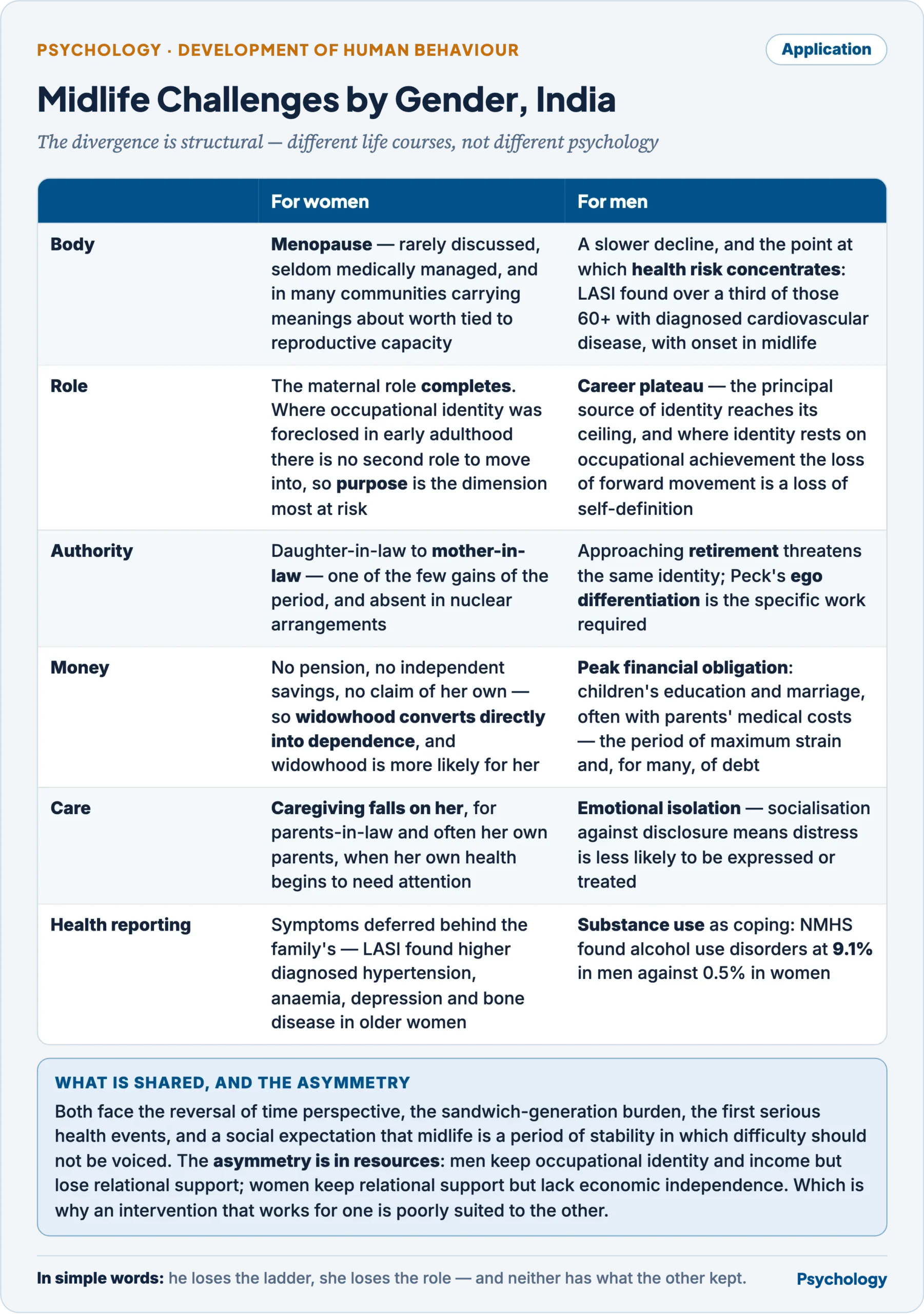
The challenges diverge sharply by sex, and the divergence is structural, following from different life courses rather than different psychology.
For women:
- Menopause arrives in a context where it is rarely discussed, seldom medically managed, and in many communities carries meanings about diminished worth tied to reproductive capacity. Symptoms are frequently untreated and attributed to age.
- The completion of the maternal role is more consequential where motherhood was the principal identity. A woman whose occupational identity was foreclosed in early adulthood has no second role to move into when children marry and leave, which makes purpose the dimension most at risk.
- Role transition within the household. The shift from daughter-in-law to mother-in-law brings an increase in authority that is one of the few gains of the period, and its absence in nuclear arrangements removes a compensation that the joint family provided.
- Caregiving falls disproportionately on her, for ageing parents-in-law and often her own parents, at the point when her own health is beginning to need attention.
- Economic vulnerability is acute. A woman who has not been in paid employment has no pension, no independent savings and no claim of her own, so widowhood converts immediately into dependence. Widowhood is also more likely for her, given both the age gap at marriage and differential longevity.
- Health is reported late. Women’s own symptoms are deferred behind the family’s, which is reflected in LASI (2017-18) findings of higher diagnosed hypertension, anaemia, depression and bone and joint disease among older women than men.
For men:
- Career plateau and the limits of advancement arrive as the principal source of identity reaches its ceiling, and where identity rests almost entirely on occupational achievement the loss of forward movement is a loss of self-definition.
- Peak financial obligation. Children’s higher education and marriage fall in these years, often together with parents’ medical costs, which makes midlife the period of maximum financial strain and, for many, of debt.
- Approaching retirement threatens the same identity, and Peck’s task of ego differentiation — reappraising one’s worth in terms other than the work role — is the specific psychological work required.
- Health risk concentrates here. LASI (2017-18) found more than a third of those aged 60 and above diagnosed with cardiovascular disease, and the onset is in midlife; men show higher rates of heart disease, stroke, diabetes and chronic lung disease than women.
- Emotional isolation. Male socialisation against disclosure means distress is less likely to be expressed or treated, which contributes to the higher male suicide rate in Indian data despite lower reported depression.
- Substance use as a coping response is substantially more common, and the NMHS (2015-16) found alcohol use disorders at 9.1 per cent in men against 0.5 per cent in women.
What is shared, and what the comparison should conclude with: both face the reversal of time perspective, the sandwich-generation burden, the first serious health events, and a social expectation that midlife is a period of stability during which difficulty should not be voiced. The asymmetry is in resources — men retain occupational identity and income but lose relational support, women retain relational support but lack economic independence — which is why interventions that work for one are poorly suited to the other.
Criticisms and limitations
- Self-report, and culturally loaded. Ryff’s autonomy dimension treats resistance to social pressure as healthy, which encodes an individualistic value; in a collectivist setting the same behaviour may indicate poor adjustment, so the instrument can score interdependence as deficit.
- Two unreconciled traditions. They correlate only moderately, measure different things, and there is no agreed way to combine them into a single index, which means claims that well-being has risen or fallen depend on which tradition was measured.
- Thin evidence for adult stages. Levinson’s sample was forty men; Erikson’s adult stages were never operationalised; and the age bands of all the schemes describe a mid-twentieth-century Western life course.
- A concept without evidential support. The midlife crisis entered common understanding regardless,, and its persistence illustrates how readily a vivid idea from a small qualitative study outlives its own disconfirmation.
- Age confounded with cohort. Almost all the evidence on adult well-being compares people of different ages at one time, so differences attributed to development may belong to the historical experience of the cohort.
- A recent and incomplete Indian evidence base. LASI’s first wave dates from 2017-18 and covers those aged 45 and above, so there is no comparable longitudinal data on younger adults, and the NMHS adolescent component was a feasibility subsample in four states rather than a national estimate.
- Prescribed more confidently than evidenced. Most recommendations for promoting well-being across the life span are derived from correlational findings about what accompanies well-being, not from trials of what produces it, and the few randomised interventions show smaller effects than the literature’s confidence implies.
Previous Year Questions
- 2025Highlight the major factors that influence the psychological well-being of youth in the Indian setting.
- 2022Evaluate the developmental challenges faced during midlife transitions across gender in the Indian context.
- 2009What is psychological well being? Discuss various methods in promoting psychological well being across major stages of the life span.