

Role of genetic and environmental factors in determining human behaviour; influence of cultural factors in socialization.
Official Syllabus: Paper I · Unit 4 Development of Human Behaviour
“A cognitive structure, a network of associations that organises and guides an individual’s perception.”
— Sandra Bem (1983), defining the schema through which gender is acquired and applied
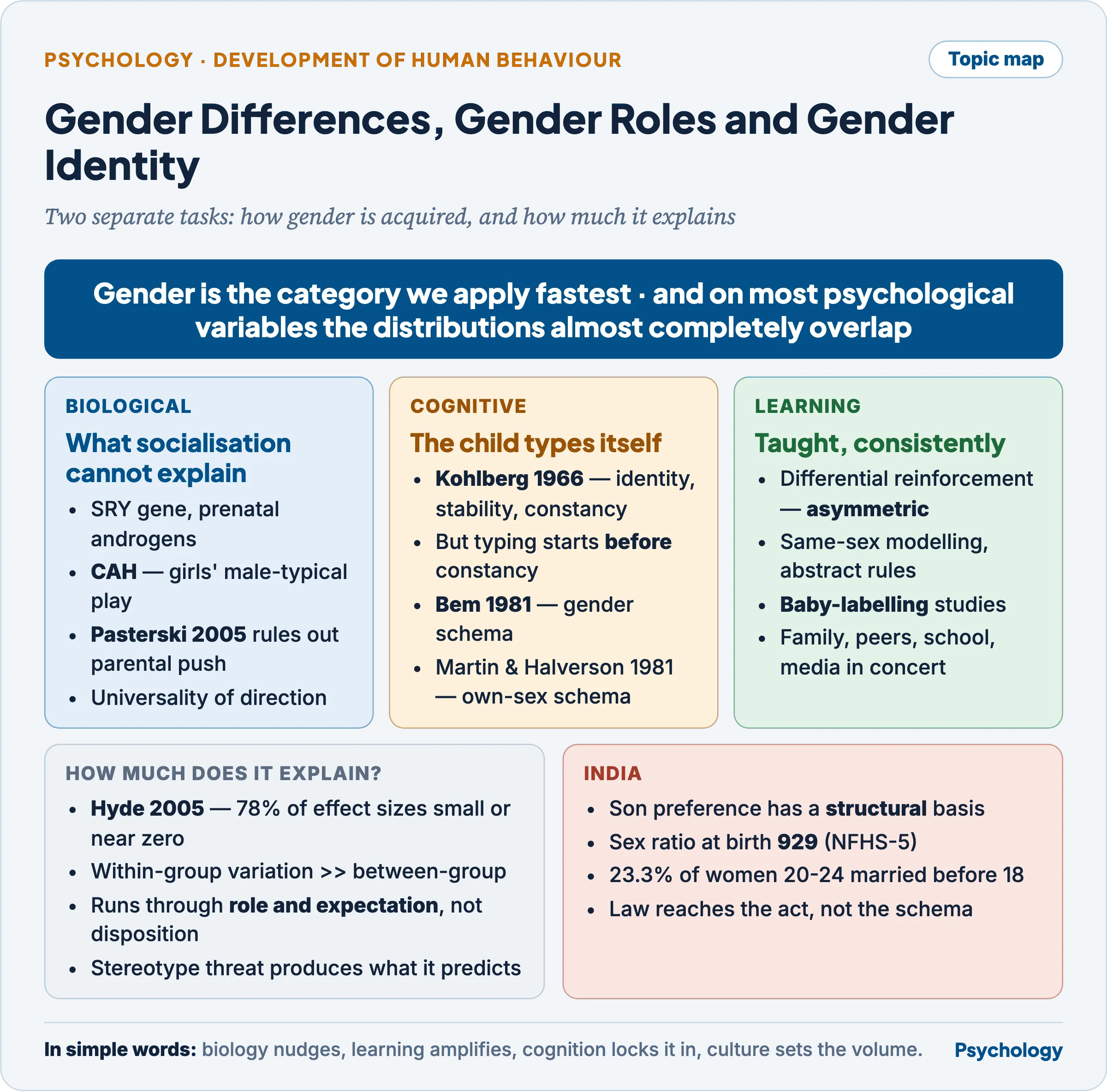
Sorting people into groups is an automatic cognitive operation, and gender is the category humans apply fastest and most universally. The consequence is a false dichotomy: because we perceive two groups, we treat all men as alike, all women as alike, and the two as distinct — when in fact the distributions overlap almost completely on most psychological variables. Explaining how a child acquires a gender, and then deciding how much that gender actually explains about behaviour, are the two separate tasks of this topic.
The vocabulary, kept distinct
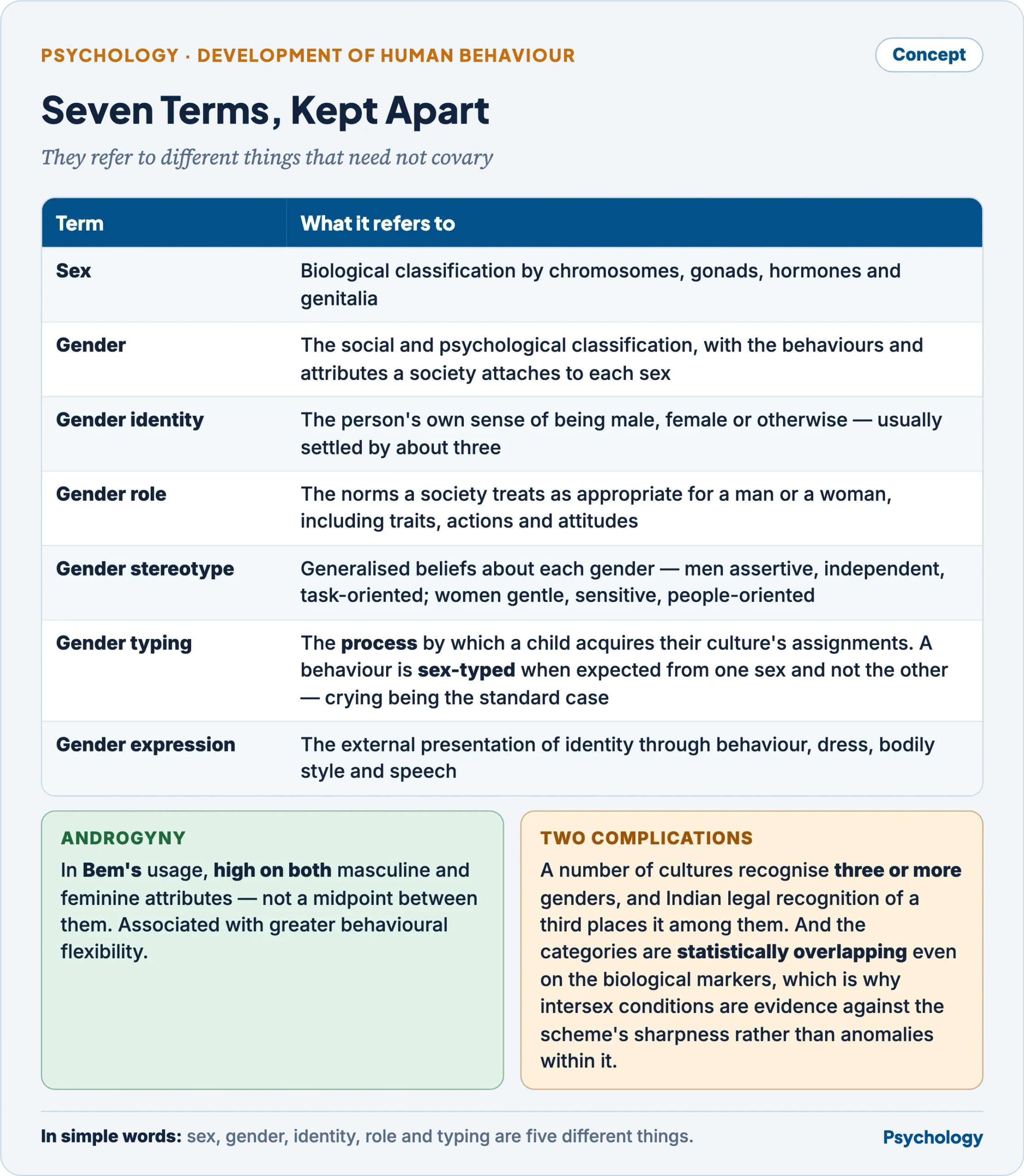
Imprecision here destroys an answer, because the terms refer to different things that need not covary.
- Sex is the biological classification by chromosomes, gonads, hormones and genitalia.
- Gender is the social and psychological classification, with the behaviours, roles and attributes a society attaches to each sex.
- Gender identity is the person’s own sense of being male, female or otherwise, usually established by about three years of age.
- Gender roles are the social and behavioural norms a particular society treats as appropriate for a man or a woman, including the personality traits, actions and attitudes it associates with each.
- Gender stereotypes are the generalised beliefs about what members of each gender are like — men as assertive, independent, aggressive, task-oriented; women as gentle, dependent, sensitive, emotional, people-oriented.
- Gender typing, or sex-typing, is the process by which a child acquires the roles, preferences, attributes and behaviours their culture assigns to their sex. A behaviour is sex-typed when it is expected and judged appropriate from one sex and unexpected or inappropriate from the other — crying being the standard illustration, comforted in a girl and discouraged in a boy.
- Gender expression is the external presentation of gender identity through behaviour, dress, bodily style and speech.
- Androgyny, in Bem’s usage, is high standing on both masculine and feminine attributes rather than a midpoint between them, and is associated with greater behavioural flexibility.
Two facts complicate any two-category scheme. Most cultures recognise two genders, but a number recognise three or more, and the Indian legal recognition of a third gender places it among them. And the categories are statistically overlapping rather than discrete even on the biological markers, which is why intersex conditions are not anomalies within the scheme but evidence against its sharpness.
Biological influences
The biological case does not rest on the existence of sex differences, which could be socialised, but on evidence that cannot be explained by socialisation.
- Chromosomal and gonadal determination. The 23rd chromosome pair sets sex, and the SRY gene on the Y chromosome initiates testicular development, after which the hormonal environment does the work.
- Prenatal androgens are the principal mechanism. During a sensitive period the presence or absence of testosterone organises both genital development and, on the evidence below, aspects of later behaviour.
- Congenital adrenal hyperplasia supplies the strongest available natural experiment. In this genetic condition the adrenal glands overproduce androgens from before birth, so genetic females are exposed prenatally to atypically high testosterone while being raised as girls. girls with CAH consistently show more male-typical and less female-typical play, toy preference and playmate preference than unaffected girls, including their own unaffected sisters, on questionnaire, interview and direct behavioural observation alike. A meta-analysis of twenty independent samples covering 517 females with CAH found large differences from control females across every play outcome, while boys with and without CAH did not differ — which is what a hormonal account predicts, since male foetuses are already androgen-exposed.
- The decisive control comes from Pasterski and colleagues (2005), who measured parental encouragement alongside toy choice. Parents of CAH girls did not push them toward boys’ toys; they gave their CAH daughters more positive feedback for girl-typical play than parents of unaffected girls gave theirs. The male-typical play therefore occurred against the direction of parental socialisation, which rules out differential reinforcement as its explanation. This is the single most useful study for the biological side of the argument, because it tests and eliminates the rival account rather than ignoring it.
- Cross-cultural regularity. Greater male physical aggression and sex-segregated play in middle childhood appear in every society studied, and universality of this breadth is difficult to generate from culturally variable socialisation.
- The evolutionary account proposes that differential parental investment selected for different mating and risk strategies. It explains the pattern of findings but is post hoc — it accommodates whatever is found rather than predicting it in advance — which limits how much weight it can carry.
A caution that keeps the biological case honest: the same study programme that found the CAH effect failed to find amniotic fluid testosterone predicting gender-typed behaviour in typically developing children. Either the measure is insufficiently sensitive or the effect is confined to the clinical range, and the honest statement is that prenatal androgens demonstrably matter at atypical concentrations while their role in normal variation remains unsettled.
Cognitive influences
The cognitive tradition’s distinctive claim is that the child gender-types itself. Once a child has understood which category they belong to, they actively seek out and adopt the behaviours that category prescribes, with no further pressure required.
Kohlberg’s cognitive-developmental theory
Kohlberg (1966) applied a Piagetian stage logic to gender, and the sequence is the examinable content. (It is frequently misattributed to Piaget himself, who never worked on gender.)
- Gender identity, by about two and a half to three years: the child correctly labels their own sex and that of others, but understanding is tied to surface appearance.
- Gender stability, by about four or five: the child grasps that gender is permanent over time — a boy understands he will not become a mother.
- Gender constancy, by about six or seven: the child understands that gender survives changes in appearance, so a man in a dress and a wig is still a man. This is the gender analogue of conservation, and it arrives at the same point in the Piagetian sequence, which is the theory’s main internal evidence.
Kohlberg’s prediction is that systematic gender-typing should begin only once constancy is achieved, because only then is the category stable enough to organise behaviour around. The evidence contradicts this: children show clear sex-typed toy preferences from around two, long before constancy. This is the theory’s principal empirical failure and the reason the next account replaced it.
Bem’s gender schema theory
Sandra Bem (1981, 1983) retained the cognitive insight and removed the stage requirement. Her objection to Kohlberg was twofold: his theory could not explain why sex rather than race, religion or age becomes the organising principle of a child’s identity, and it made children socialise themselves with no external social force at all.
Her account supplies both. A gender schema is a cognitive structure and network of associations that organises perception — information about “mother” linking to woman, female, nurturer, caretaker. Schemas then do three things: they direct attention toward schema-consistent information, they guide interpretation of what is encountered, and they determine what is encoded and therefore remembered. Children become gender-schematic because their society is gender-polarising — it marks gender everywhere, in clothing, pronouns, toys, spaces and forms of address — so gender is made available as the most salient sorting principle. In Bem’s image, the child is given not rose-coloured glasses but gender-coloured ones.
The theory’s predictive strength is that schemas distort memory, which is testable and confirmed: children shown counter-stereotypical images, such as a woman repairing a car, frequently recall them reversed. It also explains why stereotypes are so resistant to disconfirming evidence, since the schema filters the evidence before it is stored.
Martin and Halverson (1981) added the useful distinction between an in-group/out-group schema, a simple classification of what each sex does, and an own-sex schema, the detailed knowledge a child accumulates about activities appropriate to their own group — which is why boys and girls end up differently skilled, not merely differently inclined.
Learning influences
The learning account holds that gender is taught, by the ordinary mechanisms of socialisation applied with unusual consistency.
- Differential reinforcement. Sex-typed behaviour is rewarded and cross-sex behaviour is ignored or punished, beginning in infancy. The effect is markedly asymmetric: cross-sex behaviour in boys draws much stronger disapproval than in girls, particularly from fathers, which is why the boundaries of boyhood are policed more tightly than those of girlhood.
- Modelling and observational learning. Children attend preferentially to same-sex models and acquire whole repertoires from them. Bandura’s abstract modelling matters most here, because what is extracted is not a specific act but a rule about what people of one’s sex do.
- The baby-labelling studies isolate the adult’s contribution cleanly. The same infant, introduced as a boy to half the participants and a girl to the other half, is handled, described and played with differently according to the label — more vigorously and with more encouragement of exploration when labelled male, more gently and with more soothing when labelled female. The infant has not changed; the treatment has.
- The agents operate in concert. The family supplies the first and most powerful instance, and the differentiation begins before birth with the question of the child’s sex and the choices of colour, clothing, room and toys that follow from the answer. Parents have historically prepared sons for self-sufficiency and daughters for the maintenance of relationships, which leaves daughters pursuing independence with a residue of guilt. Peers enforce gender norms more harshly than adults and are substantially sex-segregated through middle childhood, each group developing its own interaction style — negotiation, assertion and team play in boys’ groups, dyadic conversation and listening in girls’. Schools perpetuate gender-typed play and interaction and differentiate expectations by subject. Media supplies models in volume and with unusual stereotypic consistency.
How gender typing actually happens
None of the three accounts is sufficient alone, and their integration is the substantive answer.
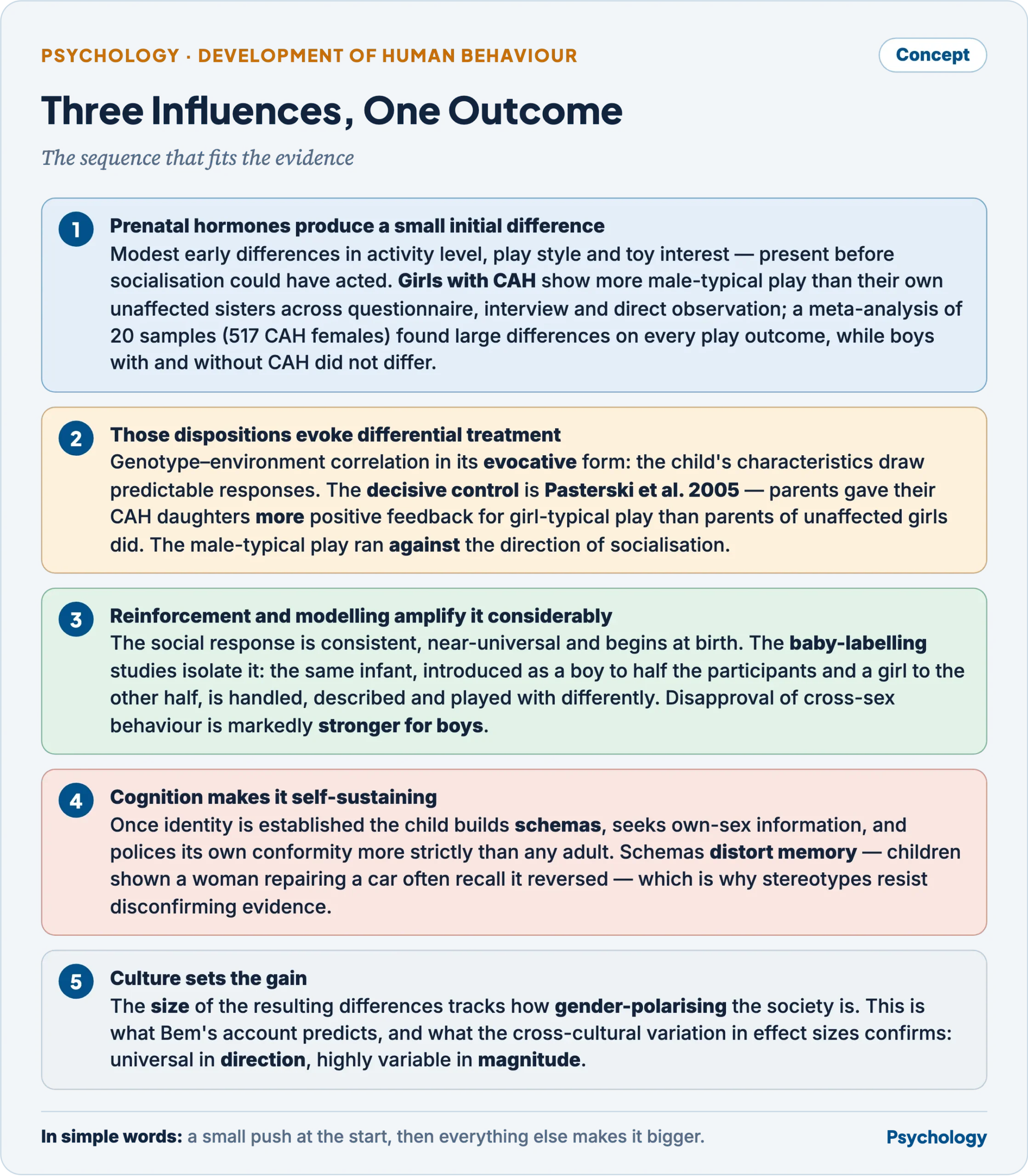
The sequence that fits the evidence runs as follows. Prenatal hormones produce modest initial differences in activity level, play style and toy interest, which are present early and not explicable by socialisation. These dispositions then evoke differential treatment, which is genotype–environment correlation operating in its evocative form. Differential reinforcement and modelling amplify the initial difference considerably, because the social response is consistent, universal and begins at birth. Cognitive development then makes the child an active participant: once gender identity is established the child builds schemas, seeks out own-sex information and polices their own conformity more strictly than any adult does. And the whole process is culturally scaled — the magnitude of the resulting differences varies with how gender-polarising the society is, which is what Bem’s account predicts and the cross-cultural variation in the size of sex differences confirms.
The useful formulation is that biology supplies a small initial difference, learning amplifies it, cognition makes it self-sustaining, and culture sets the gain. This is why the differences are universal in direction and highly variable in size.
Do gender differences account for behaviour?
This is the question on which a strong treatment separates itself, because the honest answer is largely negative and most writing on the topic assumes otherwise.
Janet Hyde’s (2005) gender similarities hypothesis is the decisive evidence. She assembled 46 meta-analyses of psychological sex differences, yielding 124 usable effect sizes across cognitive abilities, verbal and non-verbal communication, social and personality variables, well-being, motor behaviour and moral reasoning. Thirty per cent were close to zero and a further 48 per cent small — 78 per cent in all. The result is the more striking because the meta-analyses addressed precisely those domains where differences were reputed to be reliable: mathematics performance, verbal ability, moral orientation. The claim that women speak in a different moral voice, and the claim that men and women communicate in fundamentally different styles, both fail on the effect sizes. The analysis was independently replicated in 2015.
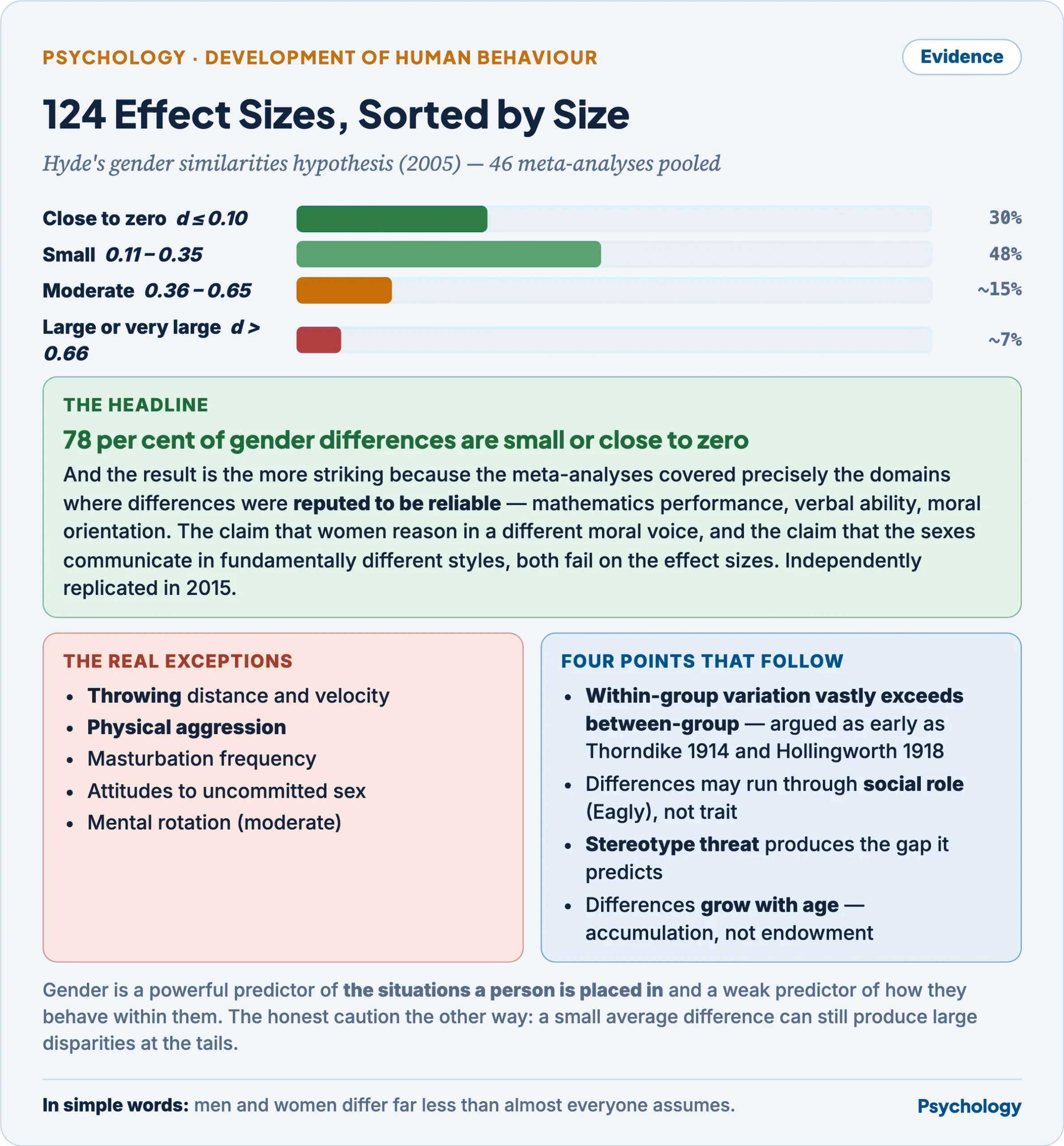
The exceptions are few and worth naming precisely, because an answer that denies all differences is as wrong as one that inflates them. The reliably moderate-to-large differences are in throwing distance and velocity, physical aggression, masturbation frequency and attitudes toward uncommitted sex. Mental rotation shows a moderate difference. Almost everything else does not.
Four analytical points follow, and they are what the question is really asking for.
- Within-group variation vastly exceeds between-group variation. This was argued as early as Thorndike (1914) and Hollingworth (1918), and it is the reason a group mean predicts an individual so poorly. Knowing a person’s sex tells you very little about their standing on almost any psychological variable.
- Gender may explain behaviour through its social meaning rather than through any trait. Men and women behave differently in part because they occupy different roles, face different expectations and are differently sanctioned — Eagly’s social role theory — so the behavioural difference is real while the dispositional difference is not.
- Expectation produces the difference it predicts. Stereotype threat research shows women’s mathematics performance falling when a test is presented as diagnostic of gender difference and the gap narrowing or vanishing when it is not. The difference is partly an artefact of the belief in it.
- Differences grow with age, which is evidence of accumulation through socialisation rather than of a fixed endowment; studies of very young children find smaller differences than studies of adults.
The defensible answer is therefore that gender differences account for far less behaviour than is commonly assumed, and most of what they do account for runs through social role, expectation and self-schema rather than through disposition. Gender is a powerful predictor of the situations a person is placed in and a weak predictor of how they will behave within them.
The Indian context
Gender socialisation in India begins before birth and is enforced at a level that makes it a matter of survival rather than of preference.
- Son preference is the organising fact. Sons carry the family name, inherit, support parents in age and perform the death rites that religious obligation assigns to them, while daughters are prepared for transfer to another family. This gives the preference a structural basis that exhortation does not reach.
- A measurable demographic consequence. NFHS-5 (2019–21) records the sex ratio at birth for children born in the preceding five years at 929 females per 1,000 males, improved from 919 in NFHS-4 but still well below the biological expectation of about 950. The overall sex ratio stood at 1,020 females per 1,000 males, above parity for the first time, which reflects female longevity rather than equal treatment at birth.
- Differential investment follows. Food, healthcare and schooling have historically been allocated unequally within households, which is why anaemia and stunting figures differ by sex and why a nutrition programme operating only on supply fails.
- Girls’ education has moved substantially. NFHS-5 (2019-21) records 71.8 per cent of females aged six and above as having ever attended school, and the gap in literacy and internet use remains large — 71.5 per cent of women literate against 84.4 per cent of men, and 33.3 per cent of women having ever used the internet against 57.1 per cent of men. The digital gap matters for this topic because media is now a principal agent of gender socialisation and access to it is itself gendered.
- Child marriage continues to structure girls’ development, with 23.3 per cent of women aged 20-24 married before 18 (NFHS-5, 2019-21), which truncates education and forecloses the identity exploration adolescence is supposed to permit.
- The policy response works at several levels: the Pre-Conception and Pre-Natal Diagnostic Techniques Act prohibiting sex determination, Beti Bachao Beti Padhao on the sex ratio and girls’ schooling, Sukanya Samriddhi Yojana on the financial calculus of raising a daughter, and the National Education Policy 2020‘s gender-inclusion fund. The psychological point is that legal prohibition addresses the act while leaving the schema intact, which is why sex ratios improve slowly and unevenly.
Criticisms and limitations
- Confounded natural experiments. CAH involves prenatal androgens but also genital virilisation, surgery, lifelong medication and parental knowledge of the diagnosis, any of which could influence how the child is treated — though the Pasterski finding on parental encouragement addresses the most obvious of these.
- Kohlberg’s stage requirement is refuted. Sex-typed preferences appear well before gender constancy, so the theory cannot be the main account of gender typing, whatever the sequence’s descriptive value.
- Hard to falsify. Gender schema theory resists it: Schemas are inferred from the behaviour they are invoked to explain, and the theory accommodates both stereotype-consistent and stereotype-inconsistent outcomes without specifying in advance which will occur.
- Direction unexplained by learning. Differential reinforcement explains how a difference is amplified but not why every society amplifies it the same way, and the universality of direction remains better explained biologically.
- Contested effect sizes. Hyde’s conclusion depends on treating small effects as unimportant, and a small average difference can produce large disparities at the tails of a distribution, which matters for outcomes determined by extremes such as elite performance.
- Binary categories. Almost the entire research literature treats sex and gender as dichotomous, which excludes intersex, transgender and non-binary development and leaves the developmental psychology of those trajectories largely unwritten.
- Cultural narrowness that matters especially here. Findings on gender socialisation derive overwhelmingly from societies where sex does not determine survival or schooling, which makes their transfer to a context of son preference and differential investment doubtful.
Previous Year Questions
- 2025Discuss the role of biological, cognitive and learning influences on gender identity and gender typing by focusing on relevant theories and research studies.
- 2023How does gender differences account for behaviour?