

Influence of cultural factors in socialization.
Official Syllabus: Paper I · Unit 4 Development of Human Behaviour
“Every function in the child’s cultural development appears twice: first, on the social level, and later, on the individual level.”
— Lev Vygotsky (1978), on the social origin of the higher mental functions
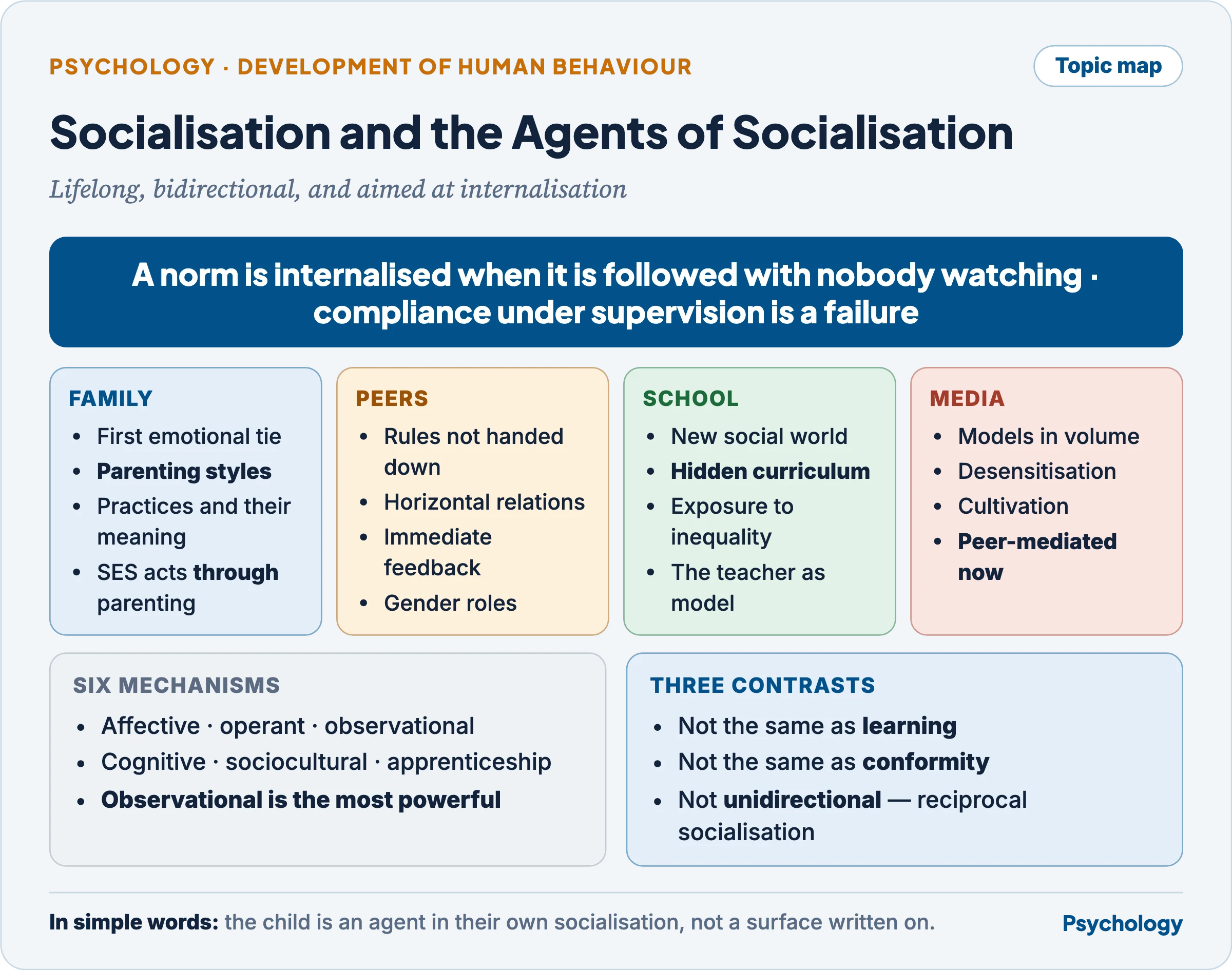
Socialisation is the process by which a person acquires the norms, values, language, skills and behavioural repertoire that make them a competent member of a particular society. Two features of the definition are easy to miss and do most of the examinable work: it is lifelong, not confined to childhood, and it is bidirectional — the child is an agent who selects, resists and reshapes what the agents of socialisation supply, rather than a surface on which culture is inscribed.
What socialisation is, and what it is not
Three contrasts fix the concept.
- Socialisation is not the same as learning. All socialisation involves learning, but learning to solve a quadratic equation is not socialisation. The content of socialisation is specifically what makes a person culturally competent — the shared meanings and practices required to act appropriately in a given society.
- Socialisation is not the same as conformity. The outcome of successful socialisation includes the capacity for autonomous moral judgement and for criticising the group’s norms, which requires that the norms have first been internalised. A perfectly conforming individual may be inadequately socialised, having acquired compliance without internalisation.
- Socialisation is not unidirectional. The older model treated the child as the object of adult transmission. The evidence does not support it: a child’s temperament shapes the parenting it receives, and recent longitudinal modelling finds adolescent behaviour predicting later parenting style at least as strongly as the reverse. This is why the modern term is reciprocal socialisation.
The concept of internalisation marks the goal. A norm is internalised when it is followed in the absence of surveillance and sanction, because the person has made it their own and feels its violation as guilt rather than as risk. Socialisation that produces only compliance under supervision has failed at its central task, and this distinction is the basis for judging any particular child-rearing practice.
How socialisation actually works: six mechanisms
Naming the mechanism is what separates a specific answer from a list of agents.
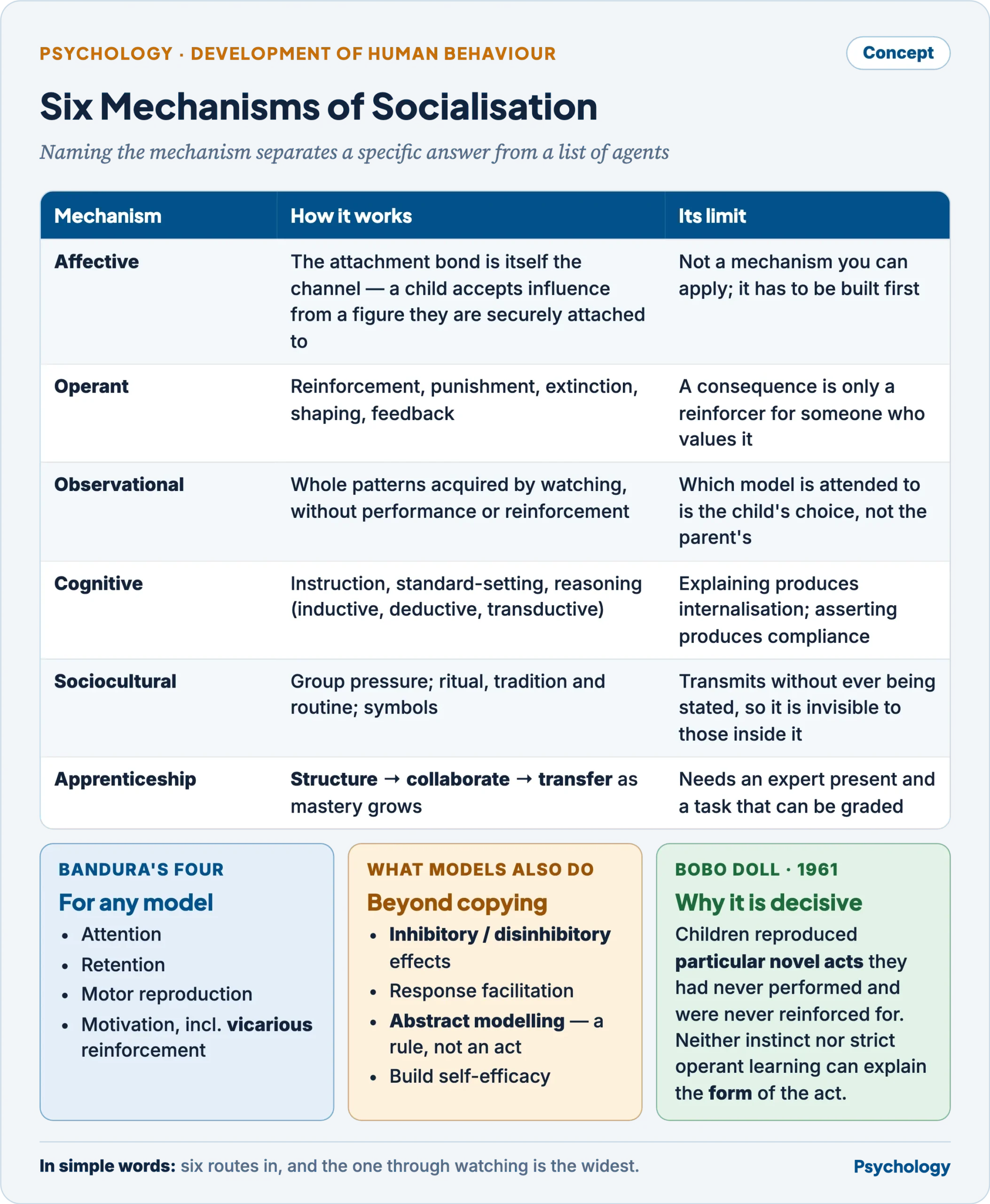
- Affective. The emotional bond with the caregiver is itself a mechanism, because a child accepts influence from someone they are securely attached to and resists it from someone they are not. Attachment is therefore not merely an outcome of early care but the channel through which all subsequent socialisation flows.
- Operant. Behaviour is shaped by its consequences — positive reinforcement, negative reinforcement, punishment, extinction and shaping by successive approximation, together with feedback that supplies evaluative information. The limitation is intrinsic: a consequence is only a reinforcer for a person who values it, so the same sanction socialises one child and not another.
- Observational. The child acquires whole patterns of behaviour by watching and imitating others, without needing to perform them or be reinforced. This is the most powerful of the mechanisms and is treated separately below.
- Cognitive. Socialisation through instruction, standard-setting and reasoning. Parents who explain why a rule exists produce internalisation; parents who assert the rule produce compliance. The forms of reasoning used with children run from the inductive (this particular act was wrong, therefore such acts are wrong) through the deductive to the transductive, which moves from one specific case to another without generalising.
- Sociocultural. Transmission through group pressure, through rituals, traditions and routines that connect a generation to its past, and through symbols that carry shared meaning. A festival, a thread tied at a ceremony, a daily prayer time: each encodes a set of values more durably than any explicit instruction.
- Apprenticeship. A graded sequence in which an expert first structures a task to the learner’s capacity, then collaborates while providing assistance, then transfers responsibility once mastery is reached. This is socialisation of skill and role, and it is the dominant mode in occupational and craft learning.
Models and social learning
Observational learning is the mechanism on which this topic principally turns, and the fullest treatment takes social learning theory as itself a theory of socialisation rather than a theory that happens to bear on it.
Albert Bandura’s central demonstration is the Bobo doll work of Bandura, Ross and Ross (1961), in which nursery children who watched an adult attack an inflatable doll reproduced the specific aggressive acts, including novel ones, while control children did not. Its force lies in a precise point: the children imitated particular forms of behaviour they had never performed and for which they had received no reinforcement, which neither an instinct account nor a strict operant account can explain.
Bandura specified four processes that any model must engage.
- Attention — the model must be noticed, which depends on their distinctiveness, prestige, perceived similarity to the observer and emotional salience.
- Retention — the observed behaviour must be stored symbolically, in images or in verbal code, so it survives the absence of the model.
- Motor reproduction — the observer must possess the physical and cognitive components to execute it.
- Motivation and reinforcement — including vicarious reinforcement, the observed consequences to the model, which is why a child who sees aggression rewarded imitates more than one who sees it punished.
Models do more than supply behaviours to copy, and the extra functions are what make them socialising agents.
- Observational learning proper — acquisition of a behaviour the observer did not have.
- Inhibitory and disinhibitory effects — a model punished for an act suppresses it in observers; a model who performs it with impunity releases it. Much of the socialisation of restraint operates this way rather than through direct sanction.
- Response facilitation — an existing behaviour is elicited because others are performing it.
- Abstract modelling — the observer extracts a rule or standard rather than a specific act. This is the most important function for socialisation, because it explains how a child acquires moral standards, linguistic rules and styles of judgement from particular instances.
- Self-efficacy — the belief in one’s capacity to execute a behaviour, built largely from mastery experience and from watching similar others succeed. It governs which socially available behaviours a person will actually attempt.
The relation to personality theory follows directly. Social learning theories of personality make personality the organised residue of socialisation rather than an independent structure. Bandura’s reciprocal determinism holds person, behaviour and environment to be mutually determining, so an individual’s dispositions select the environments that then shape them further. Rotter (1966) made locus of control — the generalised expectancy that outcomes follow from one’s own action or from external forces — a personality variable learned from a history of socialisation experience. Mischel (1968) pressed the environmental side hardest, showing that trait measures predict behaviour across situations only modestly, and later resolved the dispute with the cognitive–affective processing system, in which stable if–then contingencies rather than global traits constitute personality.
The relation between socialisation and these theories is therefore not incidental but constitutive: social learning theories are theories of socialisation, describing how it produces personality. Their shared limitation is equally clear — by locating almost everything in learning history they understate temperament and heritable disposition, which the behaviour-genetic evidence requires.
The family
The family is the first and most consequential agent: it supplies the first emotional tie, the language, the religion, the food, the first models of adult roles and the earliest standards, and it does so during the period of maximum plasticity and minimum competing influence.
Parenting styles
Diana Baumrind (1966) derived her typology from a genuinely inductive procedure rather than from theory. She identified groups of preschool children with sharply different behavioural patterns, then worked backwards through home observation, laboratory observation and parent interview to the parenting associated with each. Maccoby and Martin (1983) reorganised her three styles onto two orthogonal dimensions and added a fourth.
- Responsiveness, also called warmth or supportiveness — the extent to which parents are attuned and supportive of the child’s needs and foster individuality and self-assertion.
- Demandingness, also called behavioural control — the claims parents make for mature behaviour, supervision, and willingness to confront disobedience.
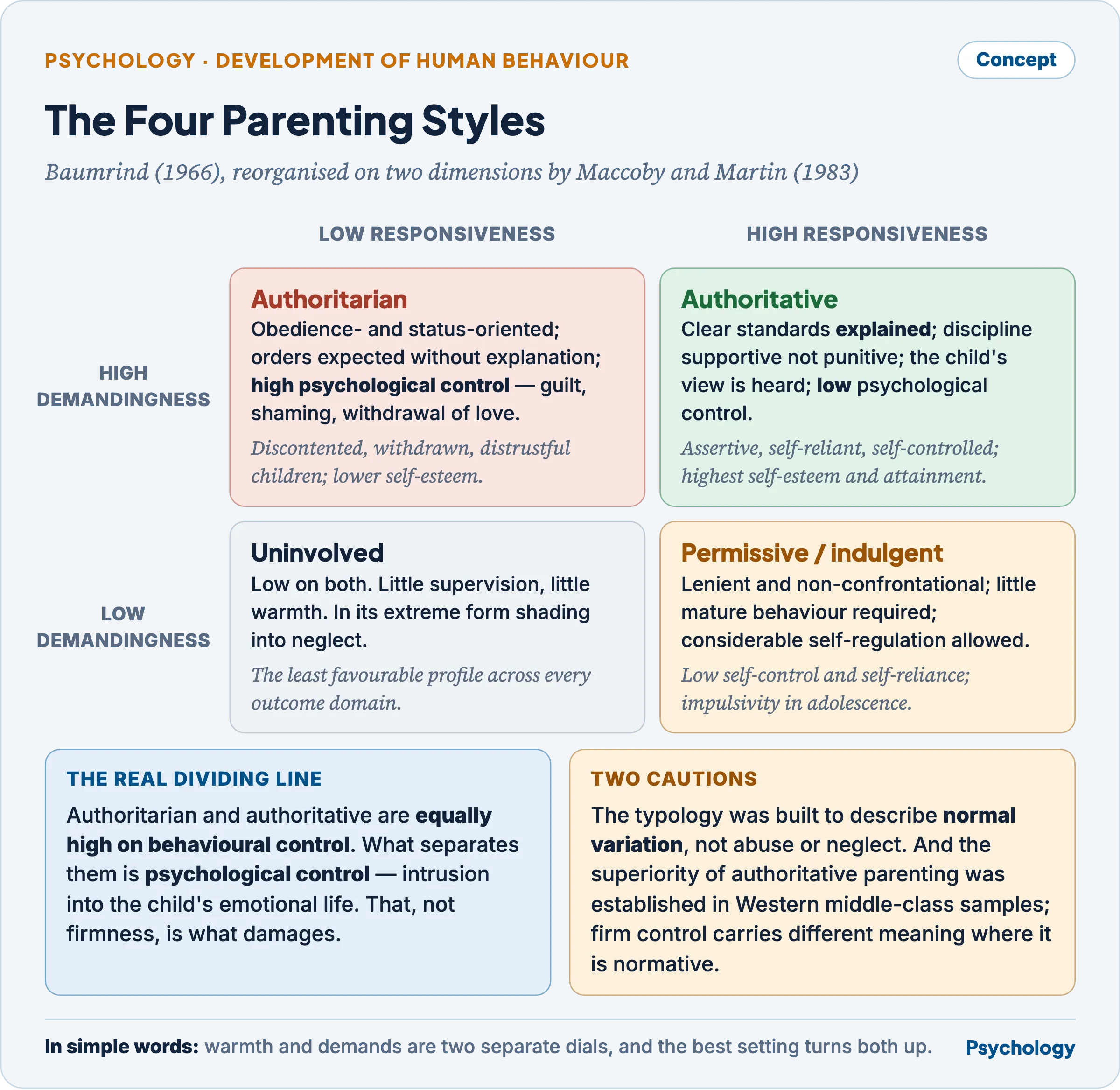
- Authoritative — high responsiveness, high demandingness. Clear standards are set and explained, discipline is supportive rather than punitive, and the child’s view is heard. Associated outcomes are the most favourable: assertive, self-reliant, self-controlled, socially competent children with higher self-esteem and school achievement.
- Authoritarian — low responsiveness, high demandingness. Obedience- and status-oriented, with orders expected to be obeyed without explanation. Associated with discontented, withdrawn and distrustful children, lower self-esteem and either excessive compliance or externalising problems.
- Permissive, or indulgent — high responsiveness, low demandingness. Lenient and non-confrontational, requiring little mature behaviour. Associated with low self-control and low self-reliance, and with impulsivity in adolescence.
- Uninvolved, or neglectful — low on both. The least favourable profile across every outcome domain, and in its extreme form shading into neglect.
Two refinements raise the quality of an answer considerably. The first is psychological control — attempts to intrude on the child’s emotional life through guilt induction, shaming or withdrawal of love. This is the real line between authoritarian and authoritative parenting, since both are high on behavioural control, but the authoritative parent is low and the authoritarian parent high on psychological control. The second is that Baumrind’s typology was built to describe normal variation, not abuse or neglect, so applying it to maltreating families stretches it past its design.
Child-rearing practices and their effects
Styles are broad orientations; practices are specific acts, and the effect of a practice depends on the style and the cultural meaning in which it is embedded.
- Physical punishment illustrates this most sharply. McLoyd and Smith (2002), following several thousand ethnically diverse children, found spanking associated with rising behaviour problems when parents were cold and rejecting but not when they were warm and supportive. A later study in the same programme found spanking predicting depressive symptoms chiefly among children whose mothers disapproved of the practice and therefore used it when highly angry. The practice is not a constant with a fixed effect; its meaning to the child is what carries the consequence.
- Marital conflict acts on the child independently of parenting quality. Children exposed to sustained conflict between parents show poorer socialisation outcomes even where each parent’s own practices are adequate.
- Negative modelling reproduces itself across generations. Children raised in violent homes disproportionately repeat the pattern as adults, because what has been modelled has been established as normal.
- Fathers have been persistently underweighted. Across cultures fathers do less routine caregiving and interact more through vigorous play, but Veneziano (2003) found fathers’ sustained affectionate involvement predicting later cognitive, emotional and social competence as strongly as mothers’ warmth and occasionally more strongly.
- Socioeconomic position operates through parenting rather than around it. Lower-income parents use harsher and more authoritarian discipline with less explanation, and higher-income parents use a more elaborated vocabulary and more cognitively stimulating activity. Three accounts compete: the family stress model, in which economic hardship degrades parental functioning and so the child’s outcome; the family investment model, in which higher financial, social and human capital is invested in the child; and the social selection view, that parental characteristics cause both their own position and the child’s outcome. Conger and Donnellan (2007) argued for an interactionist synthesis in which the influences run reciprocally across generations.
The peer group
The peer group is the agent that family cannot substitute for, because its structure is different in a way that matters.
- Rules are not handed down. Peers generate their own norms, which gives children their first experience of constructing rather than receiving a social order — the point Piaget made in arguing that genuine moral autonomy requires the symmetrical relations of peers rather than the unilateral respect owed to adults.
- Relations are horizontal. Status must be negotiated and earned rather than ascribed, which is where skills of assertion, compromise and conflict resolution are acquired.
- Feedback is immediate. Approval and exclusion follow behaviour at once, which makes the peer group a fast and powerful shaper of behaviour.
- It supplies a route out of adult supervision, and with it a domain for discussing what adults do not share or do not permit.
- It teaches gender roles, since peer groups are substantially sex-segregated in middle childhood and each develops its own interaction style.
- Peer pressure operates in both directions. It is routinely treated as negative — underage drinking, smoking, risk-taking — but the same conformity mechanism sustains academic effort, athletic commitment and prosocial norms where the group’s norms run that way.
The influence is strongest in adolescence and is often misdescribed. It is not that peers displace parents wholesale: the evidence is that peers dominate short-term and surface choices — dress, music, speech, immediate risk behaviour — while parents retain influence on long-term values, educational aspiration and moral commitments. The conflict is real but domain-specific.
The school
A child in the Indian system will spend over a decade in school, and the socialising work it does is only partly the curriculum.
- It provides entry into a new social world in which the child must locate their standing among classmates and teachers, a status not given by family position.
- It transmits the hidden curriculum — punctuality, queueing, deference to impersonal authority, competition, working to externally imposed schedules — which is the behavioural repertoire required by bureaucratic and industrial life and is taught by the school’s form rather than its content.
- It sustains or challenges the society’s categories. Schools frequently perpetuate gender-typed play and interaction, and in the Indian context caste, language and class distinctions are both reproduced and, where the school is genuinely mixed, weakened.
- It gives exposure to inequality and to difference, and so the first occasion for socialising across groups.
- It increases opportunities for exercising control over decisions, which builds competence and self-confidence.
The teacher is an agent in their own right, functioning as model, evaluator and the first significant adult outside the kinship system, and the manner of handling a child in the classroom has emotional as well as intellectual consequences.
Mass media
Media is the agent that has changed most, and an answer confined to television understates it.
- Observational learning is the primary route: media supply models, in volume, that a child would never encounter in person, and abstract modelling means the rules and standards they embody are extracted along with the specific behaviours.
- Media violence. The evidence is substantial and convergent. Bushman and Huesmann (2006) meta-analysed 431 studies with over 68,000 participants and found modest but significant effects on aggressive behaviour, aggressive cognition, angry affect and arousal, together with reduced helping. Their theoretically interesting result was a crossover: short-term effects were larger for adults and long-term effects larger for children — consistent with short-term effects being the priming of already-encoded scripts, which adults have had longer to form, and long-term effects requiring that new scripts be encoded, which children do more readily. Longitudinal studies show childhood exposure predicting later aggression with social class, intelligence, prior aggressiveness and parenting controlled, and the reverse path is weaker, which argues against the explanation that aggressive children merely choose violent content.
- Desensitisation and cultivation operate alongside imitation. Repeated exposure reduces emotional response to real violence, and heavy consumption shifts beliefs about how common violence is in the world.
- Body image, consumption and aspiration are shaped by advertising and by the uniformity of represented appearance, with documented effects on adolescent body dissatisfaction.
- Social media changes the mechanism, not only the content. Influence is now peer-mediated and quantified: the model is a peer rather than a distant professional, the feedback is numerical and public, and the exposure is continuous and algorithmically selected to the user’s existing dispositions — which is niche-picking operating at machine speed. Caplan (2003) found lonely and depressed individuals preferring online to face-to-face interaction, with poorer outcomes, which identifies the direction of vulnerability.
- Concrete instances, in the Indian setting. Four are worth having ready. Advertising and body image: adolescent girls’ exposure to a narrow range of represented appearance, including fairness-cream advertising that explicitly links skin tone to employability and marriage prospects, has documented effects on body dissatisfaction. Imitation of filmed stunts: injuries from adolescents reproducing specific acts seen in film and on video platforms are the clearest real-world instance of observational learning in the Bobo doll sense, because the act imitated is a particular sequence, not a general disposition. Aspiration and consumption: the goods, careers and lifestyles adolescents treat as normal now track what is represented to them rather than what is present in their neighbourhood, which is why rural adolescents’ expectations have shifted faster than rural opportunity. Online challenges and virality: a behaviour performed for a quantified, public peer audience combines modelling with immediate vicarious reinforcement, which is why it spreads faster than anything broadcast media could produce.
- The moderators matter more than the main effect. Parental co-viewing, mediation and explanation substantially reduce the effect of violent content, and the effect is larger for children already disposed to aggression. The honest statement is that media exposure is a real but modest contributor whose size depends heavily on what the family and peer group do alongside it.
How the three agents combine in adolescent identity formation
The three agents are usually treated separately, and separately they are misleading; what matters is how they interact.
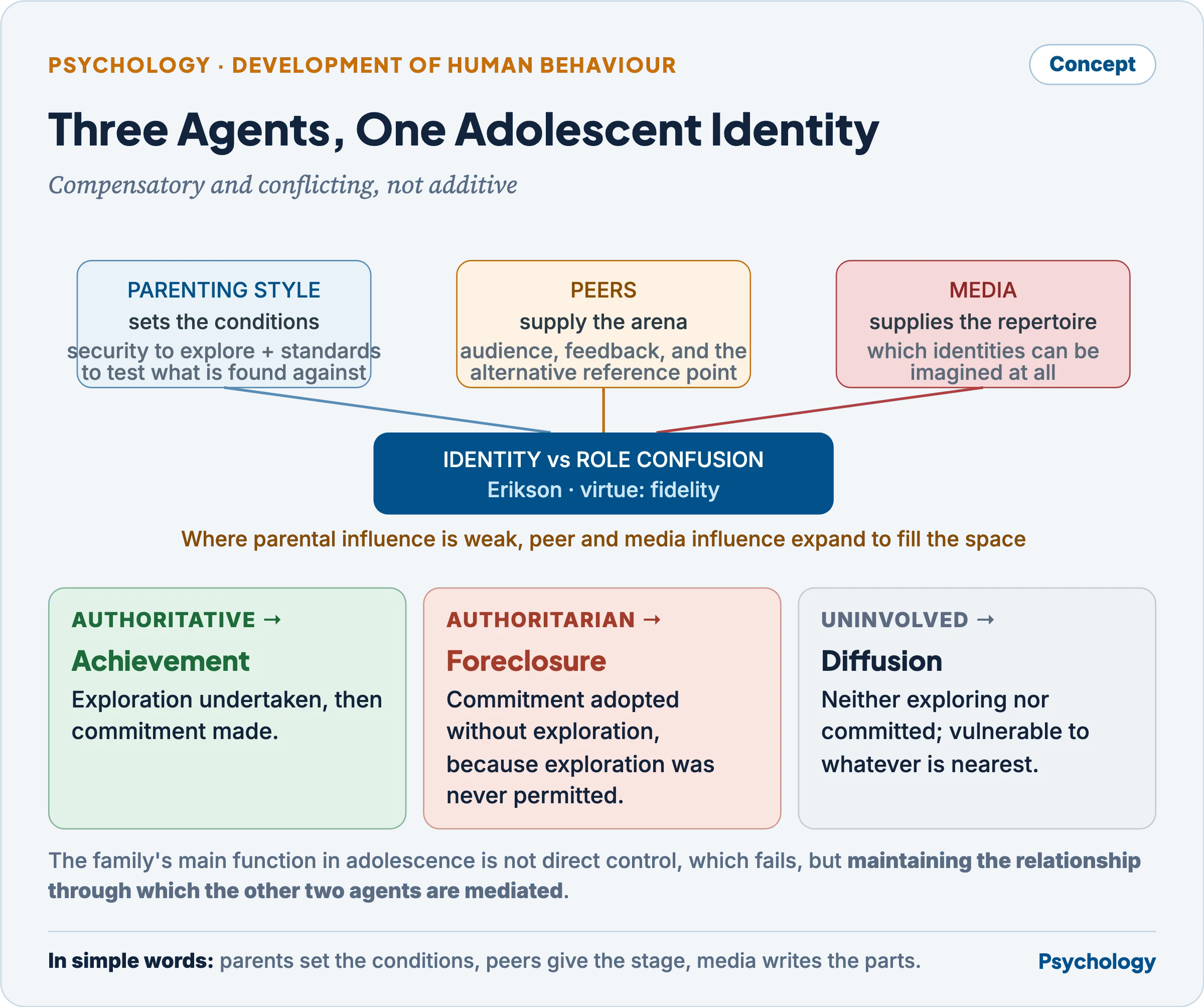
Adolescence is the period Erikson identified as the crisis of identity against role confusion, and its resolution requires material to build an identity from — available roles, ideologies and models — plus a secure base from which to experiment with them.
- Parenting style sets the conditions. Authoritative parenting supports identity achievement, because it supplies both the security to explore and the standards against which to test what is found. Authoritarian parenting tends to produce foreclosure, in Marcia’s (1966) terms — commitment adopted without exploration, because exploration was never permitted. Uninvolved parenting is associated with diffusion, neither exploring nor committing.
- Peers supply the arena. Identity is tried out in the peer group, which provides the audience, the feedback and the alternative reference point that makes separation from parents possible without isolation.
- Media supplies the repertoire. The range of identities a young person can imagine is now set largely by what is represented to them, and this is the agent whose influence has grown most and is least supervised.
The three are not additive but compensatory and conflicting. Where parental influence is weak, peer and media influence expand to fill the space; where peer and parental norms conflict, the adolescent’s prior relationship with each determines which prevails. The practical conclusion is that the family’s most important function in adolescence is not direct control, which fails, but maintaining the relationship through which the other two agents are mediated.
Criticisms and limitations
- Contested causal direction. The parenting-style literature is correlational. Authoritative parenting is associated with good outcomes, but competent children are easier to parent authoritatively, and recent bidirectional modelling finds child effects on parenting style that are sometimes larger than parent effects.
- The styles may not be culturally universal. The superiority of authoritative parenting was established largely in Western middle-class samples. Studies in Chinese, South Asian and African-American populations find firm parental control carrying different meanings and consequences where it is normative and understood as care, which makes the claim of universal superiority doubtful.
- Agent-by-agent treatment misrepresents the process. Family, peers, school and media are presented as separable influences whose effects add, when in practice each selects and moderates the others.
- Weak measurement. The formal models are weakest where they are most needed. The available formal models of socialisation measurement were developed for organisational entry — newcomer adjustment in workplaces — and transfer poorly to the socialisation of children, which is where the syllabus’s interest lies.
- Media-effects findings remain disputed in magnitude. The effect sizes are small to medium, publication bias and the laboratory measures of aggression have been criticised, and the newer social-media literature is largely cross-sectional and too recent for confident causal claims.
- An unstated default family structure. The nuclear, two-parent, mother-as-primary-caregiver arrangement from which most findings derive is globally atypical, and multiple caregiving by grandparents, aunts and older siblings — the Indian norm — is treated as a deviation rather than as a pattern in its own right.
Previous Year Questions
- 2021Describe the role of mass media in shaping the behaviour of adolescents. Support it with appropriate examples.
- 2016Describe the parenting styles that are used in raising a normal child.
- 2011Critically evaluate the role of parenting style, peer group and media in identity formation during adolescence.
- 2003Discuss in detail the influence of child-rearing practices on the growth and development of an individual.
- 2000How do models help in the process of socialization?
- 1997Is there any relation between process of socialization and the social learning theories of personality?