

Role of genetic and environmental factors in determining human behaviour.
Official Syllabus: Paper I · Unit 4 Development of Human Behaviour
“It is a plausible hypothesis that genetic differences affect psychological differences largely indirectly, by influencing the effective environment of the developing child.”
— Bouchard, Lykken, McGue, Segal and Tellegen (1990), concluding the Minnesota Study of Twins Reared Apart
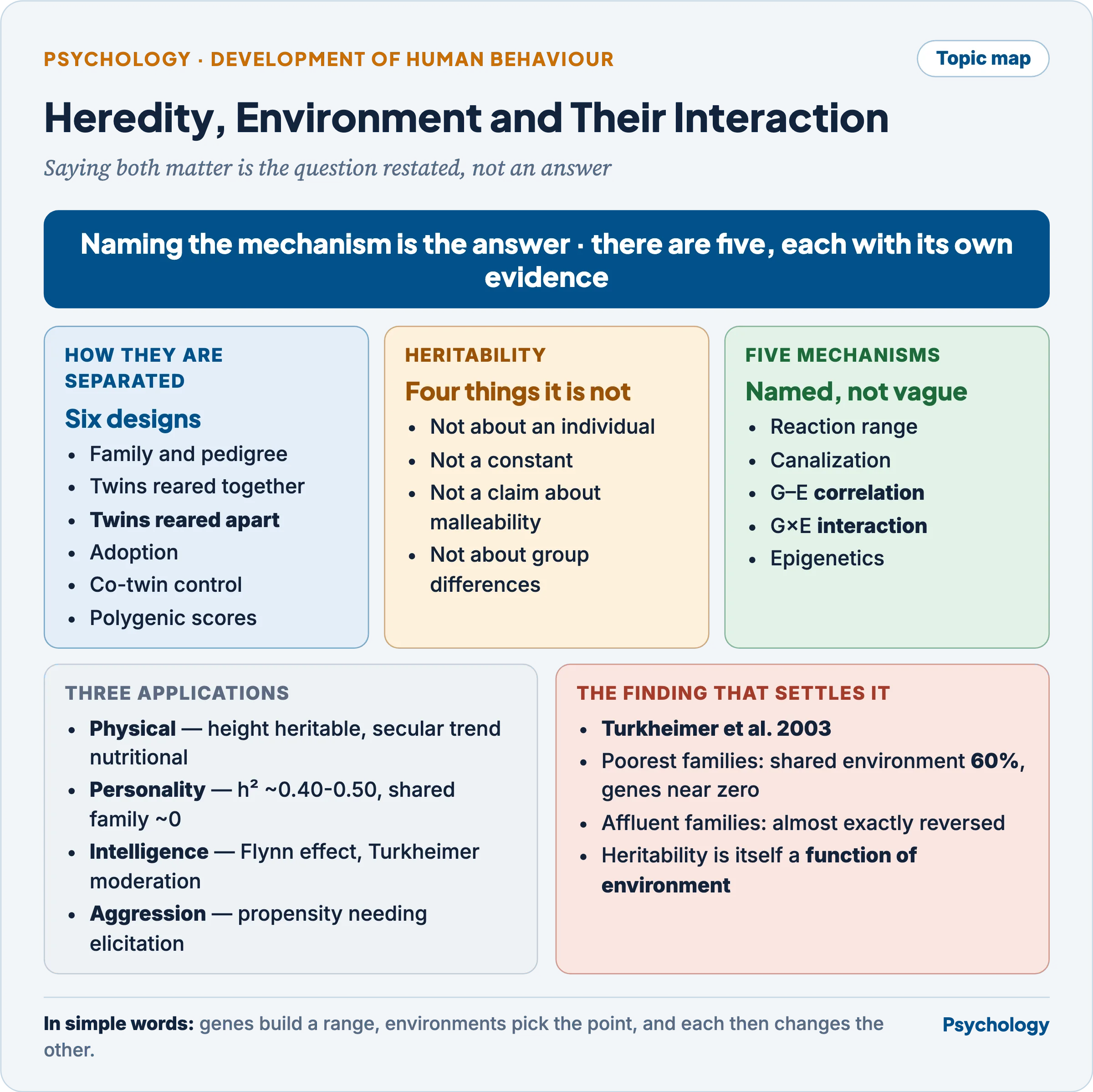
A single sentence contains the defensible modern position: genes build a range, environments select a point inside it, and each then alters the other. Saying that both matter is not an answer — it is the restatement of the question. What distinguishes a strong treatment is naming the mechanism by which the two are related, and there are five distinct ones, each with its own evidence.
The debate, and why its original form was unanswerable
The terms come from Francis Galton, who set heredity against nurture in the 1870s and read family eminence as evidence for the first. The twentieth century then produced two extreme positions, and both are worth stating because each is wrong in an instructive way.
- Hereditarianism. Arnold Gesell (1928) held development to be the unfolding of a genetically specified sequence, with environment supplying only the occasion. His co-twin control studies, in which trained and untrained identical twins converged on the same motor milestones, were genuine evidence for maturational control of motor order.
- Environmentalism. John B. Watson (1930) made the opposing claim in its most famous form: give him a dozen healthy infants and freedom to construct the world in which they are reared, and he would guarantee to produce any one of them a doctor, a lawyer, an artist, a beggar or a thief, regardless of talent, tendency or ancestry. He never attempted the demonstration, and the boast is not evidence; but his conditioning work did show that environmental arrangement shapes behaviour reliably.
The position the field reached is called interactionism, and the reason the original question had no answer is worth stating exactly. No phenotype whatever arises without both a genotype and an environment, so asking what proportion of a characteristic is genetic is meaningless as applied to an individual. The question becomes answerable only when reformulated as a question about variance in a population: of the differences among people in this population under these conditions, what proportion is associated with genetic differences among them? That reformulation makes the enquiry empirical and simultaneously limits what its answers can be used for.
Isolating the two contributions
The methodological question — how the influences can be separated at all — is answered by designs that hold one of them approximately constant.
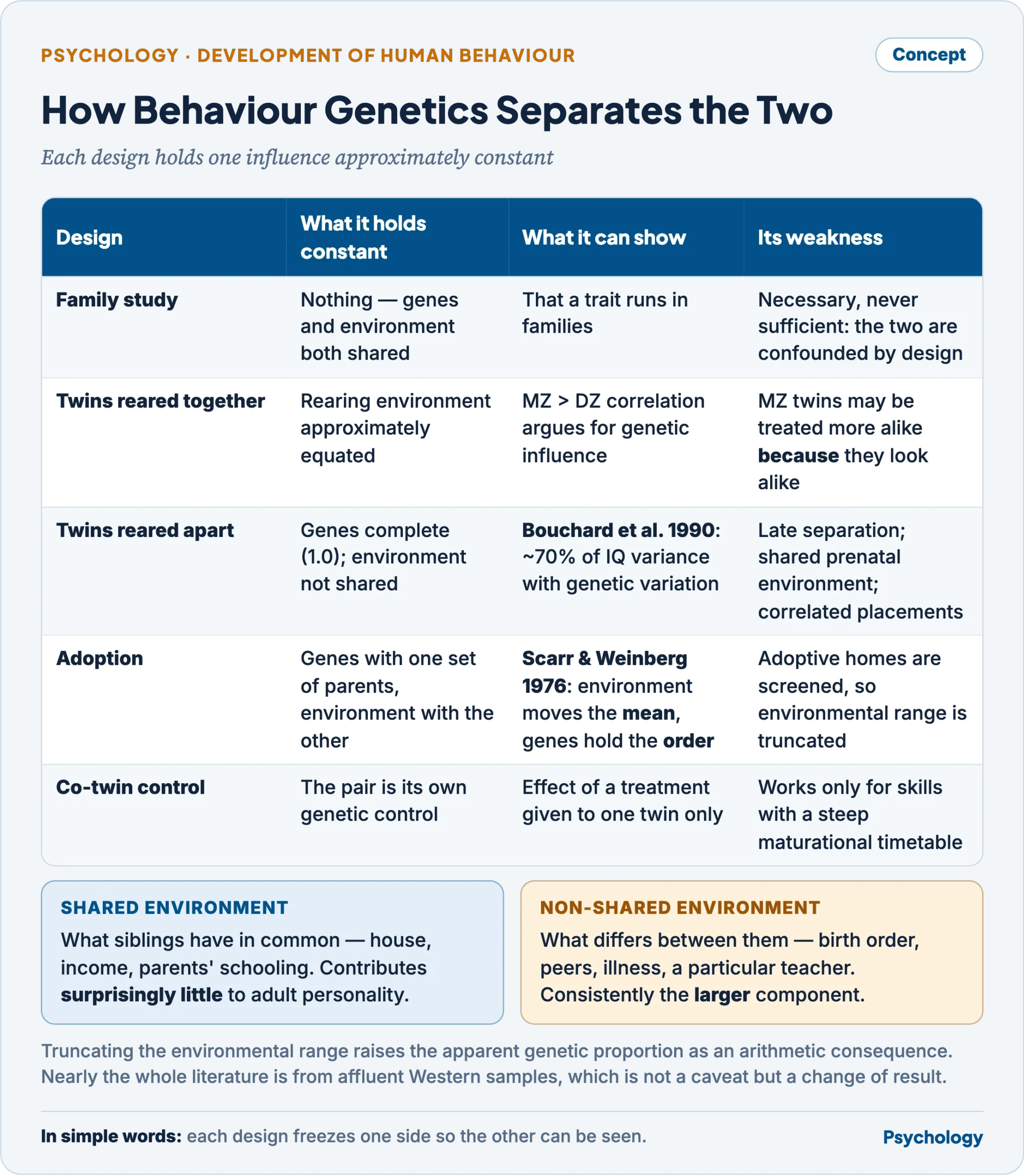
- Family and pedigree studies establish that a characteristic runs in families. This is necessary evidence but never sufficient, because families share environments as well as genes, and the two are confounded by design.
- Twin studies compare monozygotic with dizygotic pairs reared together. Genetic sharing differs — effectively 1.0 against 0.5 — while the rearing environment is approximately equated, so a higher correlation in identical than fraternal pairs argues for genetic influence.
- Twins reared apart is the strongest available design, because genetic sharing is complete while the rearing environment is not shared at all. The Minnesota Study of Twins Reared Apart (Bouchard and colleagues, 1990) put more than a hundred reared-apart twin and triplet sets through a week of intensive assessment and found about 70 per cent of IQ variance associated with genetic variation, with identical twins reared apart almost as similar on personality, occupational and leisure interests and social attitudes as identical twins reared together.
- Adoption studies reverse the logic: an adopted child shares genes with biological parents and environment with adoptive ones, so comparing the two sets of correlations partitions the influences. The Minnesota Transracial Adoption Study of Scarr and Weinberg (1976) found adopted children’s IQ raised well above the level predicted by their biological background, while their ranking continued to track it — the clearest single illustration of environment moving the mean and genes holding the order.
- Co-twin control, in which one twin receives a treatment the other does not, uses the pair as its own genetic control.
- Molecular designs now supplement all of these, either testing a named polymorphism or aggregating thousands of small effects into a polygenic score.
Two further concepts organise what the designs find. Shared environment is what siblings in one family have in common — the house, the income, the parents’ schooling. Non-shared environment is what differs between them: birth order, peer groups, illness, a particular teacher, differential parental treatment. The most consistently surprising finding in the field is that for most adult characteristics, the non-shared component is substantially the larger of the two.
What the designs cannot do
Each limitation bears directly on how much weight the findings can carry.
- Identical twins reared together may be treated more alike because they look alike, which inflates the estimate by misattributing an environmental similarity to genes.
- Reared-apart twins are frequently separated late rather than at birth, share the prenatal environment in every case, and are often placed in correlated homes by the same agency.
- Adoptive families are screened and therefore unrepresentatively favourable. Screening truncates the environmental range, and a restricted environmental range mechanically raises the apparent genetic proportion.
- Almost the whole literature comes from affluent Western populations, which is not a minor caveat but a change of result, as Turkheimer and colleagues (2003) demonstrated.
Heritability, and the four things it does not mean
Heritability is the proportion of variance in a characteristic, within a specified population under specified conditions, that is attributable to genetic variation within that population. It is a ratio of two quantities that can each change, and four consequences follow. Misunderstanding any one of them produces a wrong answer.
- It is about a population, never an individual. A heritability of 0.5 for height does not mean half of any particular person’s height is genetic. The statistic has no individual interpretation at all.
- It is not a constant. Equalise environments and heritability rises, because the environmental term in the denominator shrinks. Diversify them and it falls. A heritability figure is a description of a population at a time, not a property of the trait.
- It says nothing about malleability. Phenylketonuria is a fully penetrant single-gene disorder with an almost complete dietary remedy. High heritability is not an argument against intervention, and this inference is the commonest misuse of the statistic.
- Within-group heritability implies nothing about between-group differences. Two populations may each show high internal heritability while the entire gap between them is environmental — the standard demonstration being genetically identical seed sown in rich and poor soil, where height is highly heritable within each plot and the difference between plots is wholly nutritional.
The finding that settles the matter
Turkheimer, Haley, Waldron, D’Onofrio and Gottesman (2003) analysed Wechsler scores for 7-year-old twins from the National Collaborative Perinatal Project, a sample unusual in containing many families at or below the poverty line, and entered socioeconomic status as a continuous moderator rather than a control. The variance components did not merely shift. They reversed.
In the most impoverished families roughly 60 per cent of IQ variance was attributable to shared environment and the genetic contribution was close to zero; in affluent families the pattern was almost exactly inverted.
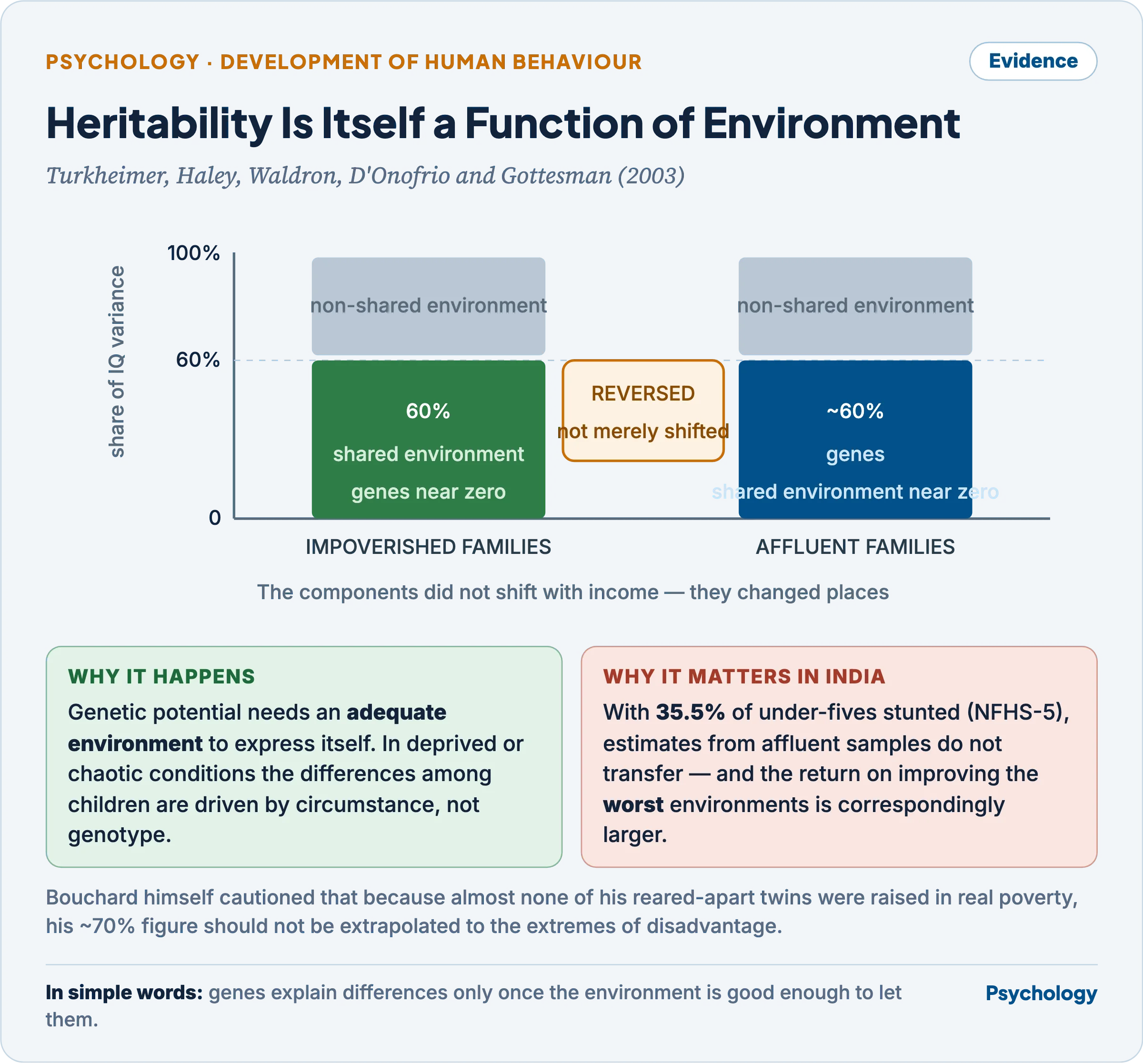
The interpretation is that genetic potential requires an adequate environment in which to be expressed, so in chaotic or deprived conditions the differences among children are driven by their circumstances and not by their genotypes. Bouchard himself had entered the same caution, noting that because almost none of his reared-apart twins were raised in real poverty or by illiterate parents, his estimate should not be extrapolated to the extremes of disadvantage still found in society.
For an Indian answer this is the single most important result on the topic. In a population where a third of children under five are stunted, heritability estimates derived from affluent Western samples do not transfer, and the expected return on improving the worst environments is correspondingly larger.
The five ways genes and environments are related
Naming the mechanism is what converts a vague interactionism into an argument.
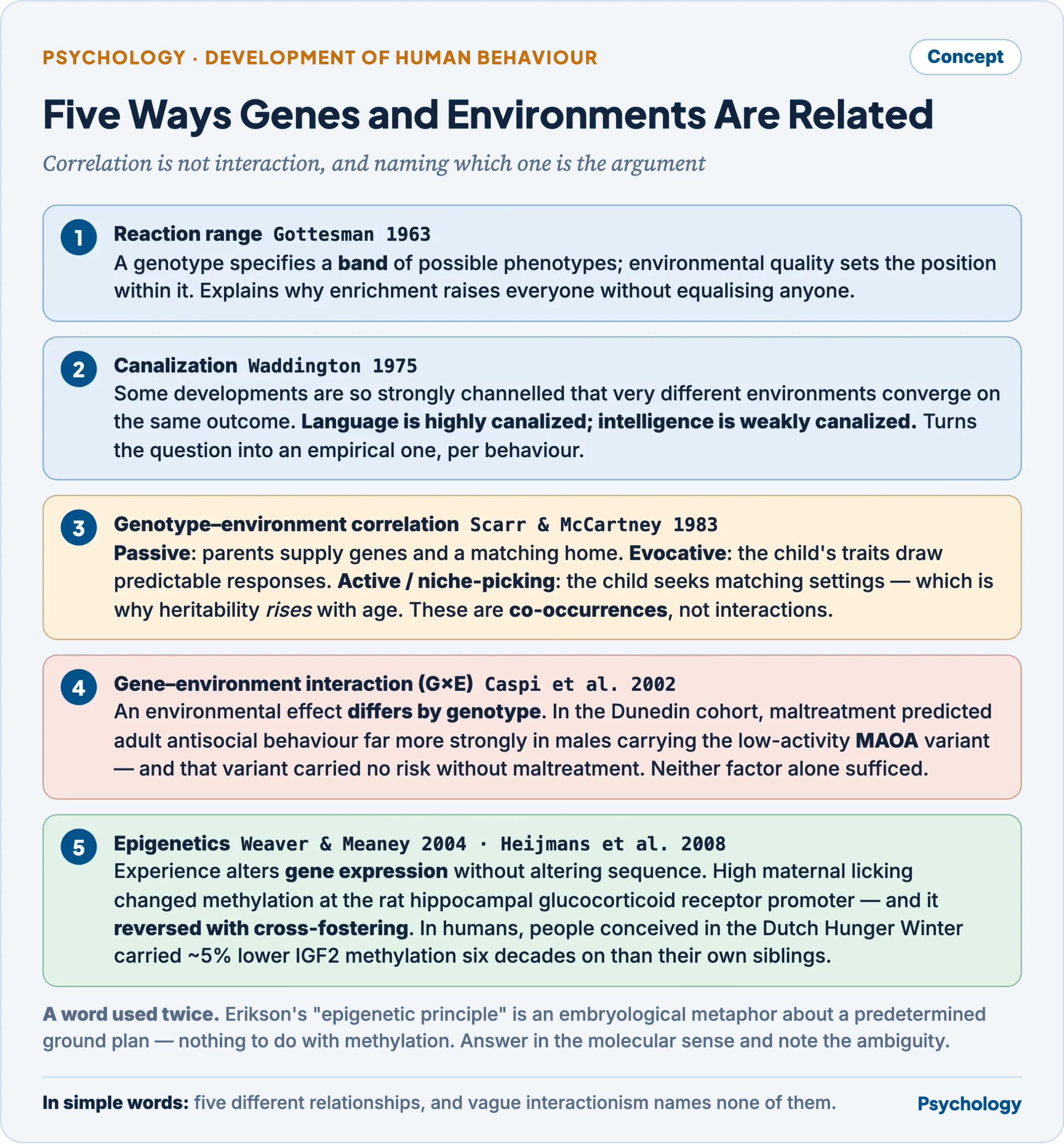
- Reaction range. Gottesman (1963) proposed that a genotype specifies not a value but a band of possible phenotypes, with position inside the band set by environmental quality. The model explains why enrichment raises everyone’s outcome without equalising outcomes, and why the same improvement benefits different children by different amounts.
- Canalization. Waddington (1975) named the opposite case: some developments are so strongly channelled that a wide range of environments converges on the same outcome. Basic language acquisition is highly canalized and occurs across enormous variation in input; measured intelligence is weakly canalized and tracks environmental quality closely. Asking how canalized a behaviour is turns the nature–nurture question into an empirical one with a different answer for each behaviour.
- Genotype–environment correlation. Scarr and McCartney (1983) showed that genotypes systematically come to occupy particular environments, in three forms. Passive: biological parents supply both the genes and a correlated environment, so a verbally able child typically also receives a book-filled home. Evocative: the child’s genetically influenced characteristics draw predictable responses, so an irritable infant elicits harsher handling and a placid one warmer, and aggressive children evoke harsher discipline. Active, or niche-picking: as autonomy grows the child seeks out environments matching their dispositions — which is why heritability estimates rise with age rather than falling, an otherwise puzzling result. These are correlations, not interactions, and conflating the two is a common error: a correlation means genes and environments co-occur, while an interaction means each one’s effect depends on the other’s level.
- Gene–environment interaction, in the strict statistical sense, where an environmental effect differs according to genotype. Caspi and colleagues (2002), working with the Dunedin birth cohort followed from 1972, found that childhood maltreatment predicted adult antisocial behaviour far more strongly in males carrying the low-activity variant of the MAOA gene; maltreated boys with that variant were about twice as likely to be diagnosed with conduct disorder and far more likely to be convicted of a violent offence by 26, while the same variant carried no elevated risk in the absence of maltreatment. Neither factor alone was sufficient — which is the definition of an interaction. Fergusson and colleagues replicated the moderation in the Christchurch cohort across several different adversities.
- Epigenetics. Experience alters gene expression without altering the DNA sequence, chiefly through DNA methylation and histone modification. Weaver, Meaney and colleagues (2004) found that rat pups receiving high maternal licking, grooming and arched-back nursing showed different methylation at the hippocampal glucocorticoid receptor promoter, producing lifelong differences in stress reactivity. Three features of that study make it unusually strong evidence: the difference reversed with cross-fostering, which establishes maternal behaviour rather than maternal genotype as the cause; it persisted into adulthood; and infusing a histone deacetylase inhibitor abolished it, demonstrating the causal route. In humans, Heijmans and colleagues (2008) found that people conceived during the Dutch Hunger Winter of 1944–45, when official rations fell to about 667 calories a day, carried roughly 5 per cent lower methylation of the imprinted IGF2 gene six decades later than their own unexposed same-sex siblings. The effect was specific to periconceptional exposure and absent in those exposed only late in gestation, which locates the vulnerable window in the earliest weeks.
Epigenetics is what finally dissolves the dichotomy rather than balancing it, because a methylation mark is a molecular record of the environment written into the regulation of the genome itself.
A terminological warning
A second and unrelated sense of the word circulates in this syllabus. Erikson’s “epigenetic principle” is an embryological metaphor meaning that development unfolds in a predetermined ground plan in which each stage has its own time of ascendancy. It has no connection to methylation or gene expression. A question on “the epigenetic model in determining human behaviour” should be answered in the molecular sense, with the Eriksonian usage noted briefly to show the ambiguity has been recognised rather than missed.
Four contested applications
Physical development, where the logic is clearest
Stature is the cleanest illustration of every distinction above, which is why it is worth stating before the harder cases. Within a well-nourished population, height is among the most heritable of human characteristics — tall parents reliably have tall children, and twin correlations are high. Yet mean adult height in many countries rose markedly across the twentieth century, a secular trend far too rapid for genetic change, and driven by nutrition, the control of childhood infection and smaller family size. The two facts are not in conflict: genes largely determine who is tall relative to their neighbours, while nutrition determines how tall the whole population becomes.
India supplies the counterpart. With 35.5 per cent of under-fives stunted on NFHS-5 (2019–21) figures, a large part of the observed variation in children’s growth is nutritional rather than genetic, and stunting is a developmental and not merely an anthropometric fact — it is associated with delayed motor milestones and reduced school attainment. The same reasoning extends to brain development, where myelination and synaptic pruning proceed on a maturational schedule but require adequate protein, iron and iodine to proceed normally. Motor development follows the pattern seen earlier: genes fix the order of milestones firmly and the dates only loosely, so handling practices advance or delay them within a genetically specified sequence.
Is personality inherited?
Behaviour-genetic work converges on heritabilities of roughly 0.40 to 0.50 for the major trait dimensions, with a second finding from the Minnesota study that is more striking than the first: shared family environment contributes very little to adult personality, since reared-apart identical twins are about as alike as reared-together ones. Half the variance nonetheless remains, and it is largely non-shared environment — the experiences that differ between siblings in one home.
“Personality is all in our genes” is therefore wrong in three distinct ways. It reads a population variance ratio as individual determination. It ignores that about half the variance is environmental. And it presumes a stable cross-situational entity that Mischel (1968) challenged by showing trait measures predict behaviour across situations only modestly, which provoked the person–situation debate and its resolution in interactionism — behaviour as a function of disposition and situation jointly.
The theoretical traditions divide accordingly.
- Trait and biological theories accommodate substantial heritability directly. Eysenck grounded extraversion in cortical arousal and neuroticism in limbic reactivity, both explicitly heritable; Cattell’s factors and the five-factor model of Costa and McCrae report consistent moderate heritabilities across cultures.
- Psychoanalytic theory makes personality the outcome of early experience acting on constitutional drives — Freud’s structure is universal but its content is biographical, so the genotype supplies the id and the environment supplies everything about how it is managed.
- Behavioural and social-cognitive theories locate personality wholly in learning history. Skinner treats it as a repertoire of reinforced responses; Bandura’s reciprocal determinism and Rotter’s locus of control make person, behaviour and environment mutually determining, which is itself an interactionist position reached from the environmental side.
- Humanistic theories — Rogers, Maslow — posit an inherent growth tendency, so something is given, but what becomes of it depends on conditions of worth and the satisfaction of needs.
The defensible conclusion distinguishes two levels. Temperament — activity level, reactivity, approach and withdrawal, rhythmicity — is substantially constitutional and observable in the first months, as Thomas and Chess (1977) documented in the New York Longitudinal Study with their easy, difficult and slow-to-warm-up classification. Their own key finding was nonetheless an interactional one: outcome depended not on temperament alone but on goodness of fit between the child’s temperament and the parents’ handling. Personality is temperament elaborated by a life.
How much do family and school environment contribute to intelligence?
Adoption studies show adopted children’s IQ correlating with both biological and adoptive parents, and the environmental contribution is clearest in the mean level: moving a child from a deprived to an enriched home raises the score substantially while the ranking continues to track biological parentage. Schooling has effects separable from age, demonstrated by comparing children of the same age with different amounts of schooling and by the measurable loss across long vacations. At the population level the Flynn effect — a sustained rise in mean scores of roughly three points a decade through the twentieth century, far too rapid for genetic change — is decisive proof of environmental potency in the aggregate.
Turkheimer’s moderation then sets the boundary condition that makes the answer specific rather than generic. Where home environments are poor, family environment accounts for most of the variance; where they are uniformly adequate, it accounts for little. In Indian conditions the honest answer therefore assigns family and school a large share, and the evaluation evidence supports it: the Banerjee, Cole, Duflo and Linden (2007) remedial-teaching trials in Mumbai and Vadodara, in which a locally recruited instructor taught basic skills to the weakest children, produced substantial learning gains concentrated precisely among the lowest-scoring pupils.
Is aggression an innate tendency or externally elicited?
The innate case rests on three lines. Lorenz treated aggression as an instinctive drive with accumulating action-specific energy requiring periodic discharge; Freud posited a death instinct; and twin studies report moderate heritability of aggressive tendency along with the sex difference in physical aggression found in every society studied.
The elicited case rests on two.
- The frustration–aggression hypothesis of Dollard, Doob, Miller, Mowrer and Sears (1939) held that aggression always follows from blocked goal-directed activity. Berkowitz (1989) reformulated it after the original proved too strong: frustration produces an emotional readiness, and aggression follows only when aggressive cues are present and the state is construed as anger.
- Bandura, Ross and Ross (1961) showed children reproducing specific aggressive acts after observing an adult model perform them. The force of this result against an instinct account is precise: instinct can explain a quantity of aggression but cannot specify the form of the act, and the children imitated particular novel movements they had never performed.
The MAOA finding is the resolution in miniature, and the honest conclusion is an interactional one. Aggression is best read as a heritable propensity whose expression requires elicitation — which is also why the available policy lever is the eliciting environment and not the propensity.
Criticisms and limitations
- A malformed question, and restating it honestly costs something. Reformulating nature–nurture as a variance question makes it tractable but also makes the answer population-specific and non-transferable, which is rarely acknowledged when heritability figures are quoted.
- Inflation by sampling. Heritability estimates are raised by the very samples that produce them. Adoptive and reared-apart twin samples are environmentally restricted by the very processes that create them, and restricting environmental range raises the genetic proportion as an arithmetic consequence.
- Candidate-gene interaction findings have replicated unevenly. The MAOA result has held up better than most, but much of the single-gene literature of the 2000s has not survived larger samples and pre-registration, and the field has moved to polygenic methods with correspondingly smaller individual effects.
- Weak translation from animal to human. The Weaver study is experimental; the famine studies are natural experiments in which cold, stress and infection cannot be separated from caloric restriction, and the measured tissue is blood rather than brain.
- The interactionist consensus can function as an evasion. Asserting that the two interact is only an advance if the mode is specified; without naming reaction range, canalization, correlation, strict interaction or epigenetic regulation, it restates the problem in more agreeable words.
- The ethical hazard is historical and real. Heritability claims have repeatedly been used to argue against intervention and to justify selective and eugenic policy. The actual implication of the evidence runs the other way: the environments that most repay improvement are exactly the worst ones, because that is where genetic potential is least able to express itself.
Previous Year Questions
- 2025“Personality is all in our genes.” Evaluate the statement in the context of different personality theories.
- 2021How much nature (genetic factors) and nurture (environmental factors) contribute to a person’s physical, cognitive and socio-emotional development?
- 2021Are we born with personality? Critically evaluate with theoretical interpretation.
- 2020How much do family and school environment contribute to intelligence?
- 2017Whatever we are, it is because of Genes. Discuss.
- 2012Describe the role of epigenetic model in determining human behaviour.
- 2002Discuss fully the relative roles of genetic and environmental factors in determining human behaviour. Cite findings of related studies in support of your answer.
- 2002Is aggression an innate tendency or an externally elicited behaviour? Answer with suitable examples to substantiate your view.
- 2000How can the contributions of heredity and environment be isolated in the study of human behaviour?
- 1998Analyse the relative contributions of heredity and environment in the development of human behaviour. Illustrate your answer from real life situations.