

Major concerns; Important Committees and Commissions; Reforms in financial management and human resource development; Problems of implementation.
This article: The standing reform machinery (O&M Division, Department of Administrative Reforms, DARPG); the important committees and commissions with year, chair, mandate, recommendations and outcome: Secretariat Reorganisation Committee (1947), Economy Committee (1948), Gopalaswami Ayyangar (1949), Gorwala (1951), Appleby (1953, 1956), O&M Division (1954), V.T. Krishnamachari (1962), Santhanam (1962–64), the First ARC (1966–70), Kothari (1976), the L.K. Jha Commission (1981–84), Sarkaria (1983–88), Satish Chandra (1989), the Fifth to Eighth Pay Commissions, the 1997 Action Plan, the Expenditure Reforms Commission, Alagh, NCRWC, Surinder Nath (2003), Hota (2004), the Second ARC (2005–09) and its fifteen reports with implementation status, and expert bodies after 2014 (Expenditure Management Commission, Debroy, Kelkar, Baswan); reforms in financial management (FRBM, outcome budgeting, RFD, accrual accounting, PFMS, DBT, GFR 2017, the 2017 budget reforms, GST, TSA and SNA-SPARSH, DFPR 2024, Jan Vishwas); reforms in human resource development (Mission Karmayogi, lateral entry, APAR and 360-degree feedback, FR 56(j), Civil Services Boards, training, e-HRMS); a theory lens; a summary table of committees.
Official Syllabus: Paper II · Unit 2-10 Administrative Reforms since Independence
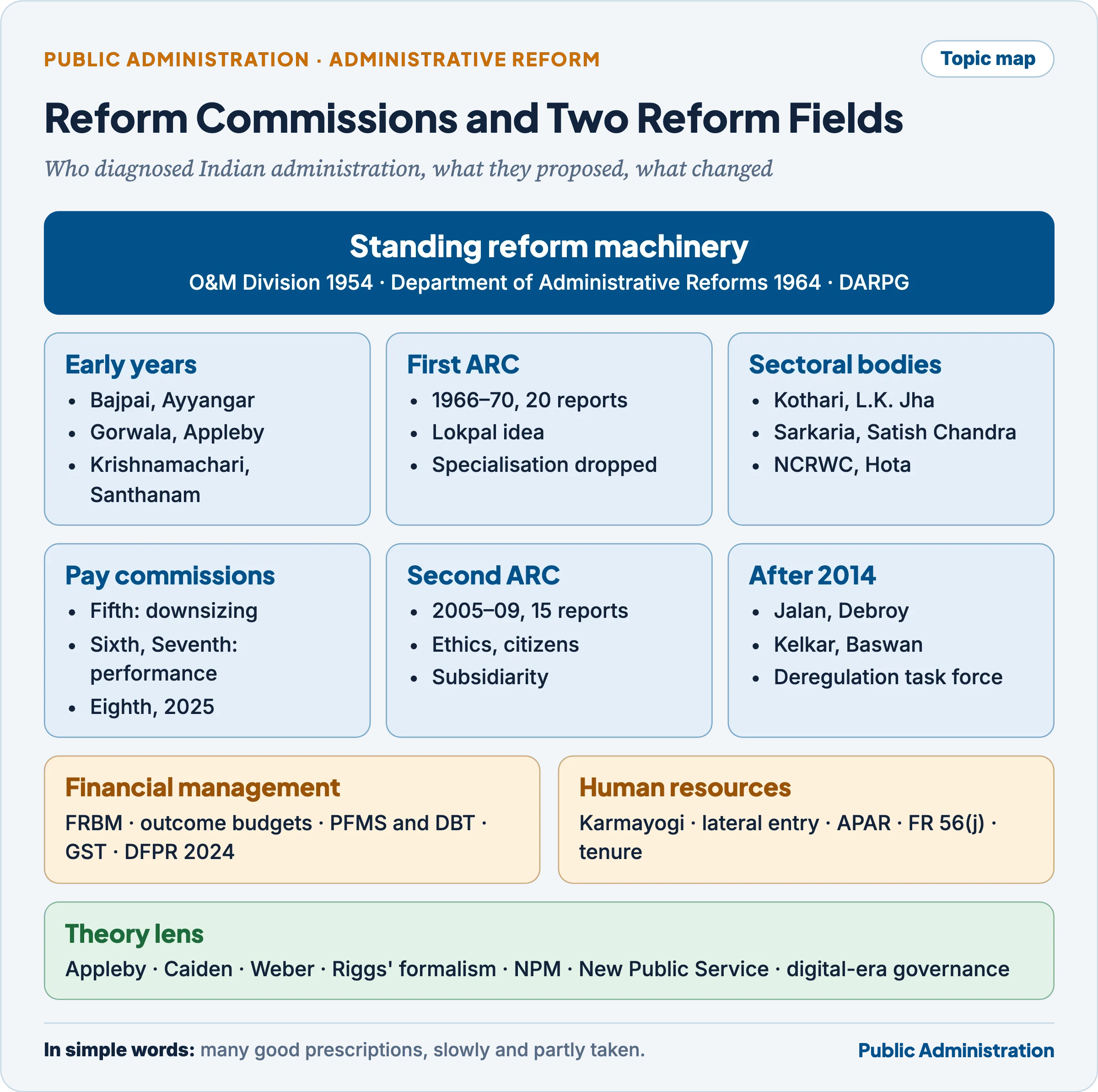
Since 1947 the Government of India has appointed well over fifty committees and commissions to examine its own machinery. Some were sweeping inquiries into the whole of public administration, such as the two Administrative Reforms Commissions; others looked at one sector, such as recruitment, corruption, pay, Centre–State relations or public expenditure. Together they form the written record of how Indian administration has tried to reform itself: what it diagnosed, what it proposed, and how much of it was actually done.
This article follows that record body by body, and then traces the two areas where reform has been most continuous: financial management and human resource development (HRD). The meaning of reform, its major concerns and the reasons implementation falters are treated separately: in brief, reform in India has been episodic rather than continuous, driven by crises, resisted by the very bureaucracy that must carry it out, and weakened by uneven political will. See the article on Administrative Reforms since Independence: Major Concerns and Problems of Implementation.
In simple words
Think of a large old house that a family inherits. Every few years it calls in an architect to inspect it. Each report says much the same: the wiring is old, the rooms are badly arranged, the doors stick. The family fixes a few cheap things, admires the plans for the big changes, and puts them in a drawer. Indian administrative reform has worked a little like that: the reports are excellent, the drawer is full, and the house changes slowly.
1. The Reform Machinery and the Shape of the Record
In simple words
Reform needs two kinds of bodies. A commission is like a visiting doctor who examines the patient once and writes a prescription. A standing reform department is like the family nurse who must make sure the medicine is actually taken. India has had both, but the nurse has usually been weaker than the doctor.
1.1 Ad hoc commissions and standing machinery
- Ad hoc bodies. Most reform bodies are appointed by an executive resolution for a fixed task and dissolve after reporting. Some are set up as Commissions of Inquiry (both ARCs), some as committees of experts (Kothari, Hota), some as one-person reviews (Ayyangar, Gorwala, Appleby).
- Standing machinery provides continuity between commissions:
- Organisation and Methods (O&M) Division (March 1954) in the Cabinet Secretariat, set up on Appleby’s advice, with O&M units in every ministry and later in the States;
- Department of Administrative Reforms (1964), in the Ministry of Home Affairs, which absorbed the O&M Division and prepared the ground for the First ARC;
- Department of Personnel (1970), created in the Cabinet Secretariat on the First ARC’s recommendation as a central personnel agency;
- Ministry of Personnel, Public Grievances and Pensions (1985), with the Department of Administrative Reforms and Public Grievances (DARPG) as the nodal reform department today. DARPG processes commission reports, runs grievance redress (CPGRAMS) and service-delivery assessments.
- Processing chain for a report (as used for the Second ARC): the concerned ministries comment, a Core Group on Administrative Reforms under the Cabinet Secretary examines them, a Group of Ministers decides, and the decisions go to ministries and States for action.
1.2 Five phases of the record
The bodies fall into five broad phases, each shaped by its political and economic setting.
| Phase | Setting | Main bodies | Dominant theme |
|---|---|---|---|
| Consolidation (1947–1964) | Partition, integration, the start of planning | Bajpai, Economy Committee, Ayyangar, Gorwala, Appleby, O&M, Krishnamachari, Santhanam | Make the inherited machine work for a development state |
| Comprehensive review (1966–1970) | War of 1962, droughts, economic strain | First ARC | Machinery of government, personnel, planning, citizens’ grievances |
| Sectoral reform (1970s–1990) | Emergency, licence regime, federal strains | Kothari, National Police Commission, L.K. Jha, Sarkaria, Satish Chandra | Recruitment, police, economic administration, federalism |
| Liberalisation and governance (1991–2004) | New Economic Policy, fiscal stress | Fifth Pay Commission, 1997 Action Plan, Expenditure Reforms Commission, NCRWC, Surinder Nath, Hota | Downsizing, transparency, accountability, civil service reform |
| Citizen-centric and digital (2005 onwards) | RTI, growth, digital public infrastructure | Second ARC, Sixth to Eighth Pay Commissions, expert committees after 2014 | Ethics, citizen-centricity, outcomes, capacity, technology |
The table shows a steady shift in what reform is for: from strengthening a controlling state in the 1950s, to slimming a regulating state in the 1990s, to building a service-delivering, citizen-facing state after 2005.
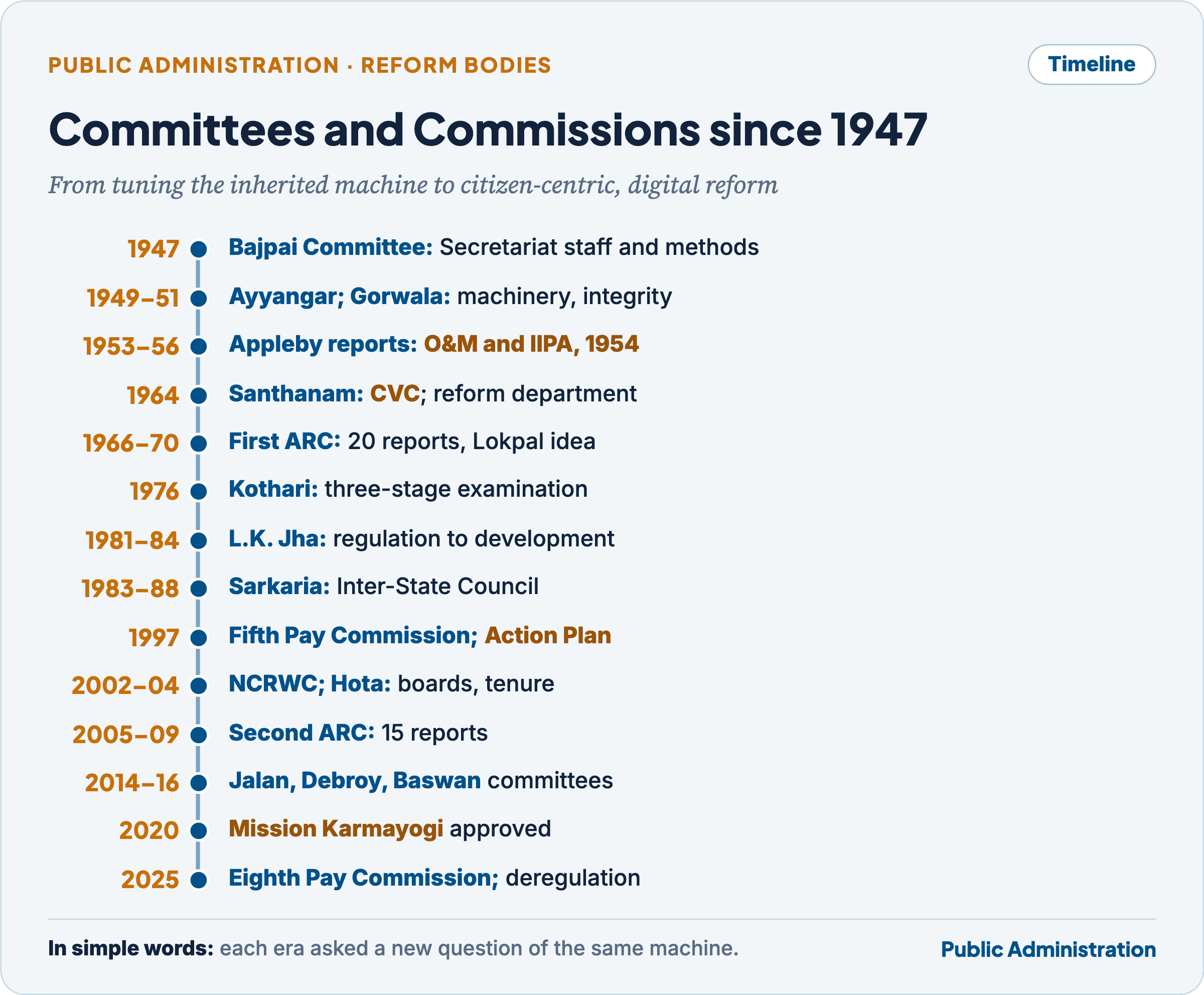
2. The Consolidation Years: Committees from 1947 to 1964
In simple words
At Independence India got a new Constitution but kept the old colonial administration. The first committees were like mechanics checking whether an old engine could pull a much heavier train. They mostly tuned the engine; they did not replace it.
2.1 Secretariat Reorganisation Committee (1947)
- Chair: Girija Shankar Bajpai, a senior ICS officer; the committee was set up before the transfer of power and reported in August 1947.
- Mandate: the shortage of personnel in the Central Secretariat after Partition (many British and Muslim officers left), the better use of available manpower, and methods of work.
- Findings and outcome: it noted that the administration was unresponsive and ill-equipped for the new challenges. Its work fed the creation of new services (the IAS, IPS, Indian Foreign Service, Central Services) and emergency recruitment to fill gaps.
2.2 Economy Committee (1948)
- Chair: the industrialist Kasturbhai Lalbhai.
- Mandate: to review the growth of civil expenditure and of staff since the war and suggest economy in the Central Government.
- Significance: the first post-Independence attempt to treat cost and staff growth as a reform problem, a theme that returns with the L.K. Jha Commission, the Fifth Pay Commission and the Expenditure Reforms Commission.
2.3 N. Gopalaswami Ayyangar Report (1949)
- Author: N. Gopalaswami Ayyangar, minister without portfolio and a former Dewan of Kashmir, asked to review the machinery of the Central Government. The report, Reorganisation of the Machinery of Government, was submitted in 1949 and printed in 1950.
- Main recommendations:
- a clear distinction between a ministry (the policy unit under a minister) and a department (a unit of work);
- grouping ministries into four bureaus: natural resources and agriculture; industry and commerce; transport and communications; labour and social services;
- an O&M Division for continuous improvement of methods;
- standing Cabinet committees to lighten the Cabinet’s load.
- Outcome: the bureau scheme was rejected; Cabinet committees were set up in 1950; the O&M idea was taken up only after Appleby repeated it.
2.4 A.D. Gorwala Reports (1951)
- Author: A.D. Gorwala, a retired ICS officer, asked by the Planning Commission to judge whether the administrative machinery was adequate for planned development.
- Two reports: Report on Public Administration and Report on the Efficient Conduct of State Enterprises.
- Findings: the public faced delay in execution, and there was lack of integrity, undue political interference and corruption.
- Recommendations:
- a clean, efficient and impartial administration, with high standards of conduct for ministers as well as officials;
- reorganisation for greater speed, efficiency and responsiveness;
- a minister and a secretary charged specifically with administrative reform, so that reform has an owner;
- for state enterprises, management through autonomous boards and corporations with clear accountability, rather than departmental running.
- Significance: the first report to put integrity and political interference at the centre of reform; its call for a reform owner anticipated the O&M Division and the Department of Administrative Reforms.
2.5 Paul H. Appleby Reports (1953 and 1956)
Paul H. Appleby, Dean of the Maxwell School at Syracuse University and a theorist of democratic administration (Big Democracy, 1945; Policy and Administration, 1949; Morality and Administration in Democratic Government, 1952), was invited by the Government of India to study its administration.
- First report: Public Administration in India: Report of a Survey (1953).
- Rated the Government of India among the dozen or so most advanced governments in the world, which lifted official morale.
- Found the system slow, over-centralised, and weighed down by excessive financial control: the Finance Ministry’s prior scrutiny of ministries’ proposals and the CAG’s influence made ministries timid.
- Observed that the Union, because the Constitution gives most programmes to the States, was largely a staff (advisory and coordinating) organisation with few line operations of its own, and that its effectiveness depended on States it could not command.
- Recommended a central O&M organisation and an Institute of Public Administration for research and training.
- Second report: Re-examination of India’s Administrative System with Special Reference to Administration of Government’s Industrial and Commercial Enterprises (1956).
- Argued for greater autonomy for public enterprises, less detailed ministerial and Finance Ministry interference, and delegation of financial powers to administrative ministries.
- Criticised the role of the CAG in auditing commercial enterprises as encouraging caution rather than enterprise.
- Outcome: of about twelve recommendations, two were implemented, both immediately: the O&M Division (March 1954) and the Indian Institute of Public Administration (IIPA, 1954), an autonomous body for research, training and consultancy. His views on financial control and autonomy were largely ignored, and his criticism of the CAG drew a sharp reply from the then CAG, A.K. Chanda (see the article on Accounting Techniques, Audit, CGA and CAG).
Indian Connect — Did later commissions depart from Appleby?
The Appleby agenda (delegation of financial powers, autonomy for enterprises, a standing improvement unit, training and research, faster decisions) reappears almost unchanged in later reports. The First ARC pressed delegation of financial and administrative powers (its 12th report) and autonomy for public undertakings; the L.K. Jha Commission wanted fewer controls and faster decisions; the 2nd ARC’s 13th and 14th Reports asked for executive agencies, delegation with accountability and outcome budgeting; the Delegation of Financial Powers Rules, 2024 finally widened ministries’ powers. The radical departures came elsewhere: transparency (RTI, 2005), ethics and ombudsmen (Lokpal, 2013), citizen-centricity (Sevottam, Right to Services laws) and digital delivery (DBT, PFMS). So later commissions extended Appleby on structure and procedure but went beyond him on rights, transparency and the citizen.
2.6 The O&M Division (1954) and its record
- Purpose: “to initiate and sustain a concerted effort to improve administrative efficiency in all branches”. The central division gave leadership and a common fund of experience; each ministry had its own O&M unit.
- Three-step method: make civil servants conscious of inadequacies; find the facts about where and why work was delayed; devise and apply remedies for economy and efficiency.
- Work done: simpler procedures, inspection systems, record management, reduced reports and returns, and training of lower staff. From 1954 to 1964 it published seven annual reports, discussed in Parliament. It prepared two statements to Parliament on administrative procedure (10 August 1961 and 1963) on delegation to field staff, faster plan execution and managerial training, needed for the Third Five Year Plan.
- Limits: it worked at the micro level of procedure (improvement rather than reform), lacked senior leadership and professional expertise, and was absorbed into the Department of Administrative Reforms in 1964. Its techniques are explained in the article on O&M, Work Study and Management Aid Tools: Network Analysis, MIS, PERT and CPM.
2.7 Other bodies of the period
- R.A. Gopalaswami, Machinery of Government: Improvement of Efficiency (1952): proposals on efficiency in the Secretariat, kept largely confidential.
- Second Central Pay Commission (Jagannath Das, 1957–59): classified offices into attached and subordinate offices on a functional basis and recommended Whitley-type negotiating machinery, which led to the Joint Consultative Machinery (1966).
- V.T. Krishnamachari, Report on Indian and State Administrative Services and Problems of District Administration (1962): prepared for the Planning Commission. It asked States to forecast their personnel needs, raise IAS cadre strength, recruit and train State civil service officers systematically (with State training institutes), and fill posts regularly. On the district, it wanted planning built from village, block and district plans, with the zila parishad setting development priorities, officials working as a team under the panchayat samiti, and the Collector coordinating development and regulatory work.
- Committee on Prevention of Corruption (K. Santhanam, 1962–64): see 2.8.
2.8 Santhanam Committee (1962–64)
- Chair: K. Santhanam, Member of Parliament, appointed by the Home Ministry (under Lal Bahadur Shastri) as corruption grew with the expanding licence and contract state. Report in 1964.
- Findings: corruption flourished where officials had wide discretion in licences, permits, contracts and inspections; ministers and senior officials set the tone; delay itself created the market for bribes.
- Recommendations:
- a Central Vigilance Commission (CVC) as an independent apex body to supervise vigilance in ministries;
- vigilance units in every ministry and department;
- changes to the conduct rules (gifts, assets, relatives’ employment) and a code of conduct for ministers;
- tougher law on disproportionate assets and faster departmental inquiries.
- Outcome: the CVC was set up by an executive resolution of February 1964; the Central Bureau of Investigation had been formed in April 1963 while the committee was at work. The CVC became statutory only through the CVC Act, 2003, after the Supreme Court’s direction in Vineet Narain v. Union of India (1997).
Common confusion
Was the Central Vigilance Commission created by law on the Santhanam Committee’s advice? No. Santhanam recommended it and the government set it up in 1964 by executive resolution. It received a statutory base only with the Central Vigilance Commission Act, 2003, after the Supreme Court in Vineet Narain (1997) directed that it be given statutory status to insulate the CBI’s supervision from the executive.
3. The First Administrative Reforms Commission (1966–1970)
In simple words
By 1965 India had fought a war, faced droughts and seen its plans falter. The government then did something it had never done: it asked a group of senior politicians to examine the whole of public administration, from the Union Secretariat down to the district, and tell it what to change.
3.1 Setting up, composition and mandate
- Constituted: by a Home Ministry resolution of 5 January 1966, as a Commission of Inquiry.
- Context: the war with China (1962), the war with Pakistan (1965), successive droughts and economic crisis. In Indian experience, reform attention rises in times of crisis.
- Composition: chaired by Morarji Desai; members K. Hanumanthaiya, H.C. Mathur, G.S. Pathak and H.V. Kamath, all Members of Parliament, with V. Shankar (ICS) as Member-Secretary. When Desai became Deputy Prime Minister (resigning on 13 March 1967), K. Hanumanthaiya became Chairman (17 March 1967). Earlier commissions had been manned by civil servants; this one was led by public men, on the model of the American Hoover Commission (1947–49).
- Mandate: to ensure “the highest standards of efficiency and integrity in the public services” and make administration “a fit instrument” for the government’s social and economic goals and responsive to the people. It covered ten areas: machinery of the Government of India and procedures of work; planning machinery at all levels; Centre–State relationships; financial administration; personnel administration; economic administration; State administration; district administration; agricultural administration; and redress of citizens’ grievances.
- Method: 20 study teams, 13 working groups and one task force prepared detailed studies before the Commission wrote its reports.
3.2 The twenty reports
The Commission submitted 20 reports before winding up in mid-1970. DARPG counts 537 major recommendations in them.
| No. | Report | No. | Report |
|---|---|---|---|
| 1 | Problems of Redress of Citizens’ Grievances (Interim, 1966) | 11 | Personnel Administration |
| 2 | Machinery for Planning (Interim) | 12 | Delegation of Financial and Administrative Powers |
| 3 | Public Sector Undertakings | 13 | Centre–State Relationships |
| 4 | Finance, Accounts and Audit | 14 | State Administration |
| 5 | Machinery for Planning (Final) | 15 | Small Scale Sector |
| 6 | Economic Administration | 16 | Railways |
| 7 | Machinery of the Government of India and its Procedures of Work | 17 | Treasuries |
| 8 | Life Insurance Administration | 18 | Reserve Bank of India |
| 9 | Central Direct Taxes Administration | 19 | Posts and Telegraphs |
| 10 | Administration of Union Territories and NEFA | 20 | Scientific Departments |
The first report, on citizens’ grievances (October 1966), is the best remembered: it proposed the Lokpal and Lokayuktas. The personnel report is the most far-reaching.
Common confusion
Did the First ARC make 581 or 537 recommendations? Both figures circulate. DARPG’s official account says the 20 reports contained 537 major recommendations; the higher figure of 581 found in many texts counts recommendations more finely. Some books also speak of “nineteen reports”, because the twentieth (Scientific Departments) was submitted only as a summary of recommendations. The safe statement is: 20 reports, about 537 major recommendations.
3.3 Key recommendations
- Citizens’ grievances: a Lokpal at the Centre and Lokayuktas in the States to deal with complaints of corruption and maladministration against ministers and officials, on the model of the Scandinavian ombudsman.
- Personnel administration (the core report):
- Specialisation: the “road to the top” should be opened to all services. Middle and senior posts in the Central Secretariat were to be filled from the functional services in functional areas, and in non-functional areas through a mid-career competitive examination open to all services. Officers would specialise in one of eight areas: economic administration, industrial administration, agricultural and rural development, social and educational administration, personnel administration, financial administration, defence administration and internal security, and planning.
- A unified grading structure, grouping posts of similar qualifications, difficulty and responsibility in the same grade.
- Recruitment: a single competitive examination for Class I services, lateral entry to senior technical posts, an end to direct recruitment to Class II, objective tests for clerical staff, and recruitment boards; a new procedure for appointing members of the UPSC and State Public Service Commissions.
- A national policy on civil service training, promotion guidelines, simpler disciplinary inquiries and civil service tribunals; depoliticisation of minister–civil servant relations; better incentives and work norms.
- A central personnel agency (the Department of Personnel) and personnel units in ministries.
- Machinery of government: fewer ministries grouped by function; delegation of financial and administrative powers; a leaner Secretariat.
- Financial administration: performance budgeting in all development departments.
- Centre–State relations: an Inter-State Council under Article 263 and fuller consultation with States.
- District administration: development responsibilities vested in the zila parishad, with a district development officer as its chief executive.
- Grievances of public servants: administrative tribunals.
3.4 Implementation and its lessons
- What was done:
- Department of Personnel (1970) in the Cabinet Secretariat, later the Department of Personnel and Administrative Reforms.
- Performance budgets were presented for four ministries from 1968-69 and extended to most ministries by the mid-1970s.
- Lokayuktas in the States from the early 1970s (Maharashtra led). The Lokpal Bill was introduced in 1968 but lapsed repeatedly; the Lokpal and Lokayuktas Act came only in 2013, after the anti-corruption movement of 2011.
- Some delegation of powers and procedural changes; administrative tribunals came much later (Article 323A in 1976, the Administrative Tribunals Act in 1985).
- What was not done: the specialisation scheme and mid-career examination for senior posts, the unified grading structure, and the Inter-State Council (created only in 1990, after Sarkaria).
- How implementation was handled: the Commission had asked for a Cabinet committee to oversee implementation, a white paper to Parliament within three months of each report, an all-party parliamentary committee to watch progress, and that the Committee of Secretaries be kept out. The government did the opposite: each ministry decided on recommendations in its own area, the Committee of Secretaries commented before Cabinet, no white paper was issued, no parliamentary committee was formed, and only progress statements were laid; a report on the implementation position went to Parliament in November 1977.
- Why it faded: the Prime Minister who appointed it (Shastri) died within days of its creation; his successor faced a party split and a struggle for survival; the Commission took four years and spread its effort widely; when it finished, the country turned to the Bangladesh war and later the Emergency. The scholar Kuldeep Mathur judged that it simply faded away, leaving a pile of reports and frustration at India’s inability to reform a colonial system. Its central lesson: implementation entrusted to the bureaucracy being reformed tends to keep the pedestrian recommendations and drop the structural ones.
4. Between the Two ARCs: Sectoral Commissions, 1970–2004
In simple words
After the First ARC, the government stopped trying to reform everything at once. It appointed smaller bodies for one problem at a time: how to recruit officers, how to run the economy with fewer controls, how the Centre and States should share power, how to cut costs.
4.1 Kothari Committee on Recruitment Policy and Selection Methods (1974–76)
- Chair: D.S. Kothari, physicist and former UGC Chairman; report in 1976.
- Recommendations: a single Civil Services Examination in three stages: an objective Preliminary to screen candidates, a Main written examination, and a Personality Test; a foundation course followed by a post-training test that would count in service allocation.
- Outcome: the three-stage examination began in 1979; the post-training test was not accepted.
4.2 National Police Commission (1977–81)
- Chair: Dharma Vira; eight reports (1979–81), appointed after the Emergency’s misuse of the police.
- Core ideas: a State Security Commission, a fixed tenure and panel-based selection for the police chief, separation of investigation from law and order, and accountability to the public. Largely unimplemented until the Supreme Court’s directions in Prakash Singh v. Union of India (2006). Covered in detail under police administration.
4.3 Economic Administration Reforms Commission (L.K. Jha, 1981–84)
- Chair: L.K. Jha, an ICS officer and former RBI Governor known for economic administration. The Commission submitted 38 reports between 1981 and July 1984, the last being an overview for the Seventh Plan.
- Subjects: tax administration, industrial approvals, rent control, economy in public expenditure, relations between government and public enterprises.
- Core recommendations:
- shift government’s emphasis from regulation to development, and from direct physical controls to indirect (fiscal and market) instruments;
- structural reform of the machinery of government to streamline economic decision-making;
- reduce government activity and change its style, to lessen harassment of citizens and delays to business;
- personnel policies promoting specialisation and professionalism;
- plans presented in terms of physical targets and outputs rather than outlays, with performance budgeting alongside financial budgeting.
- On accountability: it distinguished procedural accountability (following rules) from substantive accountability (achieving the assigned task), and argued that real accountability needs clear annual tasks for each ministry, task-based performance appraisal and stable tenure.
- On economy: cosmetic measures (bans on air travel, overtime) achieve little; the colonial pyramid of staffing (a wide clerical base, a narrow top) should give way to fewer junior and more officer posts, with a “scrap and build” rule (new work staffed from old, discontinued work) as practised in Japan.
- Significance: the intellectual bridge between the planning-era state and the 1991 reforms; many later reports, including the Fifth Pay Commission, built on it.
4.4 Sarkaria Commission on Centre–State Relations (1983–88)
- Chair: Justice R.S. Sarkaria, a retired Supreme Court judge; constituted on 9 June 1983; report in 1988 with 247 recommendations.
- Administrative recommendations relevant to reform:
- a permanent Inter-Governmental Council under Article 263 (set up as the Inter-State Council in May 1990);
- the National Development Council to be renamed the National Economic and Development Council (NEDC), given formal standing under Article 263, and supported by a standing committee, so that it becomes the apex political forum for Centre–State planning relations; States to be involved at all stages of plan formulation and centrally sponsored schemes kept to a minimum;
- strong support for the All India Services (any move to disband them “retrograde”), and new all-India services in fields such as engineering, medicine and education;
- restraint in the use of Article 356 and consultation with States on concurrent legislation.
- Details are in the article on Union–State Relations: Legislative, Administrative and Financial.
4.5 Satish Chandra Committee (1989)
- Task: review the Civil Services Examination introduced in 1979 after Kothari.
- Recommendations implemented from the 1993 examination: a compulsory Essay paper (200 marks) in the Main examination, and the Personality Test raised from 250 to 300 marks; it also urged wider publicity for the examination. It sought to correct the imbalance by which optional subjects and memory weighed heavily in selection, giving more weight to general ability, writing and personality.
4.6 The Fifth Pay Commission, the 1996–97 conferences and the Action Plan
- The Fifth Central Pay Commission (Justice S. Ratnavel Pandian; constituted 1994, report January 1997) devoted a whole part of its report to public service management, and is often called the clearest text of second-generation administrative reform in India (details in Section 5).
- Conference of Chief Secretaries (November 1996): identified the public image of bureaucracy as inaccessible, indifferent, procedure-bound, corrupt and unaccountable for results; set up working groups on right to information (under H.D. Shourie) and on computerisation of personnel systems (under N. Vittal).
- Conference of Chief Ministers (24 May 1997) adopted an Action Plan for Effective and Responsive Administration with three parts:
- accountable and citizen-friendly administration: Citizen’s Charters for departments with large public interface, grievance redress machinery down to the village;
- transparency and right to information: legislation on freedom of information (Tamil Nadu and Goa had already passed State laws);
- improving performance and integrity of the civil services: stable tenure, transparent postings, stronger vigilance.
- Outcome: Citizen’s Charters from 1997, the Freedom of Information Act, 2002 (never brought into force) and then the RTI Act, 2005.
4.7 Expenditure Reforms Commission (2000–01)
- Chair: K.P. Geethakrishnan, a former Finance Secretary; appointed in February 2000 with a one-year mandate to suggest “a road map for reducing the functions, activities and administrative structure of the Government”.
- Reports (2000–01): on food and fertiliser subsidies, optimising government staff strength, and the restructuring of individual ministries and departments.
- Thrust: downsizing and rationalising. For example, it proposed closing or privatising several units of the Ministry of Information and Broadcasting and a steady reduction of surplus staff. Implementation was limited: a few units were wound up or merged, but staff numbers and subsidies kept growing.
4.8 Alagh Committee (2001)
- Chair: economist Y.K. Alagh, appointed by the UPSC to review the Civil Services Examination.
- Findings: the Preliminary was a test of memory; candidates chose optional subjects for scorability, not their own specialisation.
- Recommendations: an aptitude test in the Preliminary (comprehension, reasoning, problem-solving, data analysis), replacing optional subjects with compulsory papers on sustainable development and social justice, science and technology in society, and democratic governance, public systems and human rights, and a lower upper age limit (26).
- Outcome: the aptitude idea was implemented as the CSAT in 2011; the Main examination was restructured in 2013 after the Nigavekar Committee.
4.9 National Commission to Review the Working of the Constitution (2000–02)
- Chair: Justice M.N. Venkatachaliah, former Chief Justice of India; report on 31 March 2002.
- On civil services and administration (Chapter 6):
- statutory Civil Service Boards under a law made under Article 309, to manage placements, promotions and transfers free from political manipulation;
- posts above Joint Secretary level open to recruitment from a wide variety of sources, including the open market;
- revisit Article 311 so that its safeguards protect the honest without shielding the corrupt;
- an oath of transparency in place of an oath of secrecy, early freedom of information legislation, and a whistle-blower (Public Interest Disclosure) law;
- the district as the basic unit of planning, with functions, finances and functionaries under elected bodies;
- recognition of specialists, who should not “play second fiddle” to generalists.
- These ideas fed directly into the Hota Committee and the Second ARC.
4.10 Surinder Nath Committee (2003)
- Chair: Lt Gen (retd) Surinder Nath, a former UPSC Chairman.
- Task: review performance appraisal, promotion, empanelment and placement of the All India Services.
- Recommendations: objective appraisal against agreed work plans; mapping officers to domains for senior placements; a more transparent empanelment process. These shaped the Performance Appraisal Report for the IAS (2007) and the later domain idea of the 2nd ARC.
4.11 Hota Committee on Civil Service Reforms (2004)
- Chair: P.C. Hota, a former UPSC Chairman; appointed on 3 February 2004, report in July 2004.
- Terms of reference: a responsive, citizen-friendly, transparent, accountable and ethical civil service; e-governance; domain knowledge; protection against wrongful pressure.
- Recommendations:
- entry age 21–24 for general candidates (with relaxations), since values are best formed at a malleable age;
- annual performance agreements and appraisal against work plans in place of the ACR;
- a minimum tenure for senior officers and a Civil Services Act under Article 309 to make Civil Services Boards statutory;
- amend Article 311 so that a public servant caught taking a bribe or holding disproportionate assets can be removed at once, with a post-decisional hearing;
- review of officers’ integrity and performance, with exit for those found wanting (building on the Fifth Pay Commission’s quinquennial reviews);
- domain assignment, a code of ethics, e-governance, and civil servants encouraged to work in NGOs;
- more women in the higher civil service.
- Outcome: tenure and Civil Services Boards came only through the Supreme Court in T.S.R. Subramanian v. Union of India (2013) and the IAS (Cadre) Amendment Rules, 2014; the Article 311 amendment and age reduction were not accepted.
5. Pay Commissions as Vehicles of Reform
In simple words
A pay commission’s main job is to fix salaries. But since salary is the government’s biggest lever over its own employees, recent pay commissions have also used their reports to say how government should be organised, how performance should be judged and how many people it should employ.
5.1 From pay-fixing to public service management
- The first four pay commissions (Varadachariar 1946–47, Jagannath Das 1957–59, Raghubir Dayal 1970–73, P.N. Singhal 1983–86) dealt mainly with pay scales, though the third renamed Classes I–IV as Groups A–D and the second recommended joint consultative machinery.
- From the fifth onward, commissions placed pay inside a reform frame: downsizing, performance, delayering, transparency.
5.2 The Fifth to Eighth Pay Commissions
| Commission | Chair; years | Reform recommendations | What happened |
|---|---|---|---|
| Fifth | Justice S. Ratnavel Pandian; 1994–97 | 30% cut in staff over ten years; abolish about 3.5 lakh vacant posts; delayering and level-jumping; contract employment; Civil Services Boards and minimum tenures; open grading in ACRs; quinquennial reviews of Group A officers; Assured Career Progression; a Right to Information Act; a shorter list of holidays | Pay rises accepted; downsizing only partly pursued; ACP introduced (1999); RTI later (2005) |
| Sixth | Justice B.N. Srikrishna; 2006–08 | Pay bands with grade pay (35 scales to 20 grades in four bands); Group D upgraded to Multi-Tasking Staff; Performance Related Incentive Scheme (PRIS); lateral entry and post-based selection at senior levels; upgrading cutting-edge jobs (teachers, nurses, constables); delegation with accountability | Pay bands and MTS implemented; Modified ACP (2009); PRIS never generally implemented |
| Seventh | Justice A.K. Mathur; 2014–15 | A pay matrix replacing pay bands; benchmark for MACP and promotion raised from “Good” to “Very Good”; withholding increments of those failing the benchmark in the first 20 years; performance-related pay; rationalisation of allowances | Accepted with changes (June–July 2016); performance pay not introduced across the board |
| Eighth | Justice Ranjana Prakash Desai; constituted 3 November 2025 | Terms of reference include an emolument structure that promotes “efficiency, accountability and responsibility” and a productivity- and performance-linked incentive scheme | Report due within 18 months |
The common thread is the attempt to link pay to performance. The weak point is the same each time: governments accept the pay rise quickly and the performance conditions slowly or not at all.
5.3 Does the Seventh Pay Commission link pay with reform?
- Critics’ case:
- It raised pay (about 14.27% in basic pay and about 23.55% overall in the first year, by its own estimate) mainly through a uniform fitment factor, with no reduction in staff or layers.
- Its performance-related pay was left to future design; it was not tied to measurable outcomes of departments.
- It did not address the size of government, the generalist–specialist issue, or accountability for service delivery to citizens.
- The fiscal burden (Union and, in turn, State pay revisions) pressed on capital spending.
- Defence:
- Raising the benchmark to “Very Good” and allowing increments to be withheld were real, if modest, performance conditions.
- The pay matrix made the structure transparent and portable; rationalising allowances simplified administration.
- A pay commission cannot by itself reform structures; that needs administrative reform bodies and political will.
- Conclusion: the Seventh Commission linked pay to performance more than its predecessors but far less than the Fifth had hoped; the Eighth Commission’s terms of reference show that the government itself now wants a stronger link.
6. The Second Administrative Reforms Commission (2005–2009)
In simple words
Forty years after the first ARC, the government set up a second one. This time the questions were new: how to make officials answer to citizens, how to use the Right to Information and computers, how to stop corruption, and how to push power down to panchayats and municipalities.
6.1 Constitution, composition and approach
- Origin: promised in the National Common Minimum Programme of the UPA government; constituted on 31 August 2005 as a Commission of Inquiry to prepare “a detailed blueprint for revamping the public administration system” and suggest measures for a “proactive, responsive, accountable, sustainable and efficient administration for the country at all levels of the government”.
- Composition: M. Veerappa Moily (Chairman), V. Ramachandran, A.P. Mukherjee, A.H. Kalro, Jayaprakash Narayan (resigned 2007), with Vineeta Rai as Member-Secretary. Moily resigned with effect from 1 April 2009, and V. Ramachandran became Chairman for the final reports.
- Terms of reference: 13 areas with 53 points: organisational structure of the Government of India; ethics in governance; personnel administration; financial management; State administration; district administration; local self-government; social capital and participative service delivery; citizen-centric administration; e-governance; federal polity; crisis management; public order.
- Method: studies by national institutions, public hearings, consultations with States and stakeholders, and field visits. It reported in instalments, which allowed early reports (RTI, NREGA, crisis management) to be acted on quickly.
- Guiding principles running through its reports:
- subsidiarity: what can be done at a lower level should not be done at a higher one;
- citizen-centricity: the citizen as the focus of service, with rights and remedies;
- ethics and accountability: transparency, ombudsmen, codes of ethics;
- delegation with accountability and outcomes over inputs;
- technology with process re-engineering.
6.2 The fifteen reports
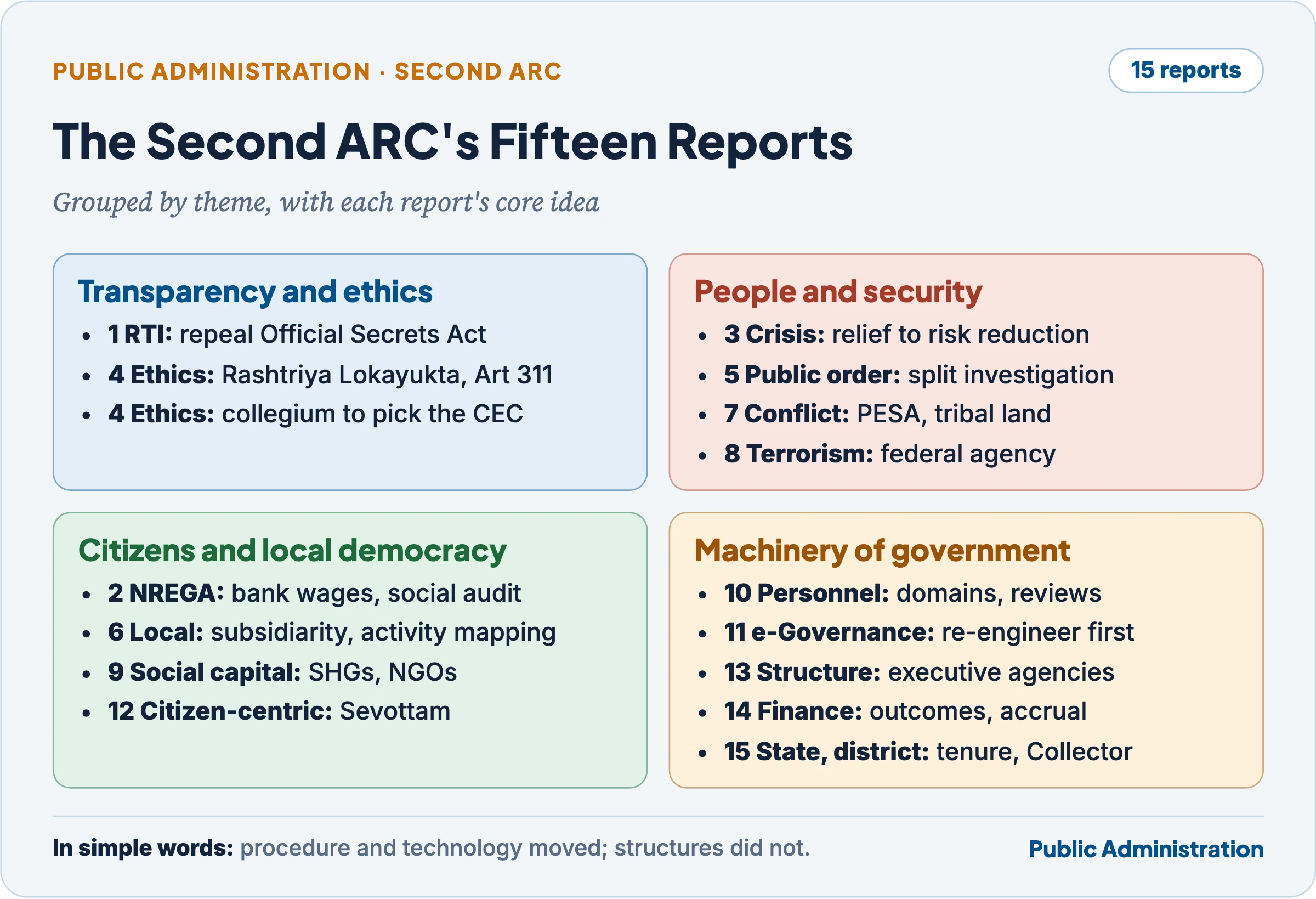
The table gives each report with its core recommendation. The years are those of submission.
| No. | Report (year) | Core recommendation | Status in brief |
|---|---|---|---|
| 1 | Right to Information: Master Key to Good Governance (2006) | Repeal the Official Secrets Act, 1923 and place necessary provisions in a chapter of the National Security Act; strong proactive disclosure under section 4; independent information commissions | Commissions set up everywhere; OSA still in force |
| 2 | Unlocking Human Capital: Entitlements and Governance, a Case Study (2006) | For NREGA: wage payment through banks and post offices, social audit, funds sent directly to districts, convergence | Largely implemented in NREGA |
| 3 | Crisis Management: From Despair to Hope (2006) | Shift from relief to risk reduction; disaster management plans and authorities at every level | Taken up under the Disaster Management Act framework |
| 4 | Ethics in Governance (2007) | A constitutional Rashtriya Lokayukta, Lokayuktas in States, codes of ethics for ministers, legislators and civil servants, amend Article 311, confiscation of illegally acquired property, ombudsman for local bodies, a collegium to select the CEC and ECs | Lokpal (statutory) only in 2013; Article 311 unchanged |
| 5 | Public Order: Justice for Each… Peace for All (2007) | Separate investigation from law and order; a new Police Act; Police Complaints Authorities; a law on federal crimes (153 of its 165 recommendations concern States) | Patchy, mostly via Prakash Singh compliance |
| 6 | Local Governance: An Inspiring Journey into the Future (2007) | Subsidiarity; a framework law making devolution mandatory; activity mapping; functional DPCs and MPCs; a directly elected Mayor; urban infrastructure through PPPs accountable to local bodies | Uneven across States |
| 7 | Capacity Building for Conflict Resolution: Friction to Fusion (2008) | Fair land acquisition and rehabilitation, PESA enforcement, strengthening Sixth Schedule councils, mechanisms for inter-State water and communal conflicts | Partly, through the land acquisition law of 2013 and PESA rules in some States |
| 8 | Combating Terrorism: Protecting by Righteous Might (2008) | A comprehensive anti-terror law and a federal agency to investigate terror offences | NIA Act, 2008; UAPA amended |
| 9 | Social Capital: A Shared Destiny (2008) | Supportive law for SHGs, cooperatives and voluntary organisations; accreditation of NGOs; corporate social responsibility | CSR made statutory (Companies Act, 2013) |
| 10 | Refurbishing of Personnel Administration: Scaling New Heights (2008) | Lower entry age, fewer attempts; mandatory training; domain assignment after 13 years; intensive reviews at 14 and 20 years; lateral entry at senior levels; a statutory Central Civil Services Authority; a Civil Services Law; performance management | Training and appraisal reforms; lateral entry from 2018; no Civil Services Law |
| 11 | Promoting e-Governance: The SMART Way Forward (2008) | Business process re-engineering before automation; a legal and interoperability framework; common service centres | Absorbed into NeGP and Digital India |
| 12 | Citizen Centric Administration: The Heart of Governance (2009) | Effective Citizen’s Charters, the Sevottam model, grievance redress with time limits, single-window delivery, citizen feedback | Sevottam, CPGRAMS; Right to Services laws in over twenty States |
| 13 | Organisational Structure of Government of India (2009) | Group departments into fewer closely related ministries; separate policy from implementation through executive agencies; flatter hierarchy and fewer levels | Little structural change |
| 14 | Strengthening Financial Management Systems (2009) | Outcome budgeting, a medium-term expenditure framework, accrual accounting, stronger internal audit and financial advisers, better parliamentary scrutiny | MTEF statement (2012 FRBM amendment); accrual still in pilot |
| 15 | State and District Administration (2009) | Secretariat reorganisation and delegation in States; stable tenure and collegial selection of the Chief Secretary; District Collector refocused on coordination, regulation and crisis management; land records modernisation | Land records programme; few structural changes |
The table shows a commission whose ideas reached far wider than its predecessor’s: from RTI and terror law to SHGs and land records. Its most implemented recommendations were those that fitted an existing programme (NREGA, NIA, e-governance); its least implemented were those that would have cut privileges or protections (Article 311, a statutory civil service authority, separation of policy from execution).
6.3 Civil service reforms: the major concerns of the 10th Report
- Concerns:
- the cult of the generalist and lack of domain expertise at senior levels;
- frequent transfers and political interference;
- ACRs that rewarded seniority rather than results; the incentive structure in government was too weak to motivate better performance;
- near impossibility of removing incompetent or corrupt officers because of cumbersome procedures;
- outdated recruitment (high entry age, many attempts) and weak in-service training.
- Recommendations:
- Recruitment: age limits of 21–25 (general), 21–28 (OBC) and 21–29 (SC/ST and persons with disabilities); attempts limited to three, five and six; National Institutes of Public Administration to offer bachelor’s courses feeding the civil services.
- Training: mandatory induction and mid-career training, linked to promotion.
- Domains: assign officers of the AIS and Central Group A services to domains after 13 years; fill Deputy Secretary and Director posts by matching domain competence.
- Senior posts: open Joint Secretary posts to all services by competition; fill some Additional Secretary and above posts from the open market; lateral entry institutionalised.
- Performance: a full performance management system with work plans, mid-year review and numerical grading; PRIS; intensive reviews at 14 years (development) and 20 years (fitness to continue), with exit for the unfit.
- Discipline: a Civil Services Law setting minimum disciplinary procedures; simpler inquiries; one-stage CVC consultation; UPSC consultation only for dismissal.
- Institutions: a statutory Central Civil Services Authority to assign domains, prepare panels, fix tenures and decide which posts are advertised.
- Current status:
- Done or partly done: open APAR (2009) and online appraisal; mandatory mid-career training; multi-source feedback for empanelment; lateral entry (2018–2024); stronger use of FR 56(j); Mission Karmayogi for competencies; Civil Services Boards through T.S.R. Subramanian.
- Not done: the Civil Services Law, the Central Civil Services Authority, domain assignment, intensive reviews at 14 and 20 years, lower age limits and fewer attempts, and PRIS.
6.4 Are the civil service recommendations “radical yet implementable”?
- Radical: they challenge lifetime tenure (20-year review), the generalist monopoly over senior posts (competition and open market), seniority (performance management) and legal shields (a Civil Services Law, Article 311 reform).
- Implementable: most need no constitutional amendment; a law under Article 309 and executive rules would do. Several were later implemented in some form (lateral entry, MCTP, open APAR, CSBs), and similar systems work in other Westminster countries (the UK’s Senior Civil Service, New Zealand’s chief executive contracts).
- Obstacles: the service associations, the courts’ protection of tenure, the reservation question in lateral entry, the risk of politicised reviews and selections, and the absence of a lead minister for reform.
6.5 Subsidiarity in the Second ARC
- The principle: functions should be performed by the lowest level of government that can do them effectively; higher levels act only when economies of scale or spillovers require.
- Where the ARC uses it:
- 6th Report: activity mapping to give each tier of panchayat and municipality clear functions; devolution of funds, functions and functionaries; a framework law to make devolution mandatory; directly elected mayors; district planning through DPCs.
- 15th Report: States to delegate to directorates and districts; the district as the unit of coordinated planning.
- 13th Report: the Union Government to concentrate on policy, standards and coordination, leaving execution to agencies and States.
- Citizen-centricity: wherever a community of users can be identified, it should run the service (school committees, water user groups).
- Assessment: subsidiarity gives a principled test for allocating functions and fits the 73rd and 74th Amendments. But States have been reluctant to transfer functionaries and untied funds; centrally sponsored schemes still flow through State departments; and local capacity is uneven.
6.6 Incentives and performance: the 10th Report’s observation
- The Commission recorded the common perception that “the incentive structure in government is too weak and inadequate to motivate better performance”. Why:
- promotion by seniority and time-bound upgrades (ACP, MACP) reward length of service, not results;
- appraisal inflation: almost everyone is “outstanding” or “very good”;
- security of tenure and Article 311 make sanctions for poor performance rare;
- pay compression at the top and no variable pay;
- frequent transfers break the link between an officer and the results of his work.
- Remedies proposed: performance management with measurable targets, PRIS, promotion on merit, recognition schemes (the Prime Minister’s Awards for Excellence in Public Administration), and reviews at 14 and 20 years. Later measures (Very Good benchmark, multi-source feedback, Karmayogi-APAR link) address parts of this.
6.7 Public-private partnership in the Second ARC’s scheme
- Where it appears: chiefly in the 6th Report’s chapter on urban infrastructure and service provision, and in the 13th Report’s separation of policy from delivery.
- The ARC’s stance: PPPs can bring finance, technology and management to infrastructure and urban services, but only if:
- the public authority remains accountable (urban service providers answer to the elected local body);
- risks are allocated to the party best able to manage them;
- independent regulation sets standards and tariffs;
- contracts are awarded transparently and monitored, with citizen feedback.
- Indian experience: highways, ports, airports and power saw rapid PPP growth after 2005, but also stalled projects, aggressive bidding, renegotiation and bank stress. The Kelkar Committee on Revisiting and Revitalising the PPP Model (2015) called for better risk-sharing, an independent review and adjudication mechanism, avoidance of unsolicited “Swiss challenge” bids, and protection of honest officials from vigilance harassment over genuine commercial decisions. The swing towards the hybrid annuity model in highways (2016) and asset monetisation (National Monetisation Pipeline, 2021) reflects these lessons.
- Evaluation: PPP is a preferred mode where revenue risk is manageable and regulation is strong (airports, ports, toll roads with stable traffic); it is a poor fit where user charges cannot cover costs or regulation is weak, where public provision with private construction contracts may be better. See the article on Regulatory Authorities and Public-Private Partnerships.
6.8 Implementation of the Second ARC
- Machinery: a Group of Ministers constituted on 30 March 2007 under the then External Affairs Minister, reconstituted on 21 August 2009 under the Finance Minister; the Core Group on Administrative Reforms under the Cabinet Secretary examined all fifteen reports; the 8th Report (terrorism) was handled directly by the Home Ministry.
- Numbers: by May 2012, thirteen reports had been considered; of 1,005 accepted recommendations, 533 had been implemented and 472 were under implementation (Lok Sabha reply). In July 2025 the government told the Rajya Sabha that decisions had been conveyed to ministries, States and UTs and that implementation was a continuous process.
- States: most recommendations on public order, local governance and district administration lie with the States; DARPG forwarded accepted recommendations to them, with uneven follow-up.
- Pattern: procedure and technology moved; structures, protections and privileges did not.
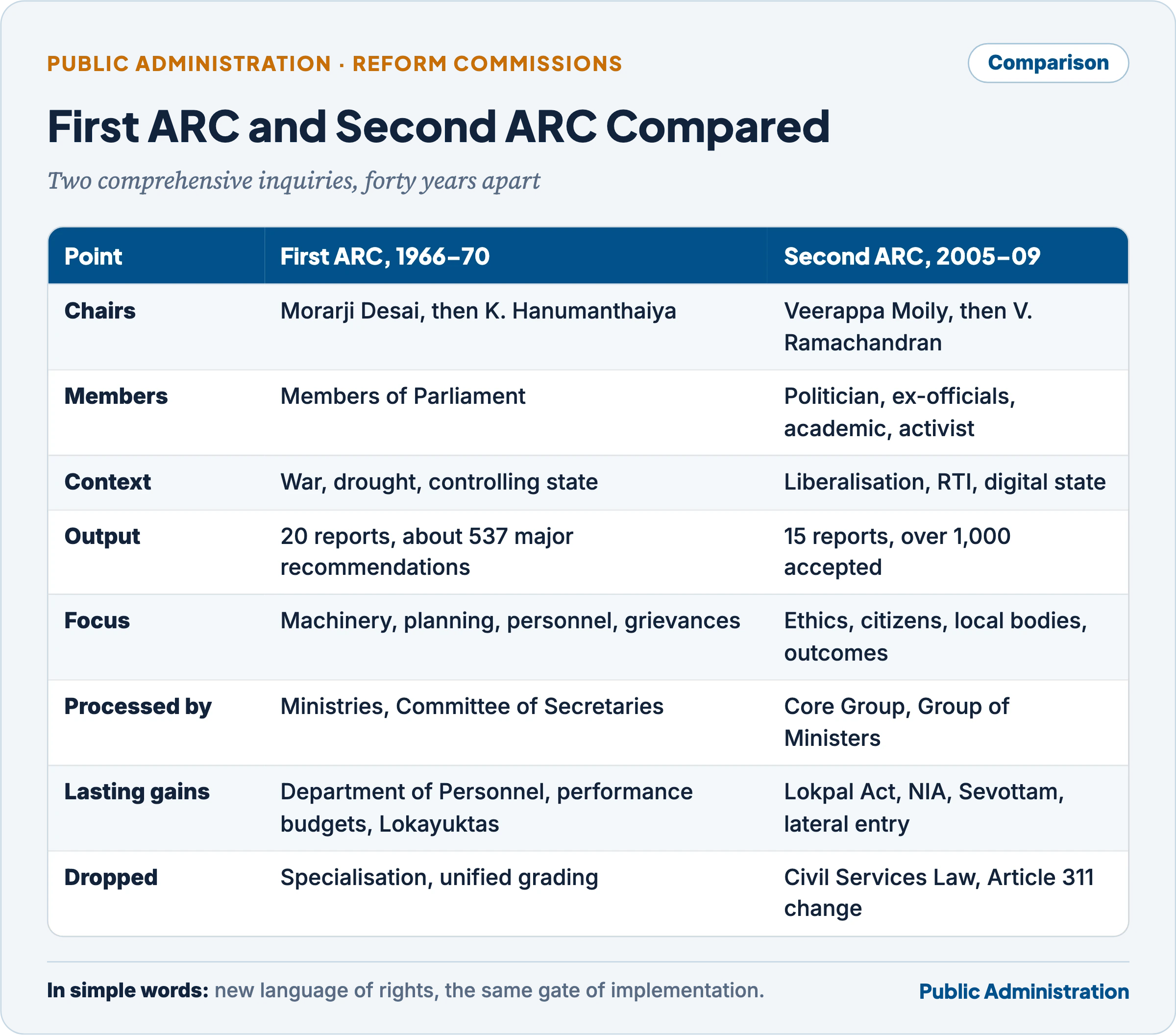
6.9 Comparing the two ARCs
| Point | First ARC (1966–70) | Second ARC (2005–09) |
|---|---|---|
| Chairs | Morarji Desai, then K. Hanumanthaiya | M. Veerappa Moily, then V. Ramachandran |
| Members | Members of Parliament | A former minister, retired civil servants, a management academic, a civil society activist |
| Context | War, drought, a controlling development state | Liberalisation, RTI, rights-based welfare, digital technology |
| Output | 20 reports, about 537 major recommendations | 15 reports; over 1,000 recommendations accepted |
| Focus | Machinery of government, planning, personnel, Centre–State, grievances | Ethics, citizen-centricity, local governance, public order, e-governance, outcomes |
| Implementation | By each ministry, vetted by the Committee of Secretaries | Core Group under the Cabinet Secretary, then a Group of Ministers |
| Lasting outcomes | Department of Personnel, performance budgeting, Lokayuktas, the Lokpal idea | Lokpal Act (2013), NIA, RFD, Sevottam, lateral entry, Right to Services laws |
| Main failure | Specialisation and unified grading dropped | Civil Services Law, OSA repeal, Article 311 reform dropped |
Both commissions saw that India’s administration was generalist, hierarchical and insulated; the second added a stronger language of rights, ethics and citizens. Both found their structural proposals stopped at the same gate: implementation by the bureaucracy and a political class content with the system.
7. Electoral and Constitutional Review Bodies, and Expert Committees after 2014
In simple words
Not every reform comes from an “administrative reforms” commission. Some come from bodies on elections or the Constitution, and since 2014 many from small expert committees asked to fix one thing quickly: the railways, the civil services examination, public expenditure or regulation.
7.1 Strengthening the Election Commission
- Dinesh Goswami Committee on Electoral Reforms (1990): consultation with the Leader of the Opposition and the Chief Justice in appointing the Chief Election Commissioner; protection of Election Commissioners on par with the CEC.
- 2nd ARC, 4th Report (2007): a collegium headed by the Prime Minister, with the Speaker, the Leader of the Opposition in the Lok Sabha, the Law Minister and the Deputy Chairman of the Rajya Sabha, to recommend the CEC and Election Commissioners.
- Anoop Baranwal v. Union of India (2 March 2023): the Supreme Court held that, until Parliament legislated, appointments should be made on the advice of a committee of the Prime Minister, the Leader of the Opposition and the Chief Justice of India.
- Chief Election Commissioner and Other Election Commissioners Act, 2023: a selection committee of the Prime Minister, the Leader of the Opposition and a Union Cabinet Minister nominated by the PM, replacing the Chief Justice; criticised as restoring executive dominance.
- Further measures proposed: equal removal protection for all Election Commissioners, a charged budget, an independent secretariat, a cooling-off period after tenure, and statutory backing for the Model Code of Conduct.
7.2 Expert committees after 2014
| Body | Year | Chair | Key recommendations | Outcome |
|---|---|---|---|---|
| Expenditure Management Commission | Constituted 4 September 2014 | Bimal Jalan | Review of budgeting process and FRBM rules, allocative efficiency, expenditure classification, cash management, IT in expenditure management | Mandated to report before the 2015-16 and 2016-17 budgets, ahead of the 2017 budget reforms |
| Committee on Restructuring Railways | 2014–15 (final report June 2015) | Bibek Debroy | Separate policy, regulation and operations; a Railway Regulatory Authority; accrual accounting; focus on core activities; phase out the separate Railway Budget | Rail Budget merged (2017-18); Rail Development Authority approved (2017) |
| Committee on Revisiting and Revitalising the PPP Model | 2015 | Vijay Kelkar | Better risk allocation, review and adjudication machinery, avoid Swiss challenge, protect honest decisions | Partly acted on: section 17A of the PC Act (2018) protects decisions taken in official functions |
| Committee on the Civil Services Examination | 2015–16 | B.S. Baswan | Review of eligibility, age, attempts and the optional paper; realistic intake planning for the IAS | Report not acted on in full |
| FRBM Review Committee | 2016–17 | N.K. Singh | Debt as the anchor; an independent fiscal council; escape clauses | Debt targets in the 2018 FRBM amendment; no fiscal council |
| Task Force on Compliance Reduction and Deregulation | Constituted 24 January 2025 | Cabinet Secretary | Reduce compliance burdens and inspections in Union and State rules | Ongoing, with a Deregulation Cell |
These bodies differ from the ARCs: narrow, fast and executive-driven, often reporting within a year to a ministry eager to act. Their recommendations were implemented more often but covered less ground.
8. Reforms in Financial Management
In simple words
Money is how a government turns promises into results. Financial management reform asks four questions: Is the government borrowing too much? Is it spending on the right things? Does it know what the spending achieved? Does the money reach the intended person quickly and honestly?
8.1 From control to results: the arc of reform
- Inherited system: line-item budgets, cash-based accounts, pre-audit and detailed Finance Ministry sanction of almost every expenditure; Appleby’s criticism of excessive financial control dates from 1953.
- Phase 1 (1950s–1980s): performance budgeting (First ARC; from 1968-69), the Integrated Financial Adviser scheme (1975) and departmentalisation of accounts (1976), delegation of financial powers (DFPR 1978).
- Phase 2 (1991–2004): fiscal crisis, expenditure reform commissions, and fiscal rules (FRBM 2003).
- Phase 3 (2005 onwards): outcomes, technology and direct transfers: outcome budgets, PFMS, DBT, GST, the 2017 budget reforms, and just-in-time fund release.
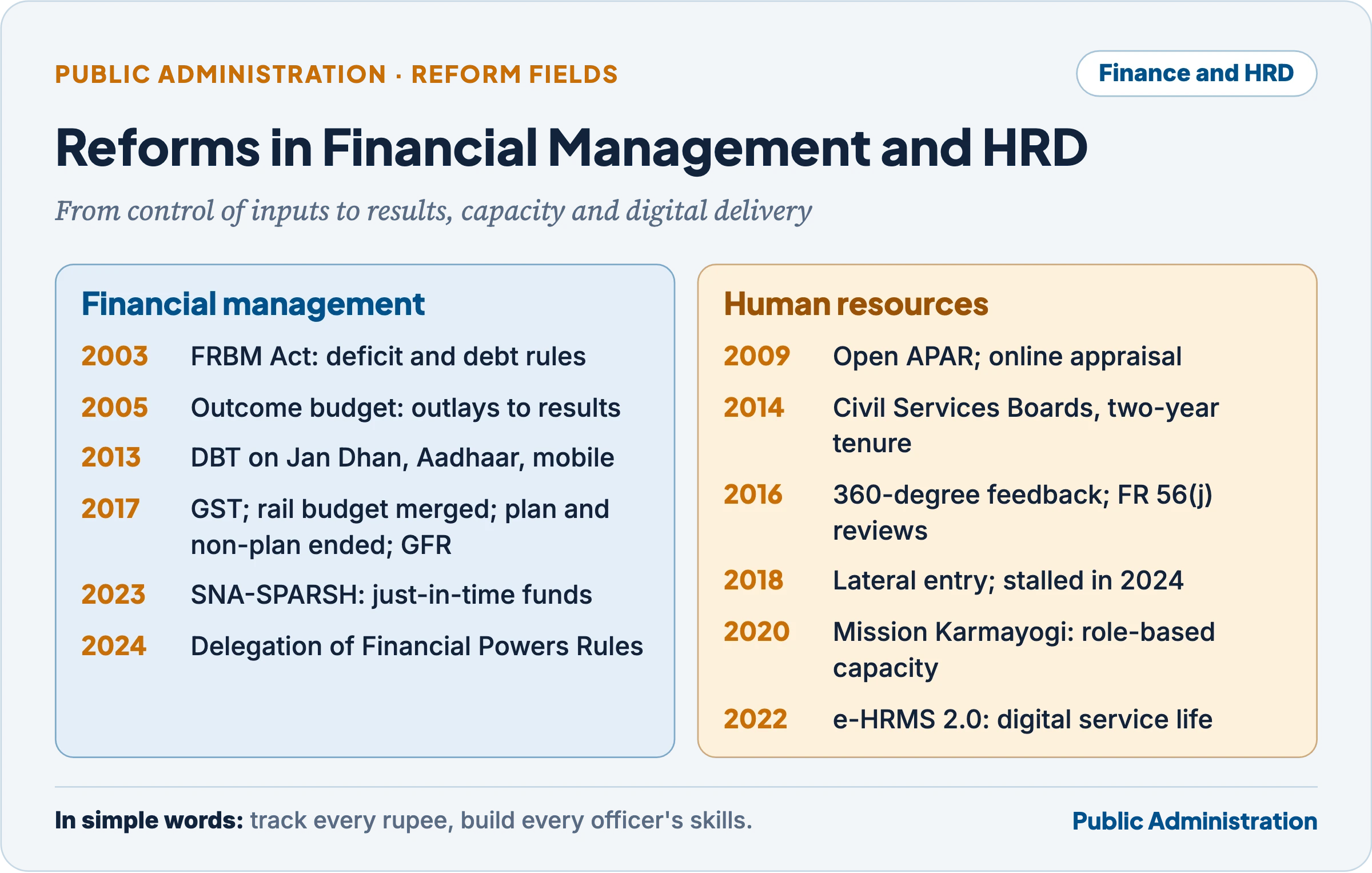
8.2 Fiscal rules: the FRBM Act, 2003 and its amendments
- The Act: the Fiscal Responsibility and Budget Management Act, 2003 (in force July 2004) required the Union to eliminate the revenue deficit, bring the fiscal deficit to 3% of GDP, end borrowing from the RBI in the primary market, and lay fiscal policy statements (medium-term fiscal policy, fiscal policy strategy, macroeconomic framework) with the budget.
- Amendments:
- 2012: the concept of effective revenue deficit and a Medium-Term Expenditure Framework Statement (a 2nd ARC 14th Report idea); CAG review of compliance;
- 2015 and 2018: new glide paths; the 2018 amendment, following the N.K. Singh Committee, made debt the main anchor (general government debt 60% of GDP, Union debt 40%) with a fiscal deficit target of 3% and an escape clause;
- from 2026-27, a debt anchor of Union debt at about 50 ± 1% of GDP by 2030-31.
- Assessment:
- Optimism proved unwarranted in part: targets were deferred or suspended repeatedly (after 2008, in 2020), there is no penalty for breach and no independent fiscal council, and off-budget borrowing lowered reported deficits for some years.
- But the Act created a culture of fiscal disclosure, ended automatic monetisation of deficits, and framed the post-COVID consolidation. Details are in the article on Budget as a Political Instrument, Parliamentary Control and the Finance Ministry.
8.3 From performance budgeting to outcome budgeting and RFD
- Performance budgeting (First ARC; 1968-69 onwards) classified spending by programmes and activities with physical targets. It became a parallel document, with outputs but little link to outcomes or to the next allocation.
- Outcome Budget (2005): introduced by Finance Minister P. Chidambaram with the principle that outlays are not outcomes. Each ministry linked financial outlays to physical outputs and intended outcomes. Since 2017-18 an Output-Outcome Monitoring Framework, run by NITI Aayog’s Development Monitoring and Evaluation Office, presents indicators for major schemes with the budget.
- Why outcome budgeting addresses performance budgeting’s weaknesses:
- it measures results for citizens (literacy, immunisation) rather than activities (schools built);
- it requires baselines and targets, making progress checkable;
- it ties performance information to the annual budget, not a separate document;
- it supports performance audit and parliamentary scrutiny.
- Its own limits: many “outcomes” are still outputs; attribution is hard; data are weak; and allocations seldom change in response to results.
- Results Framework Document (RFD, 2009): under the Performance Monitoring and Evaluation System (PMES) in the Cabinet Secretariat, each department signed an annual RFD with objectives, success indicators and weights, and was scored on a composite index. It brought a management-by-objectives culture but was discontinued after 2014; critics said it measured activities and departmental effort, not citizens’ outcomes, and was not linked to individual appraisal or budgets.
8.4 Accounting reforms: towards accrual
- Departmentalisation (1976) separated accounts from audit; the Controller General of Accounts heads government accounting.
- Government Accounting Standards Advisory Board (GASAB, 2002), under the CAG, frames accounting standards (IGAS) and accrual standards (IGFRS) for pilots.
- 2nd ARC 14th Report and the Debroy Committee urged accrual accounting, which records assets, liabilities, depreciation and pension obligations, so that the full cost of services is known.
- Status: the Union keeps cash-based accounts with additional statements (a modified cash approach); accrual remains in pilots, partly because Parliament votes cash and the transition is costly. See the article on Accounting Techniques, Audit, CGA and CAG.
8.5 PFMS, DBT and just-in-time money
- Public Financial Management System (PFMS): began around 2009 as a system to track releases under plan schemes and became the Union’s integrated platform for payments, receipts, fund tracking and accounting, linked to banks and treasuries.
- Direct Benefit Transfer (DBT), 1 January 2013: subsidies and benefits paid directly into beneficiaries’ bank accounts, using the JAM trinity: Jan Dhan accounts (Pradhan Mantri Jan Dhan Yojana, 28 August 2014), Aadhaar identity and Mobile phones. Estimated cumulative savings of about ₹5.14 lakh crore to March 2025 came from removing fake and duplicate beneficiaries.
- Treasury Single Account (TSA) for autonomous bodies, the Single Nodal Agency (2021) model and SNA-SPARSH (2023) release funds for centrally sponsored schemes just in time, cutting idle balances parked in banks and the government’s interest cost.
- Significance: these are reforms by re-engineering, not by commission report; they shrink discretion at the point of payment, which earlier reforms had tried to control by rules.
Indian Connect — Financial inclusion: law and awareness
Financial inclusion rests on legal backing: the Aadhaar Act, 2016, section 7, lets the government require authentication for subsidies paid from the Consolidated Fund; the Payment and Settlement Systems Act, 2007 regulates UPI and digital payments; RBI rules allow business correspondents and payments banks. But law creates only the channel. Many Jan Dhan accounts were opened yet lay dormant; failed authentications, unfamiliar digital fraud and distance from banking points excluded the poorest. Hence financial literacy drives, banking correspondents in villages, and grievance channels are as important as the law itself.
8.6 The 2017 budget reforms and GST
- Budget presented on 1 February (2017-18): the Finance Bill passes before 1 April, so money is available from the start of the year and routine votes on account end.
- Merger of the Railway Budget (2017-18): ended a separation dating from 1924 (Acworth Committee), following the Debroy Committee and a NITI Aayog paper.
- End of the plan/non-plan classification (2017-18): leaves the revenue/capital distinction; it removes the bias of treating “plan” as good and maintenance as bad, a distortion the L.K. Jha Commission had noted. It also followed the abolition of the Planning Commission and the creation of NITI Aayog (1 January 2015).
- Goods and Services Tax (1 July 2017): introduced through the 101st Constitutional Amendment (2016) with the GST Council under Article 279A. It replaced a cascade of Union and State indirect taxes with a destination-based tax, creating a shared fiscal space governed by a Union–State council. The federal debate is covered in the article on Union–State Relations: Legislative, Administrative and Financial.
8.7 Rules of financial administration
- General Financial Rules, 2017 (replacing GFR 2005): rules on budgeting, procurement (including the Government e-Marketplace), grants-in-aid, and standards of financial propriety.
- Delegation of Financial Powers Rules, 2024 (in force 1 April 2024, replacing the rules of 1978): wider powers to ministries and their Integrated Financial Advisers, carrying out a reform Appleby and the First ARC had sought.
- Jan Vishwas (Amendment of Provisions) Acts, 2023 and 2026: decriminalise minor offences in economic and regulatory laws; the 2026 Act (assent 7 April 2026) amended 784 provisions in 79 Acts, decriminalising 717. They reduce the inspector raj in which financial and regulatory discretion breeds corruption.
8.8 Finance Commissions and the finances of local bodies
- Thirteenth Finance Commission (Vijay Kelkar; award period 2010–15) stressed that panchayats and municipalities could not perform their constitutional functions without better finances. It linked grants to local bodies to a share of the divisible pool of central taxes, split into a basic grant and a performance grant.
- Conditions for the performance grant included a supplement to State budget documents showing local body funds, audit of local body accounts under the CAG’s technical guidance, an independent local body ombudsman, electronic transfer of grants to local bodies within days, qualifications for State Finance Commission members, a property tax board, and published service standards for urban bodies.
- Does money make local bodies more accountable? Partly. The conditions built accountability instruments (audit, ombudsman, service standards, budget transparency), which is reform by conditional transfer. But accountability also needs elected bodies with real functions and functionaries, regular State Finance Commissions, local tax effort and active gram and ward sabhas; many States met conditions on paper, a form of formalism. Later commissions continued conditional grants for local bodies. See the article on The Finance Commission and Fiscal Federalism.
8.9 Assessment of financial management reforms
- Gains: transparency of fiscal data, digital tracking of money to the beneficiary, fewer leakages, an outcome vocabulary, simpler indirect taxes, and greater delegation.
- Gaps: outcome information rarely changes allocations; accrual accounting is still not adopted; fiscal rules lack an independent watchdog; States’ fiscal management (debt, off-budget borrowing) lags; and parliamentary scrutiny has not kept pace.
9. Reforms in Human Resource Development
In simple words
A government is only as good as its people. HRD reform asks how to pick the right people, train them for the job they actually do, judge their work fairly, reward the good, remove the bad and keep them in a post long enough to make a difference.
This section summarises reforms treated in detail in the articles on Civil Services: Constitutional Position, Structure and Recruitment; Civil Service Training and Capacity Building: From LBSNAA to Mission Karmayogi; and Good Governance Initiatives and Civil Service Reforms.
9.1 Recruitment reforms
- Kothari (1976) → three-stage examination (1979); Satish Chandra (1989) → Essay and a 300-mark interview (1993); Alagh (2001) → CSAT (2011); Nigavekar (2012) → new Main examination (2013); CSAT made qualifying (2015); Baswan (2016) on age, attempts and optional papers.
- Persistent issue: the long age band and many attempts keep lakhs of young people in prolonged preparation; the 2nd ARC and Hota wanted lower ages and fewer attempts, which governments have not accepted.
9.2 Lateral entry
- Idea’s history: First ARC (lateral entry to senior technical posts), NCRWC (2002) (posts above Joint Secretary open to outside talent), 2nd ARC 10th Report and the Sixth Pay Commission (lateral entry with performance contracts).
- Practice: the first open advertisement (2018) for Joint Secretary posts was followed by others for Joint Secretary, Director and Deputy Secretary levels. A Parliament reply of February 2026 put lateral appointments since 2018 at 63. The UPSC’s advertisement of 17 August 2024 for 45 posts was cancelled on 20 August 2024 because single-post appointments carried no reservation.
- Advantages: domain expertise, fresh ideas, competition that challenges complacency, and a bridge to the private and academic sectors.
- Limits: short contracts (3–5 years) give little time to learn government; accountability is unclear when the entrant returns to the private sector; risk of conflict of interest and of politicised selection if UPSC is bypassed; demoralisation of career officers; and the reservation gap under Articles 16(4) and 335.
- Constitutional frame (Part XIV): recruitment and conditions of service are regulated under Article 309; the UPSC (Article 320) must be consulted on methods of recruitment; Article 311 protections apply to holders of civil posts. Lateral entry through UPSC on contract is constitutionally valid; the debate is about representation and neutrality, not legality.
- Why it has “not moved in the intended direction”: small numbers relative to the hundreds of senior posts; entrants placed at middle levels rather than decisive posts; the reservation controversy; weak induction and short tenures; and no statutory framework of the kind the 2nd ARC proposed.
9.3 Performance appraisal
- From ACR to APAR: the confidential report was renamed the Annual Performance Assessment Report (APAR) and disclosed in full to the officer, with a right of representation (DoPT OM of 14 May 2009), after the Supreme Court in Dev Dutt (2008) held that uncommunicated entries violated natural justice. SPARROW moved the APAR online.
- Multi-source (360-degree) feedback: from about 2015–16, empanelment at Joint Secretary and above added confidential feedback from seniors, peers, juniors and outside stakeholders. The Parliamentary Standing Committee (August 2017) found it opaque and subjective. Making it fairer requires notified criteria, a minimum number of respondents across levels, trained assessors, weighting that limits single-source bias, and sharing a summary with the officer.
- Benchmarks: “Very Good” for promotion and MACP (Seventh Pay Commission).
9.4 Accountability and exit: FR 56(j) and tenure
- FR 56(j): the government may retire a Group A or B officer who joined before 35 after he turns 50, and others after 55, with three months’ notice or pay in lieu, in the public interest; parallel provisions exist for the AIS (Rule 16(3) of the AIS (Death-cum-Retirement Benefits) Rules). Reviews have been used since 2014 to retire officers of doubtful integrity or poor performance. Courts uphold such orders if based on the whole record and not punitive in disguise.
- Civil Services Boards and tenure: T.S.R. Subramanian v. Union of India (31 October 2013) directed Civil Services Boards, minimum tenure and written orders from political superiors; the IAS (Cadre) Amendment Rules, 2014 provide for postings on the Board’s recommendation and a two-year minimum tenure, which can be overridden only by recording reasons. In practice, early transfers continue with recorded reasons, a classic case of formalism.
9.5 Capacity building: Mission Karmayogi
- Approved: by the Union Cabinet on 2 September 2020 as the National Programme for Civil Services Capacity Building (NPCSCB).
- Shift: from rule-based to role-based HR management, building the competencies each post needs.
- Architecture:
- the Prime Minister’s Public Human Resources Council at the apex;
- the Capacity Building Commission (constituted 1 April 2021) to set standards, oversee training institutions and approve annual capacity building plans;
- Karmayogi Bharat, a not-for-profit special purpose vehicle running the iGOT Karmayogi platform;
- FRAC (Framework of Roles, Activities and Competencies) and the Karmayogi Competency Model (19 October 2024).
- Reach: over 1 crore registered officials by May 2025 and over 1.6 crore by April 2026; from 2025-26, completion of prescribed iGOT courses is recorded in every Central and AIS officer’s APAR.
- Limits: online courses cannot by themselves cure structural constraints such as short tenures, vacancies, weak State institutes and the generalist career pattern; the Mission supplements but does not replace reforms in recruitment, tenure and performance management.
- Earlier training reforms: the National Training Policy (1996, revised 2012) (“training for all”), and Mandatory Mid-Career Training Programmes for the IAS (2007), as the 2nd ARC and the Yugandhar Committee had urged.
9.6 Digital HR: e-HRMS
- e-HRMS (launched 25 December 2017) digitised service books, leave, LTC, advances and tours for Central employees; e-HRMS 2.0 (25 December 2022) covers the whole service life (transfers, deputation, APAR, iGOT training, vigilance status) and integrates iGOT, SPARROW, PFMS and the probity portal; a mobile app followed on 25 December 2025. DoPT counts it among the pillars of Mission Karmayogi.
- Effect: HR decisions become traceable and data-based, reducing discretion in routine entitlements and giving managers HR analytics.
9.7 The changing character of public services
- Since 1947 the public services have moved:
- from a law-and-order and revenue service to a development service (1950s–1980s), then to a regulator and facilitator after 1991, and now to a service-delivery and digital organisation;
- from closed, generalist and secretive to partly open (lateral entry), more specialised (domains, competencies) and transparent (RTI, open APAR);
- from seniority to an emphasis on performance and capacity;
- from colonial distance to citizen-centricity (charters, Sevottam, grievance redress, Right to Services laws);
- with more representative composition through reservation and more women.
- Continuities: generalist dominance at the top, short tenures, weak links between pay and performance, and protection of tenure.
10. Reading the Reform Record through Theory
In simple words
Theories help explain why some reforms stick and others do not. A theory is like a pair of glasses: one shows the reforms as a struggle of power, another as a copy of foreign management fashion, another as laws that look good on paper but change little on the ground.
Theory lens: committees, commissions and the logic of reform
- Appleby’s democratic administration. Paul Appleby argued in Big Democracy (1945) and Policy and Administration (1949) that administration is part of the political process, accountable through elected leaders, and in Morality and Administration in Democratic Government (1952) that responsible government is ethical government. His Indian reports applied this view: decisions should be made close to the political executive and its ministries, not slowed by central financial controls. The ethics strand returns in the 2nd ARC’s 4th Report and in codes of ethics; the delegation strand in the DFPR 2024.
- Caiden on reform. Gerald Caiden, in Administrative Reform (1969), defined reform as “the artificial inducement of administrative transformation against resistance”, distinct from natural, self-adjusting change. Indian commissions are exactly such artificial inducements; their fate shows his point that reform succeeds only with sustained political backing and fails through faulty implementation, as the First ARC’s experience with the Committee of Secretaries shows.
- Weber and the rational structure. Max Weber‘s legal-rational bureaucracy (hierarchy, rules, career tenure, merit) is the frame within which most Indian reforms have worked: recruitment examinations, pay grades, tenure rules and conduct codes rationalise the structure rather than replace it. The specialist–generalist debate (First ARC, 2nd ARC domains) is a Weberian argument about expertise as the basis of authority. See the article on Weber’s Bureaucratic Model, its Critique and Post-Weberian Developments.
- Riggs and formalism. Fred Riggs (Administration in Developing Countries, 1964) described formalism in prismatic societies: a gap between formal rules and actual behaviour. Accepted-but-unimplemented recommendations, Citizen’s Charters pasted on walls, tenure rules overridden by “recorded reasons”, and RTI weakened by vacancies in information commissions all illustrate it. See the article on Riggsian Models and their Critique.
- New Public Management. Christopher Hood (“A Public Management for All Seasons?”, 1991) and David Osborne and Ted Gaebler (Reinventing Government, 1992) shaped the reforms of the 1990s and 2000s: downsizing (Fifth Pay Commission, Expenditure Reforms Commission), executive agencies (2nd ARC 13th Report), outcome budgets and accrual accounting (14th Report), performance pay (PRIS) and lateral entry. India adopted NPM’s vocabulary faster than its structures.
- New Public Service. Janet and Robert Denhardt (The New Public Service: Serving, Not Steering, 2003) argued that citizens are not customers but owners of government. The 2nd ARC’s citizen-centric 12th Report, subsidiarity in the 6th Report, social audit in the 2nd, and Right to Services laws reflect this turn from efficiency to citizenship and participation. See the article on New Public Management and After: New Public Service, New Public Governance and Digital-Era Governance.
- Digital-era governance. Patrick Dunleavy and Helen Margetts (2006) argued that digital technology reintegrates government around the citizen. PFMS, DBT, SNA-SPARSH, e-HRMS and iGOT are India’s clearest examples; they achieve by process re-engineering what commissions tried to achieve by rules.
- Public choice and principal–agent. William Niskanen‘s budget-maximising bureaucrat (1971) explains why staff and posts grew despite every economy committee, and why the Fifth Pay Commission’s 30 per cent cut was not achieved. Principal–agent theory explains the turn to performance contracts, RFDs, APAR benchmarks and FR 56(j) as tools by which political principals try to align their bureaucratic agents.
Are reform commissions worth it?
Criticism — Commissions as ritual
- Reports gather dust: the First ARC’s specialisation scheme, the Fifth Pay Commission’s downsizing and the 2nd ARC’s Civil Services Law were all accepted in spirit and dropped in practice.
- Implementation by the reformed: ministries and the Committee of Secretaries decide on recommendations that curb their own power.
- Symbolic politics: appointing a commission signals concern after a scandal or crisis, then buys time.
- Repetition: the same ideas (tenure, specialisation, delegation, performance pay) recur from Gorwala to the Eighth Pay Commission, proof that diagnosis is not the bottleneck.
- Formalism: even implemented reforms (charters, CSBs) are often hollowed out in practice.
Defence — Commissions as slow agenda-setters
- Ideas incubate: the Lokpal (proposed 1966, enacted 2013), RTI (1997 Action Plan to 2005), lateral entry (1969 to 2018) and outcome budgeting all began in commission reports.
- Institutions created: O&M, IIPA, the CVC, the Department of Personnel, the Inter-State Council, the NIA and Civil Services Boards came from commission recommendations.
- A ready menu for windows of opportunity: when crises or new governments open space for change, reformers draw on existing reports.
- Legitimacy and consultation: commissions gather evidence, hear States and citizens, and build consensus that ministries alone cannot.
- Courts use them: Vineet Narain, Prakash Singh, T.S.R. Subramanian and Anoop Baranwal all drew on commission reports.
The record suggests that commissions are necessary but not sufficient. They shape the agenda and the vocabulary of reform; whether anything changes depends on a reform owner with political authority, a monitoring mechanism outside the bureaucracy being reformed, and a window of opportunity.
Key Terms
The terms below recur across the reports discussed above.
| Term | Meaning in simple words |
|---|---|
| Administrative reform | A deliberate, planned change in administrative structures, procedures, behaviour or values to improve performance |
| Commission of Inquiry | A body set up by the government with powers to call for evidence; both ARCs were set up in this form |
| O&M (Organisation and Methods) | A technique and a unit for improving work procedures, forms, records and office layout |
| Lokpal / Lokayukta | Ombudsman bodies to inquire into corruption complaints against public functionaries at the Union and State levels |
| Unified grading structure | Grouping all posts of similar qualifications and responsibility into common grades, regardless of service |
| Specialisation (domain) | Building officers’ depth in one sector of administration rather than rotating them across all |
| Performance budgeting | Budgeting by programmes and activities with physical targets |
| Outcome budgeting | Linking outlays to measurable results for citizens, with baselines and targets |
| Results Framework Document (RFD) | An annual departmental agreement listing objectives, success indicators and weights (2009–2014) |
| Accrual accounting | Recording income and costs when they are earned or incurred, with assets and liabilities, not just cash flows |
| Fiscal rule | A legal limit on deficits or debt, such as the FRBM targets |
| Direct Benefit Transfer | Paying subsidies and benefits straight into beneficiaries’ bank accounts |
| Just-in-time release | Releasing scheme funds only when they are to be spent, to avoid idle balances (SNA-SPARSH) |
| Subsidiarity | Giving each function to the lowest level of government able to perform it well |
| Sevottam | A service-excellence model: charters, grievance redress and service delivery capability |
| Citizen’s Charter | A public statement of services, standards, time limits and remedies offered by an office |
| APAR | The annual appraisal report of a government servant, now disclosed to the officer |
| Multi-source feedback | Appraisal that adds confidential views of seniors, peers, juniors and outsiders (360-degree) |
| FR 56(j) | The rule allowing premature retirement of a government servant in the public interest |
| Civil Services Board | A board of senior officers that recommends postings and checks premature transfers |
| Lateral entry | Appointment of outside specialists to middle and senior posts, usually on contract |
| Mission Karmayogi | The national programme for competency-based civil service capacity building (2020) |
| Formalism | A gap between what rules and reports prescribe and what actually happens |
| Executive agency | A semi-autonomous unit that delivers services under a ministry’s policy and a performance agreement |
Commissions, Committees and Judgments
The table summarises every reform body and judgment discussed above, in order of time.
| Body / case | Year | Key point |
|---|---|---|
| Secretariat Reorganisation Committee (Girija Shankar Bajpai) | 1947 | Staff shortages, use of manpower and methods in the Central Secretariat |
| Economy Committee (Kasturbhai Lalbhai) | 1948 | Economy in civil expenditure and staff growth |
| Reorganisation of the Machinery of Government (N. Gopalaswami Ayyangar) | 1949 | Ministry–department distinction; four bureaus (rejected); O&M; Cabinet committees |
| Gorwala Reports (A.D. Gorwala) | 1951 | Clean, efficient, impartial administration; autonomous boards for state enterprises |
| Appleby Reports (Paul H. Appleby) | 1953, 1956 | O&M Division and IIPA (both 1954); less financial control; autonomy for enterprises |
| O&M Division | 1954 | Standing machinery for administrative improvement in the Cabinet Secretariat |
| Second Pay Commission (Jagannath Das) | 1957–59 | Attached and subordinate offices; joint consultative machinery |
| V.T. Krishnamachari Report | 1962 | IAS and State services’ strength and training; district planning with Panchayati Raj |
| Santhanam Committee (K. Santhanam) | 1962–64 | Central Vigilance Commission (1964), vigilance units, conduct rules |
| Department of Administrative Reforms | 1964 | Home Ministry department; absorbed O&M |
| First ARC (Morarji Desai; K. Hanumanthaiya) | 1966–70 | 20 reports, about 537 major recommendations; Lokpal and Lokayukta; specialisation; performance budgeting |
| Kothari Committee (D.S. Kothari) | 1976 | Three-stage Civil Services Examination from 1979 |
| National Police Commission (Dharma Vira) | 1977–81 | State Security Commission; police chief tenure |
| Economic Administration Reforms Commission (L.K. Jha) | 1981–84 | 38 reports; from regulation to development; indirect controls; task-based accountability |
| Sarkaria Commission (R.S. Sarkaria) | 1983–88 | 247 recommendations; Inter-State Council (1990); NDC as NEDC under Art 263; support for AIS |
| Satish Chandra Committee | 1989 | Essay paper; interview raised to 300 marks (from 1993) |
| Fifth Pay Commission (S. Ratnavel Pandian) | 1994–97 | 30% downsizing; CSBs and tenure; ACP; RTI |
| Chief Ministers’ Conference Action Plan | 1997 | Citizen’s Charters, right to information, integrity of services |
| Expenditure Reforms Commission (K.P. Geethakrishnan) | 2000–01 | Subsidy rationalisation, staff optimisation, ministry restructuring |
| Alagh Committee (Y.K. Alagh) | 2001 | Aptitude test (CSAT, 2011); compulsory papers; lower age |
| NCRWC (M.N. Venkatachaliah) | 2000–02 | Statutory Civil Service Boards; open recruitment above JS; revisit Art 311; oath of transparency |
| Surinder Nath Committee | 2003 | Objective appraisal; empanelment; domains |
| Hota Committee (P.C. Hota) | 2004 | Age 21–24; Civil Services Act; tenure; Art 311 amendment for corrupt officers |
| Second ARC (M. Veerappa Moily; V. Ramachandran) | 2005–09 | 15 reports; 1,005 recommendations accepted by 2012 |
| Sixth Pay Commission (B.N. Srikrishna) | 2006–08 | Pay bands; MTS; PRIS; lateral entry |
| Thirteenth Finance Commission (Vijay Kelkar) | 2010–15 | Basic and performance grants to local bodies tied to audit, ombudsman and service standards |
| Seventh Pay Commission (A.K. Mathur) | 2014–15 | Pay matrix; “Very Good” benchmark; performance pay |
| Expenditure Management Commission (Bimal Jalan) | 2014 | Expenditure classification, budgeting and FRBM review |
| Debroy Committee (Bibek Debroy) | 2014–15 | Railway regulator; accrual accounts; end separate Rail Budget |
| Kelkar Committee on PPP (Vijay Kelkar) | 2015 | Risk-sharing, dispute machinery and protection of honest decisions in PPPs |
| Baswan Committee (B.S. Baswan) | 2015–16 | Review of CSE eligibility, age, attempts and optional paper |
| N.K. Singh FRBM Review Committee | 2016–17 | Debt anchor; fiscal council |
| Eighth Pay Commission (Ranjana Prakash Desai) | 2025 | Pay with efficiency, accountability and performance-linked incentives |
| Vineet Narain v. Union of India | 1997 | Statutory status for CVC; insulation of the CBI’s supervision |
| Prakash Singh v. Union of India | 2006 | Police reforms: State Security Commissions, tenure, Police Establishment Boards |
| Dev Dutt v. Union of India | 2008 | Uncommunicated ACR entries violate natural justice; led to open APAR |
| T.S.R. Subramanian v. Union of India | 2013 | Civil Services Boards, minimum tenure, written orders |
| Anoop Baranwal v. Union of India | 2023 | Independent selection committee for CEC and ECs until Parliament legislates |
Contemporary Developments
- Delegation of Financial Powers Rules, 2024 (1 April 2024). Replaced the rules of 1978, widening the powers of ministries and their Integrated Financial Advisers, a long-standing Appleby and First ARC demand.
- Lateral entry in limbo (August 2024 to 2026). The UPSC’s advertisement of 17 August 2024 for 45 posts was cancelled on 20 August 2024 over reservation; a Parliament reply of February 2026 put lateral appointments since 2018 at 63, and in June 2026 the Personnel Minister said no workable reservation model had yet been found.
- Karmayogi Competency Model (19 October 2024) and the APAR link from 2025-26, making completion of prescribed iGOT courses part of every Central and AIS officer’s appraisal; the platform crossed 1.6 crore officials by April 2026.
- Task Force on Compliance Reduction and Deregulation (24 January 2025) under the Cabinet Secretary, with a Deregulation Cell, to cut compliance burdens in Union and State rules.
- Second ARC implementation (24 July 2025). The government told the Rajya Sabha that accepted recommendations had been conveyed to all ministries, States and UTs and that implementation is a continuous process.
- Eighth Central Pay Commission (3 November 2025) under Justice Ranjana Prakash Desai, with terms of reference stressing efficiency, accountability and a performance-linked incentive scheme; State consultations continued through 2026.
- e-HRMS 2.0 mobile app (25 December 2025), extending digital HR services across the service life of Central employees.
- Jan Vishwas (Amendment of Provisions) Act, 2026 (assent 7 April 2026), amending 784 provisions of 79 Acts and decriminalising 717, the largest step yet in trust-based regulation.
Revision Grid
| Thinker / body | Work or report (year) | Key idea |
|---|---|---|
| G.S. Bajpai | Secretariat Reorganisation Committee (1947) | Fill gaps and fix methods after Partition |
| N. Gopalaswami Ayyangar | Reorganisation of the Machinery of Government (1949) | Bureaus of ministries; O&M; Cabinet committees |
| A.D. Gorwala | Report on Public Administration (1951) | Integrity, impartiality, a reform owner |
| Paul H. Appleby | Report of a Survey (1953); Re-examination (1956) | O&M and IIPA; less financial control; ethical democratic administration |
| K. Santhanam | Committee on Prevention of Corruption (1964) | CVC, vigilance units, conduct rules |
| Morarji Desai / K. Hanumanthaiya | First ARC (1966–70) | Lokpal; specialisation; performance budgeting |
| D.S. Kothari | Recruitment Policy and Selection Methods (1976) | Three-stage examination |
| L.K. Jha | Economic Administration Reforms Commission (1981–84) | Regulation to development; indirect controls |
| R.S. Sarkaria | Commission on Centre–State Relations (1988) | Inter-State Council; NEDC; AIS |
| S. Ratnavel Pandian | Fifth Pay Commission (1997) | Downsizing; tenure; transparency |
| P.C. Hota | Committee on Civil Service Reforms (2004) | Civil Services Act; tenure; Art 311 |
| M. Veerappa Moily | Second ARC (2005–09) | Citizen-centric, ethical, subsidiarity-based governance |
| Gerald Caiden | Administrative Reform (1969) | Reform as induced change against resistance |
| Fred Riggs | Administration in Developing Countries (1964) | Formalism: rules on paper, not in practice |
| Christopher Hood | “A Public Management for All Seasons?” (1991) | NPM doctrines: outputs, performance, disaggregation |
| Janet and Robert Denhardt | The New Public Service (2003) | Serve citizens, not steer customers |
| Patrick Dunleavy and Helen Margetts | Digital-era governance (2006) | Technology reintegrates services around citizens |
Previous Year Questions
- 2026Lateral Entry in Government of India has not moved in the intended direction. Explain the reasons.
- 2026Civil services is grappling with severe capacity issues and which is a major bottleneck in implementing ambitious programmes across sectors. Mission Karmayogi can only supplement but not solve the entire capacity constraint. Give your opinion.
- 2023In the context of the Second Administrative Reforms Commission recommendations, evaluate Public-Private Partnership (PPP) as a preferred mode of implementing infrastructural projects.
- 2022Examine the lateral entry recruitment in government in the context of Part XIV of the Indian Constitution.
- 2020To strengthen the Election Commission of India and its commissioners is the need of the hour. Suggest measures to make it more independent and impartial.
- 2018“The recommendations of various commissions on administrative reforms have not made a radical departure from the Paul Appleby Report.” Do you agree? Give reasons.
- 2018“Financial inclusion needs legal backing but it also requires increasing awareness for it to become a reality.” Discuss
- 2018It is apprehended that lateral entry will lead to politicisation of bureaucracy. Do you agree? Justify
- 2017“The Second Administrative Reforms Commission (ARC) makes a strong case for the principle of subsidiarity.” Elaborate.
- 2017“The idea of lateral entry into the Civil Services would energise Indian administration.” What are its possible advantages and limitations?
- 2016Do you agree that the Seventh Pay Commission’s recommendations do not reflect and correlate the need for civil service reforms and accountability with pay increase? Justify your answer.
- 2015What are the major concerns of the Second Administrative Reforms Commission on Civil Service reforms? Indicate the current status of their implementation.
- 2014The 13 th Finance Commission highlighted an indispensable need to improve the finances of rural and urban level bodies. Des this make local bodies more accountable in the discharge of their functions?
- 2013Explain the important recommendations of V.T. Krishnamachary Committee on Indian and State Administrative Services and problems of District Administration.
- 2013“Public Administration today tends to be less public in quantitative terms, but more responsive to public needs than before in qualitative terms.” Examine with reference to citizen-centric administration.
- 2012Discuss the recommendations of the Sarkaria Commission in respect of the National Development Council for improving Centre-State planning relations.
- 2011‘Performance Appraisal Systems’ with special reference to the Performance Management and Evaluation System (PMES) are expected to transform the bureaucratic culture of Indian administration. Do you agree? Give reasons.
- 2010The Second Administrative Reforms Commission, in its 10 th Report, observes that “the common perception is that the incentive structure in government is too weak and inadequate to motivate better performance.” Elucidate.
- 2010The optimism expressed by the proponents of the Financial Responsibility and Budget Management Act, 2003, in ensuring fiscal discipline appears to be unwarranted. Comment.
- 2009Briefly discuss the main recommendations of any two of the following: Paul Appleby (1953 and 1956), Santhanam Committee, Hota Committee, Sixth Pay Commission
- 2009“The recommendations of the Second Administrative Reforms Commission on reforming the Civil Service are radical yet implementable.” Do you agree?
- 2008Describe the changing character and new orientations of Public Services in India since Independence.
- 2007National Commission to review the working of the Constitution has suggested revolutionary changes in administrative culture. Analyse its major recommendations on Civil Services and Administration.
- 1998In tune with the winds of administrative change blowing throughout the world, the Indian administration restructuring in the nineteen ninety. What are these initiatives and how effective have they been?
- 1995“The Satish Chandra Committee made a valiant attempt to correct the imbalances unnecessarily introduced in the selection process for civil servants during the late 1970s.” Comment.
- 2022‘Outcome budgeting addresses the weaknesses of performance budgeting.’ Elaborate.
- 2018“Lateral entry is an antidote to the complacency in civil service.” Discuss.
- 2017Lateral entry of competent experts into the government will promote freshness and innovation, but it can create problems of accountability.”
- 2017“360° performance appraisal system is a rational idea, but it involves complex and inauthentic procedures.” How can it be made foolproof?
- 2011Civil Servants must be social moralists in action, living up to Paul Appleby’s dictum that ‘responsible government is ethical government.’ Examine this statement in the light of good governance.