

Major concerns; Important Committees and Commissions; Reforms in financial management and human resource development; Problems of implementation.
This article: Meaning of administrative reform (Caiden, Leemans, Hahn-Been Lee; reform, change, reorganisation and administrative development; incremental and comprehensive reform; the reform process); approaches and strategies (structural, procedural, behavioural, technological; top-down and bottom-up; Caiden’s methods; instrumental and institutional bureaucracies); seven phases of reform since 1947; sixteen major concerns with Indian evidence; problems of implementation and the action-taken record of the two ARCs; conditions for successful reform; international comparisons (UK Next Steps, New Zealand, US reinventing government); recent reforms (Mission Karmayogi, the Jan Vishwas Acts of 2023 and 2026, compliance reduction and deregulation, e-Office and DARPG’s campaigns); theory lens. Committees and commissions, and financial management and HRD reforms, are summarised with a link to their own article.
Official Syllabus: Paper II · Unit 2-10 Administrative Reforms since Independence
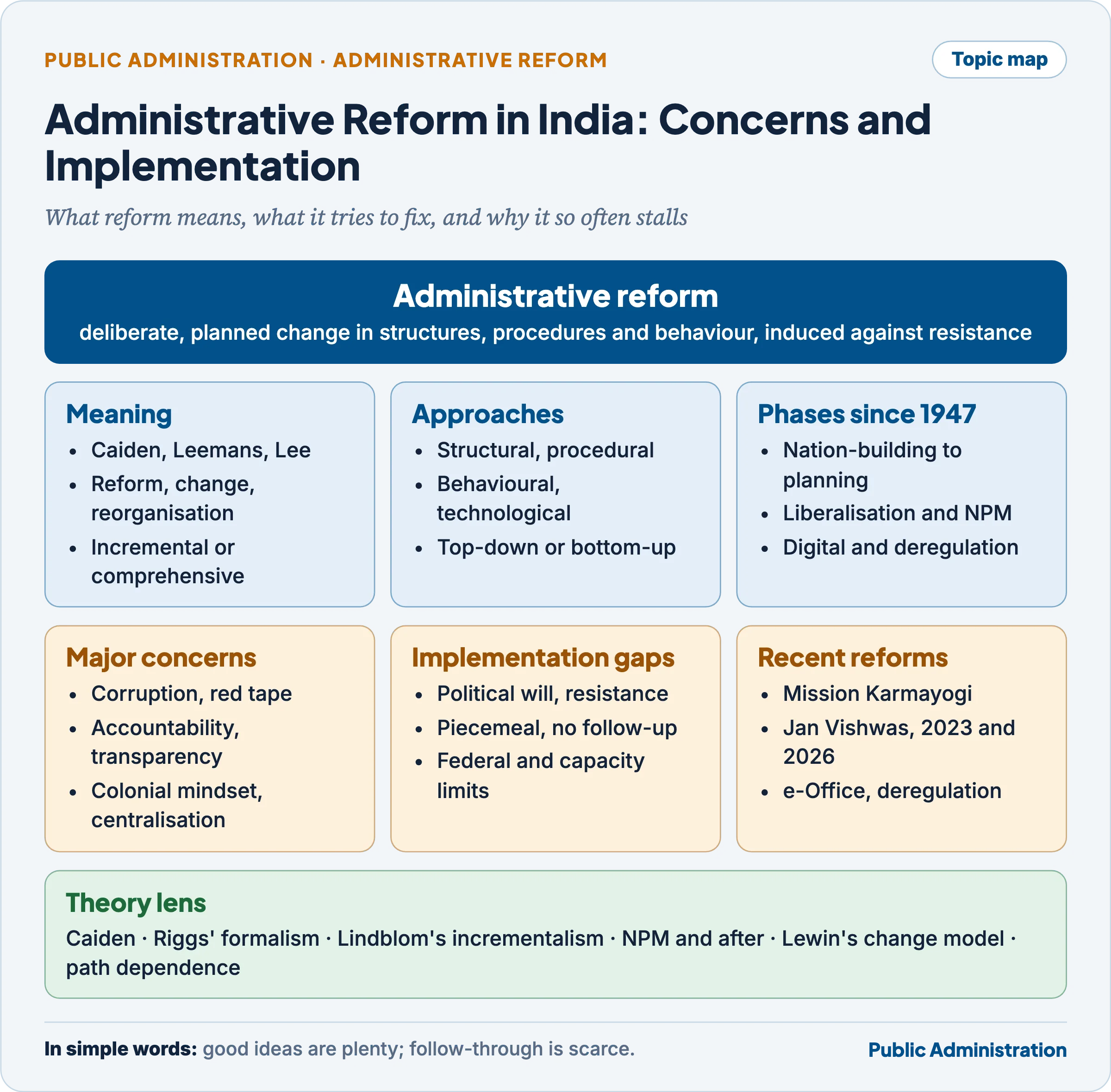
India began its life as a republic with a profound contradiction. The Constitution set new goals (democracy, federalism, welfare, social justice), but the machinery that had to deliver them was the colonial administration, built for law and order and revenue. Administrative reform is the long effort to close that gap: to turn an apparatus designed to rule into one that serves, develops and answers.
Since 1947 India has appointed dozens of committees and two Administrative Reforms Commissions. Their diagnosis has been remarkably consistent (corruption, delay, secrecy, centralisation, weak accountability), and so has the verdict on their fate: excellent ideas, uneven implementation. This article studies what reform means, what it has tried to fix, why it so often stalls, and what makes it stick.
In simple words
Think of an old family house. You can repaint it (a small change), add a room (a reorganisation), or rebuild the foundations (a reform). The family may agree that the house needs work, but each member resists the change that disturbs his own room. A good plan on paper does not rebuild the house; someone has to keep the builders working, pay for it, and make the family live by the new layout.
1. Meaning and Nature of Administrative Reform
In simple words
Administrative reform means changing the government’s machinery on purpose, to make it work better. It is not the slow, natural drift of an organisation; it is a planned push, usually against people who prefer things as they are.
1.1 Definitions
- Literal sense. To “reform” is to form again: to convert something into a better form, or to free it from earlier faults. Administrative reform therefore means converting public administration into an improved form suited to new tasks.
- Gerald Caiden (an American scholar of reform, in Administrative Reform, 1969) gave the standard definition: “the artificial inducement of administrative transformation against resistance.”
- Artificial: it is man-made, deliberate and planned, not natural, accidental or automatic.
- Inducement: it works by persuasion, argument and, finally, the threat of sanctions, because it is not accepted by all as the obvious course.
- Transformation: it seeks a real change in structure, behaviour or values, not a cosmetic adjustment.
- Against resistance: opposition is assumed. Those who gain from the old order will defend it.
- Moral purpose: Caiden stressed that reform aims at a better state of affairs, which makes it a value-laden, political act.
- Arne Leemans (Dutch scholar, editor of The Management of Change in Government, 1976): reform is “induced change in the machinery of government undertaken in an effort to bridge a gap between reality and desirability.” The stress is on the gap between what administration is and what it ought to be.
- Hahn-Been Lee (Korean scholar of development administration): reform is an effort to apply new ideas, or new combinations of ideas, to an administrative system with a conscious view to improving it for the positive goals of national development. Because new ideas carry new values, reform always involves a change of values, not only of techniques.
- Common ground. There is no single accepted definition, but scholars agree that reform aims to raise administrative capability and capacity so that national goals are achieved economically, efficiently and effectively, and services reach citizens better.
1.2 When does reform become necessary?
Caiden argued that administrative change is continuous and self-adjusting, and reform is needed only when that natural process fails. He named the situations that open the door to reform:
- When the administration is obviously failing to meet the demands placed on it.
- When it cannot anticipate future demands, even if it copes today.
- When it has reserve capacity but does not use the most effective methods available.
In each case a performance gap appears: what the administration delivers falls short of what society expects. In India the gap was built in at birth, because the inherited system had been designed for very different goals (see Section 3.1).
1.3 The goals of reform
Frederick Mosher, the American scholar of public personnel and reorganisation, identified four goals of reorganisation, which apply to reform generally:
- Changing policies and programmes, so that the machinery fits new objectives (for example, planning after 1951, liberalisation after 1991).
- Improving administrative effectiveness, the most general goal: faster, cheaper, better work.
- Solving personnel problems: better recruitment, training, morale and performance.
- Countering outside pressures and threats: pre-empting public criticism, scandal or political attack.
The fourth goal is a reminder that much reform in India has been reactive: a crisis, a scam or a court order produces a committee, rather than a steady plan producing change.
1.4 Reform, change, reorganisation and development
The terms are often used loosely. The table below separates them.
| Term | Meaning | Example |
|---|---|---|
| Administrative change | Spontaneous, self-adjusting response to new conditions; continuous | A new filing system, reshuffled postings |
| Administrative improvement | Small, internal, technique-based gains in efficiency | O&M studies of delay, work measurement |
| Reorganisation | Restructuring of units, functions and hierarchy | Merger of ministries, creation of a new department |
| Administrative reform | Deliberate, planned, value-driven transformation against resistance | Right to Information Act 2005, Mission Karmayogi |
| Administrative development | Growth of an administrative system’s capacity to make choices and shape its environment | Building institutions for planning or regulation |
- Paul Appleby, the American administrator who surveyed Indian administration in 1953, distinguished constant change (incremental adjustments in daily working) from episodic change (major shake-ups he called reorganisation). Reform, in this sense, is episodic.
- Fred Riggs used administrative development for the growing capacity of an administrative system to make deliberate choices; reform is one route to it.
- Good governance, a term that gained ground from the late 1980s, is sometimes described as the “software” of reform: values such as transparency, participation and accountability, rather than structures alone.
Common confusion
Is every administrative change a reform? No. Change happens all the time, often without anyone planning it, and may make things worse. Reform is deliberate, purposive and value-laden: it aims at improvement and expects resistance. That is also why critics call “reform” a self-presumptive term: it assumes the change will improve things, which may not happen. Some therefore prefer neutral words such as “administrative change” or “reorganisation”.
1.5 Incremental and comprehensive reform
Reform proposals differ in scope. The choice between small steps and one big redesign mirrors a famous debate in policy theory.
- Comprehensive (synoptic) reform follows the rational-comprehensive model: diagnose the whole system, set clear goals, redesign it at one stroke. The 1st ARC (1966–70), with 20 reports covering almost all of administration, was this type.
- Strength: coherence; parts of the system are reformed together.
- Weakness: huge information demands, many opponents at once, long gestation, and the risk that the whole package is shelved.
- Incremental reform follows Charles Lindblom’s idea of “muddling through” (“The Science of ‘Muddling Through'”, 1959): change by small, successive steps that build on the existing system and are easy to reverse.
- Strength: quick acceptance, low political cost, learning by doing.
- Weakness: tinkering at the margins: each step is too small to alter the system, and the radical recommendations are the ones left out.
- The Indian pattern. Most accepted recommendations have been the most pedestrian ones; the one or two crucial proposals in a report (such as the 1st ARC’s “road to the top” for specialists) are typically side-tracked. Indian reform has thus been called conservative or orthodox: it modifies existing structures rather than breaking new ground.
- A middle path. Many scholars of Indian administration recommend “bold, non-stop incrementalism”: steady, cumulative steps within a long-term plan, with top-level monitoring at the follow-up stage. Amitai Etzioni’s mixed scanning (1967) offers the theoretical version: scan broadly for fundamental choices, then proceed incrementally within them.
- Imitative and innovative. Reform can also borrow models that worked elsewhere (charters from the UK, executive agencies, regulators on the US model) or invent home-grown ones (Aadhaar-linked DBT, Right to Services laws). Imitation is easier to sell but may not fit local conditions.
1.6 Reform as a process
Reform is not a single event. Caiden described four phases, which closely follow Herbert Simon’s stages of decision-making (intelligence or search, design, choice):
- Awareness of the need for change: problems are aired; reform ideas compete with tolerance of maladministration and with top management’s preference for the status quo. Caiden remarked that reform is the work of a minority: the reformer needs courage to stand against conformity.
- Formulation of goals, strategy and tactics: diagnosis of root causes, drafting feasible proposals, building support, planning an escape route if things fail.
- Implementation: turning accepted proposals into orders, budgets, posts, rules and changed behaviour within a time frame.
- Evaluation: measuring results against the reformer’s objectives and adjusting. Without proof that reforms work, further reform is hard to propose.
Reform is most easily accepted in moments of uncertainty, disorganisation or crisis (regime change, economic collapse, war), when the old order has lost its legitimacy. This idea recurs in Section 3.9 as the “tides” of reform.
2. Approaches and Strategies of Reform
In simple words
Reformers must decide what to change (the structure, the rules, the people’s attitudes or the technology) and how to push the change (from the top, from below, all at once or step by step). Most failed reforms changed only one of these and left the rest untouched.
2.1 What reform targets
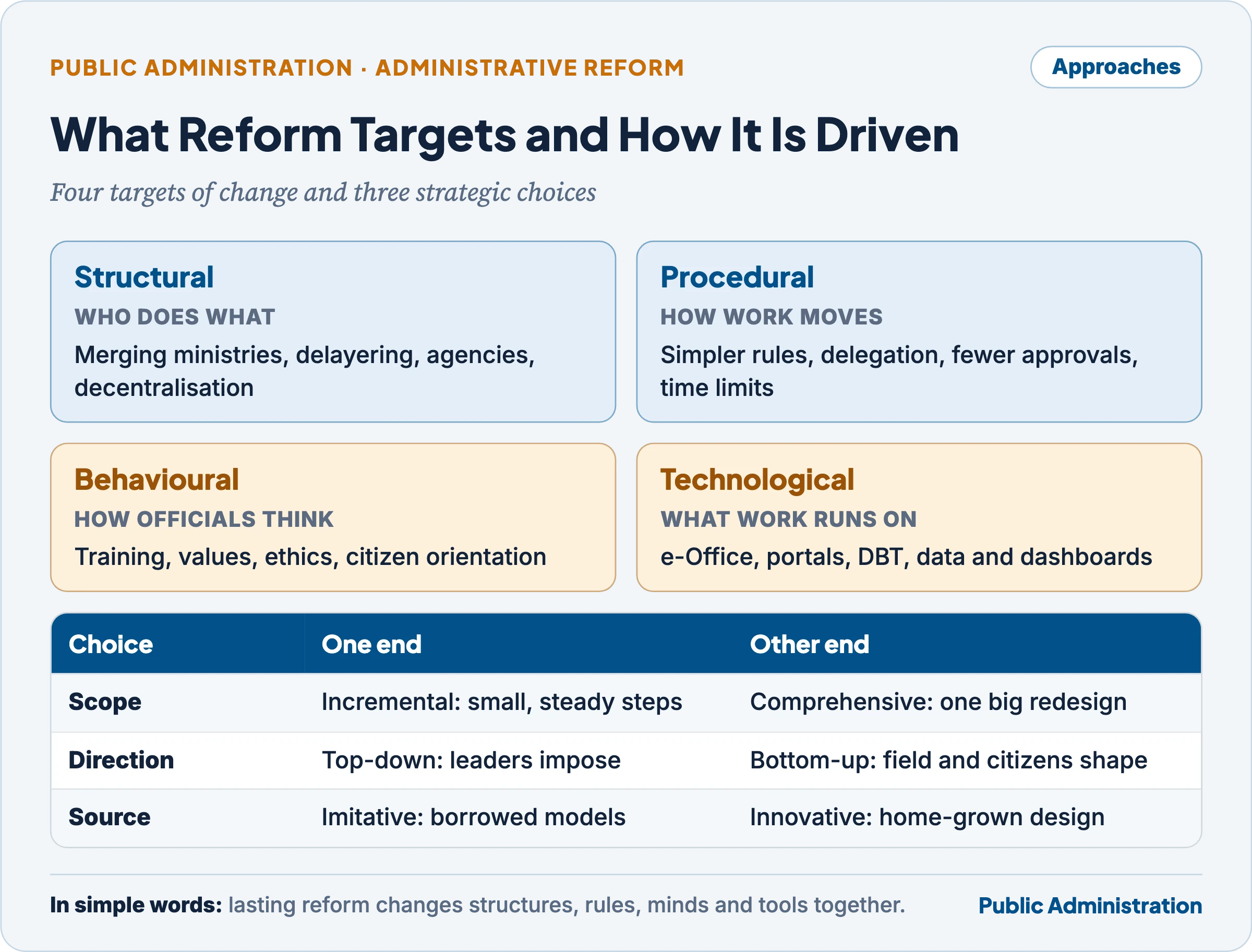
Administrative organisations have three interlinked elements (structure, process and behaviour); technology has become a fourth target.
- Structural reform: division of work, delegation and decentralisation, creation of autonomous agencies, merger or splitting of ministries, delayering of hierarchy, and coordinating mechanisms between interdependent units.
- Indian examples: creation of the Department of Administrative Reforms (1964), the 73rd and 74th Amendments (1992), the replacement of the Planning Commission by NITI Aayog (1 January 2015), the 2nd ARC’s proposal to group ministries and separate policy from execution.
- Procedural reform: changes in financial rules, work procedures, forms and filing, delegation of powers, time limits, and general attempts to cut red tape; application of management techniques (O&M, PERT, systems analysis).
- Indian examples: the O&M Division (1954), self-attestation of documents (2014), abolition of interviews for junior posts (2016), the Jan Vishwas Acts decriminalising minor offences.
- Behavioural reform: changing attitudes, values and relationships inside the bureaucracy and towards citizens, through training, participative management, sensitivity training and organisation development (OD), which uses applied behavioural science for continuous renewal.
- Indian examples: Mission Karmayogi’s shift from rule-based to role-based training, codes of ethics, citizen-centric training modules.
- Limit: Robert Golembiewski noted that public agencies have a peculiar “habit background” (reluctance to delegate, legalism, stress on caution and procedure) that makes OD harder in government than in business.
- Technological reform: e-governance, e-Office, online portals, Direct Benefit Transfer, dashboards and data analytics. Technology can remove discretion and intermediaries, but the 2nd ARC warned that computerising a bad process merely automates red tape; process re-engineering must come first.
These types are usually pursued separately: structural reform ignores its behavioural effects, procedural change is made without asking what it does to the organisation as a whole. The full benefit of reform is rarely reaped without a coherent perspective that joins them.
2.2 Top-down and bottom-up reform
- Top-down reform is designed by leaders, commissions or the Union government and imposed on lower levels.
- Merits: speed, uniformity, political backing, ability to override vested interests.
- Demerits: poor fit with local conditions, little ownership among implementers, compliance on paper.
- In India, reforms of State and local administration have often been designed in Delhi and passed down through conditions attached to central funds; States and local bodies then implement them half-heartedly. This is the substance of the criticism that reform at State and local levels is “imposed from above”.
- Bottom-up reform grows from field innovations, employees and citizens, and spreads by example.
- Indian examples: e-Seva (Andhra Pradesh) and Bangalore One single-window centres, Sakala in Karnataka (Karnataka Guarantee of Services to Citizens Act, 2011), social audit in Andhra Pradesh and Rajasthan, district-level innovations recognised by the Prime Minister’s Awards for Excellence in Public Administration.
- Demerits: innovations remain islands; India has a weak capacity to institutionalise and replicate best practices, a point the government itself made when it framed the 2nd ARC’s terms of reference.
- Mixed strategies work best: national frameworks with room for local design (the Right to Services idea spread this way, beginning with Madhya Pradesh’s Act of 2010).
2.3 Caiden’s methods (sources) of reform
Caiden described four ways in which reform is actually brought about:
- Political revolution: a radical change of regime (colonialism giving way to constitutional democracy, a coup) brings sweeping administrative change. India’s 1947 transition is the clearest case, though it changed the political masters far more than the machinery.
- Remedying organisational rigidity: in normal times, the bureaucracy itself senses strain and rigidity and seeks internal change (restructuring, re-engineering, rethinking) almost as a defence mechanism.
- Through the legal system: a new law changes administration widely (land reforms, the RTI Act 2005, the 73rd and 74th Amendments, the Jan Vishwas Acts). Law gives reform durability and public debate.
- Through changes in attitude: formal changes in structure and law fail unless people inside the organisation accept them. Caiden held that those who resist reform must be won over “in spirit as well as in body”.
Strictly, these are sources of reform impulses. Implementation itself is a more mundane matter of orders, budgets, posts, deadlines and monitoring (Section 5).
2.4 Instrumental and institutional bureaucracies
A crucial condition of reform is the status of the bureaucracy being reformed.
- An instrumental bureaucracy is a tool in the hands of political masters (the Weberian ideal). Once leaders decide on reform, it implements.
- An institutional bureaucracy has outgrown its instrumental role and acquired value and autonomy for its own members and the community. It shapes the agenda, processes the reform proposals itself, and can buy off or outlast political leaders.
- John D. Montgomery, the American scholar of development administration, argued that in post-colonial states both sides of the “demand–response” formula are weak: the public has few resources to press its demands, and the bureaucracy has little empathy with citizens’ conditions.
- India inherited an institutional bureaucracy that had developed under administrative hegemony: under colonial rule the bureaucracy was the master, unchecked by political overseers.
- Implication: reforming such a bureaucracy is more a political than a managerial task. It requires real supremacy of the elected executive, independent audit, open government and citizen scrutiny, which gradually push the bureaucracy back towards an instrumental role. At the same time, taking the top bureaucracy along remains a precondition of any reform.
2.5 Congruence of strategy, structure and substance
A recurring criticism of Indian reform is the lack of congruence between three things:
- Strategy: how reform is to be sequenced, sponsored and enforced.
- Structure: the institutions created or changed to carry it.
- Substance: the actual content: values, behaviour and services.
Examples of incongruence:
- Citizen’s Charters (1997 onwards): substance (service standards) was announced without a structure to enforce them or a strategy to change front-line behaviour; most charters remained notices on office walls until Right to Services laws gave them legal teeth.
- Downsizing (5th Pay Commission, 1997): a 30% cut was recommended without a political strategy to manage unions or a structure for redeployment; central employment did not fall as planned.
- e-Governance: technology (structure) was introduced without re-engineering processes (substance), leaving parallel paper and digital files.
- Decentralisation: the 73rd Amendment created the structure, but funds, functions and functionaries did not follow, so local bodies remained “local in form but State and central in content”, as the 2nd ARC put it.
3. Phases of Administrative Reform since 1947
In simple words
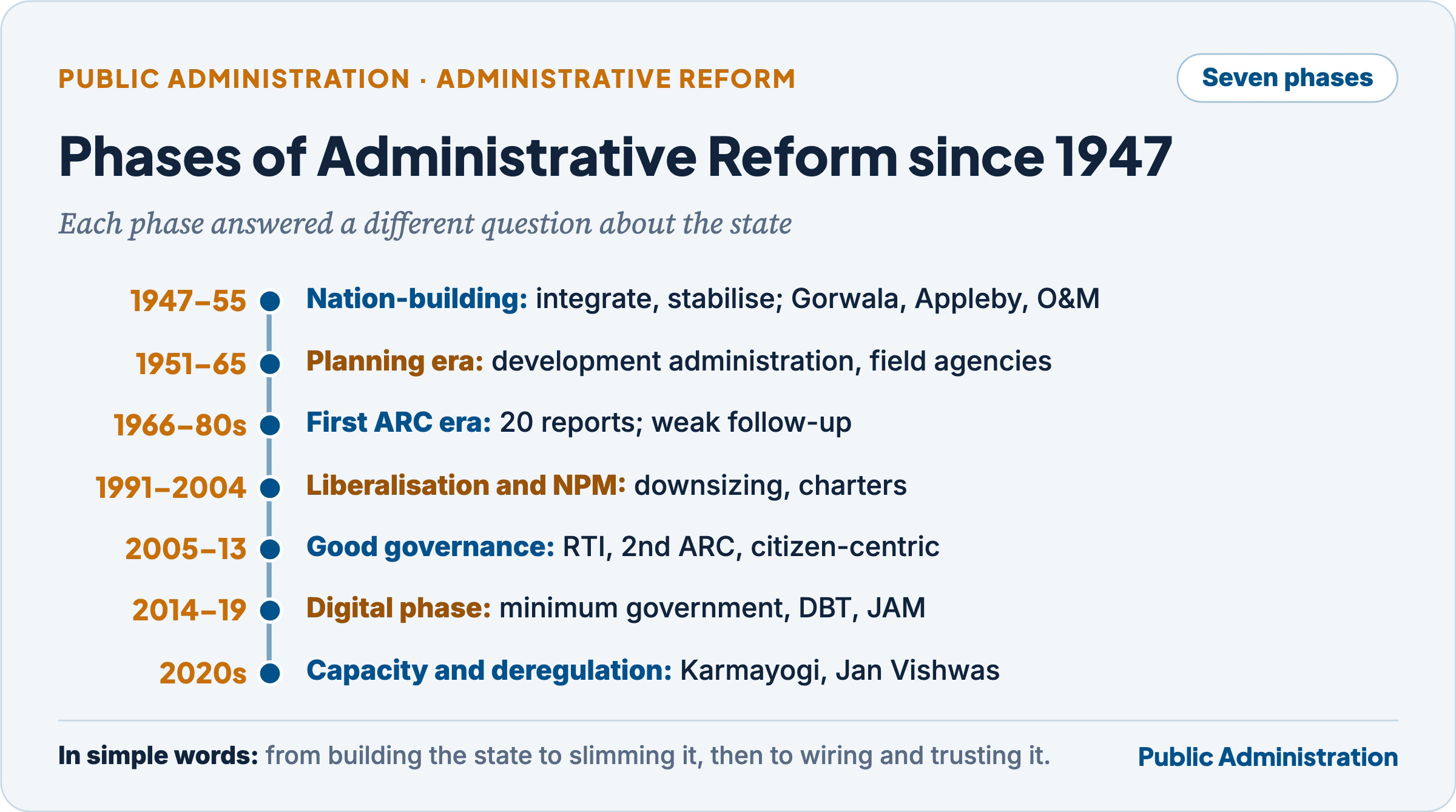
Each period of independent India asked its administration a different question: first “Can you hold the country together?”, then “Can you plan development?”, then “Can you get out of the way of the market?”, then “Can you serve the citizen?”, and now “Can you go digital, cut rules and build skills?”
3.1 The starting point: an inherited contradiction
- The British Raj’s goals were narrow:
- maintenance of law and order in a negative sense;
- collection of revenue;
- retention of strategic power in British hands;
- subordination of administration to the interests of the ruling country.
- The Constitution’s goals were new:
- a parliamentary democracy based on adult franchise;
- a Union of States, each autonomous in its sphere;
- a commitment, through the Directive Principles of State Policy, to economic and social welfare.
- The contradiction: the goals changed, but the instrument did not. The colonial administrative system was adopted “lock, stock and barrel” for the new tasks of democracy, development and nation-building. An early hope that administration would adjust by itself to the new environment proved mistaken.
- Complexity: India combined Third World conditions (poverty, illiteracy), First World institutions (democracy, rule of law, judicial review, federalism) and Second World methods (central planning). This mix, plus three levels of government, made reform unusually complex.
3.2 Phase 1: nation-building and integration (1947–mid-1950s)
- Tasks: coping with Partition and the loss of many experienced British and Muslim officers, rehabilitating refugees, integrating the princely states, and stabilising the new Union.
- Institutional choices: the IAS and IPS replaced the ICS and Indian Police, and were given constitutional status as All India Services (Article 312); training schools were set up.
- Stock-taking reports: the Secretariat Reorganisation Committee (Girija Shankar Bajpai, 1947), the Gopalaswami Ayyangar report on the machinery of government (1949), the A.D. Gorwala Report on Public Administration (1951), and the two Paul Appleby reports (1953, 1956).
- First standing reform machinery: the Organisation and Methods (O&M) Division in the Cabinet Secretariat (1954) and the Indian Institute of Public Administration (1954), both following Appleby.
- The O&M Division sought to make civil servants “improvement-conscious”, find facts about delay, and devise remedies; it published annual reports from 1954 to 1964 that Parliament discussed.
- Its limitation: it worked at the micro level (procedures, receipts, delays) and lacked the leadership and professional stature to drive structural reform.
- Character of the phase: stabilisation and continuity, not transformation. The inherited system was judged broadly sound and reinforced.
3.3 Phase 2: development administration and the planning era (1951–1966)
- Planning (the Planning Commission, 1950; Five Year Plans from 1951) placed the state at the “commanding heights” and gave the bureaucracy a new role: development administration, a term first used by U.L. Goswami (1955) and later popularised by Fred Riggs and Edward Weidner.
- New field machinery: the Community Development Programme (1952), the Balwantrai Mehta study team (1957) leading to Panchayati Raj, district development agencies.
- The licence–permit nexus: the colonial bureaucrat did not feel out of place; earlier he ruled through law and order, now through licences, quotas and permits. Politicians and bureaucrats found a common cause in distributing state largesse, and the original contradiction between Constitution and administration was brushed aside.
- Procedural reform for the Plans: a statement laid before the Lok Sabha on 10 August 1961 promised delegation to field officers, faster execution and O&M studies to support the Third Plan.
- Anti-corruption concern: the Santhanam Committee (1962–64) led to the Central Vigilance Commission (1964).
- Reform machinery: a Department of Administrative Reforms was created in March 1964 in the Ministry of Home Affairs to prepare for a wide-ranging inquiry.
3.4 Phase 3: the first ARC era (1966–late 1980s)
- Trigger: the war with China (1962), droughts and economic crisis around 1965 turned the leadership’s attention to administration. The 1st Administrative Reforms Commission was set up on 5 January 1966 under Morarji Desai (later K. Hanumanthaiya), drawn for the first time from public life rather than the civil service.
- Output: 20 reports with 537 major recommendations (plus 20 study teams, 13 working groups and a task force) before it was wound up in mid-1970.
- Fate: implementation was weak, tardy and uneven (Section 5.1). Its most important personnel recommendations (specialisation, mid-career selection for senior posts, unified grading) were rejected.
- Other bodies of the period: the Kothari Committee (1976) on recruitment; the National Police Commission (1977–81) after the Emergency; the Economic Administration Reforms Commission (L.K. Jha, 1981–83), which urged a shift from physical controls to indirect instruments and from regulation to development; the Sarkaria Commission (1983–88) on Centre–State relations.
- Character of the phase: comprehensive diagnosis, piecemeal action, and a growing gap between a controlling state and a disappointed public.
3.5 Phase 4: liberalisation and New Public Management (1991–2004)
- Trigger: the 1991 balance-of-payments crisis and the New Economic Policy: delicensing, deregulation, disinvestment, opening to foreign capital. The state was to move from producer and controller to regulator and facilitator.
- NPM ideas: reforms began to borrow from New Public Management: smaller government, contracting out, performance measurement, customer orientation (see the article on New Public Management and After).
- Key instruments:
- 5th Central Pay Commission (Justice S. Ratnavel Pandian, report January 1997): a 30% reduction in staff over ten years, abolition of about 3.5 lakh vacant posts, minimum tenures, a Civil Services Board for transfers, open appraisal, a Right to Information law and revision of the Official Secrets Act. It was called the most explicit “textbook” of second-generation administrative reform.
- Conference of Chief Secretaries (November 1996) and the Conference of Chief Ministers (24 May 1997), which adopted an Action Plan for Effective and Responsive Administration with three pillars: accountable and citizen-friendly administration, transparency and right to information, and improving the performance and integrity of the civil services. Citizen’s Charters followed from 1997.
- Expenditure Reforms Commission (K.P. Geethakrishnan, 2000–01): reports on downsizing ministries and rationalising subsidies.
- Independent regulators (TRAI 1997, electricity commissions), the Disinvestment Commission (1996), and the 73rd and 74th Amendments (1992) for decentralisation.
- Character of the phase: reform driven by economic necessity and international ideas; strong on deregulating the economy, weaker on reforming the bureaucracy itself.
3.6 Phase 5: good governance and citizen-centric administration (2005–2013)
- Ideas: good governance (World Bank 1992, UNDP 1997) and citizen-centricity replaced pure downsizing; the Tenth Plan called governance the single most important factor in achieving Plan goals.
- Landmarks:
- Right to Information Act, 2005 (the 2nd ARC called it the “master key to good governance”).
- National e-Governance Plan (May 2006) with Mission Mode Projects and Common Service Centres.
- 2nd Administrative Reforms Commission (constituted 31 August 2005, Veerappa Moily): 15 reports (2006–09) on ethics, personnel, citizen-centric administration, e-governance, local governance, organisational structure, financial management and State and district administration.
- Sevottam (a service-excellence framework of charters, grievance redress and capability), Results-Framework Documents under the Performance Monitoring and Evaluation System (2009), open performance appraisal (APAR).
- Right to Services laws, beginning with Madhya Pradesh (2010) and spreading to most States.
- Lokpal and Lokayuktas Act, 2013, after the anti-corruption movement of 2011.
- Character of the phase: rights-based reform (information, services, employment guarantee) and the citizen as rights-holder, not merely customer.
3.7 Phase 6: digital governance and “minimum government, maximum governance” (2014–2019)
- Idea: “minimum government, maximum governance”: fewer controls and procedures, more effective delivery, with technology as the main lever.
- Landmarks:
- JAM trinity (Jan Dhan accounts, Aadhaar, mobile) and Direct Benefit Transfer, cutting leakages and intermediaries.
- Digital India (2015), PRAGATI (2015) for project and grievance review, Government e-Marketplace (GeM, August 2016) for transparent procurement.
- Self-attestation of certificates (2014), abolition of interviews for junior posts (from 2016), repeal of obsolete laws (over 1,700 Central laws repealed since 2014, as reported to the Lok Sabha in 2026).
- NITI Aayog in place of the Planning Commission (2015); merger of the Railway Budget with the Union Budget and removal of the plan/non-plan distinction (2017).
- Lateral entry at Joint Secretary level (advertised 2018, appointments 2019).
- Rigorous use of FR 56(j) reviews to retire non-performing officers in public interest.
- Character of the phase: technology-led and centrally driven reform: high on delivery speed, lower on consultation and institutional checks.
3.8 Phase 7: capacity building and deregulation (2020s)
- Ideas: “rule-based to role-based” civil service, trust-based governance (decriminalisation, self-certification) and deregulation for ease of living and doing business.
- Landmarks:
- Mission Karmayogi (National Programme for Civil Services Capacity Building), approved on 2 September 2020, with the Capacity Building Commission, the iGOT Karmayogi platform and the SPV Karmayogi Bharat.
- Jan Vishwas (Amendment of Provisions) Act, 2023 (183 provisions in 42 Acts decriminalised) and the Jan Vishwas (Amendment of Provisions) Act, 2026 (784 provisions in 79 Acts amended).
- The Task Force on Compliance Reduction and Deregulation (January 2025) and the High-Level Committee on Non-Financial Regulatory Reforms (August 2025).
- e-Office and the annual Special Campaigns for disposal of pending matters (from 2021).
- The Digital Personal Data Protection Act, 2023 and its Rules (14 November 2025).
- Character of the phase: reform as continuous campaign and legal decluttering, coupled with an attempt to change the civil servant through competencies (Section 8).
3.9 The phases compared, and the “tides” of reform
| Phase | Driving question | Typical instruments | Theory in the background |
|---|---|---|---|
| 1947–mid-1950s | Can the state hold together? | Integration, AIS, O&M, Appleby | Weberian continuity |
| 1951–1966 | Can administration plan development? | Field agencies, CD, Panchayati Raj | Development administration |
| 1966–late 1980s | How should the whole machine be redesigned? | 1st ARC, Jha, Sarkaria | Rational-comprehensive reform |
| 1991–2004 | Can the state step back for the market? | Downsizing, charters, regulators | NPM, reinventing government |
| 2005–2013 | Can administration serve citizens as rights-holders? | RTI, 2nd ARC, Sevottam, RTS laws | Good governance, New Public Service |
| 2014–2019 | Can technology replace discretion? | DBT, JAM, PRAGATI, GeM | Digital-era governance |
| 2020s | Can the state trust, deregulate and upskill? | Karmayogi, Jan Vishwas, deregulation | Post-NPM, trust-based governance |
- The table shows a shift of emphasis, not clean breaks: each phase layered new instruments on older ones (a pattern institutional theorists call layering; see Section 9).
- Tides of reform. Reform proposals have the best chance at emotionally heightened moments: Independence (1947), the start of the Constitution (1950) and of planning (1951), the post-Emergency change of government (1977), and the 1991 crisis. John Kingdon’s idea of a policy window (Agendas, Alternatives, and Public Policies, 1984) explains this: reform succeeds when a recognised problem, an available solution and favourable politics converge.
- Many reforms did not come from commissions at all. RTI grew from a grassroots movement (MKSS in Rajasthan) and State laws; Panchayati Raj came from a planning body’s study team; DBT came from technology; tenure rules came from the Supreme Court. Courts, civil society, technology and economic crisis have been reform engines as important as formal committees.
4. Major Concerns of Administrative Reform
In simple words
Every reform committee since 1951 has listed roughly the same problems: officials who take bribes, files that never move, rules no one can understand, decisions taken far away in Delhi or the State capital, and citizens who feel like supplicants. The concerns below are the recurring agenda of Indian reform.
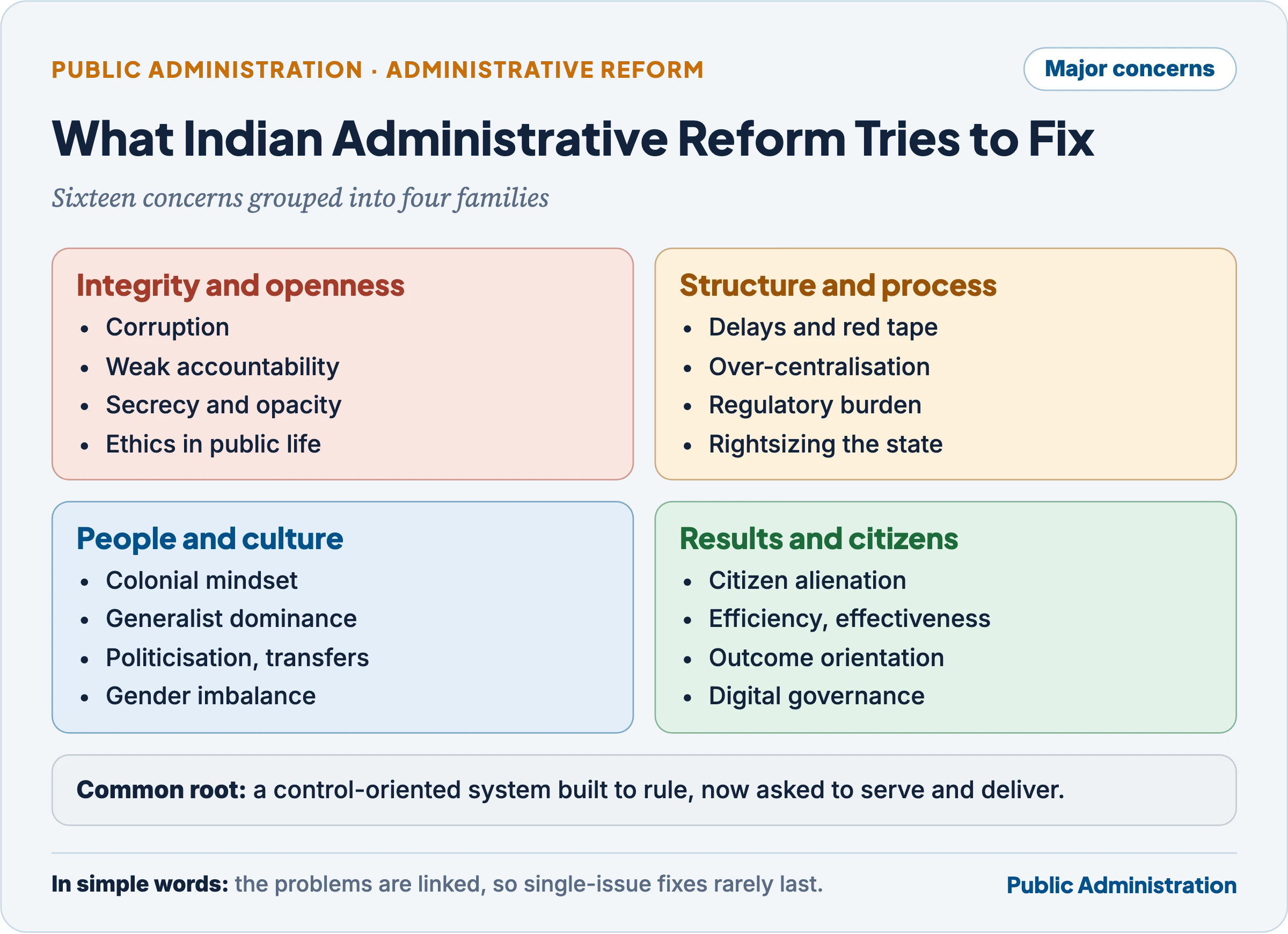
The concerns are linked by a common root: a control-oriented system built to rule, now asked to serve and deliver. Each is treated below with its Indian evidence and the reform response.
4.1 Corruption
- The problem: corruption distorts allocation, raises costs, hurts the poor most, and destroys trust. Robert Klitgaard’s formula (Controlling Corruption, 1988), Corruption = Monopoly + Discretion − Accountability, explains why a licence-heavy, secretive state breeds it.
- Indian evidence:
- India scored 39 out of 100 and ranked 91st of 182 in Transparency International’s Corruption Perceptions Index 2025 (up from 38 and 96th in 2024).
- The Vohra Committee (1993) documented a nexus between politicians, officials and criminals.
- Corruption has declined where competition, choice, transparency and technology were introduced (telecom, railway reservation, DBT), but persists in sectors where the state’s role is exclusive: police, land administration, procurement, tax administration, transfers and postings.
- Petty corruption at the cutting edge (touts in transport offices, fees for ration cards) has been documented in studies of Citizen’s Charters in Delhi.
- Reform response: the CVC (1964, statutory in 2003), the Prevention of Corruption Act, 1988 (amended 2018), the Lokpal and Lokayuktas Act, 2013, e-procurement, DBT, the 2nd ARC’s Ethics in Governance report (2007).
- A paradox: a citizen facing cumbersome rules often pays a bribe to get the rules bent; corruption thus acts as a perverse, private “administrative reformer”, which is why genuine simplification is itself an anti-corruption measure.
4.2 Accountability
- The problem: accountability has two dimensions: procedural (conformity to rules and procedures) and substantive (achievement of assigned tasks). Indian administration emphasises the first; the L.K. Jha Commission argued that achievement orientation is the true test, especially in development administration.
- Indian evidence:
- Authority is divorced from accountability at most levels, creating “plausible alibis for non-performance”, as the government noted when framing the 2nd ARC’s mandate.
- Article 311 protections and lengthy disciplinary procedures make it hard to act against non-performers; the 2nd ARC recommended repealing Article 311, which has not happened.
- Ministerial responsibility is vague: there is no ex ante specification of what a civil servant is accountable for, so ministers interpret it as they please, leading to either collusion or discord.
- Reform response: APAR (2009), Results-Framework Documents (2009–14), FR 56(j) reviews, social audit (MGNREGA), Right to Services laws, performance agreements proposed by the 2nd ARC. See the article on Accountability and Control.
4.3 Transparency and secrecy
- The problem: the Official Secrets Act, 1923 gave legal sanction to a culture of secrecy; the citizen could not learn why a decision was taken.
- Indian evidence and response:
- The Supreme Court recognised a right to know under Article 19(1)(a) (State of U.P. v. Raj Narain, 1975; S.P. Gupta v. Union of India, 1981).
- Tamil Nadu and Goa passed early State laws (1997); the Freedom of Information Act, 2002 was never notified; the RTI Act, 2005 followed.
- The 2nd ARC’s first report recommended repealing the OSA and replacing it with a chapter in the National Security Act; the OSA remains in force.
- The RTI (Amendment) Act, 2019 let the Union government fix the tenure and pay of Information Commissioners, and the DPDP Act, 2023 amended Section 8(1)(j), widening the personal-information exemption: critics see both as dilutions.
- See the article on Citizen’s Charters, RTI and Social Audit.
4.4 Delays and red tape
- The problem: red tape means excessive procedure, multiple clearances and paper that delay decisions without adding value.
- Indian evidence:
- No time limit for disposal: any official could keep a file as long as he wished, and raise inconsequential queries to delay it.
- Too many levels: the 2nd ARC proposed reducing decision levels in the Central Secretariat to about four; many proposals still pass through more.
- Veto points: structures based on hierarchy with many veto points overload decision-making and weaken individual responsibility.
- Reform response: delegation of financial powers, desk officer system, “level-jumping” and delayering (5th Pay Commission), e-Office, time-bound services under RTS laws, PRAGATI reviews of stalled projects, and the annual Special Campaigns to clear pending files and references.
4.5 The colonial mindset
- The problem: an attitude of superiority and distance from the citizen, a preference for control over facilitation, and a culture of hierarchy, status and rigidity inherited from the ICS and the “steel frame”.
- Indian evidence: the VIP culture (special treatment for the ruling elite, who therefore never experience bad administration and never demand its reform), colonial-era laws and manuals still in use, police organised under the Police Act, 1861 in many States, and the persistence of colonial procedures in district administration.
- Reform response: repeal of obsolete laws, the replacement of the IPC, CrPC and Evidence Act by the Bharatiya Nyaya Sanhita, Bharatiya Nagarik Suraksha Sanhita and Bharatiya Sakshya Adhiniyam (from 1 July 2024), removal of red beacons from official vehicles (2017), and behavioural training under Mission Karmayogi.
- The slogan for the new attitude, coined by Indian reformers, is “service with a smile, not after a mile”. Independence brought swaraj (self-rule); the challenge since has been suraj (good governance).
4.6 Generalist dominance
- The problem: senior policy posts are held mainly by generalist IAS officers who move between sectors, while specialists (engineers, doctors, economists) are kept below them.
- Indian evidence: the 1st ARC recommended functional specialisation and opening the “road to the top” to all services through a mid-career examination for eight areas of specialisation (economic, industrial, agricultural and rural, social and educational, personnel, financial, defence and internal security, planning). The government rejected it. The Surinder Nath Committee (2003) and the 2nd ARC (2008) revived domain assignment, but it remains largely unrealised.
- Reform response: lateral entry (2018–19), central domain-based empanelment, competency frameworks under Mission Karmayogi. The 2024 lateral-entry advertisement was withdrawn after objections over the absence of reservation, showing how contested this concern is.
- See the article on Civil Services Structure and Recruitment.
4.7 Over-centralisation
- The problem: the propensity to centralise is a dominant feature of Indian administration: in the Union over the States, in State secretariats over directorates, and in district offices over local bodies.
- Indian evidence:
- Centrally sponsored schemes in State subjects (health, education, rural development) are driven by Union guidelines and funds, which can erode accountability because the funder and the implementer differ.
- Local bodies remained “local in form but State and central in content” (2nd ARC, Sixth Report on Local Governance).
- Reform response: the 2nd ARC’s principle of subsidiarity (a task that a smaller unit can do should never go to a larger one), activity mapping for the “3Fs” (funds, functions, functionaries), and the Finance Commissions’ grants to local bodies. See the article on District Administration and Democratic Decentralisation.
4.8 Politicisation and the transfer economy
- The problem: arbitrary and frequent transfers and postings, the use of the Annual Confidential Report and the sale of posts have been described as the principal means of subverting the civil service; this undermines both neutrality and accountability.
- Indian evidence: short tenures in key posts are a major cause of poor governance (2nd ARC); the 5th Pay Commission had already proposed minimum tenure and Civil Services Boards in 1997.
- Reform response: T.S.R. Subramanian v. Union of India (2013) directed Civil Services Boards, minimum tenure and written orders for oral instructions; the IAS (Cadre) Amendment Rules, 2014 prescribed a two-year minimum tenure; Prakash Singh v. Union of India (2006) did the same for police chiefs. Compliance by States has been uneven. See the article on Civil Service Neutrality and Activism.
4.9 Citizen alienation
- The problem: the citizen’s contact with administration is too often a point of harassment; the asymmetry of power between a secure public servant and a poor, less literate citizen is enormous.
- Indian evidence: only a small share of the workforce holds secure organised-sector jobs, most of them in government and PSUs; this privileged position, combined with poverty, a culture of deference to authority and colonial traditions, gives even junior officials great power over citizens.
- Reform response: Citizen’s Charters (1997), Sevottam (2006), CPGRAMS (which disposed of over 20 lakh grievances in 2025 with an average disposal time of 15 days), Right to Services laws, social audit, the 2nd ARC’s Citizen Centric Administration report (2009).
- Limit: studies of charters found them incomplete, unpublicised and unenforced; officials continued to behave “in a feudal manner”, which shows that structural remedies need attitudinal change at the cutting edge.
4.10 Ethics in governance
- The problem: conduct rules prohibit specific acts but India lacks a positive statement of values for public servants and a mechanism to enforce them.
- Indian evidence and response: the Hota Committee (2004) and the 2nd ARC proposed a code of ethics and a Civil Services Law declaring values such as commitment to the Constitution, integrity, impartiality, empathy for the vulnerable and accountability; neither has been enacted. The criminalisation of politics, money power in elections and conflicts of interest remain concerns that administrative reform alone cannot fix. See the article on Administrative Ethics.
4.11 Efficiency and effectiveness
- The problem: efficiency (output per unit of input) and effectiveness (achievement of objectives) are both low where procedures dominate. The bureaucracy responds well to crises (elections, disasters, pilgrimages) but shows “colossal tardiness” in normal situations.
- Indian evidence: the efficient conduct of general elections and disaster response shows the machinery can deliver when objectives are clear, resources available and accountability enforced; routine services and project execution lag.
- Reform response: O&M and work study, PRAGATI and project monitoring, the Aspirational Districts Programme (2018) with ranked indicators, outcome budgets.
4.12 Gender
- The problem: women remain under-represented in senior administration, police and field posts, and administration has often been insensitive to women’s needs as citizens.
- Indian evidence and response: gender budgeting (Gender Budget Statement since 2005–06), one-third reservation for women in panchayats and municipalities (raised to half in many States), the Constitution (106th Amendment) Act, 2023 for women in legislatures (to take effect after delimitation), and the POSH Act, 2013 for workplaces. Women’s share in the higher civil services has risen but remains well below parity. See the article on Women and Development and SHGs.
4.13 E-governance and digital risk
- The problem: digital government promises speed, transparency and removal of discretion, but brings new concerns: the digital divide, exclusion of those without connectivity or biometric match, cyber security, data protection and vendor lock-in.
- Indian evidence:
- Digital Public Infrastructure (DPI) (Aadhaar, UPI, DigiLocker, DBT) has made India a global reference; India promoted DPI during its G20 presidency (2023).
- GeM recorded transactions of about ₹5.4 lakh crore in 2024–25, but faces implementation issues: complaints about product quality, delayed payments to sellers, cartelisation and limited participation of small sellers in some categories, and officials’ lack of familiarity with the platform.
- Cyber security: the ransomware attack on AIIMS, New Delhi (November 2022) exposed weak cyber hygiene in public institutions; CERT-In directions of 28 April 2022 require incidents to be reported within six hours. Low cyber awareness among officials (weak passwords, phishing, use of personal devices) is a recurring vulnerability, which is why cyber courses are now part of iGOT.
- Data protection: the DPDP Act, 2023 and DPDP Rules, 2025 apply to government as a data fiduciary, though with exemptions.
- Reform response: e-Office, NeSDA assessments of e-services, the 2nd ARC’s insistence on process re-engineering before automation, assisted access through Common Service Centres. See the article on E-Governance and Information Technology.
4.14 Outcome orientation
- The problem: governance focuses on inputs (staff, funds, facilities) and processes (rules followed, budget spent), not on outcomes (learning levels, health status). Success is often judged by the money consumed.
- Indian evidence and response: Outcome Budgets (from 2005–06), RFDs (2009–14), dashboards, the Aspirational Districts model, the 2nd ARC’s call for performance management systems that set measurable goals at all levels and link rewards to results. The risk is gaming of targets.
- Outcome budgeting as a financial reform is covered in the article on Committees and Commissions on Administrative Reform, and Reforms in Financial Management and HRD.
4.15 Rightsizing
- The problem: downsizing cuts numbers; rightsizing matches staff to functions, cutting in some areas and adding in others (teachers, nurses, police, regulators).
- Indian evidence:
- The 5th Pay Commission (1997) found civilian central employment growing at about 1% a year in 1984–94, with central police organisations growing much faster, and proposed a 30% cut over ten years; central employment did not fall as planned.
- The Expenditure Reforms Commission (2000–01) proposed closing or merging many units.
- Today the concern is often the reverse: large vacancies in front-line posts and growing contractualisation, which weakens accountability and service quality.
- Lessons: Japan’s Total Staff Number Law (1969) fixed a ceiling on civil service size by statute, and Japan followed a “scrap and build” principle (a new unit only if an old one is closed); Indian reformers have suggested similar rules but none has been adopted.
4.16 Regulatory burden
- The problem: layers of licences, inspections and criminal penalties for minor lapses raise the cost of living and doing business and give officials discretion that breeds corruption (“inspector raj”).
- Indian evidence:
- Union ministries and States reported reducing over 47,000 compliances by December 2025, and over 3,700 provisions have been decriminalised since 2014.
- A small manufacturing unit was reported in 2025 to face over a thousand compliances a year, which is why deregulation has moved to the State level, where most inspections sit.
- Reform response: the two Jan Vishwas Acts (2023, 2026), the Business Reform Action Plan ranking of States (since 2014), the National Single Window System, the Task Force on Compliance Reduction and Deregulation (2025) and the High-Level Committee on Non-Financial Regulatory Reforms (2025).
Indian Connect — Why reforms at the State level lag
- Administration is largely a State subject: police, land, health, local government and most service delivery sit with States, yet most reform commissions have been Union bodies.
- Few State commissions: States rarely set up their own reform commissions; Kerala’s Administrative Reforms Commission (2016, V.S. Achuthanandan) is an exception.
- Union attention has gone to the extremes: Union restructuring on one side, and local bodies through the 73rd and 74th Amendments on the other. The State secretariat–directorate system, the district collectorate and State personnel systems have changed least.
- The 2nd ARC’s Fifteenth Report (2009) proposed reforms in State and district administration (tenure of Chief Secretaries, functional autonomy for directorates, reorganised collectorates); implementation depends on each State.
- Remedies: model laws and incentives (Finance Commission and scheme-linked reform grants), State reform commissions with action-taken reports to the legislature, peer comparison through the Good Governance Index and NeSDA, and Union–State deregulation compacts of the kind begun in 2025.
5. Problems of Implementation
In simple words
A reform report is like a doctor’s prescription. Writing it is the easy part. The patient may not buy the medicine, may take half the dose, or may stop as soon as he feels slightly better. In India the prescriptions have been good; the course of treatment has rarely been completed.
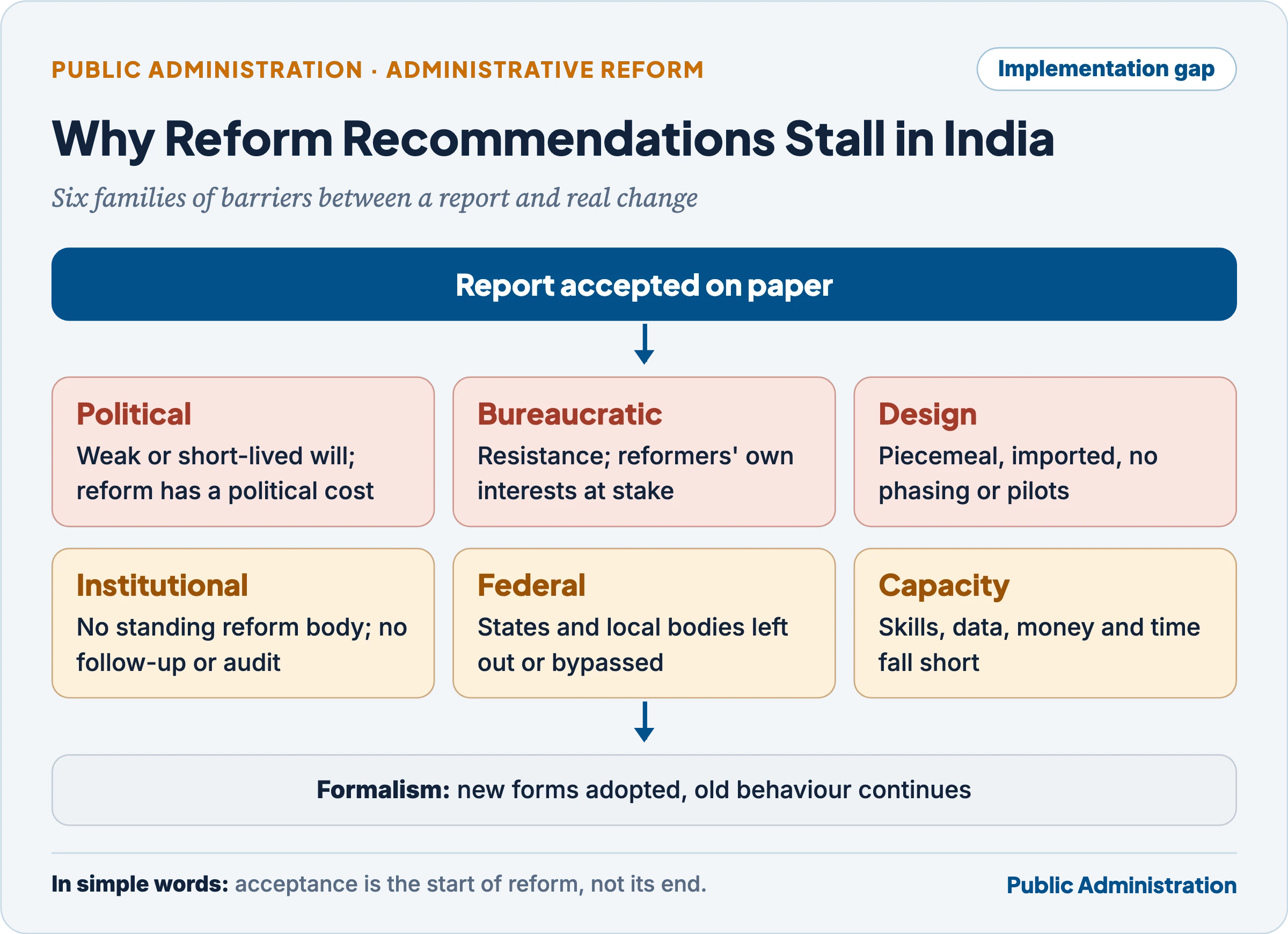
Implementation has been called the Achilles’ heel of administrative reform in India. Caiden, in Administrative Reform Comes of Age (1991), concluded that reform is difficult, rarely succeeds as expected and usually fails through faulty implementation. The record below shows why.
5.1 The action-taken record
- 1st ARC (1966–70):
- The Commission itself designed an implementation plan: a special Cabinet Committee assisted by the Cabinet Secretary; a white paper to Parliament within three months of each report; an all-party parliamentary committee to watch implementation; and, specifically, no role for the Committee of Secretaries, which it saw as a gatekeeper of the status quo.
- The government did the opposite. Each ministry decided on recommendations concerning itself; a Department of Administrative Reforms processed them; the Committee of Secretaries commented before the Cabinet, and became the de facto highest tribunal over the Commission’s reports.
- No white paper was issued and no parliamentary committee was set up; a report on implementation was placed before Parliament only in November 1977.
- Incremental items were implemented (the Department of Administrative Reforms itself, Lokayuktas in several States, grievance machinery, some delegation); basic changes (specialisation, the road to the top, unified grading) were not.
- The ARC was partly to blame: it spread its task too widely, took four years, and worked in a period of political instability; Parliament and the public grew weary of it.
- 2nd ARC (2005–09):
- Recommendations were processed by ministries, a Core Group on Administrative Reforms under the Cabinet Secretary, and a Group of Ministers (constituted 30 March 2007).
- Of 1,251 recommendations in 13 reports considered by the government, 1,005 were accepted; by May 2012, 533 had been implemented and 472 were under implementation. The reports on Public Order and Personnel Administration had still not been decided by the GoM at that stage.
- The transformative recommendations were the ones left aside: repeal of the Official Secrets Act, repeal or amendment of Article 311, a Civil Services Law and Civil Services Authority, separation of investigation from law and order, intensive reviews at 14 and 20 years of service, and agency-based restructuring of ministries.
- In 2025 the government told Parliament that implementation of accepted recommendations is “a continuous ongoing process”, conveyed to ministries and States, with no consolidated public scorecard.
Common confusion
Does “accepted” mean “implemented”? No. Acceptance is a decision on paper; implementation needs orders, rules, budgets, posts and changed behaviour. India’s reform record shows a large gap between the two: under both ARCs, the share of recommendations formally accepted was high, but the critical ones were either diluted, deferred or quietly dropped, while the easy ones were counted as achievements.
5.2 Lack of political will
- Reform has a political cost. Reforms that reduce discretion over transfers, licences, recruitment and contracts reduce the patronage politicians use to reward supporters. Downsizing angers unions and employees, a large voting bloc; decentralisation reduces the power of State politicians; transparency exposes ministers as well as officials.
- Short horizons: political leaders champion reform during crises or election campaigns but lose interest during the long, unglamorous implementation phase. The benefits of reform arrive after the next election; the costs arrive at once.
- Evidence: rhetoric about reform has rarely been matched by sustained top-level sponsorship; the 1st ARC “was not backed by top-level political will” and failed to rouse Parliament.
- Counter-evidence: where political will was strong and sustained, reforms happened despite resistance: RTI (2005), GST (2017), DBT, the Jan Vishwas Acts. The success of reform in India therefore depends on political as well as administrative will: political will to push, administrative will to implement.
5.3 Bureaucratic resistance
- The reformer is the reformed. Recommendations to curb the bureaucracy’s discretion, privileges or job security must be processed and implemented by the bureaucracy itself, which is a party to the dispute.
- Self-interest: reform threatens the authority, power and prestige of the civil service built under colonial rule; officers resist exit reviews, lateral entry, domain specialisation and open appraisal.
- Cultural inertia: officials socialised in the old order tend to revert to past practices unless the reform is institutionalised; formal organisations socialise people into conformist roles.
- Selective implementation: reforms that benefit the top bureaucracy (pay, promotions) are pursued “in right earnest”; those that hurt it are forgotten.
- A more hopeful view: a new generation of civil servants, aware of the colonial mentality of their predecessors, is less resistant to change, as field innovations show.
- Neither politician nor bureaucrat is naturally friendly to reform; the long-term remedy may lie beyond both, in civil society whose pressure compels the politician to listen and the bureaucracy to change.
5.4 Piecemeal and episodic approach
- Reform by commission, not by system: India appoints a committee “at the slightest provocation”, often after a crisis or scandal, and treats each report separately.
- Tinkering at the margins: incremental changes in procedure or structure leave the system untouched. District administration illustrates this: new schemes and committees have been added to the Collector’s office for decades without a redesign of the district as a whole.
- Multi-dimensional problems need multi-sector reform: administrative reform cannot succeed in isolation from political, electoral, judicial and police reforms. A clean, efficient bureaucracy cannot survive in a system where elections need illicit money or justice takes decades.
- Reform overload: too many initiatives at once dilute attention, and each new government renames or replaces the previous one’s flagship.
5.5 Absence of follow-up machinery
- No permanent reform body: commissions submit reports and disband; implementation falls to the very departments being reformed. Proposals for a standing reform commission or a powerful central reform agency led by a strong minister have not been implemented.
- DARPG’s limited clout: the Department of Administrative Reforms and Public Grievances coordinates but cannot compel ministries or States.
- Parliament kept out: there is no statutory duty to lay an action-taken report on reform commissions within a fixed time, unlike, for example, CAG reports, which go to the Public Accounts Committee.
- No evaluation: few reforms are evaluated against stated objectives; the absence of evidence makes it hard either to defend successful reforms or to abandon failed ones.
5.6 Federal coordination
- Divided jurisdiction: most administrative functions lie with States, but reform design is concentrated in Union bodies, and All India Services serve both levels (States sometimes see them as the Centre’s agents).
- Imposed reform: Union schemes attach reform conditions to funds; States comply on paper. The 2011 question on reforms “imposed from above” captures this.
- Uneven adoption: Right to Services laws, police reform after Prakash Singh (2006), tenure rules after T.S.R. Subramanian (2013) and local body devolution vary greatly across States.
- Positive models: the GST Council (2016) shows that a shared Union–State forum can implement a difficult reform; similar councils or compacts for administrative reform have been suggested, and the 2025 deregulation drive assigned senior Union secretaries to work with States.
5.7 Formalism
- Fred Riggs (Administration in Developing Countries, 1964) used formalism for the gap between formal prescriptions and actual behaviour in “prismatic” societies: laws, rules and institutions exist on paper but are not enforced as written.
- In Indian reform: Citizen’s Charters pasted on walls, Sevottam certificates, Civil Services Boards that rubber-stamp transfers, e-files printed and moved by hand, codes of conduct that are not enforced. New forms are adopted; old behaviour continues.
- Why it persists: in a prismatic society, older social ties (caste, kin, patronage) shape how new formal bodies actually work, and reforms that ignore these ties are captured by them. See the article on Riggsian Models and their Critique.
5.8 Capacity constraints
- Skills: many officials lack the managerial, digital, regulatory and data skills reforms require; capacity issues have hampered the implementation of many programmes.
- Vacancies and contract staff at the cutting edge (teachers, health workers, police, revenue staff) mean reform designs outrun the people available to deliver them.
- Data and infrastructure: unreliable connectivity, legacy systems, missing land records, weak statistics at the district level.
- Mission Karmayogi addresses individual competencies, but capacity is also institutional (processes, systems, incentives, tenure); training can supplement but not substitute for those.
5.9 Vested interests and the reformers themselves
- Vested interests (intermediaries, touts, contractors, unions, local elites) are most active at the implementation stage, when reforms threaten their gains.
- The VIP culture: the ruling elite move through a separate network for which administration is already “reformed”, so they generate no demand for reform.
- The reformers’ own limits: reform proposals are sometimes poorly conceived, out of date with social science, or built on the reformer’s pet model; when they fail, reformers become defensive advocates instead of diagnosticians. David Rosenbloom, the American public administration scholar, warned that reform also has a business side: consultants, contractors and academics may profit from selling reforms they do not fully understand.
- Resources: reforms are often announced without budgets for training, technology, redeployment or transition costs.
5.10 Summary of barriers and remedies
| Barrier | Indian illustration | Remedy |
|---|---|---|
| Weak political will | ARC I reports processed by ministries; OSA still in force | Cabinet-level sponsor; time-bound action-taken report to Parliament |
| Bureaucratic resistance | Committee of Secretaries as gatekeeper; rejection of the road to the top | Involve senior officers early; protect reform champions; incentives |
| Piecemeal approach | District administration reformed scheme by scheme | Systemic, phased reform plans across related sectors |
| No follow-up machinery | Commissions disband; no scorecard of 2nd ARC implementation | Standing reform commission; public dashboard of recommendations |
| Federal gaps | State-level reforms rare; police reform uneven | Union–State compacts; incentives; State reform commissions |
| Formalism | Charters on walls; boards that rubber-stamp | Legal enforceability, penalties, independent audit, citizen feedback |
| Capacity | Vacancies, digital skills gaps | Competency-based HR, rightsizing, process re-engineering |
| Vested interests | Touts at RTOs; middlemen in procurement | Technology to remove intermediaries; transparency; coalitions with users |
6. Conditions for Successful Reform
In simple words
Reforms stick when someone powerful wants them for long enough, when they fit the local situation, when the people affected are brought on board, and when there is a way to check whether they are working and to fix them if not.
6.1 Lewin’s model of planned change
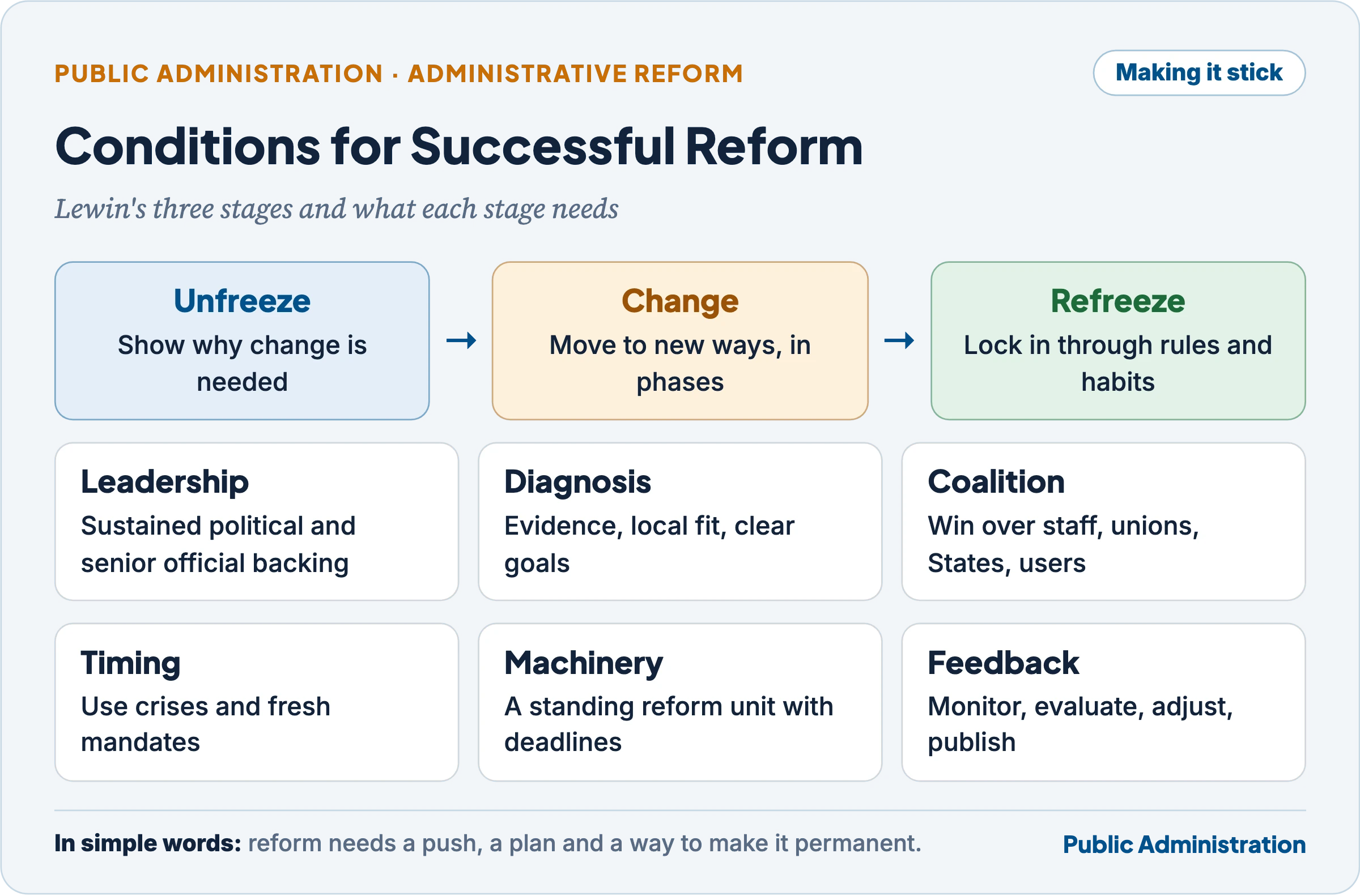
Kurt Lewin, the German-American social psychologist, proposed in “Frontiers in Group Dynamics” (1947) that planned change passes through three stages. He also developed force-field analysis: change happens when driving forces outweigh restraining forces.
- Unfreezing: creating the felt need for change by exposing the gap between performance and expectations (a crisis, a scandal, data, citizen pressure). Without unfreezing, reform ideas are “nipped in the bud”.
- Changing (moving): introducing new structures, rules and behaviour, ideally in phases with pilots, with training and support.
- Refreezing: locking the change in through law, rules, budgets, appraisal criteria, routines and culture, so that the organisation does not slide back.
- Indian application: most Indian reforms stop at the second stage. Charters and Sevottam were introduced but never refrozen through enforceable rights, which came only with Right to Services laws. RTI, by contrast, was refrozen by statute, Information Commissions and citizen use.
6.2 What successful reform needs
- Sustained top-level leadership: complete and continuing support of the political and senior administrative leadership, especially at the follow-up stage when vested interests mobilise. A strong minister should head the reform agency.
- Correct diagnosis: relevant knowledge, local fit and clear, measurable goals; proposals tailored to local circumstances and implemented through existing institutions where possible.
- Building coalitions: the reformer must win over vested interests, opponents and neutrals where possible while strengthening supporters. Caiden noted that reforms are more acceptable when they praise the virtues of reform rather than attack the defects of the unreformed, and when they invite local participation.
- Timing: using windows of opportunity (crises, fresh mandates, the start of a government’s term).
- Phasing and experimentation: a long-term plan in stages, with built-in experimentation and flexibility to adjust.
- Machinery and accountability for implementation: a standing reform unit, deadlines, budgets, and an action-taken report to the legislature.
- Evaluation and communication: monitoring built into implementation; proof of results to sustain support; public communication.
- Attitudinal change: a “mental revolution” at the cutting edge, through training, rules, incentives and supervision, so that every contact with a citizen is seen as service, not an opportunity.
- No universal package: administrative cultures differ between countries, regions and organisations. The more drastic the change sought, the more problematic its success; reform is contingent on circumstance, and there is no textbook solution.
6.3 Indian reforms that worked, and why
| Reform | What changed | Why it stuck |
|---|---|---|
| RTI Act, 2005 | Citizens can demand official information | Grassroots movement, statute, independent commissions, mass use |
| Election administration | Free and fair elections at huge scale | Constitutional body, clear objective, time-bound, high visibility |
| DBT and JAM | Benefits paid directly to bank accounts | Technology removed intermediaries; savings visible to the treasury |
| Right to Services laws | Time-bound services with penalties | Legal enforceability; appeals; started small and spread |
| GST (2017) | Unified indirect tax | Constitutional amendment; GST Council as shared Union–State forum |
| Jan Vishwas Acts | Minor offences decriminalised | Legislative route; consolidated packages; Select Committee consultation |
The common features are legal backing, clear and visible objectives, technology or institutions that reduce discretion, and coalitions beyond the bureaucracy.
6.4 Reform as a double-edged sword
Reforms solve some problems and create others. Understanding these trade-offs is part of understanding reform.
- Digital delivery vs exclusion: Aadhaar-based authentication and DBT cut leakages, but failures of biometric match and connectivity have excluded some eligible beneficiaries.
- Efficiency vs accountability: contracting out, contractual staff and agencies raise flexibility but fragment accountability; NPM-style reforms can weaken the public service ethos.
- Speed vs deliberation: centrally driven dashboards and campaigns deliver quick results but concentrate power in the Prime Minister’s and Chief Ministers’ offices and bypass ministers, States and local bodies.
- Deregulation vs protection: decriminalisation and self-certification ease business, but weaker inspection can endanger safety, environment and labour standards if monitoring is not redesigned.
- Lateral entry vs representation: outside expertise improves policy, but bypasses reservation and the merit system, which led to the 2024 withdrawal.
- Transparency vs privacy: RTI and open data increase scrutiny, while the DPDP Act’s amendment to RTI shows the tension with personal privacy.
- Performance pressure vs gaming: targets and rankings improve focus, but invite gaming and neglect of what is not measured.
7. International Comparisons
In simple words
Other democracies faced the same complaint (government is slow, costly and unresponsive) and tried different cures. India has borrowed some of their tools, but not always the conditions that made them work.
| Country | Reform | Core idea | Lesson for India |
|---|---|---|---|
| United Kingdom | Next Steps report (Efficiency Unit, February 1988); Citizen’s Charter (1991) | Separate policy (ministries) from delivery (executive agencies with chief executives and framework agreements) | The 2nd ARC proposed executive agencies; India has few genuine ones. The UK’s 1991 charter was the model for India’s 1997 charters |
| New Zealand | State Sector Act 1988, Public Finance Act 1989; Public Service Act 2020 | Chief executives on performance contracts, accrual accounting, outputs bought by ministers | Radical NPM produced efficiency but fragmentation; New Zealand itself moved to a joined-up “one public service” model in 2020 |
| United States | National Performance Review (March 1993, Vice-President Al Gore); Osborne and Gaebler, Reinventing Government (1992) | “Steering not rowing”, entrepreneurial, customer-driven, results-oriented government; Government Performance and Results Act 1993 | Inspired India’s results-framework and outcome thinking; showed that measurement needs political ownership |
| Japan | Total Staff Number Law (1969); “scrap and build” | A statutory ceiling on civil service size | A legislative check on staff growth, never adopted in India |
| Singapore, Hong Kong | Independent anti-corruption agencies | Prevention, prosecution and public education by a strong, independent body | Shaped the case for the CVC’s independence and the Lokpal |
- The pattern: Westminster-type countries combined political commitment, legal change and managerial freedom with accountability. India borrowed the instruments (charters, agencies, performance documents) more readily than the conditions (stable tenure, managerial autonomy, strong legislative oversight).
- Post-NPM correction: by the 2000s, many NPM reformers moved back towards coordination, whole-of-government and public value, a caution against copying NPM uncritically. See the article on New Public Management and After.
8. Recent Reforms
In simple words
In the last six years the government has focused on three things: retraining every official for the job he actually does, removing jail terms and paperwork for minor offences, and clearing old files and rules through campaigns and digital offices.
8.1 Mission Karmayogi
- What it is: the National Programme for Civil Services Capacity Building, approved by the Union Cabinet on 2 September 2020, to move from “rule-based to role-based” training and build a citizen-centric civil service “rooted in Indian ethos”.
- Institutions: the Prime Minister’s Public Human Resources Council, the Capacity Building Commission (to harmonise training standards, approve annual capacity building plans and supervise central training institutions), the SPV Karmayogi Bharat that owns the iGOT Karmayogi platform, and a coordination unit under the Cabinet Secretary.
- Scale (August 2026): over 1.7 crore registered users and over 5,600 courses in 23 languages; all ministries, States and UTs onboarded; tripartite agreements with 30 States and UTs; over 3,600 capacity building plans prepared for central and State departments (May 2026).
- Link to HR: from reporting year 2025–26, completion of prescribed iGOT courses is recorded in the APAR of central employees and All India Service officers.
- Assessment: a significant behavioural and technological reform, but online courses cannot fix structural capacity problems (vacancies, short tenure, poor incentives, process complexity). See the article on Civil Service Training and Capacity Building.
8.2 The Jan Vishwas Acts
- Jan Vishwas (Amendment of Provisions) Act, 2023: decriminalised 183 provisions in 42 Central Acts, replacing imprisonment for minor and technical lapses with monetary penalties and administrative adjudication.
- Jan Vishwas (Amendment of Provisions) Act, 2026 (Act No. 8 of 2026, assent 7 April 2026):
- Introduced on 18 August 2025 as a Bill covering 355 provisions in 16 Acts, it was referred to a Select Committee of the Lok Sabha (chaired by Tejasvi Surya), which held 49 sittings, reported on 13 March 2026 and recommended extending decriminalisation to 62 more Acts.
- As passed, it amends 784 provisions across 79 Central Acts administered by 23 ministries: 717 decriminalised for ease of doing business and 67 amended for ease of living; it rationalises more than 1,000 offences.
- Fines and penalties rise automatically by 10% every three years; commencement is staggered by notification.
- Significance: reform through the legal system (Caiden’s third method), a shift from deterrence by criminal law to trust-based, proportionate regulation.
- Concerns: adequacy of civil penalties as deterrents in areas such as food, drugs and environment; capacity of adjudicating officers; risk of shifting discretion from courts to officials.
8.3 Compliance reduction and deregulation
- Reducing compliance burden: ministries and States reported reducing over 47,000 compliances (simplification, digitisation, decriminalisation and removal) by December 2025.
- Task Force on Compliance Reduction and Deregulation (January 2025) and a Deregulation Cell in the Cabinet Secretariat work with States on procedures within their domains.
- High-Level Committee on Non-Financial Regulatory Reforms (constituted 19 August 2025, chaired by Rajiv Gauba), announced in the Union Budget 2025–26: it reviews regulations, certifications, licences and permissions; it recommended suspending or deferring over 200 Quality Control Orders (November 2025), risk-based and third-party inspections and simpler company law compliance for small firms.
- Repeal of obsolete laws: over 1,700 Central laws repealed since 2014; the Repealing and Amending Act, 2025 (assent 20 December 2025) repealed 71 Acts.
8.4 e-Office and DARPG’s reform initiatives
- e-Office: electronic file management across central ministries, now extended to attached and subordinate offices; it reduces file movement time and enables tracking of pendency.
- Special Campaigns (since 2021): annual drives led by DARPG for disposal of pending matters and cleanliness.
- Special Campaign 5.0 (2–31 October 2025) across 84 ministries and departments: 11.6 lakh sites covered, 29.52 lakh files closed or weeded out, 233.75 lakh sq ft of space freed and ₹833.92 crore earned from scrap disposal.
- Cumulatively (2021–25), the campaigns earned about ₹4,130 crore and freed about 930 lakh sq ft.
- CPGRAMS reforms: a 10-step reform process with monthly reports, grievance assessment indices, feedback call centres and appeals; average disposal time in central ministries of about 15 days in 2025.
- Other DARPG tools: Sevottam, the Good Governance Index (2019, 2021), the National e-Governance Service Delivery Assessment (NeSDA), the Prime Minister’s Awards for Excellence in Public Administration, Good Governance Week and the “Prashasan Gaon Ki Ore” campaign.
- Assessment: these show a campaign mode of reform: high visibility and measurable outputs, but campaigns must become routines (refreezing) to last.
9. Theory Lens: Why Indian Reform Looks the Way It Does
In simple words
Paper I theories help explain the Indian story: why reform meets resistance, why it often changes forms but not behaviour, why it moves in small steps, why it copies foreign models, and why old institutions are so hard to change.
9.1 Theory lens: reform, resistance and institutional stickiness
- Caiden’s theory of reform. Gerald Caiden (Administrative Reform, 1969) defined reform as artificial inducement of transformation against resistance. It explains why every Indian reform from the 1st ARC to lateral entry has been a political contest, not a technical exercise, and why reforms that rely only on persuasion stall.
- Riggs’ formalism. Fred Riggs (Administration in Developing Countries, 1964) showed that in prismatic societies formal rules coexist with older social practices. India’s charters, boards and codes that exist on paper but not in behaviour are textbook formalism. See the article on Riggsian Models and their Critique.
- Incrementalism vs rational-comprehensive change. Charles Lindblom (“The Science of ‘Muddling Through'”, 1959) explains why India’s comprehensive commissions produced incremental outcomes: in a pluralist democracy, only marginal changes win agreement. Etzioni’s mixed scanning suggests a better path: fundamental choices, then incremental steps. See the article on Models of Policy-Making and their Critique.
- NPM and post-NPM. Christopher Hood (“A Public Management for All Seasons?”, 1991) and Osborne and Gaebler (Reinventing Government, 1992) shaped India’s 1990s agenda (downsizing, charters, performance measures, contracting). Digital-era governance (Dunleavy and Margetts, 2006) and New Public Service (Denhardt and Denhardt, 2000) explain the later turn to DPI, rights-based delivery and citizen participation. See the article on New Public Management and After.
- Lewin’s change model. Kurt Lewin (1947) explains why India’s reforms slide back: they unfreeze and move, but rarely refreeze through law, incentives and culture. Force-field analysis shows that resistance must be weakened, not only pressure increased.
- Institutional theory and path dependence. Douglass North (Institutions, Institutional Change and Economic Performance, 1990) and Paul Pierson (“Increasing Returns, Path Dependence, and the Study of Politics”, 2000) argue that early institutional choices create increasing returns: actors adapt to them, and change becomes costly. India’s 1947 decision to retain the colonial system, the All India Services and the secretariat model created such a path. Reform has proceeded by layering (adding RTI, RTS, DBT, Karmayogi on top of old structures) rather than replacement. This also explains the “well-entrenched state” that resisted post-1991 change.
- Organisational learning. Chris Argyris and Donald Schön (Organizational Learning, 1978) distinguished single-loop learning (correcting errors within existing rules) from double-loop learning (questioning the rules themselves). Indian administration is good at single-loop correction (clearing pendency, faster disposal) and weak at double-loop change (questioning the generalist hierarchy, secrecy, the transfer system).
- Implementation theory. Jeffrey Pressman and Aaron Wildavsky (Implementation, 1973) showed that each additional clearance point reduces the chance of success; Indian reform passes through ministries, a Core Group, a GoM, the Cabinet, States and field offices. Michael Lipsky’s street-level bureaucrats (1980) explain why reforms are remade at the counter where the citizen meets the clerk. See the article on Policy Process.
Criticism — The case that administrative reform in India has failed
- Implementation deficit: two ARCs and dozens of committees, but the most important recommendations (OSA repeal, Article 311, Civil Services Law, specialisation, police reform) remain unimplemented.
- Colonial continuity: the basic structure, procedures and attitudes of the inherited system survive; reform has been “structural tinkering” without changing the paternalistic mindset.
- Formalism: charters, Sevottam, boards and codes exist on paper; citizens still meet touts and delays at the cutting edge.
- Episodic, crisis-driven reform: commissions follow scandals and crises; there is no standing reform machinery or public scorecard.
- Centralisation: recent reforms concentrate power in leaders’ offices and dashboards rather than strengthening ministers, States and local bodies.
- Political will is selective: reforms that reduce politicians’ patronage (transfers, police autonomy) are the ones that stall.
Defence — The case that reform has worked, slowly
- Real, cumulative change: RTI, the 73rd and 74th Amendments, e-governance, DBT, RTS laws, Lokpal, GST and decriminalisation have changed how citizens meet the state.
- Many reforms come from outside commissions: courts, civil society, technology and economic crises have driven change that committee counts do not capture.
- Incrementalism suits a federal democracy: steady, negotiated change across Union, States and local bodies may last longer than a single big-bang redesign.
- Capacity is rising: online grievance redress, e-Office, Karmayogi and data systems create the infrastructure future reforms need.
- The diagnosis is now shared: there is broad agreement on the thrust areas (people-centred, open, decentralised, flexible and corruption-free administration), and recent reforms have used law to make change durable.
- Comparatively robust: the administration conducts elections, disaster relief and mass digital delivery at a scale few states achieve.
9.2 Committees, Commissions and financial and HRD reforms in brief
India’s major reform bodies (the Gorwala and Appleby reports, the Santhanam Committee, the 1st ARC, the Kothari, Satish Chandra, Alagh and Hota committees, the Pay Commissions, the Expenditure Reforms Commission and the 2nd ARC’s 15 reports) and the reforms in financial management (performance and outcome budgeting, accrual accounting, PFMS, FRBM) and human resource development (training, appraisal, lateral entry, competency frameworks) are covered in detail elsewhere. See the article on Committees and Commissions on Administrative Reform, and Reforms in Financial Management and HRD.
Key Terms
| Term | Meaning in simple words |
|---|---|
| Administrative reform | Deliberate, planned change in administration to improve it, against resistance |
| Administrative change | Spontaneous, continuous adjustment of an organisation to new conditions |
| Reorganisation | Restructuring of units, functions and hierarchy |
| Administrative development | Growth of an administrative system’s capacity to make deliberate choices |
| Incremental reform | Change by small, successive steps on the existing base |
| Comprehensive reform | Redesign of the whole system at one stroke from a rational plan |
| Mixed scanning | Broad review for basic choices, followed by incremental steps |
| Structural reform | Change in who does what: units, levels, agencies, decentralisation |
| Procedural reform | Change in how work moves: rules, forms, delegation, time limits |
| Behavioural reform | Change in attitudes, values and relationships of officials |
| Organisation development (OD) | Applied behavioural science for continuous organisational renewal |
| Institutional bureaucracy | A bureaucracy with its own autonomy and values, not a mere tool of leaders |
| Formalism | Gap between formal rules and actual behaviour (Riggs) |
| Red tape | Excessive procedure that delays decisions without adding value |
| Rightsizing | Matching staff numbers to functions, cutting some and adding others |
| Subsidiarity | A task should be done by the smallest unit able to do it well |
| Process re-engineering | Redesigning a process around the citizen before computerising it |
| Decriminalisation | Replacing imprisonment for minor lapses with civil penalties |
| Unfreeze–change–refreeze | Lewin’s three stages of planned change |
| Force-field analysis | Change occurs when driving forces outweigh restraining forces |
| Path dependence | Early institutional choices lock in later options |
| Layering | Adding new institutions on top of old ones instead of replacing them |
| Policy window | A moment when problem, solution and politics align for change |
| Double-loop learning | Questioning the rules themselves, not only correcting errors within them |
| Mission Karmayogi | National programme for competency-based civil service capacity building (2020) |
| Jan Vishwas Acts | Laws of 2023 and 2026 decriminalising minor offences across Central Acts |
Commissions, Committees and Judgments
The table lists the bodies and rulings referred to in this article; their detailed recommendations belong to the article on Committees and Commissions on Administrative Reform.
| Body / case | Year | Key point |
|---|---|---|
| Secretariat Reorganisation Committee (Girija Shankar Bajpai) | 1947 | First post-Independence review of the Central Secretariat |
| Report on Public Administration (A.D. Gorwala) | 1951 | Clean, efficient, impartial administration; integrity |
| Paul Appleby reports (Paul H. Appleby) | 1953, 1956 | O&M Division and IIPA set up (1954) |
| Committee on Prevention of Corruption (K. Santhanam) | 1964 | Led to the Central Vigilance Commission |
| Department of Administrative Reforms | 1964 | Standing reform department in the Ministry of Home Affairs |
| 1st ARC (Morarji Desai, then K. Hanumanthaiya) | 1966–70 | 20 reports, 537 recommendations; weak implementation |
| State of U.P. v. Raj Narain | 1975 | Right to know as part of freedom of expression |
| S.P. Gupta v. Union of India | 1981 | Open government; disclosure as the rule |
| Economic Administration Reforms Commission (L.K. Jha) | 1981–83 | From physical controls to indirect instruments |
| Sarkaria Commission (Justice R.S. Sarkaria) | 1983–88 | Centre–State relations; support for All India Services |
| Vohra Committee (N.N. Vohra) | 1993 | Nexus of politicians, officials and criminals |
| 5th Central Pay Commission (Justice S. Ratnavel Pandian) | 1997 | 30% downsizing, tenure, Civil Services Board, RTI |
| Conference of Chief Ministers | 1997 | Action Plan: accountability, transparency, integrity |
| Vineet Narain v. Union of India | 1997 | Statutory status and independence for the CVC |
| Expenditure Reforms Commission (K.P. Geethakrishnan) | 2000–01 | Downsizing of ministries; subsidy rationalisation |
| Hota Committee (P.C. Hota) | 2004 | Code of ethics, tenure, performance appraisal |
| 2nd ARC (M. Veerappa Moily) | 2005–09 | 15 reports; 1,005 of 1,251 recommendations accepted (13 reports) |
| Prakash Singh v. Union of India | 2006 | Police reform directions: tenure, security commissions |
| T.S.R. Subramanian v. Union of India | 2013 | Civil Services Boards, minimum tenure, written orders |
| Kerala Administrative Reforms Commission (V.S. Achuthanandan) | 2016 | A rare State-level reform commission |
| Jan Vishwas (Amendment of Provisions) Act | 2023 | 183 provisions in 42 Acts decriminalised |
| Task Force on Compliance Reduction and Deregulation | 2025 | Deregulation with States; Deregulation Cell |
| High-Level Committee on Non-Financial Regulatory Reforms (Rajiv Gauba) | 2025 | Review of regulations, certifications, inspections |
| Jan Vishwas (Amendment of Provisions) Act | 2026 | 784 provisions in 79 Acts amended; 717 decriminalised |
Contemporary Developments
- Second Jan Vishwas Act (7 April 2026). The Jan Vishwas (Amendment of Provisions) Act, 2026 amends 784 provisions in 79 Central Acts, decriminalising 717; fines rise by 10% every three years; commencement is being notified in stages from April 2026.
- Mission Karmayogi at scale (August 2026). The iGOT Karmayogi platform has over 1.7 crore users and 5,600+ courses; from 2025–26, completion of mandatory courses is captured in APARs.
- Deregulation drive (2025–26). The High-Level Committee on Non-Financial Regulatory Reforms (constituted 19 August 2025) recommended suspending or deferring over 200 Quality Control Orders (November 2025); on 29 June 2026 the Prime Minister met Union secretaries to review the deregulation push, and selected secretaries have been assigned to drive it in States.
- Repealing and Amending Act, 2025 (20 December 2025). Repealed 71 Acts; the government told the Lok Sabha in 2026 that 1,725 obsolete laws have been repealed since 2014.
- Special Campaign 5.0 (October 2025). 29.52 lakh files closed or weeded out, 233.75 lakh sq ft freed and ₹833.92 crore earned from scrap across 84 ministries and departments.
- DPDP Rules (14 November 2025). The Rules operationalise the DPDP Act, 2023, with an 18-month phased compliance period; they apply to government departments as data fiduciaries, with exemptions.
- Corruption Perceptions Index 2025 (February 2026). India scored 39 and ranked 91st of 182, a small improvement from 2024.
- CPGRAMS (2025). Over 20 lakh grievances disposed of in the year, with an average disposal time of 15 days in central ministries.
Revision Grid
| Thinker / body | Work or report (year) | Key idea |
|---|---|---|
| Gerald Caiden | Administrative Reform (1969) | Artificial inducement of transformation against resistance |
| Gerald Caiden | Administrative Reform Comes of Age (1991) | Reform usually fails through faulty implementation |
| Arne Leemans | The Management of Change in Government (1976) | Reform bridges the gap between reality and desirability |
| Hahn-Been Lee | Writings on development administration | Reform applies new ideas, and hence new values, for national development |
| Frederick Mosher | Study of governmental reorganisations | Four goals: policy change, effectiveness, personnel, countering threats |
| Paul Appleby | Reports on Indian administration (1953, 1956) | Constant vs episodic change; O&M and IIPA |
| Fred Riggs | Administration in Developing Countries (1964) | Formalism in prismatic societies |
| Charles Lindblom | “The Science of ‘Muddling Through'” (1959) | Incremental change in pluralist democracies |
| Amitai Etzioni | “Mixed-Scanning” (1967) | Fundamental choices plus incremental steps |
| Kurt Lewin | “Frontiers in Group Dynamics” (1947) | Unfreeze, change, refreeze; force-field analysis |
| John Kingdon | Agendas, Alternatives, and Public Policies (1984) | Policy windows for reform |
| Pressman and Wildavsky | Implementation (1973) | More clearance points, less chance of success |
| Douglass North / Paul Pierson | 1990 / 2000 | Path dependence and increasing returns of institutions |
| Argyris and Schön | Organizational Learning (1978) | Single-loop vs double-loop learning |
| Osborne and Gaebler | Reinventing Government (1992) | Entrepreneurial, results-oriented government |
| 1st ARC | 20 reports (1966–70) | Comprehensive review; specialisation rejected |
| 2nd ARC | 15 reports (2006–09) | Ethics, citizen-centricity, subsidiarity, e-governance |
| Mission Karmayogi | Cabinet approval (2020) | Rule-based to role-based capacity building |
| Jan Vishwas Acts | 2023, 2026 | Trust-based governance through decriminalisation |
Previous Year Questions
- 2026Administrative reforms in India have been a double-edged sword. Comment.
- 2026Lack of political will to support several administrative reforms has led to their inadequate implementation. Critically validate.
- 2026Civil services is grappling with severe capacity issues and which is a major bottleneck in implementing ambitious programmes across sectors. Mission Karmayogi can only supplement but not solve the entire capacity constraint. Give your opinion.
- 2025Low cyber awareness among officials is causing cyber security issues in the administration. Comment.
- 2025Identify the implementation challenges and issues of the Government e-Marketplace (GeM).
- 2024“The success of administrative reforms in a country like India depends upon the political will.” Comment.
- 2023India has significantly advanced in its development goals, increased efficiency in the public sector and unlocked innovation in private sector by adopting the approach of building Digital Public Infrastructure. Elucidate.
- 2021Traditionally structured administrative systems have outlived their utility. Discuss as how administrative reforms can revamp, restructure and redesign the existing governmental structure to meet the new challenges faced by the Indian administrative set-up.
- 2021Red-tapism is a major obstacle to the implementation of ‘good governance. Comment.
- 2021The institutional legacy of ‘well-entrenched state’ affected the post-reforms promises in India. Explain the statement in the light of economic reforms in India.
- 2020Implementation of administrative reforms is humongous and arduous. What lacks the push to realize the changes?
- 2019Considerable attention has been paid to the restructuring of the administrative systems at the Central and local levels, but very few reforms have been undertaken at the State level. What steps would you suggest to rectify it?
- 2015“Excellent ideas but poor implementation have charactersed the administrative reforms in India since Independence.” Critically examine the statement giving examples from the Union and State Governments.
- 2015“‘Minimum government, maximum governance’ is not just a slogan but a philosophy of administration with enormous potentialities.’ Do you agree? Give reasons for your answer.
- 2014“Unimplemented reforms in administration weaken the administrative reforms process most.” Do you agree? Give your answer citing specific cases as illustrations.
- 2012‘Efforts made towards administrative reforms so far have been lacking in congruence between strategy, structure and substance.’ Discuss with illustrations.
- 2011“The real problem of administrative reforms in India at the State and the local levels is that they are imposed from above.” Comment.
- 2011“Administrative reforms get diluted because of constant tinkering on the margin rather than a holistic transformation.” Discuss the statement in the context of reforming district administration in India.
- 2010With reference to India, discuss the assertion that administrative reforms are multi-dimensional and need to be substantiated by reforms in other related areas of state action.
- 2009In your view, which have been the five most important administrative reforms implemented after Independence? What has been their impact?
- 2008‘The shift from the Nehruvian to the liberalisation model of development has necessitated reinventing government.’ Comment.
- 2006“All efforts in the field of reforms in public administration by the political executive have resulted in no significant output.” Comment.
- 2005“Efforts made towards administrative reforms so far have been lacking in a congruence between strategy, structure and substance.” Comment.
- 2004“In spite of valuable suggestions through Administrative Reforms, still we have not been able to come up to the expectations of the people.” Discuss.
- 2003“The size of the leviathan goes on expanding, despite the country’s recent commitment to downsizing or rightsizing.” Comment.
- 2002“The problems of administrative improvement in India are larger and more complex than in any other country in the world.”-Comment.
- 2002“After independence, despite the change in socio-economic and political milieu, the basic features of colonial on administration continues to exist in our administrative system.” Comment.
- 2001“Administrative Reforms in India are not necessarily the result of the recommendations of any specific committees or commissions.” Comment.
- 2000“Most administrative reforms have a political cost.” Comment.
- 1999Do you agree with the view that the Indian reform effort has been conservative or orthodox, not breaking radically never ground, but only modifying the existing structures and process? Give arguments.
- 1998In tune with the winds of administrative change blowing throughout the world, the Indian administration restructuring in the nineteen ninety. What are these initiatives and how effective have they been?
- 1998“The success of administrative reforms in a country like India depends upon political as well as administrative will.” Comment.
- 2020Administrative reform is “an artificial inducement of administrative transformation against resistance.” (Gerald Caiden). Identify the nature of resistance and inducements required to overcome it.
- 2014“Many Asian and African countries have inherited the colonial idea of civil service as a privileged elite. Hence, the social status of the civil services is an important aspect of the bureaucracy’s unsuitability for change.” Comment.
- 2011‘A crisis of credibility’ in the administrative system can be overcome only by ‘reinventing government’. Comment.
- 2003Examine the needs and facets of administrative reforms in the fast changing scenario of the 21 st century. What are the obstacles to administrative reforms? Give suggestions to overcome them.
- 1997“Administrative reforms are induced changes in the machinery of government undertaken in order to bridge the gap between reality and desirability.” Comment.
- 1996“Whatever is purpose it is true that reform always takes place against ‘resistance’ and that failure to recognise the various sources of opposition, and to plan and to neutralise them, is a major reason for the widespread failure of reform efforts.” Examine.
- 1994“The entire process of development and nation building hinges on the effectiveness of administrative reforms.” Comment.
- 1993“Administrative reforms represent efforts, intended to enhance and/or expand the administrative and managerial capacity of Public administration to achieve national objectives or goals.” Elucidate.
- 1992‘Administrative reform, by its very definition, seeks to apply new ideas to administration and thus entails new values. Comment.