

Budget as a political instrument; Parliamentary control of public expenditure; Role of finance ministry in monetary and fiscal area; Accounting techniques; Audit; Role of Controller General of Accounts and Comptroller and Auditor General of India.
This article: Accounting techniques in Indian government (purposes, the three parts of government accounts, Finance and Appropriation Accounts, single entry and cash basis, the six-tier classification and the List of Major and Minor Heads, cash vs accrual accounting, GASAB, IGAS and IGFRS, PFMS, e-payments, Treasury Single Account, SNA and SNA-SPARSH); separation of accounts from audit (1976) and the Indian Civil Accounts Organisation; the Controller General of Accounts (mandate, Principal Chief Controllers, Integrated Finance, monthly accounts, internal audit); audit (meaning, roles, types by timing, agency and focus, propriety, performance and social audit); the Comptroller and Auditor General (Articles 148–151 and 279, the 1971 Act and its 1976 amendment, appointment, tenure, removal, independence, organisation, functions, audit of public undertakings and local bodies, reports and the PAC, landmark audits, court rulings); debates on overreach, paralysis and the limits of audit; comparison with the UK NAO, the US GAO and court and board models; reforms; the CAG’s international role; theory lens.
Official Syllabus: Paper II · Unit 2-09 Financial Management
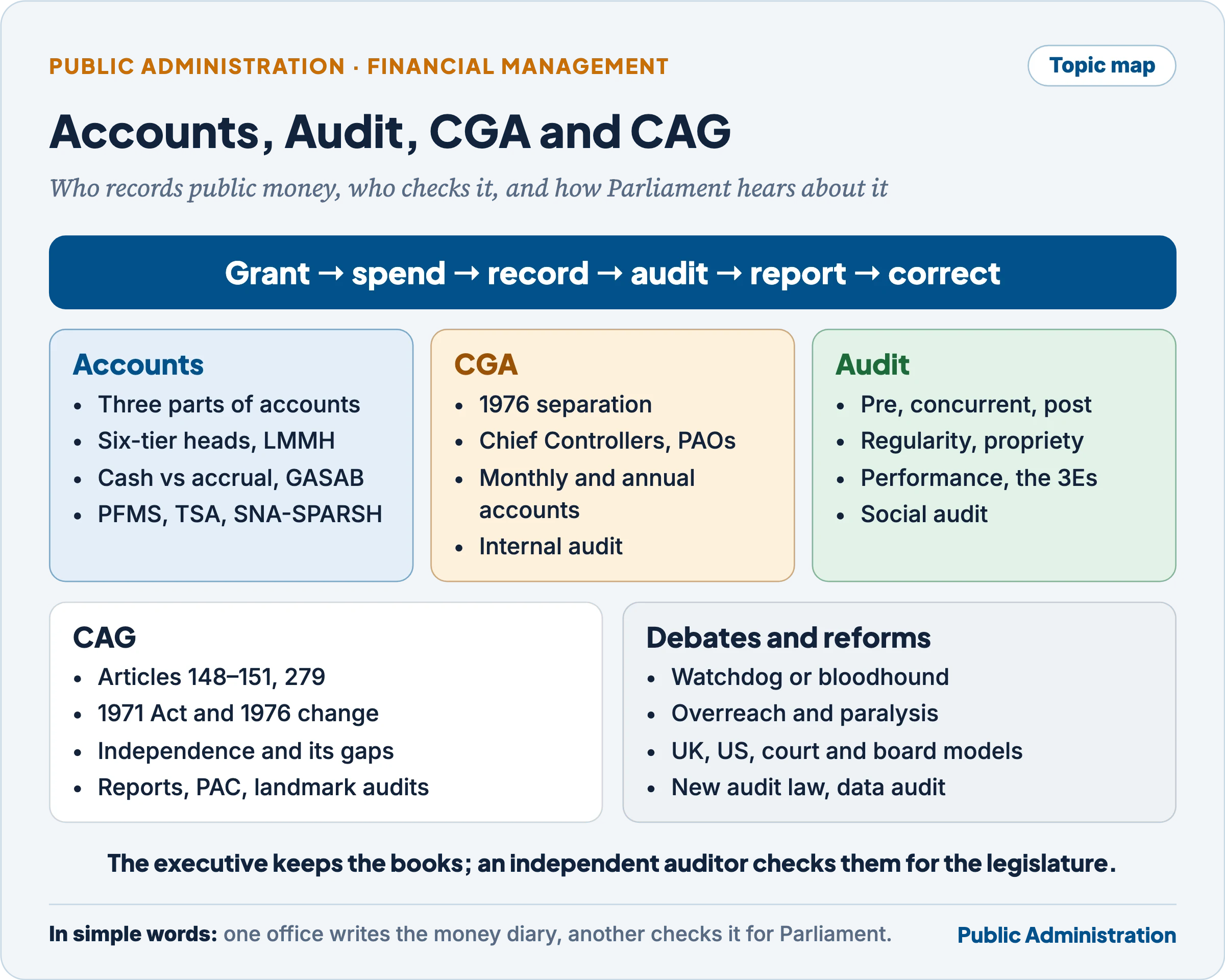
Parliament votes money in the budget, but a vote is only a promise. Whether the promise was kept is known from two later instruments: accounts, which record every rupee actually received and paid, and audit, which independently checks those records and the decisions behind them. In India the first job belongs mainly to the executive, led by the Controller General of Accounts (CGA) in the Ministry of Finance; the second belongs to a constitutional authority outside the executive, the Comptroller and Auditor General of India (CAG). Together they close the loop of the power of the purse: grant, spend, record, verify, report, correct.
- What sits elsewhere. The budget as a political instrument, parliamentary control (cut motions, guillotine, the PAC, Estimates Committee and COPU) and the Finance Ministry’s role in monetary and fiscal policy form the other half of this unit. In short: Parliament grants money through the Appropriation and Finance Acts, the Finance Ministry controls its release and frames fiscal policy, and Parliament’s financial committees examine spending afterwards, relying heavily on the CAG. See the article on Budget as a Political Instrument, Parliamentary Control and the Finance Ministry.
- The theory of financial accountability (its meaning, the accountability chain and the general types of audit) is in the article on Financial Accountability, Accounts and Audit. This article stays with Indian institutions: how they are built, how they work and how they are being reformed.
In simple words
A housing society collects maintenance money from every flat. The treasurer pays the bills and keeps a register of every payment (accounts). Once a year an outside auditor, whom the treasurer cannot sack, checks the register against the bills and also asks why the society paid double for painting the gate (audit). The auditor’s report is read out at the general body meeting, where members question the committee (Parliament). The treasurer is like the CGA; the auditor is like the CAG.
1. Government Accounts: Purpose and Framework
In simple words
Government accounts are the official record of where public money came from and where it went. They are kept under fixed headings, the same across the Union and all States, so that anyone can compare what was spent with what Parliament allowed.
1.1 Meaning and purposes
- Accounts are statements of facts about money or things having money value; accounting is the process of recording, classifying and summarising financial transactions and interpreting the results.
- L.D. White, the American pioneer of public administration, in Introduction to the Study of Public Administration (1926), listed the purposes of public accounts. Put in Indian terms:
- to record every transaction faithfully;
- to protect honest officials handling cash and expose dishonest ones (fidelity);
- to show the financial condition of each department;
- to keep spending within the grant and allow adjustment of the pace of spending during the year;
- to give information to decision-makers for future plans;
- to make audit possible.
- The PYQ statement that accounting produces “promptly and clearly the facts relating to financial conditions and operations that are required as a basis of management” captures the modern view: accounts are a tool of management, not only a record for the auditor.
- Promptness matters because a manager who learns about overspending six months later cannot correct it.
- Clarity matters because accounts that only a trained accountant can read do not help a Secretary, a minister or a legislator.
- This is the logic behind departmentalisation (1976), monthly accounts, PFMS dashboards and the push for accrual-based information.
1.2 How government accounting differs from commercial accounting
Government and business both keep accounts, but for different reasons, and so they keep them differently.
| Basis | Commercial accounting | Government accounting in India |
|---|---|---|
| Main aim | Profit or loss and net worth | Compliance with the legislature’s appropriation; fiscal result (surplus or deficit) |
| Basis | Accrual | Cash (receipts and payments) |
| Entry system | Double entry (every transaction has a debit and a credit) | Largely single entry under functional heads; double entry only in commercial departments and proforma accounts |
| Classification | By ledger account, customer, product | By function, programme, scheme and object (the six tiers) |
| Statements | Profit and loss account, balance sheet | Finance Accounts, Appropriation Accounts, monthly accounts |
| Assets and liabilities | Fully shown | Only partly disclosed in statements |
- The table shows why the debate on reform is not just technical. A cash, single-entry system is excellent for checking whether money voted was spent within the vote, the classic parliamentary question. It is poor at answering the management questions of cost, assets and liabilities, which a welfare and infrastructure state now needs.
- Commercial departments (for example the Railways’ workshops, departmental undertakings) keep proforma accounts on commercial lines (trading, profit and loss, balance sheet) so that their real cost and efficiency can be judged. Cost accounting, which allocates costs to activities, is used selectively.
1.3 The three parts of government accounts
The Constitution itself decides the basic shape of the accounts. Every rupee of the Union (and of each State) sits in one of three parts.
| Part | Article | Contents | Legislative control |
|---|---|---|---|
| Consolidated Fund of India | 266(1) | All revenues, all loans raised (market loans, treasury bills, external loans), all repayments of loans given; all expenditure | No withdrawal without an Appropriation Act (Article 114); charged items not voted |
| Contingency Fund of India | 267(1) | An imprest at the President’s disposal for urgent, unforeseen spending; set up by the Contingency Fund of India Act, 1950; corpus ₹30,000 crore after the Finance Act, 2021 | Advances recouped once Parliament authorises the expenditure |
| Public Account of India | 266(2) | Money the government holds as banker or trustee: provident funds, small savings, deposits, reserve funds, remittances | No appropriation needed, since the money is not the government’s own; still audited |
- States have their own Consolidated Fund, Contingency Fund and Public Account under the same Articles.
- The three-part structure is the first thing a classification code reveals: the first digit of a major head separates revenue receipts (0, 1), revenue expenditure (2, 3), capital expenditure (4, 5), loans and advances (6, 7) and the Contingency Fund and Public Account (8).
1.4 The accounts produced: monthly to annual
- Initial accounts are kept by Pay and Accounts Offices (PAOs) in each ministry (and by treasuries in the States).
- Monthly accounts of the Union are consolidated by the CGA and released on its website, giving the public and the Finance Ministry an early reading of receipts, expenditure and the deficit during the year.
- Annual accounts are of two kinds, and both go to the CAG for audit and certification before they are laid before Parliament.
| Basis | Finance Accounts | Appropriation Accounts |
|---|---|---|
| Question answered | What is the overall financial position? | Did spending stay within each grant voted or charged? |
| Contents | Receipts and disbursements under every head; balances of the three Funds; debt, guarantees, loans | Grant-by-grant comparison of authorised and actual spending, with reasons for savings and excesses |
| Union (civil) | Compiled by the CGA | Prepared by ministries; consolidated by the CGA (Railways, Defence and Posts prepare their own) |
| States | Prepared by the CAG’s Accountants General (Accounts and Entitlement) | Same |
| Then | Certified by the CAG; laid under Article 151 | Audited by the CAG; examined by the PAC; excesses regularised under Article 115 |
- The CGA also publishes “Accounts at a Glance”, a short annual digest of the Union’s accounts in charts and tables for non-specialists.
2. Accounting Techniques
In simple words
Accounting techniques are the rules for writing the money diary: when to write an entry, under which heading, and with what details. India’s choices here decide how quickly the government learns what it has spent and how much it really owes.
2.1 Classification: the six tiers and the List of Major and Minor Heads
Until 1974 Indian accounts were classified mainly by the department and the object of spending (salaries, travel, supplies), a structure inherited from British rule. It suited a law-and-order state but could not show what the money was achieving. The 1st ARC, in its report on Finance, Accounts and Audit (1968), linked accounting reform to performance budgeting and asked that major heads reflect functions and minor heads programmes. A government team accepted the idea, and a revised accounting structure came into force on 1 April 1974.
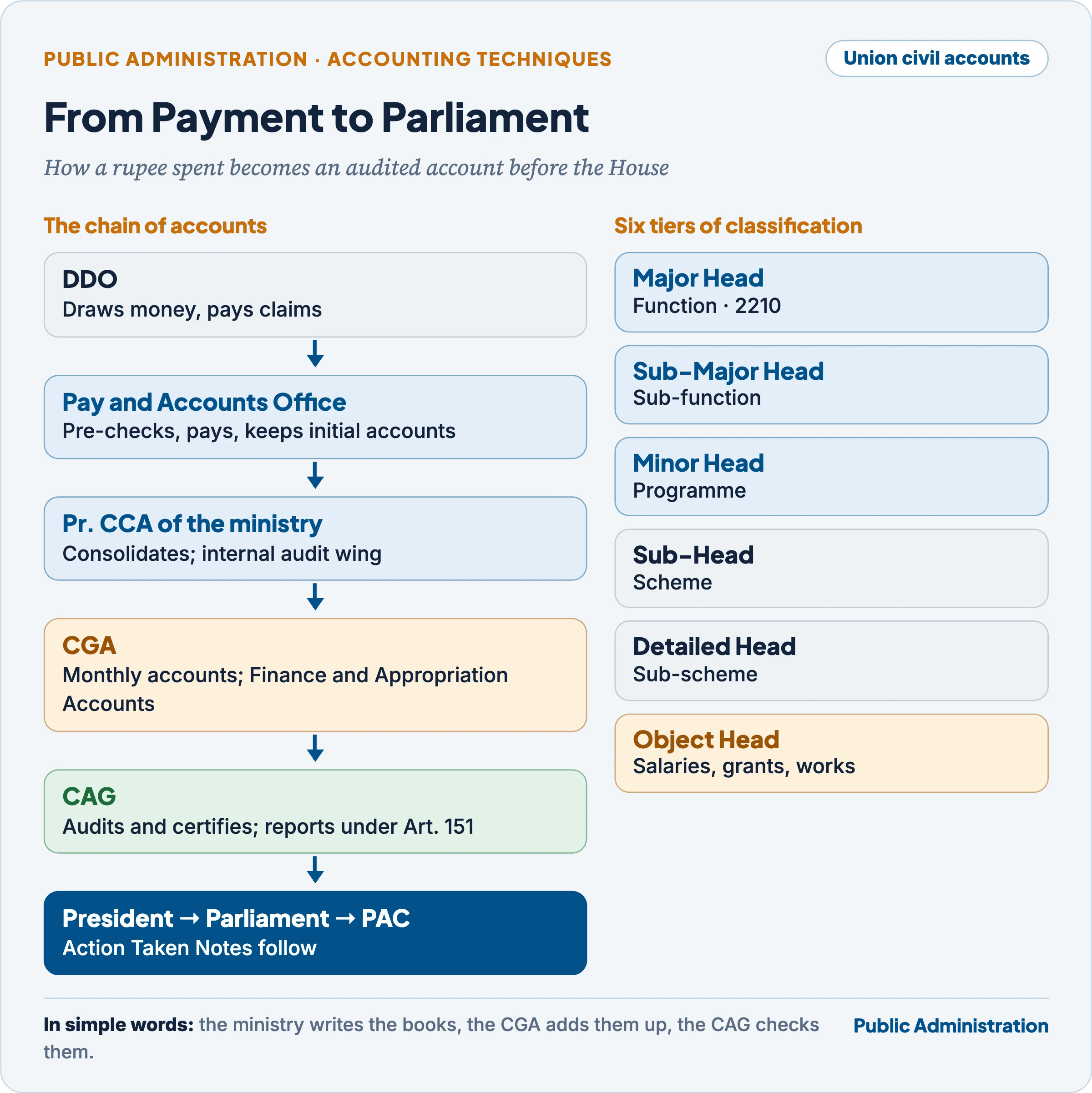
- Sectors: General Services, Social Services, Economic Services, and Grants-in-aid and Contributions (with sub-sectors).
- The six tiers (now used):
- Major Head (four digits): a function of government, such as 2210 Medical and Public Health;
- Sub-Major Head (two digits): a sub-function;
- Minor Head (three digits): a programme;
- Sub-Head: a scheme;
- Detailed Head: a sub-scheme or activity;
- Object Head (two digits): the object on which money is spent (salaries, office expenses, grants-in-aid, major works), which preserves item-wise control.
- List of Major and Minor Heads (LMMH): the master list, maintained by the CGA, common to the Union and all States down to the minor-head level. Opening or changing a major or minor head needs the CAG’s advice under Article 150. The list is amended through numbered correction slips almost every month (new heads for new schemes, funds and pension systems).
- Illustration (codes real, example illustrative): a district hospital’s medicines are booked under 2210 (revenue spending on Medical and Public Health); building a new ward goes under 4210 (capital outlay on the same function); a loan to a State health corporation would go under 6210. One function, three kinds of transaction, three first digits.
- Why uniformity matters: it lets the CAG, the Finance Commission and the RBI compare and consolidate the accounts of the Union and 28 States, and it prevents a government from hiding spending under a vague head.
- After 2017–18, the Plan and Non-Plan distinction was dropped; schemes are now classified as Central Sector and Centrally Sponsored, with revenue and capital kept separate.
2.2 Cash, accrual and modified bases
The three bases.
- Cash basis: a transaction is recorded when cash is received or paid. It is simple and objective, and it matches the way Parliament votes money (cash for the year).
- Accrual basis: a transaction is recorded when the economic event happens, when value is earned, used up, transferred or owed, whether or not cash moves. Assets are capitalised and depreciated; receivables and payables are recorded; liabilities such as pensions are recognised.
- Modified cash or modified accrual: a halfway house, keeping cash accounts but adding statements on assets, liabilities, guarantees and arrears.
A worked example (illustrative figures). A State health department receives ambulances worth ₹20 crore on 20 March but pays the supplier on 15 April.
- Cash accounts show nothing in the year the ambulances arrived and ₹20 crore of expenditure in the next year. The first year’s deficit looks better than it was.
- Accrual accounts show, in the first year, an asset of ₹20 crore and a liability of ₹20 crore to the supplier; thereafter the ambulances are depreciated over, say, eight years, so each year’s operating cost includes the wear on them.
Why accrual is pressed for.
- Hidden liabilities: cash accounts do not show unpaid bills, pension obligations, guarantees to public enterprises or arrears to contractors. A government can improve its deficit simply by deferring payments or by advancing one-time receipts.
- Full cost of services: without depreciation and accrued costs, a ministry cannot know what a hospital bed-day or a kilometre of road really costs, so outcome budgeting and performance audit lack a cost base.
- Asset stewardship: roads, buildings and equipment bought with public money vanish from cash accounts on the day of payment; nobody is accountable for maintaining them.
- Intergenerational fairness: the true burden passed to future taxpayers becomes visible.
Why caution is advised.
- Valuation problems: heritage, defence and infrastructure assets are hard to value; disputed tax demands raise the question of when revenue is “earned”.
- Judgement replaces fact: estimates of pension liability or impairment involve assumptions that can themselves be manipulated.
- Cost and capacity: asset registers, standards, software and trained staff across thousands of offices and 28 States are expensive.
- Parliament votes cash: unless budgeting also moves to accruals, the two must be reconciled every year. For these reasons many experts favour running cash and accrual statements in parallel during a long transition.
The Indian roadmap.
- Government Accounting Standards Advisory Board (GASAB): constituted by the CAG on 12 August 2002 with the support of the Government of India, under the CAG’s role in Article 150. It is chaired by a Deputy CAG and includes the heads of the organised accounting services (civil, defence, railways, posts and telecom), the Finance Ministry, the RBI and States.
- Twelfth Finance Commission (C. Rangarajan, 2004) recommended accrual accounting for the Union and States; the Union accepted it in principle and asked GASAB for an operational framework and a roadmap. The Thirteenth Finance Commission and the 2nd ARC (2009) endorsed a phased move with pilots.
- Two families of standards:
- Indian Government Accounting Standards (IGAS), for the cash system, become mandatory once notified by the Finance Ministry. Four have been notified: IGAS 1 (disclosure of guarantees), IGAS 2 (accounting and classification of grants-in-aid), IGAS 3 (loans and advances) and IGAS 4 (prior-period adjustments). Others, such as IGAS 7 (foreign currency transactions) and IGAS 10 (public debt and other liabilities), await notification.
- Indian Government Financial Reporting Standards (IGFRS), for the accrual system (presentation of financial statements, property, plant and equipment, revenue, inventories, contingent liabilities), are recommendatory for pilot studies pending government decision.
- Present position: the Union and the States still keep cash-based accounts, now accompanied by growing disclosure statements (guarantees, liabilities, off-budget borrowing, asset registers). In practice India is moving towards a modified cash system rather than a big-bang switch.
- Natural resource accounting: GASAB has also prepared asset accounts for natural resources; compendia on water resources and on mineral and energy resources were released in 2024.
Indian Connect — Why GASAB sits with the CAG and not the Finance Ministry
Under Article 150 the form of accounts is prescribed by the President on the advice of the CAG. Standard-setting therefore begins in the CAG’s office: GASAB drafts a standard after consultation, the CAG advises, and the Ministry of Finance notifies it, after which it binds the Union and the States. This splits the roles neatly: the auditor designs the rules of recording, the executive adopts and applies them, and the auditor then checks compliance. The weakness is speed: several standards approved by GASAB have waited years for notification, which shows that accounting reform depends on the executive’s willingness as much as on technical readiness.
2.3 Digital accounting: treasuries, PFMS and just-in-time money
The biggest change in Indian accounting in the last two decades is not a change of basis but a change of speed and visibility. Computerised treasuries and a single national platform now let the government see money moving almost in real time.
- Computerised treasuries. States built Integrated Financial Management Systems (IFMS) that link budget allocation, bill submission, treasury checks, e-payment and accounting. Bills are passed online against available budget, payments go straight to bank accounts, and the day’s transactions are accounted the same day.
- Public Financial Management System (PFMS). A web platform run by the CGA. It began in 2009 as the Central Plan Scheme Monitoring System to track releases under central schemes down to implementing agencies, was renamed PFMS, and grew into the platform for all Union payments, receipts and accounting, for Direct Benefit Transfer and for tracking scheme money in States.
- E-payments and e-receipts. Union ministries pay electronically through PFMS; non-tax receipts flow through the Bharatkosh Non-Tax Receipt Portal. Paper cheques and cash have nearly disappeared from Union payments.
- Treasury Single Account (TSA) for autonomous bodies. The Expenditure Management Commission (Bimal Jalan, report September 2015) recommended bringing autonomous bodies under a TSA to cut idle balances and borrowing costs. After pilots in the ICMR (February 2019) and IIT Delhi, the system covered 149 autonomous bodies by February 2022. The money stays in the government’s account until the body actually pays a vendor or beneficiary, which ends the parking of grants in bank deposits.
- Single Nodal Agency (SNA), 2021. By a Department of Expenditure order of 23 March 2021, every State designates one nodal agency and one bank account for each Centrally Sponsored Scheme; all implementing agencies draw from it, and PFMS shows the balance.
- SNA-SPARSH, 2023. Notified on 13 July 2023, it integrates State IFMS, PFMS and the RBI’s e-Kuber. The Centre’s share is released “just in time”, only when a payment to an end-beneficiary is actually due, and unspent money lapses at the end of the year. A similar hybrid TSA model is being extended to Central Sector Schemes (2024–26).
- The gain. The Finance Secretary reported in June 2022 that the new system saved about ₹10,000 crore of interest in 2021–22, because the government no longer borrowed money only to see it lie in agency accounts.
Indian Connect — Computerisation of treasuries: has it revolutionised accounting and budgeting?
Yes, in four ways. Accounts are current (daily rather than months late); fund flows are traceable to the last agency; cash management has become precise, so borrowing falls; and the audit trail is complete, allowing the CAG to analyse whole databases instead of samples. But not fully. The system is only as good as the data entered (the CAG’s 2023 audit of Ayushman Bharat found invalid entries in the beneficiary database); States differ widely in IFMS quality; just-in-time release can delay field work when sanctions are slow; and accounting basis has not changed: the books are still cash-based, so digital speed has not yet produced cost and liability information. Computerisation has transformed the plumbing of public money; the accounting philosophy is changing more slowly.
2.4 Management accounting in government
- Management accounting is the use of accounting data, past and projected, to help managers plan, control and decide: cost per output, variance between plan and actual, trends in expenditure, cash forecasts.
- In government it means accounts that answer a Secretary’s questions (which schemes are under-spending, which districts lag, what each unit of service costs), not only Parliament’s question (was the vote exceeded).
- Departmentalisation (1976) was explicitly justified as a step to management accounting: the ministry that spends should own the accounting machinery so that information reaches its managers quickly.
3. Separating Accounts from Audit and the Controller General of Accounts
In simple words
Until 1976 the national auditor also wrote the Union’s account books, so he was checking his own work. In 1976 the job of keeping accounts was handed to the ministries themselves, under a new officer, the Controller General of Accounts, and the auditor was left free to audit.
3.1 The combined system and why it was questioned
- From 1860, when the first Auditor General, Sir Edward Drummond, took charge, the same office handled accounts and audit. The Government of India (Audit and Accounts) Order, 1936 continued this, and after 1950 the CAG compiled the accounts of the Union and all States as well as auditing them. Railways and Defence were exceptions with their own accounts.
- Case for the combination: economy; uniform accounting across a federation under one authority; an accounts office independent of the spending department cannot be pressured to pass doubtful claims; pre-audit of claims is itself an audit process.
- Case against:
- an auditor who compiles the accounts he audits cannot be fully independent;
- accounting is an executive function, audit a quasi-parliamentary one; mixing them blurs responsibility;
- accounts kept outside the ministry reached its managers late, so ministries could not use them for control or performance budgeting;
- accounting duties brought the audit department partly under the Finance Ministry’s influence;
- the department that spends money should be the one that accounts for it.
3.2 The 1976 reform
- June 1975: the Union Cabinet approved a scheme for departmentalised accounts.
- 1976: the change was made by Ordinance and then by two statutes:
- the CAG’s (Duties, Powers and Conditions of Service) Amendment Act, 1976, under which, using the proviso to Section 10 of the 1971 Act, the President relieved the CAG of compiling Union accounts;
- the Departmentalisation of Union Accounts (Transfer of Personnel) Act, 1976, assented to on 8 April 1976 and deemed in force from 1 March 1976, which moved staff from the Indian Audit and Accounts Department to the ministries.
- Phasing: ministries came under the scheme in stages during 1976, and all civil ministries, including Posts and Telegraphs, by the end of the year.
- New organisation: an office of the Controller General of Accounts in the Department of Expenditure, and the Indian Civil Accounts Service (ICAS), carved out of the Indian Audit and Accounts Service and constituted as a Group A service in April 1977, recruited since then through the Civil Services Examination. ICAS marks 1 March as Civil Accounts Day.
- Constitutional follow-up: the 42nd Amendment (1976), effective 1 April 1977, rewrote Article 150 so that the President prescribes the form of accounts after consulting the CAG; the 44th Amendment (1978) strengthened this to “on the advice of” the CAG.
- States: the reform covered the Union only. In most States the CAG’s Accountants General (Accounts and Entitlement) still compile State accounts, but the accounts and audit wings were separated inside the CAG’s department (from 1984) so that the office that compiles a State’s accounts does not audit them.
Common confusion
Who prescribes the form of government accounts: the CAG or the President? Under the original Article 150 (1950) the CAG prescribed the form of accounts with the approval of the President. The 42nd Amendment made the President the prescribing authority after consultation with the CAG, and the 44th Amendment changed “after consultation with” to “on the advice of” the CAG. So today the President (in practice the Union government) prescribes, but only on the CAG’s advice. This is why GASAB’s standards and any change in major and minor heads pass through the CAG.
Assessment of departmentalisation.
| Gains | Problems |
|---|---|
| Independence of audit: the CAG audits accounts he did not prepare | Internal checks weakened: payment, accounting and internal audit now sit inside the same ministry |
| Responsibility: the spender accounts for the spending; Secretary answerable as Chief Accounting Authority | Staff and cost rose; two organisations where there was one |
| Speed: monthly accounts available quickly to ministries | States lagged, so the Union and States follow different models |
| Management accounting and later PFMS became possible | The quality of internal audit has stayed weak |
| Audit concentrates on audit, including performance audit | Some loss of the uniformity a single accounts authority gave |
- On balance, the separation is regarded as a success at the Union level: it made the CAG a purely external auditor, a position closer to the Lima Declaration’s idea of an independent supreme audit institution, and it gave ministries the data base on which digital PFM was later built.
3.3 The accounting set-up inside a ministry
After 1976 each civil ministry runs its own payment and accounting organisation. The Integrated Finance scheme, introduced by a Department of Expenditure order of 6 October 1975, placed a Finance Ministry nominee inside every ministry and tied the new accounts set-up to him.
| Functionary | Role |
|---|---|
| Secretary | Chief Accounting Authority; responsible for all transactions, the accounts and their certification; principal witness before the PAC |
| Integrated Financial Adviser (IFA) | Finance officer answerable to both the Secretary and the Finance Ministry; budget, expenditure control, scheme appraisal, outcome monitoring; heads the finance and accounts set-up on the Secretary’s behalf |
| Principal Chief Controller / Chief Controller / Controller of Accounts | Heads the ministry’s accounting organisation: Principal Accounts Office, Pay and Accounts Offices, monthly and annual accounts, Appropriation Accounts, internal audit wing, PFMS operations |
| Principal Accounts Officer | Consolidates the accounts of the ministry’s PAOs; manages the ministry’s bank and cash arrangements |
| Pay and Accounts Officer (PAO) | Pre-checks and makes payments; keeps initial accounts |
| Drawing and Disbursing Officer (DDO) | Draws money for an office and pays staff and claims |
- One chain runs from the DDO to the Secretary (vertical integration), while the IFA and the accounts chief also answer to the Finance Ministry and the CGA (dual control), which keeps standards common across ministries.
3.4 The Controller General of Accounts
Position. The CGA, in the Department of Expenditure, is the principal accounts adviser to the Government of India. Under the Allocation of Business Rules, 1961, he or she is responsible for establishing and maintaining a technically sound accounting system for the Union, prescribing the principles, systems and form of accounts (subject to Article 150), and is the cadre controlling authority of the Indian Civil Accounts Service. The present CGA, T.C.A. Kalyani, a 1991-batch ICAS officer and earlier Principal Chief Controller of Accounts of the Home Ministry, took charge on 1 September 2025 as the 29th CGA, succeeding S.S. Dubey.
Mandate. The PYQ asks why the office is expected to strengthen public financial management. Its functions answer that question.
- Rules and standards: frames the Civil Accounts Manual, rules on receipts and payments, and the List of Major and Minor Heads; issues technical advice on accounting matters, which ministries must follow.
- Payments and receipts: runs the payment and receipt system of civil ministries through PAOs; manages the Union’s cash through PFMS and the RBI.
- Consolidation and reporting: consolidates monthly accounts of the Union and publishes monthly fiscal data; prepares the Union Government Finance Accounts and the Appropriation Accounts (Civil) for audit by the CAG; publishes Accounts at a Glance.
- Pensions: authorises and accounts for pensions of civil Central government employees through the Central Pension Accounting Office.
- Internal audit: sets norms for and coordinates the internal audit of civil ministries through the internal audit wings of the Chief Controllers.
- PFMS, TSA and SNA: owns the PFMS platform; operates the Treasury Single Account, Central Nodal Agency and SNA-SPARSH modules that track scheme money from the Consolidated Fund to the beneficiary.
- Follow-up of audit: coordinates ministries’ responses to CAG observations and PAC recommendations (Action Taken Notes).
- Capacity: trains accounts staff through the Institute of Government Accounts and Finance (set up in 1992) and manages the ICAS cadre.
Why the CGA matters for public financial management.
- Fiscal policy needs data: the deficit, debt and fiscal rules under the FRBM Act are measured from the accounts the CGA compiles. Late or wrong accounts mean late or wrong fiscal policy.
- Cash management: with TSA and SNA-SPARSH, the CGA’s systems decide when money leaves the Consolidated Fund, which reduces borrowing and interest.
- Transparency: monthly public accounts and dashboards let Parliament, the media and analysts follow spending in-year.
- Performance: linking PFMS data with scheme outputs is the base for outcome budgets and performance audit.
- Limits: the CGA’s writ runs only over civil ministries of the Union (Defence, Railways and Posts have their own accounts organisations; States have their own treasuries and the CAG’s Accountants General), and the accounting basis is still cash.
Indian Connect — The CGA and the CAG: two offices, one chain
The two offices are often confused because of their titles. The CGA is an executive officer inside the Finance Ministry who keeps the Union’s accounts and controls its payment system. The CAG is a constitutional authority outside the executive who audits those accounts and reports to Parliament. They are linked at three points: the CAG advises on the form of accounts (Article 150) and on accounting standards (GASAB); the CGA submits the Finance and Appropriation Accounts to the CAG for audit and certification; and the CGA coordinates the executive’s replies to the CAG’s findings. One records, the other verifies.
3.5 Internal audit and the Chief Controllers
- Meaning. Internal audit is the executive’s own continuous review of whether its controls, risks and operations work as intended. It reports to the Secretary, not to Parliament.
- In the Union, it is done by the internal audit wings under each Principal Chief or Chief Controller of Accounts, following norms set by the CGA. It covers regularity, systems (procurement, inventory, IT controls) and, increasingly, risk-based reviews of schemes and fund flows to implementing agencies.
- Why it matters for performance:
- it is concurrent, so a loss can be stopped before it occurs;
- it reviews systems, not only transactions, so it improves service delivery;
- a sound internal control system lets the CAG rely on it and focus external audit on high-risk areas;
- it supports risk management: the riskiest activities are audited first.
- Weaknesses: internal audit in India has largely stayed a routine regularity check, short of staff and skills, and not independent of the management it reviews; in many States it barely exists beyond treasury pre-checks.
- Reform ideas: a CAG-led Task Force (2006) found internal audit narrow and ignored by management; the 2nd ARC’s 14th Report (2009) recommended a professionally qualified Chief Internal Auditor in each ministry, an Audit Committee in each ministry, and a full move to risk-based internal audit; the CAG’s own standards since then expect auditees to maintain internal control systems that external audit can assess.
- Internal vs external audit in one line: internal audit helps the manager run the ministry; external audit helps the legislature hold the ministry to account. Neither replaces the other.
4. Audit: Meaning, Roles and Types
In simple words
Audit is a check by someone who did not do the work. In government, it asks three questions about public money: was it spent as the law allowed, was it spent sensibly, and did it achieve anything.
4.1 Meaning and roles
- Audit is an independent examination of accounts, records and decisions to discover and report unauthorised, illegal, irregular or wasteful spending and unsound practices, and increasingly to judge performance.
- James C. Charlesworth, the American political scientist, gave the classic appropriation-centred definition: audit is the process of finding out whether the administration has spent, or is spending, its funds in accordance with the terms of the legislative instrument that appropriated them. It ties audit to the legislature’s grant.
- Audit as part of legislative and external control: audit is the means by which Parliament, which cannot itself inspect thousands of offices, gets a trusted, expert account of the executive’s financial conduct.
- S.L. Goel, the Indian writer on financial administration, distinguished three roles:
- preventive audit, which finds procedural and methodological errors so they are not repeated;
- curative audit, which detects embezzlement and leads to disciplinary action;
- promotive audit, which suggests new procedures and helps administrative improvement.
- Ashok Chanda, CAG from 1954 to 1960, argued that mature democracies treat audit not as a necessary evil but as a valued ally of administration; audit and administration play complementary roles in toning up government.
Is auditing about finding faults? The Paper I question on this point turns on the modern view of audit.
- The traditional image of audit is fault-finding: catching irregular payments, missing vouchers and frauds.
- The professional view is broader: audit gives assurance that financial information is accurate, complete and reliable, so that legislators, citizens, lenders and managers can trust it. The certification of the Finance Accounts is assurance, not accusation.
- Faults still matter: assurance is credible only because the auditor is willing to report errors and misconduct. But the aim is reliable information and better systems, not blame for its own sake. This is the meaning of Lord Justice Lopes’s line in the English Kingston Cotton Mill case (1896) that an auditor is “a watch-dog, but not a bloodhound”.
4.2 Types of audit
Audits can be classified by when they happen, who does them, and what they examine. The three ways of classifying overlap: a single CAG performance audit is external, post-facto and performance-focused at the same time.
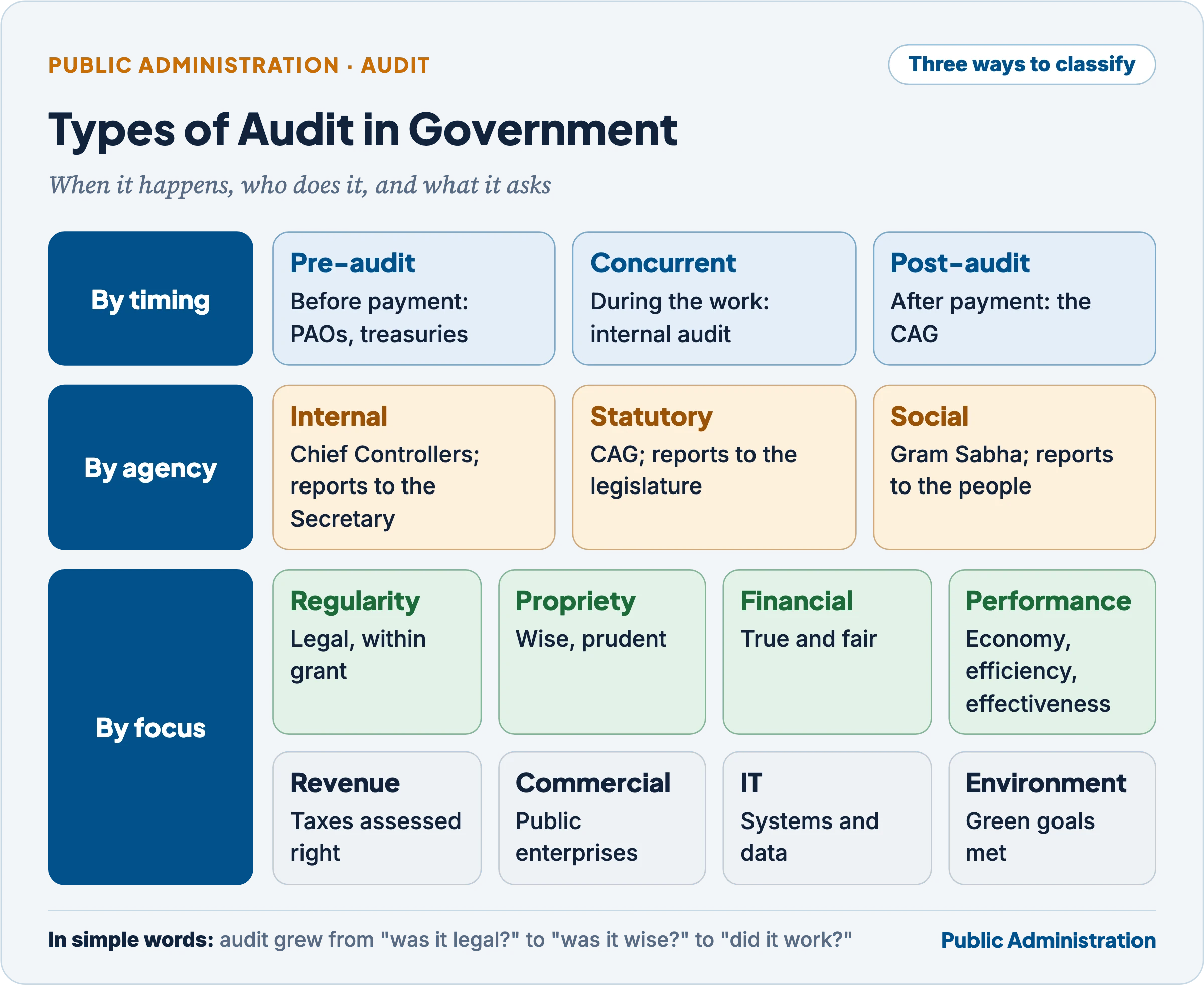
By timing.
- Pre-audit: checking a claim before payment. In the Union it is done by PAOs; in States by treasuries. It prevents wrong payments but can slow work.
- Concurrent audit: checking during a programme or transaction, typically by internal audit or for large projects; it allows mid-course correction. The CAG’s July 2009 study report on Commonwealth Games preparedness, sent to the government before the Games, was an unusual concurrent-style audit.
- Post-audit: checking after payment and closure of accounts; the CAG’s statutory audit is essentially post-audit, which is why it is called a post-mortem.
By agency.
- Internal audit by the executive’s own wings (Section 3.5).
- External statutory audit by the CAG, independent and reporting to the legislature.
- Social audit by the community (Section 4.5).
By focus.
| Type | Question asked | Indian example |
|---|---|---|
| Regularity (compliance) audit | Was spending legal, within the grant, sanctioned by a competent authority, supported by vouchers? | Expenditure without sanction; drawal beyond the grant |
| Propriety audit | Was it wise, faithful and economical, as a prudent person would spend his own money? | Contracts on single bids without justification (CWG, 2011) |
| Financial (attest) audit | Do the accounts present a true and fair view? | Certification of Finance and Appropriation Accounts; accounts of companies and autonomous bodies |
| Performance audit | Were the programme’s goals met with economy, efficiency and effectiveness? | Bharatmala and Ayushman Bharat audits (2023) |
| Revenue (receipt) audit | Were taxes assessed and collected correctly? | Under-assessment of income tax; GST refunds; exemptions to banks and NBFCs (2026 report) |
| Commercial audit | Are public enterprises run efficiently and their accounts correct? | Supplementary audit of central public sector enterprises |
| IT audit | Are computerised systems reliable, secure and controlled? | Audits of PFMS, IFMS, beneficiary databases |
| Environmental audit | Are environmental laws and goals met? | Audits of river cleaning, pollution control, mining |
4.3 Propriety audit: what sets the CAG apart
- Regularity audit is obligatory: the CAG must check that money was legally available and spent according to authority (Section 13 of the 1971 Act).
- Propriety audit goes further and judges the wisdom, faithfulness and economy of a decision. Its yardstick is the standards of financial propriety in the General Financial Rules, 2017, which require, among other things, that:
- every officer exercise the same vigilance over public money as a person of ordinary prudence over his own;
- spending be no more than the occasion demands;
- no authority sanction expenditure that directly or indirectly benefits itself;
- public money not be used for the benefit of a particular person or section unless the law permits.
- Why propriety distinguishes the CAG from a professional auditor: a chartered accountant certifies whether a company’s accounts are true and fair; he does not ask whether a board decision was wise. The CAG, acting for the legislature, can ask whether a lawful payment was nonetheless wasteful, extravagant or unfair. The CWG report of 2011 quoted exactly these canons to criticise decisions that were formally sanctioned.
- Why it is used with care: propriety involves judgement, so it is applied selectively; it is also the point at which charges of “second-guessing the executive” arise.
- The CAG’s authority is wider than a professional auditor’s for further reasons: it audits receipts, stores and stock as well as expenditure; it covers all levels of government; it reports to the legislature, not to shareholders; its findings feed a parliamentary committee that can summon Secretaries; and it carries out performance audit of whole programmes.
4.4 Performance audit: value for money
- Performance audit (also value-for-money or 3E audit; earlier called efficiency-cum-performance audit in India) examines whether programmes and organisations work with economy (inputs at least cost), efficiency (best ratio of output to input) and effectiveness (intended outcomes achieved). Many audit offices add equity and environment.
- In India it grew from the Five-Year Plans: once spending shifted to development programmes, checking individual vouchers “mistook the trees for the wood”, and Parliament wanted to know whether schemes worked. The CAG issued Performance Auditing Guidelines (2014) and adopted Auditing Standards (2017) in line with international standards.
- Relation with performance and outcome budgeting: a performance audit needs criteria, and an outcome budget supplies stated targets and indicators. The relationship is close but not absolute: auditors also draw criteria from scheme guidelines, statutes, norms and good practice, and the CAG ran performance reviews long before outcome budgets began (2005). The full argument is in the article on Financial Accountability, Accounts and Audit.
- Efficiency, effectiveness and equality are the three objectives most closely tied to accounting and finance: accounts measure costs (efficiency), performance audit measures results (effectiveness), and distributional analysis of spending shows who benefits (equality). An audit that looks only at cost can reward a cheap scheme that excludes the poorest.
4.5 Social audit (brief)
- Social audit is an audit by the people, especially beneficiaries: records are read out and verified against reality in a public meeting, and officials must answer.
- Legal basis: under Section 17 of MGNREGA (2005) the Gram Sabha conducted regular social audits; the MGNREGA Audit of Schemes Rules, 2011 were framed in consultation with the CAG, and Auditing Standards for Social Audit were notified in December 2016. MGNREGA was replaced from 1 July 2026 by the Viksit Bharat Guarantee for Rozgar and Ajeevika Mission (Gramin) Act, 2025 (VB-G RAM G), whose Section 20 again requires the Gram Sabha to conduct regular social audits of all works, with access to muster rolls, bills, measurement books, digital records and geo-tagged photographs.
- How it helps the CAG: social audit supplies ground truth (whether work exists, whether wages were paid) that a sample-based statutory audit cannot reach in lakhs of villages; the CAG in turn supplies standards, training and credibility, and can use social audit findings as evidence. Under flagship programmes the two are complementary.
- Why social audit is “more comprehensive” yet weaker: it looks beyond money to benefits, participation and dignity, and it includes people as auditors; but it often lacks legal teeth (no power to punish, slow follow-up), faces capture by local elites, and its quality varies across States. Its effectiveness rises where State social audit units are independent and findings lead to recovery and discipline.
- Statutory and social audit: not two sides of one coin, but two coins of different value that buy different things: statutory audit buys independence, expertise and parliamentary enforcement; social audit buys local knowledge, immediacy and citizen voice. Detailed treatment is in the article on Citizen’s Charters, Right to Information and Social Audit.
5. The CAG: Constitutional and Statutory Position
In simple words
The CAG is India’s national auditor. The President appoints him, but the government cannot remove him; only Parliament can, by a special majority. He checks the accounts of the Union, every State and many public bodies, and his reports go to Parliament and the State legislatures.
5.1 Evolution
- 1858–1860: after the Crown took over from the East India Company, the accounts and audit of India were reorganised; on 16 November 1860 Sir Edward Drummond assumed charge as the first Auditor General. The CAG now observes 16 November as Audit Diwas.
- Government of India Act, 1919: the Auditor General received statutory status, appointed by the Secretary of State in Council; the Public Accounts Committee was set up in 1921.
- Government of India Act, 1935: the Auditor General of India, appointed by the Crown and removable only like a Federal Court judge; the Audit and Accounts Order, 1936 set out his duties. The Constitution’s provisions are modelled on these.
- 1950: Articles 148–151 created the Comptroller and Auditor General of India; the first holder was V. Narahari Rao (1948–54).
- Constituent Assembly: B.R. Ambedkar told the Assembly in May 1949 that the CAG was “probably the most important officer” in the Constitution, more important than the judiciary in one sense, because he was to see that no money was spent without the legislature’s authority.
- 1971: the CAG’s (Duties, Powers and Conditions of Service) Act, under Article 149; 1976: amended to separate Union accounts from audit.
5.2 Articles and Acts at a glance
The CAG’s mandate is spread across the Constitution, the 1971 Act and other laws. The table brings them together with exact numbers.
| Provision | Content |
|---|---|
| Article 148(1) | Appointed by the President by warrant under his hand and seal; removable only in like manner and on like grounds as a Supreme Court judge |
| Article 148(2) | Oath before the President in the form in the Third Schedule |
| Article 148(3) | Salary and conditions fixed by Parliament by law; salary, leave, pension and age of retirement not to be varied to his disadvantage |
| Article 148(4) | No further office under the Union or any State after ceasing to hold office |
| Article 148(5) | Service conditions of the Indian Audit and Accounts Department and his administrative powers prescribed by the President after consulting the CAG |
| Article 148(6) | Administrative expenses of his office charged on the Consolidated Fund of India |
| Article 149 | Duties and powers in relation to the accounts of the Union, the States and any other authority or body, as Parliament prescribes |
| Article 150 | Form of accounts prescribed by the President on the advice of the CAG |
| Article 151(1), (2) | Reports on Union accounts to the President, who lays them before each House; on State accounts to the Governor, who lays them before the Legislature |
| Article 279 | CAG ascertains and certifies the net proceeds of taxes; his certificate is final |
| Articles 243J, 243Z | State laws to provide for maintenance and audit of accounts of Panchayats and Municipalities |
| CAG (DPC) Act, 1971: s.3 | Salary equal to a Supreme Court judge |
| s.4 | Term of six years or until age 65, whichever is earlier; may resign to the President |
| s.10, s.11, s.12 | Compilation of accounts (with the proviso used in 1976); preparation of annual accounts; information and assistance to governments |
| s.13 | Audit of all expenditure from the Consolidated Funds of the Union, States and Union Territories with legislatures; of Contingency Funds and Public Accounts; of trading and manufacturing accounts |
| s.14 | Audit of bodies substantially financed by grants or loans (at least ₹25 lakh a year and 75 per cent of the body’s spending; or, with approval, any body receiving at least ₹1 crore) |
| s.15 | Audit of grants and loans to check that their conditions are met |
| s.16 | Audit of receipts into the Consolidated Funds |
| s.17 | Audit of stores and stock |
| s.18 | Powers to inspect offices, call for records and put questions |
| s.19, s.19A | Audit of government companies (under company law) and statutory corporations; laying of reports on them |
| s.20 | Audit of other bodies on request of the President or Governor, or by entrustment |
| s.23 | Power to make regulations on the scope and extent of audit (Regulations on Audit and Accounts, 2007, amended 2020) |
| Companies Act, 2013, ss.139 and 143 | CAG appoints statutory auditors of government companies, issues directions, conducts supplementary audit and comments on their accounts |
| FRBM Act, 2003, s.7A (inserted 2012) | Government may entrust the CAG with periodic review of compliance with the Act |
- Unitary audit in a federation: unlike the United States or Australia, where States have their own auditors, India has one CAG for the Union and all States. Accountants General in the States are his officers. This gives uniform standards and federal supervision of State finances by a Union-level constitutional body, a design some States have questioned but the Constitution makes clear.
5.3 Appointment, tenure and removal
- Appointment: by the President, which in practice means on the advice of the Union Council of Ministers. The Constitution lays down no qualifications and no selection procedure.
- The Constituent Assembly debates suggest the framers expected a person with experience of finance and accounts. The first CAGs came from the Indian Audit and Accounts Service; most CAGs since the late 1970s have been IAS officers who had held senior Secretary-level posts.
- In 2013 a group of former senior officials, including a former Chief Election Commissioner, challenged the appointment of Shashi Kant Sharma, a former Defence Secretary, citing conflict of interest (defence audits) and the absence of a transparent procedure. The Delhi High Court (N. Gopalaswami v. Union of India, 13 August 2014) dismissed the petitions: no qualifications are prescribed, the President acts on ministerial advice, and nothing showed lack of integrity or competence.
- Tenure: six years or age 65 (Section 4 of the 1971 Act).
- Removal: only by the President after an address by each House of Parliament supported by a majority of the total membership and two-thirds of those present and voting, on grounds of proved misbehaviour or incapacity, as for a Supreme Court judge. No CAG has been removed.
- Recent holders: Vinod Rai (2008–13), Shashi Kant Sharma (2013–17), Rajiv Mehrishi (2017–20), Girish Chandra Murmu (2020–24), and K. Sanjay Murthy, a 1989-batch IAS officer and former Higher Education Secretary, sworn in on 21 November 2024.
5.4 Independence: safeguards and gaps
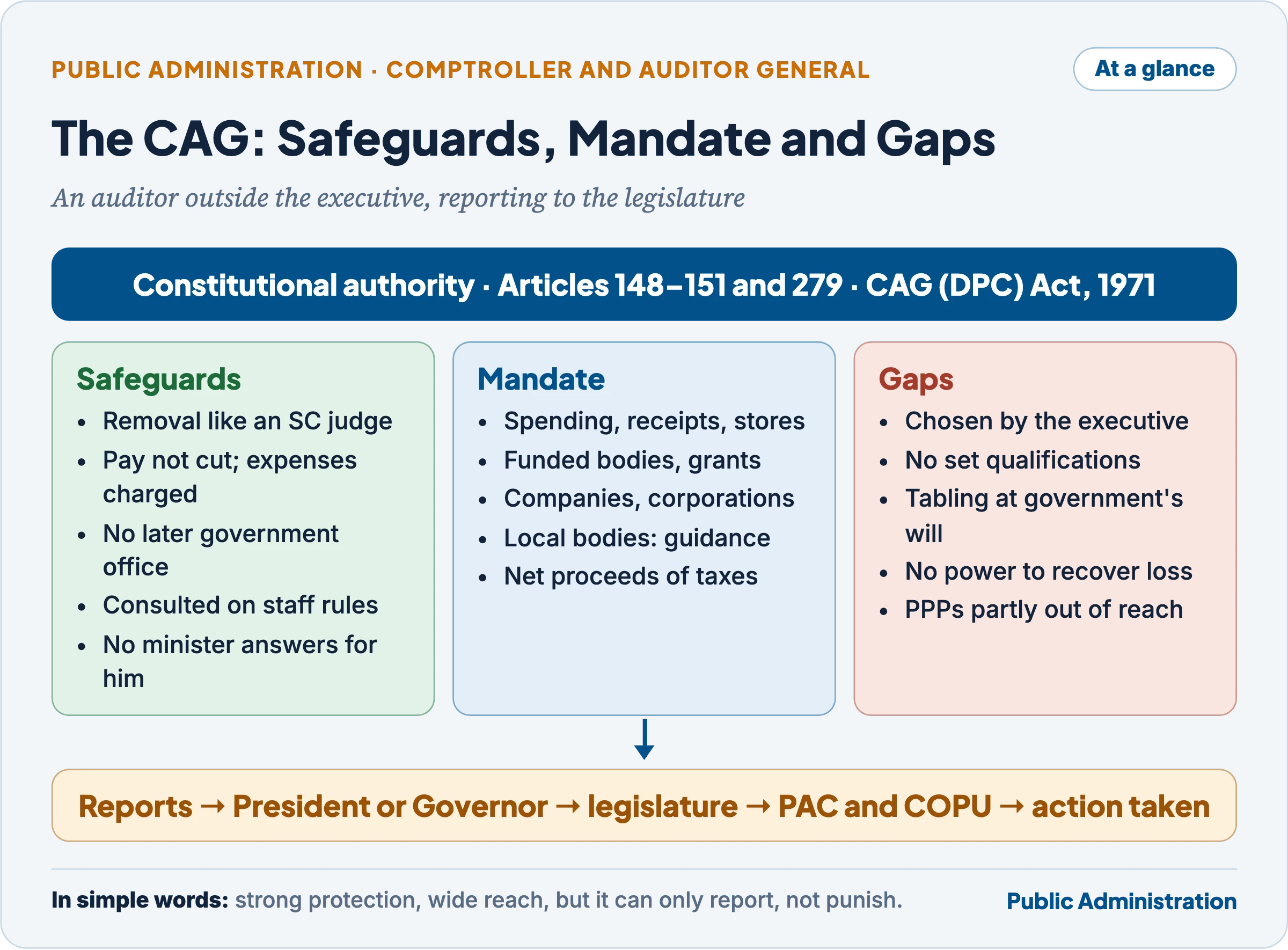
Safeguards.
- Security of tenure: he does not hold office at the President’s pleasure; removal needs a parliamentary special majority.
- Financial security: salary and service rights cannot be cut after appointment; his office’s expenses are charged, so Parliament cannot starve him through the vote.
- No post-retirement office under the Union or States, which removes the incentive to please the government.
- Control of his department: rules for the Indian Audit and Accounts Department are made only after consulting him; he frames his own audit regulations, standards and manuals (Section 23).
- No ministerial answerability for him: no minister represents the CAG in Parliament, and none can be asked to answer for his actions.
- Oath to the Constitution: like judges, he swears to uphold the Constitution and the laws.
Gaps.
- Appointment by the executive without criteria, consultation or a selection committee: the audited chooses its auditor.
- Tabling depends on the executive: reports go to the President or Governor, who lays them, in practice when the government decides. Several States have delayed inconvenient reports for months; the Delhi excise report of 2025 was tabled only after a change of government.
- Replies and access: ministries are not bound by law to reply to audit queries within a fixed time, and access to records of private partners depends on contracts and court rulings.
5.5 Organisation of the Indian Audit and Accounts Department
- Headquarters: the CAG, assisted by Deputy CAGs and Additional Deputy CAGs who head functional wings (Union audit, State audit, commercial, local bodies, government accounts, reports).
- Field offices: Principal Directors and Directors General of Audit for Union ministries, Defence, Railways and Posts; Principal Accountants General (Audit) and (Accounts and Entitlement) in each State.
- Service: the Indian Audit and Accounts Service (IA&AS), recruited through the Civil Services Examination, with subordinate audit cadres.
- Training and research: the National Academy of Audit and Accounts, Shimla; the International Centre for Information Systems and Audit, Noida; the International Centre for Environment Audit and Sustainable Development, Jaipur; and regional institutes.
- Professional framework: Regulations on Audit and Accounts (2007, amended 2020), Auditing Standards (2017), Performance and Compliance Auditing Guidelines, and an Audit Quality Management Framework that sets policies on leadership, ethics, staffing, audit performance and quality review in line with INTOSAI standards.
- Digital audit: the One IA&AD One System (OIOS) workflow platform, begun in November 2020 and used for the entire audit process from 1 April 2023; the CAG-Connect portal linking about 10 lakh auditee entities (2025); and an in-house CAG-LLM for audit analytics (under development).
- Specialised cadres: from 1 January 2026, two centralised cadres, Central Revenue Audit and Central Expenditure Audit, bring more than 4,000 audit professionals of the Union audit offices under single cadre control to build domain expertise.
6. The CAG at Work: Mandate, Reports and Parliament
In simple words
The CAG’s day job is to check a vast range of government offices, companies and bodies, write reports on what he finds, and send them to the legislature. Parliament’s Public Accounts Committee then picks the important findings, questions officials and asks the government to act.
6.1 What the CAG audits
- Union and State governments: all expenditure, receipts, stores, Contingency Funds and Public Accounts (Sections 13, 16, 17).
- Autonomous bodies substantially financed by government (Section 14) and grantees (Section 15): universities, research councils, development authorities, societies.
- Public undertakings:
- Government companies: the CAG appoints the statutory auditors (chartered accountants), may direct them, conducts supplementary audit and comments on their accounts; it also conducts compliance and performance audits of companies. Reports on central enterprises go to Parliament and are examined by the Committee on Public Undertakings (COPU).
- Statutory corporations under their own Acts (sole audit by the CAG for some, supplementary audit after chartered accountants for others, as each Act provides).
- The 1993 PYQ reflects an old debate: CAG audit of public undertakings is a strong instrument of parliamentary control, but critics in the enterprises argued that a government-department style of audit, focused on rules and individual transactions, encouraged caution, delay and fear of commercial risk, hurting efficiency. The 1st ARC response was a specialised Audit Board (1968) within the CAG’s department to bring commercial expertise to such audits. The article on Public Sector Undertakings: Evolution, Forms, Autonomy, Accountability and Control covers this.
- Local bodies: under Articles 243J and 243Z, State laws provide for audit of Panchayats and Municipalities, usually by a State Director of Local Fund Audit. On the Eleventh Finance Commission’s recommendation (2000), the CAG provides Technical Guidance and Support (TGS): setting standards, prescribing methods, training, and test-checking and supplementary audit of the primary auditor’s work, through entrustment under Section 20(1). Chapter 9 of the 2020 Regulations sets out the CAG’s role in local body audit; the Fifteenth Finance Commission made audited accounts available online a condition for local body grants.
- Revenue certification: net proceeds of taxes under Article 279.
- Accounts of States: compilation of State accounts (through Accountants General) and entitlement work (provident fund, pension authorisation) for State employees.
- Fiscal reviews: FRBM compliance reports for the Union (since 2014–15) and State Finances Audit Reports on every State’s debt, deficits, guarantees and off-budget borrowing.
- Requests: audits of other bodies on request (Section 20), and special audits ordered by courts in some cases.
- Limits of mandate: secret service expenditure, where the CAG accepts a certificate from the competent authority; private partners in PPPs, except so far as contracts and law allow; and bodies below the Section 14 thresholds.
6.2 Reports and the route to Parliament
- Products: compliance audit reports (Union civil, defence, railways, revenue, commercial; and each State), performance audit reports on schemes, financial audit reports on the accounts of the Union and States (for example the report on the Accounts of the Union Government tabled in April 2026), State Finances reports and periodic publications on State finances (a decadal compendium in September 2025 and a 2024–25 publication in June 2026).
- Process:
- field audit produces an inspection report to the auditee;
- serious points become draft paragraphs, sent to the Secretary for comment;
- the CAG finalises the audit report, signed by him, and sends it to the President or Governor;
- the report is laid before Parliament or the Legislature;
- the PAC (and COPU) selects paragraphs, takes evidence from Secretaries and reports;
- the government sends Action Taken Notes; the PAC reports on them.
- “Friend, philosopher and guide” of the PAC: the CAG or his officers sit with the PAC, brief it on each paragraph, suggest questions, and help draft its reports. Without the CAG’s expertise the PAC, made up of busy legislators, could not examine technical accounts; without the PAC, the CAG’s findings would lack a forum that can summon officials and press the government.
- How accountability is secured through CAG reports: the Council of Ministers is answerable to the Lok Sabha; the CAG’s reports turn that general answerability into specific, documented questions about named schemes, contracts and decisions; the PAC converts them into recommendations; and debate, media and courts carry them to the public. The chain is only as strong as its weakest link, which is usually follow-up.
- Why the office is “away from the public eye” yet among the most important: the CAG does not legislate, judge or govern, holds no press conferences on policy, and works through dense reports read mainly by committees. Yet every rupee of the Union and the States passes under its scrutiny, its reports are among the most credible public sources on how government works, and it is the institution through which the legislature’s control of money becomes real.
6.3 Landmark audits
The table shows the range of the CAG’s influence, from reports that shook governments to data-driven performance audits of welfare schemes.
| Report | Tabled | Core finding | What followed |
|---|---|---|---|
| Bofors gun purchase (defence audit) | 1989 | Irregularities in the howitzer contract | Major political consequences in the 1989 election |
| 2G spectrum (Report No. 19 of 2010) | 16 Nov 2010 | Licences issued in 2008 at 2001 prices; presumptive loss up to ₹1.76 lakh crore | JPC and PAC inquiries; CBI case; Supreme Court cancelled 122 licences (2012); trial court acquitted the accused (2017) |
| Commonwealth Games 2010 (Report No. 6 of 2011) | 5 Aug 2011 | Delayed decisions created artificial urgency; waivers, single bids, nomination contracts; weak governance model | Prosecutions of organisers; lessons for event governance |
| Coal block allocation | 17 Aug 2012 | Allocation without competitive bidding gave allottees a gain of about ₹1.86 lakh crore | Supreme Court cancelled 214 allocations (2014); auction law of 2015 |
| Rafale / IAF capital acquisition (Report No. 3 of 2019) | 13 Feb 2019 | 36-aircraft deal 2.86 per cent cheaper than the audit’s aligned price; prices redacted | Political debate; shows reach and limits of defence audit |
| Bharatmala Pariyojana Phase I (Report No. 19 of 2023) | 10 Aug 2023 | Cost escalation; Dwarka Expressway at ₹250.77 crore/km against ₹18.20 crore/km approved | PAC examination; ministry defended design changes |
| Ayushman Bharat–PM-JAY (Report No. 11 of 2023) | 8 Aug 2023 | Weak validation: about 7.5 lakh beneficiaries registered against one invalid mobile number; payments in death cases | Database and claim-system changes |
| Delhi Excise Policy 2021–22 | 25 Feb 2025 | Revenue loss of about ₹2,002 crore; expert advice ignored | Referred to the Delhi Assembly’s PAC |
6.4 Courts and the CAG
- Centre for Public Interest Litigation v. Union of India (Supreme Court, 2 February 2012): cancelled the 122 2G licences, relying in part on the CAG’s findings, showing that audit can trigger judicial correction.
- Arun Kumar Agrawal v. Union of India (Supreme Court, 9 May 2013): the CAG is an independent constitutional functionary, but its report is not gospel truth; it is always subject to scrutiny by Parliament, the government may offer its views, and the PAC may accept or reject its conclusions; courts should not grant relief merely on the basis of a CAG report.
- Association of Unified Telecom Service Providers of India v. Union of India (Supreme Court, 17 April 2014): licence fees and spectrum charges under revenue-sharing arrangements are receipts of the Consolidated Fund, so the CAG may examine the records of private telecom operators to verify the government’s share. This extended audit into private entities that share public revenue, a principle with obvious relevance to PPPs and natural-resource contracts.
- Manohar Lal Sharma v. Principal Secretary (Supreme Court, 2014): declared coal block allocations since 1993 illegal and cancelled 214 of them, upholding the substance of the audit criticism.
- N. Gopalaswami v. Union of India (Delhi High Court, 13 August 2014): upheld the appointment of the CAG; the absence of prescribed qualifications or procedure left the choice to the executive.
7. Debates: Watchdog or Bloodhound, Overreach and Paralysis
In simple words
People argue about the CAG in two opposite ways. Some say it is too weak: it can only write reports, years late, and nothing happens. Others say it is too strong: it second-guesses honest decisions and frightens officers into doing nothing.
7.1 Appleby versus Chanda
- Paul Appleby, the American scholar invited to review Indian administration, in Public Administration in India: Report of a Survey (1953) and Re-examination of India’s Administrative System (1956), argued that:
- audit and accounting are necessary but pedestrian functions with a narrow perspective;
- auditors and accountants cannot discover much of importance about administration; what auditors know is auditing, which is not administration;
- India placed an extraordinary reliance on audit inherited from colonial rule, and fear of audit produced a widespread and paralysing unwillingness to decide and act;
- better internal management, delegation and preventive design (he gave the example of collusion at a railway platform gate, better prevented by a turnstile than detected by an auditor) would do more than external audit.
- Ashok Chanda, then CAG, and later defenders replied that:
- in a poor country spending vast sums through a young bureaucracy, independent audit is the main safeguard against waste and corruption;
- audit enforces parliamentary supremacy, a basic feature of the Constitution, so it cannot be scrapped or relaxed to suit administrative convenience;
- mature democracies treat audit as a valued ally.
- Appleby’s proposals were not accepted; the CAG’s position was retained, but his critique lives on in every later charge of “audit paralysis”.
7.2 The overreach debate
- The charge (2010–2013 and after):
- the 2G and coal reports estimated presumptive losses (revenue foregone under a hypothetical alternative) that critics called speculative;
- the CAG questioned policy choices (first-come-first-served allocation, nomination of coal blocks, tariffs, PPP terms) that belong to the elected executive;
- reports were leaked or publicised before parliamentary scrutiny and became political weapons;
- ministers said in public that the CAG was going beyond its mandate; in November 2012 a minister of state even spoke of a multi-member CAG, a suggestion by former CAG V.K. Shunglu, before the government disowned the idea.
- The defence:
- quantifying the cost of a decision is part of propriety and performance audit, so that Parliament can judge it;
- the CAG does not question the objective of a policy but whether its execution was lawful, prudent and effective;
- the Supreme Court’s cancellation of the spectrum and coal allocations upheld the substance of the criticism even where the numbers were disputed;
- the remedy for disagreement is Parliament, as Arun Kumar Agrawal (2013) said: the PAC can reject a finding.
- Settlement in practice: since the mid-2010s the CAG has used presumptive-loss language more sparingly and emphasised systemic findings, data analytics and recommendations, while governments have accepted performance audit of flagship schemes.
7.3 Watchdog, not bloodhound
- The phrase, from the English Kingston Cotton Mill case (1896), means the auditor must be vigilant, sceptical and thorough, but need not assume dishonesty in every transaction or hunt individuals.
- For the CAG this implies: focus on systems and material risks rather than petty objections; give auditees a fair chance to explain; report balanced findings that note good practice; and leave investigation and punishment to the agencies and courts.
- It also implies the opposite duty: a watchdog that does not bark when it sees wrongdoing has failed. Hence the 1999 PYQ’s list of qualities, dignity, independence, detachment and fearlessness, which the constitutional safeguards exist to protect.
7.4 Does the CAG cause paralysis?
- The argument (2022 PYQ): officers fear that a decision taken in good faith under time pressure will later be judged by an auditor with hindsight, then picked up by the media, vigilance agencies and investigators. They therefore delay, refer files upward, prefer L1 bids over value, avoid PPPs and innovation, and seek cover in procedure. After the 2G and coal episodes, “policy paralysis” became a common complaint.
- Why the CAG is not the primary cause:
- audit has no power to punish; the fear comes mainly from criminal law (the old Prevention of Corruption Act provision on obtaining pecuniary advantage “without public interest”, amended in 2018), vigilance practice and media trials;
- paralysis also stems from unclear delegation, overlapping approvals and weak protection for bona fide decisions;
- the 2018 amendment and prior-sanction requirements for investigating officials were partly a response to this fear.
- Where audit contributes: compliance-heavy audit that ignores context, objections over trivial deviations, and reports that blur error, negligence and malfeasance.
- Balance: the answer lies in risk-based, outcome-oriented audit, clear criteria for good-faith decisions, quick audit (so officers can correct course), and better internal control, rather than weaker external audit. The CAG’s recent pre-audit engagement with auditees and audit advisories on procurement (on vendor registration, re-tendering and timely payment to contractors) point in this direction.
7.5 A “limited” office: the hobbled prosecutor
The 2011 PYQ quotes a pointed description of the CAG as a prosecutor with a law that hobbles it, a judge without the power to sentence and a litigant with no right of appeal. Each image matches a real limit.
- Prosecutor hobbled by law: the 1971 Act predates PPPs, joint ventures, societies and funds routed through Panchayati Raj institutions and NGOs; the CAG must rely on entrustment, contracts and court rulings for access; ministries need not reply to audit queries within any fixed time.
- Judge without power to sentence: the CAG can only report. Unlike the Board of Audit of Japan (which can demand indemnity and disciplinary action), the Cour des comptes of France (which can fine public managers for serious financial faults) or New Zealand’s former surcharge powers, it cannot recover losses, surcharge a negligent official or start disciplinary or criminal proceedings.
- Litigant with no right of appeal: if a ministry rejects an audit finding, or the PAC never takes it up, the CAG has no forum to press it further.
- Other limits:
- post-audit and delay: findings arrive years after the event, “dissection after rigor mortis”;
- PAC backlog: only a small share of audit paragraphs is ever examined; State PACs lag further;
- tabling at the executive’s discretion;
- no comptroller role: despite the title, the CAG has no control over the issue of money from the Consolidated Fund; in the UK the Comptroller still authorises the Treasury’s drawals, but in India money is drawn on the executive’s own authority and the CAG enters only at the audit stage;
- no prescribed qualifications or transparent selection;
- falling output: the number of reports on the Union tabled in some recent years has been well below the levels of the mid-2010s, which critics read as reduced scrutiny.
Criticism — Audit as an obstacle to administration
- Hindsight bias: decisions taken under uncertainty are judged with full knowledge of outcomes.
- Rule-mindedness: compliance auditors push officers to protect themselves with procedure rather than deliver results.
- Overreach: presumptive-loss figures and comments on policy turn an auditor into a political actor without political accountability.
- Paralysis: fear of adverse paragraphs, magnified by media and vigilance, slows decisions, especially in procurement and PPPs.
- Post-mortem and impotence: findings arrive late and lead to little action, so audit can become a ritual.
Defence — Audit as a guardian of democracy
- Power of the purse: without an independent auditor, Parliament’s control of money would end with the budget vote.
- Deterrence: the certainty of audit prevents much misconduct that never appears in any report.
- Systemic learning: performance audits of schemes such as PM-JAY and Bharatmala exposed design and data flaws that the executive then fixed.
- Credible information: CAG reports are often the only independent, documented account of how public money was used.
- Validated by institutions: courts upheld the substance of major audit findings, and Parliament retains the final word on each.
- Right remedy: clearer delegation, protection for good-faith decisions and better audit quality, not weaker audit.
8. Global Models and the CAG’s International Role
In simple words
Every democracy has a national auditor, but they are built in three main ways: a single auditor who reports to Parliament, a court that can punish, or a board of several members. India follows the first, with one important difference: its auditor is created by the Constitution rather than by Parliament.
8.1 Three models of supreme audit institutions
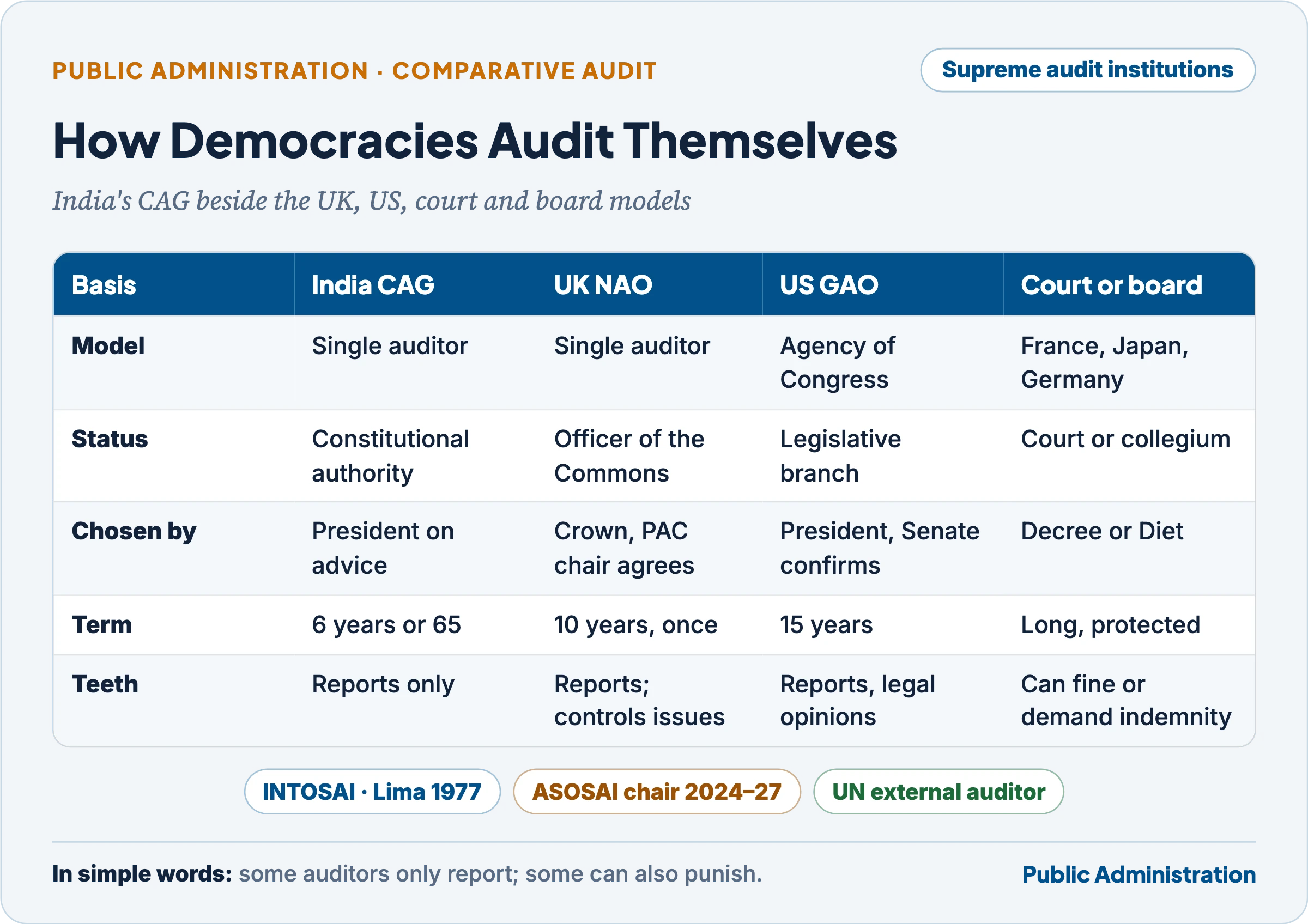
- Westminster (monocratic, parliamentary) model: a single Auditor General closely tied to Parliament and its PAC, reporting findings without judicial powers. India, the UK, Canada, Australia.
- Judicial model: a court of audit whose members are magistrates; it audits and can judge and sanction public accountants and managers. France, Italy, Spain, Portugal.
- Board (collegiate) model: a board decides collectively, without full judicial powers. Japan’s Board of Audit, Germany’s Federal Court of Audit, Indonesia’s BPK, South Korea’s Board of Audit and Inspection.
| Basis | India: CAG | UK: C&AG and NAO | USA: GAO | France: Cour des comptes |
|---|---|---|---|---|
| Legal base | Constitution (Arts 148–151); 1971 Act | Exchequer and Audit Departments Act 1866; National Audit Act 1983; 2011 Act | Budget and Accounting Act 1921; renamed Government Accountability Office 2004 | Constitution; Code of financial jurisdictions |
| Head’s status | Constitutional authority, not an officer of Parliament | Officer of the House of Commons | Head of a legislative-branch agency | First President of a court |
| Appointment | By the President on government advice | By the Crown on an address of the Commons moved by the PM with the PAC chair’s agreement | By the President from names proposed by a congressional commission; Senate confirmation | By decree; members are irremovable magistrates |
| Term | 6 years or age 65 | 10 years, non-renewable | 15 years | Career magistrates |
| Powers | Audit and report | Audit, value-for-money reports; real comptroller power over issues from the Consolidated Fund | Audits, investigations, legal opinions for Congress | Audit and jurisdictional powers to fine public managers |
| Budget | Charged on Consolidated Fund | Set by a parliamentary commission | Appropriated by Congress | State budget |
- Lessons for India: legislative involvement in appointment (UK, US), a long single term (UK, US), parliamentary control of the audit office’s budget (UK), and enforcement powers (France, Japan). India’s strengths that others lack: constitutional status and a unitary audit of the whole federation.
Common confusion
Is the CAG an “officer of Parliament”, like the UK’s Comptroller and Auditor General? Not formally. The UK’s C&AG has been an officer of the House of Commons since the National Audit Act, 1983, and works hand in hand with its PAC, which helps choose him. India’s CAG is a constitutional authority independent of both the executive and the legislature: appointed by the President, reporting through the President or Governor, and not subordinate to Parliament or its committees. He is often called an “agent” or “friend” of Parliament because his audit serves Parliament’s control of money, and only Parliament can remove him; but he is not its employee. His dual role, auditing for the legislature while also checking that subordinate authorities obey the executive’s own rules, places him between the two branches.
8.2 The CAG on the world stage
- INTOSAI (International Organisation of Supreme Audit Institutions, founded 1953; about 195 members): India is a founder member. The CAG sits on its Governing Board, chairs the Knowledge Sharing and Knowledge Services Committee, the Working Group on IT Audit and the Compliance Audit Subcommittee. INTOSAI’s Lima Declaration (1977) and Mexico Declaration (2007) on SAI independence are the benchmarks against which the Indian CAG is measured: strong on constitutional status and tenure, weaker on control over the timing of publication and on follow-up.
- ASOSAI (Asian Organisation of Supreme Audit Institutions, 48 members): the CAG of India took over as Chair for 2024–2027 at the 16th Assembly in New Delhi in September 2024.
- United Nations: the CAG was a member of the UN Board of Auditors in 1993–1999 and 2014–2020, chairing it in 2017 and 2018. It is now the external auditor of the WHO (2020–2023, re-elected for 2024–2027), the IAEA (2022–2027), the ILO (2024–2027), the FAO (2020–2025) and the OPCW, and a member of the UN Panel of External Auditors. A bid for the UN Board of Auditors for 2026–2032 was withdrawn on the Ministry of External Affairs’ advice.
- Other forums: the SAI20 engagement group, chaired by India during its G20 presidency (2023), the BRICS SAIs (India hosted the 5th BRICS SAI Leaders’ Summit in Bengaluru in May 2026, on ease of living and urban mobility), and bilateral agreements with about 29 SAIs.
9. Reforms: Proposed and Under Way
In simple words
Reformers want the auditor to be chosen more openly, to have a modern law with clearer powers, to reach new places where public money now goes, and to report faster using data. Some of this is already happening inside the CAG’s office; the legal changes are still pending.
9.1 Reform agenda
| Area | Proposal | Status |
|---|---|---|
| Selection | Prescribed qualifications; a broad-based selection committee (PM, Leader of Opposition, Chief Justice or PAC chair) | Sought in 2013 petitions; not adopted |
| Structure | Multi-member audit board like the Election Commission (Shunglu suggestion, 2012); critics fear dilution of a single accountable head | Not adopted |
| Modern audit law | Amend the 1971 Act (CAG’s 2010 proposals under Vinod Rai): replies within 30 days, time-bound tabling of reports, explicit mandate over PPPs, joint ventures and funds routed through PRIs and NGOs (estimated at over ₹80,000 crore a year in 2010) | Pending |
| Enforcement | Powers to summon officials, fix responsibility and recover losses, with appeal to a senior Deputy CAG; or statutory follow-up duties for departments | Pending |
| Tabling | Reports to be laid within a fixed time; or published by the CAG if not laid | Pending |
| Local bodies | Statutory role for the CAG in local body audit; strong State local fund audit; online audited accounts | TGS in place; Finance Commission conditions since 2020 |
| PAC capacity | Five-year PAC term, research staff, examination of all reports within a time limit | Partly discussed |
| Real-time audit | Use PFMS, GSTN, GeM and other databases for continuous, data-driven audit | Under way (OIOS, CAG-Connect, analytics, CAG-LLM) |
| Quality and specialisation | Audit Quality Management Framework; specialised cadres; certification programmes | Under way (cadres from 2026; IIT Madras certification, 2026) |
| Internal audit | Chief Internal Auditor and Audit Committees in ministries (2nd ARC) | Partly implemented |
- The 2nd ARC’s 14th Report (2009) asked for timely and balanced CAG reports, systematic tracking of pending audit paragraphs, and stronger internal audit so that the CAG could focus on high-risk areas.
9.2 Theory lens: accountability, agency and the independent auditor
The working of accounts and audit in India is explained by several Paper I ideas. Each throws light on a different part of the institution.
- Principal–agent theory (Michael Jensen and William Meckling, 1976). Citizens and Parliament (principals) delegate money to ministers and officials (agents) who know more about its use. Accounts are the agents’ report; audit is independent verification; the PAC is the principal’s sanction. The CAG’s constitutional independence exists because a monitor chosen and controlled by the agent would not reduce information asymmetry. The theory also explains the appointment controversy: in India the agent (the executive) chooses the monitor. See the article on Financial Accountability, Accounts and Audit.
- Accountability theory (Barbara Romzek and Melvin Dubnick, 1987). Their four types map neatly onto Indian institutions: hierarchical accountability through the IFA, the Chief Controllers and internal audit; legal accountability through the CAG’s regularity and propriety audit; professional accountability through accounting standards (GASAB) and auditing standards; and political accountability through the PAC and public debate. The Challenger study behind their typology showed how one form can crowd out another, much as compliance audit can crowd out professional judgement in the paralysis debate. See the article on Accountability and Control.
- The Finer–Friedrich debate (1940–41). Herman Finer argued for external, objective control; Carl Friedrich for inner professional responsibility. The CAG and PAC are Finer’s instruments; internal audit, financial advisers and accounting standards rely on Friedrich’s. The paralysis debate is this old argument in new form: too much external control breeds defensive compliance, too little invites misuse.
- Dicey’s rule of law and independent institutions. A.V. Dicey, in Introduction to the Study of the Law of the Constitution (1885), held that government must act under regular law, enforced by authorities independent of it. Articles 265 and 114 (no tax and no spending without law) are the financial rule of law; the CAG, like the judiciary and the Election Commission, is one of the independent constitutional guardians that make it real. See the article on Administrative Law: Meaning, Scope, Significance and Dicey.
- New Public Management and value for money (Christopher Hood, 1991). NPM’s stress on explicit standards, output controls and economy moved audit from compliance to performance and value-for-money audit, and accounting from cash towards accrual and full costing. India’s outcome budgets, performance audits and accrual roadmap all carry this stamp. See the article on New Public Management and After.
- The audit society (Michael Power, 1997). Power warned that audit can become a ritual of verification that produces comfort rather than control, and that organisations reshape themselves to be auditable rather than better. The growth of paperwork for utilisation certificates and the “fear of the para” in Indian offices illustrate the danger; data-driven, risk-based audit is the attempted answer.
- Public value (Mark Moore, Creating Public Value, 1995). Moore asked managers to create value that citizens recognise, legitimised by an authorising environment. Performance audit that asks whether outcomes reached people, and social audit that lets beneficiaries judge, extend accountability from money spent to value created.
- Weber’s legal-rational bureaucracy. The six-tier classification, codified rules (GFR, Civil Accounts Manual) and documentary audit trail are Weberian calculability at work; they guarantee legality and predictability, but, as Appleby saw, can harden into rule-mindedness that values the voucher over the result.
Key Terms
| Term | Meaning in simple words |
|---|---|
| Consolidated Fund of India | The main government account into which all revenue and borrowing go and from which all spending is made (Article 266(1)) |
| Public Account | Money the government holds for others as banker or trustee, such as provident funds (Article 266(2)) |
| Contingency Fund | A reserve for urgent, unforeseen spending, refilled once Parliament approves (Article 267) |
| Finance Accounts | Annual statement of all receipts, payments, balances, debt and guarantees |
| Appropriation Accounts | Annual grant-by-grant comparison of money voted with money spent |
| LMMH | List of Major and Minor Heads: the common code book of Union and State accounts |
| Major / minor / object head | Codes for the function, the programme and the item of spending |
| Cash accounting | Recording a transaction when cash is received or paid |
| Accrual accounting | Recording a transaction when value is earned, used or owed, showing assets and liabilities |
| GASAB | Government Accounting Standards Advisory Board, set up by the CAG in 2002 |
| IGAS / IGFRS | Indian accounting standards for the cash system (mandatory when notified) and for the accrual system (for pilots) |
| PFMS | The CGA’s online platform for Union payments, receipts, scheme fund tracking and DBT |
| Treasury Single Account | System in which grants stay in the government account until actually paid out |
| SNA-SPARSH | Just-in-time release of Centrally Sponsored Scheme funds through PFMS, State IFMS and RBI e-Kuber (2023) |
| Departmentalisation of accounts | Transfer of Union accounting from the CAG to the ministries (1976) |
| Chief Accounting Authority | The Secretary of a ministry, responsible for its accounts |
| Integrated Financial Adviser | Finance officer inside a ministry, answerable to it and to the Finance Ministry (1975) |
| Controller General of Accounts | Head of the Union’s civil accounting system in the Department of Expenditure |
| Pre-audit / post-audit | Checking a claim before payment / checking after payment |
| Propriety audit | Audit of the wisdom, faithfulness and economy of spending |
| Performance (value-for-money) audit | Audit of economy, efficiency and effectiveness of programmes |
| Social audit | Verification of records against ground reality by the community in a public forum |
| Technical Guidance and Support (TGS) | The CAG’s supervision of State auditors who audit Panchayats and Municipalities |
| Presumptive loss | An audit estimate of revenue foregone because of a decision, not cash stolen |
| Supreme Audit Institution | A country’s national public auditor |
Commissions, Committees and Judgments
| Body / case | Year | Key point |
|---|---|---|
| Kingston Cotton Mill (English Court of Appeal) | 1896 | Auditor is “a watch-dog, but not a bloodhound” (Lord Justice Lopes) |
| Government of India Act | 1919 | Statutory Auditor General; PAC set up in 1921 |
| Government of India Act; Audit and Accounts Order | 1935; 1936 | Auditor General of India, removable only like a Federal Court judge; combined accounts and audit |
| Constituent Assembly (B.R. Ambedkar) | 1949 | CAG “probably the most important officer” in the Constitution |
| Appleby reports | 1953, 1956 | Audit a pedestrian function; reliance on audit breeds unwillingness to decide and act |
| 1st Administrative Reforms Commission (chair K. Hanumanthaiya), report on Finance, Accounts and Audit | 1968 | Functional and programme-based heads for performance budgeting; revised accounting structure from 1 April 1974 |
| CAG (DPC) Act | 1971 | Duties, powers and service conditions of the CAG; amended 1976 |
| Scheme of Integrated Financial Adviser | 6 October 1975 | One financial adviser inside each ministry |
| Departmentalisation of Union Accounts (Transfer of Personnel) Act | 1976 | Union accounts moved to ministries; CGA and Indian Civil Accounts Service created |
| 42nd and 44th Amendments (Article 150) | 1976, 1978 | President prescribes form of accounts “on the advice of” the CAG |
| Expenditure Reforms Commission (K.P. Geethakrishnan) | 2000–01 | Reviewed Union expenditure; ten reports; restructuring of ministries |
| Eleventh Finance Commission (A.M. Khusro) | 2000 | CAG to provide technical guidance and supervision of local body audit |
| GASAB constituted by the CAG | 12 August 2002 | Accounting standards for Union and States |
| Twelfth Finance Commission (C. Rangarajan) | 2004 | Recommended accrual accounting |
| 2nd ARC, 14th Report, Strengthening Financial Management Systems (chair M. Veerappa Moily until 1 April 2009; V. Ramachandran acting chair) | April 2009 | Internal audit, Audit Committees, accrual pilots, timely and balanced audit |
| Centre for PIL v. Union of India | 2012 | 2G licences cancelled, drawing on audit findings |
| V.K. Shunglu’s suggestion | 2012 | Three-member CAG; not adopted |
| Arun Kumar Agrawal v. Union of India | 2013 | CAG report subject to Parliament’s scrutiny; not a sole basis for judicial relief |
| Association of Unified Telecom Service Providers v. Union of India | 17 April 2014 | CAG can audit private telecom firms’ records on revenue shared with government |
| Manohar Lal Sharma v. Principal Secretary (Supreme Court) | 2014 | Coal block allocations since 1993 cancelled |
| N. Gopalaswami v. Union of India (Delhi High Court) | 13 August 2014 | Appointment of the CAG upheld; no prescribed criteria |
| Expenditure Management Commission (Bimal Jalan) | 2015 | Bring autonomous bodies under a Treasury Single Account |
Contemporary Developments
- 27 August 2026: the CAG and IIT Madras launched a three-tier Certification on Audit of Digital Systems, covering IT, cybersecurity, digital public platforms, privacy and artificial intelligence.
- 16 June 2026: the CAG released its publication on State Finances 2024–25, continuing the series that began with the decadal compendium of September 2025 on the rise in States’ debt.
- 20 May 2026: CAG K. Sanjay Murthy described the use of AI and machine learning to analyse whole procurement datasets for bid rotation, vendor clustering and cartel-risk patterns, and the development of a sovereign CAG-LLM for audit.
- 1 January 2026: two centralised cadres, Central Revenue Audit and Central Expenditure Audit, came into effect in the Indian Audit and Accounts Department, uniting more than 4,000 audit professionals for domain specialisation.
- 16 November 2025 (Audit Diwas): the CAG launched the CAG-Connect portal linking about 10 lakh auditee entities with audit offices, made pre-fieldwork desk review of auditee databases mandatory, and announced audits of ease of living in 100 cities.
- 26 September 2025: at GASAB’s 37th meeting, the CAG launched a digital GASAB website; GASAB’s work on natural resource asset accounts (water; minerals and energy) was highlighted.
- 1 September 2025: T.C.A. Kalyani took charge as the 29th Controller General of Accounts; during 2025–26 the CGA extended TSA and hybrid TSA to Central Sector and more Centrally Sponsored Schemes.
- 21 November 2024: K. Sanjay Murthy was sworn in as CAG; in September 2024 the CAG of India became Chair of ASOSAI for 2024–2027.
Revision Grid
| Thinker / body | Work or report (year) | Key idea |
|---|---|---|
| L.D. White | Introduction to the Study of Public Administration (1926) | Purposes of public accounts: fidelity, information, control, aid to audit |
| James C. Charlesworth | Definition of audit | Audit checks spending against the legislative instrument of appropriation |
| B.R. Ambedkar | Constituent Assembly (1949) | CAG probably the most important officer under the Constitution |
| Paul Appleby | Reports of 1953 and 1956 | Audit pedestrian; reliance on it breeds paralysis |
| Ashok Chanda | CAG (1954–60) | Audit a valued ally of administration |
| S.L. Goel | Writings on financial administration | Preventive, curative and promotive audit |
| Lord Justice Lopes | Kingston Cotton Mill (1896) | Watchdog, not bloodhound |
| 1st ARC | Finance, Accounts and Audit (1968) | Programme-based accounts for performance budgeting |
| Twelfth Finance Commission | Report (2004) | Accrual accounting |
| 2nd ARC | 14th Report (2009) | Internal audit, Audit Committees, accrual pilots, balanced audit |
| Expenditure Management Commission | Report (2015) | Treasury Single Account for autonomous bodies |
| Jensen and Meckling | Theory of the firm (1976) | Principal–agent problem; audit as monitoring |
| Romzek and Dubnick | Accountability in the public sector (1987) | Hierarchical, legal, professional and political accountability |
| A.V. Dicey | Law of the Constitution (1885) | Rule of law enforced by independent authorities |
| Michael Power | The Audit Society (1997) | Audit as ritual of verification |
| Mark Moore | Creating Public Value (1995) | Accountability for value created, not only money spent |
| INTOSAI | Lima (1977) and Mexico (2007) Declarations | Independence, access, reporting and follow-up of SAIs |
| T.C.A. Kalyani / K. Sanjay Murthy | CGA from 2025 / CAG from 2024 | Current heads of Union accounts and of public audit |
Previous Year Questions
- 2024The office of the Comptroller and Auditor General of India and its functioning is away from the public eye. Still it is one of the most important office under the constitution. Discuss.
- 2023Computerization of treasuries has revolutionized the accounting and budget planning process, Comment.
- 2023Accountability of the Executive to the Parliament in the domain of financial administration is secured through CAG reports. Discuss.
- 2022Comptroller and Auditor General (CAG) is today a primary cause of widespread and paralysing unwillingness on the part of government institutions to decide and act. Discuss.
- 2020The office of the Comptroller and Auditor General of India stands on the pillar of autonomy. Discuss the major lacunae in the functioning of this constitutional body and also suggest measures for its strengthening.
- 2018“Social audit has lent a critical edge to the implementation of programmes such as MGNREGA.” Comment.
- 2017“The office of the Controller General of Accounts (CGA) is expected to strengthen public financial management in India.“ Discuss its mandate.
- 2014Discuss the changes in the powers of Controller and Auditor General (CAG) of India, following a recent Supreme Curt judgement concerning a private service provider.
- 2014“Social auditing of flagship programmes of the Central government facilitates the performance of the Comptroller and Auditor-General.” Elaborate the statement with appropriate examples.
- 2013“Accounting is the essence of producing promptly and clearly the facts relating to financial conditions and operations that are required as a basis of management.” Substantiate the statement in the context of accounting methods and techniques in government.
- 2013“The concept of social audit is more comprehensive that of traditional audit.” Comment.
- 2011Comment on the following statement: “The Comptroller and Auditor-General (CAG) of India is a prosecutor with a law that hobbles its functioning, a judge without the power to sentence and a litigant with no right to appeal.”
- 2006“Audit, like the judiciary, the executive and the legislature is one of the important ingredients of democracy.” Comment.
- 2005“Audit provides a healthy safeguard against public money going down the drain.” Comment.
- 2002“The role of Comptroller and Auditor General is a limited one.” Comment.
- 2001“It is the audit of propriety that distinguishes the audit of the Comptroller and Auditor General of India (CAG) from the audit made by any professional auditor.” Comment.
- 1999Do you think the Comptroller and Auditor-General’s role is to maintain the dignity, independence, detachment of outlook and fearlessness necessary for a fair, impartial and dispassionate assessment’ of the actions of the executive in the financial field? Give arguments.
- 1998“CAG should be watch-dog and not a blood-hound.” Comment.
- 1996“CAG is the friend, philosopher and guide of the Public Accounts Committee.” Comment.
- 1994“As an auditor, the Comptroller and Auditor-General’s functions and authority are wider and more comprehensive that those exercised by professional auditors.” Comment.
- 1993“The Comptroller and Auditor General’s audit of Public Undertakings is an effective instrument of parliamentary control, but the form, content and the approach of this audit have affected the efficiency and profitability of the Public Undertakings in India.” Comment.
- 1991‘The office of the Comptroller and Auditor General of India is a Constitutional device to ensure parliamentary accountability, federal supervision and expert administrative control over expenditure in the Financial administration of the nation.’ Comment.
- 1988“Unlike Finance Ministry, the Comptroller and Auditor General of India do not control public expenditure. He only offers an objective-oriented mechanism which is conductive to popular control of public expenditure.” Comment.
- 2024Auditing is not about finding faults, it is about ensuring the accuracy and integrity of financial information. Analyse.
- 2022The audit function has always been viewed as an integral part of government financial management. Discuss the significance of internal audit in improving the performance of the government sector.
- 2018“Sound Performance Auditing is impossible without systematic Performance or Outcome Budgeting.” Explain the relationship between the two.
- 2017Can we say that statutory audit and social audit are two sides of the same coin? Or are they two separate coins with varying values?
- 2017“There can be no performance auditing without performance budgeting “.
- 2016“In spite of certain advantages, Social Audit arrangements have mostly been ineffective because there is no legal provision for punitive action.” Comment.
- 2014“The fact that we call something performance auditing means that we imply salient features which can distinguish it from other forms of enquiry.” Discuss with reference to the main measures or indicators of performance measurement.
- 2011Whereas ‘value for money’ audit aims at economy and ‘performance’ audit seeks efficiency, ‘social’ audit goes beyond both, to examine the effectiveness of a programme or activity. Examine this statement with suitable illustrations.
- 2006“Audit continues to be considered as something alien, something extraneous and something of the nature of an impediment.” Explain.
- 2002“Auditing in Government is an exercise in post-mortem.” – Examine.
- 2001‘Statutory External auditing is one of the protectors of democracy in the parliamentary form of Government.’ Comment.
- 1993“Government has numerous ideal objectives, and three of these are closely linked to accounting and finance: efficiency, effectiveness and equality.” Comment.
- 1991‘It (Audit) is the process of ascertaining whether the administer has spent or is spending its fund in accordance with the terms of legislature which appropriated money.’ Comment.
- 1990‘What the auditors know is auditing……. Which is not administration.’ Comment on the nature, importance and role of audit in administration.
- 1989“Public bureaucracies have not grown yet to adopt their accounting and auditing mechanisms to the ever-growing automation within them.” Comment.
- 1987‘The financial administration in modern times needs updating administrative cybernetics and Audit reforms.’ Comment.