

Budget as a political instrument; Parliamentary control of public expenditure; Role of finance ministry in monetary and fiscal area; Accounting techniques; Audit; Role of Controller General of Accounts and Comptroller and Auditor General of India.
This article: The constitutional framework of the Union budget (Articles 112–117, 265–267, Money Bills and Financial Bills, charged and voted expenditure); the budget as a political instrument (Wildavsky’s politics of budgeting and incrementalism, ideology and mandate, populism and electoral budgeting, interim budgets and votes on account, coalition and federal bargaining, gender, green and outcome budgeting, the budget as a signal and as an indicator of fiscal health); parliamentary control of public expenditure (general devices, the stages of the budget in Parliament, cut motions, the guillotine, Appropriation and Finance Bills, other grants; the Public Accounts Committee, Estimates Committee, Committee on Public Undertakings and Departmentally Related Standing Committees; limits of control and reforms from the FRBM Act to the 2017 budget changes); the Ministry of Finance (six departments, budget formulation, expenditure control, fiscal policy and FRBM, revenue and the GST Council, debt management, financial services and bank NPAs) and its relationship with the Reserve Bank in monetary policy (inflation targeting, the Monetary Policy Committee, the Section 7 episode); a theory lens.
Official Syllabus: Paper II · Unit 2-09 Financial Management
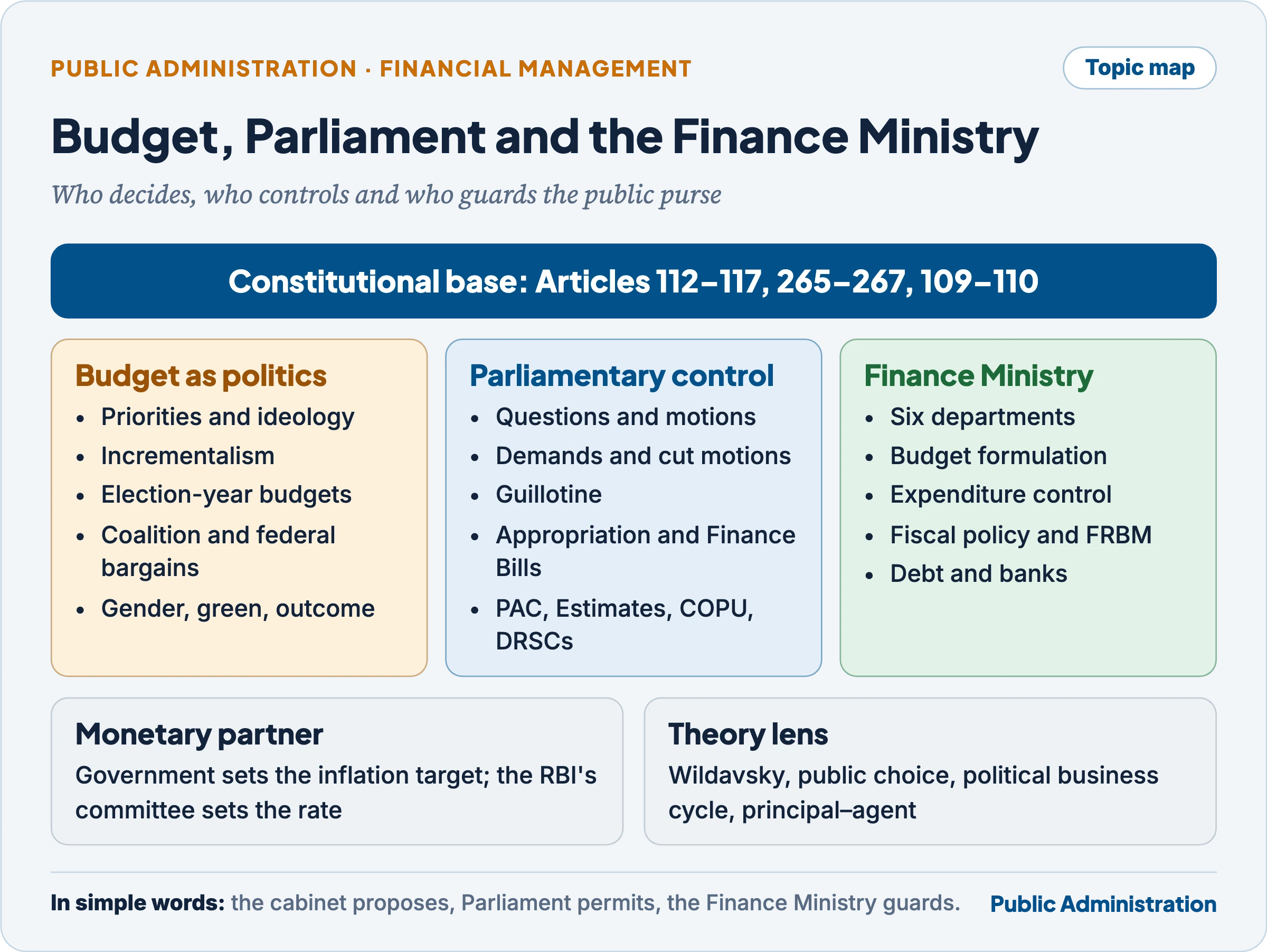
Every year on 1 February the Finance Minister stands in the Lok Sabha and announces how about ₹53 lakh crore of public money will be raised and spent. The Union budget is at once an accounting statement, an economic plan, a legal authorisation and a political manifesto. Who gets what, who pays, and who decides are political questions, so the budget is the place where democracy, administration and economics meet.
Indian Public Administration studies three relationships around this document. The first is between the budget and politics: how parties, coalitions, elections and States shape it. The second is between Parliament and the executive: how the legislature, which alone can authorise taxes and spending, actually controls the money. The third is inside the executive: the Ministry of Finance as guardian of the purse, manager of fiscal policy and partner (sometimes rival) of the Reserve Bank of India in monetary policy.
In simple words
Think of a housing society. The managing committee prepares the year’s budget, but it cannot raise maintenance charges or spend the reserve fund unless the general body of members approves. The treasurer checks every bill before it is paid, and an auditor checks the books after the year ends. In India, the managing committee is the Cabinet, the treasurer is the Finance Ministry, the general body is Parliament, and the auditor is the CAG.
1. The Constitutional and Institutional Framework of the Budget
In simple words
The Constitution never uses the word “budget”. It speaks instead of an annual statement of receipts and spending, and it lays down a few iron rules: no tax without a law, no spending without Parliament’s approval, and some payments that Parliament may discuss but cannot block.
1.1 The budget in the Constitution
- Annual Financial Statement (Article 112). The President causes to be laid before both Houses, for every financial year, a statement of the estimated receipts and expenditure of the Government of India. This statement is what is popularly called the budget.
- It shows separately the sums charged on the Consolidated Fund and the sums required for other expenditure (voted expenditure).
- It distinguishes expenditure on revenue account from other expenditure (capital).
- Three funds (Articles 266 and 267).
- Consolidated Fund of India (Article 266(1)): all revenues, all loans raised and all loan repayments received by the Union. No money can be withdrawn from it except under an appropriation made by law (Articles 114(3) and 266(3)).
- Public Account of India (Article 266(2)): money the government holds as a banker or trustee, such as provident funds, small savings deposits and remittances. Payments from it need no appropriation.
- Contingency Fund of India (Article 267): an imprest (advance) at the President’s disposal for urgent, unforeseen expenditure, recouped after Parliament approves the spending. Its corpus was raised from ₹500 crore to ₹30,000 crore by the Finance Act, 2021.
- No tax without law (Article 265). No tax can be levied or collected except by authority of law. This is the Indian form of the old English principle of “no taxation without representation”.
- The States have parallel provisions: Articles 202–207 (Annual Financial Statement, demands, Appropriation Bills, supplementary and excess grants, votes on account, Financial Bills in the State Legislature).
1.2 Articles and Acts governing the budget and the Finance Ministry
The table brings together the provisions used throughout this article.
| Provision | Content |
|---|---|
| Article 112 | Annual Financial Statement; charged expenditure listed in Article 112(3) |
| Article 113 | Charged estimates not submitted to vote (but may be discussed); other estimates presented as Demands for Grants to the Lok Sabha, which may assent, refuse or reduce them; no demand except on the President’s recommendation |
| Article 114 | Appropriation Bill; no amendment varying the amount or destination of a grant or charged sum; no withdrawal from the Consolidated Fund except under appropriation by law |
| Article 115 | Supplementary, additional and excess grants |
| Article 116 | Vote on account, vote of credit, exceptional grant |
| Article 117 | Financial Bills: need the President’s recommendation; a Bill imposing a tax cannot start in the Rajya Sabha |
| Articles 109–110 | Money Bills: introduced only in the Lok Sabha; Rajya Sabha may only recommend within 14 days; the Speaker’s certificate is final (Article 110(3)) |
| Articles 265, 266, 267 | No tax without law; Consolidated Fund and Public Account; Contingency Fund |
| Articles 279A, 292, 293 | GST Council; borrowing by the Union; borrowing by States (Union consent under 293(3) where a State owes the Union) |
| Articles 148–151 | Comptroller and Auditor General; audit reports laid before Parliament |
| Provisional Collection of Taxes Act, 1931 | New duties in the Finance Bill can be collected at once, but the Bill must be passed within 75 days |
| FRBM Act, 2003 (amended 2004, 2012, 2015, 2018) | Fiscal targets, three fiscal policy statements with the budget, CAG review of compliance (section 7A, 2012) |
| RBI Act, 1934 | Section 7 (Government directions to the RBI), sections 45ZA (inflation target), 45ZB (Monetary Policy Committee), 45ZN (failure to meet target), inserted by the Finance Act, 2016 |
| General Financial Rules, 2017; Delegation of Financial Powers Rules, 2024 | Executive rules on sanction, procurement, grants and the powers of ministries and their financial advisers |
1.3 Charged and voted expenditure
- Charged expenditure (Article 112(3)) includes:
- the emoluments and allowances of the President and other expenditure relating to his office;
- salaries and allowances of the Chairman and Deputy Chairman of the Rajya Sabha and the Speaker and Deputy Speaker of the Lok Sabha;
- debt charges (interest, sinking fund, redemption) for which the Union is liable;
- salaries, allowances and pensions of Supreme Court judges and pensions of High Court judges;
- salary, allowances and pension of the CAG;
- sums required to satisfy any judgment, decree or award of a court or arbitral tribunal;
- any other expenditure declared by the Constitution or by Parliament to be so charged (for example, the administrative expenses of the CAG’s office and of the UPSC).
- Why charge some expenditure? The constitutional justification has four parts:
- Independence of constitutional offices. If the salary of a judge or the CAG had to be voted every year, a hostile majority could starve or pressure the office. Charging it places the office beyond annual political bargaining, which is the condition of judicial and audit independence.
- Credit and good faith of the state. Interest and repayment of debt are legal obligations to lenders; leaving them to an annual vote would raise doubts about default and raise borrowing costs.
- Rule of law. Court decrees against the state must be paid; a vote could otherwise defeat a judgment.
- Dignity of the Head of State and the presiding officers, who must stand above party contests.
- Parliament is not shut out. Charged items can be discussed in both Houses (Article 113(1)), they appear in the Appropriation Bill, and they are audited and examined by the PAC. Only the vote is withheld.
- The scale. Interest payments alone, the largest charged item, are about ₹14 lakh crore in Budget 2026-27, roughly a quarter of total expenditure. A large share of the budget is therefore beyond Parliament’s vote by design.
1.4 Bills in the budget: Money Bills and Financial Bills
- Money Bill (Article 110). A Bill containing only provisions on taxes, borrowing, the Consolidated and Contingency Funds, appropriation, charged expenditure, receipt or audit of public money, and matters incidental to these. The Appropriation Bill and normally the Finance Bill are Money Bills.
- The Rajya Sabha can neither reject nor amend; it returns the Bill with or without recommendations within 14 days, which the Lok Sabha may accept or reject.
- The President cannot return a Money Bill for reconsideration.
- Financial Bills (Article 117). Bills that contain Money-Bill matters along with other matters (Category A, which can start only in the Lok Sabha on the President’s recommendation), or that merely involve expenditure from the Consolidated Fund (Category B, which can start in either House). The Rajya Sabha has full powers over both.
- The Money Bill route controversy. Since 2015, several non-fiscal changes have been passed as Money Bills or inside Finance Bills: the Aadhaar Act, 2016, changes to the Prevention of Money Laundering Act, and Part XIV of the Finance Act, 2017 restructuring tribunals.
- In K.S. Puttaswamy v. Union of India (2018), the majority upheld the Aadhaar Act’s certification as a Money Bill; Justice D.Y. Chandrachud’s dissent called it a “fraud on the Constitution” because it bypassed the Rajya Sabha.
- In Rojer Mathew v. South Indian Bank (2019), a five-judge Bench doubted the Aadhaar majority’s reading of the word “only” in Article 110(1) and referred the question to a seven-judge Bench. The reference was still pending in 2025.
- For parliamentary control the issue is that the Money Bill route removes the second chamber’s scrutiny of measures that are not truly financial.
Common confusion
Is the budget itself a Money Bill? No. The Annual Financial Statement is a statement laid before Parliament, not a Bill. What Parliament passes are the Demands for Grants (voted by the Lok Sabha as motions, not as a Bill), the Appropriation Bill, which is a Money Bill, and the Finance Bill, which is usually a Money Bill. That is why the Rajya Sabha discusses the budget but does not vote on the Demands for Grants.
2. The Budget as a Political Instrument
In simple words
A family budget shows what the family values: one family spends on school fees, another on a bigger car. A government budget does the same for a nation. It shows whose needs come first, whose taxes go up or down, and which regions and groups the government wants to please. That is why every budget is also a political message.
2.1 More than an economic horoscope
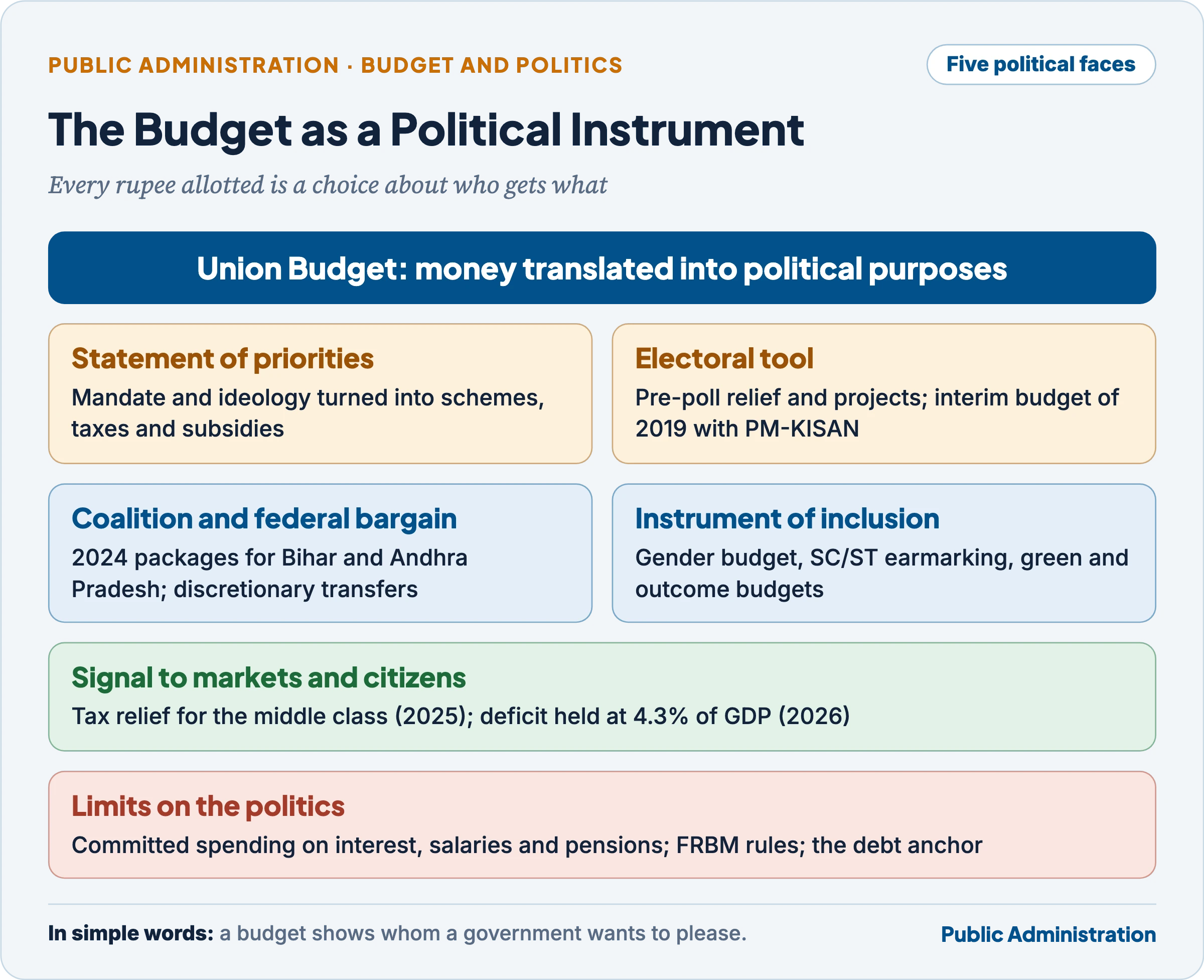
A government budget is often called the nation’s economic horoscope: it forecasts growth, inflation, revenue and deficits. That description is incomplete, because the budget does not merely predict the future; it chooses it.
- Economic face. It is the main instrument of fiscal policy: it raises resources, sets the deficit and steers demand, investment and growth. Richard Musgrave, the German-American public finance economist, in The Theory of Public Finance (1959), gave it three functions: allocation (providing public goods), distribution (reducing inequality) and stabilisation (managing employment and prices).
- Political face. It translates the ruling party’s ideology and manifesto into money. It rewards supporters, reaches swing voters, accommodates coalition partners and answers critics.
- Administrative face. It is a work plan: each ministry’s programmes, staff and targets are fixed by its grant. It is also the main instrument of control over the bureaucracy, since nothing can be spent without a budget head.
- Legal face. Once passed through the Appropriation and Finance Acts, it is law: the authority to spend and to tax.
- Social face. It redistributes income and opportunity through taxes, subsidies, transfers and services, and so shapes social justice.
Government budget and commercial budget compared. The policy content of a government budget is clearest when it is set beside a company’s budget.
| Basis | Government budget | Commercial budget |
|---|---|---|
| Purpose | Public welfare, equity, stability, development | Profit and shareholder value |
| Order of planning | Expenditure is decided first (needs and policy), then revenue is raised to match | Expected revenue is estimated first, spending fitted to it |
| Approval | Needs legislative sanction; it becomes law | Approved by the board; internal document |
| Openness | Published, debated, audited by a constitutional auditor | Largely confidential |
| Deficit | May be deliberate (counter-cyclical, developmental) | Losses are a failure |
| Coercion | Backed by the power to tax | Depends on voluntary sales |
| Accountability | To Parliament and citizens | To owners |
Because a government decides its spending first and then taxes or borrows to finance it, every item in the budget is a policy choice. Expenditure on fertiliser subsidy, defence or rural roads is a decision about who gets what, which is the classic definition of politics given by Harold Lasswell, the American political scientist, in Politics: Who Gets What, When, How (1936).
2.2 Wildavsky: budgeting as politics and incrementalism
- Aaron Wildavsky, the American political scientist, in The Politics of the Budgetary Process (1964), argued that the budget is the translation of financial resources into human purposes and that budgeting is a political process, not a technical exercise. Since no one can calculate the full value of every programme, budget-makers rely on simplifying rules.
- Incrementalism. The base (last year’s allocation) is accepted as given, and attention goes to the increment (the small change this year). Each agency expects its fair share of any growth or cut.
- Roles. Spending agencies act as advocates who ask for more; the central budget office acts as guardian who cuts. Budgets emerge from bargaining between these roles, not from a single calculation.
- Aids to calculation. Budget-makers cope with overload through heuristics: looking at the base, comparing with similar agencies, testing what the legislature will accept, and spending all funds by the end of the year so that the base is not cut.
- Reform is political. Wildavsky warned that no significant change can be made in the budgetary process without affecting the political process, because budget rules decide who has power over money. In his later work, How to Limit Government Spending (1980) and The New Politics of the Budgetary Process (1988), he argued that the answer to spending growth lies in changing political rules (spending limits, constitutional constraints), not in new techniques such as PPBS or ZBB.
Indian Connect — Incrementalism in Indian budgets
- Committed expenditure dominates. Interest payments, defence, pensions, salaries, major subsidies and transfers to States leave a small discretionary margin; the debate each year is about the increment.
- Advocates and guardian. Spending ministries bid high; the Department of Expenditure trims in pre-budget meetings chaired by the Expenditure Secretary. Disputes go up to the Finance Minister and Prime Minister, as Wildavsky’s model predicts.
- “March rush”. Ministries spend heavily in the last quarter to avoid losing the base. The Finance Ministry caps spending at about 33% of the budget estimate in the last quarter and 15% in March, a rule that only makes sense in an incremental system.
- Why techniques failed. Performance budgeting (from the late 1960s), ZBB (from 1986–87) and the outcome budget (from 2005) all became parallel documents rather than drivers of allocation, which is what Wildavsky predicted for comprehensive techniques.
The theory of budget types (line-item, performance, PPBS, ZBB, outcome) and of Wildavsky’s arguments in full is in the article on Budgets and the Budgetary Process. Here the stress is on how Indian politics shapes Indian budgets.
2.3 Ideology, mandate and political priorities
- Mandate into money. A party seeks a mandate on a programme; once in power it uses the budget to deliver it. Examples:
- The UPA government (2004), elected on a “common man” platform, funded the National Rural Employment Guarantee Act, 2005, farm loan waivers (2008) and the National Rural Health Mission (2005).
- The NDA government since 2014 has used budgets for capital expenditure-led growth (Union capex budgeted at ₹12.2 lakh crore in 2026-27), direct benefit transfers, housing, toilets and tap water (Pradhan Mantri Awas Yojana, Swachh Bharat, Jal Jeevan Mission), and direct income support to farmers (PM-KISAN).
- The budget as a signal. Budgets announce intent to markets, investors, States and voters.
- Budget 2025-26 (1 February 2025) made income up to ₹12 lakh (₹12.75 lakh for salaried taxpayers) tax-free under the new regime, at a revenue cost of about ₹1 lakh crore in direct taxes. The government presented it as relief for the middle class; it came days before the Delhi Assembly election and was widely read as a political signal to urban salaried voters.
- Budget 2026-27 (1 February 2026), the first prepared in the new Kartavya Bhawan, framed itself around three “kartavyas” (duties): growth, people’s capacity and inclusion, and held the fiscal deficit at 4.3% of GDP, signalling fiscal discipline to markets.
- Policy timing. Governments tend to front-load unpopular reforms (subsidy cuts, tax increases) early in their term and popular measures close to elections. This is the logic of the political business cycle (section 2.4).
- Subsidies as political choices. Food, fertiliser and fuel subsidies, free foodgrains under PM Garib Kalyan Anna Yojana (extended for five years from January 2024), and free electricity or cash transfers by States all express a political judgement about whom to protect.
2.4 Electoral budgeting, populism and interim budgets
- The political business cycle. William Nordhaus, the American economist, in “The Political Business Cycle” (Review of Economic Studies, 1975), argued that incumbents expand the economy before elections (lower unemployment, more spending) and accept inflation afterwards. James Buchanan and Richard Wagner, in Democracy in Deficit (1977), argued that democracies have a deficit bias: voters like spending and dislike taxes, so politicians borrow.
- Indian evidence. Stuti Khemani, the World Bank economist, in a study of 14 major Indian States from 1960 to 1992 (Journal of Development Economics, 2004), found no overall rise in spending or deficits in election years, but a shift towards targeted benefits: tax breaks for narrow producer groups and more public investment, especially road construction, which can be placed where it wins votes. Electoral budgeting in India is thus about targeting, not only about totals.
- Announcements for poll-bound States. Union budgets regularly carry projects for States about to vote:
- 2021: announcements for West Bengal, Tamil Nadu, Kerala and Assam, which voted that year.
- 2025-26: a Makhana Board, support for the Western Kosi canal, greenfield airports and expansion of IIT Patna for Bihar, which voted in November 2025.
- 2026-27: a Dankuni–Surat freight corridor and an East Coast Industrial Corridor node at Durgapur (West Bengal), rare-earth corridors including Tamil Nadu and Kerala, and health and tier-2 city infrastructure including Assam, all ahead of the April 2026 Assembly elections.
- Interim budgets and votes on account. In an election year the outgoing government presents an interim budget and seeks a vote on account (Article 116) to cover spending until the new Lok Sabha passes a full budget.
- By convention, an interim budget avoids major new schemes and tax changes, leaving them to the new government. The convention is not law.
- The interim budget of 1 February 2019 broke it: it announced PM-KISAN (₹6,000 a year to about 12 crore small and marginal farmer families, ₹75,000 crore a year), a pension scheme for unorganised workers and a full tax rebate up to ₹5 lakh of income. Critics called it a full budget in all but name; the government argued that taxpayers needed certainty from 1 April.
- The interim budget of 2024 was more restrained, and the full budget followed in July 2024 after the election.
- Populism and freebies. Cash transfers, loan waivers and free services raise the question of where welfare ends and vote-buying begins.
- In S. Subramaniam Balaji v. State of Tamil Nadu (2013), the Supreme Court held that manifesto promises of freebies are not a “corrupt practice” under the Representation of the People Act, but asked the Election Commission to frame guidelines; the Commission added a section on manifestos to the Model Code of Conduct.
- The fiscal concern is sharpest in States, many of which have rising debt and off-budget borrowings; the Sixteenth Finance Commission recommended capping State deficits at 3% of GSDP and ending off-budget borrowing.
2.5 Coalition and federal bargaining
- Coalition budgets. When a government depends on allies, the budget becomes a bargaining chip.
- In the July 2024 budget, the first after the BJP lost its own majority, the Finance Minister announced special financial support of ₹15,000 crore for Amaravati (Andhra Pradesh, ruled by the TDP) and about ₹26,000 crore of road projects and a ₹21,400 crore power plant for Bihar (ruled with the JD(U)). The two allies held 28 Lok Sabha seats between them; the opposition called it a budget to save the government.
- The episode is a textbook case of the budget as an instrument of coalition maintenance, explained by coalition theory: partners trade support for side-payments to their regions.
- Federal bargaining. States depend on the Union for a large share of their revenue, so the Union budget is closely watched by every State government.
- Formula-based transfers (tax devolution and Finance Commission grants, 41% of the divisible pool for 2026–31) are relatively insulated from bargaining.
- Discretionary channels (Centrally Sponsored Schemes, special assistance, capital loans to States, project announcements) are where political bargaining happens. Opposition-ruled States complain that conditions, branding requirements and delayed releases are used selectively.
- Cesses and surcharges, which are kept outside the divisible pool, are a standing grievance: they let the Union raise revenue it does not share.
- The Finance Commission and the constitutional scheme of transfers are covered in the article on the Finance Commission and Fiscal Federalism.
2.6 The budget as an instrument of inclusion and results
Gender budgeting. Gender budgeting is the analysis of the whole budget for its different effects on women and men, and the adjustment of allocations and processes to close gaps. It is not a separate budget for women.
- In India: a Gender Budget Statement has been published with the Union budget since 2005-06, in two parts (Part A: schemes with 100% allocation for women; Part B: schemes with 30–99% for women); Gender Budget Cells were set up in ministries. The Gender Budget Statement for 2026-27 reported ₹5.01 lakh crore, about 9.37% of the Union budget, from a record 53 ministries and departments.
- Achievements: it has made ministries ask how their schemes affect women, created accountability points (Gender Budget Cells), and supported targeting in schemes such as PM Awas Yojana (house titles in women’s names) and Ujjwala.
- Limitations: the statement is often an accounting exercise (tagging existing schemes rather than redesigning them); a few large schemes dominate the numbers; outcomes (women’s employment, safety, care burden) are rarely tracked; and Part B percentages are often assumed rather than measured.
- Beyond allocations to mainstreaming: gender budgeting becomes a tool of gender mainstreaming only when gender analysis enters scheme design, sex-disaggregated data, gender audit and outcome indicators, and when planning departments are held accountable for gender results. Several States (Kerala, Odisha, Madhya Pradesh, among others) publish their own gender budgets.
Green budgeting. Green or climate budgeting tags and assesses spending and taxes for their environmental effects. The Union issued its first sovereign green bonds in January 2023; States such as Odisha (climate budget since 2020-21), Bihar and Assam publish climate or green budget statements.
Outcome budgeting and performance management.
- Output-based performance budgeting links money to physical outputs (roads built, children immunised) and their unit costs. India introduced performance budgets for development ministries from the late 1960s, after the First Administrative Reforms Commission (1968) recommended them, and extended them in the 1970s.
- Outcome Budget (2005). Finance Minister P. Chidambaram introduced it with the slogan that outlays are not outcomes. Since 2017-18 the Output-Outcome Monitoring Framework, run by NITI Aayog’s Development Monitoring and Evaluation Office, presents outputs and outcomes of major schemes with the budget.
- Why performance budgeting struggled: many government activities (diplomacy, policing, research, regulation) have no easily measurable output; indicators measured activity rather than results; budgets were still drawn up by line items; and performance documents were not used in allocation or in parliamentary debate.
- Performance management needs indicators. An output-outcome framework works only if each scheme has specific, measurable indicators with baselines and targets, data systems to report them (PFMS, scheme dashboards), and consequences for performance in the next allocation.
- The techniques themselves are covered in the article on Budgets and the Budgetary Process.
2.7 The budget as an indicator of fiscal health
The receipts and expenditure statement is also a health report on the state’s finances. Four readings matter.
- Deficits. The fiscal deficit (total borrowing need) was 4.4% of GDP in 2025-26 (revised) and is budgeted at 4.3% in 2026-27; the revenue deficit shows how much borrowing finances current consumption rather than assets.
- Debt. Central government debt was estimated at 56.1% of GDP in 2025-26 (RE) and 55.6% in 2026-27, on a path to the new debt anchor of 50 ± 1% by 2030-31.
- Quality of spending. The share of capital expenditure (₹12.2 lakh crore in 2026-27) versus revenue spending on salaries, subsidies and interest indicates whether today’s borrowing builds tomorrow’s capacity.
- Interest burden. Interest of about ₹14 lakh crore pre-empts revenue that could fund services: a sign of past deficits.
- Limits of the indicator. Cash-based figures miss off-budget borrowings, contingent liabilities (guarantees) and pension obligations. That is why accrual accounting and disclosure of extra-budgetary resources matter (see the article on Accounting Techniques, Audit, CGA and CAG).
3. Parliamentary Control of Public Expenditure: Principles and General Devices
In simple words
Parliament is the people’s purse-keeper. It controls money in three ways: before it is spent (by approving the budget), while it is being spent (by asking questions and debating), and after it is spent (by examining the accounts and the auditor’s report).
3.1 Why legislatures control the purse
- Historical root. The British Parliament won the power of the purse in a long struggle with the Crown (Magna Carta, 1215; the Bill of Rights, 1689, which forbade taxation without Parliament’s consent). Representative government grew out of the principle that those who pay must consent.
- Two elements. The power has two sides: granting money (authorisation) and supervising its use (accountability).
- Three stages of control:
- Ex ante: approving taxes and Demands for Grants; prior scrutiny by committees.
- Concurrent: questions, debates, motions, supplementary demands, committee reviews during the year.
- Ex post: examination of the Appropriation and Finance Accounts and CAG reports by the Public Accounts Committee; regularisation of excess grants.
- Two kinds of devices. Parliament uses general devices that apply to all government business (questions, motions, debates) and specific financial devices (budget procedure and financial committees).
- The classic justification. The old British view, cited in Indian financial literature, is that the taxpayer cannot be left to the spending departments: some authority not directly concerned with spending must weigh each item against others and against resources. Inside the executive, that authority is the Finance Ministry (section 8); outside it, Parliament.
3.2 Questions as a technique of control
- Meaning. A question is a request by a member to a Minister for information on a matter for which the Minister is responsible. The right to ask questions came with the Indian Councils Act, 1892, and the right to ask supplementary questions with the Indian Councils Act, 1909.
- Types:
- Starred questions are answered orally on the floor; members may ask supplementaries, which turn the question into a cross-examination of the Minister.
- Unstarred questions receive written answers; they yield the bulk of the data on spending and schemes.
- Short notice questions on matters of urgent public importance, admitted only if the Minister agrees to answer at short notice.
- Why questions are a powerful financial control:
- Searchlight on administration. Almost any act of government, however small, can be the subject of a question; the answer is drafted by the department but given by the Minister in public.
- Record-keeping and caution. The prospect of a question makes departments keep careful records of every transaction; the fear of a parliamentary question is one of the strongest pressures on civil servants to act regularly.
- Exposure of scandals. In 1957–58, questions by Feroz Gandhi on the Life Insurance Corporation’s investment in companies of Haridas Mundhra led to the Chagla Commission of inquiry and the resignation of Finance Minister T.T. Krishnamachari (1958). The episode remains the classic example of questions protecting public money.
- Data for the public. Answers on scheme releases, utilisation and pending bills are the main public source on how money is spent.
- Limits:
- Ministers can give evasive or partial answers, or decline on grounds of public interest.
- The Question Hour is often lost to disruption: in the Budget Session of 2026, the Lok Sabha spent less than 15 minutes on Question Hour on 12 days (PRS Legislative Research).
- Questions are individual and episodic; they cannot examine a whole programme the way a committee can.
- Some members use questions for publicity or to gather information for private interests.
3.3 Other general devices
| Device | What it does | Financial relevance |
|---|---|---|
| Adjournment motion | Sets aside the business of the House to discuss a definite matter of urgent public importance; needs the support of 50 members for leave; its adoption is in effect a censure | Used for scams, price rise, sudden crises |
| Calling attention motion | A member draws a Minister’s attention to an urgent matter; the Minister makes a statement | Quick accountability on spending failures |
| Short duration discussion | Discussion on a matter of urgent public importance without a formal motion or vote | Debates on price rise, farm distress, schemes |
| Zero Hour | Informal Indian practice after Question Hour for raising urgent matters | Raises local grievances about funds and schemes |
| Resolutions and motions | Recommend a course of action or express the House’s view | Can censure a policy or Minister |
| No-confidence motion | Tests the Council of Ministers’ majority | Defeat on a major financial vote amounts to loss of confidence |
| Debates | On the President’s Address, the budget, Bills, reports | Compel the government to explain and defend policy |
These devices control administration in both financial and non-financial matters. The specifically financial devices are the budget procedure and the committees, taken up next.
4. The Budget in Parliament: Stages and Instruments
In simple words
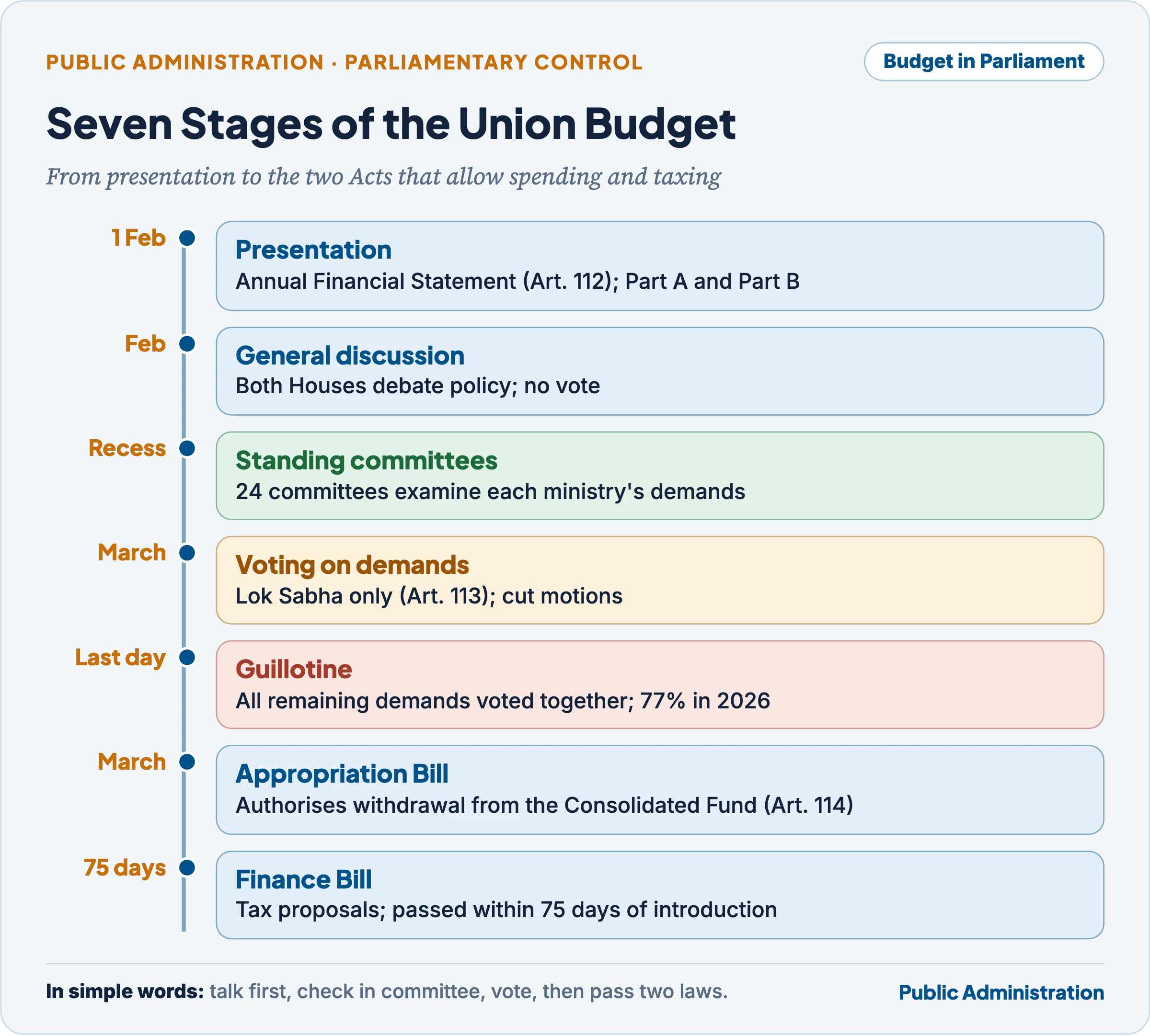
After the budget is presented, Parliament first talks about it as a whole, then its committees study each ministry’s demands, then the Lok Sabha votes ministry by ministry, and finally two laws are passed: one that lets the government spend and one that lets it tax. If time runs out, all remaining demands are voted together in one go.
4.1 Presentation
- Date. Since 2017-18 the Union budget is presented on 1 February (it used to be the last working day of February), so that it can be passed before the financial year begins on 1 April. Budget 2026-27 was presented on Sunday, 1 February 2026.
- Before it: the Economic Survey, prepared by the Chief Economic Adviser, reviews the economy.
- The speech. Part A covers the economy, expenditure and schemes; Part B covers tax proposals.
- Documents laid: the Annual Financial Statement, Demands for Grants, the Finance Bill with a memorandum, the Receipt Budget and Expenditure Budget, Budget at a Glance, the three FRBM statements (Macro-economic Framework, Medium-term Fiscal Policy cum Fiscal Policy Strategy), the Output-Outcome Framework, and statements such as the Gender Budget Statement.
- There is no discussion on the day of presentation.
4.2 General discussion
- Both Houses discuss the budget as a whole and the principles and policy underlying it, over a few days.
- No motion is moved, no amendment is allowed, and nothing is voted. The Finance Minister replies at the end.
- Value: it is the main occasion for debating fiscal strategy (deficits, taxes, priorities) and the place where the opposition presents its alternative. In 2025 the general discussion lasted about 16 hours in the Lok Sabha and 17 in the Rajya Sabha (PRS).
4.3 Departmental scrutiny by standing committees
- After the general discussion, the Houses adjourn for three to four weeks. During the recess the 24 Departmentally Related Standing Committees (DRSCs) examine the Demands for Grants of the ministries under them and report to both Houses.
- The committees may suggest changes but cannot move cut motions; their reports are advisory, and the demands are voted whether or not the report has been discussed. (The DRSC system is examined in section 5.5.)
4.4 Discussion and voting of Demands for Grants; cut motions
- Demands for Grants are presented ministry by ministry (normally one demand per ministry or department). The Business Advisory Committee allots time and the House selects a few ministries for detailed discussion.
- Only the Lok Sabha votes on Demands for Grants (Article 113(2)); the Rajya Sabha may discuss the budget but not vote on demands.
- The Lok Sabha can assent, refuse or reduce a demand; it cannot increase a demand or create a new one, since demands come only on the President’s recommendation (Article 113(3)).
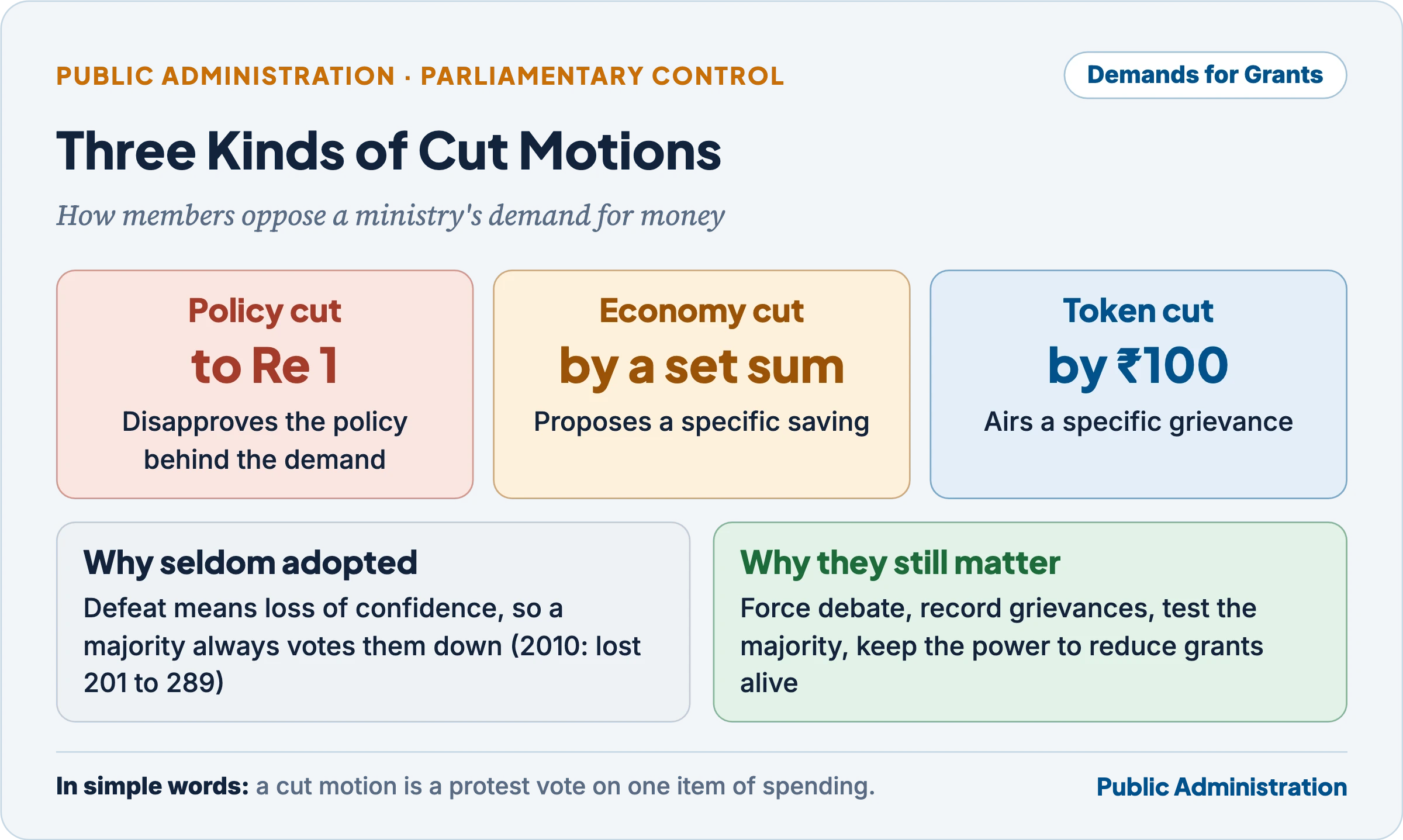
Cut motions. A cut motion is a motion to reduce the amount of a demand. It is the only formal instrument by which members can oppose a specific item of expenditure. The Lok Sabha Rules recognise three kinds.
| Cut motion | Wording | Purpose | Example |
|---|---|---|---|
| Disapproval of policy cut | “That the amount of the demand be reduced to Re 1“ | Total disapproval of the policy underlying the demand; the member must state the policy and may propose an alternative | Opposing the petroleum pricing policy of a ministry |
| Economy cut | “That the amount of the demand be reduced by a specified amount“ | The amount represents the economy the member thinks can be made, by a lump sum or by omitting or reducing an item | Cutting a specified sum from an inflated establishment head |
| Token cut | “That the amount of the demand be reduced by ₹100“ | To ventilate a specific grievance within the ministry’s responsibility | Delays in a rural road scheme in a member’s region |
Conditions of admissibility (Lok Sabha Rules): a cut motion must relate to one demand and one specific matter, stated precisely; it must not reflect on the character of persons, must not seek to amend existing laws, must not relate to charged expenditure, and must not raise matters that are sub judice or under the control of bodies not primarily responsible to the Union.
Why cut motions are “seldom enacted”.
- A cut motion carried against the government signals that the House has refused it money, which by convention amounts to a loss of confidence. A government with a majority therefore whips its members to defeat every cut motion.
- In practice, cut motions are almost never adopted in the Lok Sabha.
- The April 2010 episode. The opposition moved cut motions against the UPA government’s fuel and fertiliser price increases, hoping to defeat a minority-dependent government. On 27 April 2010 the main cut motion was defeated 289 to 201, after the BSP voted with the government and the SP and RJD walked out. The same day the Speaker, Meira Kumar, ruled that members may move cut motions even on demands not discussed and put to the guillotine, overruling a 2003 practice.
Why cut motions still matter.
- Forum for debate. They force a discussion on a specific ministry and policy, compelling the Minister to reply on the record.
- Ventilation of grievances. Token cuts carry local and sectoral grievances into the budget debate.
- Test of the majority. In coalition or minority governments they become trials of strength, as in 2010.
- Signal to the executive. Even defeated cut motions put specific failures and waste on the parliamentary record, which committees, the media and the CAG can follow up.
- Constitutional symbolism. They embody Parliament’s right under Article 113 to reduce or refuse a grant, the core of the power of the purse.
4.5 The guillotine
- Meaning. On the last day allotted for the Demands for Grants, the Speaker puts all outstanding demands to vote together, whether discussed or not. The term comes from the British House of Commons.
- Why it exists. The budget must be passed before 1 April, or the government has no authority to spend. With dozens of ministries and limited sittings, the guillotine ensures that the budget is passed on time and prevents obstruction from holding up the entire financial business of the state.
- The evidence on its use:
- In 2018 and 2023, the entire budget was passed without discussion in the Lok Sabha, amid disruptions.
- In 2025, the Lok Sabha discussed the expenditure of only three ministries; about 90% of total budgeted expenditure was passed without discussion (PRS).
- In 2026, five ministries were listed for discussion (Railways, Agriculture, Home Affairs, External Affairs, Power) but only Agriculture and Railways were discussed; on 18 March 2026 the House approved Demands for Grants of over ₹53 lakh crore, about 77% of the budget, by the guillotine (PRS; The Hindu).
- Evaluation:
- For: it is a time-management device in a crowded calendar; DRSCs have already examined all demands; no government business would be done without some closure.
- Against: it turns the vote on most of the budget into a formality; ministries with the largest budgets (Defence, Home, Road Transport) go years without floor debate; it weakens the deterrent effect of scrutiny on the bureaucracy; and disruptions combined with the guillotine mean that the opposition loses its chance to question spending.
- Middle path: more sitting days for the budget, a rotation so that every large ministry is discussed at least once every few years, and floor time for DRSC reports before the guillotine falls.
Common confusion
Does the guillotine mean that a demand is not voted? No. A guillotined demand is voted and passed; what it is denied is discussion. Constitutionally the grant is valid. The criticism is about the quality of scrutiny, not the legality of the vote.
4.6 The Appropriation Bill (Article 114)
- After the demands are voted, the government introduces the Appropriation Bill to authorise withdrawal from the Consolidated Fund of (a) the grants voted by the Lok Sabha and (b) the charged expenditure.
- No amendment may be moved that varies the amount or destination of any grant or alters charged expenditure.
- It is a Money Bill: the Rajya Sabha returns it (usually without recommendations) and the President assents. Only then can money be spent.
- Why it matters: it converts Lok Sabha votes into law and fixes the destination of each grant. Spending on a purpose not covered by the Appropriation Act is unconstitutional, which is what the CAG and PAC check later.
4.7 The Finance Bill
- The Finance Bill gives effect to the government’s tax proposals for the year. Under the Provisional Collection of Taxes Act, 1931, new or increased duties declared in it can be collected immediately, but the Bill must be passed within 75 days.
- Debate on the Finance Bill is wide: members can discuss general administration and grievances, on the principle that taxation requires consent.
- Concerns: recent Finance Bills have carried amendments to many non-tax laws (tribunals, money laundering, political funding through electoral bonds in 2017), and some have been passed without debate (2018, 2023). This dilutes both Lok Sabha and Rajya Sabha scrutiny and is the background of the Money Bill litigation (section 1.4).
4.8 Other grants and re-appropriation
| Grant | Article | When used |
|---|---|---|
| Vote on account | 116(1)(a) | Advance grant for part of the year until the full budget is passed; routine before 2017, now used mainly in election years with an interim budget |
| Supplementary grant | 115(1)(a) | The amount authorised for a service in the current year proves insufficient |
| Additional grant | 115(1)(a) | Need for a new service not contemplated in the budget |
| Excess grant | 115(1)(b) | More was spent than was granted; voted only after the PAC examines the excess and recommends regularisation |
| Vote of credit | 116(1)(b) | An unexpected demand whose magnitude or indefinite character prevents detailed statement (for example, war) |
| Exceptional grant | 116(1)(c) | A purpose that forms no part of the current service of any financial year |
| Token grant | Practice | A nominal sum voted to allow a new service to be funded by re-appropriation of savings |
- Supplementary demands are presented in batches during the year (Monsoon and Winter sessions and at the end of the year). They are a second opportunity for discussion, but large supplementaries also reveal poor estimation at the budget stage.
- Excess grants are treated with special caution: they represent spending without authority, and the PAC must first examine each case.
- Re-appropriation is the transfer of savings from one unit of appropriation to another within the same grant and within the same section (revenue or capital). It cannot be used between grants, between voted and charged, or to start a New Service or New Instrument of Service, which needs Parliament’s approval. The Delegation of Financial Powers Rules, 2024 govern who can approve it.
5. The Financial Committees of Parliament
In simple words
The whole House cannot read thousands of pages of accounts or visit every project. So it appoints small groups of members who study the budget estimates, the accounts and the auditor’s reports in detail, question senior officers, and report back. These are the financial committees.
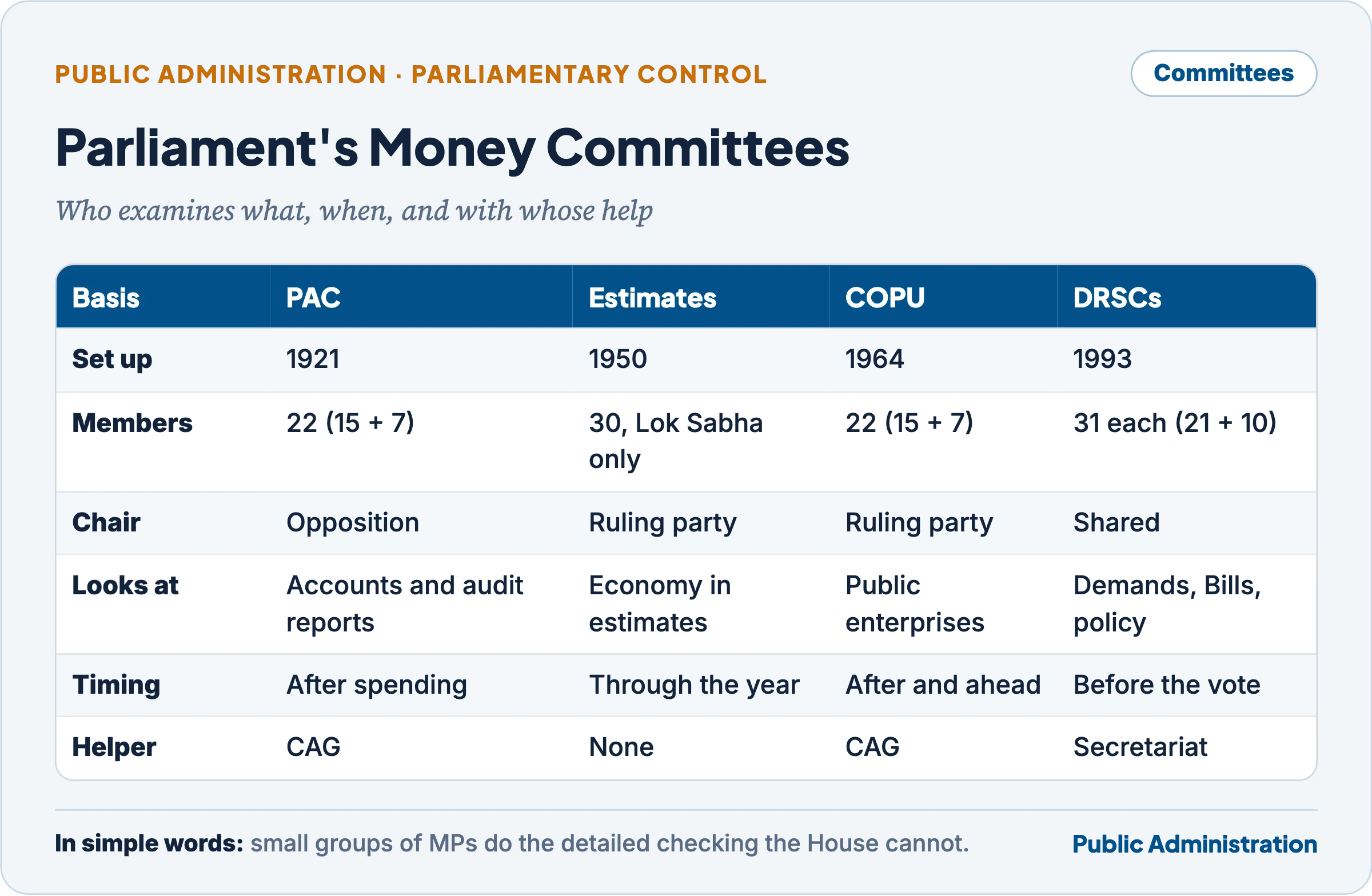
5.1 The Public Accounts Committee (PAC)
Origin and composition.
- First constituted in 1921 under the Government of India Act, 1919 (Montagu–Chelmsford reforms); the Finance Member chaired it. After independence the Finance Minister continued to chair it until 1950, when it became a parliamentary committee under the Speaker with a non-official chairman.
- Constituted every year under Rule 308 of the Lok Sabha Rules: not more than 22 members, 15 elected by the Lok Sabha and 7 by the Rajya Sabha (associated from 1954-55), by proportional representation through the single transferable vote. Term: one year. A Minister cannot be a member.
- Opposition chairmanship. Until 1966-67 a senior ruling-party member was chairman. In 1967 the Speaker appointed M.R. (Minoo) Masani of the Swatantra Party, an opposition member, as chairman; the convention of an opposition chairman has been followed ever since. K.C. Venugopal (Congress) chairs it in the 18th Lok Sabha (appointed August 2024).
Functions.
- Examines the Appropriation Accounts (spending against each grant) and Finance Accounts of the Union, and the CAG’s reports on them, on revenue receipts, and on autonomous bodies audited by the CAG.
- It satisfies itself that:
- money shown as spent was legally available for the purpose to which it was applied;
- the expenditure conforms to the authority governing it;
- every re-appropriation was made according to the rules.
- Examines excesses over grants and recommends their regularisation by excess grants under Article 115.
- Goes beyond legality to propriety: wasteful, extravagant or imprudent spending; losses; weaknesses of systems. Guiding principles drawn from British practice ask whether money voted has been spent on services that are useful and serviceable to the nation, and whether high standards of public morality have been maintained.
Method of working.
- The CAG as partner. The PAC’s work rests on CAG reports; the CAG briefs the chairman, helps select paragraphs, sits through the evidence and checks the draft report for facts. He is often called the PAC’s “friend, philosopher and guide”. (The CAG’s role is covered in the article on Accounting Techniques, Audit, CGA and CAG.)
- Selection. The committee picks a limited number of important paragraphs for detailed examination; ministries send explanatory notes on all paragraphs.
- Evidence. Secretaries, as the principal accounting authorities of their ministries, appear as witnesses. Meetings are private; the committee works on a non-party basis and adopts reports by consensus.
- Sub-committees and study groups (from 1952-53) take up large subjects.
- Follow-up. Ministries submit Action Taken Notes; the PAC presents Action Taken Reports that sort the replies into recommendations accepted, not pursued, not accepted (reiterated) and interim.
Significance.
- The taxpayer’s window. The PAC is described as the best medium through which the taxpayer sees what has been done with his money. Its opposition chairman and cross-party membership make it the most credible parliamentary check on spending.
- Conventional authority. Its recommendations are not legally binding, but by long convention they are treated as almost equivalent to the House’s own view and are accepted in most cases; disagreements are settled through consultation and are reported back to the House.
- Deterrent. The prospect of appearing before the PAC makes Secretaries keep proper records and avoid irregular spending.
- Systemic reform. It pressed for the separation of accounts from audit (achieved in 1976), performance reviews and better accounting in large spending departments. It examined major audits such as 2G spectrum (2011) and the CAG’s performance audit of Bharatmala Pariyojana (2023).
Is the PAC only a post-mortem?
- The charge: the PAC examines accounts two or more years after the money was spent, when officers have moved on and losses cannot be recovered. It cannot disallow spending; it can only comment.
- The answer: a post-mortem still diagnoses the disease. PAC findings prevent recurrence, drive changes in rules and systems, fix responsibility and create a deterrent. Interim reports by the CAG and faster selection of urgent paragraphs have reduced the time lag.
Limitations.
- Post-mortem character and long delays.
- Cannot question policy, only spending within policy, though the line between the two is thin (a wasteful contract often reflects a flawed policy).
- Dependent on the CAG: its scope is largely coextensive with audit reports; weak or delayed audit means weak scrutiny.
- Selective coverage: it can take up only a small fraction of the paragraphs in each year’s audit reports; the rest are settled by correspondence or never discussed.
- One-year term prevents specialisation (though members are often re-elected).
- Little House discussion of its reports; Action Taken Notes are often delayed or formulaic (“matter under consideration”).
- State PACs carry backlogs; in the Bihar fodder case (1990s), audit had reported excess drawals, but the State PAC did not act in time.
- Reforms proposed: a PAC term co-terminous with the Lok Sabha, with one-third retiring each year; a time limit (for example 18 months) for examining every audit report; fewer but sharper audit paragraphs, with routine irregularities settled through departmental audit committees; research staff; and floor debate where the government rejects a recommendation.
5.2 The Estimates Committee
- Origin. It traces back to the Standing Finance Committee (1921), which was chaired by the Finance Member and controlled by the Finance Department. After independence the first Estimates Committee was constituted on 10 April 1950, on the initiative of Finance Minister John Mathai, to be free of Finance Ministry control.
- Composition. 30 members, all from the Lok Sabha (25 originally; 30 from 1956-57), elected every year by proportional representation. The Rajya Sabha has no place on it. The chairman is appointed by the Speaker, usually from the ruling party (Sanjay Jaiswal of the BJP in 2024-25 and 2025-26). A Minister cannot be a member.
- Functions (Lok Sabha Rules):
- to report what economies, improvements in organisation, efficiency or administrative reform, consistent with the policy underlying the estimates, may be effected;
- to suggest alternative policies to bring about efficiency and economy in administration (added in 1953, after the committee complained that it could not touch policy);
- to examine whether the money is well laid out within the limits of the policy implied in the estimates;
- to suggest the form in which estimates are presented to Parliament.
- Policy limit. A Speaker’s direction clarified that “policy” means policy laid down by Parliament by statute or resolution; the committee may examine policies the government adopted in its executive capacity and suggest alternatives.
Why it is called a “continuous economy committee”.
- It is not tied to the budget calendar: it may examine estimates throughout the year and report from time to time.
- Its focus is economy and efficiency of administration, not legality.
- It returns again and again to the same ministries and themes (organisation, staffing, procedure), so its influence is continuous rather than a one-time vote.
- One of its first reports, on the reorganisation of the Central Secretariat, was in effect an organisation and methods study; later reports led to the creation of the Bureau of Public Enterprises (1965), following its 52nd Report of the Third Lok Sabha.
How it works.
- Selective approach: at the start of each year it chooses a few ministries and a few subjects within them (a rule settled in 1951), on the British pattern.
- Material: ministries supply detailed information under prescribed heads (organisation, functions, schemes, actual expenditure for three years, reasons for variation); members frame questionnaires; sub-committees and study groups make on-the-spot visits.
- Evidence: officials and non-official experts are examined; unlike the PAC, it has no CAG to guide it and must start from scratch.
- Reports: adopted by consensus (notes of dissent are not allowed by convention); a draft is sent to the ministry for factual verification; recommendations cover organisation, economy and presentation of estimates. Follow-up reports sort government replies into accepted, not pressed, not accepted and pending.
- Reports are not debated in the House, so that a non-partisan report is not turned into a party battle; members may still refer to them in debate.
Is it “merely a big list of advices”?
- The critique:
- Its recommendations are advisory; the government can reject them.
- It examines estimates after they are presented, and Demands for Grants are voted regardless of whether it has reported, so it has no role in framing or passing them.
- Members are laymen with one-year terms and no expert support; critics such as Ashok Chanda, a former CAG, argued that its forays into administrative reorganisation produced impractical recommendations that the government then had to reject, damaging both.
- Selective coverage means a ministry is examined perhaps once in several years.
- Since 1993, the DRSCs examine every ministry’s demands, and the Estimates Committee’s role has shrunk.
- The defence:
- Advisory, but influential: a large share of its recommendations has been accepted over the decades; a government that ignores them loses a ready source of advice.
- Lay character is a strength: a committee of experts would be dominated by them; lay members bring common sense and representativeness.
- Educative value: its reports are a mine of information on how departments work, for Parliament, scholars and the public.
- Forward-looking: it is the only financial committee that looks at future economy and organisation rather than past irregularity.
Should Parliament scrutinise estimates before they are included in the budget? One view, rooted in the British tradition, holds that in a parliamentary system the government is responsible for preparing estimates; prior parliamentary scrutiny would blur responsibility and delay the budget, so Parliament’s real control lies in ex post audit and the PAC. The opposite view holds that ex post control is “crying over spilt milk”: Parliament needs to examine policy and allocation before money is committed. India settled for a middle position: estimates are prepared by the executive alone, but they are examined after presentation and before the vote by the DRSCs, and continuously by the Estimates Committee.
5.3 The Committee on Public Undertakings (COPU)
- Origin. In December 1953, Lanka Sundaram, an independent member, moved a resolution arguing that the PAC and Estimates Committee could not give public enterprises enough attention. A sub-committee of the Congress Parliamentary Party under V.K. Krishna Menon (1959) supported a separate committee that would not act as a super-management board. COPU was set up on 1 May 1964, on the pattern of the British Select Committee on Nationalised Industries.
- Composition. 22 members: 15 from the Lok Sabha and 7 from the Rajya Sabha; one-year term; chairman from the Lok Sabha appointed by the Speaker (Baijayant Panda of the BJP in 2024-25 and 2025-26).
- Functions:
- to examine the reports and accounts of the public undertakings specified in its schedule;
- to examine the CAG’s reports on them;
- to examine whether their affairs are managed in accordance with sound business principles and prudent commercial practices, in the context of their autonomy and efficiency;
- other functions of the PAC and Estimates Committee relating to public undertakings that the Speaker allots.
- Excluded: matters of major government policy (as distinct from business functions), day-to-day administration, and matters for which special machinery exists under a statute (for example, pricing policy or labour relations handled by other bodies).
- Working: individual enterprise reports, horizontal studies across a group of enterprises (personnel policy, financial management, role of financial advisers), and Action Taken Reports. The First ARC (1967) favoured horizontal studies to cover more undertakings faster.
- Assessment: COPU has combined the PAC’s backward-looking scrutiny with the Estimates Committee’s forward-looking concern for efficiency. Its limits: it cannot cover all enterprises (important ones, including some defence units, have been kept outside), its recommendations carry less conventional weight than the PAC’s, they are rarely debated, and its tone has been called both too harsh and too uneven. In the era of disinvestment and listed CPSEs (see the article on Liberalisation, Privatisation and Disinvestment), its focus has shifted to performance, governance and the use of public assets.
5.4 The three financial committees compared
The key contrast is time and orientation: the PAC looks back at legality and propriety, the Estimates Committee looks forward at economy, and COPU does both for one sector.
| Basis | PAC | Estimates Committee | COPU |
|---|---|---|---|
| Set up | 1921 (under the Speaker from 1950) | 1950 | 1964 |
| Members | 22 (15 Lok Sabha + 7 Rajya Sabha) | 30 (Lok Sabha only) | 22 (15 + 7) |
| Chair | Opposition member (since 1967) | Usually ruling party | Usually ruling party |
| Main material | Appropriation and Finance Accounts, CAG reports | Estimates of selected ministries | Reports, accounts and CAG audit of PSUs |
| Orientation | Ex post: legality, regularity, propriety | Continuous: economy and efficiency | Commercial efficiency and autonomy |
| CAG support | Continuous | None | For audit reports |
| Description | Watchdog of public expenditure | Continuous economy committee | Guardian of public enterprise accountability |
5.5 Departmentally Related Standing Committees (DRSCs)
- Origin. The system was inaugurated on 31 March 1993 with 17 committees, after the Rules Committees of both Houses recommended sector-wise scrutiny; it was expanded to 24 in 2004.
- Composition. Each has 31 members: 21 from the Lok Sabha and 10 from the Rajya Sabha; 16 are serviced by the Lok Sabha Secretariat and 8 by the Rajya Sabha Secretariat. Ministers cannot be members; the term is one year; chairs are shared between ruling and opposition parties.
- Functions:
- consider the Demands for Grants of their ministries before the Lok Sabha votes on them;
- examine Bills referred to them;
- consider annual reports of ministries;
- consider national basic long-term policy documents referred to them.
- They do not consider matters of day-to-day administration, and their reports have persuasive value only.
- Value for financial control:
- Every ministry’s demands are now examined at least by a committee, including ministries the House never discusses; the 1993 change was described at the time as ending the immunity of “sacred cows” such as atomic energy, whose budget had never been discussed.
- Ministries frame demands more carefully, knowing they will be questioned.
- Members develop specialisation, and ruling-party members often take non-partisan positions.
- The committee system follows a worldwide trend towards legislatures working through committees, combining the British cabinet system with the American committee model.
- Have they analysed demands for grants effectively?
- Strengths: they have produced detailed reports on under-utilisation of funds, unrealistic allocations, gaps between demands and allocations, and poor outcomes; their reports are the main source of informed parliamentary comment on each ministry’s budget.
- Weaknesses:
- Time: three to four weeks to study thousands of crores; most committees study only some heads.
- No independent research and costing staff comparable to the US Congressional Budget Office; reliance on ministry data.
- No link to the vote: most demands are then guillotined, so committee findings are rarely debated before money is voted.
- Low attendance and annual changes of membership; recommendations not binding; Action Taken Notes slow.
- They cannot recommend cut motions or changes in totals; they have no role in taxation.
- Verdict: DRSCs have widened the reach of scrutiny but not deepened its effect on allocation. Their full potential depends on more time, research support and a formal link between their reports and the voting of demands.
The general working of parliamentary committees, select committees and JPCs is covered in the article on Parliament and Judiciary.
5.6 The accounting and audit link
The rest of the unit completes the accountability chain begun in Parliament. The Controller General of Accounts (under the Department of Expenditure since the departmentalisation of accounts in 1976) compiles the Union’s accounts, which the Comptroller and Auditor General (Articles 148–151) audits and reports to Parliament, where the PAC takes up the findings. Accrual accounting, types of audit, the CAG’s independence and the debate over its role are covered in the article on Accounting Techniques, Audit, CGA and CAG.
6. How Effective is Parliamentary Control of Public Expenditure?
In simple words
On paper, Parliament controls every rupee. In practice, the government that commands a majority writes the budget, decides what gets debated, and passes most spending without discussion. Parliament’s control is real, but it works mainly through publicity, committees and the auditor rather than through votes.
6.1 Factors that constrain effective scrutiny of budget proposals
- Executive dominance and party discipline. In a parliamentary system the government commands the majority; any cut is treated as a vote of no confidence, so the majority never amends. Party whips (and the anti-defection law) limit independent judgement.
- Constitutional limits. The Lok Sabha can only reduce or refuse, never increase or reallocate; charged expenditure is not voted; the Rajya Sabha has no vote on demands and cannot amend Money Bills.
- Time and the guillotine. Spending of over ₹50 lakh crore is voted in a few weeks; in 2025 about 90% and in 2026 about 77% of the budget passed without discussion; in 2018 and 2023, all of it did.
- Fewer sittings and disruptions. Budget Sessions have fewer sittings than in the 1990s; disruptions eat into debate and Question Hour.
- Complexity of documents. Thousands of pages, technical classification and scattered data make it hard for members to identify what matters.
- Weak research support. India has no Parliamentary Budget Office; members depend on ministry data and a small secretariat.
- Ex post committees. The PAC and COPU examine spending years later; the Estimates Committee has no link to the vote.
- Money Bill route and Finance Bills carrying non-financial measures bypass the Rajya Sabha.
- Off-budget spending. Borrowings by public enterprises and special purpose vehicles (for example, earlier food subsidy financing through FCI loans from the National Small Savings Fund), guarantees and extra-budgetary resources escape the vote; the CAG found several such liabilities undisclosed in its review of FRBM compliance for 2019-20 (Report No. 18 of 2022).
- Tabling of CAG reports. Fewer Union audit reports have been tabled in recent years, which narrows the PAC’s material.
- Members’ incentives. Members are judged by constituency service and party loyalty, not by budget scrutiny; financial expertise is rare and turnover high.
- States. State legislatures sit even fewer days and often pass budgets within a few sittings, with weaker committees.
6.2 Is parliamentary control declining?
Criticism — The case that parliamentary financial control is declining
- The vote has become a formality: the guillotine now carries most of the budget; floor discussion of large ministries such as Defence or Home has become rare.
- Disruption and time loss: fewer sittings, lost Question Hours and Finance Bills passed without debate (2018, 2023).
- Bypassing the second chamber: the Money Bill route for non-financial laws has reduced the Rajya Sabha’s role.
- Opacity: off-budget borrowings, guarantees and special purpose vehicles move spending out of the appropriation process.
- Committees without teeth: advisory reports, slow Action Taken Notes, one-year terms, no research office.
- Executive control of information: fewer audit reports tabled, delayed data, and limited parliamentary access to fiscal analysis.
Defence — The case that control is changing form rather than declining
- Committee scrutiny has widened: since 1993 every ministry’s demands are examined by a DRSC; financial committees continue to function with opposition participation and an opposition PAC chair.
- Transparency by law: the FRBM Act requires fiscal policy statements, disclosures and CAG review of compliance (section 7A); extra-budgetary resources are now disclosed; outcome frameworks and the Gender Budget Statement are laid with the budget.
- Audit-driven accountability: the PAC has taken up major audits (2G, coal, Bharatmala), and audit findings reach the public through the media.
- Digital data: PFMS, dashboards and just-in-time fund release make spending far more traceable than in the paper era.
- Realistic expectations: in no parliamentary system does the legislature write the budget; its role is to authorise, publicise and hold to account, which still happens.
Taken together, the evidence suggests that Parliament’s ex ante control through the vote has weakened, while ex post and informational control through committees, audit and fiscal transparency has partly grown. The weakness lies mainly in the link between scrutiny and decision: committee findings rarely reach the vote.
6.3 Budget reforms that bear on parliamentary control
| Reform | Year | What changed | Effect on control |
|---|---|---|---|
| DRSC system | 1993 | Committee scrutiny of all ministries’ demands | Wider ex ante scrutiny |
| FRBM Act | 2003 (in force 2004; amended 2012, 2018) | Deficit and debt targets; three fiscal statements; CAG review of compliance | Medium-term framework and transparency before Parliament |
| Outcome Budget | 2005 | Physical outputs and outcomes with outlays | Basis for results-based questioning |
| Gender Budget Statement | 2005-06 | Gender analysis of allocations | Accountability for gender effects |
| Budget presented on 1 February | 2017-18 | Passage before 1 April | Ends routine vote on account; money available from the start of the year |
| Merger of the Railway Budget | 2017-18 | Separate Railway Budget (since 1924, after the Acworth Committee) ended | A single statement of the Union’s finances |
| End of Plan/Non-Plan classification | 2017-18 | Only revenue/capital distinction remains | Clearer link between spending and outcomes |
| Output-Outcome Monitoring Framework | 2017-18 onwards | Indicators for major schemes laid with budget | Performance information for committees |
| Disclosure of extra-budgetary resources | 2019-20 onwards | Statement of off-budget borrowings | More complete picture of the deficit |
| Debt anchor | from 2026-27 | Central debt of 50 ± 1% of GDP by 2030-31 | A clear medium-term target to judge budgets against |
Merits of merging the Railway Budget with the General Budget (2017).
- Unity of the budget: a single, comprehensive statement of the Union’s finances, as the principle of budgetary unity requires.
- End of the dividend burden: the railways no longer pay a dividend on capital provided by the general exchequer, easing their finances.
- Better allocation: railway capital spending is weighed against roads, ports and other infrastructure within one fiscal frame, supporting multimodal planning.
- Less populism: the annual Railway Budget had become an occasion for announcing new trains and projects for political reasons; many were never funded.
- Saved parliamentary time and simpler procedure.
- Concerns: loss of a separate occasion to scrutinise a huge commercial undertaking, possible dilution of railway autonomy, and pressure on the railways’ operating ratio. The merger followed the Bibek Debroy Committee (2015) and a NITI Aayog paper.
6.4 The FRBM Act and fiscal discipline
- Promise. The Fiscal Responsibility and Budget Management Act, 2003 was meant to bind governments to fiscal discipline: eliminate the revenue deficit, bring the fiscal deficit to 3% of GDP, end borrowing from the RBI in the primary market, and place medium-term fiscal statements before Parliament.
- Why the optimism proved unwarranted:
- Targets repeatedly deferred or suspended (2004, 2008, 2012, 2015, 2018, 2020); a law amended whenever it binds offers weak commitment.
- No penalty for breach and no independent fiscal council, despite recommendations by the N.K. Singh FRBM Review Committee (2017) and the Fourteenth and Fifteenth Finance Commissions.
- Creative accounting: off-budget borrowings and deferred subsidy payments lowered reported deficits.
- Capital spending squeezed to meet headline targets in bad years.
- What it achieved:
- A culture of fiscal reporting before Parliament (statements, disclosures, mid-year reviews).
- An end to automatic monetisation of deficits.
- A credible glide path after COVID (fiscal deficit from 9.2% of GDP in 2020-21 to 4.4% in 2025-26) and the new debt anchor.
- Lesson for parliamentary control: fiscal rules work best as transparency devices that help Parliament and the public judge the government, rather than as mechanical limits. The economics of the FRBM Act is covered in the article on Monetary and Fiscal Policies, Public Borrowing and Public Debt.
6.5 Strengthening parliamentary control
- A Parliamentary Budget Office to give independent costing and analysis to members and committees.
- More time: longer Budget Sessions; a rotation so that every major ministry’s demands are discussed on the floor at least once in a Lok Sabha’s term; DRSC reports discussed before the guillotine.
- Pre-budget debate on the fiscal strategy and medium-term framework.
- Committee reforms: longer tenures (co-terminous with the Lok Sabha, one-third retiring annually), research staff, statutory deadlines for Action Taken Notes, and House discussion when the government rejects a recommendation.
- Narrow Money Bill use to genuinely financial matters, and full debate on Finance Bills.
- Fiscal council to assess compliance with fiscal rules.
- Training of members in financial management, and better presentation of budget documents (outcome data linked to demands).
- The Second Administrative Reforms Commission, in its 14th Report, Strengthening Financial Management Systems (April 2009), stressed outcome budgeting, a medium-term expenditure framework, accrual accounting and stronger internal control as the basis on which better legislative scrutiny can rest.
7. The Ministry of Finance: Structure
In simple words
The Finance Ministry is the government’s treasurer, tax collector, banker’s manager and economic adviser rolled into one. Every other ministry needs its approval to spend beyond its own limits, which makes it the most powerful department after the Prime Minister’s Office.
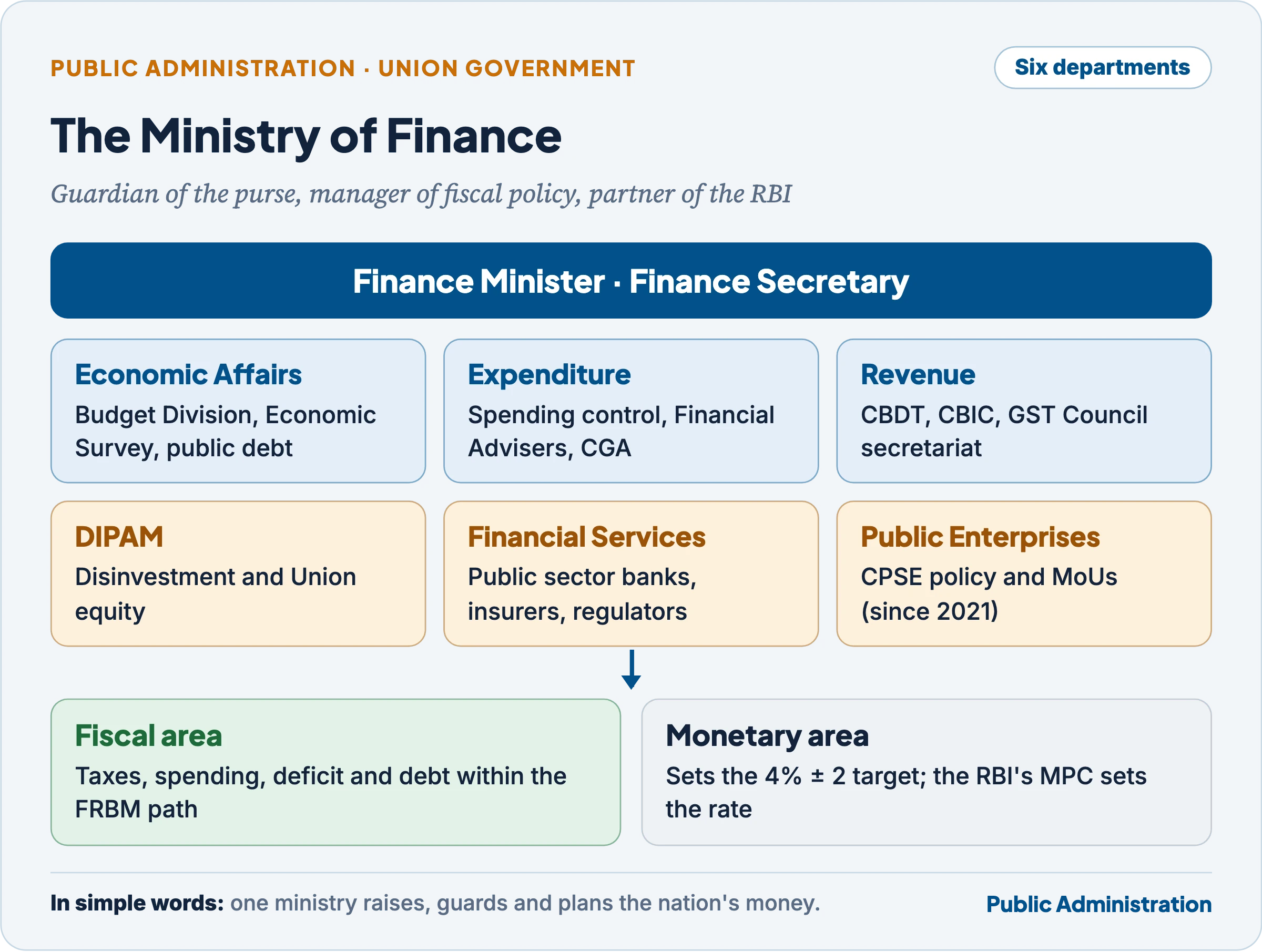
7.1 Six departments
The Ministry now has six departments; the Department of Public Enterprises was moved to it from the Ministry of Heavy Industries and Public Enterprises on 6 July 2021.
| Department | Main functions |
|---|---|
| Economic Affairs (DEA) | Macro-economic policy; preparation of the Union budget through its Budget Division; Economic Survey (Chief Economic Adviser); public debt policy (Public Debt Management Cell); capital markets; external finance and multilateral institutions; currency and coinage |
| Expenditure (DoE) | Nodal department for public financial management: expenditure control, Financial Advisers, General Financial Rules and Delegation of Financial Powers Rules, appraisal of schemes, transfers to States, Finance Commission and Pay Commission matters; houses the Controller General of Accounts and the Chief Adviser Cost |
| Revenue (DoR) | Union taxes through the Central Board of Direct Taxes and the Central Board of Indirect Taxes and Customs; GST matters; the Enforcement Directorate, FIU-IND and GSTN under its control; the Revenue Secretary is ex officio Secretary to the GST Council |
| Investment and Public Asset Management (DIPAM) | Disinvestment, strategic sales, management of Union equity, asset monetisation (Department of Disinvestment, 1999; renamed DIPAM in 2016) |
| Financial Services (DFS) | Public sector banks, insurers and development finance institutions; matters relating to the RBI, IRDAI and PFRDA, including appointments; financial inclusion (Jan Dhan, Mudra, social security schemes); Debt Recovery Tribunals |
| Public Enterprises (DPE) | General policy on CPSEs: board composition, Ratna status, wage policy, Memorandum of Understanding system, dispute resolution (from the Bureau of Public Enterprises, 1965) |
- Leadership. A Cabinet Minister heads the Ministry, assisted by Ministers of State. The senior-most of the departmental Secretaries is designated Finance Secretary.
- Why one ministry has so much: the Indian model, inherited from the British Treasury, combines revenue, expenditure, budget, debt and financial-sector responsibilities. Some countries split these (for example a separate budget office); India keeps them together, which strengthens coordination but concentrates power.
8. Role of the Finance Ministry in the Fiscal Area
In simple words
In money matters, the Finance Ministry does five things: it prepares the budget, it checks every big spending proposal, it collects taxes, it manages the government’s borrowing, and it looks after the banks and financial institutions the government owns. Behind all five is one job: keeping the government solvent while it pursues its goals.
8.1 Budget formulation
- Budget circular (August–September). The Budget Division issues the circular with timelines and formats; ministries enter estimates online.
- “He who spends should estimate.” Estimates are built from below: heads of offices, controlling officers, Financial Advisers, then the ministry.
- Pre-budget meetings (October–November). The Expenditure Secretary holds meetings with each ministry to settle revised estimates and next year’s allocations within ceilings.
- Revenue side. The Department of Revenue forecasts receipts and frames tax proposals; DIPAM estimates disinvestment receipts.
- Consultations. The Finance Minister meets industry, farmers, trade unions, economists and State Finance Ministers.
- Finalisation. The Finance Minister settles the budget with the Prime Minister; disputes between the Finance Ministry and spending ministries go to the Prime Minister or the Cabinet; the Cabinet approves it shortly before presentation, and the President’s recommendation is obtained.
- Intensity of scrutiny. It is least for charged items, light for standing charges (salaries, continuing establishment) and detailed for new items, which cannot be included without the Finance Ministry’s prior approval.
- Influence on policy. Since every proposal with financial implications passes through it, the Finance Ministry has a hand in the policies of all other ministries; the Cabinet gives heavy weight to its views.
8.2 Expenditure control
The Finance Ministry’s control over spending falls into three parts.
(a) Control during preparation. It asks of every proposal a set of standard questions, which the British economist Ralph Hawtrey summarised for the Treasury:
- Is the proposal proper, that is, does it merit public money?
- Does the ministry have the authority to propose it?
- Is there enough justification that the expenditure is necessary or desirable?
- Have all interested parties been consulted?
- Are the costs of individual items excessive?
- Are the financial arrangements the most economical, or are there alternatives?
The aim, in the old British phrase, is to put the departments on their defence and make them give strong reasons for any increase.
(b) Control during execution.
- Appraisal of schemes and projects. Large schemes are appraised by the Expenditure Finance Committee or the Public Investment Board, chaired by the Expenditure Secretary, before approval by the Minister, Finance Minister or Cabinet according to cost.
- Delegation of financial powers. The Delegation of Financial Powers Rules, 2024 (in force from 1 April 2024, replacing the rules of 1978) define what ministries, heads of departments and offices can sanction on their own. Beyond these limits, the Finance Ministry’s prior concurrence is needed.
- General Financial Rules, 2017 govern procurement, grants-in-aid, budgeting and accounts across government.
- Integrated Finance Advisers. Under the scheme of Integrated Financial Adviser (6 October 1975), each ministry has a Finance Ministry nominee inside it, responsible both to the Secretary of the ministry and to the Finance Ministry. The IFA is associated with schemes from the start, prepares the budget and outcome budget, monitors expenditure, and oversees accounts and internal audit. The DFPR 2024 lets the IFA exercise the Finance Ministry’s delegated powers, under its supervision.
- Re-appropriation, new services, write-offs and waivers need the competent authority’s sanction under the rules.
- Expenditure management. Monthly and quarterly expenditure plans; caps on year-end spending (about 33% of the budget estimate in the last quarter and 15% in March); quarterly reviews.
- Cash management. The Public Financial Management System (PFMS) tracks releases down to implementing agencies; the Single Nodal Agency model (2021) and SNA-SPARSH (from 2023) release funds for centrally sponsored schemes just in time, cutting idle balances.
(c) Miscellaneous control. Grants-in-aid rules, write-off of losses, waiver of recoveries, contracts, and staff strength through the Staff Inspection Unit.
8.3 Criticism of Finance Ministry control and the search for balance
- Paul Appleby, the American public administration scholar invited by the Government of India, in Public Administration in India: Report of a Survey (1953) and his 1956 Re-examination of India’s Administrative System, criticised detailed Finance Ministry and audit control for producing delay, timidity and risk-aversion; he saw a ministry that accepted precedent and refused risks.
- A.D. Gorwala, in his Report on Public Administration (1951), argued that what financial matters need is control, not interference in small matters.
- Ashok Chanda, in Indian Administration (1958), observed that the Finance Ministry often strained at the gnat and swallowed the camel: it fought over petty establishment items while large technical programmes, which it could not judge, went through.
- Other criticisms:
- a “cheese-paring” or “candle-ends” mentality that saves small sums and loses large ones;
- inflated estimates, because departments expect cuts;
- false economy: cutting maintenance or staff in ways that raise costs later;
- Finance Ministry officials judging technical details of schemes for which they lack expertise;
- long files and repeated references, which delay projects.
- The defence: in a large democracy with heavy spending, a strong central check is the only protection against extravagance and departmental empire-building (the Niskanen budget-maximising bureaucrat); the Finance Ministry acts as Parliament’s extended arm inside the executive.
- India’s answer: delegation with accountability. Powers were progressively delegated to ministries (the IFA scheme of 1975; the DFPR of 1978 and 2024), while the Finance Ministry kept macro control through ceilings, appraisal of large schemes and fiscal rules. Ministers and Secretaries are expected to be the main guardians of economy in their own departments. Appleby himself recognised that the aim is to combine the drive of enthusiasm in spending departments with the restraining discipline of review.
8.4 Fiscal policy and the FRBM framework
- Theoretical basis. John Maynard Keynes, the British economist, in The General Theory of Employment, Interest and Money (1936), showed that government spending and taxation can manage aggregate demand; Musgrave’s three functions give fiscal policy its goals of allocation, distribution and stabilisation.
- The Finance Ministry’s fiscal role:
- sets the fiscal stance (deficit, debt path) in the budget and the FRBM statements;
- designs tax policy (the Income-tax Act, 2025, in force from 1 April 2026, replacing the 1961 Act; GST 2.0 rate rationalisation from 22 September 2025, through the GST Council);
- allocates expenditure between revenue and capital, Centre and States, sectors and schemes;
- manages counter-cyclical policy (the COVID stimulus of 2020-21, the capital expenditure push since 2021-22).
- The FRBM framework (section 6.4) gives the medium-term discipline; the debt anchor of 50 ± 1% of GDP by 2030-31 is now the main guide.
- Coordination with States. Through the Finance Commission’s recommendations, borrowing ceilings under Article 293(3), interest-free capital loans to States, and the GST Council.
8.5 Revenue administration and the GST Council secretariat
- The Department of Revenue administers Union taxes through the CBDT (direct taxes) and CBIC (customs, central excise, CGST and IGST), both statutory boards under the Central Boards of Revenue Act, 1963.
- GST Council (Article 279A). The Union Finance Minister chairs it; the Union Minister of State for revenue or finance and a minister nominated by each State are members. The Cabinet set up its secretariat in New Delhi on 12 September 2016, with the Revenue Secretary as ex officio Secretary to the Council and officers drawn from the Centre and the States. The secretariat prepares agendas and implements decisions; the Union bears its cost.
- In Union of India v. Mohit Minerals (2022), the Supreme Court held that the GST Council’s recommendations have persuasive, not binding, value, since Parliament and State legislatures have simultaneous power to legislate on GST.
8.6 Public debt management
- The RBI manages the market borrowing of the Union (and of States by agreement) as the government’s banker and debt manager, under the RBI Act.
- The Finance Ministry decides the borrowing programme in the budget (gross market borrowing of ₹17.2 lakh crore in 2026-27). The Middle Office in the Budget Division (set up September 2008) was subsumed into the Public Debt Management Cell (PDMC) on 4 October 2016, as an interim step towards a statutory Public Debt Management Agency. The PDMC has advisory functions: planning borrowings, managing liabilities, monitoring cash balances, developing the government securities market and maintaining an integrated debt database.
- The PDMA debate. Separating debt management from the RBI would end the conflict of interest between keeping government borrowing cheap and fighting inflation, but the RBI argued that coordination of monetary and debt policy is easier under one roof in a developing market. The statutory agency announced in 2015 has not been created.
- Articles 292 and 293 set the constitutional frame of Union and State borrowing; the economics of public debt is covered in the article on Monetary and Fiscal Policies, Public Borrowing and Public Debt.
8.7 Financial services: public sector banks and NPAs
- The problem. After the 2015 Asset Quality Review by the RBI, hidden stressed loans were recognised as non-performing assets; the gross NPA ratio of public sector banks peaked at 14.58% in March 2018.
- The Finance Ministry’s response (the “4R” strategy): Recognition of NPAs transparently, Resolution and Recovery (the Insolvency and Bankruptcy Code, 2016, amended SARFAESI and debt recovery laws), Recapitalisation, and Reforms (governance, mergers of PSBs, Indradhanush plan of 2015).
- Recapitalisation. The government infused ₹3.10 lakh crore into PSBs from 2016-17 to 2020-21, of which about ₹2.76 lakh crore was through recapitalisation bonds and about ₹35,000 crore through budgetary allocation.
- Justification for budgetary support:
- PSBs hold most public deposits; their failure would hurt depositors and the payment system;
- the government as majority owner must keep its banks adequately capitalised under Basel norms;
- recapitalisation restored credit flow to industry, MSMEs and agriculture;
- recapitalisation bonds limited the immediate fiscal cost.
- Protecting both taxpayers and depositors:
- Moral hazard: repeated bailouts reward bad lending; taxpayers bear losses created by bank managements and large borrowers.
- Safeguards: capital tied to governance reforms; the IBC shifting control from defaulting promoters to creditors; wilful defaulters barred from resolution; professional boards; and the RBI’s prudential framework for early resolution.
- Results: gross NPAs of PSBs fell to 2.58% by March 2025, and PSBs earned a record net profit of ₹1.78 lakh crore in 2024-25, paying dividends back to the government.
8.8 The Finance Ministry and the States
- Releases tax devolution and Finance Commission grants; administers capital loans to States; fixes net borrowing ceilings for States under Article 293(3); monitors State finances. These are covered in the article on the Finance Commission and Fiscal Federalism.
Indian Connect — The Finance Ministry as “custodian of public revenues”
The Finance Ministry is often described as the custodian of all public revenues. The description is true in three senses: it frames the tax laws and collects Union taxes; it controls the Consolidated Fund through the budget, appropriation and payment systems; and it watches every spending proposal through the Department of Expenditure and the IFAs. But custody is not ownership. Parliament authorises every rupee, the CAG audits it, the RBI acts as banker, and in GST the Ministry shares power with the States in the GST Council. The Ministry’s power is therefore delegated and checked: strong enough to impose discipline, but accountable to Parliament through the budget and to audit through the accounts.
9. The Finance Ministry and Monetary Policy: Relationship with the Reserve Bank
In simple words
The government decides how much to spend and borrow; the Reserve Bank decides the price of money (the interest rate). Since 2016, the government sets the inflation target, and a six-member committee led by the RBI Governor decides the interest rate needed to hit it. The two must work together, but the RBI needs room to say no.
9.1 Division of roles
- Monetary policy (interest rates, liquidity, credit) is conducted by the Reserve Bank of India under the RBI Act, 1934. The Finance Ministry does not set interest rates.
- The Finance Ministry’s monetary role is indirect but important:
- it sets the inflation target in consultation with the RBI (section 45ZA);
- it appoints the Governor, Deputy Governors and Central Board (through the Department of Financial Services) and the three external members of the Monetary Policy Committee;
- its fiscal deficits and borrowing shape inflation, interest rates and the RBI’s room for manoeuvre;
- it chairs the Financial Stability and Development Council (2010), the forum of financial regulators;
- it controls supply-side tools that affect prices: customs duties, food stock releases, fuel taxes.
- End of fiscal dominance. Until 1997, ad hoc treasury bills let the Centre borrow automatically from the RBI, creating money. Agreements of 1994 and 1997 ended this, and the FRBM Act barred RBI subscription to primary issues of government securities from 2006 (except under the escape clause after 2018). These steps gave the RBI real control over money creation.
9.2 Flexible inflation targeting (2016)
- Legal basis. The Finance Act, 2016 amended the RBI Act, following the Urjit Patel Committee (2014).
- Target (section 45ZA). The Central Government, in consultation with the RBI, fixes the inflation target once every five years: 4% CPI inflation, with a band of 2–6%, set for 2016–21, retained in March 2021 for 2021–26, and retained again on 25 March 2026 for 1 April 2026 to 31 March 2031.
- Monetary Policy Committee (section 45ZB). Six members: the Governor (chair, with a casting vote), a Deputy Governor, an RBI officer, and three external members appointed by the Central Government for four years. Its decision on the policy rate is binding on the RBI; minutes and votes are published.
- Accountability (section 45ZN). If average inflation stays above 6% or below 2% for three consecutive quarters, the RBI must report to the Government the reasons and remedial action; this was triggered for the first time in 2022.
- The design is goal dependence with instrument independence: the elected government sets the goal; the expert committee chooses the means. It reflects the theory of time inconsistency (Kydland and Prescott, 1977): a government tempted to create surprise inflation before elections gains credibility by delegating rate-setting.
- Recent course: after cutting the repo rate to 5.25% during 2025, the MPC raised it to 5.50% on 7 October 2026, amid higher crude prices and a weaker rupee.
9.3 Coordination and tension
- Coordination devices: the inflation target, Government nominees on the RBI Board, the FSDC, regular consultations on the borrowing calendar, and the surplus transfer from the RBI to the Government (a record ₹2.87 lakh crore for 2025-26, approved in May 2026), governed by the Economic Capital Framework recommended by the Bimal Jalan Committee (2019).
- Episodes of tension:
- In October 2012, Finance Minister P. Chidambaram publicly disagreed with the RBI’s refusal to cut rates under Governor D. Subbarao, saying the government would “walk alone” if it had to.
- The Section 7 episode (2018). Section 7 of the RBI Act lets the Central Government, after consulting the Governor, give the RBI directions in the public interest; it had never been used. In October 2018 the Government sent letters seeking consultation under Section 7 on easing the Prompt Corrective Action framework for weak banks, credit to MSMEs and power companies, and the use of RBI reserves. Deputy Governor Viral Acharya warned in a public lecture (26 October 2018) that undermining central bank independence could provoke a crisis of confidence. No direction was issued, but Governor Urjit Patel resigned on 10 December 2018. The reserves question went to the Bimal Jalan Committee.
- What the episodes show: formal independence in rate-setting does not settle questions of regulation, reserves and bank supervision, where the Government, as owner of most banks and as shareholder of the RBI, has strong interests. Healthy coordination depends on conventions of restraint, transparent rules (such as the Economic Capital Framework) and public accountability on both sides.
Common confusion
Does the Finance Ministry make monetary policy since the 2016 reform? No. The Government sets the target (4% ± 2) and appoints half the MPC, but the policy rate is decided by the MPC by vote and binds the RBI. The Finance Ministry makes fiscal policy; it influences monetary conditions through deficits, borrowing and appointments, not by setting rates. Monetary and fiscal policy are different instruments, but both regulate aggregate demand, so they must be coordinated: a loose fiscal policy forces a tighter monetary policy, and vice versa. The instruments are compared in the article on Monetary and Fiscal Policies, Public Borrowing and Public Debt.
10. Reading the Indian Budget through Paper I
In simple words
Theories from Paper I explain why Indian budgets look the way they do: why they change only a little each year, why they swell before elections, why ministries always ask for more, and why Parliament finds it so hard to control a government it has elected.
Theory lens: politics, agents and rules in Indian financial management
- Wildavsky’s politics of budgeting. Aaron Wildavsky, The Politics of the Budgetary Process (1964): budgets are made by bargaining between advocate ministries and a guardian Finance Ministry, on an incremental base. Indian practice (committed expenditure, pre-budget bargaining, the March rush, failed comprehensive techniques) fits closely. See the article on Budgets and the Budgetary Process.
- Public choice and the budget-maximising bureaucrat. William Niskanen, Bureaucracy and Representative Government (1971): bureaus seek larger budgets because budget size brings power, pay and prestige; legislators lack the information to resist. The case for a strong Finance Ministry and for appraisal by the Expenditure Finance Committee rests on this logic. See the article on New Public Administration and Public Choice.
- Political business cycle and deficit bias. William Nordhaus, “The Political Business Cycle” (1975), and James Buchanan and Richard Wagner, Democracy in Deficit (1977): governments spend before elections and avoid taxes, producing deficits. Pre-election budgets (2019 interim budget, announcements for poll-bound States) and Khemani’s evidence of targeted electoral spending in Indian States illustrate the theory; the FRBM Act is the rule-based remedy.
- Principal–agent theory. Citizens (principals) delegate to Parliament, Parliament to the executive, and ministers to bureaucrats (agents), each with information asymmetry. Budget votes, questions, DRSCs, the PAC and the CAG are monitoring devices; the guillotine and off-budget borrowing are points where the agent escapes the principal. See the article on Financial Accountability, Accounts and Audit.
- Legislative control and executive dominance. The debate on legislative control in the article on Accountability and Control (Herman Finer’s insistence on external control; the “decline of Parliament” thesis) applies directly: Parliament’s control of money is strong in law and weak in practice, and works mainly through publicity, committees and audit.
- Keynes and Musgrave. Keynes (1936) made the budget an instrument of stabilisation; Musgrave (1959) added allocation and distribution. The Finance Ministry’s fiscal role (counter-cyclical spending, capex push, redistribution through subsidies and transfers) is their framework in practice. See the article on Monetary and Fiscal Policies, Public Borrowing and Public Debt.
- Rational budgeting reforms: PPBS, ZBB and outcome budgeting. Allen Schick, “The Road to PPB” (1966), described budgeting’s shift from control to management to planning. India’s performance budget (late 1960s), ZBB (1986-87), outcome budget (2005) and OOMF (2017-18) follow this sequence, and their limited impact on allocation confirms Wildavsky’s scepticism.
- Coalition and federal bargaining theory. William Riker, The Theory of Political Coalitions (1962), and the theory of side-payments explain the July 2024 packages for Bihar and Andhra Pradesh; the gap between formula-based and discretionary transfers is the arena of federal bargaining studied in the article on the Finance Commission and Fiscal Federalism.
Key Terms
| Term | Meaning in simple words |
|---|---|
| Annual Financial Statement | The Constitution’s name (Article 112) for the budget: estimated receipts and expenditure for the year |
| Consolidated Fund | The main government account into which all revenues and loans go; money leaves it only under a law of appropriation |
| Public Account | Money the government holds as banker or trustee (provident funds, deposits); no appropriation needed |
| Contingency Fund | An advance fund (₹30,000 crore for the Union) for urgent unforeseen spending, recouped after Parliament approves |
| Charged expenditure | Spending Parliament may discuss but not vote on (President, judges, CAG, debt charges, court decrees) |
| Demands for Grants | Ministry-wise requests for voted expenditure, passed by the Lok Sabha |
| Cut motion | A motion to reduce a demand: policy cut (to ₹1), economy cut (by a specified sum), token cut (by ₹100) |
| Guillotine | Putting all remaining demands to vote together on the last allotted day, without discussion |
| Appropriation Bill | The law that authorises withdrawal of voted and charged sums from the Consolidated Fund (Article 114) |
| Finance Bill | The Bill that gives effect to the year’s tax proposals |
| Vote on account | An advance grant for part of the year until the full budget is passed (Article 116) |
| Excess grant | A grant to regularise spending beyond the amount voted, after PAC examination (Article 115) |
| Money Bill | A Bill dealing only with Article 110 matters; the Rajya Sabha can only recommend |
| PAC | Public Accounts Committee: examines accounts and CAG reports; opposition chairman since 1967 |
| Estimates Committee | Lok Sabha committee that suggests economies and efficiency in estimates; the “continuous economy committee” |
| COPU | Committee on Public Undertakings: examines the working of public enterprises |
| DRSCs | Departmentally Related Standing Committees (24): examine Demands for Grants, Bills and policy of ministries |
| Integrated Financial Adviser | A Finance Ministry officer placed inside each ministry to advise and control spending (1975) |
| Gender budgeting | Analysing the whole budget for its effects on women and men, and changing allocations to close gaps |
| Outcome budget | A budget that sets and reports results (outcomes), not only outlays |
| Incrementalism | Budgeting by small changes to last year’s base |
| Inflation target | The CPI inflation goal (4% ± 2) set by the Government for the RBI under section 45ZA |
| Monetary Policy Committee | The six-member body that decides the policy repo rate |
| Section 7 (RBI Act) | Power of the Government to give directions to the RBI in the public interest after consulting the Governor |
| FRBM Act | The 2003 law setting fiscal deficit and debt targets and requiring fiscal statements with the budget |
Commissions, Committees and Judgments
| Body or case | Year | Key point |
|---|---|---|
| Public Accounts Committee (Government of India Act, 1919) | 1921 | First financial committee; Finance Member chaired it until independence |
| Acworth Committee (chair: William Acworth) | 1921 | Led to the separation of the Railway Budget by the convention of 1924 |
| Estimates Committee (on Finance Minister John Mathai’s initiative) | 1950 | Lok Sabha committee on economy and efficiency in estimates |
| A.D. Gorwala, Report on Public Administration | 1951 | Financial control should mean control, not interference |
| Paul Appleby Reports | 1953, 1956 | Criticised delay and risk-aversion produced by finance and audit controls |
| V.K. Krishna Menon sub-committee | 1959 | Supported a separate committee on public undertakings (COPU, 1964) |
| First Administrative Reforms Commission (chair: Morarji Desai, later K. Hanumanthaiya), Report on Finance, Accounts and Audit | 1968 | Performance budgeting; separation of accounts from audit |
| Integrated Financial Adviser scheme | 1975 | Finance Ministry adviser placed inside each ministry with enlarged delegated powers |
| Department-related Standing Committees | 1993 (24 from 2004) | Committee scrutiny of all ministries’ demands |
| FRBM Act | 2003 | Fiscal targets; fiscal statements; CAG review added in 2012 |
| Second ARC, 14th Report, Strengthening Financial Management Systems | 2009 | Outcome budgeting, MTEF, accrual accounting, stronger internal control |
| C. Rangarajan Committee on efficient management of public expenditure | 2011 | Remove the Plan/Non-Plan distinction |
| Urjit Patel Committee on the monetary policy framework | 2014 | CPI inflation target of 4% ± 2 and an MPC |
| Bibek Debroy Committee on railway restructuring | 2015 | Phase out a separate Railway Budget |
| N.K. Singh FRBM Review Committee | 2017 | Debt as the anchor; fiscal council; escape clause |
| Bimal Jalan Committee on the RBI’s Economic Capital Framework | 2019 | Rule-based reserves; transfer of ₹1.76 lakh crore |
| Sixteenth Finance Commission (chair: Arvind Panagariya) | report 2025, tabled 2026 | 41% devolution; State deficits capped at 3% of GSDP; end to off-budget borrowing |
| S. Subramaniam Balaji v. State of Tamil Nadu | 2013 | Manifesto freebies not a corrupt practice; Election Commission to frame guidelines |
| K.S. Puttaswamy v. Union of India (Aadhaar) | 2018 | Majority upheld Aadhaar Act’s passage as a Money Bill; Chandrachud J dissented |
| Rojer Mathew v. South Indian Bank | 2019 | Money Bill question referred to a seven-judge Bench (pending) |
| Union of India v. Mohit Minerals | 2022 | GST Council recommendations persuasive, not binding |
| Speaker’s ruling (Meira Kumar) | 2010 | Cut motions may be moved on demands put to the guillotine |
Contemporary Developments
- 1 February 2026: Union Budget 2026-27, the first prepared in Kartavya Bhawan and presented on a Sunday: total expenditure ₹53.5 lakh crore, capital expenditure ₹12.2 lakh crore, fiscal deficit 4.3% of GDP, debt 55.6% of GDP; announcements for poll-bound West Bengal, Tamil Nadu, Kerala and Assam (freight and industrial corridors, rare-earth corridors, tier-2 city infrastructure).
- 18 March 2026: the Lok Sabha passed Demands for Grants of over ₹53 lakh crore by the guillotine; only Agriculture and Railways were discussed, and about 77% of the budget passed without discussion (PRS). The 2025 Budget Session had passed about 90% without discussion.
- 25 March 2026: the Government retained the 4% ± 2 inflation target for 1 April 2026 to 31 March 2031.
- 1 April 2026: the Income-tax Act, 2025 came into force, replacing the Income-tax Act, 1961.
- Budget Session 2026: Question Hour lasted less than 15 minutes on 12 days in the Lok Sabha; an opposition resolution to remove the Speaker was defeated, and the Lok Sabha had no Deputy Speaker for the seventh year (PRS).
- 22 May 2026: the RBI Board approved a record ₹2.87 lakh crore surplus transfer to the Government for 2025-26.
- 7 October 2026: the MPC raised the repo rate by 25 basis points to 5.50%, its first increase since February 2023.
- 1 April 2024: the Delegation of Financial Powers Rules, 2024 replaced the rules of 1978, widening ministries’ and IFAs’ powers; in 2024-25 PSBs posted a record net profit of ₹1.78 lakh crore with gross NPAs down to 2.58% (March 2025).
Revision Grid
| Thinker / body | Work or report (year) | Key idea |
|---|---|---|
| Harold Lasswell | Politics: Who Gets What, When, How (1936) | Allocation of values is the essence of politics, and of budgets |
| John Maynard Keynes | The General Theory (1936) | Fiscal policy manages aggregate demand |
| Richard Musgrave | The Theory of Public Finance (1959) | Allocation, distribution, stabilisation |
| Aaron Wildavsky | The Politics of the Budgetary Process (1964) | Budgeting as politics; incrementalism; advocates and guardians |
| Allen Schick | “The Road to PPB” (1966) | Control, management, planning orientations |
| William Niskanen | Bureaucracy and Representative Government (1971) | Budget-maximising bureaucrat |
| William Nordhaus | “The Political Business Cycle” (1975) | Pre-election expansion |
| Buchanan and Wagner | Democracy in Deficit (1977) | Deficit bias of democracies |
| Kydland and Prescott | Time inconsistency (1977) | Case for delegating monetary policy |
| Stuti Khemani | Electoral cycles in Indian States (2004) | Targeted, not aggregate, election-year spending |
| Paul Appleby | Reports (1953, 1956) | Finance and audit control breed delay and timidity |
| A.D. Gorwala | Report on Public Administration (1951) | Control, not interference |
| Ashok Chanda | Indian Administration (1958) | Finance Ministry strains at the gnat and swallows the camel |
| John Mathai | Estimates Committee (1950) | Parliamentary scrutiny of estimates free of the Finance Ministry |
| M.R. Masani | PAC chairman (1967) | Start of the opposition-chair convention |
| P. Chidambaram | Outcome Budget (2005) | Outlays are not outcomes |
| Urjit Patel Committee | Monetary policy framework (2014) | Inflation targeting and the MPC |
| N.K. Singh Committee | FRBM Review (2017) | Debt anchor, fiscal council |
Previous Year Questions
- 2026Though seldom enacted, Cut Motions remain vital instruments of parliamentary accountability. Comment.
- 2025Budget is the pivot around which the whole financial administration revolves. Discuss the socio-economic and political implications of budget.
- 2025The ‘guillotine’ hastens the budgetary process to meet the timeline. Evaluate the procedure.
- 2024“Parliamentary control over public expenditure is declining.” Comment.
- 2021Budget proposals in the Parliament/ State Legislatures fail to ensure their effective scrutiny. Identify the factors which constrain effective scrutiny of the budget proposals.
- 2020Budget is an indicator of financial health of a polity which is reflected in the statement of income and expenditure. Discuss.
- 2019The strategy to deal with the non-performing assets of banks may lead to overburdened taxpayers. Examine the role of government to protect the interests of both.
- 2018“Gender budgeting requires rethinking beyond allocations to become a powerful tool of gender mainstreaming.” Discuss.
- 2018“Performance management requires identification of indicators and measures to ensure that goals are achieved efficiently.” Discuss.
- 2016What merits do you foresee in the proposed merger of the Railway Budget with the General Budget?
- 2016Justify the budgetary support to nationalized banks to overcome the crisis resulting out of Non-Performing Assets (NPA).
- 2015Explain how budget can be used as a political instrument.
- 2014“Gender responsive budgeting has infused greater accountability of planning departments towards women empowerment programs.” Examine the statement.
- 2013“Performance budgeting failed because it was applied to sectors/programmes where quantitative evaluation was not feasible.” Examine the principles underlying performance budgeting techniques.
- 2013Justify the constitutional provision to treat certain expenditure as charged upon the Consolidated Fund of India.
- 2012What is an output-based performance budgeting system? Analyse this system in the context of India.
- 2012‘Questions represent a powerful technique of parliamentary control over expenditure.’ Explain.
- 2010The optimism expressed by the proponents of the Financial Responsibility and Budget Management Act, 2003, in ensuring fiscal discipline appears to be unwarranted. Comment.
- 2009Examine the role of the Finance Ministry of the Union Government in designing and implementing monetary and fiscal policies.
- 2008‘The Budget is more than the economic horoscope of the nation.’ Comment.
- 2007“Parliamentary Departmental Committees have played their role effectively in analysing the demands for grants.” Evaluate.
- 2005“Public Accounts Committee conducts a post-mortem examination of Public Accounts.” Comment.
- 2004“The Estimates Committee is – ‘a continuous economy committee’.” Comment.
- 2003“Questions represent a powerful technique of parliamentary control over expenditure.” Comment.
- 2001“Control over public expenditure is an essential feature of accountable and responsible financial administration.” In the light of this statement discuss various methods of control over public expenditure which are exercised by the Indian Parliament.
- 2001“The policy of the government is reflected by various items of the budget.” Explain by distinguishing between a commercial budget and a government budget.
- 1999“The Public Accounts Committee is probably the best medium through the eyes of which the tax-payer sees what has been done with his money.” Comment.
- 1997“The main function of the Public Accounts Committee is to ascertain that the money granted by Parliament has been spent by the government within the scope of the demand.” Comment.
- 1997Critically examine the role of the Finance Ministry as the custodian of all public revenues.
- 1995“The Estimates Committee merely gives a big list of advices.” Comment.
- 1992‘Public Accounts Committee of Parliament is the real watch dog of financer of Union Govt.’ Comment.
- 1990‘Whereas the control over expenditure, as well as on actual expenditure, incurred after the accounts are closed and audited, is essential, it appears to be neither necessary nor desirable to scrutinise the estimate before their inclusion in the budget in a parliamentary system of government.’ Comment.
- 1989‘The Parliamentary Control over administration is a misnomer……… It is like the blade at the top of the Guillotine, which need not fall to be Parliament gets improved, the desire to control by its members will abate.’ Comment.
- 1987What have you to suggest to make legislative control over public administration healthy and purposeful?
- 2024Ineffectiveness of legislative control over administration can stem from various factors, hence in ensuring effectiveness, a comprehensive approach is the need of the hour. Discuss.
- 2023“Monetary Policy and fiscal policy are different; but both are used to regulate economy.” Discuss.
- 2017“Budgeting is a political process” – (Aaron Wildavsky)
- 2016“The legislative control over administration is not as effective as it ought to be.” Comment.
- 2016“Fiscal policy and monetary policy are the two tools used by the State to achieve its macroeconomic objectives.” Examine the statement and point out the differences between the tools.
- 2015“No significant change can be made in the budgetary process without affecting the political process.” (Wildavsky). Analyse.
- 2014“Instead of reforms to budgetary process Wildavsky proposes to redefine the role of political institutions and rules by which politics leads to agreement on budget.” Explain.
- 2013Budget allocation involves series of tensions between actors with different backgrounds, orientations and interests and between short-term goals and long-term institutional requirements. Discuss.
- 2012‘Those who budget, deal with their overwhelming burdens by adopting heuristic aids to calculation’ (Wildavsky). Explain.
- 2008“Good economics and bad politics cannot coexist a sound budgetary process.” Discuss this statement in the context of the developmental challenges in countries experiencing competitive politics.
- 2005Why does the issue of budgeting as politics versus budgeting as analysis remain important in the budgeting process? Do you agree that some synthesis of the two positions seems possible? Illustrate.
- 2003“Legislative controls over finances are inadequate and incomplete.” Comment.
- 2002Examine the government budget as an instrument of public policy and a tool of legislative control.
- 2000Write short note on Budget as an instrument of socio-economic transformation.
- 1998“Budget is a tool which serves many purposes.” Comment.
- 1995Describe the methods by which the Public Accounts Committee and the Estimates Committee control administration.
- 1991Examine the nature of parliamentary control over the National Finances in India.
- 1989Give reasons for the failures on the part of bureaucracy and the legislature to supervise the enactment of the budgetary provisions.