

Constitutional position; Structure, recruitment, training and capacity building; Good governance initiatives; Code of conduct and discipline; Staff associations; Political rights; Grievance redressal mechanism; Civil service neutrality; Civil service activism.
This article: Civil service neutrality (meaning; political, ideological and procedural neutrality; impartiality and anonymity; impartiality versus indifference; rationale and preconditions); anonymity and ministerial responsibility; the British model (Northcote–Trevelyan, Weber’s sine ira et studio, Masterman Committee, Armstrong Memorandum, Civil Service Code); the American experience (spoils system, Pendleton Act, Hatch Act, Schedule F); models of politicised bureaucracy; neutrality in India (Patel’s vision, constitutional and statutory basis, conduct rules); the committed bureaucracy debate (Kumaramangalam, Emergency, Shah Commission); the minister–civil servant relationship; erosion of neutrality (transfers, caste and patronage, post-retirement posts, officers joining politics); judicial responses and reform proposals (T.S.R. Subramanian, Prakash Singh, 2nd ARC); neutrality versus responsiveness; civil service activism (meaning, roots, forms, whistle-blowing and its protection, limits and dangers); neutrality and activism as a dilemma; contemporary issues.
Official Syllabus: Paper II · Unit 2-08 Civil Services
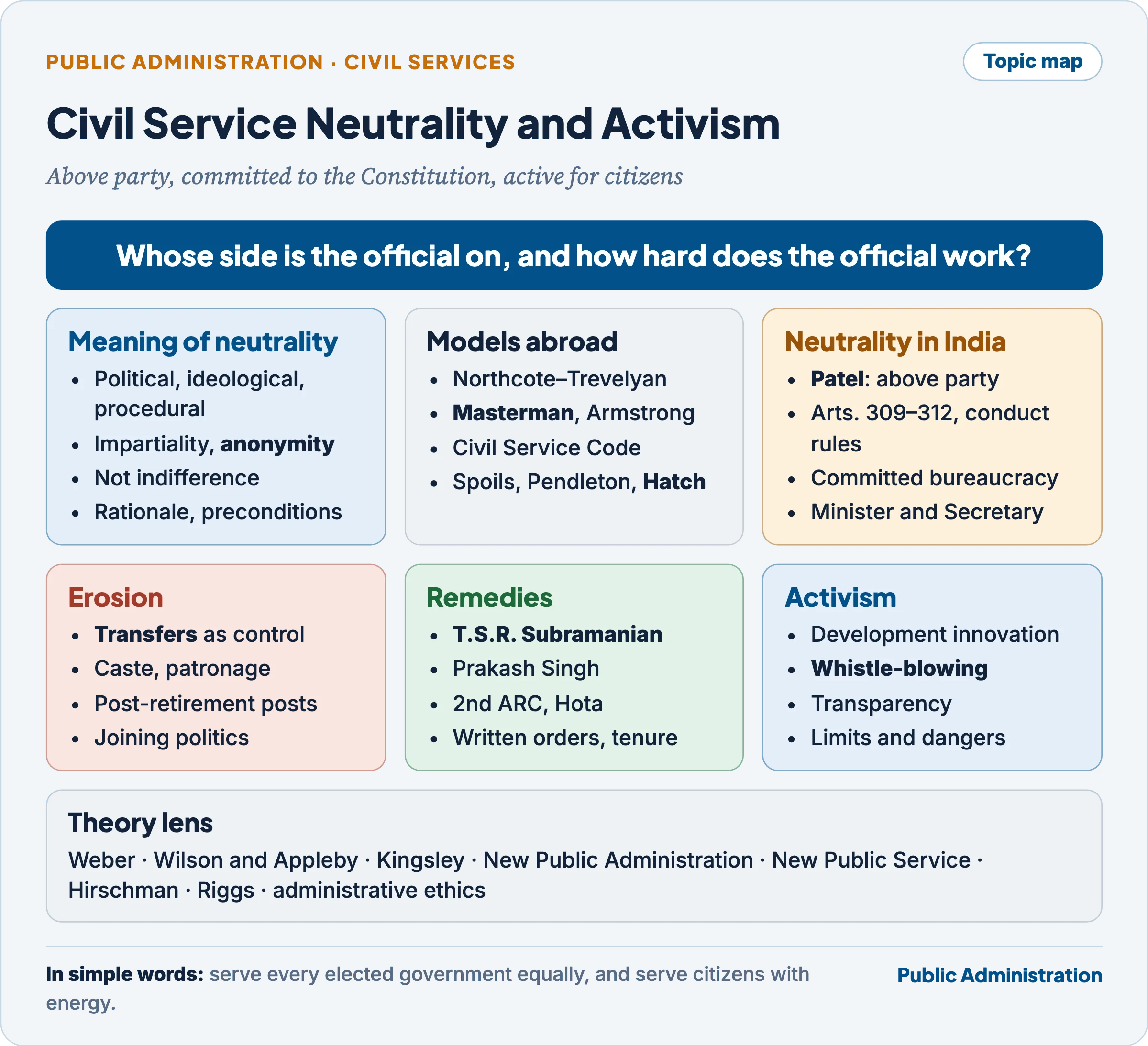
A permanent civil service serves governments that come and go. In a parliamentary democracy like India, a district Collector may work under three Chief Ministers of three different parties in a single decade, and a Union Secretary may draft one government’s flagship law and then help the next government amend it. This is possible only if the service is neutral: loyal to the government of the day, but not to any party. At the same time, India expects its officers to be far more than neutral clerks. It wants them to fight corruption, push development into remote villages and stand up for the weak. That second expectation is civil service activism.
- The two ideas look like opposites. Neutrality asks the official to stay in the background and serve whoever wins; activism asks the official to step forward and act on conviction.
- This article explains what each means, where each came from, how each works and fails in India, and how the two can be reconciled. The democratic setting of these questions (bureaucratic power, representative bureaucracy, the four images of politicians and bureaucrats) is covered in the article on Bureaucracy, Democracy and Development; here the focus is on neutrality and activism as civil service values.
In simple words
Think of a referee in a cricket match. The umpire must not support either team, or the game loses meaning. But a good umpire is not indifferent either: he knows the rules thoroughly, watches every ball keenly and gives firm decisions. A neutral civil servant is like that umpire. An activist civil servant is the umpire who also notices the pitch is unsafe and insists it be fixed before play.
1. Civil Service Neutrality: Meaning and Dimensions
In simple words
Neutrality means the civil servant does not take sides between political parties. Whichever party wins the election, the officer gives the same honest advice and carries out its lawful decisions with the same effort.
1.1 Meaning
- The core idea. Civil service neutrality is the political impartiality of the permanent service: officials do not belong to, work for or favour any party, and serve successive governments of any political complexion with equal loyalty and competence.
- Herman Finer, the British political scientist, in The Theory and Practice of Modern Government (1932), described the civil service as a permanent body of professionally employed officials who are politically neutral and serve the state regardless of which party forms the ministry.
- Mohit Bhattacharya, the Indian scholar of public administration, called traditional neutrality a kind of “political sterilisation”: governments may change, but the official keeps offering technical advice from a position aloof from the politics of the day.
- R.B. Jain, an Indian scholar of bureaucracy and politics, added a second element: neutrality means not only the absence of political activity or bias in individual officials, but also that the bureaucracy as a whole responds to the will of the government, whatever its political colour.
- The United Nations’ handbook on civil service practice described political neutrality as the essential complement of the merit system: it guarantees that the career official gives the government of the day impartial advice, criticism and assistance.
1.2 Three related norms: neutrality, impartiality, anonymity
The classical (Weberian–British) model joins three norms. They are related but not identical.
| Norm | Meaning | What it forbids | Example |
|---|---|---|---|
| Political neutrality | No party affiliation; equal service to every elected government | Party membership, campaigning, partisan advice | A Secretary briefs a new minister as fully as the old one |
| Impartiality | Acting without bias between citizens, whatever their caste, class, religion or politics | Favouring friends, castes or vote banks in decisions | A licence granted on merit, not on a legislator’s call |
| Anonymity | Working behind the minister, without public praise or blame | Press statements, public defence of policy, claiming credit | The minister, not the Secretary, answers in Parliament |
- Neutrality concerns the official’s relation to parties and governments; impartiality concerns the official’s relation to citizens; anonymity concerns the official’s relation to Parliament and the public.
- Bhattacharya summed up the trio: anonymity keeps the official away from the “din and fury” of politics, impartiality means acting without bias whatever the social pressures or the nature of the client, and neutrality means remaining unaffected by changes in the flow of politics.
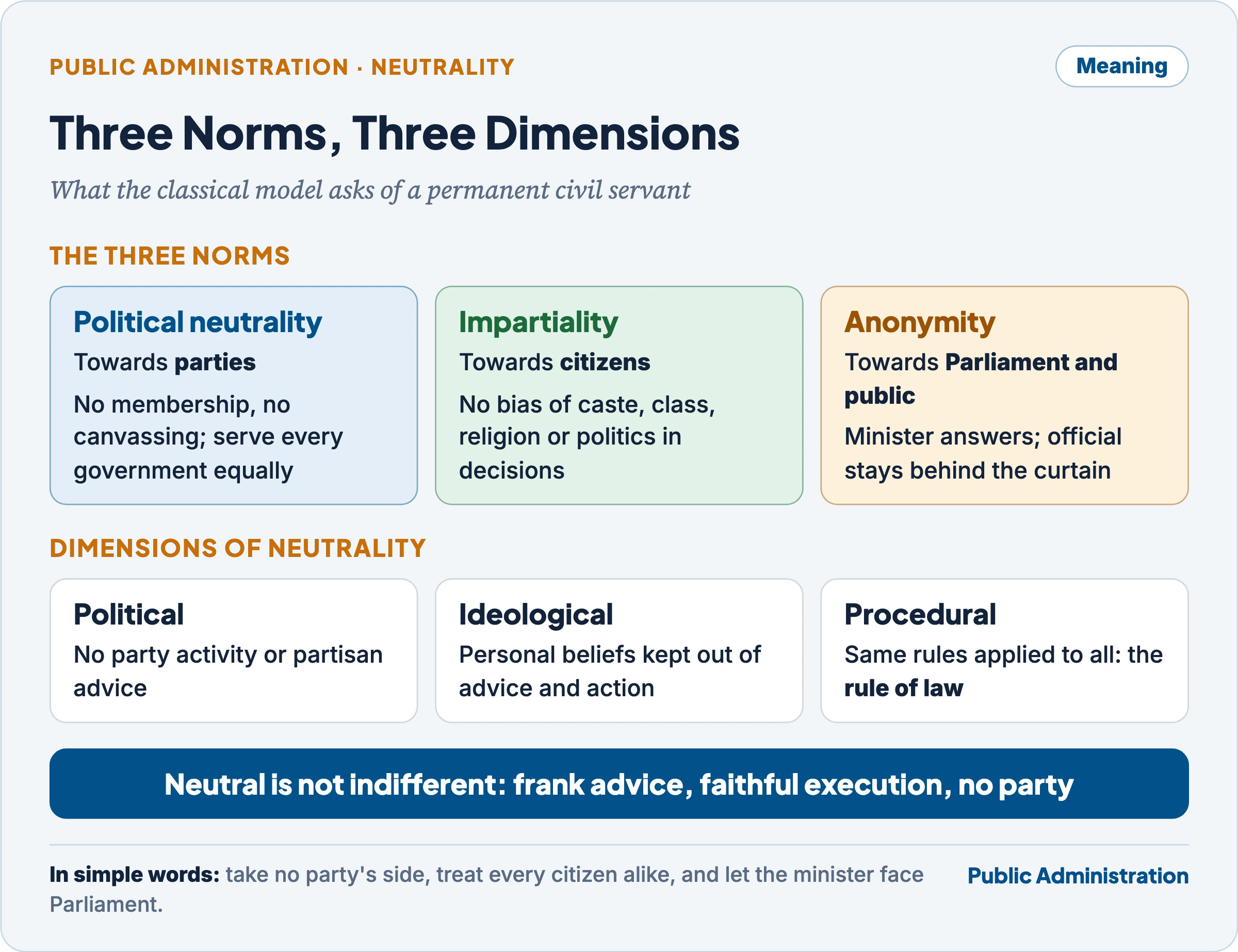
1.3 Dimensions of neutrality
Neutrality operates at several levels. Separating them shows that neutrality can be strong in one dimension and weak in another.
- Political (party) neutrality. The narrowest and most important sense: no party membership or activity, no canvassing, no partisan public comment. This is what conduct rules regulate.
- Ideological neutrality. The official does not let a personal ideology (socialist, market-liberal, religious, regional) colour advice or implementation. This is harder, because every adult has values; the duty is to keep them out of official work, not to have none.
- Procedural neutrality. Rules, procedures and the law are applied uniformly to all. It is the link between neutrality and the rule of law (see 1.5).
- Neutrality between social groups. A widely used Indian analysis distinguishes neutrality between classes (landlord and tenant, employer and worker), between cultural groups (religion, caste, language, region) and between political parties. The first two are often the hardest in a deeply unequal society, because officials drawn from one class or group may unconsciously favour it.
- Example: a Labour Commissioner adjudicating a factory dispute must be seen as neutral by both employer and union; a district administration distributing subsidised fertiliser must not let large farmers capture it.
- Remedy suggested: a more representative recruitment base, better education in shared constitutional values, and strong organisation of weaker groups so that no single interest captures a department.
- Political neutrality versus programme neutrality. Paul Appleby, the American scholar-administrator, drew a useful line. Officials must be politically neutral (not taking sides between parties) but not programme-neutral: once the elected government adopts a policy, they must carry it out sincerely, even if they advised against it.
1.4 Impartiality is not indifference
- Neutral does not mean value-free. A neutral official still has professional judgement, gives frank advice and may argue hard against a proposal inside government. Neutrality governs whose side the official is on (no party’s), not whether the official has a view.
- Neutral does not mean passive. An official who watches injustice and does nothing because “it is not my job” is indifferent, not neutral. Indifference violates the duty of responsiveness to the public, particularly the weaker sections, which India’s conduct rules list beside political neutrality.
- Neutral does not mean silent obedience to illegality. Neutrality is owed to lawful government. An official who carries out an illegal order is not neutral but complicit.
Common confusion
Does a neutral civil servant have to be a person without opinions? No. Neutrality restricts partisanship, not thinking. The British Civil Service Code, for example, requires officials to give advice “on the basis of the evidence” and forbids them to “ignore inconvenient facts”, while also forbidding them to let personal political views determine advice. The neutral official argues freely inside government, accepts the minister’s final decision, implements it faithfully, and would serve an opposition government in the same way.
1.5 Why neutrality matters
- Continuity of government. In a multi-party democracy governments change through elections; a neutral service lets the state keep running through every transition.
- Merit and professionalism. Neutrality is the twin of the merit system: officers selected and promoted on merit owe nothing to a party, and can be trusted by all parties.
- Three kinds of confidence (the classic British formulation):
- public confidence that the service is free from political bias;
- ministers’ confidence, whatever their party, that they will get loyal service;
- officers’ own morale, based on confidence that promotion depends on merit, not on politics.
- Long-term perspective. Ministers think of the next election; a permanent, impartial service can weigh the long-term social pay-offs of a policy and keep institutional memory.
- Defence against patronage. Without neutrality, posts become spoils for party workers, as in nineteenth-century America.
- Unity in a diverse country. A neutral all-India service acts as a unifying force across States ruled by different parties.
- Rule of law. Neutrality is the administrative face of the rule of law (A.V. Dicey‘s idea that everyone is governed by the same law applied equally). Laws are general and impersonal; an official who applies them without regard to party or person is simply applying the law as it is written. When officials bend rules for the ruling party, the law becomes the will of whoever is in power. This is why the 2013 question links neutrality to the rule of law.
- Gerald Caiden, the British-American scholar of administrative reform, argued that the merits of a neutral bureaucracy (permanence, continuity, professionalism and reliability) far outweigh its demerits (conservatism, instrumentalism and reluctance to change).
1.6 Preconditions of neutrality
Neutrality works only in certain settings. Bhattacharya identified three preconditions:
| Precondition | Meaning | Present in Britain? | Present in India at independence? |
|---|---|---|---|
| Class and cultural congruence | Ministers and senior officials share a social background | Yes (Oxbridge, middle class) | No: an anglicised elite served mass leaders |
| Consensus on core values | No fundamental disagreement about the shape of society | Largely yes | No: deep disputes on land, caste, property, planning |
| Shared belief system | Common assumptions about how government should work | Yes | Weak |
- Gabriel Almond, the American political scientist, argued that a neutral, instrumental bureaucracy comes closest to reality where political culture is secular and rational and where interest articulation and aggregation are done by specialised bodies such as parties and interest groups.
- J. Donald Kingsley, in Representative Bureaucracy (1944), argued that British officials could be impartial only because they shared the middle-class outlook of the parties they served. Where society is divided, the same officials would be seen as partisan.
- Implication for India: where these conditions are absent, “neutrality” can become a cover for inertia and status-quo maintenance. This was the core of the 1970s complaint against the inherited service (Section 7).
2. Anonymity and Ministerial Responsibility
In simple words
In a parliamentary system the minister takes the credit and the blame for everything the department does. In return, the civil servant stays out of the limelight. Anonymity is the officer’s side of that bargain.
- Meaning. Anonymity means the civil servant works behind the curtain, without public praise or blame. Officials do not issue political statements, do not defend policy in public, and are not named in Parliament for their advice.
- Its basis. It is the counterpart of ministerial responsibility. Because the minister answers to Parliament for every act of the department, the minister must also protect the officials who acted on his or her policy. In the chain of accountability, civil servants answer to ministers, and ministers answer to Parliament.
- The logic behind it:
- The official is an instrument of the political executive, not an independent political actor.
- Anonymity lets officials give frank advice without fear that it will be used against them in public.
- It also protects the minister’s freedom to reject advice without public embarrassment.
- Limits. Anonymity covers lawful and proper acts done under the minister’s policy. It does not cover an official who acts against orders, abuses authority for personal ends or commits a crime: such an official is personally liable.
- Indian anchor: the Mundhra affair (1957–58). The state-owned Life Insurance Corporation bought shares in companies of the businessman Haridas Mundhra. A one-man commission under Justice M.C. Chagla (1958) held that constitutionally the minister is responsible for the acts of his Secretary and cannot take shelter behind officials or disown their actions. Finance Minister T.T. Krishnamachari resigned in February 1958, though the decision had been taken at official level. The case is the classic Indian statement of anonymity and ministerial responsibility.
- British anchor: Crichel Down (1954). An inquiry into the handling of requisitioned farmland in Dorset named and criticised individual officials. Agriculture Minister Sir Thomas Dugdale resigned, accepting responsibility, but the episode started the long debate on whether ministers should always shield officials.
2.1 Why anonymity has weakened
- Committees of Parliament. Secretaries now depose before the Public Accounts Committee, departmentally related standing committees and joint committees, and are questioned by name.
- Right to Information Act, 2005. File notings, including an officer’s own note, can be disclosed; the Central Information Commission has held since 2006 that file notings are not exempt as a class. Advice is therefore traceable to its author.
- Audit and investigation. CAG reports, CVC and CBI inquiries and court cases name the officers who took decisions.
- Media and social media. Officers are photographed, quoted and praised or attacked by name; some officers build their own public following.
- Ministers blaming officers. In practice ministers increasingly disown unpopular decisions and blame “the bureaucracy”, which breaks their side of the bargain. When Prime Minister Rajiv Gandhi announced at a January 1987 press conference that there would soon be a new Foreign Secretary, the incumbent, A.P. Venkateswaran, resigned: a public humiliation that ignored the norm that officials are not criticised in public.
- Assessment. Anonymity in the strict sense has largely broken down; what survives is the principle that policy responsibility lies with the minister, while officers are increasingly answerable for their own decisions and conduct.
Common confusion
Are neutrality and anonymity the same thing? No. Neutrality is about not taking party sides; anonymity is about not appearing in public as the author of advice or policy. An officer can lose anonymity without losing neutrality: a Secretary who explains a scheme on television, or whose file note is released under RTI, may still be perfectly non-partisan. Anonymity has eroded far more than neutrality has, mainly because of transparency laws, which most people regard as a gain.
3. The British Model: Where Neutrality Was Born
In simple words
Britain built the idea of a permanent, politically neutral service in the nineteenth century, and has written it down more and more precisely ever since: first in reports, then in a memorandum, then in a code, and finally in an Act of Parliament.
- Northcote–Trevelyan Report (1854). Sir Stafford Northcote and Sir Charles Trevelyan recommended entry by open competitive examination, promotion by merit, and a unified, permanent service. A Civil Service Commission followed in 1855, and open competition became the norm from 1870. Merit-based entry is the foundation of neutrality: an official chosen by examination owes nothing to a patron.
- Weber’s neutral official. Max Weber, the German sociologist, in his writings on bureaucracy (published in Economy and Society, 1922) and in “Politics as a Vocation” (1919), held that the official should administer sine ira et studio, “without anger or partiality”. The official carries out the orders of the political leader as conscientiously as if they were his own convictions; the politician, by contrast, must take sides and bear personal responsibility. See the article on Weber and Bureaucracy.
- Haldane Committee on the Machinery of Government (1918) confirmed that ministers decide and answer to Parliament, and officials advise and execute.
- Masterman Committee on the Political Activities of Civil Servants (report June 1949). Chaired by J.C. Masterman, an Oxford academic, it was set up after staff unions sought wider political rights.
- It described impartiality, a public mind untinged by political leanings, as a long-recognised virtue of the British administrator, and warned that any weakening of it would be the first step towards a “political” civil service, contrary to the public interest.
- It drew a line between grades: the industrial and minor and manipulative grades (some 450,000 staff) were made politically free, while office grades remained restricted.
- The government’s 1953 White Paper (Cmd 8783) then settled the three categories still used: politically free, intermediate (may take part with permission) and politically restricted (senior grades barred from national politics).
- Armstrong Memorandum (26 February 1985). Sir Robert Armstrong, Cabinet Secretary and Head of the Home Civil Service, issued “The Duties and Responsibilities of Civil Servants in Relation to Ministers” after the trial and acquittal of Clive Ponting, a defence official who had leaked documents on the sinking of the Belgrano and pleaded the public interest. Its key propositions:
- the civil service has no constitutional personality separate from the government of the day;
- the official’s duty is first to the minister of the department;
- the service is non-political, and must keep the confidence of present ministers while being able to serve future ones equally.
- Critics said it equated the public interest with the government’s interest and left no room for conscience.
- Civil Service Code (1996, revised 2006 and 2010). The code turned the memorandum into published standards with a right of appeal to the Civil Service Commissioners. Since the Constitutional Reform and Governance Act, 2010, it rests on statute. Its four core values are integrity, honesty, objectivity and impartiality; “impartiality” includes serving equally well governments of different political persuasions.
- Nolan Committee (1995) set out the Seven Principles of Public Life, including objectivity; see the article on Administrative Ethics.
- Pressure points in Britain. The growth of special advisers (temporary political appointees inside departments), the Thatcher-era charge that senior appointments favoured officials seen as reliable, and public criticism of officials by ministers have all tested the tradition, but the formal doctrine has been strengthened rather than abandoned.
Indian Connect — The colonial ICS and its claimed neutrality
The Indian Civil Service was presented as the neutral, incorruptible steel frame standing above Indian factions. It openly refused to be influenced by Indian commercial and industrial interests, and that refusal was cited as proof of impartiality. But its neutrality ran in one direction only: it was neutral among Indians, not between India and Britain. Tariff and excise policy, such as the countervailing cotton excise duty of 1896 imposed on Indian mill cloth to protect Lancashire’s market, shows the service serving imperial interests. Independent India inherited the habit of standing aloof from local pressures, together with an elite, status-quo outlook that later critics attacked. See the article on Legacy of British Rule.
4. The American Experience: From Spoils to Merit
In simple words
For much of the nineteenth century, American government jobs were handed out to party workers after every election. The chaos and corruption this caused forced the country to build a merit system and laws keeping officials out of party politics.
- The spoils system. From President Andrew Jackson (1829) onwards, “rotation in office” let each winning party replace officials with supporters; Senator William Marcy‘s phrase “to the victor belong the spoils” (1832) gave the system its name. It produced incompetence, corruption and discontinuity.
- Its end began with a murder. President James Garfield was shot in 1881 by a disappointed office-seeker. The Pendleton Civil Service Reform Act (1883) created a Civil Service Commission and filled a “classified” set of posts by competitive examination, protected from political dismissal. Coverage grew steadily over the following decades.
- Hatch Act (1939). It barred most federal employees from active participation in political management or campaigns and from using official authority to influence elections. The Hatch Act Reform Amendments (1993) relaxed it for most employees, allowing off-duty campaigning, while keeping strict limits for sensitive agencies.
- Second Hoover Commission (1955). Its proposals for a senior career service set out what neutrality demands of senior officials: keep clear of party activity, avoid such emotional attachment to one administration’s policies that they cannot work with the next, and make no public political speeches.
- A politicised top layer by design. Unlike Britain or India, the United States fills its top policy posts (about 4,000 positions, many needing Senate confirmation) with political appointees who leave with the President. The Senior Executive Service (Civil Service Reform Act, 1978) sits below them. The model accepts political responsiveness at the top and neutral competence below.
- Schedule F and Schedule Policy/Career. In October 2020, Executive Order 13957 created “Schedule F” to remove job protections from career officials in policy-influencing posts. It was rescinded in 2021, revived by Executive Order 14171 (20 January 2025) as Schedule Policy/Career, and implemented by an Office of Personnel Management final rule effective 9 March 2026 and an order of June 2026 moving positions into it. Such officials remain career staff hired on merit but become removable at will. Supporters call it accountability; critics see a return towards the spoils logic that the Pendleton Act ended.
The three national traditions can be compared as follows.
| Feature | Britain | United States | India |
|---|---|---|---|
| Top policy posts | Career permanent secretaries | Political appointees | Career Secretaries (with some lateral entry, 2018–2023) |
| Legal basis of neutrality | Civil Service Code under the 2010 Act | Hatch Act, merit-system law | Articles 309–312, conduct rules, RP Act |
| Political activity of officials | Graded: free, intermediate, restricted | Off-duty activity allowed for most since 1993 | Barred for all government servants (voting allowed) |
| Main threat | Special advisers, ministerial pressure | Spoils revival (Schedule F) | Transfers, patronage, post-retirement rewards |
| Anonymity | Strong but eroding | Weak; officials testify publicly | Formally strong, practically eroding |
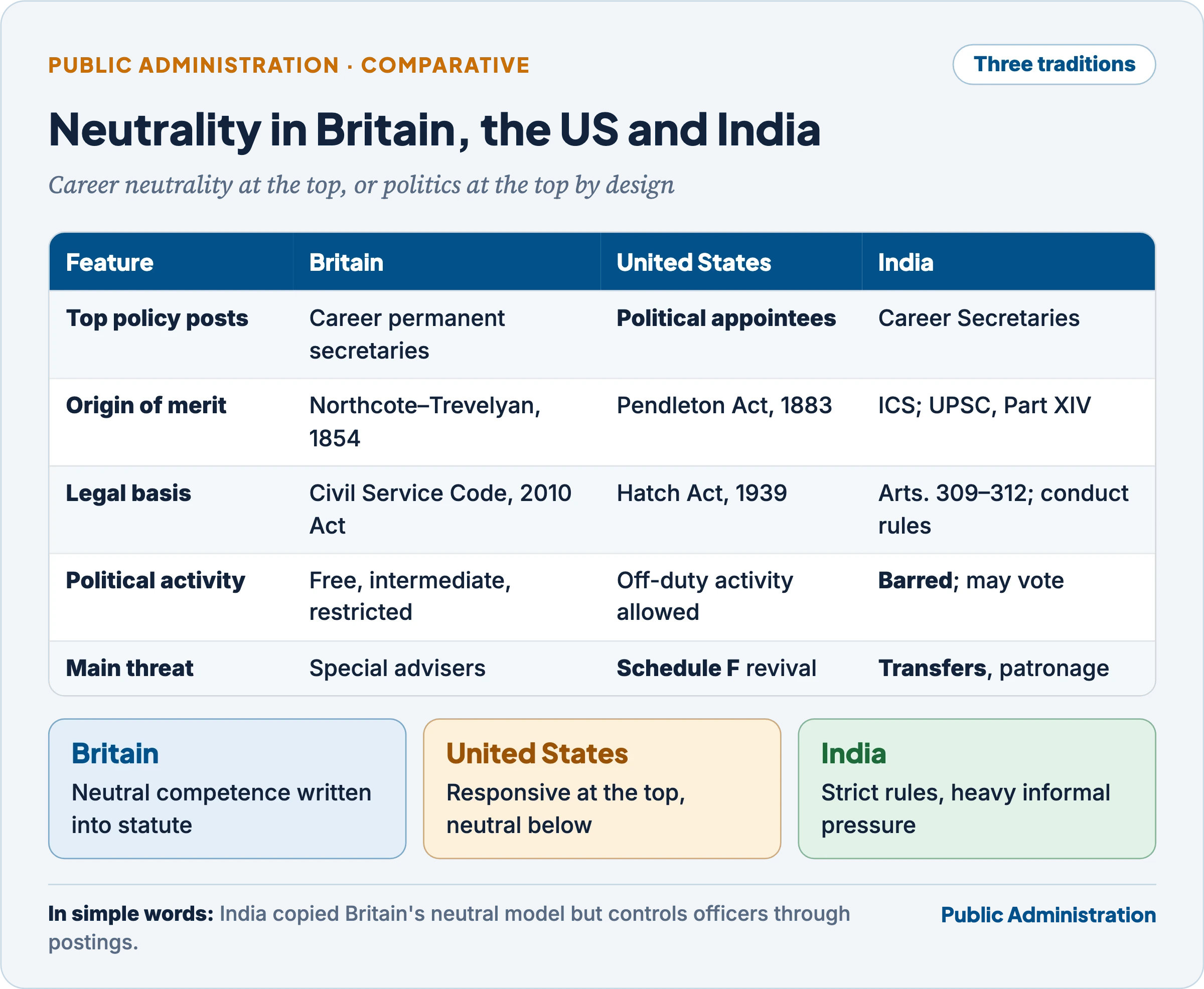
- Reading the table. Britain and India share the career, neutral model at the top; the United States deliberately politicises its apex. India’s rules on political activity are stricter than either, yet its neutrality is under heavier informal pressure, chiefly through control over postings and transfers.
5. Neutral, Committed and Politicised: A Spectrum
In simple words
Bureaucracies are not simply “neutral” or “political”. They sit somewhere on a line, from officials who keep entirely out of politics to officials who are party workers in uniform.
- Merle Fainsod, the American political scientist, classified bureaucracies by their relation to political authority:
- representative (responsible and responsive to the political forces that win elections, as in democracies);
- party-state (penetrated and controlled by a single party, as in the former USSR);
- military-dominated;
- ruler-dominated (personal instruments of an autocrat);
- ruling (the bureaucracy itself rules, as in colonial India).
- O.P. Dwivedi and R.B. Jain, scholars of comparative and Indian administration, defined a politicised bureaucracy as one that is involved in, influences or is influenced by the politics of the day, of the ruling party or the opposition, and placed bureaucracies on four rungs:
| Type | Party involvement in personnel matters | Officials’ political role |
|---|---|---|
| Depoliticised (neutral) | None | Non-political; serve every government |
| Semi-politicised | Limited | Some identification with the ruling party |
| Committed | High | Committed to the policies and programmes of the ruling party |
| Fully politicised | Complete; party and state structures overlap | Identify with the ruling party’s ideology and interests |
- R.B. Jain’s causes of the breakdown of classical neutrality:
- the civil servant’s growing role in policy-making, which is inherently political;
- the leadership role of bureaucracy in developing countries engaged in socio-economic change;
- the difficulty of separating political from practical considerations in advice;
- the element of political assessment in appraising top officials, done by ministers;
- the simple fact that officials are human beings with their own biases.
- Peter Self, the British scholar, wanted the senior official to be less a “political eunuch” than a “political chameleon”: responsive to the values of each government in turn, without belonging to any. This is the idea of political responsiveness without politicisation, developed in the article on Bureaucracy, Democracy and Development.
6. Neutrality in India: Vision, Constitution and Rules
In simple words
India decided at independence to keep a permanent, merit-based service that would stand above party politics, and protected it in the Constitution. Detailed conduct rules then spell out what an officer may and may not do politically.
6.1 Sardar Patel’s vision
- Sardar Vallabhbhai Patel, India’s first Home Minister, overcame resistance from provincial leaders to keep the all-India services.
- In a letter to Jawaharlal Nehru dated 27 April 1948, he wrote that an efficient, disciplined and contented service, assured of its prospects through diligent and honest work, was essential to sound administration under democracy even more than under authoritarian rule, and that “the service must be above party”. Political considerations in its recruitment, discipline and control should be reduced to the minimum, if not eliminated, and constitutional guarantees were the best means of securing this.
- In the Constituent Assembly on 10 October 1949 he argued that India would not remain united without a good all-India service with the independence to speak out its mind, and told members that he had given his own Secretaries freedom to write notes opposing his views: an officer who withheld honest advice for fear of displeasing the minister should rather leave.
- Three principles follow: the service is above party; political considerations are kept out of its recruitment, discipline and control; and constitutional safeguards protect it. Patel’s vision thus combined neutrality with frank advice, which is the Indian meaning of neutrality to this day.
6.2 Constitutional and statutory basis
India’s neutrality rests on a layered framework, from the Constitution down to conduct rules. The table lists the main provisions.
| Provision | Content | How it supports neutrality |
|---|---|---|
| Article 309 | Legislatures regulate recruitment and service conditions; rules by President or Governor meanwhile | Service conditions set by rule, not by party favour |
| Article 310 | Civil servants hold office during the pleasure of the President or Governor | Subject to Article 311 and law |
| Article 311 | No dismissal by an authority subordinate to the appointing one; no dismissal, removal or reduction in rank without inquiry and hearing | Security of tenure lets officers refuse partisan demands |
| Article 312 | All India Services created by Parliament after a Rajya Sabha resolution | Recruitment and discipline partly outside State party control |
| Articles 315–323 | Public Service Commissions; fixed tenure, removal only after Supreme Court inquiry (Article 317), bar on further government employment (Article 319), consultation on recruitment and discipline (Article 320) | Merit recruitment insulated from patronage |
| AIS (Conduct) Rules, 1968 | Rule 3(1A) and 3(2B) (inserted 2014); Rule 3(3)(iii) on written orders; Rule 5 on politics and elections; Rules 6 and 7 on media and criticism of government | Detailed duties of neutrality for IAS, IPS, IFoS |
| CCS (Conduct) Rules, 1964 | Rule 5 (politics and elections); Rule 8 (press); Rule 9 (criticism of government) | Same duties for Central services |
| Representation of the People Act, 1951 | Section 129: officers on election duty must not act for candidates or influence voting; Section 28A (and Section 13CC of the 1950 Act): election officials deemed on deputation to the Election Commission | Neutrality enforced during elections |
| AIS (Death-cum-Retirement Benefits) Rules, 1958 | Government sanction needed for commercial employment within one year of retirement | Limits conflicts of interest after service |
- Political neutrality in the conduct rules. Rule 5 of both sets of rules bars membership of, or association with, any political party or organisation that takes part in politics, and any part in a political movement or activity. Officers may vote but must not canvass or indicate how they voted. Government decides whether an organisation is “political”; the July 2024 change on the RSS (Section 9) turned on this power.
- The 2014 values. Rule 3(1A) of the AIS (Conduct) Rules, inserted in 2014, requires every member to maintain high ethical standards, integrity and honesty; political neutrality; merit, fairness and impartiality; accountability and transparency; responsiveness to the public, particularly the weaker sections; and courtesy. Rule 3(2B) adds duties to uphold the supremacy of the Constitution and democratic values, take decisions solely in the public interest, decide on merit alone, and implement lawful orders.
- Written orders. Rule 3(3)(iii) requires an officer to act on a superior’s direction in writing; an oral direction must be confirmed in writing as soon as possible. This simple rule is one of the strongest protections of neutrality, because a partisan order is rarely written down.
- Political rights of civil servants (voting, association, criticism, contesting elections) and discipline under the conduct rules are treated in detail in the article on Conduct, Discipline and Staff Relations.
6.3 The Indian meaning of neutrality
- Non-partisanship plus commitment to the Constitution. India never adopted the purely instrumental British idea. The 2014 rules require political neutrality and also commitment to the supremacy of the Constitution and democratic values and responsiveness to the weaker sections. An Indian officer is meant to be neutral between parties but not neutral between the Constitution and its violation, or between the powerful and the poor.
- 2nd Administrative Reforms Commission (Tenth Report, Refurbishing of Personnel Administration, November 2008). Its chapter on the relation between the political executive and civil servants held that the political neutrality and impartiality of the civil services must be safeguarded, and that the onus lies equally on the political executive and the civil services. It asked that this duty be written into both the code of ethics for ministers and the code of conduct for civil servants. Its Fourth Report, Ethics in Governance (2007), proposed that a code for ministers require them to uphold the political impartiality of the civil service and not ask officials to act against their duties.
7. The Committed Bureaucracy Debate
In simple words
Around 1970, India’s leaders said neutral officers were too slow and too conservative for a poor country that wanted rapid change. They asked for “committed” officers. The question was: committed to what, the Constitution or the ruling party?
This debate is covered in the article on Bureaucracy, Democracy and Development as part of the relationship between politicians and bureaucrats. Here it is summarised for what it shows about neutrality as a value.
- Background. Nehru himself had complained that civil servants were “fossilised” in outlook. After the Congress split of 1969, Indira Gandhi‘s government pursued bank nationalisation, the abolition of privy purses and land reform, and called the administrative machinery a stumbling block to national progress. She asked for government servants with commitment to the development of the country and personal involvement in the task.
- The Kumaramangalam doctrine. Mohan Kumaramangalam, the Steel Minister and a leading voice of the government’s left wing, defended the supersession of three senior Supreme Court judges in April 1973 by arguing that the government was entitled to look at a judge’s philosophy and prefer a “forward-looking” judge in tune with the government’s programme. The demand for a committed judiciary and the demand for a committed bureaucracy came from the same logic: institutions meant to be impartial should share the ruling government’s social philosophy.
- The official clarification. Indira Gandhi denied wanting servile or party-committed officials. Jagjivan Ram explained that commitment meant dedication to a society without exploitation and with equality of opportunity, not attachment to a party; the civil servant should still advise fearlessly, whether or not the advice was accepted.
- What happened in practice. The Emergency (1975–77) showed the second meaning winning. The Shah Commission (Justice J.C. Shah, former Chief Justice of India, appointed in 1977, reports in 1978) documented officials who carried out illegal arrests, demolitions and coercive sterilisation, often on oral orders, out of fear or ambition. Its findings strengthened the case for written orders and for protecting officers who refuse unlawful directions.
- Three legitimate commitments. A widely used academic analysis argues that a bureaucracy should be committed to:
- human and constitutional values (justice, liberty, equality and fraternity; the Directive Principles) and the objectives laid down in law;
- service of the people, putting citizens’ interests above the bureaucracy’s own;
- professional ethics of the officer’s own discipline (medicine, engineering, accounts).
Commitment of these kinds reinforces neutrality between classes, groups and parties; only commitment to a party or leader destroys it.
- Appleby’s committed cadres. In his reports on Indian administration in the 1950s, Paul Appleby noted that new programmes such as community development needed staff genuinely zealous about them, and suggested recruiting such cadres flexibly and later converting them into career bodies. Development work requires commitment, but commitment to the programme, not the party.
Indian Connect — Generalism as a bulwark against committed bureaucracy
The generalist all-India services were defended in the 1970s and after as a bulwark against a party-committed bureaucracy. An IAS officer recruited by the UPSC, protected by Article 311, belonging to a national cadre and rotated across subjects is harder to capture than a department-specific specialist dependent on one minister. Critics reply that rotation itself has become a tool of control, because a generalist can be shifted anywhere at any time. The generalist–neutralist model suits parliamentary democracy because it gives ministers loyal, versatile advisers who will serve the next government equally. See the article on Civil Services: Constitutional Position, Structure and Recruitment for the generalist–specialist debate.
8. Neutrality at Work: The Minister and the Civil Servant
In simple words
Neutrality is tested every day in the room where a minister and a Secretary meet. The minister has the mandate; the Secretary has the knowledge and the rules. A good relationship needs each to respect the other’s role.
8.1 Division of roles
| Minister (political executive) | Civil servant (permanent executive) |
|---|---|
| Formulates policy and takes important decisions | Supplies facts, analysis and options; gives frank advice |
| Answers to Parliament and the people | Answers to the minister |
| Supervises implementation; decides larger administrative questions | Implements decisions faithfully, even against own advice |
| Makes top appointments; intervenes to redress legitimate grievances | Discharges delegated and statutory functions; keeps continuity |
- Principles governing the relationship:
- Both must uphold the Constitution and the laws.
- The minister has the final say on policy.
- The civil servant must implement faithfully decisions taken against his or her advice.
- The civil servant has full freedom to advise frankly and without fear.
- The civil servant observes neutrality, impartiality and anonymity.
- Peter Self’s four zones of interaction show where the line blurs: policy-making and arbitration of interests (politicians are formally responsible, but officials supply much of the content); individual and local claims (officials defend uniform rules against politicians’ wish to help particular supporters, the main source of friction); and the balance between political accountability and administrative discretion (an unavoidable point of conflict).
- Ruling and administering. Ministers both rule (set direction, answer for it politically) and administer (supervise, decide individual matters); civil servants formally only administer. In practice senior officers shape rule-making through advice, drafting and delegated legislation, so the distinction is one of legitimacy and accountability, not of activity: the minister’s choices carry an electoral mandate, the officer’s do not.
- Autonomy and control. The administrator needs autonomy and discretion to apply expertise, adapt rules to cases and act fast; the politician needs control and intervention to make the bureaucracy carry out the mandate and to redress grievances. Too much autonomy produces bureaucratic dominance; too much intervention produces politicisation and paralysis. Neutrality is the norm that lets both coexist: officers accept control over policy, politicians accept officers’ independence in applying the law to individual cases.
- Blurring as one descends. The line between political and administrative jurisdiction is clearest at the Union level, where a Secretary deals with a minister on policy. It blurs at the State level, where ministers intervene in postings and schemes, and blurs most at the district and local level, where legislators, panchayat leaders and officials deal face to face over individual beneficiaries, transfers and contracts.
8.2 Causes of friction
- Ministers discourage frank advice and judge officers by their willingness to do what they are told.
- Personal affiliations: officers align with individual ministers or factions, and ministers cultivate “their” officers.
- Transfer, suspension and disciplinary powers used against officers who do not oblige.
- Factionalism, group rivalry and casteism among both ministers and officials.
- Political instability after the end of one-party dominance, with frequent changes of government in the States.
- Confusion of roles: ministers interfere in day-to-day administration; officers keep important matters from ministers or play one minister against another in coalitions.
- Ministers blaming officers for failures, against the doctrine of ministerial responsibility.
- Officers criticising ministers in private circles, provoking similar reactions.
- Differences of background: social origin, education, outlook and commitments differ sharply between politicians and officials.
- Rigidity of officers who apply rules without understanding the legitimate political needs of elected representatives.
8.3 First ARC remedies (Report on Personnel Administration, 1969)
- All major decisions, with reasons, should be recorded in writing, especially where the minister departs from policy or differs from the Secretary on an important issue.
- Ministers should create a climate of free and frank advice and give Secretaries guidance.
- The Prime Minister, assisted by the Cabinet Secretary and the central personnel agency, should arrest the growth of personal affiliations between ministers and officers.
- Ministers should not interfere in day-to-day administration; where a citizen’s grievance shows a rule is wrong, the rule should be changed rather than relaxed for one case.
- Secretaries should show greater sensitivity to ministers’ difficulties and distinguish minor adjustments from compromises of principle.
- The relation should be one of loyalty from the Secretary and confidence from the minister.
In simple words
A popular saying captures the balance: bureaucrats should not play politics, but they must understand how politics works.
- Understanding politics without playing it. A Secretary who ignores the political pressures a minister faces gives advice that cannot be used; a Secretary who joins those pressures stops being neutral. The ideal is political literacy (knowing what voters, coalition partners and legislators need) combined with political abstinence (refusing to serve a party’s interest). Woodrow Wilson‘s dichotomy of politics and administration (1887) asked officials to stay out of politics entirely; Appleby‘s continuum (Policy and Administration, 1949) showed that administration is itself a political process. The working answer in India lies between them. See the article on Wilson and Evolution of the Discipline.
9. Erosion of Neutrality in India
In simple words
On paper, Indian officers are neutral. In practice, politicians control their postings, careers and post-retirement jobs, so many officers find it safer to please the party in power. This section lists the main ways neutrality has been worn down.
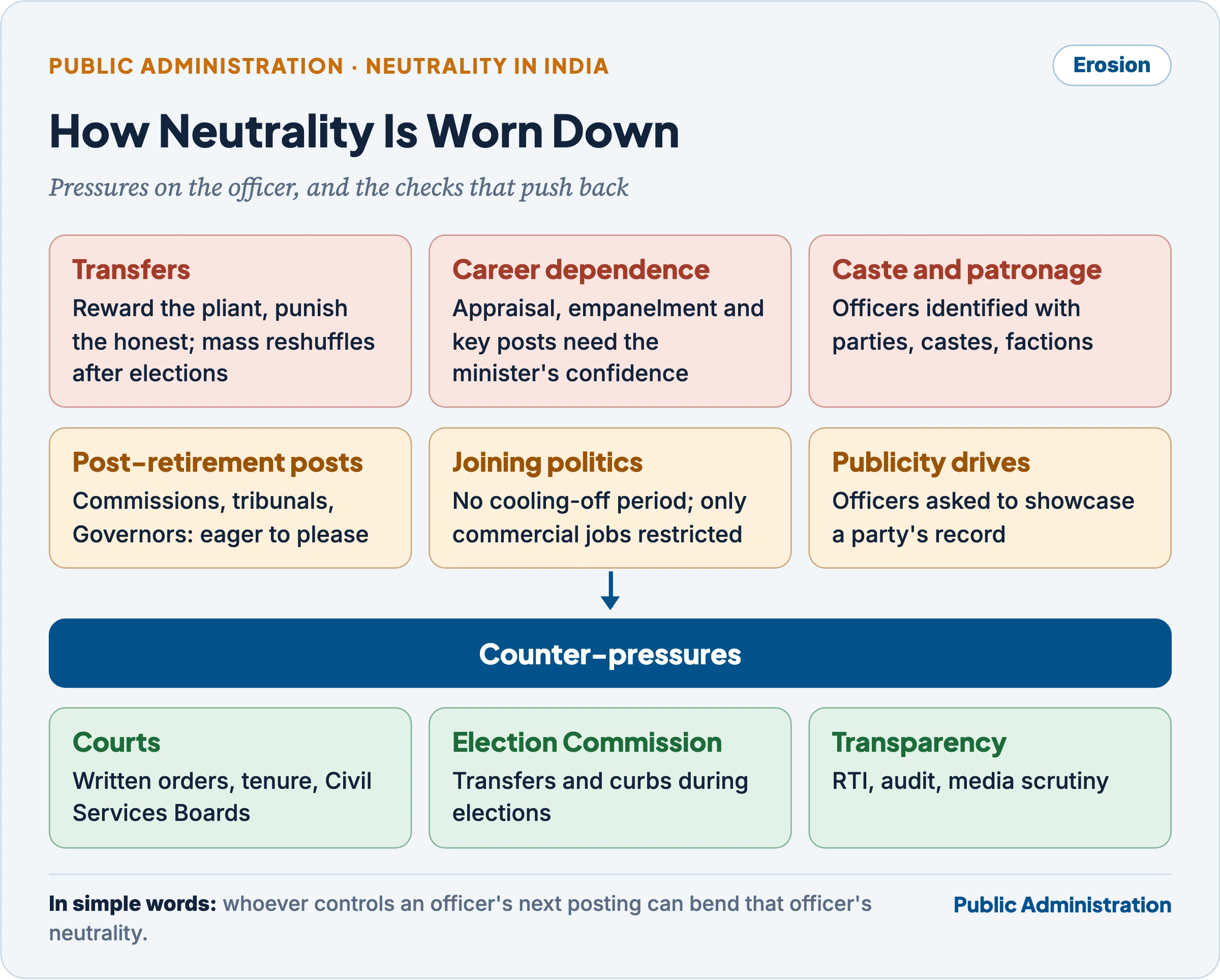
9.1 Transfers and postings as instruments of control
- The main lever. Article 311 protects officers from dismissal, but not from transfer. A transfer needs no inquiry, can be ordered overnight and can move an officer from a powerful post to an obscure one. It is the most common way of rewarding the pliant and punishing the honest.
- Wholesale reshuffles follow changes of government, especially in the States: Collectors, Superintendents of Police and Secretaries are replaced en masse with officers seen as close to the new rulers. Even in the Union government, there is a perception that officers must cultivate patronage to obtain good positions.
- Case: Ashok Khemka. The 1991-batch Haryana IAS officer cancelled the mutation of a Gurugram land deal involving Robert Vadra in 2012 and repeatedly flagged irregularities. He was transferred 57 times in about 34 years, under governments of different parties, before retiring on 30 April 2025 as Additional Chief Secretary (Transport). The pattern shows transfer used as punishment across party lines.
- Case: Durga Shakti Nagpal. As SDM in Gautam Buddh Nagar, Uttar Pradesh, the young IAS officer acted against illegal sand mining; she was suspended on 27 July 2013, officially for ordering the demolition of a mosque wall. After national protest, including from fellow officers, the suspension was revoked in September 2013.
- The transfer “industry”. Reports from several States describe money and caste brokering in postings, especially for lucrative field posts.
9.2 Career dependence on political superiors
- Appraisal and empanelment. Ministers write or review the appraisal of senior officers, and empanelment for Joint Secretary and above, selection of Chief Secretaries, DGPs and heads of key agencies depend heavily on the political executive’s confidence. An officer’s career advancement therefore depends on pleasing political superiors, which pulls against neutrality.
- “Confidence” as a criterion. Choice of officers for sensitive posts on the basis of the political executive’s comfort is legitimate up to a point (a minister must trust the Secretary), but becomes politicisation when “confidence” means party loyalty.
- Premature retirement. Rules allow government to retire officers early in the public interest after periodic review, under Fundamental Rule 56(j) and Rule 16(3) of the AIS (Death-cum-Retirement Benefits) Rules. The 2nd ARC proposed intensive reviews at 14 and 20 years of service, with continuation depending on performance. Removing deadwood is legitimate, but without an objective performance management system (agreed targets, measured results, independent review), the same power can be used to remove inconvenient rather than incompetent officers. Objective appraisal must therefore come before compulsory retirement.
9.3 Caste, region and patronage
- Identification with parties and castes. Officers are increasingly perceived, rightly or wrongly, as belonging to a particular political dispensation, caste network or regional group. Fred Riggs‘ idea of the prismatic society, where formal merit rules coexist with older loyalties of caste and kin, fits this pattern (see the article on Riggsian Models).
- Nexus. The Vohra Committee (1993) described a nexus of politicians, criminals and some bureaucrats in parts of the country.
- Religious or ideological groupings. In November 2024, Kerala suspended an IAS officer for creating a messaging-app group of officers on religious lines (“Mallu Hindu Officers”), which the suspension order said created communal formations within the cadre.
9.4 Post-retirement rewards
- Sinecures. Governorships, membership of commissions and tribunals, regulatory posts, advisory jobs and extensions are in the gift of the government. The prospect can make officers eager to please in their final years.
- Speed of appointment. In Anoop Baranwal v. Union of India (2 March 2023), a Constitution Bench noted that Arun Goel had taken voluntary retirement and been appointed Election Commissioner on the same day (18 November 2022), and said it was “a little mystified” by the speed. The Court ordered that the Chief Election Commissioner and Election Commissioners be chosen by a committee of the Prime Minister, Leader of the Opposition and Chief Justice of India until Parliament legislated; the Chief Election Commissioner and Other Election Commissioners (Appointment, Conditions of Service and Term of Office) Act, 2023 then replaced the Chief Justice with a Union Cabinet Minister nominated by the Prime Minister. Goel resigned in March 2024.
9.5 Officers joining politics
- The pattern. Many senior officers have joined parties and contested elections soon after retirement or resignation, sometimes for the party in whose government they served.
- The cooling-off proposal. In 2012 the Election Commission proposed a cooling-off period (reported as two years) before retired or resigned senior officers could join a party, arguing that officers with political ambitions may favour a party in their last years of service. In 2013 the government, on the Attorney General’s opinion, rejected it as inconsistent with Article 14 and the citizen’s right to contest elections. In May 2022 the Supreme Court declined to direct a cooling-off law, saying the question was for the legislature, while stressing that political neutrality is non-negotiable during service.
- Only commercial employment is restricted: AIS officers need government sanction to take commercial employment within one year of retirement.
9.6 Government publicity and political events
- Publicity versus propaganda. Officers legitimately explain and deliver government schemes. The line is crossed when they are asked to celebrate a party’s record in the run-up to elections.
- Case: Viksit Bharat Sankalp Yatra (2023). An October 2023 order asked ministries to nominate Joint Secretaries, Directors and Deputy Secretaries as “district rath prabharis” for a yatra showcasing the government’s achievements of nine years. After complaints that this turned officials into campaigners, the Election Commission on 26 October 2023 directed that the activity not be carried out in the five poll-bound States until 5 December 2023.
- Ideological organisations. On 9 July 2024, the DoPT removed the Rashtriya Swayamsevak Sangh from Home Ministry memoranda of 1966, 1970 and 1980 that had treated participation in its activities as a breach of Rule 5 of the CCS (Conduct) Rules. Central government employees may now take part in its activities; the bar on the Jamaat-e-Islami in the same memoranda remains. Supporters said the RSS is a cultural, not political, body; critics saw a risk to the appearance of neutrality.
9.7 The opposite failure: fear and paralysis
- Risk aversion. Fear of vigilance, audit and investigative agencies, and of being targeted by the next government, makes many officers avoid decisions altogether. Section 17A of the Prevention of Corruption Act (inserted in 2018) requires prior approval before inquiry into decisions taken in official functions, partly to protect bona fide decisions.
- Why it matters for neutrality. An officer who fears the next government is no more neutral than one who courts the present one; both let party politics shape decisions.
9.8 Is neutrality a myth?
- For “myth”: transfers, patronage, post-retirement rewards and visible party alignments show that neutrality is often formal rather than real (Riggs’ formalism: the gap between prescribed rules and actual behaviour).
- Against “myth”: elections are still conducted by civil servants whom all parties broadly trust; officers serve successive governments of opposite parties in every State; the UPSC remains merit-based; and the conduct rules are enforced in visible cases. Neutrality is eroded and contested, not dead.
10. Restoring Neutrality: Courts and Reform Proposals
In simple words
Since political leaders have little incentive to give up control over officers, much of the push to protect neutrality has come from commissions and, more forcefully, from the Supreme Court.
10.1 Judicial responses
- Vineet Narain v. Union of India (1997). Gave the Central Vigilance Commission superintendence over the CBI and a minimum two-year tenure for the CBI Director: the first major judicial attempt to insulate investigators from political control.
- Prakash Singh v. Union of India (22 September 2006). Directed State Security Commissions, a minimum two-year tenure for the DGP and for field police officers such as SPs, selection of the DGP from a UPSC-prepared panel, Police Establishment Boards for postings and transfers, separation of investigation from law and order, and Police Complaints Authorities. Compliance has been partial in many States.
- T.S.R. Subramanian v. Union of India (31 October 2013). On a petition by retired officers led by a former Cabinet Secretary, the Court directed:
- Civil Services Boards at the Centre and in the States to recommend postings and transfers, until Parliament enacts a law under Article 309;
- a minimum fixed tenure for civil servants;
- that officers act on written orders, recording oral instructions, because much of the deterioration in governance stemmed from political interference through verbal orders.
The IAS (Cadre) Amendment Rules, 2014 then provided a minimum two-year tenure and postings on the Civil Services Board’s recommendation, with reasons to be recorded for any departure. Similar rules followed for the IPS and IFoS.
- Anoop Baranwal v. Union of India (2023). Applied the same logic of insulation from the executive to appointments to the Election Commission (Section 9.4).
Indian Connect — Why written orders matter
The T.S.R. Subramanian judgment rested on a simple observation: partisan instructions are almost always oral. Requiring officers to act only on written orders, and to record any oral instruction, creates a paper trail that makes illegal or partisan directions costly to give. It also protects the officer, who can later show that a decision was ordered. The rule already existed in Rule 3(3)(iii) of the AIS (Conduct) Rules; the Court turned it into a constitutional expectation linked to good governance and the RTI Act.
10.2 Commissions and committees
- Santhanam Committee on Prevention of Corruption (1962–64) urged that oral instructions be recorded and led to the CVC (1964).
- First Administrative Reforms Commission (1966–70): remedies listed in 8.3.
- National Commission to Review the Working of the Constitution (2002) recommended a statutory Civil Services Board to handle transfers and promotions and delink civil service careers from politics.
- Surinder Nath Committee (2003) sought objective appraisal and placement of All India Service officers.
- Hota Committee (P.C. Hota, 2004) recommended a Civil Service Act, statutory Civil Services Boards, fixed tenure, recorded reasons when a Board is overruled, and protection for honest officers.
- Draft Public Services Bill (2006–07) proposed values including political neutrality, a Public Services Authority free of political control, fair transfers and the right to raise objections to orders that violate the code, without victimisation.
- 2nd ARC (2005–09): Fourth Report (Ethics in Governance, 2007) and Tenth Report (Refurbishing of Personnel Administration, 2008) recommended a Civil Services Law with a Central Civil Services Authority, codes of ethics for ministers and officers, the equal onus for neutrality noted in 6.3, protection for whistle-blowers, and classification of abuse of authority unduly favouring or harming someone and obstruction of justice as offences under the Prevention of Corruption Act.
10.3 Measures to strengthen neutrality
- A Civil Services Act under Article 309 that puts values, tenure, transfers and performance management on a statutory footing.
- Civil Services Boards with real autonomy, including outside members, and public reasons when they are overruled.
- Minimum tenure for key posts, enforced and monitored.
- Written orders and recorded oral instructions, linked to RTI.
- Objective, transparent appraisal (online appraisal, multi-source feedback) to reduce political assessment.
- Cooling-off periods for post-retirement political posts and appointments to constitutional bodies.
- Operational whistle-blower protection (Section 13.2).
- Codes of ethics for ministers as well as officers, as the 2nd ARC proposed.
- Values-based training, now part of Mission Karmayogi (see the article on Training and Capacity Building).
- Political consensus: since every party benefits from a neutral service when in opposition, an agreed code is in all parties’ long-term interest.
In simple words
Neutrality matters even more for development than for routine administration. When the state hands out loans, subsidies, land and licences, an official who favours big farmers, big firms or the ruling party’s supporters defeats the very purpose of development.
- Neutrality and development administration. In development work the bureaucracy distributes scarce resources among groups with unequal power. Neutrality between classes and groups is what lets small farmers, small industries and weaker sections get their share. A development bureaucracy therefore needs neutrality towards parties and commitment to the development objectives laid down in law: the two together, not one instead of the other.
11. Neutrality versus Responsiveness
In simple words
Voters elect a government to change things. If officials are so “neutral” that they resist every change, democracy is blocked. If they are so “responsive” that they do whatever the ruling party wants, the law is blocked. The task is to find the balance.
- The tension stated. Herbert Kaufman, the American scholar, argued in 1956 that American administration swings among three values: representativeness, neutral competence and executive leadership. Terry Moe (1985) described presidents seeking “responsive competence”, officials responsive to their political direction, rather than neutral competence. Every reform of the civil service shifts the balance among these values.
- Representative bureaucracy. Kingsley (1944) argued that a bureaucracy is truly responsive only if it mirrors society; a narrow elite’s “neutrality” hides its class bias. India’s reservation policy and the debates on the social background of recruits draw on this idea. Representativeness can make neutrality more credible to groups that previously saw the service as alien. See the article on Bureaucracy, Democracy and Development.
- New Public Administration. The Minnowbrook Conference (1968) and H. George Frederickson‘s “Toward a New Public Administration” (1971) rejected value-neutrality. Frederickson added social equity to efficiency and economy as a goal, and called for an active, proactive administrator who works for the disadvantaged. This is the intellectual root of civil service activism (see the article on New Public Administration and Public Choice).
- New Public Management. NPM (1980s–90s) sought managerial responsiveness: performance contracts, agencies, results and lateral entry of outside managers. It treated officials as managers answerable for outputs, and in several countries increased political control over senior appointments (contract heads of agencies, political advisers). Critics warned that it weakened the career neutrality of the service.
- Lateral entry and politicisation. India appointed 63 lateral entrants at Joint Secretary, Director and Deputy Secretary level in rounds of 2018, 2021 and 2023, selected through the UPSC. Critics feared a back door for ideologically aligned appointees; supporters pointed to UPSC selection and domain expertise. The August 2024 advertisement for 45 posts was withdrawn over the absence of reservation. The politicisation risk depends on who selects and how: transparent UPSC selection, fixed terms and conduct rules applying equally to lateral entrants reduce it.
- New Public Service. Janet and Robert Denhardt (“The New Public Service: Serving Rather than Steering”, 2000; book 2003) argued that officials should serve citizens, not customers, help citizens articulate shared interests, and treat accountability as multi-faceted (to law, community values, professional norms and citizens). This supports a citizen-oriented activism grounded in democratic values rather than in managerial targets or party direction.
- The middle path. James Svara‘s idea of complementarity (2001) suggests a workable balance: officials respect political supremacy and accept the mandate; politicians respect professional competence and the law. Responsiveness is owed to the elected government’s lawful programme; neutrality is owed to every party and every citizen.
12. Civil Service Activism: Meaning and Roots
In simple words
An activist civil servant does not wait for problems to come to the office. He or she goes out, finds what is wrong, and uses the powers of the post creatively and courageously to fix it, while staying within the law.
- Meaning. Civil service activism is a proactive, change-oriented and citizen-centred orientation in which officials use their discretion creatively and courageously to achieve the goals of public policy, fight maladministration and protect the public interest, instead of confining themselves to routine compliance.
- The activist bureaucrat is:
- goal-oriented rather than rule-oriented, treating rules as means;
- innovative, finding new ways to deliver services or solve problems;
- citizen-friendly, accessible and responsive, especially to the poor;
- courageous, ready to resist illegality and corruption at personal cost;
- ethical, guided by constitutional values more than by career interest.
- Roots in theory.
- New Public Administration (Section 11): Dwight Waldo, who convened Minnowbrook, described its essence as a movement towards normative theory, philosophy, social concern and activism.
- Development administration: the bureaucracy as an agent of socio-economic change, which requires attitudinal change from status-oriented to change-oriented officers (see the article on Development Administration).
- Good governance: transparency, responsiveness, participation and accountability demand officials who take initiative (see the article on LPG and Good Governance).
- New Public Service: officials as stewards of democratic values and facilitators of citizen engagement.
- Indian need. In a society with mass poverty, weak local institutions and low citizen capacity, passive neutrality often means that the powerful capture the state. India’s conduct rules themselves require responsiveness to the weaker sections, which makes a measure of activism a duty, not an indulgence.
- Activism versus judicial activism. Judicial activism means courts going beyond their traditional role to make policy or direct the executive. Civil service activism is within the executive’s own role: it is about how vigorously and creatively officials perform their own functions. Its legitimacy therefore rests on the law and the elected government’s policy, not on the official’s personal agenda.
13. Forms of Civil Service Activism
In simple words
Activism takes several shapes: an officer who builds a road the system ignored, one who exposes a scam, one who opens government files to the public, or one who quietly redesigns a service so that people no longer need to pay bribes.
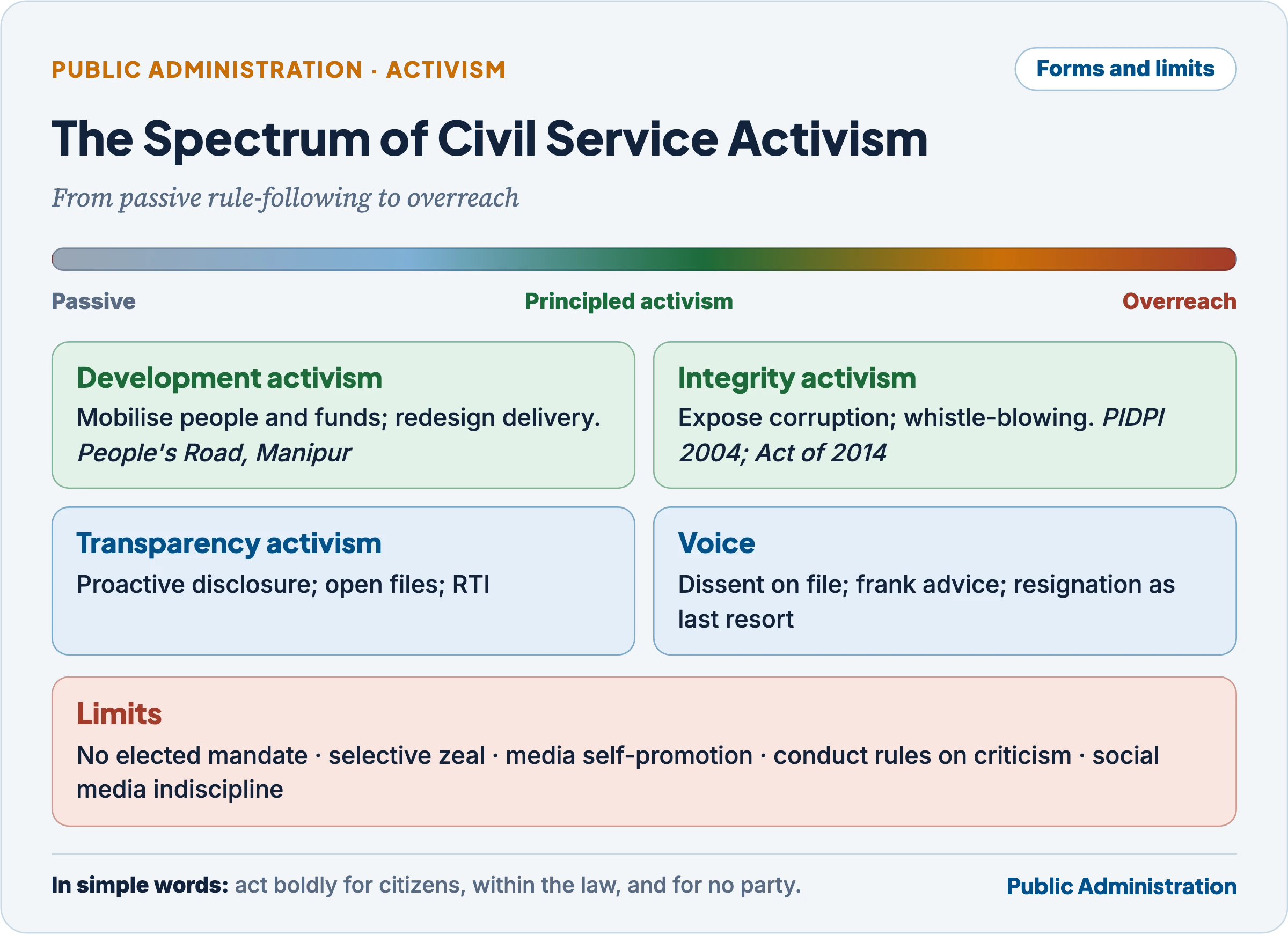
13.1 Development activism and innovation
- Meaning. Officers use their position to mobilise resources and people, redesign delivery and solve local problems.
- Armstrong Pame, Manipur (2012–13). As SDM of Tousem in Tamenglong district, the 2009-batch IAS officer raised funds largely through social media and local contributions, and with community labour built a 100-km “People’s Road” connecting remote villages, opened in February 2013, after government funds were refused.
- N. Prasanth, Kozhikode (2015). As Collector he ran “Operation Sulaimani“, a scheme giving free meals to the hungry through coupons honoured by local eateries, and used social media to engage citizens.
- e-Governance pioneers. Officers in several States led early online land records, bill payment and citizen service centres, showing that system redesign can remove the need for bribes more effectively than punishment.
- Institutional recognition. The Prime Minister’s Awards for Excellence in Public Administration (instituted in 2006) reward district and departmental innovations, giving activism an official channel.
13.2 Integrity activism and whistle-blowing
- Whistle-blowing is disclosure by an insider of corruption, fraud or danger to authorities or the public, when internal channels fail. It is the sharpest form of activism, because it pits loyalty to the organisation against the public interest.
- Satyendra Dubey (2003). An Indian Engineering Service officer with the National Highways Authority of India wrote to the Prime Minister’s Office about corruption in the Golden Quadrilateral project, asking that his identity be protected. He was murdered in Gaya in November 2003.
- S. Manjunath (2005). An Indian Oil Corporation officer who acted against fuel adulteration at petrol pumps in Uttar Pradesh was murdered in November 2005.
- The response. The government’s Public Interest Disclosure and Protection of Informers (PIDPI) Resolution of 2004 made the CVC the designated agency to receive complaints and protect complainants’ identity. Complaints under it have risen steadily: the CVC reported 2,630 complaints received or carried forward in 2024, against 555 in 2020.
- Whistle Blowers Protection Act, 2014. Passed by Parliament (Lok Sabha 2011, Rajya Sabha February 2014), it received assent on 9 May 2014. It provides a mechanism to receive complaints of corruption or wilful misuse of power against public servants and to protect complainants from victimisation. But it has never been brought into force: the government says it first needs amendments to guard against disclosures affecting sovereignty, security and other interests listed in Section 8(1) of the RTI Act. The Whistle Blowers Protection (Amendment) Bill, 2015 was passed by the Lok Sabha on 13 May 2015 but lapsed with the dissolution of the sixteenth Lok Sabha in 2019. Critics argue the amendment would have diluted protection. As of the government’s December 2025 replies to Parliament, the PIDPI Resolution remains the operative mechanism.
- Sanjiv Chaturvedi. The Indian Forest Service officer exposed irregularities in Haryana and, as Chief Vigilance Officer at AIIMS, New Delhi, pursued corruption cases; he faced repeated transfers and litigation and received the Ramon Magsaysay Award (Emergent Leadership) in 2015.
- Ashok Khemka and Durga Shakti Nagpal (Section 9.1) show the personal cost: transfers, suspensions, chargesheets and litigation.
- Earlier exemplars. T.N. Seshan as Chief Election Commissioner (1990–96) enforced the Model Code of Conduct with unprecedented vigour; J.M. Lyngdoh as Chief Election Commissioner insisted on free elections in Jammu and Kashmir (2002) and resisted early elections in Gujarat; Kiran Bedi reformed Tihar Jail. Seshan (1996), Bedi (1994) and Lyngdoh (2003) received Magsaysay Awards.
13.3 Transparency activism within government
- Proactive disclosure. Officers who publish data under Section 4 of the RTI Act, open files to inspection and answer applications fully practise transparency activism from inside.
- Officers’ own voice. Some officers have used RTI and internal appeals to expose irregularities in their own departments.
- Protecting RTI users. Dozens of RTI activists outside government have been attacked or killed after seeking information on local corruption. Because the Whistle Blowers Protection Act is not in force and the RTI Act has no protection clause, there are demands to amend the RTI Act (or operationalise the 2014 Act and extend it to RTI users) so that an applicant facing threats gets protection and the information sought is published proactively, removing the motive to silence the applicant.
- The link to anonymity. Transparency activism is a further reason why anonymity has declined: an official whose notes are public must be ready to defend them.
13.4 Voice, loyalty and exit
Albert Hirschman‘s Exit, Voice, and Loyalty (1970) explains how members respond to an organisation’s decline. Applied to civil servants:
| Response | In the civil service | Example |
|---|---|---|
| Voice | Dissent notes, objections on file, internal appeals, whistle-blowing | Officers recording disagreement on file; PIDPI complaints |
| Loyalty | Staying and implementing faithfully despite disagreement | The classical neutral official |
| Exit | Resignation in protest or to enter politics | Kannan Gopinathan (IAS) resigned in 2019 citing curbs on freedom of expression; Shah Faesal resigned in 2019 to launch a party, later returning to service |
- Neutrality favours loyalty plus internal voice; activism adds public voice; resignation is the last resort when conscience and duty cannot be reconciled. A healthy system protects voice so that exit and silent loyalty are not the only options.
14. Limits and Dangers of Activism
In simple words
An officer who acts on conscience can do great good. But an officer who replaces the people’s elected choices with personal views, or who seeks fame through media, can do great harm. Activism needs boundaries.
- Democratic legitimacy. Officials are not elected. An officer who overrides the lawful policy of an elected government because he or she thinks it wrong substitutes personal values for the people’s mandate, the administrative equivalent of judicial overreach.
- Selective activism. Activism can be partisan in disguise: zeal against one party’s associates and blindness to another’s. Then it destroys neutrality instead of complementing it.
- Media activism and the “celebrity bureaucrat”. Publicity can help mobilise citizens, but chasing media attention risks self-promotion, pre-judging cases, violating anonymity and confidentiality, and creating a personality cult around an office.
- Conduct rules. Officers may not criticise government policy in public (AIS Rule 7; CCS Rule 9), and need permission for many media engagements. Activism must use internal channels and lawful means first.
- Social media. It has multiplied both the reach and the risks of officer activism. In November 2024, Kerala suspended N. Prasanth (the former “Operation Sulaimani” Collector) for social-media posts attacking a senior officer, holding that they amounted to indiscipline unbecoming of an IAS officer. The same tool that built his reputation as an innovative Collector led to his suspension.
- Activism as a path to politics. Officers who gain public fame through activism are courted by parties; when they join one, it raises doubts about whether their earlier activism was neutral.
- Disrupting teamwork and hierarchy. Constant public confrontation can damage the cohesion of administration and make cooperation with elected leaders impossible.
- Personal risk and burnout. Without legal protection, activist officers face transfers, inquiries and threats; many withdraw into risk-averse passivity.
- The ethical test. Carl Friedrich‘s inner responsibility and Herman Finer‘s external control (the Friedrich–Finer debate) both apply: activism is legitimate when driven by professional conscience and accountable to law and superiors. See the article on Administrative Ethics.
15. Neutrality and Activism: Dilemma or Complement?
In simple words
Neutrality and activism look like opposites, but they answer different questions. Neutrality answers “whose side are you on?” (no party’s). Activism answers “how hard and how creatively do you work?” (as hard as the law and the public interest demand).
- Where they conflict. If activism means taking political sides, campaigning publicly against government policy or acting on personal ideology, it is incompatible with neutrality. If neutrality means indifference, mechanical rule-following or silence in the face of illegality, it is incompatible with activism.
- Where they reinforce each other. Properly understood, they are two halves of professional public service:
- neutral between parties, classes, castes and religions;
- active in pursuing the goals laid down in the Constitution and the law, in serving citizens and in resisting corruption.
- A worked contrast. A District Collector who enforces sand-mining law equally against miners linked to the ruling and the opposition party is both neutral and activist. A Collector who raids only the opposition’s miners is activist but not neutral. A Collector who enforces nothing for fear of trouble is “neutral” only in the sense of being passive.
| Aspect | Passive neutrality | Principled activism | Partisan activism |
|---|---|---|---|
| Relation to parties | Non-partisan | Non-partisan | Partisan |
| Relation to policy goals | Indifferent | Committed to lawful goals | Committed to a party’s goals |
| Use of discretion | Minimal | Creative, within law | Selective, often beyond law |
| Accountability | To rules | To law, superiors and citizens | To patrons |
| Effect | Inertia | Good governance | Politicisation |
- The reconciling formula. Neutrality towards parties, commitment to the Constitution, activism for citizens. This is close to what John Rohr called regime values: officials take their ethical bearings from the constitutional values of the regime they have sworn to serve.
Criticism — Neutrality is a myth
- Brian Chapman (The Profession of Government, 1959): neutrality tends in the end to moral corruption; if all governments are to be served with equal loyalty, there is no ground to criticise an official who served Hitler to the best of his ability. It also shields senior officials, who in fact shape policy, from scrutiny.
- Kingsley and Indian critics such as C.P. Bhambri: the bureaucracy is a social class with interests; its “neutrality” hides elite bias.
- New Public Administration: value-neutral administration serves the status quo and ignores social equity.
- Developing-country argument: where there is no consensus on social goals, neutrality becomes inertia; rapid change needs committed officials.
- Indian practice: transfers, patronage, post-retirement rewards and officers’ political careers show neutrality as formal, not real.
Defence — Neutrality is a necessary ideal
- Weber: only an impartial, rule-bound official can run a modern state predictably; politics without a neutral bureaucracy becomes personal rule.
- Patel and the Constitution’s framers: a service above party is essential to a united, democratic India; Articles 309–312 and 315–323 exist to secure it.
- Masterman and the Civil Service Code: public confidence, ministers’ confidence and officers’ morale all depend on impartiality.
- American experience: the spoils system showed the cost of abandoning neutrality, and the Pendleton Act was the answer.
- Indian practice: elections are administered by officers all parties accept; services remain merit-recruited; courts (T.S.R. Subramanian, Prakash Singh) have reinforced neutrality.
- Neutrality redefined as non-partisanship plus constitutional commitment answers most criticisms: it forbids serving a dictator’s illegal orders while still requiring loyalty to any lawful government.
- Assessment. The criticisms defeat neutrality as indifference, not neutrality as non-partisanship. The Indian synthesis (non-partisan, committed to the Constitution, responsive to the weak, active within the law) keeps what is valuable in both neutrality and activism and avoids the dangers of each.
Neutrality answers whose side the official is on; activism answers how hard and how creatively the official works for the public within the law.
Theory lens: neutrality and activism through Paper I ideas
- Weber’s legal-rational bureaucracy. Weber’s official acts sine ira et studio and owes obedience to impersonal rules, which is the ideal type of neutrality. Indian Part XIV, UPSC recruitment and conduct rules are its formal embodiment; the erosion of neutrality is the gap between Weber’s ideal and Indian practice. See the article on Weber and Bureaucracy.
- Wilson’s dichotomy and Appleby’s continuum. Wilson (1887) gave neutrality its classic rationale by separating politics from administration; Appleby showed that administration is political, which is why senior Indian officers cannot be politically sterile and must instead be non-partisan participants in policy. See the article on Wilson and Evolution of the Discipline.
- Representative bureaucracy. Kingsley (1944) explains why the inherited elite service was seen as biased and why reservation and wider recruitment make neutrality credible to all groups.
- New Public Administration. Frederickson‘s social equity and the active administrator provide the intellectual case for civil service activism and for the Indian rule that officers be responsive to the weaker sections. See the article on New Public Administration and Public Choice.
- New Public Service. The Denhardts’ official serves citizens and democratic values, grounding activism in citizenship rather than in managerial targets (NPM) or party direction (politicisation). See the article on New Public Management and After.
- Riggs’ prismatic model. Formalism, the gap between formal norms and behaviour, describes neutrality in India: complete on paper, compromised by caste, patronage and transfers in practice. See the article on Riggsian Models.
- Hirschman’s exit, voice and loyalty. Explains the choices of the dissenting official (internal voice, public whistle-blowing, faithful loyalty, resignation) and why protecting voice is essential to a service that is both neutral and principled.
- Administrative ethics and principal–agent theory. The Friedrich–Finer debate decides how far activism may rest on inner conscience versus external control; principal–agent theory shows why politicians (principals) use transfers to control officials (agents), and why courts and commissions try to limit that control without destroying accountability. See the article on Administrative Ethics.
16. Other Civil Service Themes in Brief
In simple words
Neutrality and activism rest on the rest of the civil service system: how officers are protected, recruited, trained, disciplined and heard. Each of these has its own article; the essentials are given here.
- Constitutional position, structure and recruitment. Articles 308–323, the doctrine of pleasure and Article 311 safeguards, the All India Services, UPSC and the Civil Services Examination give the service its security and merit base, the foundations of neutrality. See the article on Civil Services: Constitutional Position, Structure and Recruitment.
- Training and capacity building. Foundation and induction courses, mid-career training and Mission Karmayogi now include ethics, values and citizen-centricity, the attitudes on which principled activism depends. See the article on Training and Capacity Building.
- Good governance initiatives. Citizen’s Charters, e-governance, performance management and grievance systems create institutional channels for citizen-oriented activism. See the article on Good Governance Initiatives in the Civil Services.
- Code of conduct, discipline, staff associations, political rights and grievances. The detailed conduct rules, disciplinary procedure, the right to form associations, the limited political rights of officials and grievance redressal through tribunals and joint councils are covered in the article on Conduct, Discipline and Staff Relations.
Key Terms
| Term | Meaning in simple words |
|---|---|
| Civil service neutrality | Officials do not take sides between parties and serve every elected government equally |
| Political neutrality | No party membership, campaigning or partisan advice |
| Programme neutrality | Indifference to the policies being carried out; not required of officials (Appleby) |
| Impartiality | Acting without bias between citizens of any caste, class, religion or politics |
| Anonymity | Officials work behind the minister, without public praise or blame |
| Ministerial responsibility | The minister answers to Parliament for everything the department does |
| Sine ira et studio | “Without anger or partiality”: Weber’s description of the ideal official’s attitude |
| Spoils system | Government jobs given to supporters of the winning party |
| Merit system | Recruitment and promotion by open competition and proven ability |
| Hatch Act | US law (1939) limiting federal employees’ political activity |
| Schedule F / Schedule Policy/Career | US category making career officials in policy posts removable at will |
| Committed bureaucracy | Officials committed to the goals of the state; distorted form: loyal to a party |
| Politicised bureaucracy | Officials serving a party’s interests, often covertly and against rules |
| Kumaramangalam doctrine | 1973 claim that government may prefer judges whose philosophy matches its programme |
| Neutral competence | Expert service given impartially to any government |
| Responsive competence | Expertise directed to the political goals of the government of the day |
| Representative bureaucracy | A bureaucracy whose composition mirrors society |
| Civil service activism | Proactive, innovative, citizen-centred use of official discretion within the law |
| Whistle-blowing | An insider’s disclosure of wrongdoing to authorities or the public |
| PIDPI Resolution | 2004 order making the CVC the agency for whistle-blower complaints |
| Civil Services Board | Committee of senior officers recommending transfers and postings |
| Cooling-off period | Waiting time before a retired official may take certain jobs or join politics |
| Formalism | Gap between formal rules and actual behaviour (Riggs) |
| Exit, voice, loyalty | Hirschman’s three responses to an organisation’s decline |
| Regime values | Constitutional values that guide officials’ ethical choices (Rohr) |
Commissions, Committees and Judgments
| Body / case | Year | Key point |
|---|---|---|
| Northcote–Trevelyan Report (Stafford Northcote, Charles Trevelyan), UK | 1854 | Open competition and merit; permanent, unified service |
| Pendleton Act, USA | 1883 | Civil Service Commission and merit recruitment; start of the end of the spoils system |
| Haldane Committee (Lord Haldane), UK | 1918 | Ministers decide and answer; officials advise and execute |
| Hatch Act, USA | 1939 | Limits on federal employees’ political activity; relaxed in 1993 |
| Masterman Committee (J.C. Masterman), UK | 1949 | Impartiality as core virtue; politically free and restricted grades |
| Chagla Commission (Justice M.C. Chagla) on the Mundhra deal | 1958 | Minister constitutionally responsible for his Secretary’s acts; T.T. Krishnamachari resigned |
| Santhanam Committee (K. Santhanam) | 1962–64 | Record oral instructions; led to the CVC |
| First ARC (Morarji Desai, then K. Hanumanthaiya), Personnel Administration report | 1969 | Major decisions in writing; ministers not to interfere in routine; curb personal affiliations |
| Shah Commission (Justice J.C. Shah) | 1977–78 | Documented officials’ compliance with illegal Emergency orders |
| Armstrong Memorandum (Sir Robert Armstrong), UK | 1985 | Civil service has no constitutional personality apart from the government of the day |
| Vohra Committee (N.N. Vohra) | 1993 | Nexus of politicians, criminals and bureaucrats |
| Civil Service Code, UK | 1996; statutory 2010 | Integrity, honesty, objectivity, impartiality |
| Vineet Narain v. Union of India | 1997 | CVC superintendence over CBI; two-year tenure for CBI Director |
| NCRWC (Justice M.N. Venkatachaliah) | 2002 | Statutory Civil Services Board for transfers and promotions |
| PIDPI Resolution | 2004 | CVC designated to receive and protect whistle-blower complaints |
| Hota Committee (P.C. Hota) | 2004 | Civil Service Act, statutory Civil Services Boards, fixed tenure |
| Prakash Singh v. Union of India | 2006 | Security Commissions, two-year tenure, Police Establishment Boards |
| 2nd ARC (Veerappa Moily), 4th and 10th Reports | 2007, 2008 | Codes for ministers and officers; equal onus for neutrality; Civil Services Law |
| T.S.R. Subramanian v. Union of India | 2013 | Civil Services Boards, minimum tenure, written orders |
| Whistle Blowers Protection Act | 2014 | Mechanism and protection for disclosures; not yet in force; 2015 amendment lapsed |
| AIS (Conduct) Amendment Rules | 2014 | Political neutrality and constitutional values written into Rule 3 |
| Anoop Baranwal v. Union of India | 2023 | Independent committee for Election Commission appointments until law made |
Contemporary Developments
- October 2023: The Election Commission directed on 26 October that senior officers not be used as “district rath prabharis” for the Viksit Bharat Sankalp Yatra in five poll-bound States until 5 December 2023, after complaints that the order drew officials into political publicity.
- March 2024: On 18 March, the Election Commission removed the Home Secretaries of six States (Gujarat, Uttar Pradesh, Bihar, Jharkhand, Himachal Pradesh, Uttarakhand), who also held charge in Chief Ministers’ offices, and the West Bengal DGP, to ensure a level playing field for the Lok Sabha elections.
- July 2024: A DoPT office memorandum of 9 July removed the RSS from the 1966, 1970 and 1980 memoranda barring central government employees from its activities; the bar on the Jamaat-e-Islami remains.
- August 2024: The UPSC advertisement for 45 lateral-entry posts (17 August) was withdrawn on 20 August at the government’s request, after objections that single-post recruitment carried no reservation.
- November 2024: Kerala suspended two IAS officers, one for a religion-based messaging-app group of officers and one for social-media attacks on a senior officer, under the AIS (Conduct) Rules.
- April 2025: Ashok Khemka retired on 30 April after 57 transfers in about 34 years, a symbol of transfer used against officers who resist pressure.
- December 2025: The government told Parliament that the Whistle Blowers Protection Act, 2014 has still not been brought into force; the PIDPI Resolution remains the mechanism, with complaints to the CVC rising from 555 (2020) to 2,630 (2024).
- February–June 2026 (comparative): In the United States, the OPM final rule on Schedule Policy/Career took effect on 9 March 2026, and a June 2026 executive order moved policy-influencing career posts into it, making them removable at will, the sharpest challenge to career neutrality in a major democracy in decades.
Revision Grid
| Thinker / body | Work or report (year) | Key idea |
|---|---|---|
| Max Weber | “Politics as a Vocation” (1919); Economy and Society (1922) | Official acts sine ira et studio; politician takes sides |
| Woodrow Wilson | “The Study of Administration” (1887) | Politics–administration dichotomy |
| Paul Appleby | Policy and Administration (1949) | Administration is political; political but not programme neutrality |
| Herman Finer | The Theory and Practice of Modern Government (1932) | Civil service as permanent, politically neutral body |
| J. Donald Kingsley | Representative Bureaucracy (1944) | Neutrality rests on class congruence |
| Brian Chapman | The Profession of Government (1959) | Neutrality as myth; risk of moral corruption |
| Merle Fainsod | Types of bureaucracy | Representative, party-state, military, ruler-dominated, ruling |
| O.P. Dwivedi and R.B. Jain | Politicisation typology | Depoliticised, semi-politicised, committed, fully politicised |
| Peter Self | Administrative Theories and Politics (1972) | “Political chameleon”, four zones of interaction |
| Herbert Kaufman | 1956 essay | Representativeness, neutral competence, executive leadership |
| H. George Frederickson | “Toward a New Public Administration” (1971) | Social equity; the active administrator |
| Denhardt and Denhardt | The New Public Service (2000, 2003) | Serve citizens, not steer; multi-faceted accountability |
| Albert Hirschman | Exit, Voice, and Loyalty (1970) | Responses of members to organisational decline |
| Sardar Patel | Letter to Nehru (1948); Constituent Assembly (1949) | Service above party; independence to speak its mind |
| Masterman Committee | Report (1949) | Impartiality; graded political rights |
| Armstrong Memorandum | 1985 | Duty first to the minister; no separate constitutional personality |
| Shah Commission | Reports (1978) | Emergency excesses by compliant officials |
| 2nd ARC | 10th Report (2008) | Equal onus for neutrality on ministers and officials |
| Supreme Court | T.S.R. Subramanian (2013) | Civil Services Boards, tenure, written orders |
Previous Year Questions
- 2026An important characteristic of the British Civil Service was its open refusal to be influenced by commercial and industrial interests of India in the name of neutrality. Explain.
- 2024“The neutrality of civil service has become a myth.” Comment.
- 2023“Civil Service Reforms along with a transparent transfer policy will go a long way in insulating civil servants from undesired political pulls and pressures.” Discuss.
- 2021Do you agree with the view that the civil service in India is losing its neutral and anonymous character? Argue your case.
- 2020Political neutrality of civil servants has been regarded as one of the cardinal principles in democratic governments. Is its sanctity being maintained in practice in India? Elucidate.
- 2019Effective ‘Performance Management System’ needs to precede ‘taking deadwood out’ from bureaucracy. Comment.
- 2018It is apprehended that lateral entry will lead to politicisation of bureaucracy. Do you agree? Justify
- 2014Discuss the need for civil service neutrality in development administration. Suggest some measures for achieving and strengthening it in practice.
- 2013“Civil service neutrality is founded on the application of the principles of Rule of Law.” Comment.
- 2012‘Bureaucrats should not play politics, but understand how politics Works.’ Comment.
- 2010“Civil service neutrality is a fiction. How any thinking person can be neutral?” Comment.
- 2009“There is no basic contradiction between Civil Service neutrality and Civil Service activism.” Comment.
- 2001“It is axiomatic that a country’s public administration system, including its bureaucracy, must fit into and respond to its overall political system.” In the mutual relations between the civil servants and the ministers since Independence.
- 1993“The generalist-neutralist model of Civil Service, more than any other model of Civil Service, fits in framework of parliamentary democracy in India, a legacy of the British pattern with which Indians have been familiar.” Comment.
- 1991‘The Politician-Civil Servant relationship in India has been a much complex phenomenon; it just cannot be tackled through mere structural remedies.’ Comment.
- 1990‘The line of demarcation between the spheres of Jurisdiction of the political executive and the Civil Servants get blurred more vividly as we descend from the Union to the State and further to the local level.’ Comment.
- 1987‘Generalism in Civil Service is a powerful bulwark against committed bureaucracy.’ Comment.
- 1987‘Though the legislature and the executive rule as well as administer, the Civil Servants only administer and do not role.’ Comment.
- 2023“In career advancement, civil servants are necessitated to political superiors and hence the phenomenon poses the challenges to civil service neutrality.” Comment.
- 2023“The backlash against Right to information (RTI) by the State hampered the citizen’s right to know.” Examine and point out the need to amend the RTI Act to provide protection to RTI activists.
- 2004Civil Service neutrality is a thing of the Past. Discuss.
- 2004The administrator needs autonomy and discretion in much the same way as the politician needs control and intervention. Discuss.
- 2002“The doctrine of political neutrality and anonymity is on more relevant to modern civil service.” – Comment.
- 1999“The principle of bureaucratic neutrality is more superfluous and redundant in the context of developing countries.” Comment.
- 1997How far is it true to state that for a developing democracy the concept of civil service neutrality is outdated; instead there is a need for a civil service with professional competence and commitment?
- 1996“Committed bureaucracy is unsuitable in a Parliamentary democracy.” Comment.
- 1989The essence of New Public Administration is “some sort of movement in the direction of normative theory, philosophy, social concern & activism.” (Waldo). Comment.