- Darwinism is the body of ideas that grew from Charles Darwin’s On the Origin of Species (1859). Its core is that species change through time by the natural selection of inherited variations in a struggle for existence.
- The book appeared in the year Alexander von Humboldt and Carl Ritter died. It closed the classical period and pushed geography from a teleological, God-ordered view of the earth towards causal, law-seeking science.
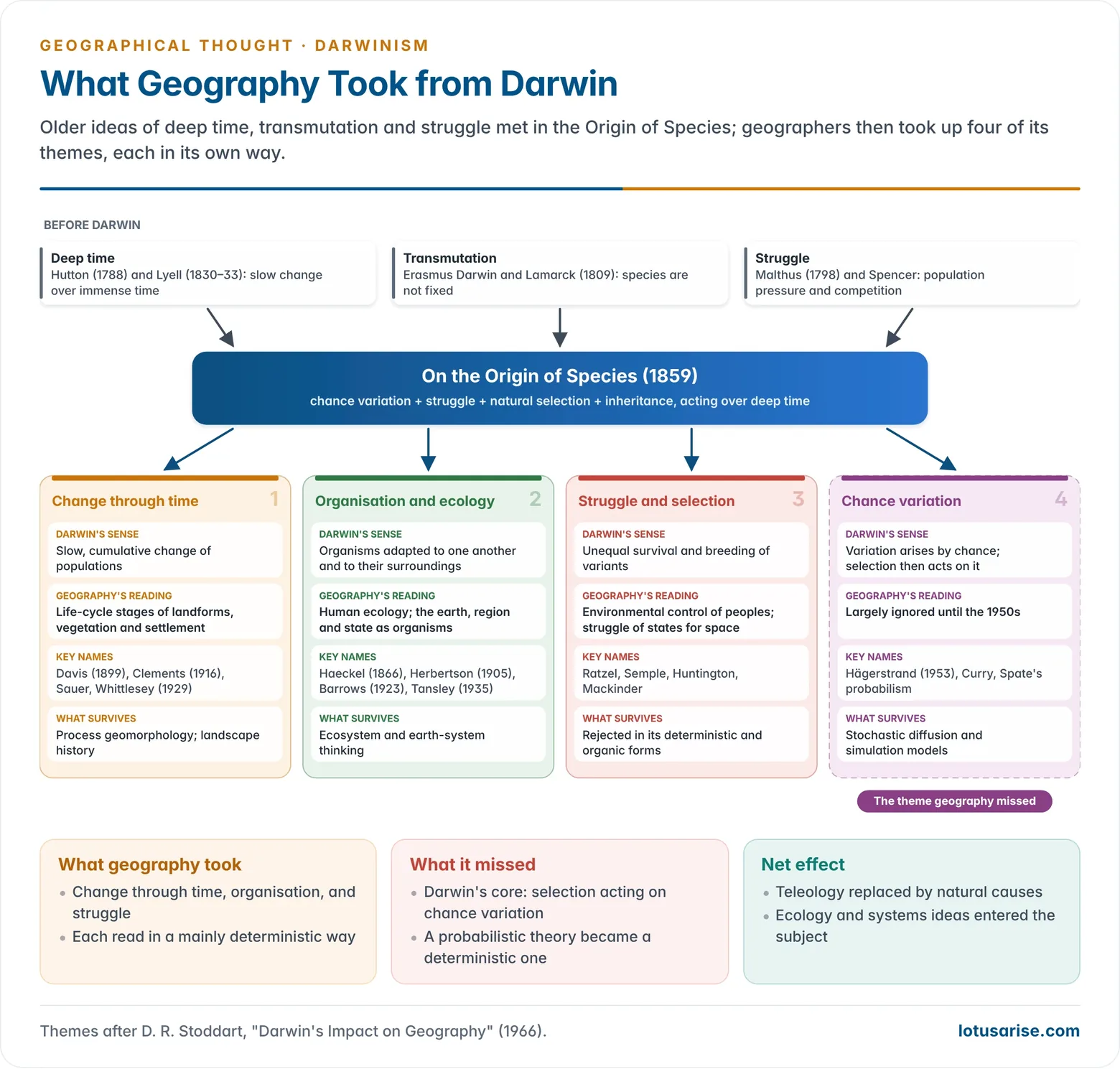
- Geographers borrowed Darwin’s ideas selectively. They took up evolution as change through time, organisation and ecology, and struggle and selection, but largely ignored his fourth idea, chance variation. The result was a mainly deterministic reading of what was at heart a probabilistic theory.
Evolutionary Ideas before Darwin

Deep Time in Geology
- Georges-Louis Leclerc, Comte de Buffon (Théorie de la Terre, 1749) argued that the earth had a long natural history rather than a recent creation.
- James Hutton (Theory of the Earth, 1788; expanded 1795) set out uniformitarianism: processes working today, such as weathering, erosion and deposition, acting over immense time, explain the rocks and relief of the past.
- William Smith used fossils to correlate and date rock strata. They showed that different plants and animals had lived at different periods.
- Charles Lyell’s Principles of Geology (1830–33) made gradual change over vast time the ruling idea of geology. Thomas Henry Huxley later called the Origin the logical sequel to Lyell’s book.
Evolution in Biology
- Erasmus Darwin, Charles’s grandfather, speculated on the common descent of life in Zoonomia (1794–96).
- Jean-Baptiste Lamarck (Philosophie zoologique, 1809) proposed that organisms change through the use and disuse of organs and pass on these acquired characters. In his classic example, the giraffe’s neck lengthened through generations of stretching for leaves.
- Darwin’s alternative: giraffes born with longer necks survived better and left more offspring, so the trait spread by selection, not by effort.
Social Evolution
- Thomas Robert Malthus (Essay on the Principle of Population, 1798) argued that population outruns food, so that struggle and checks are inevitable. This gave Darwin the key to his mechanism.
- Herbert Spencer wrote of evolution as a universal law of progress from simple to complex, applying to societies as much as to organisms. He coined “survival of the fittest” (1864), which Darwin adopted in the 1869 edition of the Origin.
Darwin and On the Origin of Species (1859)
Darwin the Naturalist-Geographer
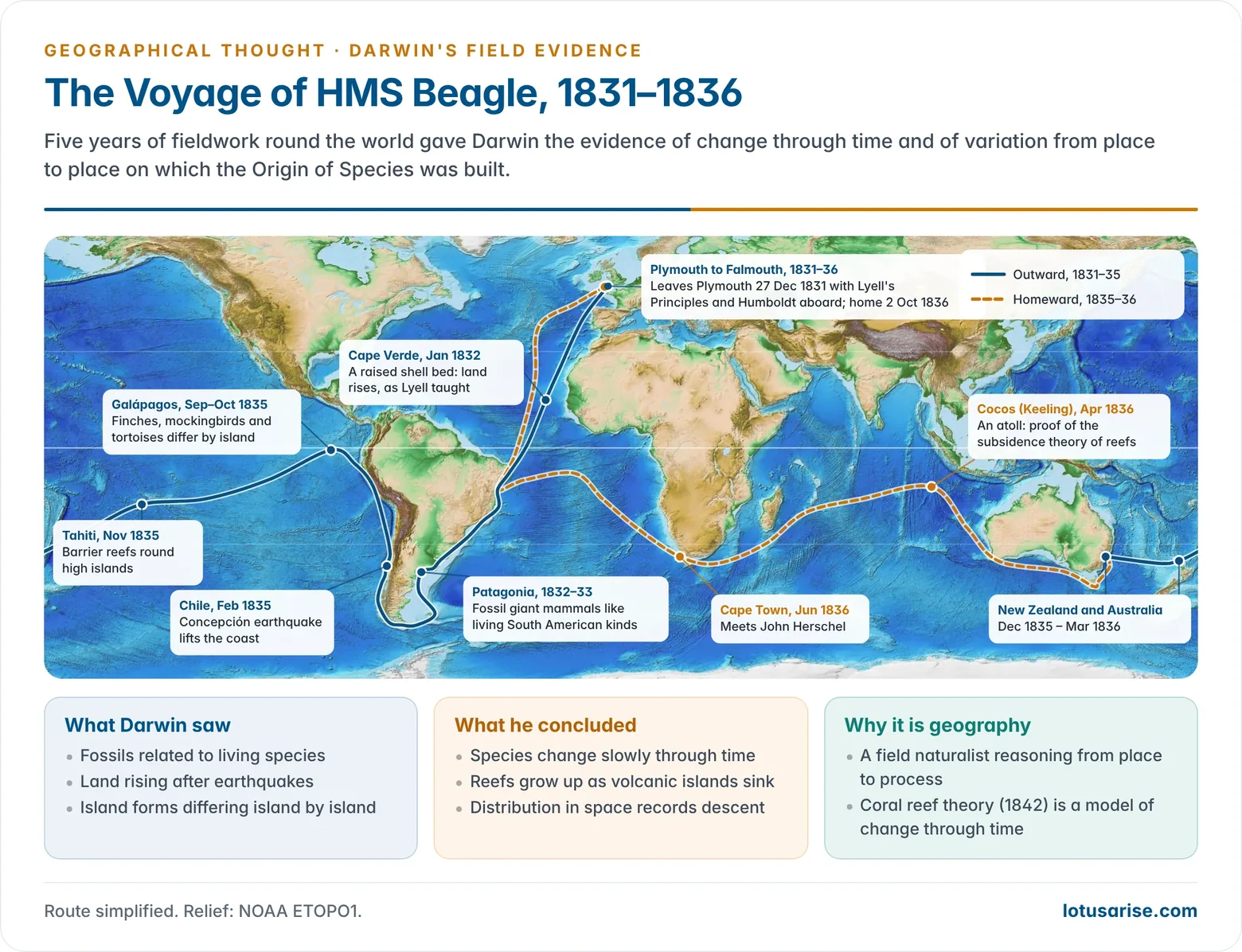
- Charles Robert Darwin (1809–1882) studied medicine at Edinburgh and then took a degree at Cambridge (1831). He sailed as naturalist on HMS Beagle (1831–36), carrying Humboldt’s Personal Narrative, which had fired his ambition, and the first volume of Lyell’s Principles.
- Field evidence from the voyage:
- Fossil giant mammals in Patagonia resembled living South American species.
- Raised beaches and the Chilean earthquake of 1835 showed land rising before his eyes.
- The Galápagos Islands held finches, mockingbirds and tortoises that differed from island to island.
- Coral reefs (1842): Darwin explained the sequence of fringing reef, barrier reef and atoll by the slow subsidence of a volcanic island while coral grew upward.
- This was a geographical theory of change through time. Drilling at Enewetak in 1951–52 found over 1,200 m of shallow-water limestone resting on volcanic basalt, as the theory predicts.
- Wallace and biogeography: Alfred Russel Wallace, working in the Malay Archipelago, reached natural selection independently.
- He mapped the sharp faunal break between Asia and Australasia now called the Wallace Line.
- His Geographical Distribution of Animals (1876) divided the world into zoogeographical realms, with India in the Oriental realm.
- Distribution through space thus became evidence for descent through time, which made biogeography a Darwinian field from the start.
- Publication: Darwin’s and Wallace’s papers were read together at the Linnean Society on 1 July 1858. The Origin followed on 24 November 1859, and The Descent of Man in 1871.
The Core of the Theory
| Proposition | Meaning |
|---|---|
| Struggle for existence | More young are born than can survive; numbers stay roughly constant |
| Variation | No two individuals are alike, and many differences are inherited |
| Natural selection | Variants better suited to the environment survive and breed more |
| Gradual change | Small differences accumulate over long periods into new species |
| Common descent | All species, humans included, share ancestors |
- The mechanism mattered most to Darwin. As the geographer David Stoddart stressed, his theory was not just “evolution” but an account of how chance variations are selectively preserved and inherited.
Why 1859 Was a Turning Point
- End of teleology: the adaptation of living things to their surroundings could now be explained naturally, with no need for a divine design. Ritter’s purposive geography lost its scientific footing.
- Humankind within nature: after The Descent of Man, people became a proper subject of scientific study alongside plants and animals.
- Laws and causes: science after Darwin sought natural laws and mechanical causation, tested by the hypothetico-deductive method rather than by inductive compilation.
- A charter for geography: if organisms evolve in relation to their surroundings, then the study of life in its environment, geography’s old concern, gained new scientific weight.
- The new university chairs of the 1870s in the German school went mostly to natural scientists, who were shaped by this outlook.
- Peschel and the turn to morphology: Oscar Peschel’s Neue Probleme der vergleichenden Erdkunde (1870) compared landforms such as fjords, islands and deltas to find their causes, dropping Ritter’s religious frame.
- For several decades geomorphology dominated academic geography, a phase sometimes called its “geologification”.
- The gap widened between a law-seeking physical geography and a human geography still searching for its method. This sharpened the physical–human dualism.
Four Darwinian Themes in Geography
- David Stoddart’s essay “Darwin’s Impact on Geography” (1966) identified four themes in the Origin and traced what geography made of each.
Change through Time
- Geomorphology: William Morris Davis’s “geographical cycle” (1899) described landscapes passing through youth, maturity and old age to a peneplain, a function of structure, process and stage.
- Davis took the idea of slow cumulative change from Darwin and uniformitarianism from Lyell.
- However, he applied the life-cycle analogy to individual landforms, not populations, so the result was closer to denudation chronology than to Darwinian mechanism.
- In India, the worn-down Aravalli ranges and the stepped erosion surfaces of the Chota Nagpur plateau have long been read in this cyclic framework.
- Plant ecology and soils: Frederic Clements’s theory of plant succession to a climax (1916) and Henry Chandler Cowles’s studies of dune vegetation applied the same developmental logic. Soils were likewise described as passing to “mature” profiles.
- Human and historical geography:
- Carl Sauer’s Berkeley school traced the cultural landscape as a product of human occupance over time.
- Derwent Whittlesey’s sequent occupance (1929) saw each stage of occupation carrying “the seed of its own transformation”. He drew the idea consciously from plant succession.
- Critique within geomorphology: Walther Penck (1924) objected that Davis’s stages assumed rapid uplift followed by stillness. He argued that landforms reflect the ratio of uplift to erosion, not age alone.
- Limitation: geographers turned Darwin’s process into a history. “Evolution” came to mean little more than development and progress.
Organisation and Ecology
- Darwin was struck by the “exquisite” adaptation of organisms to one another and to their physical conditions. Ernst Haeckel named the study of these relations ecology (Oekologie, 1866).
- Human ecology:
- Sociologists of the Chicago school, led by Robert E. Park, borrowed competition, dominance, invasion and succession from plant ecology to study city neighbourhoods.
- Harlan H. Barrows, in his 1923 presidential address “Geography as Human Ecology”, defined geography as the study of human adjustment to natural environments. Few geographers followed him, as it seemed to push physical geography out.
- The organic analogy was applied at three levels:
- the earth as an organism (Ritter, Humboldt);
- the region: Andrew John Herbertson’s natural regions (1905) were “definite associations of inorganic and living matter” with orderly changes like those of a plant or animal;
- the state: Friedrich Ratzel’s political organism.
- After Darwin the analogy lost its religious meaning and became biological. Because it described rather than explained, it was largely abandoned by the late 1930s.
- The ecosystem: Arthur Tansley’s ecosystem (1935) gave the ecological idea an analytical form, a system of organisms and environment linked by flows of matter and energy.
- Stoddart (1965) urged it as a geographical method. It joins physical and human geography in one framework, works at any scale from a farm to a nation, and can be quantified.
- It underlies modern environmental and earth-system geography. In India it informs the division of the country into agro-ecological regions for land-use planning.
Struggle and Selection
- This was the most influential theme, and the most misused. Struggle for survival in a given environment became the basis of environmental determinism and of an organic, expansionist political geography.
- Friedrich Ratzel (1844–1904):
- He trained as a zoologist and popularised Darwinism in his first book (1869).
- The first volume of his Anthropogeographie (1882) treated human groups as shaped by their environments.
- In Politische Geographie (1897) and his essay “Der Lebensraum” (1901) he treated the state as an organism tied to the soil, which must grow or decline and competes with other states for living space (Lebensraum).
- His laws of the spatial growth of states (1896) included the following: the territory of a state grows with its culture; growth proceeds by absorbing smaller units; the frontier is the peripheral organ of the state, shifting as it grows or shrinks; and the first stimulus to expansion comes from outside.
- Ellen Churchill Semple, his American student, opened Influences of Geographic Environment (1911) with “Man is a product of the earth’s surface”.
- Ellsworth Huntington (Civilization and Climate, 1915) ranked civilisations by climatic energy, placing the tropics, India included, low.
- Herbert John Fleure classified human regions into regions of difficulty, effort and increment. Griffith Taylor applied evolutionary sequences to races, nations and towns.
- Halford Mackinder (1904) read Eurasian history as a struggle between steppe nomads and settled peoples, and between land and sea power.
- These ideas fed the environmentalism debate. The French possibilists answered that a people’s genre de vie, not the environment alone, decides how it uses its setting.
Randomness and Chance
- Darwin’s theory began with chance variations on which selection acts. Geographers neglected this point and applied the theory in a deterministic, Newtonian way.
- Reasons for the neglect:
- Darwin separated the mechanism of evolution from its course, and geography seized on the course.
- Darwin himself stressed chance less in later editions.
- Chance sat uneasily with both religious belief and the nineteenth-century search for fixed laws.
- The revival came in the 1950s and 1960s:
- Torsten Hägerstrand simulated the diffusion of innovations with random (Monte Carlo) methods (1953).
- Oskar Spate’s probabilism replaced strict environmental control with likelihoods.
- Leslie Curry and others treated settlement patterns and landforms as outcomes of random processes operating under constraints.
- Stochastic models entered settlement, migration and landform studies. Darwin’s probabilistic core finally found a place in geography.
- The uneven spread of high-yielding seed varieties in India’s Green Revolution, outward from early-adopting districts of Punjab, Haryana and western Uttar Pradesh, is the kind of pattern such diffusion models describe.
Social Darwinism and Its Misuse
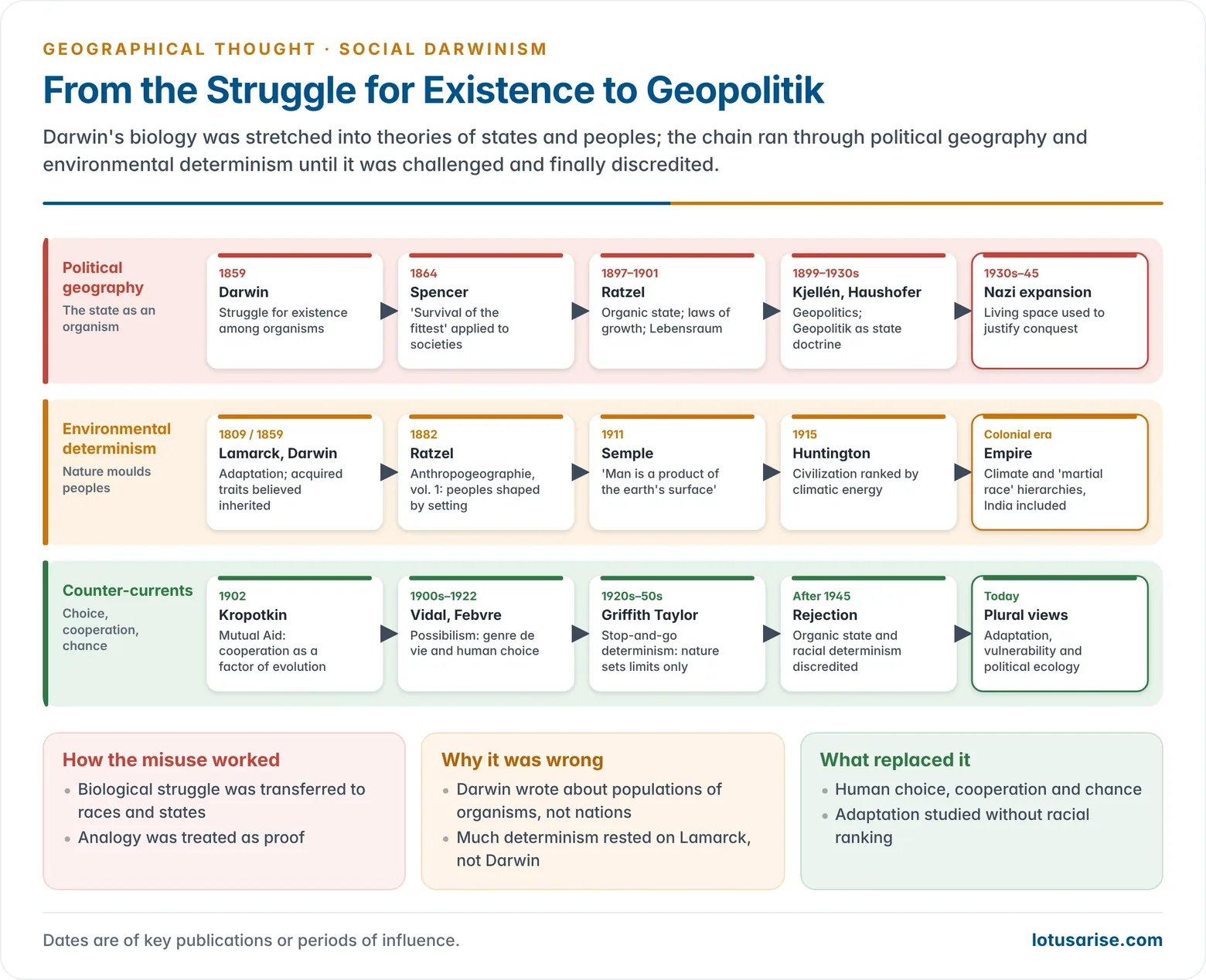
- Social Darwinism applied “struggle” and “survival of the fittest” to societies, races and nations. It drew more on Spencer than on Darwin, who wrote about populations of organisms.
- Uses:
- It justified laissez-faire inequality, eugenics and racial hierarchy.
- It made colonial rule look natural: hot climates were said to produce indolent peoples fit to be governed. In India, ideas of “martial races” and an “enervating” tropical climate were used to rank and manage communities.
- In political geography, Ratzel’s Lebensraum passed through Rudolf Kjellén, who coined the term geopolitics (1899), to Karl Haushofer’s Geopolitik. It was then used to justify Nazi territorial expansion, which discredited organic state theory after 1945.
- Neo-Lamarckism: historians such as David Livingstone have shown that much early environmental determinism, especially in the United States, rested on Lamarck’s inheritance of acquired characters, not on Darwinian selection.
- It allowed environments to mould peoples directly and permanently, a claim Darwin’s theory does not support.
- Counter-currents:
- Peter Kropotkin, geographer and anarchist, argued in Mutual Aid (1902) that cooperation is as much a factor of evolution as competition.
- Russian geographers on the whole rejected Spencerian determinism.
- The possibilists stressed human choice.
Evaluation
- Lasting gains:
- Darwinism freed geography from teleology and a priori theology.
- It made humankind a part of nature open to scientific study, and gave the discipline the idea of process acting over time.
- It supplied ecology, the root of today’s systems and environmental approaches.
- Indirect influence: the idea of organisation, meaning the interdependence of diverse phenomena in one place, carried into the chorology of Alfred Hettner and Richard Hartshorne. Their geography, however, kept ecology at arm’s length until the systems ideas of the 1960s.
| Branch | Darwinian idea used | Outcome |
|---|---|---|
| Geomorphology | Change through time | Davis’s cycle; later replaced by process studies |
| Biogeography and ecology | Organisation, adaptation | Wallace’s realms; succession; the ecosystem |
| Human geography | Struggle and adaptation | Environmental determinism, then possibilism |
| Political geography | Struggle for space | Organic state, Lebensraum, Geopolitik |
| Spatial analysis | Chance variation (late) | Stochastic diffusion and settlement models |
- Distortions: geography’s reading was selective and deterministic. Analogy stood in for analysis, and the struggle theme lent a scientific gloss to racism, imperialism and expansionist geopolitics.
- Current relevance:
- Evolutionary economic geography (from the mid-2000s, e.g. Ron Boschma and Koen Frenken) applies variety, selection and retention, together with path dependence, to the rise and decline of firms, industries and regions.
- Niche construction theory in biology treats organisms, humans above all, as modifying the environments that select them. This sits naturally with Anthropocene geography, where human action reshapes the very conditions of survival.
- The Darwinian legacy in geography is therefore double-edged. Its scientific core of process, interdependence and chance endures, while its social misuse stands as a warning about stretching biological analogy to human society.
Previous Year Questions
- No direct PYQ has been asked on this sub-topic yet.