- A budget is an account of everything that enters and leaves a system. The heat budget of the oceans balances the heat the sea gains against the heat it loses. The salt budget balances the salts and fresh water that enter the sea against those that leave it.
- Neither budget closes at a single place. The tropics gain heat and the high latitudes lose it, and some seas gain fresh water while others lose it. Currents carry the difference, so both budgets are the hidden drivers of ocean currents and of climate.
- Over the whole ocean and over many years, both budgets are almost balanced. The one large modern exception is the steady gain of heat from global warming.
Heat Budget of the Oceans

Sources of heat and the ocean’s capacity to store it
- The sun supplies almost all of the ocean’s heat. Short-wave radiation is absorbed in the upper layers and stirred downward by winds and waves.
- Minor sources add very little:
- heat from the Earth’s interior through the sea floor, only about 0.1 W/m² on average, though important locally at ridges and vents;
- sensible heat from warmer air, condensation on the sea surface, friction of currents and waves, and chemical, biological and radioactive processes.
- Water stores heat far better than land:
- Its specific heat is about 4,000 J per kg per °C, roughly five times that of rock.
- It is transparent and mobile, so heat is spread through a thick layer, and evaporation removes heat without raising its temperature.
- The top 3 m or so of the ocean hold as much heat as the whole atmosphere, which is why the sea warms and cools slowly and moderates the planetary heat budget.
The heat budget equation
- Over a column of sea water from the surface to the bottom, the change in stored heat equals the sum of the fluxes across its surface and sides:
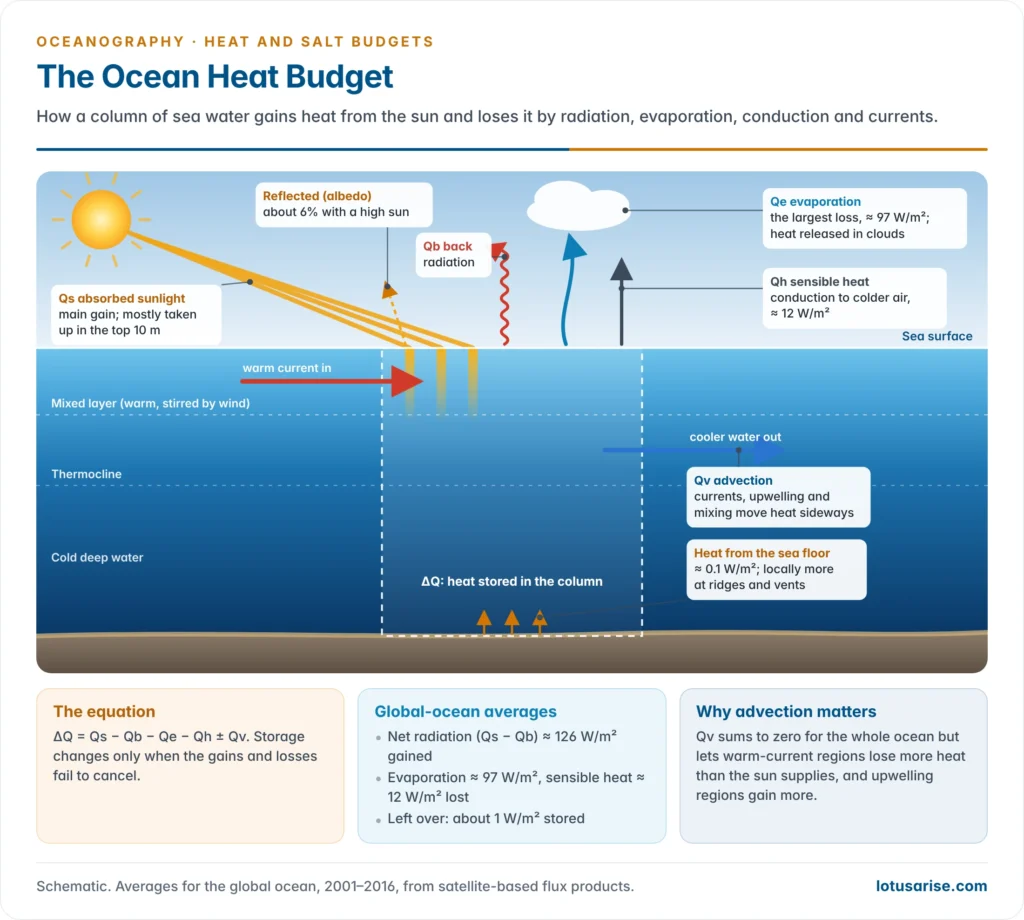
- ΔQ = Qs − Qb − Qe − Qh ± Qv
- Fluxes are in watts per square metre (W/m²). Qs is a gain, Qb, Qe and Qh are normally losses, and Qv can be either.
| Term | Process | Direction | Main controls |
|---|---|---|---|
| Qs | Short-wave solar radiation absorbed | Gain | Sun’s altitude, day length, cloud, sea-surface albedo |
| Qb | Net long-wave (back) radiation | Loss | Sea temperature, cloud, water vapour in the air |
| Qe | Latent heat used in evaporation | Loss | Wind speed, air humidity, sea temperature |
| Qh | Sensible heat by conduction to the air | Usually loss | Sea–air temperature difference, wind |
| Qv | Advection by currents and mixing | Gain or loss | Warm and cold currents, upwelling |
| ΔQ | Change in heat stored | — | Seasonal warming or cooling; long-term trend |
Absorbed solar radiation (Qs)
- Qs is the short-wave energy that enters the sea after reflection.
- The albedo of the sea is low, about 6% when the sun is high, but it rises steeply at low sun angles; sea ice reflects most of the light.
- Most of the energy is absorbed in the top 10 m. Red and infrared light go within the first metre; only blue-green light reaches below 100 m in clear water.
- Qs is highest under the clear skies of the subtropics and lower over the cloudy equatorial belt and the high latitudes.
Back radiation (Qb)
- The sea radiates as a near-perfect black body in the long-wave infrared. The atmosphere sends part of this back as counter-radiation, and Qb is the net loss.
- Qb varies less than the other terms, because a warmer sea radiates more but sits under moister air that returns more. It is largest under the clear, dry skies of the subtropical highs.
Latent heat (Qe) and sensible heat (Qh)
- Evaporation is the ocean’s chief cooling process. Every kilogram evaporated removes about 2.45 million joules, which is released into the atmosphere when the vapour condenses.
- Qe is largest where dry, strong winds blow over warm water: the trade-wind belts, and the Gulf Stream and Kuroshio in winter, when cold continental air flows off North America and Asia.
- Sensible heat (Qh) is small, because sea and air usually differ by only a degree or two. Their ratio Qh/Qe, the Bowen ratio, is only about 0.1 over the oceans, far lower than over dry land.
- Satellite-era averages over the global ocean (2001–2016) show how the absorbed radiation is spent:
- net radiation (Qs − Qb): about 126 W/m² gained;
- evaporation (Qe): about 97 W/m² lost, roughly three-quarters of it;
- sensible heat (Qh): about 12 W/m² lost;
- what is left, about 1 W/m², is the heat the ocean is now storing.
Advection (Qv)
- Qv is the heat carried into or out of a column by currents, upwelling and mixing. It is zero for the ocean as a whole but decisive for any region.
- The Gulf Stream and North Atlantic Drift import the heat that the north-east Atlantic gives up to the air each winter.
- Upwelling brings cold water to the surface off Peru, California and Somalia, and along the equator.
Where the ocean gains and loses heat
- Net gain: the tropical oceans, above all the cold upwelling zones of the eastern equatorial Pacific and Atlantic, where cool water absorbs strong sunlight but evaporates little.
- Net loss: the western boundary currents in winter (Gulf Stream, Kuroshio), the Nordic and Labrador Seas, and the Southern Ocean near Antarctica. Annual-mean losses over the Gulf Stream and Kuroshio exceed 100 W/m².
- Seasonal swing: in the middle latitudes the ocean stores heat in summer and releases it in winter, which gives marine climates their mild winters.
Latitudinal imbalance and poleward heat transport
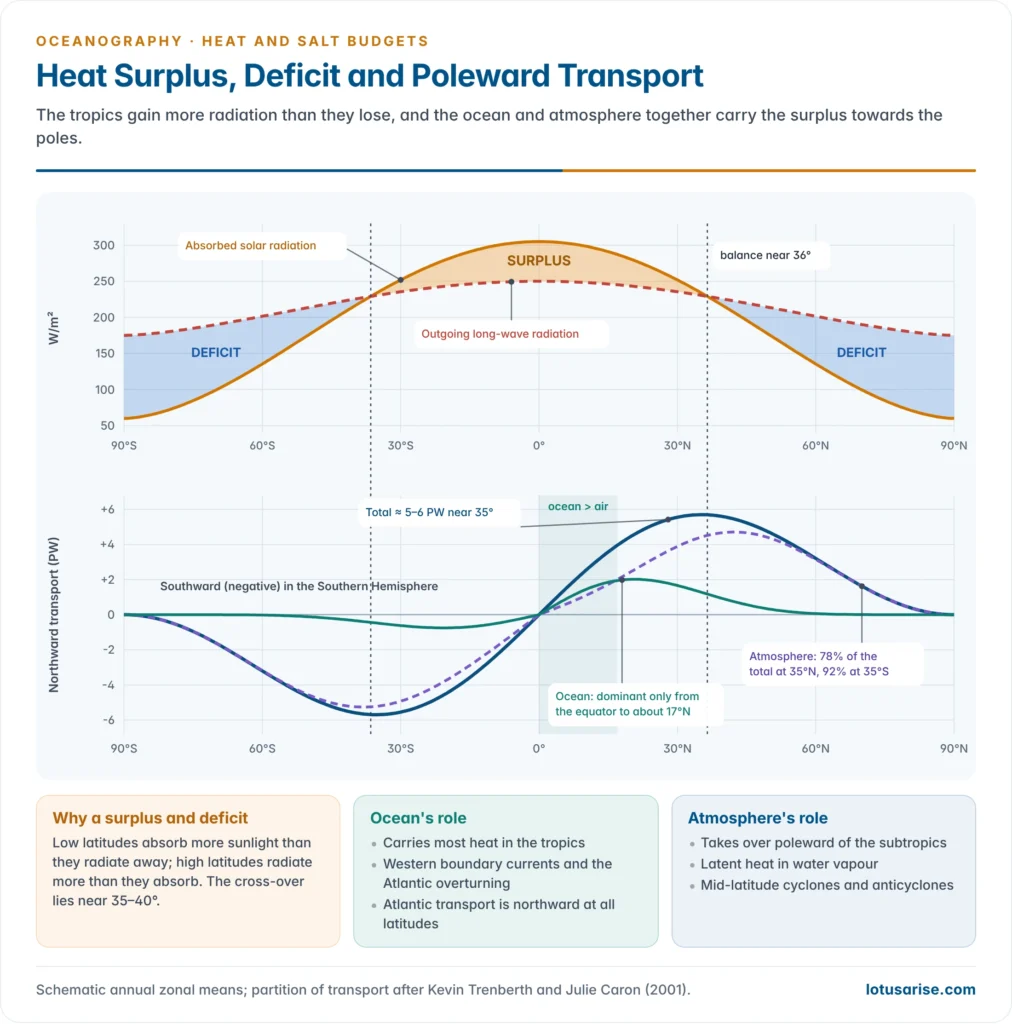
- Between about 35–40° N and S the Earth absorbs more radiation than it emits. Poleward of these latitudes it emits more than it absorbs.
- The tropics do not grow ever hotter, because heat is carried poleward by the atmosphere and the ocean together.
- The total transport peaks near 35° latitude at about 5–6 petawatts (1 PW = 10¹⁵ W) in each hemisphere.
- The ocean’s share is largest in the tropics.
- Ocean transport dominates only between the equator and about 17°N, reaching about 2 PW in the northern tropics (Kevin Trenberth and Julie Caron, 2001).
- At 35°, where the total peaks, the atmosphere carries about 78% in the Northern Hemisphere and 92% in the Southern, largely as latent heat in water vapour and in mid-latitude cyclones.
- How the ocean moves heat:
- Wind-driven gyres: warm western boundary currents flow poleward and cooler eastern boundary currents return equatorward.
- The overturning (thermohaline) circulation: warm surface water flows north in the Atlantic, cools and sinks, and returns south at depth.
- The Atlantic is an exception. It carries heat northward at every latitude, even in the South Atlantic, because of its overturning circulation. The RAPID array at 26.5°N has measured about 1.2–1.3 PW since 2004.
- This is why north-west Europe is far warmer than Labrador in the same latitudes.
- The Indian Ocean gains heat in the north, where it is closed by Asia, receives warm Pacific water through the Indonesian Throughflow, and exports heat southward.
- The seasonal heat-storage contrast between the Indian Ocean and the Asian landmass helps drive the monsoon.
Ocean heat uptake and global warming
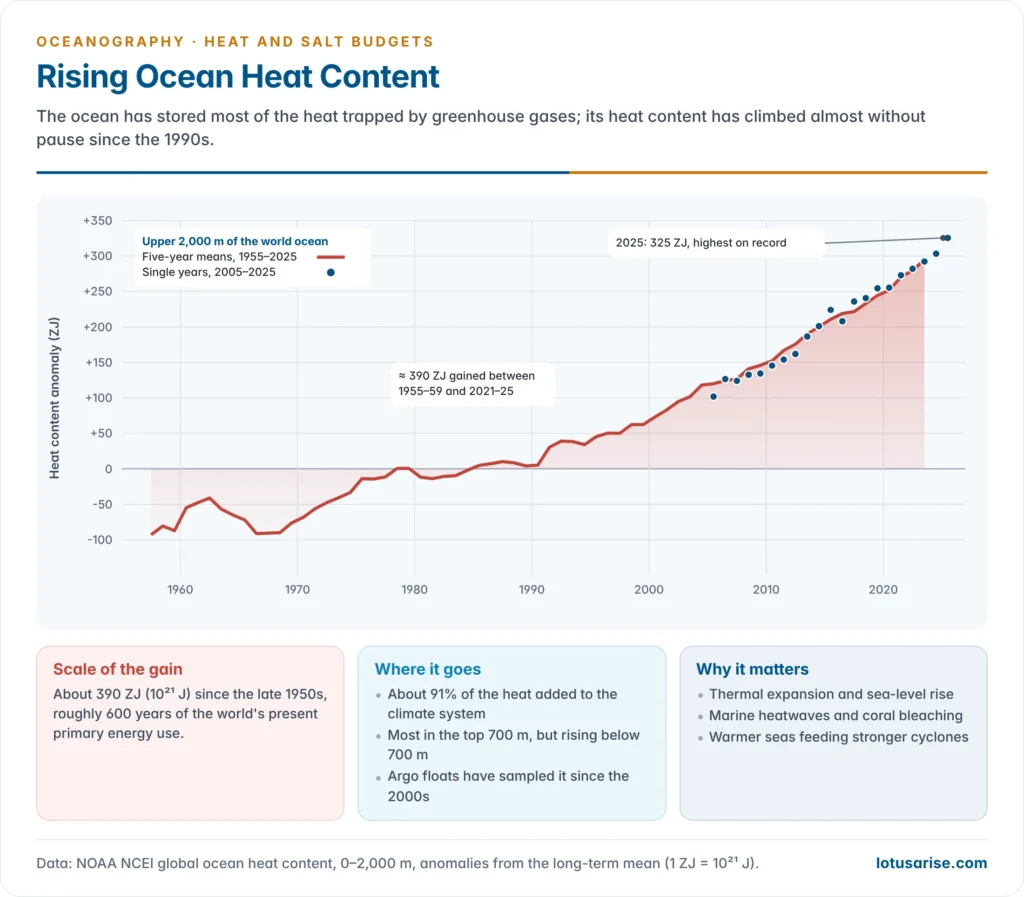
- The ocean is the main store of the Earth’s energy imbalance. The planet now absorbs more sunlight than it emits, and the imbalance roughly doubled between 2005 and 2019, to about 1 W/m².
- The IPCC Sixth Assessment Report (2021) found that ocean warming accounted for about 91% of the heat added to the climate system between 1971 and 2018. Land took about 5%, melting ice 3% and the atmosphere 1%.
- Ocean heat content is measured mainly by about 4,000 Argo floats, which profile the upper 2,000 m every ten days.
- An international study published in January 2026 found that the upper 2,000 m gained about 23 zettajoules (10²¹ J) in 2025, a record for the tenth year running, even as surface temperatures dipped with the shift to La Niña.
- The Indian Ocean has taken a disproportionate share. During the 2003–2012 slowdown in surface warming, about 70% of the global upper-700 m heat gain occurred there, carried from the Pacific by the Indonesian Throughflow (Sang-Ki Lee and colleagues, 2015).
- INCOIS (Hyderabad), the Indian Argo data centre, tracks this warming with floats and moored buoys.
- Consequences:
- thermal expansion, about a third to a half of recent sea-level rise;
- more frequent marine heatwaves and coral bleaching, and more energy for rapidly intensifying tropical cyclones;
- stronger stratification, which starves the upper ocean of oxygen and nutrients;
- warming and expansion that would continue for centuries even if emissions stopped.
- Ocean heat has uses too. The 20–25 °C difference between tropical surface water and water below about 1,000 m can generate power by ocean thermal energy conversion (OTEC).
- NIOT is building a 65 kW OTEC plant at Kavaratti (Lakshadweep), under the Deep Ocean Mission, to run a desalination plant of 1 lakh litres a day.
Salt Budget of the Oceans
Total salt and the constancy of composition
- Sea water holds about 35 g of dissolved salts per kilogram. This is about 5 × 10¹⁶ tonnes in all, enough to cover the land in a layer more than 150 m thick.
- Six ions make up about 99% of the dissolved salt: chloride (about 55%), sodium (31%), sulphate (8%), magnesium (4%), calcium (1%) and potassium (1%).
- The principle of constant proportions states that the ratios of the major ions are nearly the same everywhere, although total salinity varies from place to place.
- First noted by Alexander Marcet (1819) and established by Johan Georg Forchhammer (1865), it is also called Forchhammer’s principle. William Dittmar confirmed it in 1884 from 77 Challenger Expedition samples.
- Why it holds: the ocean mixes in about 1,000 years, while the major ions stay for millions of years, so each is stirred evenly many times before removal.
- Consequences: salinity can be found from one ion (chlorinity) or from electrical conductivity, and differences in salinity come from adding or removing water, not salt.
- It breaks down near river mouths, in enclosed seas such as the Baltic and Black Seas, at hydrothermal vents and in evaporating lagoons.
Inputs of salt
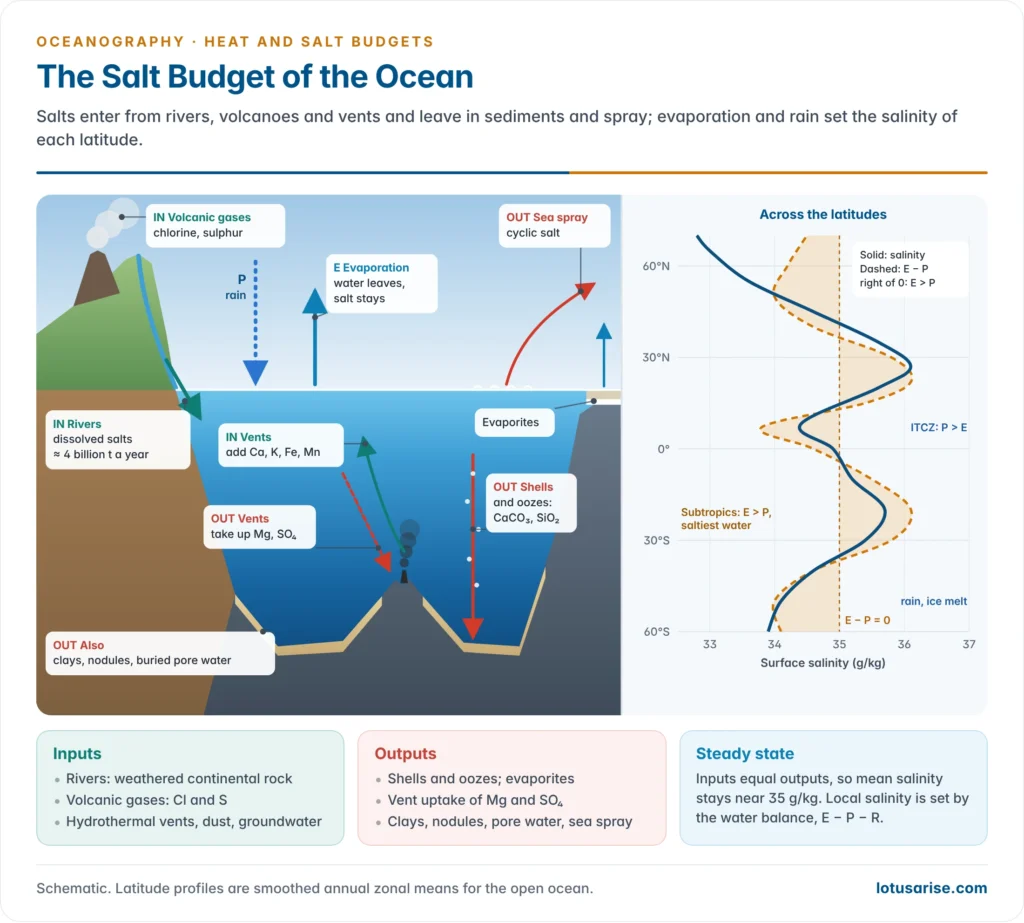
- Rivers are the main present-day supply. They carry roughly 4 billion tonnes of dissolved solids a year, weathered from continental rocks.
- River water is dominated by calcium and bicarbonate, sea water by sodium and chloride, so the sea is not simply concentrated river water.
- Volcanic outgassing supplies chlorine and sulphur. Early outgassing explains why chloride, scarce in rocks, is the sea’s most abundant ion.
- Hydrothermal vents at mid-ocean ridges add calcium, potassium, iron and manganese.
- Minor inputs include submarine groundwater, wind-blown dust and weathering of sea-floor basalt.
Outputs of salt (sinks)
- Biological uptake: organisms remove calcium carbonate (shells, corals, coccoliths) and silica (diatoms, radiolarians), which settle as oozes. This is why calcium and silica, abundant in rivers, are scarce in the sea.
- Hydrothermal circulation at ridges removes magnesium and sulphate as sea water reacts with hot basalt.
- Evaporites: salt precipitates where shallow arms of the sea dry out, as in the Mediterranean during the Messinian Salinity Crisis (about 5.96–5.33 million years ago).
- Other sinks: adsorption of ions such as potassium on clays, ferromanganese nodules and crusts, pore water buried with sediment, and sea spray, which carries salt onto land to return as “cyclic salt”.
Steady state and residence time
- Salinity has stayed close to 35 g/kg for hundreds of millions of years, so inputs and outputs balance: the ocean is in a steady state.
- Residence time is the average time an ion stays dissolved before removal:
- residence time = total amount in the ocean ÷ rate of supply (or removal)
- Unreactive ions such as chloride and sodium stay for tens of millions of years; ions used by life, such as iron, are removed in centuries.
| Constituent | Approximate residence time (years) |
|---|---|
| Chloride | 100 million |
| Sodium | 68 million |
| Calcium | 1 million |
| Water | 4,100 |
| Iron | 200 |
- The age-of-the-ocean error shows why the steady state matters. Edmond Halley (1715) proposed dating the ocean from its accumulating salt, and John Joly (1899) divided the sea’s sodium by the yearly river supply to get 80–90 million years.
- That figure is a residence time, not an age, because sodium is removed as fast as it arrives. The ocean is about 4 billion years old.
The freshwater balance: evaporation minus precipitation
- Over the open ocean, surface salinity is set by the water balance, not the salt balance.
- Evaporation and freezing remove fresh water and raise salinity; precipitation, river runoff and melting ice add it and lower salinity.
- Freshwater balance = E − P − R, where E is evaporation, P is precipitation and R is river and ice runoff.
- Globally the oceans evaporate about 413,000 km³ of water a year and receive about 373,000 km³ as precipitation. The difference of about 40,000 km³ returns as runoff from the land, closing the global water budget.
- Georg Wüst (1936) showed that open-ocean surface salinity rises almost in step with E − P. The zonal pattern follows:
| Belt | E − P | Surface salinity |
|---|---|---|
| Equatorial (0–10°) | Negative: heavy convective rain | Moderate, about 34.5–35 |
| Subtropical (20–30°) | Strongly positive: dry sinking air, trade winds | Highest, above 36–37 in the open ocean |
| Temperate (40–60°) | Negative: frontal rain | Falling, about 33–34 |
| Polar | Negative: melting ice, low evaporation | Lowest, below 33–34 |
- Marginal seas magnify the balance. A sea joined to the ocean over a sill must exchange water through its strait; Knudsen’s relations (Martin Knudsen, 1900) express this as conservation of water and salt.
- The Mediterranean and Red Seas lose more water by evaporation than they gain. Ocean water flows in at the surface and saltier, denser water flows out at depth through Gibraltar and Bab-el-Mandeb.
- The Baltic and Black Seas gain more fresh water than they lose, so the exchange is reversed.
- Indian Ocean contrast: the Arabian Sea has a positive E − P under dry Arabian winds and receives the salty Red Sea and Persian Gulf outflows. The Bay of Bengal has a negative balance: monsoon rain and the Ganga–Brahmaputra make it one of the freshest tropical seas.
- The water cycle is intensifying. The IPCC reports that since the 1950s salty regions have become saltier and fresh regions fresher.
Linking the Heat and Salt Budgets to Circulation
- The two budgets act together through density. Heat loss and evaporation make surface water denser, while heating, rain and runoff make it lighter. Their combined effect is the buoyancy flux, which drives the thermohaline circulation.
- Evaporation links both budgets. It removes latent heat and leaves salt behind, so the subtropics are both the main source of atmospheric moisture and the saltiest surface waters.
- Deep water forms where both budgets push the same way:
- In the Nordic and Labrador Seas, salty Atlantic water loses heat in winter and sinks as North Atlantic Deep Water.
- Around Antarctica, freezing sea ice rejects brine and forms the densest water in the ocean, Antarctic Bottom Water.
- The Atlantic is saltier than the Pacific. Trade winds carry Atlantic water vapour across Central America to the Pacific, and the Mediterranean outflow adds salt. This is one reason deep water sinks in the North Atlantic but not in the North Pacific.
- The salt budget can switch the heat transport. Henry Stommel (1961) showed that the overturning circulation sustains itself by carrying salt north.
- Enough fresh water from melting ice or heavier rain could weaken it and cut the northward flow of heat. This salt-advection feedback underlies present concern over the AMOC.
- The Bay of Bengal shows the link in miniature. Its fresh surface layer forms a barrier layer that blocks mixing with cooler water below, so heat stays in a thin, very warm layer that feeds the Bay’s strong cyclones.
| Aspect | Heat budget | Salt budget |
|---|---|---|
| Main gain | Absorbed sunlight (Qs) | Rivers, volcanic gases, hydrothermal vents |
| Main loss | Evaporation (Qe), back radiation (Qb) | Sediments, evaporites, hydrothermal uptake, sea spray |
| Regional imbalance | Tropical surplus, polar deficit | E − P: subtropical excess evaporation, equatorial and high-latitude excess rain |
| Balanced by | Poleward transport by currents and winds | Exchange of water by currents and the atmosphere |
| Long-term state | Now gaining heat (about 91% of global warming) | Near steady state; water cycle intensifying |
| Effect on density | Cooling raises density | Salting raises density |
Previous Year Questions
2009Comment on marine heat budget and the oceanic circulation system.