- The hydrological cycle is the endless circulation of water between the oceans, atmosphere and land, through evaporation, condensation, precipitation, infiltration and runoff, with no beginning or end.
- It is driven by solar energy and gravity. The total amount of water stays almost constant; only its state and location change.
- By carrying latent heat from the tropics and the oceans to higher latitudes and to the land, it links the water budget with the heat budget of the Earth.
Stores and Residence Times

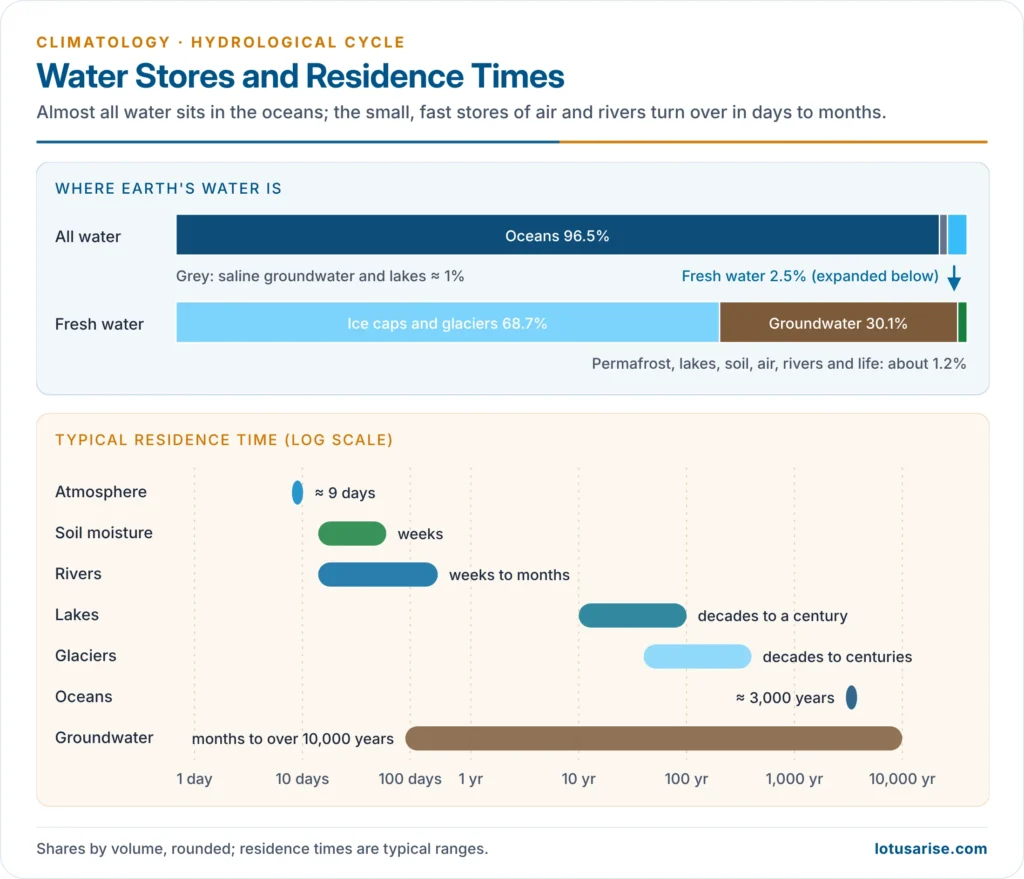
| Store | Share of Earth’s water | Typical residence time |
|---|---|---|
| Oceans | 96.5% | About 3,000 years |
| Ice caps and glaciers | 1.7% | Decades (glaciers) to many millennia (ice sheets) |
| Groundwater | 1.7% | Months to over 10,000 years |
| Lakes | 0.013% | Decades to a century |
| Soil moisture | 0.001% | Weeks |
| Atmosphere | 0.001% | About 9 days |
| Rivers | 0.0002% | Weeks to months |
- Only about 2.5% of Earth’s water is fresh, and over two-thirds of that is locked in ice.
Processes
- Evaporation (mainly from the oceans) and transpiration (from plants) lift water into the air as vapour; sublimation adds a little from ice.
- Condensation forms clouds; precipitation returns water to the surface.
- On land, water is intercepted by vegetation, infiltrates the soil, percolates to groundwater, or flows off as runoff to rivers and the sea.
Global Water Balance
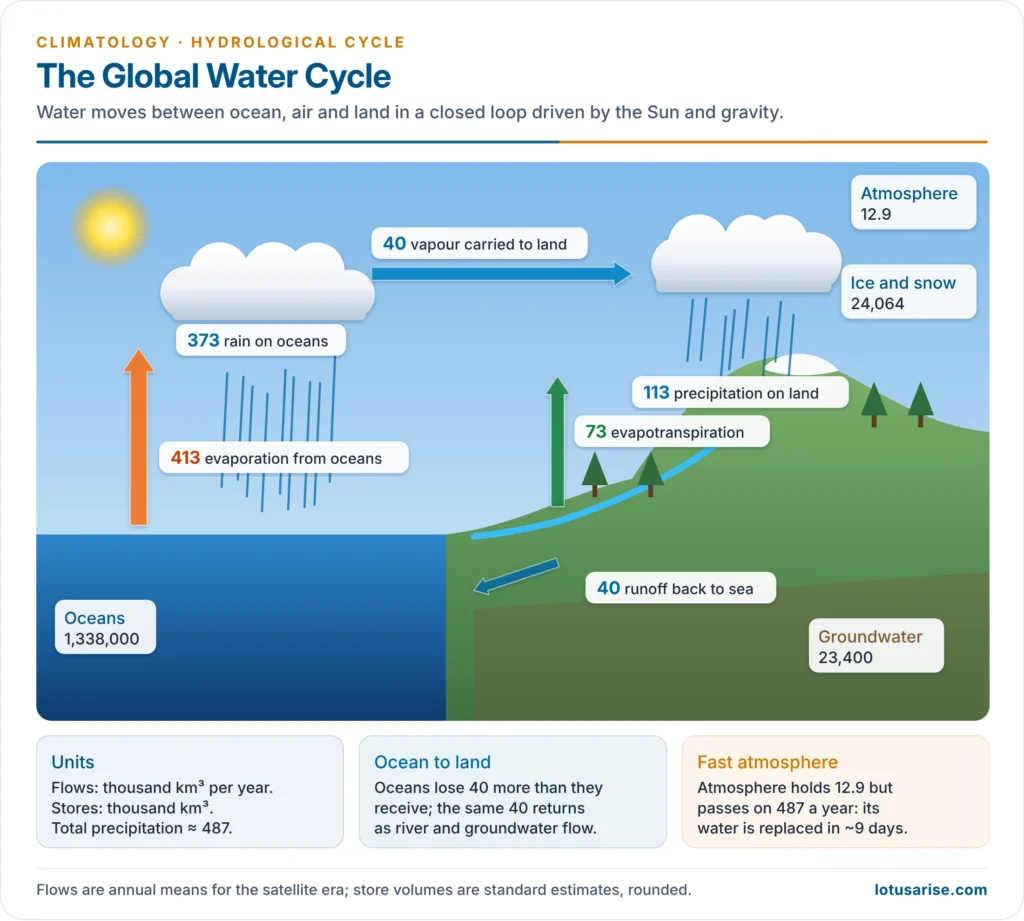
- About 487,000 km³ of water falls as precipitation each year, balanced by equal evaporation.
- Oceans: evaporation (about 413,000 km³) exceeds precipitation (about 373,000 km³).
- Land: precipitation (about 113,000 km³) exceeds evapotranspiration (about 73,000 km³).
- The difference, about 40,000 km³, is carried from ocean to land by winds and returns as river and groundwater runoff, keeping sea level steady.
- Meridional exchange: evaporation exceeds precipitation under the subtropical highs (about 10°–40°); precipitation exceeds evaporation in the equatorial belt and the middle latitudes. Winds and cyclones move the surplus moisture, and its latent heat, between these belts.
Human Impacts and Change
- Dams and irrigation redistribute water; deforestation reduces transpiration and raises runoff; urban paving cuts infiltration and worsens flash floods.
- Groundwater depletion in India: the 2025 national assessment puts annual extraction at about 247 billion m³, roughly 61% of the extractable resource, with 730 of 6,762 units over-exploited. In the 2023 assessment, extraction exceeded recharge in Punjab (164%), Rajasthan (149%) and Haryana (136%).
- Warming intensifies the cycle (IPCC Sixth Assessment Report): air holds about 7% more vapour per 1 °C; heavy rainfall, wet–dry contrasts and evaporative demand are increasing, and South Asian summer monsoon rainfall is projected to rise.
Previous Year Questions
2018Explain the role of evaporation in the hydrologic cycle.1991Write short note: Hydrological cycle.