

Reason, Revelation and Faith.
Official Syllabus: Paper II, Section B, Unit 5
If faith goes beyond the evidence, what produces it? Is faith an act of the intellect that accepts truths on God’s authority, an act of the will that chooses to believe when reason cannot decide, a feeling, or a way of experiencing the world? The great theories of faith answer differently. This article examines the classic Augustinian view (faith seeking understanding), Aquinas’ account of faith as intellectual assent moved by the will — and how it reconciles reason and faith — the voluntarist theories of Pascal, William James, Tennant and Kant, whether those theories are adequate, and John Hick’s non-propositional view of faith as “experiencing-as”.
In simple words
Think of three ways a person might come to believe that a new bridge is safe. A juror weighs expert reports and a respected engineer’s word, and assents — that is like Aquinas (intellect assenting on authority). A gambler says, “I can’t be sure, but the reward of crossing is huge and the risk small — I’ll bet on it” — that is like Pascal and James (the will deciding). A local villager has crossed it every day and simply sees it as safe — that is like Hick (faith as a way of experiencing).
Context & Problem
- Faith as the reception of revelation: each view of revelation (Article 2) brings a view of faith. If revelation is a set of truths, faith is assent; if it is God’s self-disclosure, faith is a free response and a way of seeing.
- The evidential gap: most philosophers and believers agree that religious claims are not proved to everyone’s satisfaction. Theories of faith differ mainly in how they bridge the gap:
- By authority received through the intellect (Augustine, Aquinas).
- By an act of will (Pascal, James, Tennant).
- By the demands of practical reason (Kant).
- By a distinctive mode of experience (Hick).
- A modern statement of the voluntarist idea: “faith is distinguished from the entertainment of a probable proposition by the fact that the latter can be a completely theoretic affair. Faith is a ‘yes’ of self-commitment; it does not turn probabilities into certainties… it is a volitional response.” The emphasis on the will goes back at least to Aquinas.
Core Doctrine
Augustine and Anselm: Faith Seeking Understanding
- Augustine (354–430) built his view on a line of Isaiah: “Unless you believe, you will not understand.”
- “Believe in order to understand” (crede ut intelligas): faith comes first; understanding is its reward. A pupil must first trust the teacher before he can grasp the subject.
- “Understand in order to believe” (intellige ut credas): reason also has a role before faith — to see whom and what to believe.
- Faith defined: “to think with assent” — faith is a thinking, not a blind leap, but thinking that assents before it sees.
- Authority: Augustine said he would not believe the Gospel unless moved by the authority of the Church; faith rests on trusted witnesses, as most of our knowledge of history does.
- Illumination: understanding is a gift of God’s inner light.
- Anselm (1033–1109) gave the formula “faith seeking understanding” (fides quaerens intellectum): “I do not seek to understand in order to believe, but I believe in order to understand. For this too I believe: that unless I believe, I shall not understand.” His ontological argument was offered within faith, as a prayer of understanding.
- The model: reason works inside faith, as its servant — clarifying, defending, deepening. Faith is primary, reason secondary — “reason is the slave of faith” in the medieval phrase, with three works: explaining scripture, answering unbelievers, and giving rational support to faith.
Aquinas: Faith as Intellectual Assent
St Thomas Aquinas (1225–1274) gave the classic Catholic analysis of faith, still central to the “propositional” view.
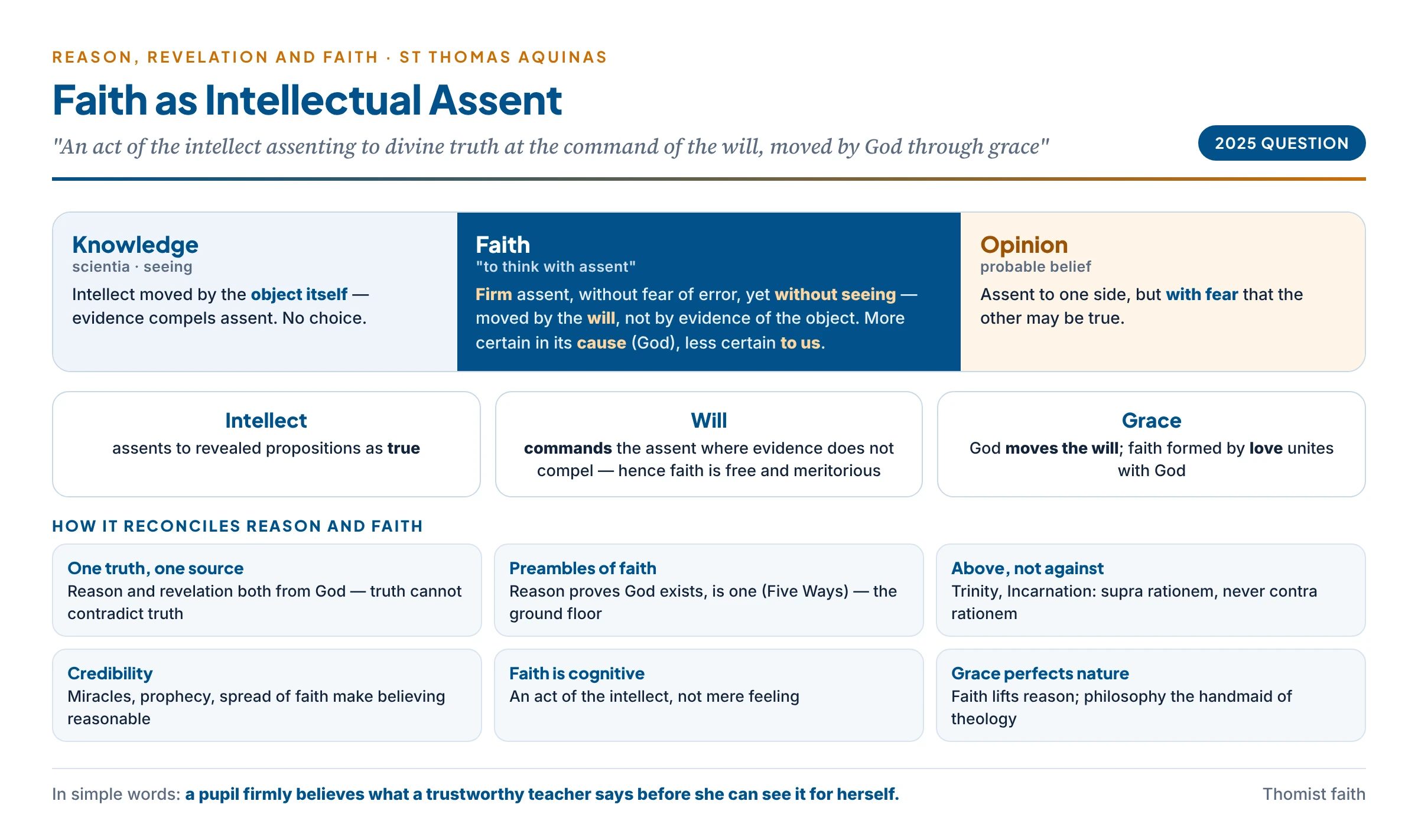
- Definition: faith is “an act of the intellect assenting to divine truth at the command of the will, moved by God through grace.” Three agents are at work:
- The intellect — which assents to propositions as true.
- The will — which commands the assent where the evidence does not compel it.
- Grace — God moving the will and inclining the mind to believe.
- Faith between knowledge and opinion:
- In knowledge (scientia) and in seeing self-evident truths, the intellect is moved by the object itself — the evidence compels assent; there is no room for choice.
- In opinion, the intellect assents to one side but with fear that the other side may be true.
- In faith, the intellect assents firmly, without fear of error, yet without seeing the object — it is moved not by the evidence of the object but by the will. Hence Augustine’s phrase fits: faith is “to think with assent” — the mind still searches, yet assents.
- The object of faith: God as First Truth. We believe the articles of faith because God has revealed them — and God can neither deceive nor be deceived.
- The certainty of faith: faith is more certain than knowledge in its cause (God’s word is infallible) but less certain to us, because we do not see — faith is knowledge “in a mirror, darkly”.
- Faith is meritorious because it is voluntary — one freely chooses to trust God; a proof that compelled everyone would leave no room for merit.
- Formed and unformed faith: faith formed by love (fides formata) unites the believer to God; unformed faith (fides informis) is bare assent — “even the devils believe, and tremble”.
How Aquinas reconciles reason and faith (the 2025 question)
- Twofold truth, one source: some truths about God are reachable by reason (that God exists, is one, is good), others only by revelation (the Trinity, the Incarnation). Since both come from God, “truth cannot contradict truth“.
- Preambles of faith: the truths of reason are the preambles (praeambula fidei) — the ground on which faith builds. Reason can prove, for example, through the Five Ways, that God exists.
- Above, not against: revealed truths are above reason (supra rationem) but never contrary to reason (contra rationem). Any argument against faith must contain an error that reason can expose.
- Why reveal what reason can prove: otherwise few would know God, they would know only after a long time, and their knowledge would be mixed with error.
- Credibility: reason can see that belief is reasonable through the signs of revelation — miracles, fulfilled prophecy, the spread of the faith.
- Faith is itself an act of the intellect: by placing faith in the intellect (as assent to truths) rather than in feeling, Aquinas makes faith a cognitive act — one that reason recognises as its own kind of activity.
- The will fills the gap respectfully: the will supplies firmness only where the evidence is not decisive, so faith does not violate reason; it completes it.
- Theology as a science: theology reasons rigorously from revealed principles, as optics reasons from principles borrowed from geometry.
- Grace perfects nature: “grace does not destroy nature but perfects it” — faith does not cancel reason; it lifts it to truths beyond its reach. Philosophy becomes the “handmaid of theology“.
Criticisms of Aquinas
- Propositional narrowness (Hick): faith becomes assent to statements, leaving out personal trust (fiducia) — the Protestant objection.
- The will commanding belief: to some (Clifford) it is intellectually dishonest to make the will supply firmness the evidence does not warrant.
- The preambles collapse if the proofs fail (Hume, Kant) — then faith loses its rational ground floor.
- Miracles and prophecy are weak public evidence (Hume, Article 3).
- Kierkegaard: by making faith a quasi-knowledge, Aquinas objectifies what is a matter of passionate inwardness.
- Defence: Aquinas never claims to prove the mysteries; he claims only that they are not absurd and that believing them is reasonable — a modest and still powerful position.
In simple words
A child learning that the earth goes round the sun assents firmly, though she cannot check it herself — because she trusts her teacher. She is not seeing the truth (knowledge), nor is she unsure (opinion); she believes on authority, and later study may let her understand. Aquinas’ faith is like that — with God as the teacher who can neither deceive nor be deceived.
Voluntarist Theories of Faith
Voluntarism (from Latin voluntas, will) treats faith as the acceptance of beliefs by a deliberate act of will, when evidence is lacking or evenly balanced. The classic voluntarists are Pascal and William James.
1. Pascal’s Wager
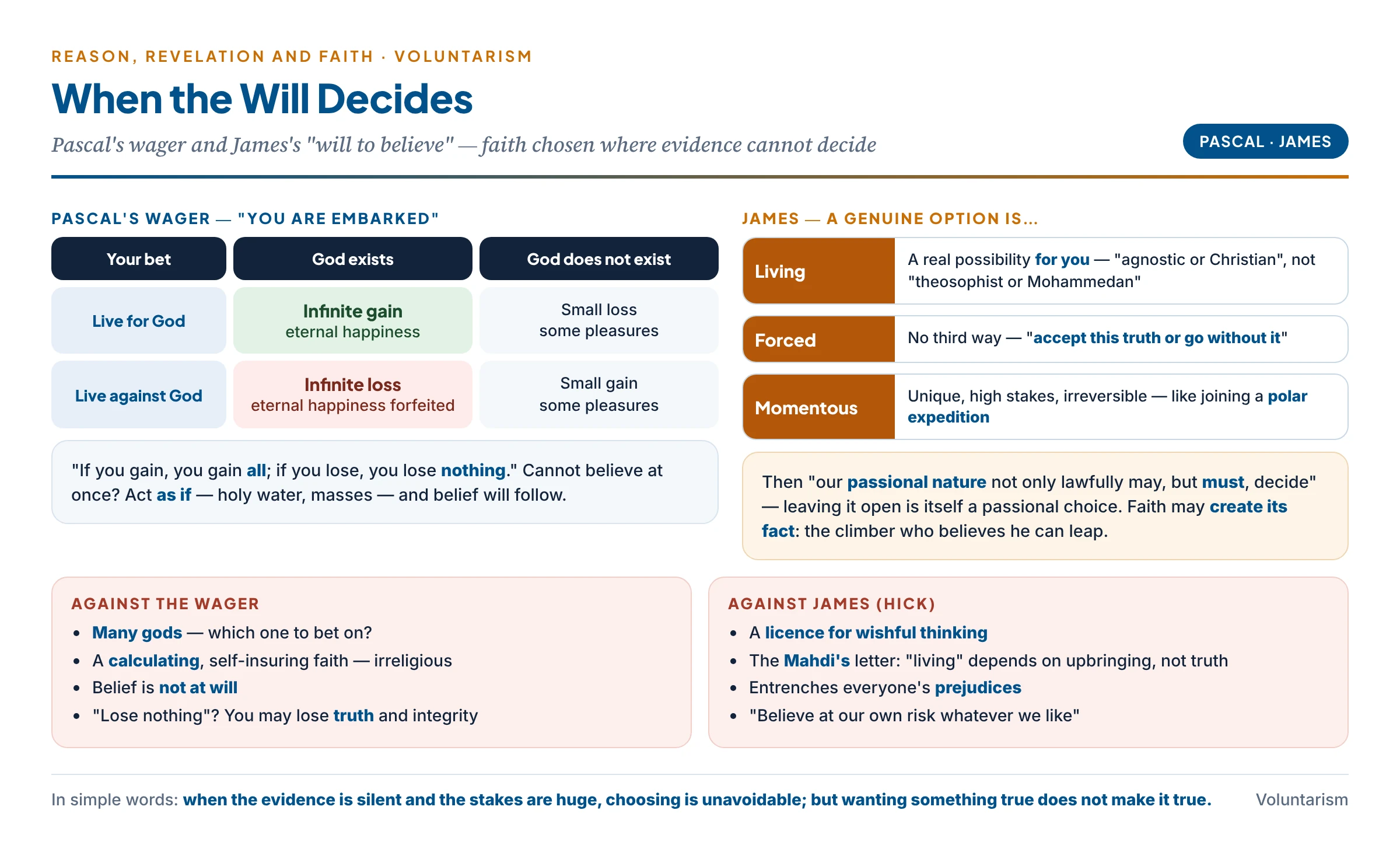
- Blaise Pascal (1623–1662), mathematician and believer, in the Pensées: reason cannot decide whether God exists — “God is, or He is not. But to which side shall we incline? Reason can decide nothing here.“
- You must wager: “It is not optional. You are embarked.” Not choosing is itself living as if there were no God.
- The calculation — weigh the gain and loss of each bet:
- Bet on God, and God exists: you gain eternal happiness — an infinite gain.
- Bet on God, and God does not exist: you lose little — a few pleasures.
- Bet against God, and God does not exist: you gain little — some finite pleasures.
- Bet against God, and God exists: you risk losing eternal happiness.
- Pascal’s conclusion: “If you gain, you gain all; if you lose, you lose nothing. Wager then, without hesitation, that He is.“
- But I cannot just believe: Pascal admits belief cannot be switched on. His remedy: learn from those who were once bound like you; act as if you believed — “taking holy water, having masses said” — and “this will naturally make you believe” by quieting the proud reasoning that blocks faith.
- “The heart has its reasons which reason does not know.” Pascal’s deeper view is that God is known by the heart; the wager is only for the person stuck between belief and unbelief.
- Objections:
- Many gods: the wager works equally for any god who rewards belief — Allah, Viṣṇu, or an invented deity. It cannot tell us which God to bet on.
- An unworthy God: it assumes God will be pleased by a calculating, self-regarding attitude — “a rational form of self-insurance“, which many believers find irreligious (Hick).
- Belief is not under direct control of the will — we cannot believe something just because it pays.
- “You lose nothing” is false — one may lose truth, intellectual honesty, and a life shaped by a false belief.
- It presupposes a particular, anthropomorphic God who rewards belief and punishes unbelief.
- Its value: it shows that the decision about God is forced and momentous, and that refusing to choose is also a choice.
2. William James: “The Will to Believe”
- The context: William James (1842–1910), founder of pragmatism, replied in “The Will to Believe” (1896) to W.K. Clifford’s rule that “it is wrong always, everywhere, and for anyone, to believe anything upon insufficient evidence” (Article 6).
- Kinds of options (choices between hypotheses):
- Living or dead — a living option is one that really appeals to you as a possibility. “Be a theosophist or be a Mohammedan” is dead for most of James’s audience; “be an agnostic or be a Christian” is living.
- Forced or avoidable — “call my theory true or false” is avoidable (you may stay indifferent); “either accept this truth or go without it” is forced — there is no third way.
- Momentous or trivial — joining a polar expedition, a once-in-a-lifetime chance with great stakes, is momentous; an ordinary choice that can be reversed is trivial.
- A genuine option is one that is living, forced and momentous.
In simple words
A young man loves a woman but waits for proof that she loves him before he shows any affection. While he waits, the chance passes — and his very coldness may make her indifferent. “Waiting for evidence” was not neutral: it was a choice, and it cost him the good he hoped for. James says the religious question is like that — refusing to decide is also deciding.
- James’s thesis: “Our passional nature not only lawfully may, but must, decide an option between propositions, whenever it is a genuine option that cannot by its nature be decided on intellectual grounds; for to say, under such circumstances, ‘Do not decide, but leave the question open,’ is itself a passional decision.“
- Two duties of the inquirer: “Know the truth” and “Avoid error“. Clifford cares only for avoiding error; James asks why fear of error should outweigh the hope of truth: “Better risk loss of truth than chance of error — that is your faith-vetoer’s exact position… Dupery for dupery, what proof is there that dupery through hope is so much worse than dupery through fear?”
- The religious option is genuine: whether God exists cannot be settled by evidence either way, and it is momentous — “we cannot escape the issue by remaining sceptical and waiting for more light, because, although we do avoid error in that way if religion be untrue, we lose the good, if it be true, just as certainly as if we positively chose to disbelieve.”
- Faith may help create its fact: in some cases belief brings about its own truth — the climber who believes he can leap the chasm is more likely to make it; mutual trust creates friendship and society. And if there is a personal God, one who will not trust without proof, like a man who “in a company of gentlemen… believed no one’s word without proof”, might cut himself off from the very acquaintance he seeks.
- Hick’s criticism — a licence for wishful thinking:
- James imagines the Mahdi writing, “I am the Expected One… you shall be infinitely happy if you confess me”; James’s only reason for ignoring this is that it is not a living option for him.
- But whether an idea is living for me is an accidental fact about my upbringing; it does not affect its truth.
- James’s method would make everyone more firmly entrenched in their present prejudices; it amounts to encouraging us “to believe, at our own risk, whatever we like“. If our aim is to believe what is true, this permissiveness does not help.
3. F.R. Tennant: Faith as Venture
- Tennant (1866–1957) identified faith with the element of willing venture in all discovery. Belief is constrained by what already is; faith reaches beyond the actual to the ideally possible, which it first creates in imagination and then may realise — every machine and every discovery (Columbus and America) began as a faith-venture.
- No guarantee: “Hopeful experimenting has not produced the machine capable of perpetual motion; and had Columbus steered with confidence for Utopia, he would not have found it.” Faith always risks.
- Science and religion alike: science postulates an orderly world; theology postulates a meaningful, purposive one.
- Hick’s criticism: a scientist’s “faith” is only a preliminary to testing; it has value only in relation to later verification by external facts. Religious faith, on Tennant’s own account, is “verified” only subjectively — by its inspiring effects — and Tennant concedes that a false belief may also inspire. This reduces faith to an unverifiable hope.
4. Kant: Moral or Rational Faith
- Kant called his position “rational faith” (Vernunftglaube): theoretical reason cannot prove God, freedom or immortality, but practical reason must postulate them, because the moral law commands us to seek the highest good (virtue crowned with happiness), which is possible only if there is a God and an immortal life.
- Subjective, not objective: faith has “subjective certainty, sufficient for action, but insufficient for objective knowledge“. Kant said one must not say “it is morally certain that there is a God”, but “I am morally certain“.
- Harmony of reason and faith: in this sense Kant keeps complete harmony between reason and faith — religion “within the boundaries of mere reason“.
- Is it voluntarist? Not arbitrary will: faith arises from the needs of moral reason, not from desire. But critics say it still grounds belief on a need rather than evidence, and that morality may not require God at all.
Are Voluntarist Theories of Faith Adequate?
The 2017 paper asked this question.
What they get right:
- The role of the will: faith is not mere intellectual assent; it involves commitment, decision and risk — Aquinas himself gave the will a role.
- The evidential situation: they honestly admit that the question of God cannot be settled by evidence, and that suspending judgement is itself a choice (James).
- The stakes: they show why the religious question is momentous and forced, unlike an academic puzzle.
- Practical life: much rational action proceeds on trust beyond proof — marriage, friendship, enterprise, scientific research.
- Faith can create facts: in personal relations, trust often makes trustworthiness possible.
Where they fail:
- Indifference to truth: they risk making faith wishful thinking — believing what we would like to be true (Hick’s Mahdi objection).
- No way to choose among faiths: the wager and the will to believe support any faith equally; they cannot tell the believer which God to trust.
- Belief is not voluntary: we cannot believe by decision; at most we can act so as to cultivate belief, which looks like self-manipulation.
- A bargaining faith: faith as a bet or calculation of advantage reduces God to a prize, and treats faith as self-interest — remote from the love of God for his own sake.
- Neglect of experience and grace: believers say faith arises from an awareness of God and from grace, not from a decision made in the dark.
- Tillich’s verdict: the voluntaristic view is one of the three distortions of faith — it breaks off one function of the mind (will) from the whole person (Article 4).
- Verdict: voluntarist theories are not adequate as a complete account of faith. They capture its element of commitment and risk, but they need to be joined to an account of the grounds of faith — experience, revelation, evidence — such as Hick’s.
Common confusion
Was Pascal’s Wager meant as a proof that God exists? No. The wager does not try to prove that God exists; it starts from the admission that reason cannot decide. It is an argument about what it is prudent to do — to live as if God exists and to seek faith — given that uncertainty. Pascal himself held that God is truly known by the heart, and that the wager is only a first step for the hesitating mind.
Hick’s Non-propositional Faith: “Experiencing-as”
John Hick (1922–2012) built a theory of faith that goes with the non-propositional view of revelation (Article 2).
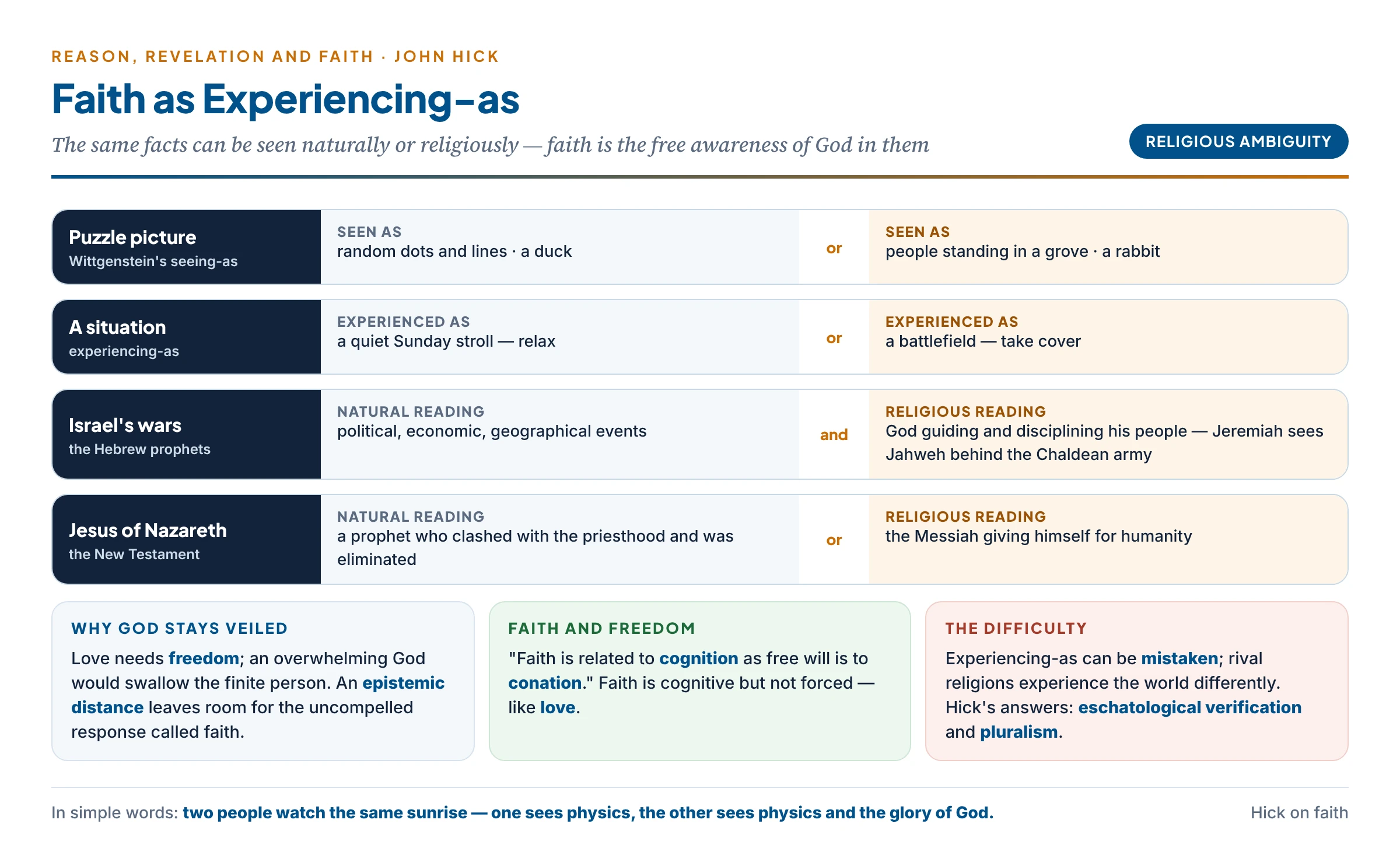
- The religious ambiguity of the universe: the world can be construed both naturalistically and religiously; neither reading is forced on us. The traditional term for the human awareness of God, as distinct from knowledge, is faith.
- Why God does not show himself overwhelmingly — the answer parallels the problem of evil:
- A relationship of love and trust requires freedom, and this freedom must extend to our very consciousness of God.
- To be aware of God is unlike being aware of a finite person: God is the source of our being and highest good; to become aware of him is to see oneself as a dependent creature called to worship and obedience. An overwhelming display would swallow the finite person.
- So God created a world in which he is present in ways that leave us free to recognise or not recognise him — an epistemic distance. Divine activity always leaves room for “that uncompelled response that theology calls faith“.
- Faith is the correlate of freedom: “faith is related to cognition as free will is to conation.” As an early Church Father wrote, “not merely in works, but also in faith, has God preserved the will of man free and under his own control.”
- The nearest human analogy is love: the existence of the beloved, unlike that of a stranger, affects one’s whole being.
- From “seeing-as” to “experiencing-as”:
- Wittgenstein pointed out puzzle pictures — a page of random dots and lines suddenly seen as people standing in a grove; the duck–rabbit figure seen now as a duck, now as a rabbit. The whole field is seen as having a significance.
- Hick widens this to experiencing-as: a whole situation is experienced as having a significance. Driving on a highway, one is aware of the situation as requiring certain responses; a person reacts differently in the midst of a battle and on a quiet Sunday stroll, because he experiences the two situations differently. The significance of a situation lies largely in its bearing on our dispositions to act.
- Experiencing-as can be mistaken — a mentally ill person may experience everyone as a threat.
- Two levels of significance: the religious mind experiences events both as happening in human history and as mediating the presence and activity of God — a religious significance laid over the natural one.
- The Hebrew prophets experienced the wars of their time both as political events and as God’s dealings with Israel — guiding, disciplining, punishing. They were not building a philosophy of history afterwards; they experienced history as it happened as God’s activity. Of Jeremiah during the Chaldean siege it was said: “behind the serried ranks of the Chaldean army he beheld the form of Jahweh fighting for them and through them against His own people.”
- The New Testament: Jesus can be seen as a self-appointed prophet who clashed with the priesthood and was eliminated, or, with the apostles, as the Messiah giving himself for humanity. To see him so is to share the faith that produced the New Testament.
- Life as a whole: religious faith experiences all of life as a situation in which one is always having to do with God; the ethic of the faith says how it is appropriate to act in such a situation.
- Evaluation:
- Strengths: faith becomes cognitive (it is an awareness of reality) without being propositional; it is free without being arbitrary; it explains why both belief and unbelief are understandable; it fits the personal God of the Bible.
- Criticisms: rival religions “experience” the world in incompatible ways — which is right? (Hick’s later answer was religious pluralism, Unit 09); experiencing-as can be mistaken, so how do we know the religious interpretation is correct? (Hick’s answer: eschatological verification — the end of life will show); and critics say faith becomes merely an interpretation, without a clear claim about what exists.
In simple words
Two people stand before the same sunrise over the Himalayas. One sees light scattering through the atmosphere; the other sees that too — and also the glory of God. Neither has more data than the other. The second sees the same facts as something more. Hick says that “seeing more in the same facts” is what faith is.
Indian Connect — Indian Connect — theories of faith and Indian paths
- Aquinas and Nyāya both join inference (natural theology; Udayana’s proofs) with testimony (revelation; śabda) — reason prepares, authority completes.
- Pascal’s “act as if” echoes the Indian stress on practice (sādhana): ritual, japa and service cultivate śraddhā before full understanding.
- Hick’s experiencing-as is close to the bhakti saint who sees Kṛṣṇa everywhere — and to Advaita’s claim that the same world is seen as saṃsāra by the ignorant and as Brahman by the knower.
- Grace and effort: the Śrī Vaiṣṇava debate between the “monkey” school (the baby monkey clings to its mother — human effort) and the “cat” school (the mother cat carries the kitten — God’s grace alone) mirrors the Western debate about will and grace in faith.
Critical Evaluation
Critics and Defenders
Criticism — Against the classical theories
- Against Aquinas: faith becomes assent to propositions; the will forces a firmness the evidence lacks; the preambles fall with the proofs.
- Against Pascal: many gods; a calculating faith; belief is not at will.
- Against James: a licence for wishful thinking (Hick); “living” options depend on upbringing.
- Against Tennant: scientific faith is tested; religious faith only hopes.
- Against Kant: need does not prove existence; morality may not require God.
- Against Hick: rival experiencings-as conflict; interpretation may be mistaken.
Defence — For them
- Aquinas: faith above but not against reason is modest and coherent; grace perfects nature.
- Augustine and Anselm: all understanding starts from trust.
- Pascal: refusing to choose is itself a choice; the stakes are infinite.
- James: suspending belief in a genuine option is a passional decision too; faith can create facts.
- Kant: faith grounded in moral reason, not desire.
- Hick: faith as free, cognitive awareness explains both belief and unbelief.
Cross-Tradition Comparison
| Theory | Faith is mainly… | What bridges the evidence gap | Indian parallel |
|---|---|---|---|
| Augustine, Anselm | Trust that seeks understanding | Authority of witnesses | Śraddhā before jñāna |
| Aquinas | Intellectual assent moved by will and grace | God’s authority; credibility signs | Nyāya: anumāna + śabda |
| Pascal | A wager of the whole life | Prudence under uncertainty | Sādhana that cultivates faith |
| James | A passional decision in a genuine option | Right to choose when evidence is silent | Gītā: act with faith (śraddhāvān) |
| Tennant | A venture toward the possible | Willing risk | — |
| Kant | Rational moral faith | Needs of practical reason | Mīmāṃsā: dharma known for action |
| Hick | Experiencing-as | Free interpretation of ambiguous experience | Bhakti vision; Advaita’s double seeing |
Synthesis (Siddhānta)
- Every theory of faith answers the same question: how is the evidential gap bridged?
- Augustine and Anselm: by trust that then seeks understanding — reason works inside faith.
- Aquinas: faith is intellectual assent commanded by the will under grace, firmer than opinion yet without the sight of knowledge. It reconciles reason and faith through one truth from one source, the preambles, the rule above but not against reason, the credibility signs and the principle that grace perfects nature.
- Voluntarists (Pascal, James, Tennant) let the will decide where evidence cannot; Kant lets practical reason postulate God. They capture faith’s risk and commitment but, taken alone, are inadequate: they court wishful thinking, cannot choose among faiths, and turn faith into calculation.
- Hick makes faith a free, cognitive experiencing-as in a religiously ambiguous universe — avoiding both propositional narrowness and voluntarist arbitrariness, but facing the problem of conflicting interpretations.
- Balanced view: faith involves intellect (content and assent), will (commitment and risk), feeling (trust and love) and experience (awareness) together — the “centred act of the whole person” (Tillich) — and is reasonable when it is grounded, coherent and morally sound.
“I do not seek to understand in order to believe, but I believe in order to understand.” — St Anselm
Previous Year Questions
- 2025Distinguish between Natural Theology and Revealed Theology in the context of the Propositional view of Revelation.
- 2025How does Aquinas’ account of Faith as “an intellectual assent” reconcile the juxtaposition between Reason and Faith? Discuss.
- 2017Discuss whether the voluntarist’s theories of faith are adequate.