

Proofs for the Existence of God and their Critique (Indian and Western).
Official Syllabus: Paper II, Section B, Unit 2
The teleological argument — also called the argument from design or, in Kant’s phrase, the physico-theological proof — reasons from the order, adaptation and purpose we see in nature to an intelligent Designer who planned it. The word comes from the Greek telos, “end” or “purpose”. It is the oldest, the most popular and the most intuitive of all the theistic proofs: the eye seems made for seeing, the seasons seem arranged for crops, and the laws of physics seem set just right for life. The argument asks a simple question — can such order be an accident? — and answers that it must be the work of a mind. This article explains the argument from its roots in Plato to Aquinas’ Fifth Way, Paley’s watch, the three marks of purpose, Tennant’s wider teleology and the modern fine-tuning argument; then the great criticisms of Hume, Kant, Darwin and Mill; and finally the Indian design arguments of Nyāya and Śaṅkara, and Rāmānuja‘s critique.
In simple words
You are walking on a beach and find, written in the sand, the words “WELCOME HOME”. You do not think the waves did it. The letters are too well formed and too meaningful to be an accident — someone with a mind and a purpose wrote them. The design argument looks at the eye, the beating heart and the orbits of the planets in the same way: they look far more carefully “written” than any message in the sand, so — the argument says — someone wrote them too.
Context & Problem
What the Design Argument Claims
- From order to a mind. The argument starts from an observed fact — the world shows order, harmony and purpose — and infers a cause of that fact: an intelligence powerful and wise enough to produce it.
- A posteriori. Like the cosmological argument, it starts from experience (a posteriori — “after experience”), not from the bare idea of God (contrast the ontological argument, Article 2).
- Two kinds of order.
- Order of purpose (spatial order) — parts arranged to serve an end: the lens, retina and nerve of the eye working together for sight.
- Order of regularity (temporal order) — the world behaves according to simple, stable laws: the sun rises, objects fall, chemicals combine in fixed proportions.
- Two ways of arguing.
- By analogy — the world is like a machine; machines have designers; so the world probably has a designer (Paley, Cleanthes in Hume’s Dialogues).
- By best explanation — a designer explains the order of the world better than chance or blind necessity (the modern fine-tuning argument; Swinburne).
- What it hopes to show. That the world is the product of a Being with infinite knowledge, desire, power and will to realise its ends — the God of religion.
Roots of the Argument
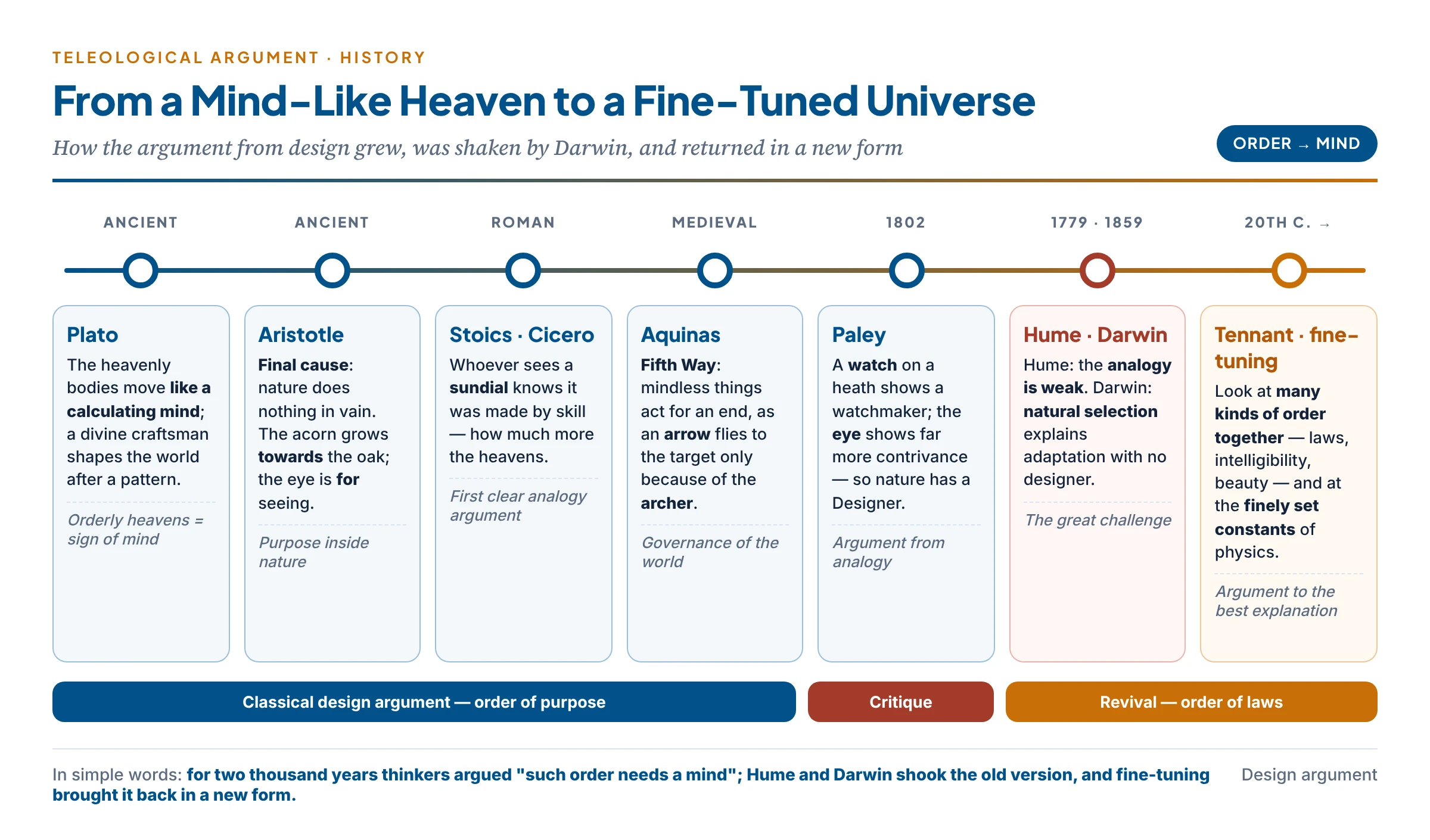
- Plato. In the Laws and the Timaeus, the regular movement of the heavenly bodies is like the movement and calculation of a mind; the cosmos is shaped by a divine craftsman (the Demiurge) who looks to the Forms as a pattern.
- Aristotle. His final cause — the “that for the sake of which” — says nature does nothing in vain: the acorn grows towards the oak, the eye exists for seeing. The argument from design takes this natural purposiveness and asks who gave it.
- The Stoics and Cicero. Cicero’s On the Nature of the Gods compares the cosmos to a sundial or a water-clock: whoever sees one knows it was made by skill; how much more the heavens.
- Medieval and early modern. Aquinas made it his Fifth Way; Newton saw the fine balance of the solar system as the work of “an intelligent and powerful Being”; the eighteenth-century “natural theologians” filled books with examples of design.
Why It Is Called an Extension of the Cosmological Argument
- More detail from experience. The cosmological argument uses only the most general features of the world — that things exist, change and are caused (Articles 3 and 4). The design argument studies the empirical features of the universe far more extensively and in detail: eyes, wings, seasons, the ozone layer.
- Order is contingent. Like contingent existence, order is not guaranteed by anything in nature itself — nature could have been a chaos. So order too must be grounded in a self-existing, infinite intelligence.
Why It Appeals So Widely
- It begins from what everyone sees, needs no technical philosophy, and grows stronger as science reveals more intricate order.
- Even its greatest critic among the moderns, Kant, said it “always deserves to be mentioned with respect” — it is “the oldest, the clearest, and the most accordant with the common reason of mankind” and a powerful instrument for heightening religious feeling.
Core Doctrine
1. Aquinas’ Fifth Way — the Argument from Governance
- The argument.
- We see that things which lack knowledge — natural bodies, plants, the elements — act for an end: they act always or nearly always in the same way to obtain the best result.
- This cannot be by chance; it must be by design.
- But what lacks knowledge cannot move towards an end unless it is directed by something with knowledge and intelligence — as the arrow is directed to the target by the archer.
- So there is an intelligent being by whom all natural things are directed to their end — “and this being we call God”.
- What is special. Aquinas does not argue from complicated machines. He argues from the simple fact that mindless things behave purposefully — a seed always grows into its own kind of plant, fire always rises, the heart always pumps. Purpose without awareness needs an aware Director.
- Its place. It is the last of the Five Ways (Article 3); the first three are cosmological, the fourth argues from degrees of perfection.
In simple words
An arrow does not know where the target is, yet it flies straight to it. Nobody thinks the arrow is clever; everyone knows there is an archer behind it. Aquinas says a seed “aiming” at becoming a tree, or a bee “aiming” at its hive, is like that arrow: it does not know its goal, so someone who knows must be aiming it.
2. Paley’s Watch
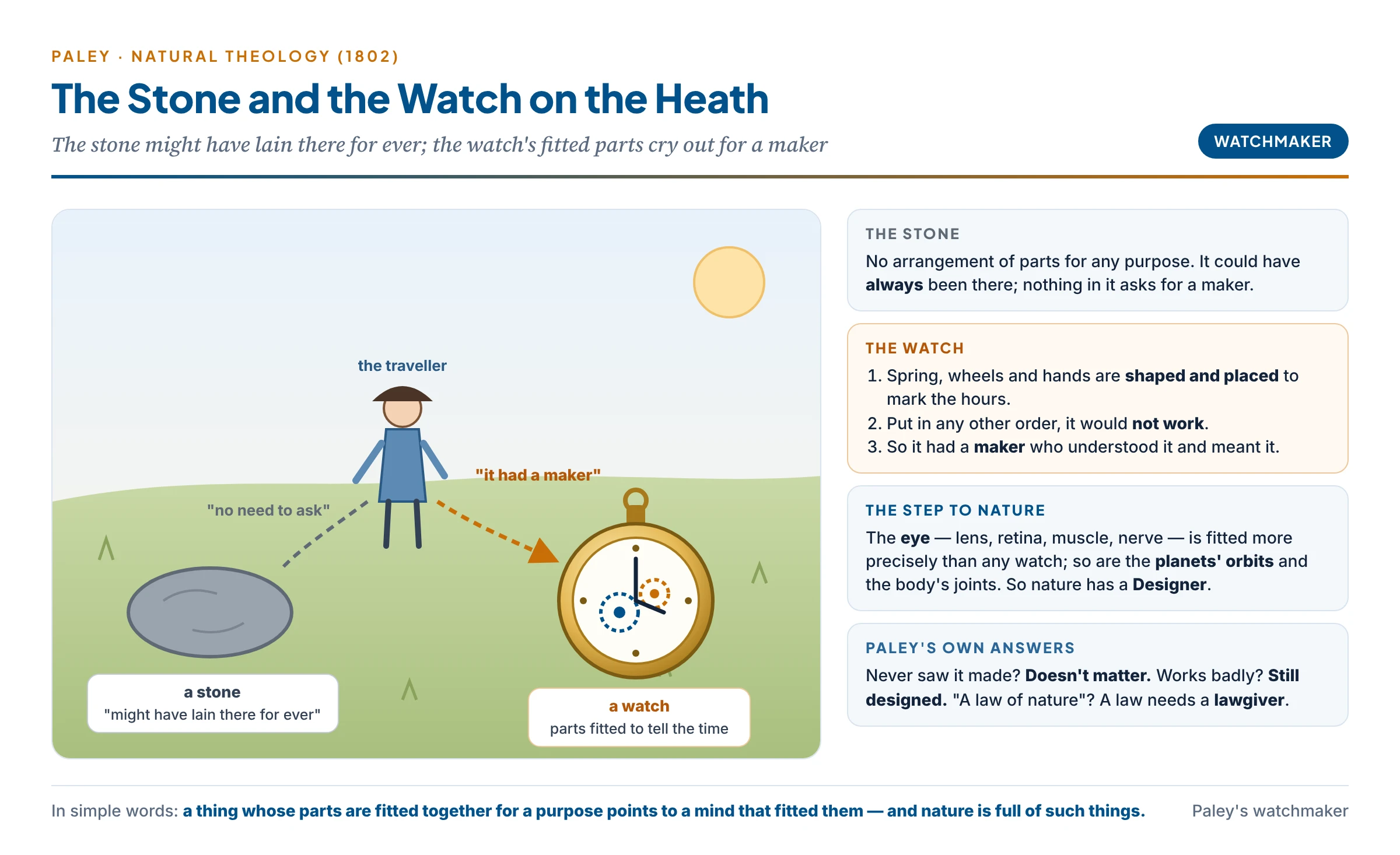
- William Paley (Natural Theology, 1802) gave the argument its most famous form.
- The heath. “In crossing a heath, suppose I pitched my foot against a stone, and were asked how the stone came to be there; I might possibly answer that, for anything I knew to the contrary, it had lain there for ever.” But suppose I found a watch on the ground.
- Why the watch is different. Its parts — spring, wheels, chain, balance, glass — are framed and put together for a purpose: to mark the hours. If they were shaped differently, or placed in any other order, the watch would not work. From the mere presence of such a mechanism, I conclude that the watch must have had a maker who understood its construction and designed its use.
- The step to nature. Every sign of contrivance in the watch exists in the works of nature — “with the difference, on the side of nature, of being greater and more“. The human eye is Paley’s favourite example: lens, retina, muscles and nerve fitted together as precisely as any telescope. The orbits of the planets, the joints of the body and the instincts of animals tell the same story.
- The conclusion. The universe must have an intelligent Creator — God.
- Paley’s own answers to objections.
- We never saw a watch being made? It would not matter; the structure itself shows design. We infer a maker of an ancient building we never saw built.
- The watch sometimes goes wrong? Imperfection does not show that there was no design; a faulty watch still had a watchmaker.
- Some parts seem useless? We may not understand every part; that does not cancel the evidence of the parts we do understand.
- It could be explained by a “law of nature”? A law is a rule, not an agent; laws need a lawgiver.
3. The Three Marks of Purpose — Selection, Combination and Gradation
Theologians who defend the argument point to three characteristics that always show intention, and claim that all three are present in nature.
- 1. Selection. Out of many possibilities, just the right ones are chosen.
- The organs of each species are selected to fit its conditions of living: gills for water, lungs for air, the camel’s hump and padded feet for the desert.
- Breathing organs of each species are well adapted to the air, water or soil in which it lives.
- 2. Combination. Separate parts are correlated so that they work as one.
- In the human body, heart, lungs, blood vessels, nerves and brain depend on one another and function as an integrated whole.
- Different species too are interdependent: flowers and bees, plants and the animals that eat them and spread their seeds.
- 3. Gradation. A given end is reached through a chain of means, each making provision for the next.
- Soil supports plants, plants support herbivores, herbivores support carnivores; in general, lower life sustains and supports higher life.
- The whole series seems arranged to lead up to beings capable of thought and moral life.
- Cosmic examples. The perfect cycle of seasons, the rhythm of day and night, the movement of the planets, a climate fit for life, and the ozone layer — a life-saving shield against harmful rays — look like well-thought creations, not products of chance. Nineteenth-century writers such as James Martineau and Arthur I. Brown filled whole books with such adaptations of plants and animals and the protective arrangements of the earth.
- The conclusion. All these marks point to an ultimate entity with infinite knowledge, power, desire and will to realise its ends — a conscious power “functioning behind the scene” — which can only be God.
In simple words
Think of a cricket team. Selection: the captain picks a fast bowler, a spinner and a wicket-keeper, not eleven goalkeepers. Combination: they field as one unit, each covering a different part of the ground. Gradation: the openers wear down the bowling so the middle order can score, and the middle order sets up the finishers. Nobody thinks such a team assembled itself by accident. The design argument says the living world shows the same three marks — chosen parts, working together, step by step towards an end.
4. Order of Regularity — the Argument from Laws
- The newer version. Even if biology could explain the eye, there is a deeper order: the whole universe obeys simple, universal laws that hold everywhere and always. Richard Swinburne (The Existence of God, 1979) calls this temporal order.
- Why it matters. Natural selection itself works only because there are stable laws of chemistry and heredity. Science explains things by laws; it cannot explain why there are laws at all. A designer who chooses to make a law-governed world is, Swinburne argues, the simplest explanation.
- Probability, not proof. Swinburne does not claim certainty. He says the existence of a law-governed universe is more probable if there is a God than if there is not — a “cumulative case” (Article 10).
5. Tennant’s Wider Teleology
- F.R. Tennant (Philosophical Theology, 1928–30) accepted that Darwin had weakened the argument from single adaptations. His answer was to look at many kinds of order together — a “wider teleology”.
- The strands of evidence.
- Adaptation in living things — weakened by Darwin, but still present.
- Intelligibility — the world is understandable by our minds; it fits our reason like a key in a lock.
- The fitness of the inorganic world — the physical environment is suited to give rise to and sustain life.
- Beauty — nature is full of beauty far beyond what survival needs; the “aesthetic argument”.
- Moral life — the world produces beings with conscience and moral ideals, and seems fitted to train character.
- Progress — the whole process moves upward from matter to life to mind.
- The point. Any one strand might be explained away; together they make design far more probable than chance. “The forcibleness of Nature’s suggestion” lies in the conspiration of many factors.
In simple words
A detective rarely solves a case from one clue. A footprint might be anyone’s; a cigarette butt might be old; a torn button might be an accident. But when all the clues point to the same person, the case becomes strong. Tennant treats the order of nature in this way: adaptation, intelligibility, beauty, the fitness of the earth and moral life are separate clues — together they point to a Designer.
6. A Finely Tuned Universe — the fine-tuning argument and the Anthropic Principle
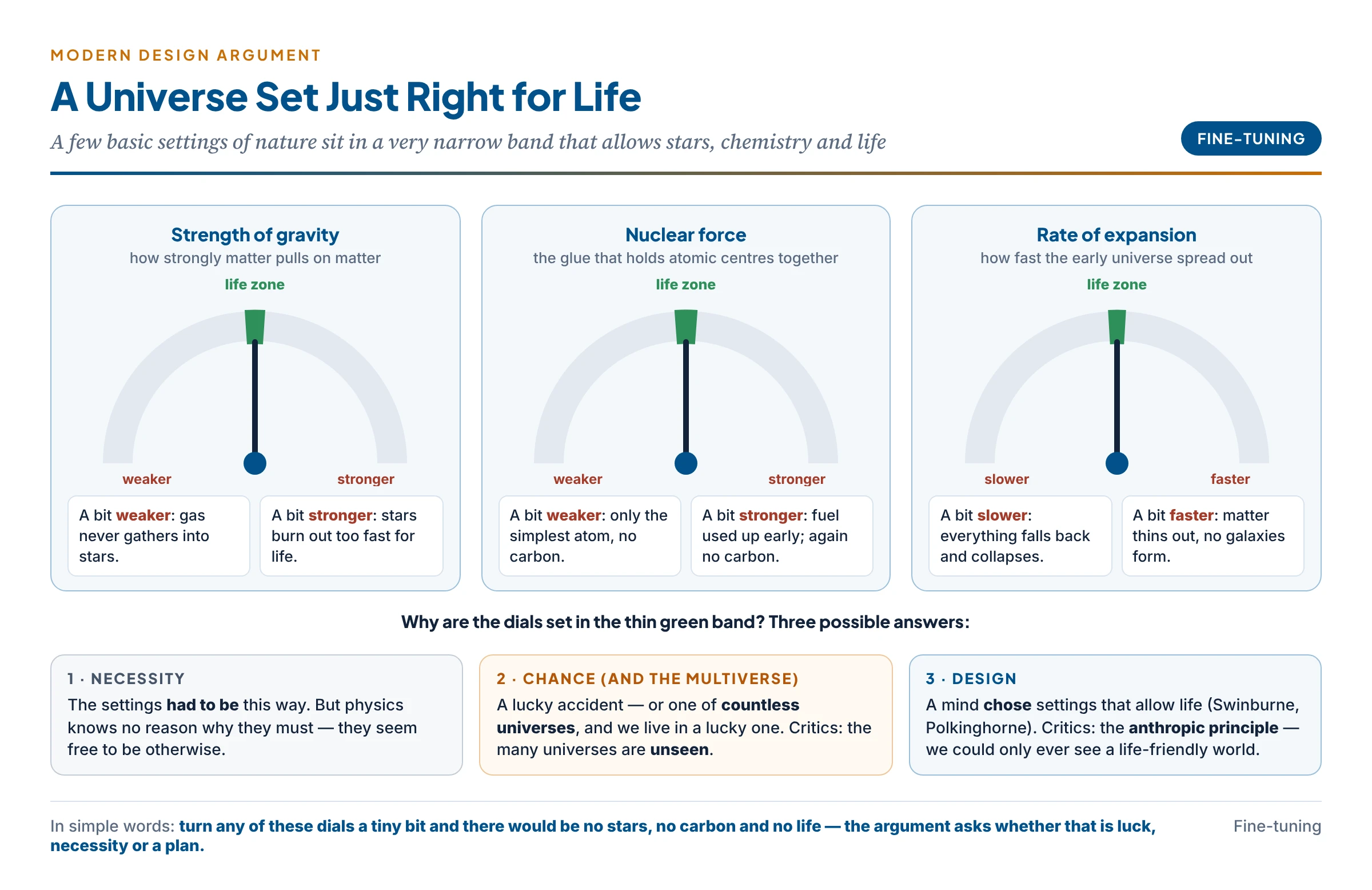
- The modern discovery. Physics has found that a handful of basic constants of nature — the strength of gravity, the strength of the force that holds atomic nuclei together, the rate at which the universe expands, the “cosmological constant” — are balanced on a knife’s edge.
- If gravity were slightly stronger, stars would burn out too quickly; slightly weaker, and stars would never form.
- If the nuclear force were a little different, there would be no carbon — and no life as we know it.
- Some of these settings must be accurate to a precision so fine that a change by a fraction smaller than one part in an enormous number would have made a lifeless universe.
- The argument.
- The fine-tuning of the universe for life is due either to physical necessity, to chance, or to design.
- It is not due to necessity — physics knows no reason why the constants must have these values.
- It is not plausibly due to chance — the odds are astronomically against it.
- So it is due to design.
- Supporters. Swinburne, John Polkinghorne (physicist and priest); the astronomer Fred Hoyle, struck by the special conditions that allow carbon to form in stars, said it looked as if “a superintellect has monkeyed with physics”.
- The anthropic principle. Coined by the physicist Brandon Carter (1973). In its weak form it says: we should not be surprised that the universe allows life, because if it did not, we would not be here to observe it. Critics of fine-tuning use this as a reply; defenders say it describes the fact but does not explain it.
- The multiverse reply. Some cosmologists propose an enormous ensemble of universes with different constants. If there are vastly many, it is to be expected that some will permit life — and we naturally find ourselves in one of those. Defenders reply that the multiverse is itself unobserved and may need fine-tuning of its own.
In simple words
A man faces a firing squad of fifty trained marksmen — and every one of them misses. He could say, “Of course they missed, otherwise I wouldn’t be alive to wonder about it.” True — but he would still be right to suspect that the misses were arranged. The fine-tuning argument says our life-permitting universe is like that survival: the anthropic principle tells us why we notice it, but not why it happened.
Critical Evaluation
Hume’s Dialogues Concerning Natural Religion
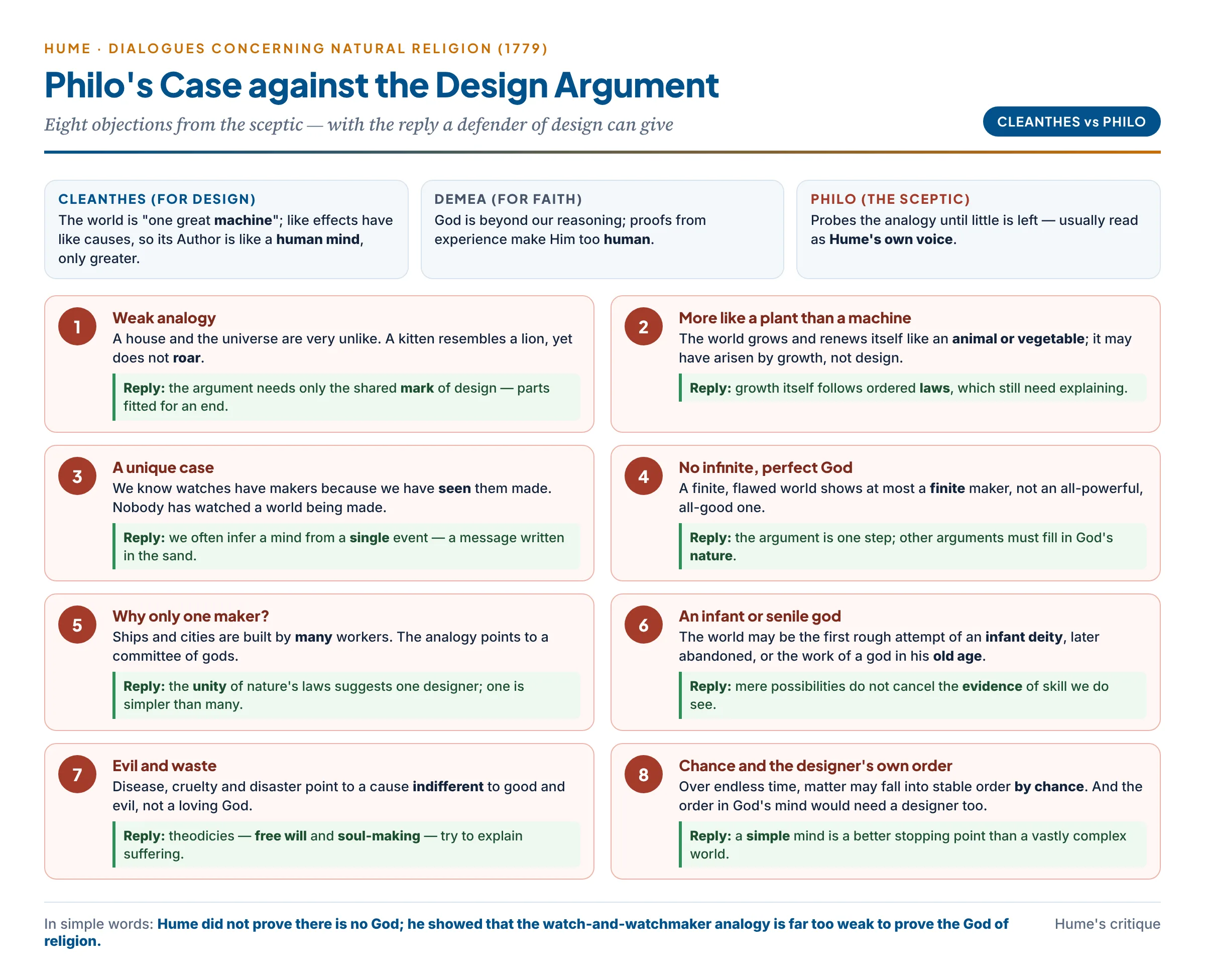
David Hume‘s Dialogues (published after his death, 1779) is the classic critique. Three characters debate: Cleanthes defends the design argument, Demea defends faith and a priori reasoning, and Philo, the sceptic, demolishes the argument — usually taken as Hume’s own voice.
- Cleanthes’ argument. “Look round the world: contemplate the whole and every part of it: you will find it to be nothing but one great machine, subdivided into an infinite number of lesser machines.” The curious adapting of means to ends resembles, though it exceeds, the products of human contrivance. Since the effects resemble each other, the causes resemble each other: the Author of nature is somewhat similar to the mind of man, though with much larger faculties.
Philo’s objections
- 1. The analogy is weak. An argument from analogy is only as strong as the likeness between the two things compared. A house and the universe are very unlike. A kitten and a lion are alike in many ways, yet we cannot infer that a kitten roars because a lion does. Likewise, the universe and a watch do not share enough relevant features to infer that they were made in the same way.
- 2. The world is more like an organism than a machine. It grows, decays and renews itself like an animal or a vegetable. If so, it may have arisen by generation or vegetation — the way a tree grows from a seed — and not by design. Why choose the machine as our model rather than the plant?
- 3. A unique case. We know that houses and watches have makers because we have seen houses and watches being made, again and again. But the universe is one, unique whole; we have never watched worlds being made. Where there is no repeated experience, inductive inference has nothing to go on.
- 4. A part cannot be the model of the whole. “What peculiar privilege has this little agitation of the brain which we call thought, that we must thus make it the model of the whole universe?” Mind is only one of the forces we see in nature, alongside heat, gravity and growth.
- 5. It does not prove an infinite or perfect God. A finite, imperfect world can at most show a finite designer, with power and skill proportionate to the effect. It cannot show omnipotence, omniscience or perfect goodness.
- 6. Why only one designer? Great human works — a ship, a city — are made by many workers. The analogy suggests polytheism: a committee of gods.
- 7. A botched or abandoned job. For all we know, this world “was only the first rude essay of some infant deity, who afterwards abandoned it, ashamed of his lame performance”; or the work of a senile deity in his dotage; or of an inferior god mocked by his superiors.
- 8. The problem of evil (dysteleology). The world is full of disease, cruelty, waste, earthquakes and famine. If we argue from the world to its maker, we should infer a maker who is indifferent to good and evil, not a loving God. Nature looks less like a well-run house than a “blind Nature, impregnated by a great vivifying principle, and pouring forth from her lap, without discernment or parental care, her maimed and abortive children”.
- 9. The Epicurean hypothesis. Given a finite number of particles moving for an infinite time, every possible arrangement will occur sometime — including stable, orderly ones that maintain themselves. Order may arise by chance and then persist because it is stable.
- 10. The regress. If the order of the world needs a mind to explain it, the order in that mind — its ideas arranged to plan a world — needs explaining too. Who designed the designer? If the divine mind can be orderly without a cause, so can the material world.
- 11. Anthropomorphism. The argument makes God a magnified human craftsman, with thoughts that succeed one another, plans and efforts — far from the infinite, unchanging God of religion.
Replies made on behalf of the argument
- On analogy. The argument need not claim the world is exactly like a watch; it needs only that it shows the same mark of design — complex parts working for an end. Paley’s eye has that mark.
- On uniqueness. Science routinely reasons about unique events (the origin of the universe, the history of life). We infer intelligence from a single unrepeatable message, like the beach sand writing.
- On the regress. An explanation can be good even if we cannot explain the explainer; and a simple divine mind is a better stopping point than a vastly complex universe.
- On many gods. Simplicity and the unity of the laws of nature suggest one designer.
- On evil. Hume’s objection weakens the argument’s conclusion (a good God) more than its core (a designing mind); and theodicies (free will, soul-making) try to answer it.
- Hume’s own ending. Even Philo concedes at the close that “the cause or causes of order in the universe probably bear some remote analogy to human intelligence” — a very thin conclusion, far from the God of religion.
Kant’s Critique of the Physico-theological Proof
Immanuel Kant treats the design argument with respect but finds it unable to prove God.
- 1. Merely analogical. It rests on the analogy of a mechanic and his machine, or a potter and his pot. An analogy has no force of demonstration. In religion we value freedom of will, moral worth and spiritual creativeness — the very things a mechanism leaves out. The analogy is also highly anthropomorphic: we picture the whole of reality in terms of human needs and ends, though reality may be far more than this.
- 2. It ignores evil. It cannot explain physical, mental or moral evil. There is much disharmony and chaos in nature, but the defenders one-sidedly emphasise selection, combination and gradation.
- 3. An architect, not a creator. At most it shows an author of the world’s form, not the creator of its matter. An architect shapes pre-existing material, as a potter shapes clay. Even an infinite architect presupposes the reality of matter, so God becomes limited by matter; but the God of religion must create matter itself.
- 4. A disguised cosmological — and so ontological — argument. To move from “a very great architect” to an all-sufficient, necessary Being, the argument must fall back on the cosmological argument (from contingent to necessary being), which in turn rests on the ontological argument (Articles 2 and 4). So all the a posteriori proofs are, in the end, a priori in essence.
- 5. Order may be supplied by the mind. For Kant, the understanding organises experience through its own categories — “the understanding makes nature” in the sense of its lawful form. We cannot be sure the order we find is in things as they are in themselves rather than in the way we must experience them. Purposiveness, in his later Critique of Judgment, is a regulative idea that guides inquiry (“look for the function of each organ”), not a proven fact about a Designer.
- 6. Yet it is valuable. It is no proof — or, as an argument, a feeble one — but a potent instrument for heightening religious emotion, enlivening the study of nature and preparing the mind for the moral argument (Article 6).
Common confusion
Did Hume say that “order in nature is merely a human creation to hide the chaos in nature”? Not quite. Many notes put this line under Hume. Hume’s points are that the order we see might arise from matter itself (the Epicurean hypothesis), from generation like a plant, or from causes we cannot know — and that our ideas of necessary connection come from custom. The stronger claim that the mind itself supplies the order we find in nature belongs to Kant: the understanding gives experience its lawful form, so order in experience cannot by itself prove an orderer beyond experience. Philo does suggest the world may be far less orderly than defenders admit, but he does not call order a mask over chaos.
The Mind That Observes Order — Can Design Arguments Still Be Used?
- The challenge. If the human mind is so made that it naturally sees order — finding patterns, faces in clouds, purposes everywhere — then perhaps the order we “see” in nature is partly our contribution.
- Kant: the forms of space, time and causality come from the mind; order in experience is guaranteed by our way of knowing.
- Psychology: human beings are prone to see agency and purpose even where there is none (a rustle in the grass is “someone”).
- Why the argument is not simply destroyed.
- The mind may give experience its general form, but it does not invent the particular facts — that the eye has a lens and retina, or that gravity has exactly the strength it has. These are discovered, often to our surprise.
- The fact that our minds and nature fit each other — that the world is intelligible and mathematics describes it — is itself a fact needing explanation; Tennant treats it as one strand of design.
- Even if order is partly read into nature, the argument can be recast as inference to the best explanation: why is there a world whose structure supports minds at all?
- The balance. The objection rules out a demonstrative design proof; it leaves room for a modest, probable argument that supports faith rather than replacing it.
Darwin and Natural Selection
- Charles Darwin (On the Origin of Species, 1859) gave the most serious blow. Living things are adapted to their surroundings not because they were designed, but because, over vast periods of time:
- Offspring vary slightly from their parents.
- More are born than can survive; there is a struggle for existence.
- Those whose variations suit their environment survive and reproduce more (“survival of the fittest”).
- Useful variations accumulate over millions of years, producing complex organs gradually.
- Apparent purpose explained. What looks like purpose (teleology) is really teleonomy — goal-like behaviour produced by a blind process. Complexity arises from the bottom up, step by step, not from the top down by a plan.
- Darwin’s own verdict. “The old argument of design in nature, as given by Paley, which formerly seemed to me so conclusive, fails, now that the law of natural selection has been discovered.”
- The blind watchmaker. Richard Dawkins (The Blind Watchmaker, 1986; The God Delusion, 2006): natural selection is the only watchmaker in nature, but it is blind — it does not see ahead or plan.
- Evidence against perfect design.
- Vestigial organs — the human appendix, the tail-bone, the tiny wings of flightless birds — make sense as left-overs of evolution, not as parts of a perfect plan.
- The vertebrate eye — Paley’s favourite — has its nerve fibres in front of the retina, creating a blind spot; an engineer starting from scratch would not wire it so.
- Theistic replies.
- Theistic evolution — God works through evolution; natural selection is the method of design, not its rival. Many scientists who are believers hold this view.
- Evolution itself depends on laws of nature and a fine-tuned universe; the design argument moves from organisms to the laws that make evolution possible (sections 4 and 6).
- Evolution explains how complexity develops, not why there is a universe that can produce minds at all.
Mill, Science and the Modern Debate
- J.S. Mill (Nature, published in Three Essays on Religion, 1874).
- Nature is cruel: “In sober truth, nearly all the things which men are hanged or imprisoned for doing to one another are nature’s every day performances.”
- If there is a designer, the evidence of design shows contrivance — and contrivance means working within limits. A designer who needs means is not omnipotent. Mill concluded that, at best, the argument shows a designer of limited power and doubtful goodness.
- Chance and indeterminism. Quantum mechanics describes events at the smallest scale as probabilistic, and chaos theory shows that tiny differences can produce wildly different outcomes. Such ideas speak of chance and indeterminism rather than the neat harmony and determinism the old argument assumed.
- Intelligent design. In the 1990s the “intelligent design” movement (Michael Behe, Darwin’s Black Box, 1996) argued that some biological systems — such as the bacterial flagellum, a tiny rotating “outboard motor” — are irreducibly complex: remove one part and they stop working, so they could not have evolved step by step. Biologists replied that such parts often had other uses earlier in evolution. In the United States, the court in Kitzmiller v. Dover Area School District (2005) held that intelligent design is not science and could not be taught as such in public-school biology classes.
- Observer selection. Philosophers such as Elliott Sober point out that we could only ever observe a life-permitting universe, which weakens the inference from “the odds were low” to “it was designed” — the firing-squad case divides philosophers on exactly this point.
Three Main Objections Weighed
| Objection | What it says | Example | Defender’s reply | Assessment |
|---|---|---|---|---|
| Imperfections and evil (Hume, Mill) | A perfect, good designer would not make a world full of flaws and suffering | Blind spot of the eye; earthquakes, tsunamis, disease | Suffering serves moral growth (soul-making); we cannot fully see God’s purpose | Weakens the step to a good God more than the step to some designer |
| Natural selection (Darwin, Dawkins) | Blind variation and selection explain adaptation without a designer | Eye evolved through many small changes; vestigial appendix, tail-bone | Theistic evolution; laws of evolution themselves need explaining | Destroys the argument from single organs; leaves the argument from laws and fine-tuning |
| Weak analogy (Hume, Kant) | The universe is too unlike a watch to infer the same kind of cause | Kitten and lion; world like a plant; quantum randomness | Order and purpose are themselves signs of mind; fine-tuning recasts it as best explanation | Rules out proof by analogy; a probable argument remains open |
Is the Natural World “Designed as a Watch”?
- For the claim. The eye, the cell, the genetic code and the balance of the physical constants are more intricate than any watch. The cell is often compared to a factory with machines, messengers and a vast store of coded information.
- Against the claim.
- A watch is made all at once by a maker who has a plan; living things grow and evolve over long periods.
- A watch has no waste; nature is full of waste — millions of seeds for one tree, extinct species, vestigial organs.
- A watch is designed for one clear purpose; nature’s “purposes” often conflict — the deer’s speed against the tiger’s hunger.
- Watches are known to be designed because we see watchmakers; worlds are not.
- The verdict. The world shows order and apparent purpose — that much is common ground. Whether it is “manifestly designed” depends on whether the order is better explained by mind, by law and selection, or by chance and observer selection. The watch analogy dramatises the question; it does not settle it.
Critics and Defenders
Criticism — Critics
- Hume: weak analogy; a unique world; many or imperfect makers; evil; Epicurean chance; who designed the designer?
- Kant: analogy proves no God; ignores evil; an architect, not a creator; collapses into the cosmological and ontological proofs; order may come from the mind.
- Darwin and Dawkins: natural selection is a blind watchmaker; vestigial organs and the eye’s blind spot show no perfect plan.
- Mill: nature is cruel; contrivance implies a limited designer.
- Modern science: quantum chance, chaos, the multiverse and observer selection weaken the inference.
Defence — Defenders and strengths
- Paley: contrivance shows a maker even if we never saw the making and even if the work is imperfect.
- Selection, combination and gradation are the marks of purpose, and nature shows all three.
- Tennant: many independent strands — adaptation, intelligibility, beauty, moral life — together make design probable.
- Swinburne and Polkinghorne: laws of nature and fine-tuning are best explained by a designer; Darwin presupposes them.
- Kant himself: the argument deserves respect and strengthens religious feeling.
Cross-Tradition Comparison
Western and Indian Design Arguments
| Point | Western design argument | Indian design argument |
|---|---|---|
| Main thinkers | Aquinas, Paley, Tennant, Swinburne | Nyāya (Udayana); Śaṅkara (against Sāṃkhya); Rāmānuja (critic) |
| Starting fact | Adaptation, order, laws, fine-tuning | The world is an effect made of parts; inert atoms or matter cannot arrange themselves |
| Model | Watchmaker, archer, architect | Potter and pot; carpenter and chariot; builder and palace |
| What God is | Designer and (in theism) creator from nothing | Efficient cause ordering eternal atoms (Nyāya); material and efficient cause (Advaita) |
| Main critics | Hume, Kant, Darwin, Mill | Cārvāka, Buddhists, Jainas, Mīmāṃsā, Sāṃkhya; Rāmānuja within theism |
| Role of scripture | Natural theology tries to do without it | Vedāntins treat reason as support for scripture, not a substitute |
Indian Connect — Nyāya: the world as a pot needs a potter
- Kāryāt — mountains, seas and bodies are made of parts and have limited size, so they are effects; every effect needs a maker with knowledge, desire and effort, as a pot needs a potter. Since the parts are atoms no human can see, the maker must be all-knowing.
- Āyojanāt — inert atoms cannot combine by themselves; an intelligence must set them in motion, as a chariot moves only when driven.
- Both arguments combine the cosmological idea (an effect needs a cause) with the design idea (order needs a mind). Full treatment: Article 7.
Indian Connect — Śaṅkara’s design argument against Sāṃkhya
- Śaṅkara, commenting on the Brahmasūtra, uses a design argument against Sāṃkhya, which holds that unconscious Pradhāna (primal matter) evolves the world by itself.
- The argument of arrangement (racanā-anupapatti): an orderly world like ours cannot be produced by an unconscious cause. Wood and bricks do not arrange themselves into a palace or a chariot without a builder who understands them.
- No activity without a conscious mover: clay moves only when the potter handles it; a chariot moves only when driven.
- Sāṃkhya’s analogies rejected: Sāṃkhya says Pradhāna acts unconsciously for the soul’s good, as milk flows from the cow for the calf, or water flows downhill. Śaṅkara replies that milk flows because of the living cow’s love for the calf, and that grass becomes milk only when eaten by a cow, not when it lies in the field.
- Yet Śaṅkara does not rest belief in Brahman on this reasoning: Brahman is known through scripture, and reason only supports it (Article 8).
Indian Connect — Rāmānuja’s critique of the design inference
- Rāmānuja, though a theist, rejects the Nyāya attempt to prove God by inference.
- No single maker shown. The world is not produced at one time or as one whole; its parts are not uniform like pots. Things produced at different times are seen to have different causes — so the inference points, if anywhere, to many makers.
- Embodied, limited makers. Every maker we know has a body and limited powers; inference from pots gives only a skilled artisan, not an omniscient, omnipotent Lord.
- Souls might do it. Individual souls, through great merit and austerity, can gain extraordinary powers; inference cannot rule out that such souls shaped the world.
- Conclusion. God is known from scripture alone (śāstraika-pramāṇa). This is strikingly close to Hume’s “many makers” and “finite maker” objections and to Kant‘s point that design shows only an architect (Article 8).
Indian Connect — Jaina and Buddhist objections
- Jainas (Malliṣeṇa): many beings can co-operate without a single master, as bees build one hive or ants one anthill — so the unity of the world does not prove one God. Products such as wild grass grow without any maker.
- Buddhists (Dharmakīrti): the order of the world is already explained by the karmic intentions of living beings; and an eternal, unchanging God could not produce effects one after another. Full treatment: Article 9.
Kant and Śaṅkara–Rāmānuja on the Limits of Design
- Common ground. Kant, Śaṅkara and Rāmānuja all agree that design reasoning cannot by itself establish the supreme Being of religion.
- Difference. Kant turns to moral faith (Article 6); the Vedāntins turn to śruti (revealed scripture). Both treat design reasoning as an aid that fits a belief grounded elsewhere.
Synthesis (Siddhānta)
- The design argument infers an intelligent Designer from the order, adaptation and purpose of the world. Its roots go back to Plato, Aristotle and the Stoics; Aquinas gave it as his Fifth Way (the arrow and the archer); Paley made it famous with the watch found on the heath; its defenders point to the three marks of selection, combination and gradation; Tennant widened it into a cumulative case, and the modern fine-tuning argument applies it to the laws and constants of physics.
- Hume showed that as an argument from analogy it is weak — the world is unique, it might resemble a plant, it might have many or imperfect makers, its evils point to an indifferent cause, and the designer’s own order needs explaining. Kant added that it gives at most an architect, not a creator, ignores evil, and leans on the cosmological and ontological proofs; and that the mind may itself supply the order we find. Darwin explained biological adaptation by natural selection, and Mill found nature too cruel for a good, omnipotent designer.
- What survives is not a demonstration but a probable argument: the existence of laws, the intelligibility of the universe and its fine-tuning for life remain facts for which a designing mind is one serious explanation, competing with chance, necessity and the multiverse.
- Indian thought shows the same pattern. Nyāya argues from the world as an effect to an all-knowing maker; Śaṅkara uses design reasoning against Sāṃkhya’s unconscious Pradhāna; but Rāmānuja, like Hume and Kant, denies that inference can prove one omniscient God — God is known through scripture, and reason only supports.
- Contemporary relevance.
- Cosmology and fine-tuning keep the debate alive in physics and philosophy.
- Evolution and education — the intelligent-design controversy shows how the argument touches public life and the boundary between science and religion.
- Ecology — the old sense of an ordered, purposeful nature inspires respect for the earth, even among those who reject the argument.
- For religion, the argument’s lasting value lies, as Kant saw, in wonder: it turns attention to the order of the world and makes reflection on God natural.
“The old argument of design in nature, as given by Paley, which formerly seemed to me so conclusive, fails, now that the law of natural selection has been discovered.” — Charles Darwin
“This proof always deserves to be mentioned with respect. It is the oldest, the clearest, and the most accordant with the common reason of mankind.” — Kant
Previous Year Questions
- 2025Present an account of Design argument to prove the existence of God along with its criticism by David Hume.
- 2016“The natural world is as complexly and manifestly designed as a watch.” Evaluate.
- 2013Critically evaluate three main objections against the argument from design for the existence of God.
- 2010Human mind is such that it naturally observes order in nature. Given this, can one use arguments from design for the existence of God? Discuss.
- 2009Analyse the teleological argument as a proof for the existence of God.