

Proofs for the Existence of God and their Critique (Indian and Western).
Official Syllabus: Paper II, Section B, Unit 2
The cosmological argument (from the Greek kosmos, “ordered world”) argues from the plain fact that the world exists — and that it changes, depends on causes and need not have existed — to a first cause or necessary being that explains it. Aquinas gave its classical medieval form in the first three of his Five Ways (Article 3). This article follows the argument beyond Aquinas: Leibniz‘s argument from the Principle of Sufficient Reason, Samuel Clarke‘s distinction between dependent and self-existent being, and the Kalām argument that the universe began to exist. It then sets out the great critique of the argument — by Hume, Kant, Mill and Russell, the charge of the fallacy of composition, the problem of regress, and the challenge “why can’t nature itself be the self-existent being?” — and ends with the Indian versions of the argument and their critics.
In simple words
You come home late at night and find a lamp burning in an empty room. You ask, “Why is the lamp on?” Your neighbour says, “Because the switch is on.” “And why is the switch on?” “Because someone pressed it.” Every answer explains one thing by another. The cosmological argument asks a bigger question: why is there a room, a lamp, a switch, a world at all — why is there something rather than nothing? It claims that a chain of things that each explain one another can never answer that question, and that the answer must lie in a being that explains itself.
Context & Problem
Why Move from the Ontological to the Cosmological Argument?
- The ontological argument stays inside ideas. It tries to prove God from the mere concept of God (Article 2). But if “God” names a real being, then — as Hume pointed out — it is absurd to try to prove a matter of fact by any a priori argument.
- So begin from experience. The cosmological argument starts from actual states of affairs that anyone can verify — that things exist, move and are caused. It is therefore a posteriori.
- Its supreme assumption. It assumes that the contingent world stands in need of a philosophical explanation — that the question “why are things as they are, and why are they at all?” is a legitimate question.
A Short History
- Plato. In its elementary form the argument appears in Plato’s Laws and Phaedrus: all motion goes back to a self-moving principle, the soul.
- Aristotle stated it clearly: motion requires an Unmoved Mover.
- Islamic and Christian philosophers. al-Kindī and al-Ghazālī gave the “Kalām” form; Avicenna (Ibn Sīnā) distinguished the necessary from the possible being; Aquinas made it the central argument of natural theology; Duns Scotus gave a subtle version.
- Modern versions. Leibniz (17th century) and Samuel Clarke (1705) built it on the Principle of Sufficient Reason; William Lane Craig (1979) revived the Kalām argument in the light of the Big Bang.
- India. The Nyāya argument “from effects” (kāryāt) is the Indian cosmological argument par excellence; the Vedānta schools treat Brahman as “that from which the world originates” (see Cross-Tradition Comparison).
The Two Forms of the Argument
The argument is usually expressed in two forms: the causal argument and the argument from contingency.
(a) The causal argument
- Every event has a cause; no event in the world is without a cause.
- Events keep on happening: the present event A is caused by a previous event B, B by C, C by D, and so on.
- The causal series seems interminable. But to understand the whole series of causes and effects, we must posit a First Cause which does not itself need a further cause.
- This First Cause, which produces the whole series, is the Prime Mover — moving without being moved. It may be called God.
- So the world, as a causal series, requires God to explain it; God exists as his own cause and the cause of the world.
(b) The argument from contingency
- Things in the world are contingent — each could have failed to exist; none contains the ground of its own existence.
- A contingent thing cannot exist by itself; so a world made of contingent things needs a ground beyond itself.
- That ground cannot be another contingent thing, or the question simply repeats.
- So there exists a necessary being — one that exists of itself and grounds all contingent things. This is God.
- How the two differ. The causal form looks backward along a chain of events (often in time); the contingency form looks beneath the whole chain, asking why there is a chain at all. Aquinas’ First and Second Ways are mainly causal; his Third Way is the contingency form (Article 3).
In simple words
A row of dominoes falls, each knocked over by the one before. The causal form asks: what pushed the first domino? The contingency form asks a different question: why are there dominoes and a table at all, rather than nothing? Even an endless row of falling dominoes would leave that second question unanswered.
Core Doctrine
1. Leibniz: The Principle of Sufficient Reason
- Two great principles. Leibniz held that all reasoning rests on two principles: the Principle of Contradiction (whatever involves a contradiction is false) and the Principle of Sufficient Reason (PSR) — “no fact can be real or existing, and no statement true, unless there is a sufficient reason why it is so and not otherwise”, even if we usually cannot know that reason.
- The first question. “Why is there something rather than nothing?” — for nothing is simpler and easier than something. And, given that things exist, why do they exist in this way rather than another?
- The argument.
- The world is a collection of contingent things — things that could have been otherwise or not at all.
- Every contingent thing has its reason in some earlier state of the world, and that in another — but going back through the states of the world, however far, never gives the reason for the whole series.
- Even if the world were eternal, the series of its states would still need a reason why it exists and is as it is.
- So the sufficient reason of the whole must lie outside the series of contingent things — in a substance which is the reason of its own existence, that is, a necessary being.
- This necessary substance is God, the “ultimate reason of things”.
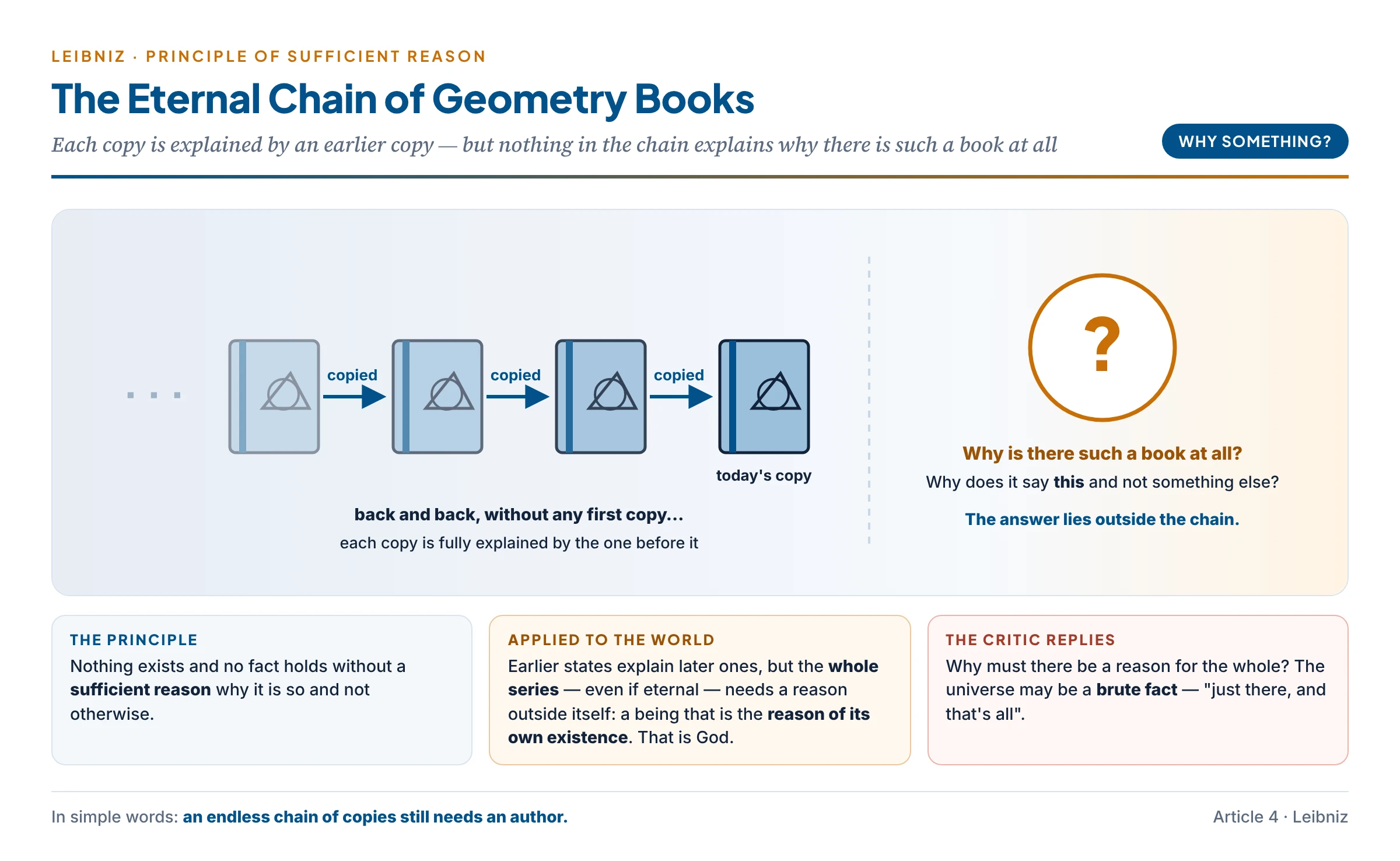
- The geometry books. Leibniz’s famous illustration: suppose a book of geometry had always existed, each copy copied from an earlier one, for ever. We could explain each copy by the one before it — but we would never explain why there is such a book at all, or why it says what it says. Going back through the copies does not help; the reason lies outside the series.
- God and the best world. For Leibniz, God, finding infinitely many possible worlds in his understanding, chose the best one; so the PSR leads both to God’s existence and to his wisdom and goodness.
- “God is the first reason of things.” This phrase sums up the Leibnizian view: God is not just the first cause in time, but the ultimate reason why anything is and why it is thus.
In simple words
A photocopied notice is pinned on a wall. It was copied from another copy, which was copied from another… Even if the copying went back for ever, you would still ask: who wrote the notice? The words on the paper need an author, not just an earlier copy. Leibniz says the world is like that notice: earlier states explain later states, but only something outside the whole chain explains why the chain exists.
2. Samuel Clarke: Dependent and Self-Existent Being
- The setting. In his Boyle Lectures, A Demonstration of the Being and Attributes of God (1705), the English philosopher Samuel Clarke, a follower of Newton, gave the most rigorous version of the contingency argument in English.
- The argument.
- Something has existed from eternity — for if ever nothing existed, nothing could ever have come to be.
- Either there has always existed some independent, unchangeable being, or there has been an infinite succession of changeable, dependent beings, one produced by another without any original cause.
- An infinite succession of dependent beings, taken as a whole, has nothing outside it to cause it, and nothing inside it that exists by itself. So it has no reason at all for its existence — which is absurd.
- Therefore there has always existed an independent, self-existent being — the cause of all dependent beings.
- Dependent being. A being whose existence comes from another — which depends for its existence on causes outside itself, and which could be conceived not to exist without contradiction. Every tree, person, planet and star is dependent.
- Self-existent being. A being whose existence is from itself — which has the reason of its existence in its own nature, depends on nothing, and cannot be supposed not to exist. Clarke calls this “necessarily existing“.
- The difference in short. The dependent being receives existence; the self-existent being has it of itself. The dependent being explains nothing ultimately; the self-existent being is the final explanation.
- Why the self-existent being is “theocentric”. Clarke goes on to argue that the self-existent being must be eternal, infinite, omnipresent, one — and also intelligent and free:
- The world contains intelligence (in us); a cause cannot give what it does not have; so the first cause is intelligent.
- The world is varied and could have been otherwise; a being acting by blind necessity would produce only one uniform effect; so the first cause acts by free choice.
- An intelligent, free, infinite, self-existent being is a personal God — the centre (theos) of all being. So the argument is theocentric: it does not stop at an impersonal “first something” but points to God.
- Can nature itself be the self-existent being? This is the crucial question.
- Yes, say the naturalists. Hume asked: “Why may not the material universe be the necessarily existent being?” Spinoza’s “God or Nature” makes nature the one self-existent substance; materialists and the Cārvāka hold that matter exists and acts by its own nature (svabhāva); Sāṃkhya takes prakṛti, uncaused and eternal, as the source of the world; Russell said the universe is simply a brute fact.
- No, says Clarke. Matter cannot be self-existent: we can easily conceive it not to exist, or to be otherwise; it is divisible and made of parts; its forms and motions are changeable and not essential to it; and the order and intelligence in the world cannot come from blind matter.
- Evaluation. If “nature” means the sum of changing, dependent things, it seems as dependent as its parts; if it means a single, eternal, self-existent ground of all change, the naturalist and the theist differ mainly over whether that ground is personal and intelligent.
3. The Kalām Cosmological Argument
- Origin. “Kalām” is the name of medieval Islamic dialectical theology. al-Kindī and al-Ghazālī argued that the world began in time; al-Ghazālī put it simply: “every being which begins has a cause for its beginning”. In 1979 William Lane Craig revived the argument.
- The argument.
- Whatever begins to exist has a cause.
- The universe began to exist.
- Therefore the universe has a cause.
- Why the universe began — the philosophical case.
- An actual infinite cannot exist. Imagine a library with infinitely many books: if you remove every second book you still have as many books as before — which seems absurd. So an infinite number of past events is impossible.
- An infinite series cannot be completed by adding one member after another. If the past were infinite, we could never have arrived at today — like counting down from infinity and reaching zero.
- Why the universe began — the scientific case.
- Big Bang cosmology suggests that the universe, including space and time, had a beginning about 13.8 billion years ago.
- The second law of thermodynamics: the universe is running down (energy spreads out). If it had existed for ever, it would already have reached a state of uniform “heat death”; it has not, so it has not existed for ever.
- From a cause to a personal Creator. The cause of the whole of space and time must be timeless, spaceless, immaterial and enormously powerful. And since a timeless cause produced an effect with a beginning, the cause must have chosen to create — so it is personal, possessing will.
- What is distinctive. Unlike Aquinas and Leibniz, the Kalām argument depends on the universe having a beginning in time. It accepts a first cause not merely to avoid an infinite regress, but because an infinite past is held to be impossible.
- Objections.
- Quantum events. Some physicists hold that events at the quantum level, and perhaps the universe itself, can arise without a cause (for example from a quantum “vacuum”).
- “Begins to exist” is ambiguous. Things within the universe begin from pre-existing material; the universe as a whole would begin from nothing — a very different case, so the first premise may not apply to it.
- No “before”. If time began with the universe, there was no time before it in which a cause could act.
- Not settled science. Some cosmological models do not treat the Big Bang as an absolute beginning.
- Who caused God? If everything that begins has a cause, critics ask why God is exempt; Craig replies that God did not begin.
- The leap to a person. Even a cause of the universe need not be the personal, loving God of religion.
In simple words
Imagine you are told that a man has been counting down — “…five, four, three, two, one, zero!” — and has just reached zero, but that he never started: he has been counting from minus infinity for ever. It sounds impossible: an endless count can never be finished. The Kalām argument says the past is like that count — if it had no beginning, we could never have arrived at today.
Common confusion
Does Clarke’s argument avoid the Principle of Sufficient Reason? No. Some notes say Clarke’s “necessary being” argument is “similar to Leibniz but avoids reliance on the Principle of Sufficient Reason”. In fact Clarke rests on a version of that principle: “whatever exists has a cause, reason or ground of its existence”, and his rejection of an unexplained infinite succession depends on it. The difference from Leibniz lies in emphasis — Clarke stresses the contrast between dependent and self-existent being and draws out God’s attributes — not in dropping the principle.
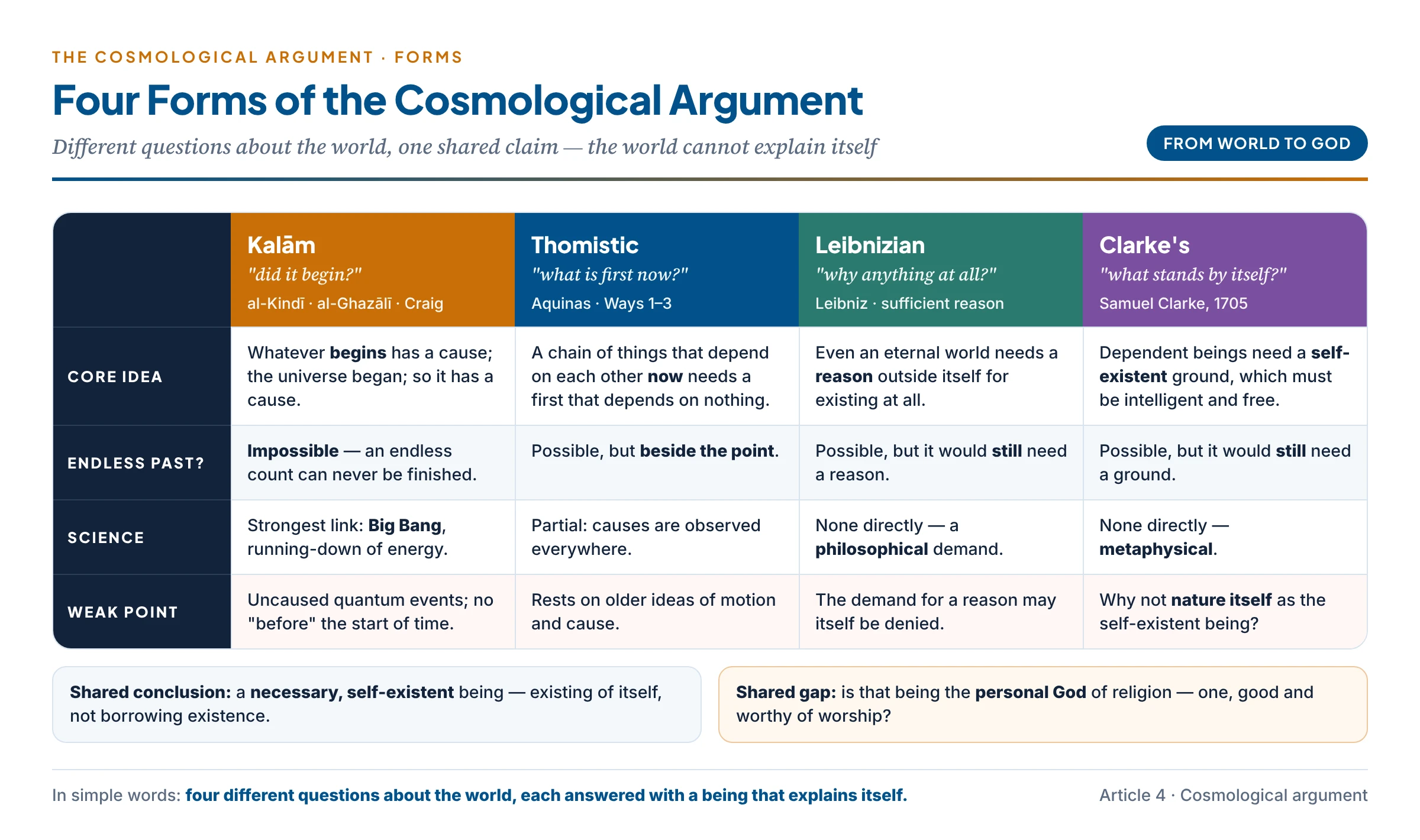
The Four Forms Compared
| Point | Kalām | Thomistic | Leibnizian | Clarke’s |
|---|---|---|---|---|
| Key question | Did the universe begin? | What is the first cause acting now? | What is the sufficient reason of the whole? | What self-existent being grounds dependent ones? |
| Kind of cause | Cause in time | Cause in a hierarchy of dependence | Reason outside the series | Ground of dependent beings |
| Infinite past? | Impossible | Possible, but irrelevant | Possible, but still needs a reason | Possible, but still needs a ground |
| Support from science | Big Bang, thermodynamics | Partly (causation observed) | Philosophical, not empirical | Metaphysical, not empirical |
| Weak point | Quantum events; “beginning” of time | Rests on Aristotelian ideas | The PSR itself may be denied | Why not nature as self-existent? |
- Common core. All four say the world cannot explain itself and need a being that does.
- Complementary, not rival. The Kalām appeals to science; the Thomistic to the order of dependence; the Leibnizian to the demand for explanation; Clarke’s to the contrast of dependent and independent being and to God’s attributes. Modern defenders often prefer the Kalām for its link with cosmology and the Leibnizian for its depth.
“Necessary Being” Understood Rightly
- A factual, not logical, necessity. In the cosmological argument “necessary” does not mean “true by definition” (as “a triangle has three sides”). It means a being that exists of itself and cannot fail to exist — a metaphysical or ontological necessity.
- The priority of being. Aquinas held that existence is prior to essence or idea: we do not say God exists because we have the idea of him; we have the idea of him because he exists.
- Existential understanding. Some defenders add that “necessary being” should be understood existentially or convictionally — as the ground on which the believer’s whole life rests — rather than in the empirical language of science.
Critical Evaluation
1. Hume: Composition, Regress and Matter
- The setting. In Hume’s Dialogues Concerning Natural Religion (published 1779), the character Demea presents an a priori cosmological argument, and the sceptic Philo (with Cleanthes) attacks it.
- (a) The fallacy of composition. Each member of a chain may have a cause, but that does not mean the whole chain has a cause apart from its members.
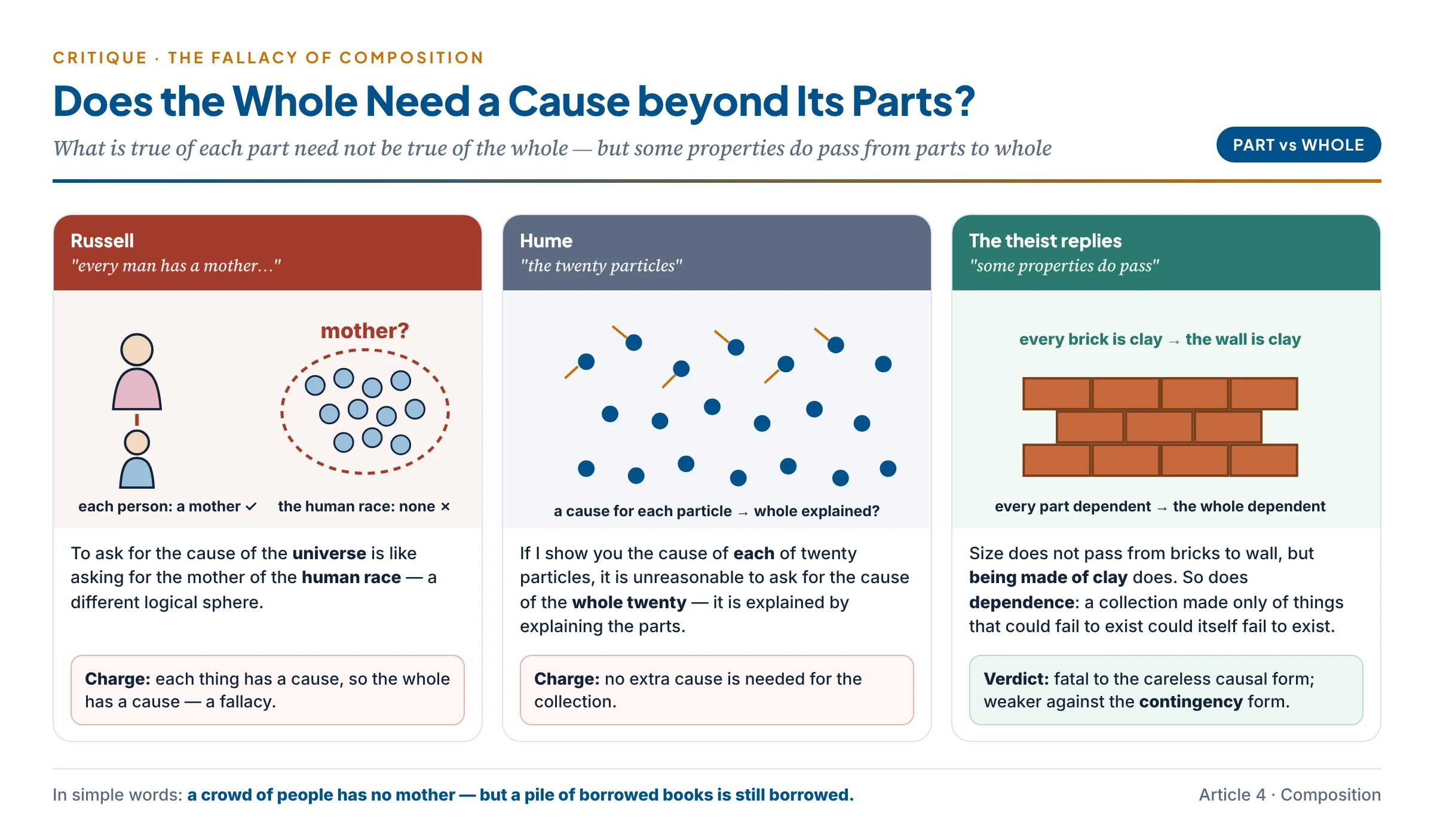
“Did I show you the particular causes of each individual in a collection of twenty particles of matter, I should think it very unreasonable, should you afterwards ask me, what was the cause of the whole twenty. This is sufficiently explained in explaining the cause of the parts.” — David Hume, Dialogues Concerning Natural Religion
- (b) An infinite regress is not impossible. In an eternal succession, each member is explained by the one before. Why, then, demand a cause for the series as a whole?
- (c) Why not matter? If we must have a necessarily existing being, “why may not the material universe be the necessarily existent being?” We do not know matter’s inner nature well enough to say it could not be necessary.
- (d) No necessary existence. “Whatever we conceive as existent, we can also conceive as non-existent.” There is no being whose non-existence implies a contradiction; so the very idea of a necessary being is empty.
- (e) Causation known only by experience. We learn about causes only from repeated experience of one thing following another; we have no experience of universes being made, and causal necessity itself is only a habit of the mind.
2. Kant: The Cosmological Argument Depends on the Ontological
- (a) Causality only for experience. Causality is a category of the human understanding. It is valid only within possible experience — the world of phenomena in space and time. Using it to reach a cause beyond experience is an illegitimate leap (a “transcendental illusion”). The world as a whole is not a perceptible phenomenon.
- (b) No proof that an infinite series is impossible. Within experience we can never show that a series of causes must stop; reason here falls into its “antinomies”, proving with equal force that the world has and has not a beginning.
- (c) A false satisfaction. Reason, tired of searching for conditions, comforts itself by imagining an unconditioned being, and mistakes this comfort for knowledge.
- (d) It collapses into the ontological argument. The argument concludes to a necessary being, and then identifies it with the most perfect being (God). But to say that the most perfect being is necessary is to say that its existence follows from its concept — which is the ontological argument, already refuted. So the cosmological argument is the ontological argument in disguise; it adds only an empirical starting point that is soon abandoned (see Article 2).
- Our knowledge is limited. Kant concludes that human knowledge is limited to the phenomenal world of space and time; we cannot speculate about what lies beyond. God remains possible — and becomes a postulate of moral reason (Article 6) — but cannot be proved by speculative reason.
3. Mill and Russell: “Who Made God?”
- The objection. If everything must have a cause, then God must have a cause too. If something can exist without a cause, it may just as well be the world as God. Either way, the argument fails.
- Mill. John Stuart Mill recalled that his father taught him that the question “Who made me?” cannot be answered, since it immediately suggests “Who made God?“. Mill held that the permanent element in nature — matter and force — could itself be the uncaused cause; only changes need causes.
- Russell. In Why I Am Not a Christian (1927), Bertrand Russell repeated Mill’s point: “If everything must have a cause, then God must have a cause.” He saw no reason to accept God merely to escape an infinite regress — in mathematics, infinite series without a first member cause no trouble.
4. The Russell–Copleston Debate (1948)
- The occasion. In a famous BBC radio debate in 1948, the Jesuit historian of philosophy F. C. Copleston defended the argument from contingency against Russell.
- Copleston’s case. The world is a totality of contingent objects, none of which contains the reason for its existence; so there must be a being outside the world which contains its own reason for existing — a necessary being.
- Russell’s replies.
- The brute fact. “I should say that the universe is just there, and that’s all.” Not everything needs an explanation; the universe may simply exist.
- The mother of the human race. “Every man who exists has a mother, and it seems to me your argument is that therefore the human race must have a mother, but obviously the human race hasn’t a mother — that’s a different logical sphere.” Asking for the cause of the universe is a category mistake.
- “Necessary” applies only to propositions. The word “necessary” can be applied meaningfully only to analytic propositions — those true by definition — not to things. So “necessary being” is meaningless.
- Copleston’s rejoinder. Russell refused even to ask the question. Copleston had already described this move in his account of Aquinas: whoever declines the path to a transcendent being must deny that the problem is real and say that things “just are” — “and if one refuses even to sit down at the chess board and make a move, one cannot, of course, be checkmated.”
5. The Fallacy of Composition Examined
- The charge. What is true of each part need not be true of the whole. Every brick in a wall may be small; the wall is not small. Every human has a mother; humanity has none. So even if each thing in the world has a cause, the world as a whole need not.
- A. J. Ayer. It is consistent to talk about the cause of a worldly object, but inconsistent to look for the cause of the whole universe — we can speak of the cause of a human being, not of humanity.
- The theist’s reply. Some properties do pass from parts to whole. If every brick in a wall is made of clay, the wall is made of clay; if every piece of a puzzle is contingent, the whole puzzle could also have failed to exist. Contingency — dependence — seems to be such a property: a collection of dependent things, however large, is itself dependent (Leibniz’s geometry books).
- Assessment. The objection defeats the careless form of the argument (“each thing has a cause, so the whole has one cause”); it is less decisive against the contingency form, which argues that a whole made only of dependent things is itself dependent.
6. Other Objections
- Causality is a procedure of science. “Every event must have a cause” is only a procedural assumption of science. In itself it is neither true nor false — only useful or useless — and was designed to explain particular events in the world; it cannot be universally accepted as a truth about everything.
- The world is not an event. An event is something whose coming into being and passing away could be recorded. The world is the sum of all actual and possible events, not itself one more event; so the causal postulate does not apply to the universe as a whole.
- Contingency does not imply its opposite. From the fact that something is contingent it does not follow that its opposite — something permanent or necessary — exists.
- The supersensible is beyond us. The principle of causality has meaning only in the world of sense; applied to a supersensible “first cause” it becomes empty (Kant, Russell).
- The logical positivists. Since all statements about existence are contingent and only analytic statements are necessary, “necessary existence” is a self-contradiction; to say a fact or being is necessary is to misuse language.
- Who created God? If every effect needs a cause, God needs one too; if God is uncaused, the causal principle on which the argument rests has been abandoned.
- Science. Quantum events seem to occur without determining causes; the Big Bang and the laws of thermodynamics may describe the origin of the universe in a mechanical way. Stephen Hawking and Leonard Mlodinow claimed in The Grand Design (2010) that “because there is a law such as gravity, the universe can and will create itself from nothing”. Sāṃkhya, too, explains the cosmos without a first cause in the form of God.
- A “God of the gaps”. God is used to fill a gap in our explanation; as science advances, the gap may shrink.
- A first cause is not the God of religion. Even if there is a first cause or necessary being, nothing shows it is one, personal, good or worthy of worship.
Does the Causal Argument Assume What It Tries to Prove?
- The charge of circularity. Every argument must take its premises as true. The causal argument assumes “every event has a cause” and “a causal series cannot go on for ever“, and concludes that there is a cause without a cause. Either the conclusion contradicts the first premise, or the rejection of the regress already assumes a first cause — which is what was to be proved.
- The defender’s reply.
- The premise is not “everything has a cause” but “whatever comes to be (or is dependent) has a cause”; a self-existent being does not come to be, so there is no contradiction.
- The premises (the PSR, the impossibility of an unexplained dependent series) are accepted on independent grounds — we use them in all our explaining — not because we already believe in God.
- The critic’s rejoinder. Those premises are no more certain than the conclusion; someone who doubts God will equally doubt that the whole universe needs a reason. So the argument persuades only those who already accept its starting principles.
- Balanced view. Every deductive argument, if valid, contains its conclusion implicitly in its premises; that alone does not make it circular. The real question is whether the premises are known independently — and here the cosmological argument is strongest when it rests on the contingency of things and weakest when it simply forbids a regress.
Two Main Objections — and Can Theists Answer Them?
| Objection | Theist’s answer | Is it satisfactory? |
|---|---|---|
| 1. Who caused God? / Why stop the regress? (Mill, Russell) | Only what begins or depends needs a cause; God is self-existent. The regress rejected is one of present dependence, not of time. | Partly — it removes the contradiction, but critics ask why the universe could not be the self-existent thing. |
| 2. The whole need not have a cause — brute fact, composition (Hume, Russell) | The PSR demands a reason for everything; a whole made only of dependent parts is itself dependent. | Partly — it depends on accepting the PSR, which critics reject as an unproven demand of reason. |
- The underlying issue. Both objections come down to one choice: is the existence of the universe explicable, or a brute fact? The theist bets on intelligibility; the critic does not. Reason alone does not seem able to force the choice.
Is the Argument from Contingency More Than a Logical Exercise?
- Critics (Hume, Kant, Russell, Ayer): it plays with the word “necessary”, which properly applies only to propositions; it is a logical exercise that tells us nothing about reality.
- Defenders: it begins from the most basic fact — that something exists — and asks the deepest question of metaphysics, why there is anything at all; “necessary being” names a real (metaphysical) necessity, not a verbal one.
- A middle view. The argument cannot compel belief, but it shows that the existence of a contingent world raises a real question, to which theism is one rational answer (Article 3 discusses Aquinas’ version).
“God Is the First Reason of Things”
- The claim. God is not just the first event in a chain, but the ultimate reason why there is any chain at all and why it is as it is — Leibniz’s “sufficient reason” of the universe; Spinoza’s cause of itself (causa sui); the Vedānta’s “that from which the world arises, by which it lives and into which it returns”.
- Strengths. It meets the human demand for complete intelligibility; it avoids a mere first moment in time; it unites cause and reason, existence and explanation.
- Criticisms. A “reason” is a logical relation between propositions, a “cause” a real relation between events — to call God the “reason” of things confuses the two (Hume, Kant); the PSR itself may be false (quantum chance; brute facts); and a reason of the world need not be a personal God (Spinoza’s God is Nature).
Critics and Defenders
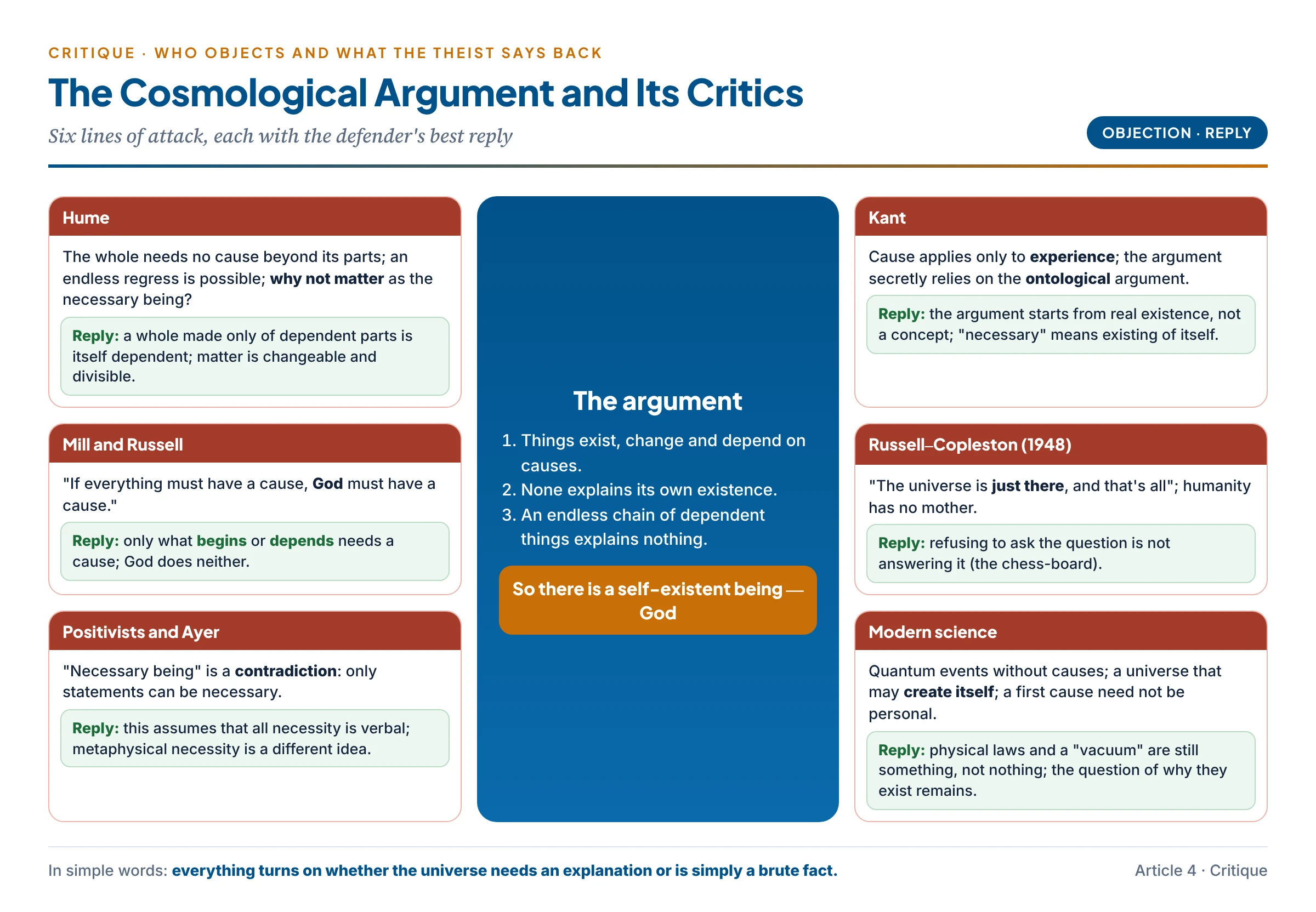
Criticism — Critics
- Hume: the whole needs no cause beyond its parts; an infinite regress is possible; matter may be the necessary being.
- Kant: causality applies only to phenomena; the argument smuggles in the ontological argument.
- Mill and Russell: “who made God?”; the universe is “just there”; humanity has no mother.
- Positivists and Ayer: “necessary being” is a contradiction; the cause of the whole is meaningless.
- Science: quantum chance, a self-creating universe, a first cause that is not a personal God.
Defence — Defenders and strengths
- Leibniz: the PSR — even an eternal world needs a reason outside itself.
- Clarke: dependent beings, however many, need a self-existent ground that is intelligent and free.
- Kalām: an actual infinite past is impossible; the Big Bang suggests a beginning.
- Copleston: contingency is passed from parts to whole; refusing the question is not answering it.
- Aquinas: “necessary” is metaphysical, not logical; God does not come to be, so needs no cause.
Cross-Tradition Comparison: The Indian Cosmological Argument
Nyāya: The World as an Effect
- Kāryāt. The earth, mountains and plants are effects, because they are made of parts and have limited size; every effect has an intelligent maker with knowledge, desire and effort, as a pot has a potter; so the world has an all-knowing maker — Īśvara.
- Dhṛtyādeḥ. The world is upheld and in time dissolved by God’s will — a parallel to Aquinas’ sustaining cause and Clarke’s dependence of the world on God.
- Āyojanāt. Inert atoms need an intelligent being to give them their first motion — parallel to the Unmoved Mover.
- Only an efficient cause. For Nyāya, God is the efficient (instrumental) cause; the eternal atoms are the material cause. God orders the world but does not create matter. (Full treatment in Article 7.)
Vedānta: Brahman as the Source of the World
- Brahman as cause. The Brahmasūtra defines Brahman as “that from which the origin, sustenance and dissolution of this world proceed” — a cosmological idea.
- But known by scripture, not inference. Śaṅkara and Rāmānuja insist that this Brahman is known from śruti (the Upaniṣads), not proved by inference; the inferential cosmological argument, they hold, could at most show some maker or makers (Article 8).
- Advaita (Śaṅkara). Brahman is both the material and the efficient cause of the world, as a spider spins its web out of itself. But the world is an appearance (vivarta) of Brahman through māyā, not a real transformation.
- Viśiṣṭādvaita (Rāmānuja). Brahman is both material and efficient cause; the world is Brahman’s body, a real transformation of its subtle form.
- Dvaita (Madhva). The world is real and wholly dependent on God (Viṣṇu), the one independent reality. But God is only the efficient cause; the material cause is prakṛti. Madhva argues that composite things depend on their parts, and the chain of dependence must end in one independent, intelligent reality (Article 8).
Common confusion
Is God both the material and the efficient cause of the world in all Indian systems? No. Many notes say that “in Nyāya and Vedānta God is both the material and the efficient cause, while Western arguments treat God as efficient cause only”. This holds for Advaita and Viśiṣṭādvaita, where Brahman is the material and efficient cause. For Nyāya–Vaiśeṣika, God is only the efficient cause — the eternal atoms are the material cause. For Madhva’s Dvaita, too, Viṣṇu is only the efficient cause and prakṛti is the material cause. And Christian theism, holding creation out of nothing, does not treat God as a mere shaper of material either.
Western and Indian Cosmological Arguments Compared
| Point | Western (Aquinas, Leibniz, Clarke, Kalām) | Indian (Nyāya, Vedānta) |
|---|---|---|
| Starting point | Motion, causation, contingency, beginning | The world as an effect with parts; its origin, sustenance and dissolution |
| Method | Natural theology — reason from the world | Nyāya: inference; Vedānta: scripture, with reason in support |
| What God is to the world | Creator out of nothing; ground of existence | Nyāya and Madhva: efficient cause only; Advaita and Rāmānuja: material and efficient cause |
| Infinite regress | Rejected (in present dependence or, for Kalām, in time) | Cycles of creation and dissolution are beginningless; regress of worlds is accepted, but each world needs a maker |
| Nature of God | Personal, transcendent | Personal Īśvara (Nyāya, Rāmānuja, Madhva); impersonal Brahman appearing as Īśvara (Advaita) |
| Main critics | Hume, Kant, Mill, Russell | Cārvāka, Buddhists, Jainas, Mīmāṃsā, Sāṃkhya |
Indian Critics of the Cosmological Argument
- Buddhists. Everything arises by dependent origination (pratītyasamutpāda); there is no uncaused first cause. A permanent God could not produce successive effects — he would produce everything at once or nothing at all.
- Jainas. The universe is beginningless; if everything needs a maker, so does God; if God needs none, neither does the world.
- Sāṃkhya. Prakṛti, the uncaused primal nature, is self-existent and evolves by itself — Hume’s “why not matter?” in Indian form.
- Cārvāka. Things act by their own nature (svabhāva): fire is hot and water cold by nature, not by a maker’s design.
- Mīmāṃsā. The world was never created; it has always been as it is.
- These critiques are set out fully in Article 9.
Indian Connect — Key takeaways
- India’s kāryāt argument is a true cosmological argument, but its God is an architect of eternal atoms, not a creator out of nothing.
- Vedānta affirms Brahman as the source of the world but, like Kant, denies that inference can prove it; scripture is the decisive source.
- Madhva’s argument from the dependence of composites on their parts is the closest Indian parallel to Clarke’s dependent and self-existent being.
- Sāṃkhya’s prakṛti gives Hume’s question — “why may not nature itself be self-existent?” — its strongest Indian form.
Synthesis (Siddhānta)
- What the argument shows. In all its forms, the cosmological argument says that the world — changing, caused, contingent and perhaps beginning in time — cannot explain itself, and that the final explanation must lie in a being that exists of itself. Its best versions (Leibniz, Clarke, the contingency form) do not depend on the universe having a beginning; the Kalām version stakes everything on it.
- What the critique shows. Hume, Kant, Mill and Russell reveal its weak points: the step from parts to whole, the refusal of a regress, the meaning of “necessary being”, the dependence on the ontological argument, and the leap from a first cause to the personal God of religion. Science adds that causation itself may not be universal.
- Where the debate rests. The decisive question is whether the existence of the universe has an explanation at all, or is simply a brute fact. The theist, with Leibniz, holds that reason demands an explanation; the critic, with Russell, that it does not. Neither side can strictly prove its starting point — so the argument does not compel assent, but it gives belief in God a serious rational basis and shows what one must deny in order to reject it.
- The Indian view. The Nyāya argues to an intelligent maker; the Vedānta schools accept a cosmic source but rest their knowledge of it on scripture; the Buddhists, Jainas and Sāṃkhyas reply, like Hume, that the world may need no maker beyond its own nature.
- Contemporary relevance.
- Cosmology — the Big Bang, the age of the universe and theories of a self-creating universe keep the Kalām argument alive.
- Philosophy — the Principle of Sufficient Reason and the question “why is there something rather than nothing?” remain central in metaphysics.
- Dialogue — the argument offers common ground for Christian, Islamic and Indian rational theology (Article 10).
“I should say that the universe is just there, and that’s all.” — Bertrand Russell
Previous Year Questions
- 2017Compare and contrast the different forms of cosmological arguments for the existence of God.
- 2015Examine the ontological and cosmological arguments in favour of existence of God.
- 2013State and elucidate cosmological argument for the existence of God in Western and Indian Philosophy.
- 2013Discuss two main objections against this (cosmological argument) argument. Are theists able to answer these satisfactorily?
- 2010Is contingent argument for the existence of God anything more than a logical exercise? Discuss.
- 2010If each and every argument has to take that its premises are true, would the causal argument for the existence of God as the first cause be different from assuming that it is true? Argue in favour of your position.
- 2009Critically examine the causal argument as a proof for the existence of God.
- 2007State and evaluate the cosmological argument for the existence of God. What are its two forms? What is the difference between a dependent being and self existent being? Why the self-existent being be Theocentric? Can’t the nature itself be conceived as self-existent being? Discuss.
- 2005“God is the first reason of things.” Critical notes.