

Gender Discrimination: Female Foeticide, Land and Property Rights; Empowerment.
Official Syllabus: Paper II, Section A, Unit 9
The classical schools of feminism (Article 3) spoke as if “woman” were one category with one experience. From the 1970s onward that assumption was challenged from several sides. Eco-feminists linked the domination of women with the domination of nature. Black, Third World and Dalit feminists showed that gender never works alone — it intersects with race, caste and class, so that a poor Dalit woman faces an oppression different in kind from that of an upper-caste urban woman. Care ethicists argued that moral philosophy itself had a male bias, privileging abstract justice over concrete care. And feminist critics of John Rawls asked whether justice can stop at the door of the family. This article explains these later currents and then turns to Indian voices on women — Jyotiba and Savitribai Phule, Tarabai Shinde, Pandita Ramabai, Gandhi (who called the female sex “the nobler of the two”) and Ambedkar (who measured a community’s progress by the progress of its women).
In simple words
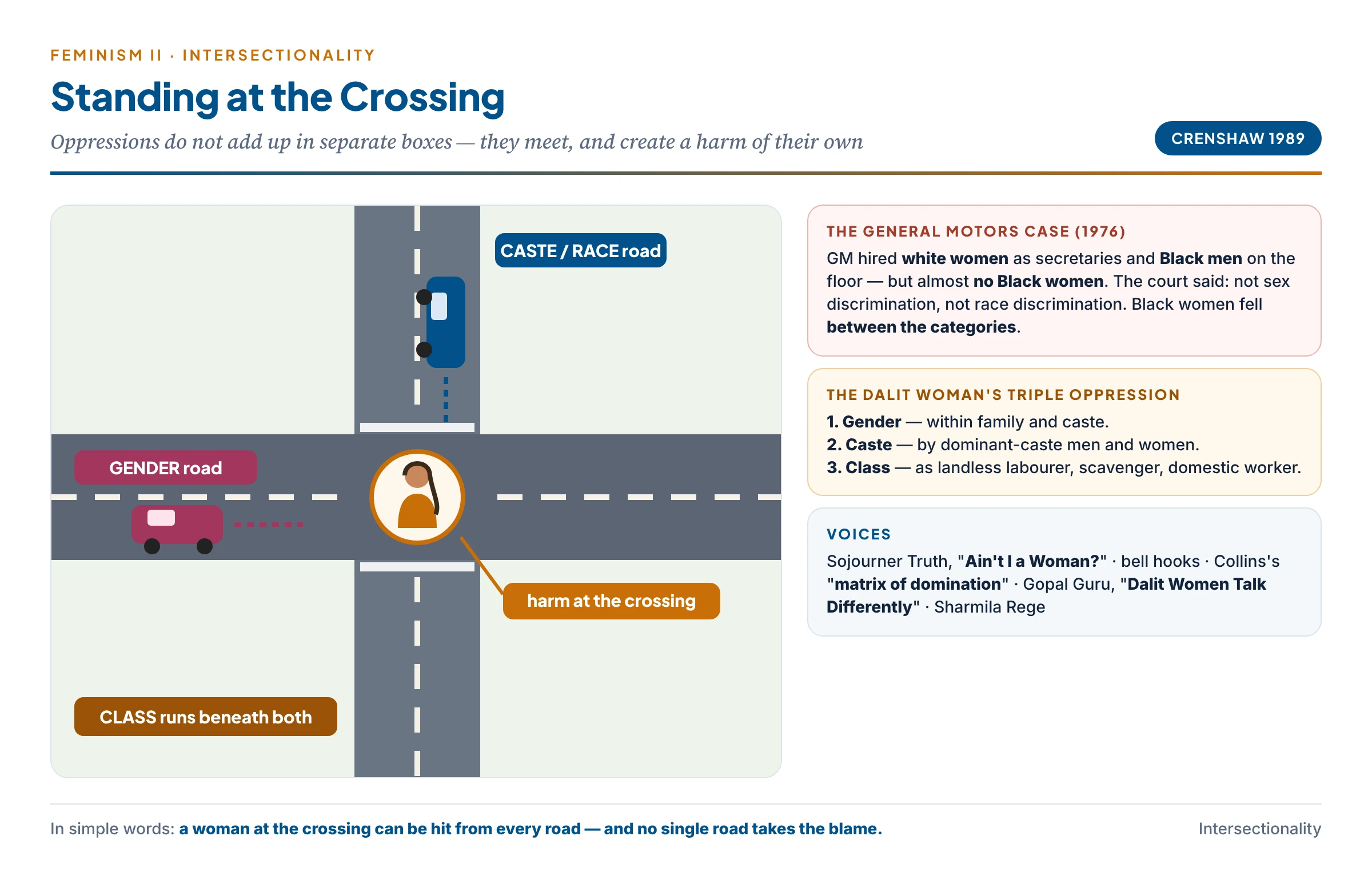
Picture a road crossing. A car coming down one road can hit you; so can a car coming down the other. If you stand exactly at the crossing, cars from both directions can hit you — and an accident there cannot be blamed on one road alone. Kimberlé Crenshaw used this picture: a Dalit woman, or a Black woman, stands at the crossing of gender and caste (or race). Her injury is not “gender plus caste” added up; it is a new kind of harm that happens only at the crossing.
Context & Problem
Why the Classical Schools Were Not Enough
- Whose experience? Liberal and radical feminism were largely shaped by white, educated, middle-class women in the West. Their demands — the right to a career, escape from the suburban home — meant little to women who had always worked in fields, factories or other people’s homes.
- Which oppression comes first? Marxists said class; radicals said patriarchy. Women who faced caste or racial oppression found that neither placed their experience at the centre.
- Is justice only public? Mainstream political philosophy, including Rawls, focused on the public institutions of society and left the family largely outside justice.
- Is morality male? Moral theory from Kant to Kohlberg valued impartial rules and rights and treated feelings and relationships as secondary — exactly the qualities associated with women.
Core Doctrine
1. Eco-feminism
- Meaning: eco-feminism holds that the domination of women and the domination of nature are connected — both come from the same patriarchal, hierarchical way of thinking. The term was coined by the French writer Françoise d’Eaubonne (1974).
- Hierarchical dualisms: Western thought splits the world into pairs and ranks one side over the other:
- Culture over nature.
- Man over woman.
- Reason over emotion.
- Mind over body.
- Human over animal.
- Women are placed on the “nature–emotion–body” side, so the logic that justifies exploiting nature also justifies subordinating women.
- Carolyn Merchant (The Death of Nature, 1980): the Scientific Revolution replaced the old image of the earth as a living, nurturing mother with a picture of nature as a dead machine to be controlled — clearing the way for both environmental destruction and the control of women.
- Vandana Shiva (Staying Alive, 1988):
- Western “maldevelopment” — commercial forestry, monoculture, big dams, the Green Revolution — destroys both ecosystems and the livelihoods of rural women who depend on forests, water and seeds.
- She calls for the recovery of the “feminine principle” (Prakṛti, Śakti) — the creative, life-sustaining power of nature that Indian tradition honoured.
- With Maria Mies (Ecofeminism, 1993) she criticised the global capitalist economy for treating women’s work and nature’s work as free resources.
- Chipko (1973 onwards, Uttarakhand): women of villages such as Reni, led by Gaura Devi, hugged trees to stop commercial felling — the classic image of eco-feminism in action.
- Criticisms:
- Essentialism: linking women “naturally” to nature repeats the old stereotype that women are closer to the body and emotion.
- Romanticism: it idealises traditional village life and Indian tradition, which also contained patriarchy.
- Bina Agarwal’s “feminist environmentalism” (1992): women’s concern for forests and water comes not from any special nature but from their material position — they are the ones who collect fuel, fodder and water. The remedy is giving women rights and control over these resources.
In simple words
A timber contractor looks at a Himalayan forest and sees logs to sell. A woman of Reni looks at the same forest and sees fuel, fodder, water, medicine and her children’s future. Eco-feminism says the first way of looking — nature as a thing to exploit — is the same way of looking that treats women as resources for others. Feminist environmentalism adds: the woman sees the forest differently because she depends on it daily — so give her rights over it.
2. Intersectionality
- Kimberlé Crenshaw (“Demarginalizing the Intersection of Race and Sex”, 1989) coined the term.
- Her legal example: in a US case (1976), Black women sued General Motors for discrimination. The company had hired white women (as secretaries) and Black men (on the factory floor) but almost no Black women. The court refused to recognise a claim combining race and sex: it was not “sex discrimination” (women were hired) and not “race discrimination” (Black people were hired). Black women fell between the categories.
- Lesson: oppressions are not separate boxes to be added; they intersect, producing distinct experiences. Single-axis thinking (only gender, only race) makes those at the intersection invisible.
- Earlier roots: the formerly enslaved Sojourner Truth’s speech “Ain’t I a Woman?” (1851), the Combahee River Collective statement of Black feminists (1977), bell hooks (Ain’t I a Woman, 1981) — and Patricia Hill Collins, who spoke of a “matrix of domination“.
- Identity choice: intersectionality also explains a practical dilemma — a poor woman may find it hard to choose between joining the men of her own poor class in a socialist movement and the women of the rich class in a feminist movement. Her interests are split across both.
- Postcolonial feminism: Chandra Talpade Mohanty (“Under Western Eyes”, 1984) criticised Western feminists for picturing “the Third World woman” as a single, passive victim — ignoring her agency, struggles and differences.
3. Dalit Feminism: “Dalit Women Talk Differently”
- Gopal Guru (“Dalit Women Talk Differently”, 1995) argued that Dalit women need their own voice, because they face pressures from outside (the dominant castes) and from within (Dalit patriarchy).
- Sharmila Rege (“A Dalit Feminist Standpoint”, 1998) called for a standpoint that begins from Dalit women’s experience; she drew on Phule and Ambedkar.
- Triple oppression of the Dalit woman:
- Gender oppression within her family and caste.
- Caste oppression by dominant-caste men and women — including caste-based sexual violence.
- Class exploitation as landless agricultural labourers, manual scavengers and domestic workers.
- Why separate voices? Mainstream Indian feminism was long dominated by upper-caste, urban women who did not see their own caste privilege, while the Dalit movement was often led by men who sidelined gender issues. Dalit women fell between the two — exactly Crenshaw’s intersection.
- Relevance: violence against Dalit women (the Bhanwari Devi case of 1992, which led to the Vishaka guidelines on workplace harassment, is one well-known example), the Hathras case (2020), manual scavenging and landlessness show why gender policy must be caste-sensitive.
4. The Ethics of Care
- Carol Gilligan (In a Different Voice, 1982), a psychologist and student of Lawrence Kohlberg, challenged the male bias of moral psychology and philosophy.
- Kohlberg’s six stages of moral development rose from obedience and self-interest to conformity, then law and order, then social contract and, at the top (stage 6), universal ethical principles of justice and rights — Kantian, impartial reasoning.
- The puzzle: girls often scored lower (around stage 3, “good boy/good girl” — concern for relationships and approval), which suggested that women were morally less developed.
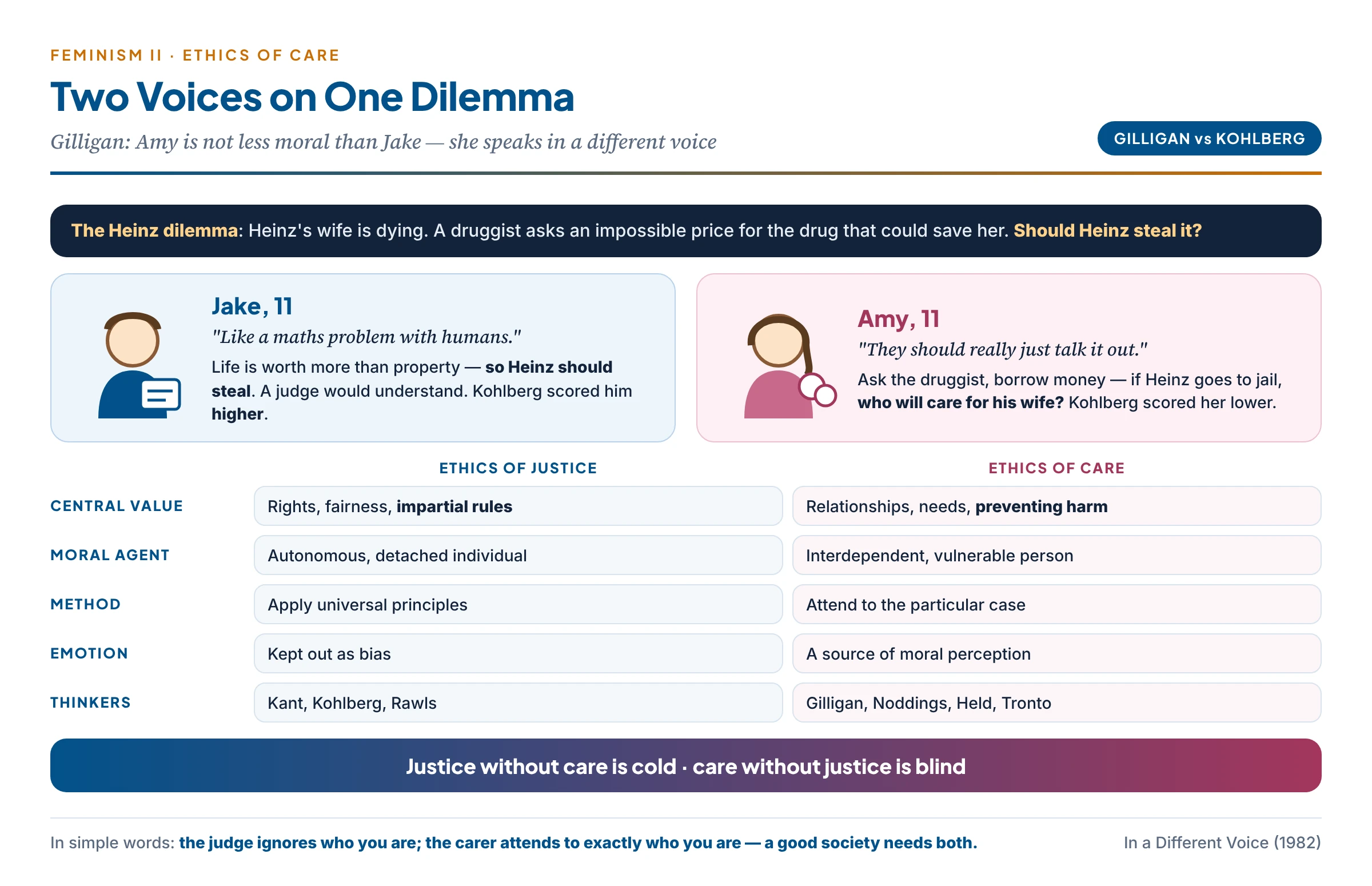
- The Heinz dilemma: a man’s wife is dying; a druggist charges an unaffordable price for a drug that could save her. Should Heinz steal it?
- Jake, an eleven-year-old boy, treats it like a mathematics problem: life is worth more than property, so Heinz should steal.
- Amy, an eleven-year-old girl, looks for a way to keep the relationships intact: Heinz should talk to the druggist, borrow money, find a way — if he steals and goes to jail, who will care for his wife?
- Kohlberg’s scale ranked Jake higher; Gilligan argued Amy was not less moral but differently moral.
- Gilligan’s conclusion: girls are not morally deficient; they speak “in a different voice” — a morality of responsibility and relationships rather than abstract rights. The different voice is defined by its theme, not by sex; both men and women can use it.
- Core tenets of care ethics (developed by Nel Noddings, Caring, 1984, and Virginia Held, The Ethics of Care, 2006):
- Moral particularity — moral decisions cannot be made by mechanically applying universal rules; they require attention to the concrete, unique needs of particular people in real relationships.
- Relational ontology — human beings are not isolated, self-sufficient contract-makers; we are born into vulnerability and dependence. Care is the basic moral reality.
- Emotion as moral — compassion, sympathy and love are legitimate moral faculties, not irrational intrusions to be suppressed.
- Noddings distinguishes the “one-caring” and the “cared-for“, and natural caring (a mother’s for her child) from ethical caring (care we choose to extend).
- Joan Tronto (Moral Boundaries, 1993) made care political, describing four phases — caring about (noticing a need), taking care of (accepting responsibility), care-giving (doing the work) and care-receiving (the response) — and asked who does the care work in society and why it is so poorly valued.
| Point | Ethics of justice (Kohlberg, Kant, Rawls) | Ethics of care (Gilligan, Noddings, Held) |
|---|---|---|
| Central value | Fairness, rights, impartial rules | Responsiveness, relationships, preventing harm |
| The moral agent | Autonomous, detached, rational individual | Embedded, interdependent person |
| Method | Apply universal principles to cases | Attend to the particular situation and needs |
| Role of emotion | Kept out — a source of bias | Central — a source of moral perception |
| Image | Blindfolded Lady Justice holding scales | Eyes wide open, attending to a suffering person |
| Danger | Cold, abstract, blind to dependence | Partial, parochial, may exploit the carer |
- Can care ground public justice?
- Problems: care thrives in close relationships; in public life (courts, taxation, appointments) it can slide into favouritism and nepotism. Marginalised groups — minorities, Dalits — need universal rights to protect them from local power.
- Possibilities: care enriches public policy — health, child-care, elder care, disability support, environmental protection — and reminds us that every citizen is vulnerable and dependent at some stage of life (Held, Tronto).
- Synthesis: justice and care are complements. Justice without care is cold; care without justice is blind and arbitrary.
- Is care ethics essentialist? Critics worry that praising a “female” ethic of care reinforces the stereotype that women are naturally carers, and so justifies leaving care work to them. Gilligan’s reply: the “different voice” is a theme found in both sexes; the aim is to value care and share it, not to confine women to it.
In simple words
A judge deciding a case and a mother nursing a sick child both act morally, but differently. The judge must ignore who the people are and apply the same rule to all — that is justice. The mother must attend to exactly this child, his fever, his fear — that is care. A good society needs judges who remember that people are fragile, and carers who remember that every child, not only their own, deserves fairness.
5. Okin: Justice Inside the Family
- Susan Moller Okin (Justice, Gender, and the Family, 1989) criticised Rawls and liberal political theory:
- Rawls’s parties in the original position were “heads of households“, which quietly kept the internal life of the family out of view.
- Yet the family is the first school of moral development — if children grow up in families built on domination, how will they learn justice?
- The unequal division of unpaid domestic work makes women economically vulnerable in marriage and after divorce.
- Remedy: put sex explicitly behind the veil of ignorance, and apply justice to the family — leading toward a “gender-free” society in which sex does not determine roles.
- Can issues of gender discrimination be met by justice as fairness?
- Yes, in principle: behind the veil, nobody knows their sex, so nobody would accept a society that discriminates; equal basic liberties, fair equality of opportunity and the difference principle all condemn discrimination.
- But not fully as Rawls framed it: by treating the family largely as private and the parties as household heads, Rawls under-theorised the source of women’s disadvantage.
- Rawls’s later reply: the family is part of the basic structure of society, so the principles of justice constrain it (for example, by protecting the equal rights of women as citizens), but they do not directly regulate its internal life.
- Conclusion: justice as fairness, extended in Okin’s way to the family and to unpaid care, can meet gender discrimination; without that extension it remains incomplete (see the critiques of Rawls in Unit 1).
- Amartya Sen adds that many injustices against women are subtle — hidden in family food shares, health care or perceived worth — and therefore harder to identify than the clear cases that ideal theories focus on.
- Okin also asked “Is Multiculturalism Bad for Women?” (1997): group rights for cultures may strengthen patriarchal practices within them — so feminists, cultural minorities and others must be accommodated without sacrificing women’s equality.
In simple words
A school may teach fairness every morning in the assembly, but if at home the daughter washes the dishes while the son studies, and the father alone decides everything, the child learns a different lesson. Okin’s point is that the family is the first school of justice — a society cannot be just if its homes teach domination.
6. Indian Voices on Women
Jyotiba and Savitribai Phule
- Opened one of the first schools for girls in Pune (1848); Savitribai became India’s first woman teacher of such a school and faced abuse and stones on her way.
- Started a home to prevent the killing of infants born to widows (1863) and campaigned for widow remarriage — an early fight against the destruction of unwanted lives.
- Saw caste and patriarchy as twin systems justified by Brahminical scriptures.
Tarabai Shinde — Stri Purush Tulana (“A Comparison of Women and Men”, 1882) turned the usual charges against women back on men, asking why men’s vices are never discussed — one of the first Indian feminist texts.
Pandita Ramabai — scholar and reformer; The High-Caste Hindu Woman (1887) exposed child marriage and the plight of widows; founded the Sharada Sadan (1889) to educate widows and make them independent.
Mahatma Gandhi
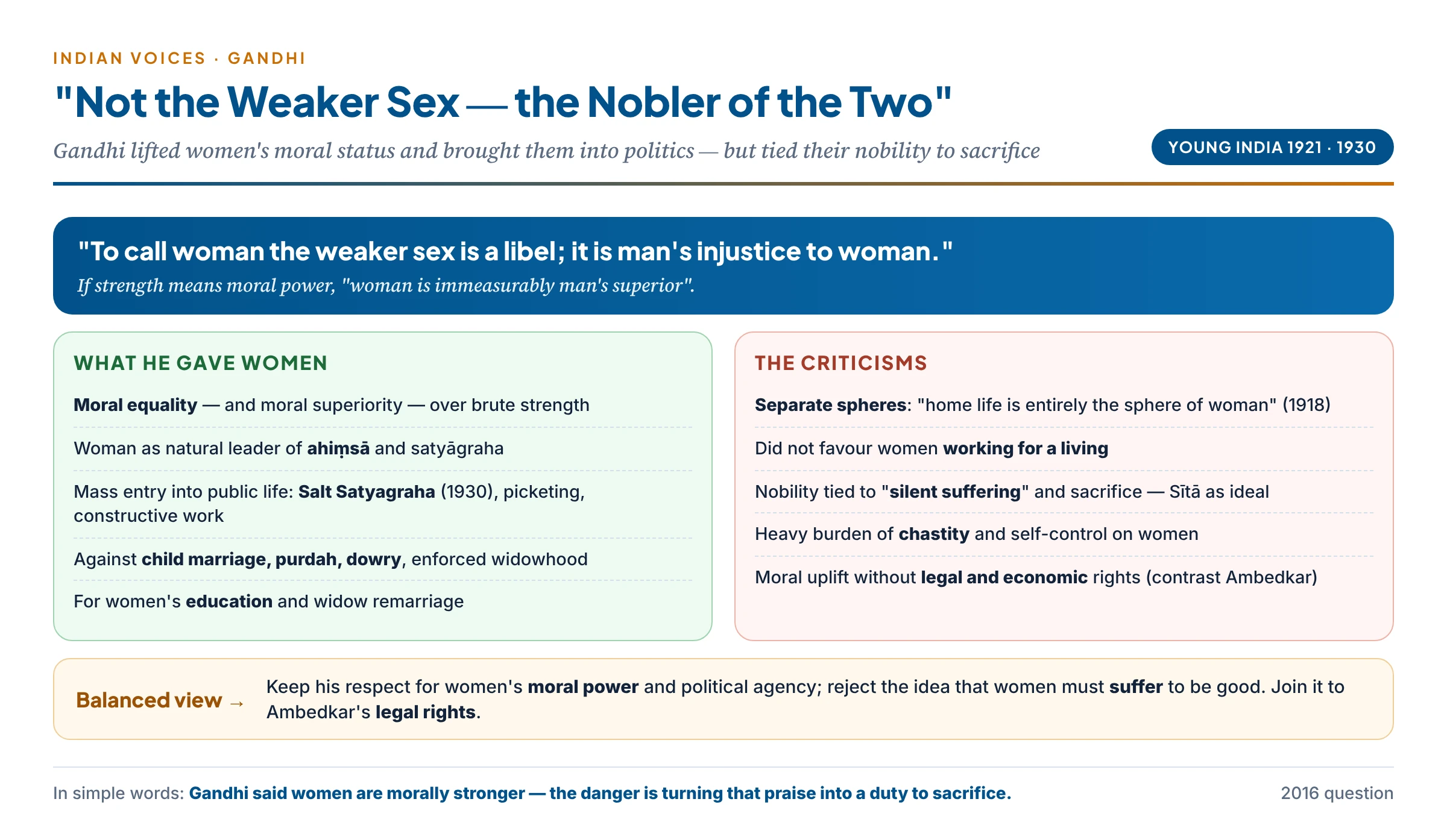
- Moral equality and superiority of women:
- “To call woman the weaker sex is a libel; it is man’s injustice to woman. If by strength is meant brute strength, then, indeed, is woman less brute than man. If by strength is meant moral power, then woman is immeasurably man’s superior.”
- Woman is “not the weaker sex. It is the nobler of the two, for it is even today the embodiment of sacrifice, silent suffering, humility, faith and knowledge.”
- Since non-violence (ahiṃsā) means infinite love and the capacity for self-suffering, woman is the natural leader of satyāgraha: “Who can make a more effective appeal to the heart than woman?”
- Practice: he drew women into the freedom movement in large numbers — the Salt Satyagraha (1930), picketing of liquor and foreign-cloth shops, constructive work; Sarojini Naidu led the Dharasana raid.
- Social reform: he opposed child marriage, purdah, dowry and enforced widowhood, supported widow remarriage and women’s education, and said a girl should be free to refuse a marriage arranged for money.
- Criticisms:
- Separate spheres: in a 1918 speech he said man is supreme in “outward activities” while “home life is entirely the sphere of woman“, and he did not favour women working for a living — a view of complementary but separate roles.
- Idealising sacrifice: praising women as embodiments of “silent suffering” and holding up Sītā and Damayantī as models may reinforce the very expectation of self-sacrifice that keeps women subordinate.
- Sexuality: his stress on chastity and self-control placed a heavy moral burden on women.
- Yet many feminists acknowledge that Gandhi brought ordinary women into public life on a scale never seen before and gave them confidence and dignity as political actors.
- Evaluation of “the nobler sex”: the statement rightly rejects the idea of female inferiority and values moral strength over brute force; but by tying nobility to sacrifice and suffering, it risks a new stereotype. A balanced view keeps Gandhi’s respect for women’s moral power while rejecting the idea that women must suffer to be good.
B.R. Ambedkar
- “I measure the progress of a community by the degree of progress which women have achieved” (Nagpur, 1942). At the same conference he urged every bride to “stand up to her husband, claim to be her husband’s friend and equal, and refuse to be his slave”.
- Critique of Manu: in The Rise and Fall of the Hindu Woman (1951) he argued that the Manusmṛti, not Buddhism, degraded women — Buddhism had admitted women to the order and to spiritual equality.
- Hindu Code Bill: as Law Minister he drafted a code giving Hindu women rights of inheritance, divorce, monogamy and adoption. When it was blocked in Parliament, he resigned from the Cabinet (September 1951), saying that “even this part of the Bill has been killed”. Its main parts were passed later as the Hindu Marriage Act (1955) and the Hindu Succession Act (1956) (Article 6).
- Constitution and labour law: equality before law and non-discrimination by sex (Articles 14, 15, 16); as Labour Member earlier he supported maternity benefit and equal pay for women workers.
- Caste and gender: he saw endogamy as the core mechanism of caste — and endogamy requires control over women’s marriage and sexuality (sati, enforced widowhood, child marriage). So the annihilation of caste and the liberation of women are linked.
Ram Manohar Lohia counted equality between men and women among his “seven revolutions” and preferred the bold, questioning Draupadī to the obedient Sāvitrī as a model for Indian women.
Indian Connect — Indian Connect — Ambedkar and Gandhi on women
- Gandhi honoured women’s moral power and brought them into the freedom struggle, but kept a picture of complementary spheres and self-sacrifice.
- Ambedkar demanded legal rights — inheritance, divorce, equality in marriage — and linked women’s subordination to caste endogamy; he resigned when the Hindu Code Bill was stalled.
- Together they show two paths to women’s dignity: moral transformation of the heart and legal transformation of rights. Modern Indian policy needs both.
Common confusion
Did Gandhi say women are “the weaker sex” in a gentle, protective sense? No — he said the opposite. He called the label “weaker sex” a libel and “man’s injustice to woman”, and described woman as “the nobler of the two” because of her moral strength. The common criticism of Gandhi is not that he called women weak, but that he tied their nobility to sacrifice and silent suffering and to the home as their main sphere.
Critical Evaluation
Assessing the Later Currents
- Eco-feminism widened feminism to ecology and development, but risked essentialism; feminist environmentalism grounds it better in rights over resources.
- Intersectionality is now central to law and policy (it explains why the Dalit or tribal woman needs specific measures), but critics say endless sub-identities can fragment collective action. Its defenders reply that solidarity is stronger when it includes the most marginalised.
- Care ethics corrected the male bias of moral theory and gave care work philosophical dignity, but must avoid romanticising women’s self-sacrifice and must be joined to justice.
- Okin’s extension of justice into the family is widely accepted in principle, though there is debate about how far the state should regulate private life.
- Indian voices show that the struggle against gender discrimination in India grew from Indian reformers and was inseparable from the struggle against caste.
Critics and Defenders
Criticism — Critics of the later currents
- Eco-feminism: essentialist — ties women to nature and repeats the old stereotype.
- Intersectionality: fragments the women’s movement into ever-smaller identities.
- Care ethics: praises a “female” virtue and so justifies leaving care to women; parochial in public life.
- Okin: state regulation of the family threatens privacy and liberty.
- Gandhi’s view: idealises suffering and keeps women in the home.
Defence — Defenders and strengths
- Feminist environmentalism: the woman–nature link is material — rights over forests, land and water.
- Intersectionality: makes the most marginalised visible — the Dalit woman’s triple oppression.
- Care ethics: dependence is universal; care must be valued and shared by all, and joined to justice.
- Okin and Rawls: the family is part of the basic structure; justice must reach the home.
- Gandhi and Ambedkar: moral dignity and legal rights together brought Indian women into public life.
Cross-Tradition Comparison
| Theme | Western thinkers | Indian thinkers and movements |
|---|---|---|
| Woman and nature | Merchant, Mies, d’Eaubonne | Vandana Shiva’s Prakṛti; Chipko; Bina Agarwal’s feminist environmentalism |
| Intersecting oppressions | Crenshaw, bell hooks, Collins | Phule, Ambedkar, Gopal Guru, Sharmila Rege — caste and gender |
| Care and relationships | Gilligan, Noddings, Held, Tronto | Gandhi’s ahiṃsā and self-suffering; sevā (service) traditions |
| Justice in the family | Okin, Rawls’s reply | Ambedkar’s Hindu Code Bill; the Hindu Succession (Amendment) Act 2005 |
Indian Connect — Indian Connect — the takeaway
- India’s own feminist tradition is intersectional from the start: Phule and Ambedkar saw caste and patriarchy as twin systems long before the word “intersectionality” existed.
- Ahiṃsā and sevā give Indian thought a ready language of care — but, as the critique of Gandhi shows, care must be chosen and shared, not imposed on women alone.
Synthesis (Siddhānta)
- Eco-feminism links the domination of women and of nature through hierarchical dualisms; its best form, feminist environmentalism, grounds the link in women’s material rights over resources.
- Intersectionality (Crenshaw) and Dalit feminism (Guru, Rege) show that gender intersects with caste, class and race; the Dalit woman’s triple oppression needs its own voice and policy.
- The ethics of care (Gilligan, Noddings, Held, Tronto) shows that morality has a “different voice” of relationship and responsibility; justice and care are complements.
- Okin extends justice as fairness into the family; so extended, Rawls’s theory can meet gender discrimination.
- Indian voices — Phule, Tarabai Shinde, Ramabai, Gandhi (“the nobler sex”) and Ambedkar (progress measured by women’s progress; the Hindu Code Bill) — show two complementary paths: moral transformation and legal rights.
- Contemporary relevance:
- Care work — the ageing population and child-care needs make the politics of care central to policy.
- Climate change hits rural women hardest, renewing the eco-feminist and feminist-environmentalist agenda.
- Caste-based sexual violence and landlessness keep the Dalit feminist critique urgent.
“I measure the progress of a community by the degree of progress which women have achieved.” — B.R. Ambedkar
Previous Year Questions
- 2016“To me the female sex is not the weaker sex. It is the nobler of the two.” Evaluate this statement of Gandhi.
- 2011Can issue relating to gender discrimination be met by the conception of justice as fairness? Discuss.