

Crime and Punishment: Corruption, Mass Violence, Genocide, Capital Punishment.
Official Syllabus: Paper II, Section A, Unit 7
Each theory of punishment captures something true. Retribution insists that only the guilty be punished, and only as much as they deserve. Deterrence and prevention remind us that punishment must actually make society safer. Reform reminds us that the offender is a person who can change; restoration, that the victim must be heard and the harm repaired. Yet taken alone, each theory leads somewhere unacceptable — vengeance, scapegoats, indefinite “cure”, or neglect of grave wrongs. So the central debate in the philosophy of punishment is the tension between consequentialist and retributivist theories, and the search for a way to combine them. This article sets out that tension, the most influential mixed theories — H.L.A. Hart’s distinction between aim and distribution, John Rawls’s “two concepts of rules”, the expressive and communicative theories — a comparative account of all the theories, and a final synthesis.
In simple words
Think of a hospital. Why do we have hospitals at all? To make people healthy (a forward-looking aim). Whom may a doctor operate on? Only a patient who needs it and has consented — not a healthy person, even if removing his organs would save five others (a strict limit). How should treatment be given? With care, dignity and the aim of full recovery. Punishment is similar: a forward-looking aim, a backward-looking limit, and a humane method.
Context & Problem
Two Families of Theories
- Consequentialist (forward-looking, teleological): punishment is justified by its good effects — deterrence, prevention, reform. Thinkers: Bentham, Beccaria, J.S. Mill; reformists such as Plato and Gandhi also look forward.
- Retributivist (backward-looking, deontological): punishment is justified because the offender deserves it for what he has done. Thinkers: Kant, Hegel, Bradley.
The Tension Between Them
The 2006 paper asked us to “describe the tension between consequentialist and retributivist theory of punishments“. The tension appears at several points:
| Point of tension | Consequentialist answer | Retributivist answer |
|---|---|---|
| Why punish? | To prevent future crime and promote welfare | Because the offender deserves it |
| Direction | Forward — to effects | Backward — to the act |
| Punishing the innocent | Could be justified if useful and secret | Always forbidden — no guilt, no punishment |
| Useless but deserved punishment (Kant’s island) | No point — do not punish | Must still punish |
| Amount | Whatever is needed to deter — may exceed desert | Exactly what is deserved |
| Equal crimes | Unequal punishments if effects differ | Equal punishments |
| Mercy and pardon | Acceptable, if nothing is lost | A problem — it gives less than is deserved |
| Attempts (a shot that misses) | Punish like the completed crime — the danger was the same | Many say: less harm, less desert |
| The offender | A means to social welfare | An end — a responsible person |
- The deep conflict: consequentialism risks injustice to individuals (scapegoats, exemplary severity); retributivism risks pointless suffering (punishment that helps no one) and rigidity.
- Why it matters: each theory, taken alone, permits something that the other shows to be wrong. A satisfactory theory must avoid both errors.
Why Not Simply Choose One?
- Pure retribution cannot explain why the State should spend resources on punishment that achieves nothing; it gives an order of severity but no scale; it ignores reform and the victim.
- Pure deterrence cannot explain why we may not frame an innocent man or punish a petty thief with death, if these would deter.
- Pure reform cannot explain why a reformed murderer should be punished at all, nor prevent indefinite “treatment”.
- Hence the search for mixed (integrated) theories.
Core Doctrine
H.L.A. Hart — Aim and Distribution
In Punishment and Responsibility (1968), the Oxford legal philosopher H.L.A. Hart built the most influential mixed theory. His key move was to show that “Why punish?” hides several different questions, each of which may have a different answer.
- General justifying aim — Why have the institution of punishment at all?
- Answer: consequentialist — to prevent harmful conduct and protect society. A punishment system that prevented nothing would be pointless.
- Distribution — Whom may we punish, and how much?
- Liability (whom): only a person who has actually broken the law with a guilty mind (mens rea) — the retributive limit. Hart called this “retribution in distribution“.
- Amount (how much): the severity is limited by proportion to the seriousness of the offence.
- Execution (penology) — How should punishment be carried out?
- Answer: reformative — with human dignity, education, therapy and avenues for reintegration (this third tier is the way many notes develop Hart’s scheme).
- Hart’s reason for the limits — fairness and choice: a person should be punished only if he had the capacity and a fair opportunity to choose otherwise. This is why excuses (insanity, infancy, duress, accident) block punishment: the law must let each person plan his life knowing that he will not be punished unless he chooses to break the law.
- What Hart achieves:
- Society may pursue crime prevention as its goal — but never by punishing the innocent or beyond desert.
- The two theories stop competing for the same job; each gets its own job.

Common confusion
Did Hart propose a three-tier theory with reform as the third tier? Not in those words. Hart’s own key distinction is between the general justifying aim of punishment (prevention) and its distribution — liability (whom) and amount (how much). The “third tier” of execution — humane, reformative treatment of the prisoner — is a natural development of his scheme found in many notes, and it fits his spirit, but it should be presented as an extension, not as Hart’s own threefold formula.
John Rawls — Two Concepts of Rules
In “Two Concepts of Rules” (1955), John Rawls gave a similar solution from a different angle.
- Two levels:
- Justifying a practice — the legislator asks: should we have a system of criminal law with these rules and penalties? The answer looks forward: a practice is justified if it promotes the general good.
- Justifying a particular action within the practice — the judge asks: should this man be punished? The answer looks back: he broke the law, and the rules say the guilty are to be punished.
- Result: utilitarianism justifies the institution, retributivism governs its application — and they no longer conflict.
- The “telishment” argument: imagine an institution — call it telishment — that allowed officials to “punish” an innocent person whenever they judged it useful. Rawls argued that a utilitarian legislator would never choose such an institution: it would have to be secret, would create fear and insecurity for everyone, and would destroy trust in the law. So utility itself, applied to practices, rules out punishing the innocent.
In simple words
A cricket board decides, looking to the future, that the lbw rule makes the game fairer and more interesting — that is a forward-looking justification of a practice. But when the umpire gives a batsman out lbw, he does not ask whether it will make the game more interesting; he asks only whether the ball would have hit the stumps. That is a backward-looking decision within the practice. Rawls says punishment works the same way.
The Expressive (Denunciation) Theory
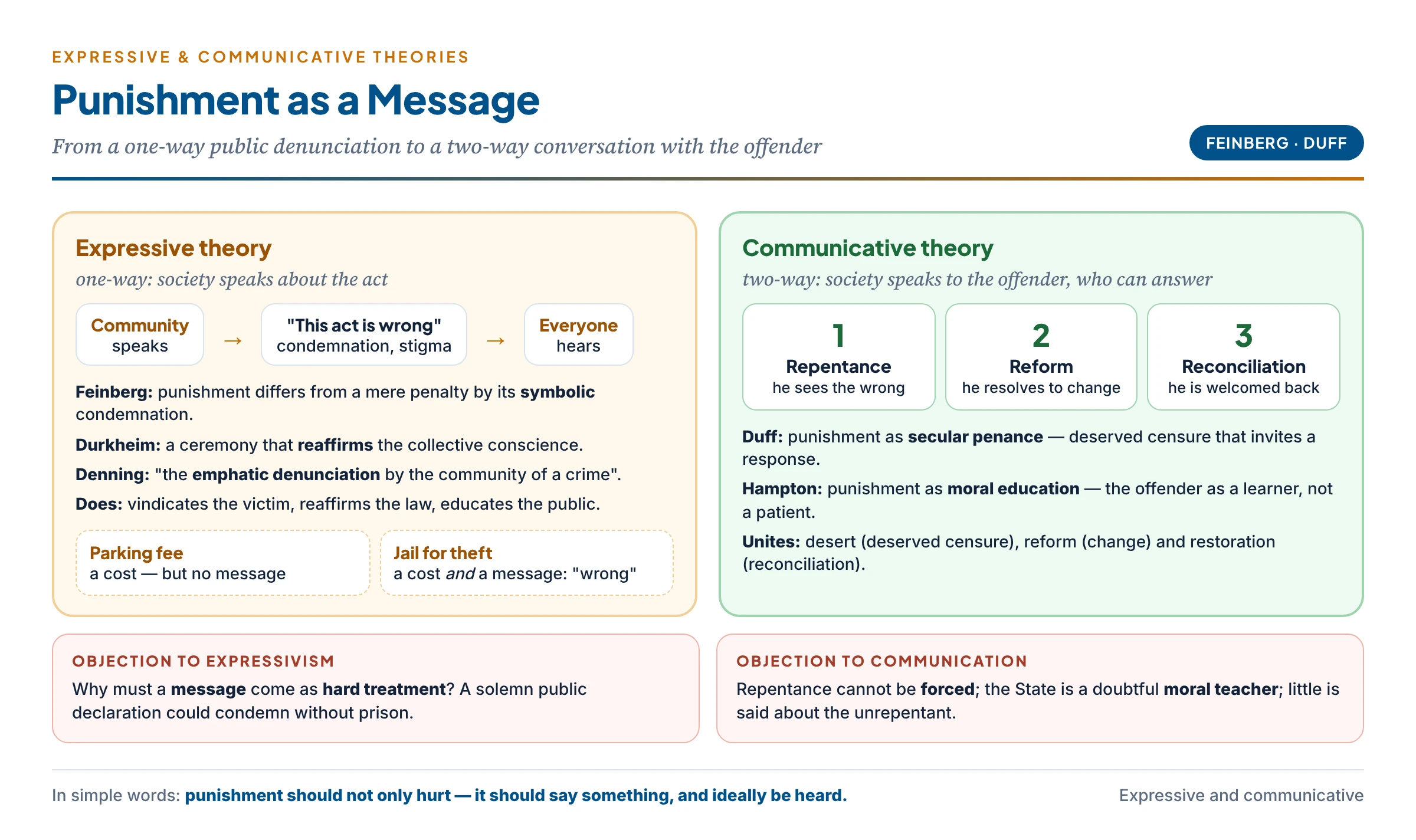
- Core idea: punishment is a way society expresses condemnation of the crime — it says publicly, “this act is wrong, and we do not accept it“.
- Joel Feinberg (“The Expressive Function of Punishment”, 1965): what distinguishes punishment from a mere penalty (a parking fee) is its symbolic meaning — resentment, indignation and reprobation on behalf of the community.
- Durkheim’s social solidarity theory: punishment is a ceremonial reaffirmation of the collective conscience; it strengthens the shared values the crime violated.
- Lord Denning told the British Royal Commission on Capital Punishment that the ultimate justification of punishment is not deterrence but “the emphatic denunciation by the community of a crime“.
- Functions of denunciation:
- Vindicates the victim — his rights mattered.
- Reaffirms the law — shared norms are not empty.
- Disavows the act — the community distances itself from it.
- Educates — teaches which acts are seriously wrong.
- Criticism: why must condemnation take the form of hard treatment (prison, pain)? A solemn public declaration could express disapproval without suffering.
In simple words
When a football referee shows a red card, the player is sent off — a real cost. But the card also says something to the player, his team, the crowd and millions watching: “that tackle crossed the line“. The expressive theory says punishment always carries such a message; without it, a punishment would be just a fee.
The Communicative Theory — Punishment as Secular Penance
- R.A. Duff (Punishment, Communication, and Community, 2001) developed the expressive idea into a two-way theory: punishment communicates censure to the offender, as a responsible member of the community, and invites a response.
- Punishment as “secular penance”: the burden of punishment gives the offender a way to face his wrong, express remorse and earn his way back.
- Duff’s three “R”s:
- Repentance — the offender recognises the wrong and is sorry.
- Reform — he resolves to change.
- Reconciliation — he is restored to the community, having made amends.
- Why it matters: it unites the theories:
- retributive — the censure is deserved and proportionate;
- reformative — it aims at the offender’s moral change;
- restorative — it aims at reconciliation with the victim and community;
- it respects dignity — it addresses the offender’s reason rather than manipulating him (answering C.S. Lewis — Article 4).
- Moral education theory (Jean Hampton): punishment’s purpose is to teach the offender, and others, that the act was wrong — not merely costly. It treats the offender as a learner, not a patient.
- Criticism: the State may be ill-suited to act as a moral teacher; repentance cannot be forced; for unrepentant offenders the theory explains little.
In simple words
Compare two teachers marking a dishonest essay. One simply writes “0/20“. The other writes “0/20”, then sits with the student, explains why copying wrongs the honest students and the student himself, and offers a chance to rewrite it. The first only penalises; the second communicates — and gives the student a way back. Duff wants punishment to be like the second teacher.
A Comparative Account of the Main Theories
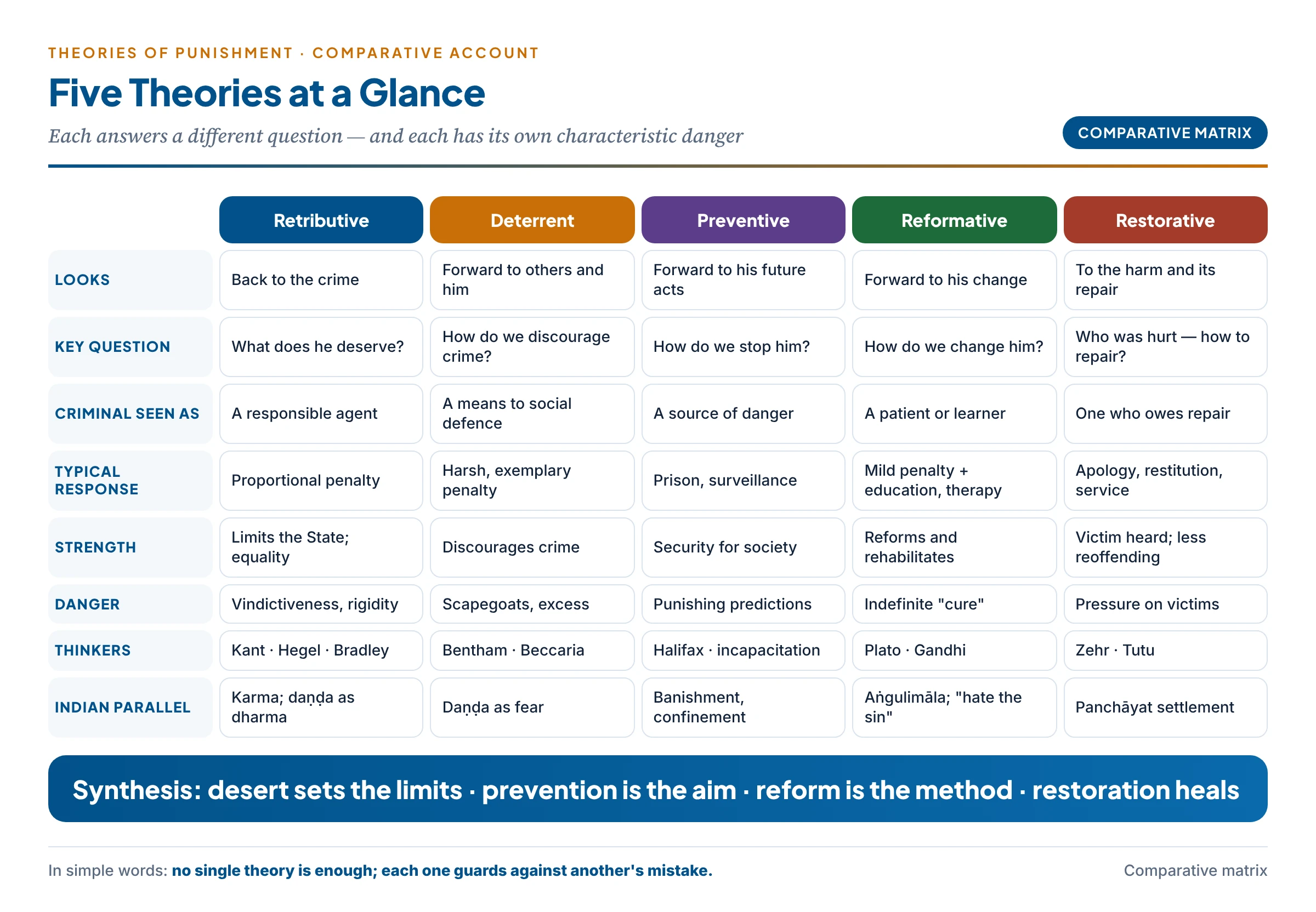
The 2007 paper asked for “a critical and comparative account of the main theories of punishment“.
| Criterion | Retributive | Deterrent | Preventive | Reformative | Restorative |
|---|---|---|---|---|---|
| Looks | Back to the crime | Forward to others and the offender | Forward to the offender’s future acts | Forward to the offender’s change | To the harm and its repair |
| Key question | What does he deserve? | How do we discourage crime? | How do we stop him? | How do we change him? | Who was hurt, and how to repair? |
| Objective | Restore the moral order disturbed | Discourage the offender and others | Disable the offender from repeating | Transform the offender | Heal victim, offender and community |
| Type of punishment | Proportional severity | Harsh, exemplary | Harsh — confinement, surveillance | Mild, with reform and rehabilitation | Apology, restitution, community service |
| Criminal seen as | Autonomous rational agent | Means to social defence | Source of danger | Patient or learner | Member of a community who owes repair |
| Strength | Reaffirms moral values; limits the State | Discourages crime effectively | Gives society a sense of security | Reforms and rehabilitates | Gives victims a voice; lowers reoffending |
| Weakness | Ignores social constraints behind crime | Ignores the impulsive factor; may punish innocents | Ignores causes and reform | Not fit for hardened criminals; ignores victim | Unsuited to grave crimes and power imbalance |
| Main danger | Vindictiveness, cruelty | Scapegoats, draconian penalties | Punishing predictions | Indefinite detention, paternalism | Pressure on victims, trivialising |
| Thinkers | Kant, Hegel, Bradley | Bentham, Beccaria | Halifax; modern incapacitation | Plato, Gandhi | Zehr, Tutu |
The Unified Approach in Indian Law
- Sentencing aims together: Indian courts treat proportionality, deterrence, prevention and reformation as joint aims of sentencing, balancing aggravating and mitigating circumstances.
- Constitutional framework (as the mixed theory requires):
- Article 14 — equality and non-arbitrariness: like cases alike; no grossly disproportionate penalties.
- Article 20 — legality (no retrospective crimes or penalties), no double jeopardy, no forced self-incrimination — the retributive “only the guilty, only by law”.
- Article 21 — just, fair and reasonable procedure; dignity of prisoners; speedy trial — the humane execution of punishment.
- The reformative voice of the Supreme Court: Justice V.R. Krishna Iyer, in Mohammad Giasuddin (1977), wrote that “every saint has a past and every sinner a future“, and urged that punishment should aim at healing the offender. In Sunil Batra (1978) the Court extended fundamental rights inside prison walls.
- The deterrent and retributive voice: in heinous cases the Court has warned against “undue sympathy” and insisted that the sentence reflect the gravity of the crime and society’s abhorrence.
- The “rarest of rare” doctrine (Bachan Singh, 1980) is itself a mixed formula: death only where deserved (aggravating circumstances) and where the alternative of life imprisonment is “unquestionably foreclosed” — that is, reform is impossible (Article 7).
- A gap: India still lacks statutory sentencing guidelines; committees such as the Malimath Committee (2003) and the Madhava Menon Committee (2008) recommended them, to reduce inconsistency between judges.
Are Retributive and Deterrent Theories Complementary?
- As rival complete theories — no: they give opposite answers in the hard cases (the useless deserved punishment; the useful undeserved punishment).
- As partners with different jobs — yes: deterrence supplies the aim, retribution the limit (Hart, Rawls); deserved punishment also deters; proportion serves both justice and deterrence (Article 3).
Critical Evaluation
Criticisms of Mixed Theories
- Ad hoc patchwork — critics say mixed theories simply glue together principles that do not belong together, without a single justification.
- The weighing problem — when aims conflict (a dangerous but not very blameworthy offender; a deserving but harmless one), mixed theories give no clear rule for weighing them.
- Utilitarian objection — if utility is the aim, why respect a desert limit when breaking it would do more good? The limit seems unjustified by the theory’s own aim.
- Retributivist objection — Hart’s desert limit is negative only; it does not explain why the guilty ought to be punished, so it may allow guilty people to go unpunished when punishing them is not useful.
- Practical inconsistency — in practice judges mix aims unpredictably, leading to disparity in sentences.
- Expressive and communicative theories — the State may be a poor moral teacher; condemnation need not require hard treatment; repentance cannot be compelled.
Defences of Mixed Theories
- Moral complexity is real — punishment serves several values at once; a single-principle theory is bound to be one-sided.
- Lexical order resolves conflicts — desert sets the outer limits first (only the guilty, never beyond desert); within those limits, prevention and reform decide. This removes the most dangerous conflicts.
- Rawls’s two-level answer shows the utilitarian can accept the desert limit: a practice that respects it produces more good than one that does not.
- It matches constitutional practice — legality, proportionality, dignity and reformation are all part of modern criminal justice.
- It answers each theory’s worst flaw — no scapegoats (retributive limit), no pointless cruelty (forward-looking aim), no indefinite cure (desert ceiling), no forgotten victim (restorative elements).
Critics and Defenders
Criticism — Critics of mixed theories
- Strict retributivists (Kant’s heirs): justice is not one factor to be traded against utility; the guilty must be punished as they deserve.
- Strict utilitarians: a desert limit that blocks a beneficial punishment is mere rule-worship.
- Abolitionists: combining failed justifications does not produce a good one.
- Critics of expressivism: condemnation can be expressed without inflicting suffering.
- Legal realists: in practice “balancing aims” means unpredictable, unequal sentences.
Defence — Defenders of mixed theories
- Hart: prevention is the aim of the institution; guilt and proportion govern its distribution.
- Rawls: utility justifies the practice; the rules — punish only the guilty — govern each case.
- Feinberg and Durkheim: punishment’s condemnatory meaning explains its link to desert and its social role.
- Duff and Hampton: punishment as censure and moral education unites desert, reform and reconciliation.
- Indian constitutional law: legality, proportionality, dignity and reformation operate together.
Cross-Tradition Comparison
Each Theory and Its Indian Parallel
| Western theory | Indian parallel | Shared idea |
|---|---|---|
| Retributive (Kant, Hegel) | Karma — every act bears its fruit; prāyaścitta; punishment as dharma (Manu) | The wrong itself calls for a response |
| Deterrent (Bentham, Beccaria) | Daṇḍa as fear — “the whole world yields through fear of punishment” (Manu) | Sanctions restrain conduct |
| Preventive | Banishment, confinement, fines in the Arthaśāstra | Disable the dangerous |
| Reformative (Plato, Gandhi) | Aṅgulimāla, Vālmīki; “hate the sin, not the sinner” | No one is beyond change |
| Restorative (Zehr, Tutu) | Panchāyat settlement, compensation | Repair harm, restore relations |
| Expressive (Feinberg, Durkheim) | Daṇḍa as the visible upholding of dharma | Punishment declares society’s values |
| Mixed (Hart, Rawls) | Kauṭilya’s yathārha-daṇḍa; Manu’s attention to time, place and the offender | Just measure combines purposes |
Indian Connect — Kauṭilya as a mixed theorist
Kauṭilya’s rule that the king should be neither too harsh nor too mild but just with the rod (yathārha-daṇḍa) already combines several theories. Punishment must deter (the harsh king terrifies, the mild king is despised); it must fit the offence (desert); it must protect the weak from mātsya-nyāya (prevention); and Manu adds that the king must consider the time, place, strength and knowledge of the offender (individualisation — the seed of reform). Classical Indian daṇḍanīti was, in effect, a mixed theory two thousand years before Hart.
Synthesis (Siddhānta)
- The philosophy of punishment is shaped by the tension between consequentialist theories (punish to prevent) and retributivist theories (punish because deserved). Each, alone, permits a serious wrong: scapegoats and excess on one side, pointless or rigid suffering on the other.
- Hart resolved much of the tension by assigning different questions to different theories: prevention justifies the institution; desert governs whom and how much; reform shapes how it is carried out. Rawls reached the same point by distinguishing the practice (justified by utility) from particular decisions (governed by rules that punish only the guilty).
- Expressive and communicative theories add what both families miss — that punishment is a message of condemnation, and at its best a conversation with a responsible person aimed at repentance, reform and reconciliation.
- Restorative practices add the victim and the repair of harm.
- Balanced position — a layered theory:
- Legality and guilt first — only the guilty, by fair procedure (retributive limit).
- Proportion as the ceiling — never more than deserved.
- Prevention as the aim — the institution exists to reduce harm.
- Reform and dignity in method — punishment should address and help the offender.
- Restoration where possible — the victim heard, the harm repaired.
- This layered view is what the Indian Constitution (Articles 14, 20, 21) and the best of Indian tradition (yathārha-daṇḍa, “hate the sin, not the sinner”) already point to: just in measure, useful in aim, humane in method.
“Every saint has a past and every sinner a future.” — Justice V.R. Krishna Iyer, quoting Oscar Wilde
Previous Year Questions
- 2015“The aim of punishment is to defend the moral law and to do justice to criminal.” Discuss.
- 2014Which theory of punishment retributive or restorative, do you recommend and why?
- 2007Consider why punishment is generally thought to require justification. In this context, give your critical and comparative account of the main theories of punishment.
- 2006Describe the tension between consequentialist and retributivist theory of punishments. Discuss critically in this context the view that argues that since no existing penal system for crime prevention has adequate justification, state punishment cannot be justified; and therefore, it should be completely abolished.
- 2004Discuss the notion of punishment. Consider in this context the importance and implications of the principle of proportionality of punishment which requires that severity of punishment be proportionate to the seriousness of the crime.
- 2003Critically examine — “Retributive and deterrent theories of punishment are mutually complementary“.