

Crime and Punishment: Corruption, Mass Violence, Genocide, Capital Punishment.
Official Syllabus: Paper II, Section A, Unit 7
The retributive theory gives the oldest and most intuitive answer to the question “Why punish?”: because the offender deserves it. Its Latin motto is punitur quia peccatum est — “he is punished because he has done wrong“. Punishment, on this view, does not need any future benefit to justify it. It is owed to the wrongdoer, as a debt is owed, and it must be in proportion to the wrong. From the crude “eye for an eye” of ancient codes to the refined theories of Kant, Hegel and Bradley, retributivism has insisted that punishment is a matter of justice, not of usefulness. This article explains its meaning and kinds, Kant’s and Hegel’s versions, the principle of proportionality, the main criticisms and defences, and whether retributivism is against human rights.
In simple words
A student copies in an exam and is caught. One teacher says, “Fail him, so that others will not copy next year.” Another says, “Fail him, so that he learns his lesson.” A third says, “Fail him because he cheated — he has not earned the marks, and it would be unfair to the honest students to let him pass.” The third teacher is a retributivist: the reason lies in what he did, not in what will happen next.
Context & Problem
Meaning of the Retributive Theory
- Core claim: punishment is justified solely because a responsible person has freely committed a wrong and therefore deserves (merits) to suffer for it.
- Backward-looking (ex post facto): it looks back to the crime, not forward to its effects. Deterrence or reform may follow, but they are not the reason for punishing.
- Deontological approach: punishment is a duty of justice, right in itself — not a means to some further good. Its chief proponent is Kant.
- Punishment as an end in itself: to punish the guilty is to restore justice that the crime upset.
- Proportionality: the severity of punishment is directly proportional to the seriousness of the crime — the greater the wrong, the greater the deserved penalty.
- Restoring equality: the crime creates an injustice — the wrongdoer has taken more than his share or has placed himself above others. Punishment rectifies the situation and regains the equality overturned by the act.
- “Eye for an eye”: in its crudest form it is expressed as “an eye for an eye, a tooth for a tooth” — the law of like-for-like (lex talionis, also jus talionis).
Origins — From Revenge to Desert
- Ancient codes: the Code of Hammurabi (Babylon, about 1750 BCE) and the Hebrew Bible (“eye for eye, tooth for tooth”) laid down lex talionis. Its original purpose was actually to limit revenge: only one eye for one eye — not a whole family’s lives for one eye.
- Aristotle’s corrective justice: when one person wrongs another, he gains and the victim loses; the judge restores the equality between them by taking away the gain. For this purpose the law “looks only to the injury” and treats the parties as equals.
- Religious traditions: punishment as expiation — paying for sin and becoming pure again.
- Modern philosophy: Kant (Metaphysics of Morals, 1797), Hegel (Philosophy of Right, 1821), F.H. Bradley (Ethical Studies, 1876), and in the twentieth century a “just deserts” revival in law and criminology.
Common confusion
Did Aristotle, “an ancient law-giver”, recommend harsher punishment for slaves? Many notes say so, but it misleads. Aristotle was a philosopher, not a law-giver (the Greek law-givers were men like Draco and Solon). In his account of corrective justice, Aristotle says the opposite of status-based punishment: it makes no difference whether a good man has wronged a bad man or a bad man a good one — the law looks only to the injury and treats the parties as equal. Unequal punishment by status belongs rather to slave-owning legal codes and to texts like the Manusmṛti. The real point the notes want to make is right: retributivism’s merit is that it looks only at the crime, not at the social rank of the criminal.
The Retributive Idea of Justice
- Retributive justice is the branch of justice concerned with the punishment of wrongdoing (as distributive justice deals with sharing benefits and burdens).
- David Miller’s three conditions of retributive justice — punishment must be:
- imposed only on those found guilty through proper procedure;
- imposed uniformly — like cases treated alike;
- proportionate in scale to the offence.
- Merit — no discrimination by status. Retributivism takes into account only the nature of the crime when deciding punishment. This was a great moral advance over codes that punished according to caste, class or status — Manu prescribed different punishments for the same crime according to the offender’s varṇa, and many ancient codes punished slaves more harshly than free men.
Core Doctrine
Key Ideas of Retributivism
- Desert — the guilty deserve to suffer; the innocent deserve not to.
- Responsibility — the offender is a free, rational agent who chose to do wrong; punishment treats him as answerable for his choice.
- Proportionality — punishment must fit the crime; neither more nor less.
- Equality — the same punishment for the same crime, whoever commits it.
- Justice, not utility — punishment is right because it is just, even if it produces no further good.
- Distinct from revenge — revenge is personal, unlimited and usually disproportionate; retribution is impartial, limited and rule-governed (Article 1).
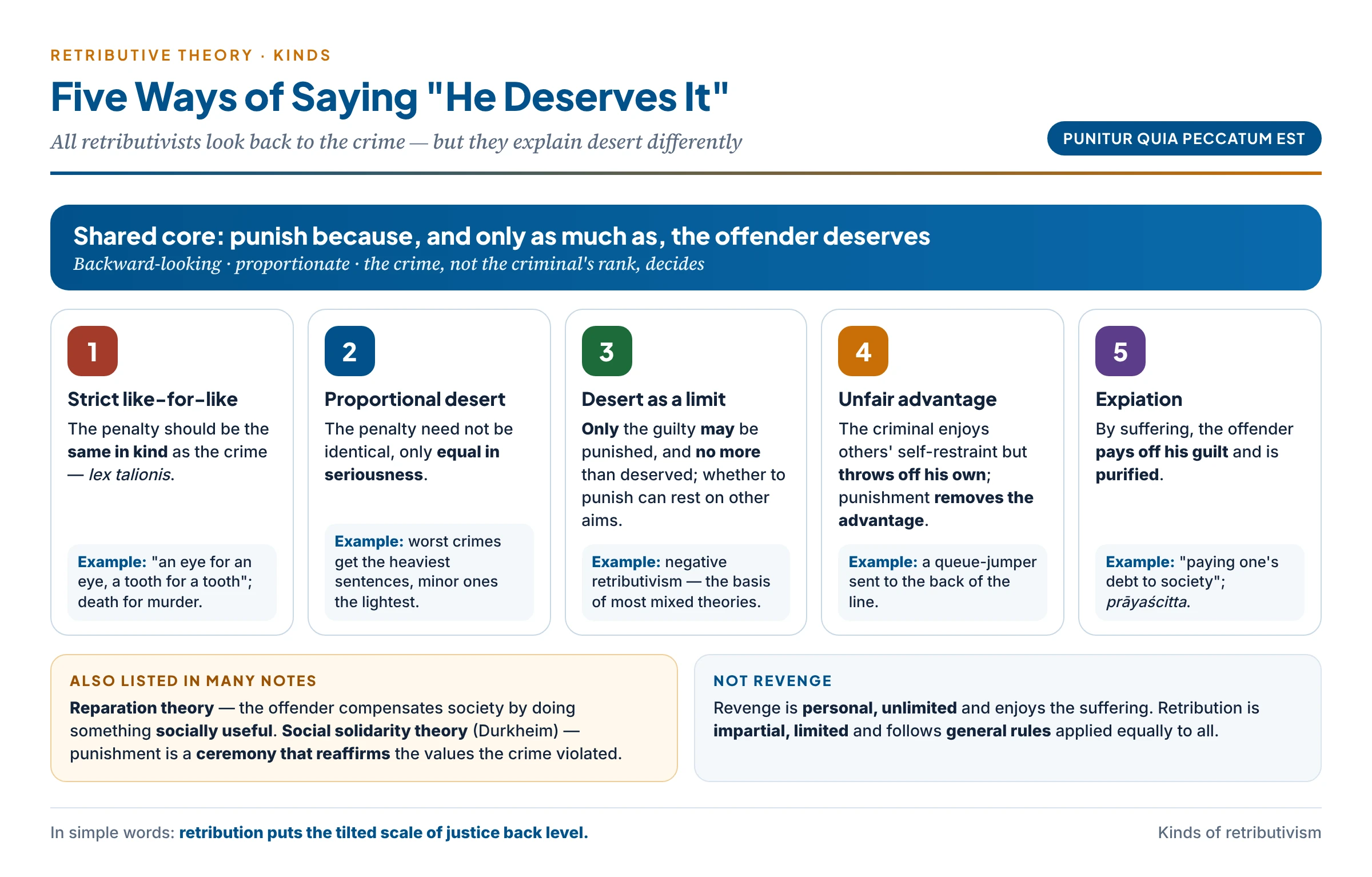
Kinds of Retributivism
- Strict retributivism (lex talionis) — the punishment should be identical in kind to the crime: a blow for a blow, death for death.
- Proportional retributivism — the punishment need not be identical but must be equal in seriousness: the worst crimes get the heaviest penalties, lesser crimes lighter ones.
- Positive vs negative retributivism:
- Positive — desert is a reason to punish: the guilty ought to be punished.
- Negative — desert is only a limit: only the guilty may be punished, and no more than they deserve. Whether to punish at all can be decided on other grounds (deterrence, reform). Most mixed theories (Article 5) adopt this negative form.
- Unfair-advantage (benefits-and-burdens) theory — the law gives everyone the benefit of others’ self-restraint, in return for the burden of restraining oneself. The criminal enjoys the benefit but throws off the burden, gaining an unfair advantage. Punishment removes the advantage and restores fairness (Herbert Morris).
- Expiatory retribution — punishment as atonement: by suffering, the offender pays off his guilt and is purified, returning to the moral community. The criminal “pays his debt to society“.
- Variants listed in many notes:
- Reparation theory — as a punishment, the offender should compensate the larger society by doing something socially useful and morally uplifting (community service, restitution).
- Social solidarity theory — punishment is essentially a ceremonial reaffirmation of the social values violated and challenged by the crime; its purpose is to strengthen social solidarity by reaffirming those basic values (Durkheim; also called the expressive theory — Article 5).
In simple words
A shopkeeper’s scale has been tilted by a cheat who put his thumb on it. Justice is not done by punishing the shopkeeper’s next customer to “set an example”, nor by teaching the cheat a course in honesty. It is done by putting the scale back level — taking away what was wrongly gained. That image of the balanced scale is the heart of retributivism.
Kant — Punishment as a Categorical Imperative
Kant gave the most rigorous defence of retributivism in the Metaphysics of Morals (1797).
- Never merely as a means. Judicial punishment can never be used merely as a means to promote some other good — neither for the criminal himself nor for civil society. It must be imposed only because he has committed a crime. A person must first be found deserving of punishment before any thought is given to whether the punishment is useful.
- Why: using a person as a tool for social benefit treats him like a thing, violating the formula of humanity of the categorical imperative (“treat humanity, in yourself and others, always as an end and never merely as a means”).
- “Woe to him…” Kant held that the law of punishment is a categorical imperative, and warned against anyone who “crawls through the windings of happiness-calculation” to find some advantage that would release the criminal from the punishment he deserves.
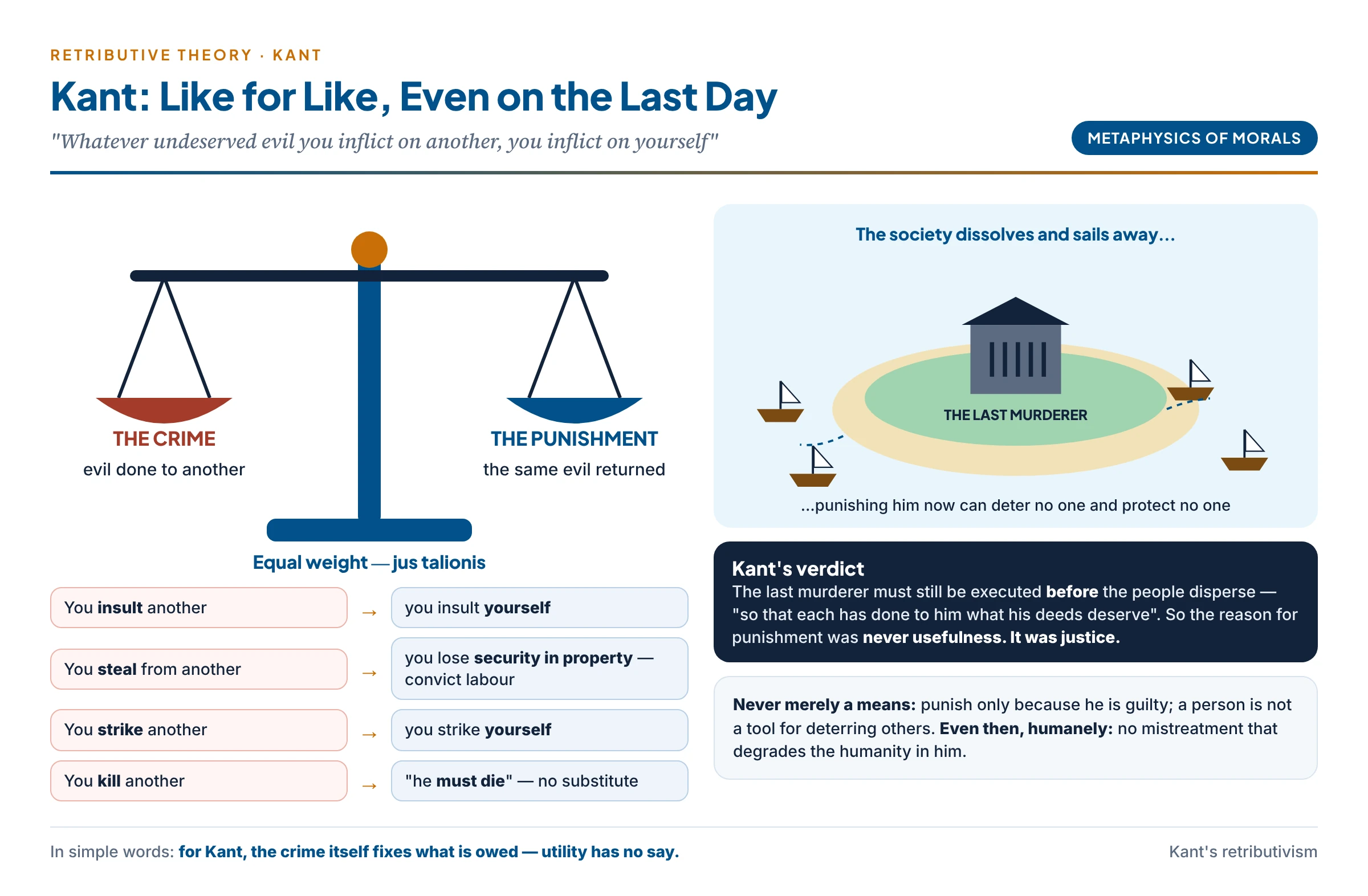
- The principle of equality (jus talionis): the kind and degree of punishment are fixed by the crime itself. Kant’s formula: whatever undeserved evil you inflict on another, you inflict on yourself:
- if you insult another, you insult yourself;
- if you steal from another, you steal from yourself;
- if you strike another, you strike yourself;
- if you kill another, you kill yourself.
- Like for like in spirit, not always in letter:
- Theft: the thief makes everyone’s property insecure, so he deprives himself of security in property; he must live by convict labour for the State.
- Insult by a rich man: a fine means nothing to him; so he may be made to apologise publicly and kiss the hand of the person he insulted — his pride is made to suffer as he made another’s suffer.
- Murder: “If he has committed murder, he must die.” There is no substitute that satisfies justice, for there is no likeness between even the most wretched life and death.
- Even the execution must be humane: the death must be free of any mistreatment that would make humanity in the person abominable. Retribution is not cruelty.
- The island example:
“Even if a civil society were to be dissolved by the consent of all its members (e.g., if a people inhabiting an island decided to separate and disperse throughout the world), the last murderer remaining in prison would first have to be executed, so that each has done to him what his deeds deserve and blood guilt does not cling to the people for not having insisted upon this punishment.” — Kant
- The point of the island example: once the society is dissolving, punishing the murderer can deter no one and protect no one. If he must still be punished, then the reason for punishment was never usefulness — it was justice.
- No bargain with justice. Kant rejected the proposal to spare a condemned criminal if he agreed to undergo dangerous medical experiments for the public good: justice “ceases to be justice if it can be bought for any price“.
- Punishment honours the criminal’s reason. As a rational being, the criminal is also a co-legislator of the law he broke. By willing a crime, he wills the punishable act; in punishing him we treat him as a responsible person (homo noumenon), not as an animal to be trained or a patient to be cured.
- Kant against Beccaria: Beccaria argued that no one in the social contract could have consented to his own execution. Kant called this a sophistry: no one is punished because he willed the punishment, but because he willed a punishable action.
Hegel — Punishment as the Negation of the Negation
Hegel (Elements of the Philosophy of Right, 1821) explained punishment through his dialectic.
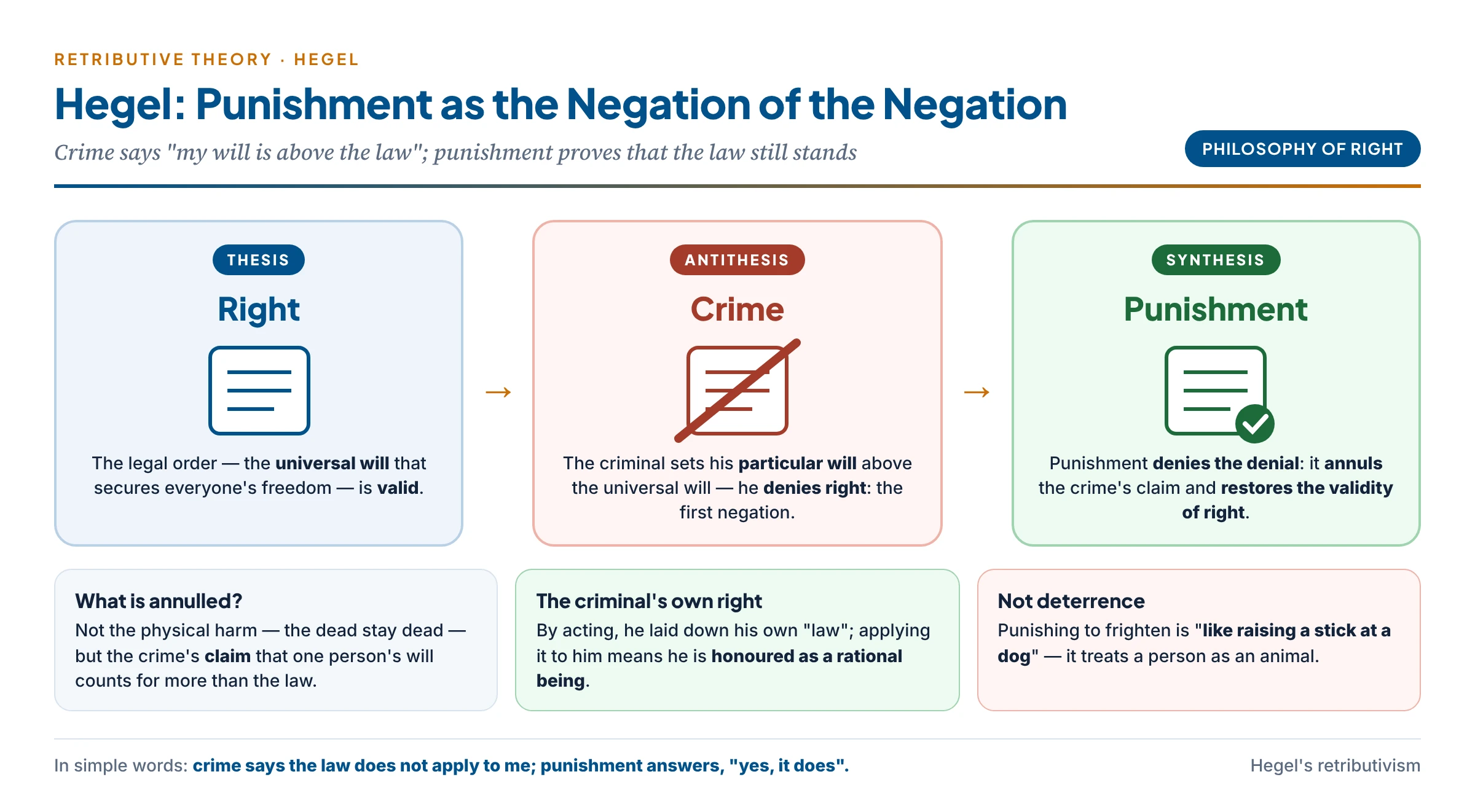
- Right (the thesis): the legal order — the universal will, expressing the freedom of all, is valid.
- Crime (the antithesis): the criminal denies right. He sets his particular will above the universal will, as if his own wish were law. Crime is the negation of right.
- Punishment (the synthesis): punishment negates the negation — it annuls the crime, showing that the criminal’s denial is null and void, and restores the validity of right.
- What “annulment” means: punishment cannot undo the physical harm (the dead stay dead). What it cancels is the crime’s claim — the claim that the criminal’s will counts for more than the law. Punishment publicly proves that right still stands.
- Punishment as the criminal’s right. Hegel’s boldest idea: punishment is not only just but the criminal’s own right. In acting, the criminal implicitly laid down a law (“such acts are permitted”); punishing him applies his own law to himself.
“Punishment is regarded as containing the criminal’s right and hence by being punished he is honoured as a rational being.” — Hegel
- Against deterrence. To justify punishment by threat is “like raising a stick at a dog” — it treats a human being like a dog, not with the freedom and respect due to him.
- Equality of value, not of form. Hegel answered the objection that lex talionis is absurd (what of a one-eyed or toothless offender?). Retribution demands equality in value, not identical form: the punishment must be equivalent in seriousness, expressed in money, years or other measures.
- Revenge vs punishment. Where there is no State and no court, punishment takes the form of revenge — and revenge, being a new wrong, provokes endless counter-revenge. Only when a court punishes in the name of the universal will does punishment become justice.
In simple words
A student tears up the class rule-book and announces, “From today, rules don’t apply to me.” If the teacher does nothing, the student’s claim wins — rules really don’t apply to him. When the teacher responds, the student’s claim is cancelled: the rules still apply. Hegel calls this the “negation of the negation”. And by holding the student responsible, the teacher treats him as someone who meant what he did — not as a child who knew no better.
F.H. Bradley — “Punishment Only Where Deserved”
- Bradley, the British idealist, stated retributivism in its most uncompromising form:
“Punishment is punishment only where it is deserved. We pay the penalty because we owe it, and for no other reason; and if punishment is inflicted for any other reason whatever than because it is merited by wrong, it is a gross immorality, a crying injustice.” — F.H. Bradley
- Desert is both necessary and sufficient: without guilt, punishment is injustice; with guilt, punishment is due. Deterrence and reform may be added in deciding the form of punishment, but never as its basis.
“The Aim of Punishment Is to Defend the Moral Law and to Do Justice to the Criminal”
This statement, set in the 2015 paper, sums up the retributive view in two parts:
- Defending the moral law:
- Crime is an attack on the moral order; punishment vindicates it (Hegel’s annulment).
- Punishment publicly declares that the act was wrong (Durkheim’s reaffirmation of shared values).
- It restores the balance of benefits and burdens upset by the offender (unfair-advantage theory).
- Doing justice to the criminal:
- He is treated as a responsible, rational person who chose his act (Kant, Hegel).
- He receives what he deserves — no more, no less (proportionality protects him from excess).
- He is not used as a tool to scare others, nor treated as a patient to be manipulated.
- Through punishment he can pay his debt and return as an equal member of society (expiation).
- Evaluation: the statement captures retributivism’s best insight — punishment must be just to the punished. But it says nothing about the victim, the causes of crime or the future — the gaps filled by deterrent, reformative and restorative theories.
The Principle of Proportionality
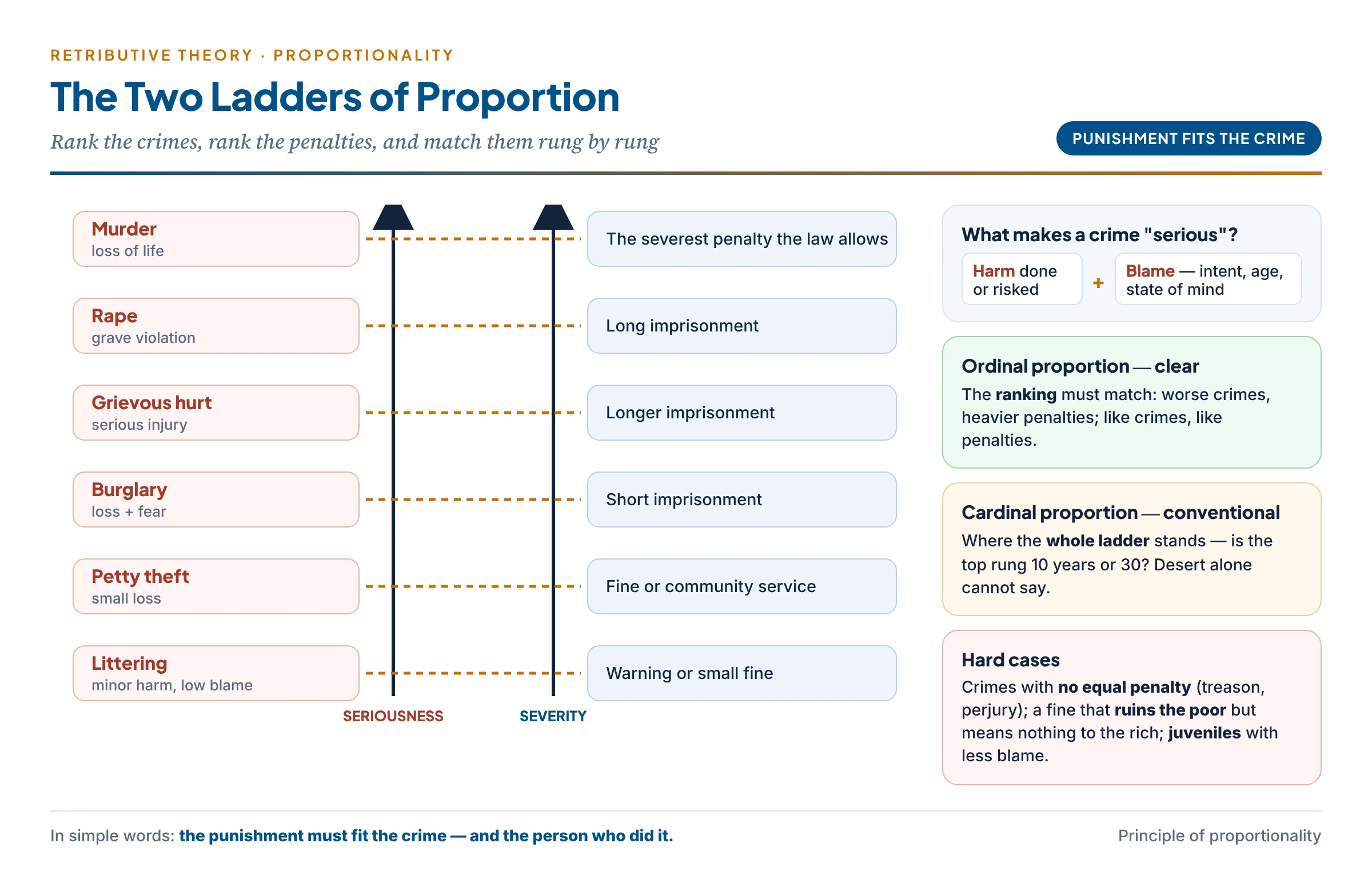
- Meaning: the severity of punishment should be proportionate to the seriousness of the crime. Seriousness depends on two things:
- Harm — how much damage the act caused or risked (killing is worse than wounding).
- Culpability — how blameworthy the offender was (intentional killing is worse than killing by negligence; an adult is more culpable than a child).
- Two senses of proportion:
- Ordinal (ranking): crimes are ranked by seriousness, and punishments ranked in the same order — murder above theft, theft above littering. Like crimes get like punishments.
- Cardinal (overall scale): the absolute level of the whole scale — whether the worst crimes get ten years or fifty. Proportionality fixes the ranking easily but the absolute scale only by convention.
- Importance and implications:
- Limits the State — forbids excessive, exemplary or terror punishments, even if they would deter.
- Equality — like cases are treated alike; differences in punishment must reflect differences in crime, not in status.
- Fairness to the offender — he is treated as a responsible agent who deserves a measured response.
- Public confidence — punishments that are far too light or far too harsh both bring the law into contempt.
- Mitigation and aggravation — proportionality requires courts to consider circumstances: age, mental state, provocation, motive, remorse, previous record.
- Constitutional standard — in India, a grossly disproportionate sentence can be struck down as arbitrary under Articles 14 and 21 (the mandatory death sentence was struck down on this ground in Mithu, 1983 — Article 7).
- Problems:
- No common measure: how many years of prison “equal” a rape or a fraud?
- Crimes without an equivalent: treason, perjury, drug-trafficking, forgery — there is no “like” penalty.
- Social inequality: the same fine is crushing for the poor and trivial for the rich.
- Juveniles and the mentally ill: reduced culpability means less desert even for very serious harm (Article 4 discusses the juvenile question).
Indian Connect — Karma, prāyaścitta and the king’s punishment
Indian thought has a cosmic retributivism: the law of karma guarantees that every act bears its exact fruit — “as you sow, so you reap” — across lives. Alongside it stands expiation (prāyaścitta): penances by which a wrongdoer can purify himself. Manu even says that those who have committed crimes and have been punished by the king go to heaven, pure like those who did good deeds — punishment as purification, exactly the expiatory form of retributivism. The difference from Kant is telling: karma’s retribution is automatic and infallible, while the State’s is human and fallible — one reason later Indian thinkers, from the Buddha to Gandhi, urged that human punishment be tempered by compassion.
Critical Evaluation
Criticisms of the Retributive Theory
- Ignores the effects of punishment — it fails to account for the proper effect of punishment on the offender and on society. Punishment that makes the offender worse, or ruins his family, is still “deserved”.
- Ignores social causes — it holds the offender fully responsible, but many crimes are the outcome of the social conditions in which offenders are born and bred. So it is unjust to attribute the cause of crime to the offender alone. (Counter: the majority of slum-dwellers and poor people are law-abiding, so poverty does not compel crime.)
- Same punishment, different persons — it upholds similar punishment for a similar crime without reference to its cause. It treats equally a rich man who steals for thrill and a poor man who steals a loaf of bread out of destitution.
- Divorced from sociological circumstances — because it ignores the social setting of crime, it fails to maintain justice in all cases.
- Supports capital punishment without considering reform — it staunchly supports the death penalty for murder without examining the possibility of reformation.
- Institutionalised revenge — critics charge that retributivism is vengeance dressed in the language of desert; “eye for an eye” is the morality of the feud.
- Adding pain to pain — how does adding the offender’s suffering to the victim’s suffering make the world better? Two evils do not make a good.
- No equivalent for many crimes — what is the like-for-like punishment for treason, perjury, forgery or rape? Literal lex talionis is either barbarous or unusable.
- The quantum problem — proportionality gives the order of severity but not the scale: desert alone cannot say whether a theft deserves one year or five.
- Free will in doubt — retributivism assumes a free, fully responsible agent. Determinism, psychology and much of criminology cast doubt on how free most offenders really are.
- Rigid and unforgiving — it leaves little room for mercy, forgiveness or second chances.
- Gandhi: “An eye for an eye makes the whole world blind.“
Defences and Strengths
- Limits State tyranny — punish only the guilty, and never beyond desert. Deterrence, by contrast, could in principle justify punishing the innocent or using exemplary severity.
- Respects persons — it treats the offender as a responsible agent with dignity, not as a tool (deterrence) or a patient (reform) (Kant, Hegel, C.S. Lewis — Article 4).
- Equality before law — the crime, not the rank of the criminal, decides the punishment.
- Captures a deep moral intuition — the guilty should not flourish while their victims suffer; no purely forward-looking theory explains why a murderer who will never offend again should still be punished.
- Vindicates the victim — punishment publicly affirms that the victim’s rights mattered.
- Not revenge — retribution is impartial, limited, rule-governed and indifferent to pleasure in suffering (Nozick’s distinctions — Article 1).
- Answers to the objections:
- To “no equivalent”: Hegel — equality is of value, not of form.
- To “social causes”: reduced responsibility can be recognised as mitigation, which retributivism itself requires (less culpability, less desert).
- To “rigidity”: retributivism sets a ceiling, not a floor; mercy below desert is possible.
Is the Retributive Theory Against Human Rights?
Arguments that it is:
- Literal lex talionis — amputation for theft, stoning, flogging — is cruel, inhuman and degrading punishment, banned by the UDHR (Article 5) and the ICCPR (Article 7).
- Death for murder, as Kant demands, conflicts with the right to life and with the global movement for abolition (Article 6).
- Ignoring reform clashes with the ICCPR (Article 10(3)): the essential aim of the prison system “shall be reformation and social rehabilitation“.
- Blindness to social causes can punish disadvantage: the poor and marginalised fill prisons.
Arguments that it is not — and may even be their foundation:
- The core human-rights principles of criminal justice are retributive in origin:
- no punishment without a crime defined by prior law (Article 20(1) of the Indian Constitution);
- no punishment of the innocent, and the presumption of innocence;
- no double punishment for the same offence;
- proportionality — no excessive penalties;
- equality — the same law for all, regardless of status.
- Kant and Hegel ground punishment in the offender’s dignity as a rational person — the very idea on which human rights rest.
- The real threats to rights come from pure deterrence (exemplary terror, scapegoats) and pure reform (indefinite “treatment”) — both of which retributivism forbids.
Balanced view: crude, literal retribution (lex talionis, cruel penalties, automatic death) is against human rights. Proportional, negative retributivism — only the guilty, only as much as deserved, by fair procedure — is not against human rights; it is one of their pillars. The task is to keep retributivism’s limits and drop its cruelty, joining it to rehabilitation.
In simple words
Think of a speed limit on a highway. It does not tell you why to drive (to reach your office); it tells you how fast you may not go. Modern retributivism works like that limit: it may not be the whole reason for punishing, but it marks the line the State may never cross — no punishment of the innocent, and no punishment beyond what is deserved.
Critics and Defenders
Criticism — Critics of retributivism
- Bentham and the utilitarians: punishment is itself an evil; inflicting it without any future benefit is pointless cruelty.
- Sociological critics: crime is largely the product of social conditions; retribution blames the individual for society’s failures.
- Determinists: if choices are caused, “desert” is an illusion.
- Reformists (Plato, Gandhi): hate the sin, not the sinner; punishment should heal, not repay.
- Human-rights critics: literal like-for-like and the death penalty are cruel and irreversible.
- Gandhi: an eye for an eye makes the whole world blind.
Defence — Defenders and strengths
- Kant: punishment must be deserved, never a mere means; justice cannot be bought.
- Hegel: punishment annuls crime and honours the criminal as a rational being.
- Bradley: punishment is punishment only where deserved.
- C.S. Lewis: desert is the only protection against “humanitarian” tyranny.
- Hart and mixed theorists: desert is the indispensable limit on whom and how much we punish.
- Rule of law: legality, presumption of innocence, proportionality and equality are retributive principles.
Cross-Tradition Comparison
Three Western Retributivists
| Point | Kant | Hegel | Bradley |
|---|---|---|---|
| Ground of punishment | Categorical imperative; desert | Restoring right; annulling crime | Desert alone |
| View of criminal | Rational co-legislator; never a mere means | Rational being whose own “law” is applied to him | Moral agent who owes a debt |
| Measure | Jus talionis — like for like | Equality of value, not form | Desert; utility only in form |
| Death penalty | Required for murder | Accepted | Accepted |
| Deterrence | Rejected as a ground | “Raising a stick at a dog” | Gross immorality as a ground |
| Distinctive idea | Island example | Punishment as the criminal’s right | Punishment only where deserved |
Retribution in Indian and Western Thought
| Point | Karma and Indian law | Western retributivism | Insight |
|---|---|---|---|
| Who delivers it | Cosmic law (karma); king’s daṇḍa | The State’s courts | Retribution as a demand of moral order |
| Proportion | Exact fruit of every act | Proportional desert | The wrong fixes the measure |
| Purification | Prāyaścitta; punished offender becomes pure (Manu) | Expiation; “paying the debt” | Punishment returns the offender to the community |
| Equality | Manu graded by varṇa | Equality before law | Modern law keeps desert, rejects hierarchy |
| Critique | Buddha, Gandhi: compassion over retaliation | Utilitarians, reformists | Desert must be tempered by humanity |
Indian Connect — Gandhi’s answer to retribution
Gandhi accepted that wrong must be resisted but rejected retaliation. “Hate the sin, not the sinner” separates the act, which deserves condemnation, from the person, who deserves respect and the chance to change. His satyāgraha sought to convert the wrongdoer, not to make him suffer. This is close to Hegel in one respect — both refuse to treat the offender as a mere object — but opposite in another: for Gandhi, justice is restored through love and self-suffering, not through the wrongdoer’s pain.
Synthesis (Siddhānta)
- Retributivism holds that punishment is justified because it is deserved — backward-looking, non-instrumental, and proportionate to the gravity of the offence.
- Kant gave it its strongest form: never punish a person merely as a means; punishment is owed even when useless (the island). Hegel deepened it: crime denies right; punishment annuls that denial and honours the criminal as rational. Bradley stated it most sharply: punishment only where deserved.
- Its strengths are lasting: it limits the State, respects the offender as a person, ensures equality, and explains why the guilty should not go free.
- Its weaknesses are equally real: crude lex talionis is cruel or unusable; desert gives an order but not a scale; it can be blind to social causes; it neglects reform and the victim’s needs.
- Is it against human rights? Literal retribution is; proportional, negative retributivism is not — legality, presumption of innocence, proportionality and equality are its gifts to human-rights law.
- Balanced position: retribution is defensible as a limiting principle but inadequate as the sole ground of punishment. Desert should decide who may be punished and how much at most; deterrence and reform should shape why we have punishment and how it is carried out (Article 5). Gandhi’s “hate the sin, not the sinner” and India’s constitutional stress on reformation point the same way — retribution constrained by dignity.
“Punishment is regarded as containing the criminal’s right and hence by being punished he is honoured as a rational being.” — Hegel
Previous Year Questions
- 2026“Retributivism presents a deontological justification for capital punishment, whereas deterrence presents a consequential justification for it.” Explain.
- 2023“Severity of punishment should be proportionate to the seriousness of the crime.” — Do you agree that while punishing a juvenile, the nature of the crime should be considered? Justify your answer.
- 2020Do you think that retributive theory of punishment is against human rights? Discuss.
- 2015“The aim of punishment is to defend the moral law and to do justice to criminal.” Discuss.
- 2014Which theory of punishment retributive or restorative, do you recommend and why?
- 2004Discuss the notion of punishment. Consider in this context the importance and implications of the principle of proportionality of punishment which requires that severity of punishment be proportionate to the seriousness of the crime.
- 2003Critically examine — “Retributive and deterrent theories of punishment are mutually complementary“.
- 2000Retributive Theory of Punishment. (Short note)