

Crime and Punishment: Corruption, Mass Violence, Genocide, Capital Punishment.
Official Syllabus: Paper II, Section A, Unit 7
Every society, from a village panchāyat to a modern Republic, punishes some of its members. Yet punishment is a strange thing: the State deliberately makes a person suffer — it locks him up, takes his money, or even takes his life — acts that would be grave crimes if a private person did them. So philosophers ask two basic questions: What is a crime, and what is punishment? and By what right does the State inflict pain on a citizen? This article explains the meaning of crime, the five features of punishment, how punishment differs from revenge, why it needs justification at all, the State’s right to punish, the Indian idea of daṇḍa (“Punishment rules all creatures”), and the abolitionist claim that State punishment should be scrapped altogether. The particular theories — retributive, deterrent, preventive, reformative and mixed — follow in Articles 2 to 5.
In simple words
Think of a cricket match. Rules alone do not keep the game fair — there must be an umpire who can give a batsman out or penalise a bowler for a no-ball. Without the umpire, the strongest team would bully the rest, and every dispute would end in a fight. But an umpire who gives people out at random, or out of anger, would be worse than none. Punishment is society’s umpire: necessary, but it must be fair, limited and justified.
Context & Problem
What Is a Crime?
- Crime is usually defined as an unlawful act (or omission) that is punishable by the State. In short: crime = a legal wrong + a State sanction.
- Crime is a public wrong. A crime is treated as an offence against society as a whole, not only against the victim. That is why a criminal case is titled “State versus the accused“, and the State prosecutes even if the victim forgives.
- Crime vs civil wrong (tort):
- A civil wrong (breach of contract, negligence) is settled by compensation to the injured person.
- A crime invites punishment — imprisonment, fine or death — in the name of the whole community.
- Crime vs sin vs vice. A sin is a wrong against God or religious law; a vice is a moral failing (envy, greed). Not every sin or vice is a crime (lying to a friend), and not every crime is a sin (a parking offence).
- The two elements of crime — the guilty act and the guilty mind:
- Actus reus — the guilty act: the outward conduct (taking, striking, killing).
- Mens rea — the guilty mind: intention, knowledge or recklessness. The old maxim says: “an act does not make a man guilty unless his mind is also guilty“. This is why a child below a certain age, or a person of unsound mind, is not punished like an adult.
In simple words
If you pick up someone’s umbrella from a rack believing it is yours, you have done the act (taking another’s umbrella) but without a guilty mind. If you pick it up knowing it is not yours and walk off, you have both. The law punishes only the second.
Crime Varies with Time and Place
- What counts as a crime is not fixed. It changes from age to age and from country to country:
- Time: witchcraft was once a capital crime in Europe; today it is not a crime at all. In the pre-industrial age, polluting air and water was not a crime; today environmental laws punish it.
- Place: homosexuality is still a crime in some countries but not in others. In India, the Supreme Court in Navtej Singh Johar (2018) decriminalised consensual same-sex relations between adults.
- Why it matters philosophically: if crime is simply “whatever the law forbids”, then the justice of punishment depends on the justice of the law itself. A law that punishes peaceful dissent or a caste “offence” makes punishment unjust from the start.
- What should be made a crime? Two classic answers:
- Harm principle (J.S. Mill): the State may use force against a person only to prevent harm to others, never merely for his own good or because the majority dislikes his conduct.
- Legal moralism (Lord Devlin): society may punish conduct that offends its shared morality, because shared morality is the cement of society. H.L.A. Hart replied in the famous Hart–Devlin debate (1959–63) that punishing harmless private conduct is tyranny of the majority.
Crime and Social Conditions
- Old view: crime is a free, wicked choice of a bad individual.
- Modern view: many crimes are largely caused by social conditions — poverty, unemployment, broken families, drug abuse, lack of education, humiliation and discrimination.
- Durkheim even called crime “normal“: every society has some crime, and the reaction to it reminds people of their shared values.
- Caution: social causes explain crime but do not wholly excuse it — the great majority of the poor are law-abiding. Both the individual’s choice and the social setting matter. This tension runs through all theories of punishment.
What Is Punishment? The Five Features
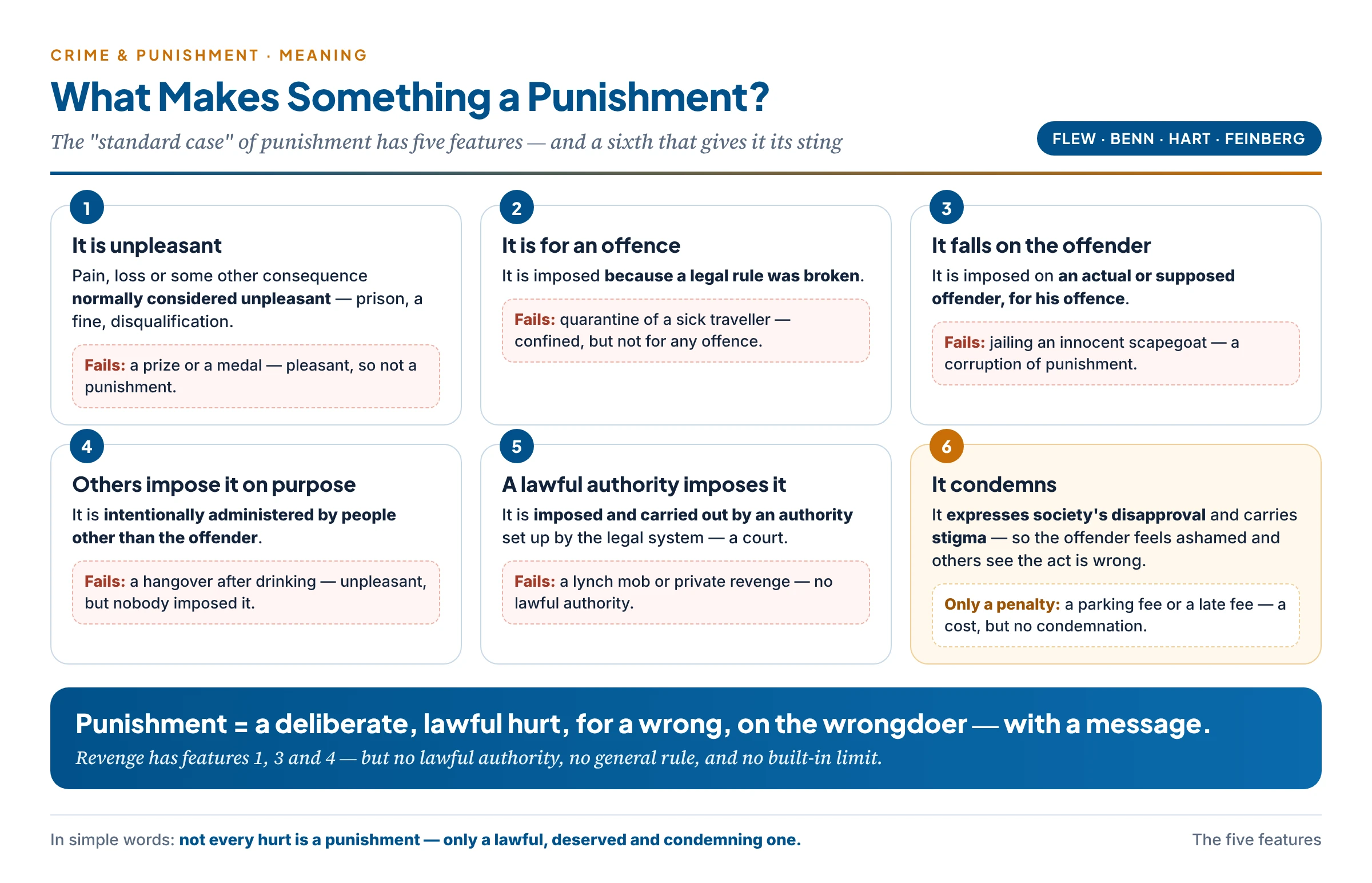
Philosophers (Antony Flew, Stanley Benn, and H.L.A. Hart, who called this “the standard case”) describe punishment by five features. Punishment is:
- Unpleasant — it involves pain, loss or other consequences normally considered unpleasant (prison, fine, disqualification).
- For an offence — it is imposed for breaking a legal rule.
- On the offender — it falls on an actual or supposed offender, for his offence.
- Intentionally imposed by others — it is deliberately administered by human beings other than the offender (a hangover after drinking is unpleasant but not punishment).
- By an authority — it is imposed and administered by an authority set up by the legal system (a court), not by a mob or a private person.
- Why each feature matters:
- Feature 2 separates punishment from quarantine (an infected person is confined, but not for an offence).
- Feature 3 shows why “punishing” an innocent person is a corruption of punishment.
- Feature 5 separates punishment from lynching and private revenge.
- Hart’s “sub-standard” cases — punishment of a whole group for one member’s act (collective punishment), punishment of a person for another’s act (vicarious punishment), and punishments in families, schools and clubs (non-legal punishment).
- A sixth feature — condemnation (Joel Feinberg). Punishment also expresses society’s disapproval. This is what separates a penalty (a parking fee, a late-fee) from a punishment (a jail term for theft): only the second carries stigma.
- Stigma is part of the point. Punishment should carry a stigma, so that the punished person feels ashamed of what he did and others see that the act is condemned.
Punishment and Revenge
- Revenge is the oldest response to injury. Punishment grew out of it but is not the same thing.
| Point | Revenge | Punishment |
|---|---|---|
| Who acts | The victim or his family | A neutral, lawful authority |
| For what | For any injury or insult, even an imagined slight | Only for a legal wrong proved by fair procedure |
| Limit | No built-in limit — usually disproportionate | Proportionate to the offence |
| Feelings | Takes pleasure in the wrongdoer’s suffering | Need not take pleasure; is done as a duty |
| Generality | Personal and selective | Follows general rules applied equally to all |
| Result | Feuds and cycles of counter-revenge | Ends the dispute and restores order |
- Robert Nozick stated these differences sharply: retribution is for a wrong, revenge may be for an injury or slight; retribution sets an internal limit to the penalty, revenge does not; revenge is personal, retribution need not be; revenge involves pleasure in another’s suffering; retribution follows general principles.
In simple words
Two neighbours quarrel. A cuts B’s tree; B burns A’s cowshed; A’s sons beat B’s sons; the feud runs for three generations. Now imagine a judge who hears both, finds A guilty of cutting the tree, and orders him to pay its value plus a fine. The feud stops. That is the step from revenge to punishment.
Why Punishment Needs Justification
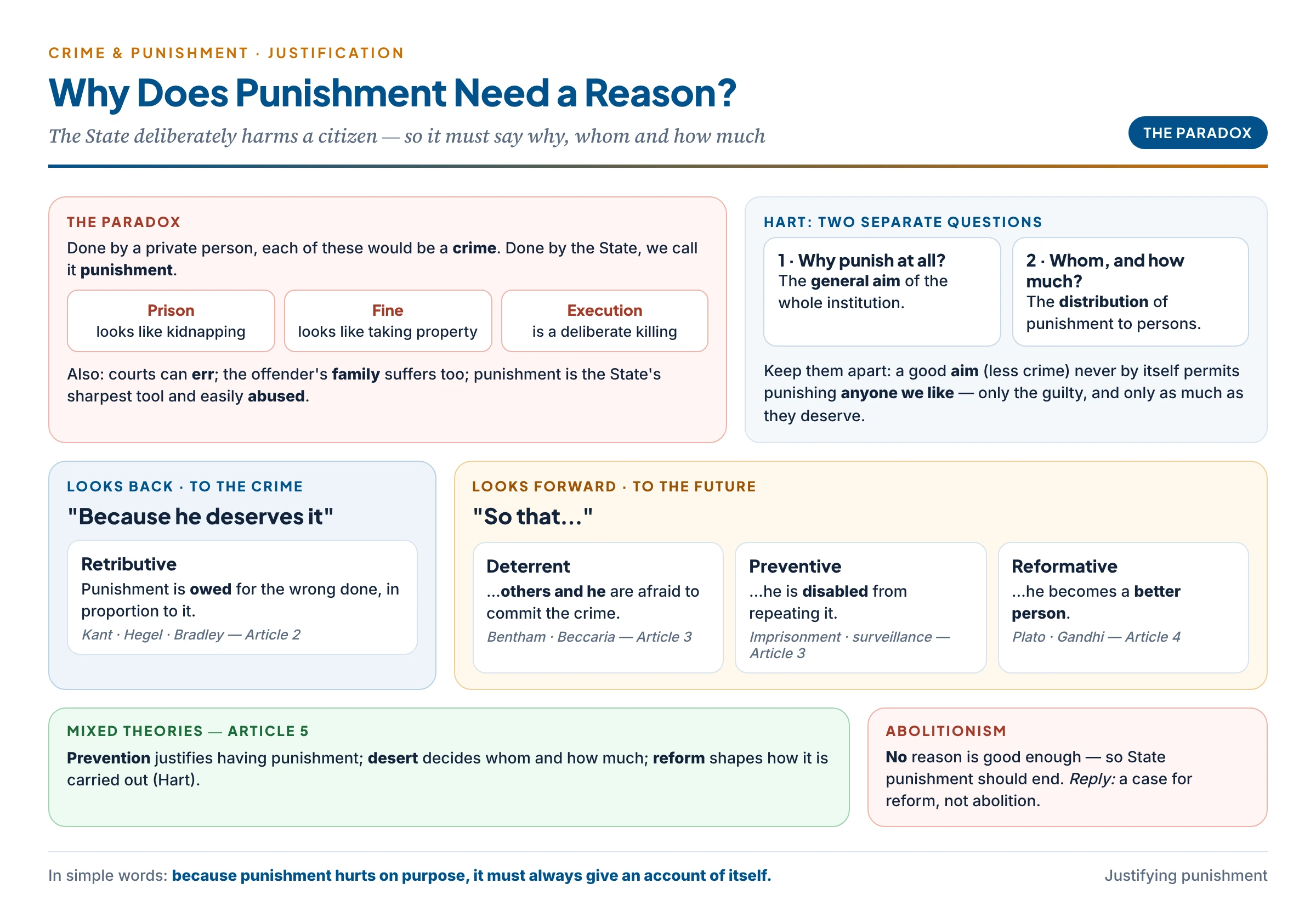
- The basic paradox. In ordinary morality, deliberately harming a person is wrong. Yet in punishment the State does exactly that:
- imprisonment is what we would call kidnapping if a private person did it;
- a fine looks like taking someone’s property;
- an execution is a deliberate killing.
- The State acts against the very rights it exists to protect — life, liberty, property. So punishment always needs a strong moral reason.
- Further reasons why justification is needed:
- Fallibility: courts make mistakes; innocent people are sometimes punished.
- Costs: prisons cost money and often make offenders worse.
- Harm to the innocent: the offender’s children, spouse and parents suffer too.
- Abuse of power: punishment is the State’s sharpest tool; history is full of its misuse against dissenters, minorities and the poor.
- Two questions, not one. Hart showed that “Why punish?” contains two separate questions:
- Why have punishment at all? — the general justifying aim of the institution.
- Whom may we punish, and how much? — the distribution of punishment.
- The main answers in brief (each explained in its own article):
- Backward-looking — retributive theory (Article 2): punish because the offender deserves it.
- Forward-looking — deterrent and preventive theories (Article 3): punish so that future crime is prevented.
- Forward-looking — reformative theory (Article 4): punish in order to reform the offender.
- Mixed theories (Article 5): combine desert, prevention and reform.
Core Doctrine
Why Society Needs Punishment
- Reward and punishment are everywhere. Families, schools, workplaces and religions all use rewards to encourage desirable behaviour and punishments to discourage undesirable behaviour. The State’s criminal law is the most organised form of the same practice.
- Protection of the weak. Without punishment, the strong would prey on the weak.
- Preventing private vengeance. If crime is not punished, injured people will take the law into their own hands — feuds, lynching, honour killing. Hence it is the duty of the State to punish the criminal, so that private revenge is replaced by public justice.
- Upholding the law’s authority. A law that is broken without consequence soon stops being a law. As Hobbes put it, “covenants, without the sword, are but words“.
- Reaffirming shared values. Punishment publicly declares that certain acts — murder, rape, cheating — are not acceptable (the expressive function).
The State’s Right to Punish
- Hobbes: in the state of nature everyone has a right to everything; the sovereign keeps this natural right when others give theirs up. The right to punish is the sovereign’s retained power, used to keep the peace.
- Locke: in the state of nature every person has the “executive power” of the law of nature — the right to punish anyone who violates it. But when everyone is judge in his own case, punishments become partial and excessive. So people hand over this power to civil government, which punishes through known laws and impartial judges. The State’s right to punish is thus borrowed from the people.
- Rousseau: a criminal who breaks the social contract attacks the whole society; punishing him is the general will defending itself.
- Beccaria: each person gave up only the smallest portion of liberty necessary for security. Punishment beyond what is necessary is an abuse, not justice — and since nobody gave up the right to his own life, the State has no right to take life (Article 6).
- Kant: the right to punish is the right of the ruler against the subject to inflict pain because of a crime; it must be grounded in justice, never only in usefulness.
- Hegel: punishment is a right of the criminal himself — by punishing him, the State treats him as a rational being who is answerable for his act (Article 2).
Daṇḍa — “Punishment Rules All Creatures”
Classical Indian political thought gives punishment a central place. Its name is daṇḍa — literally “the rod” or “staff”, meaning the coercive power of the king to punish. The science of government itself is called daṇḍanīti — “the science of the rod“.
- The famous verse of the Manusmṛti — the verse behind the 2008 question:
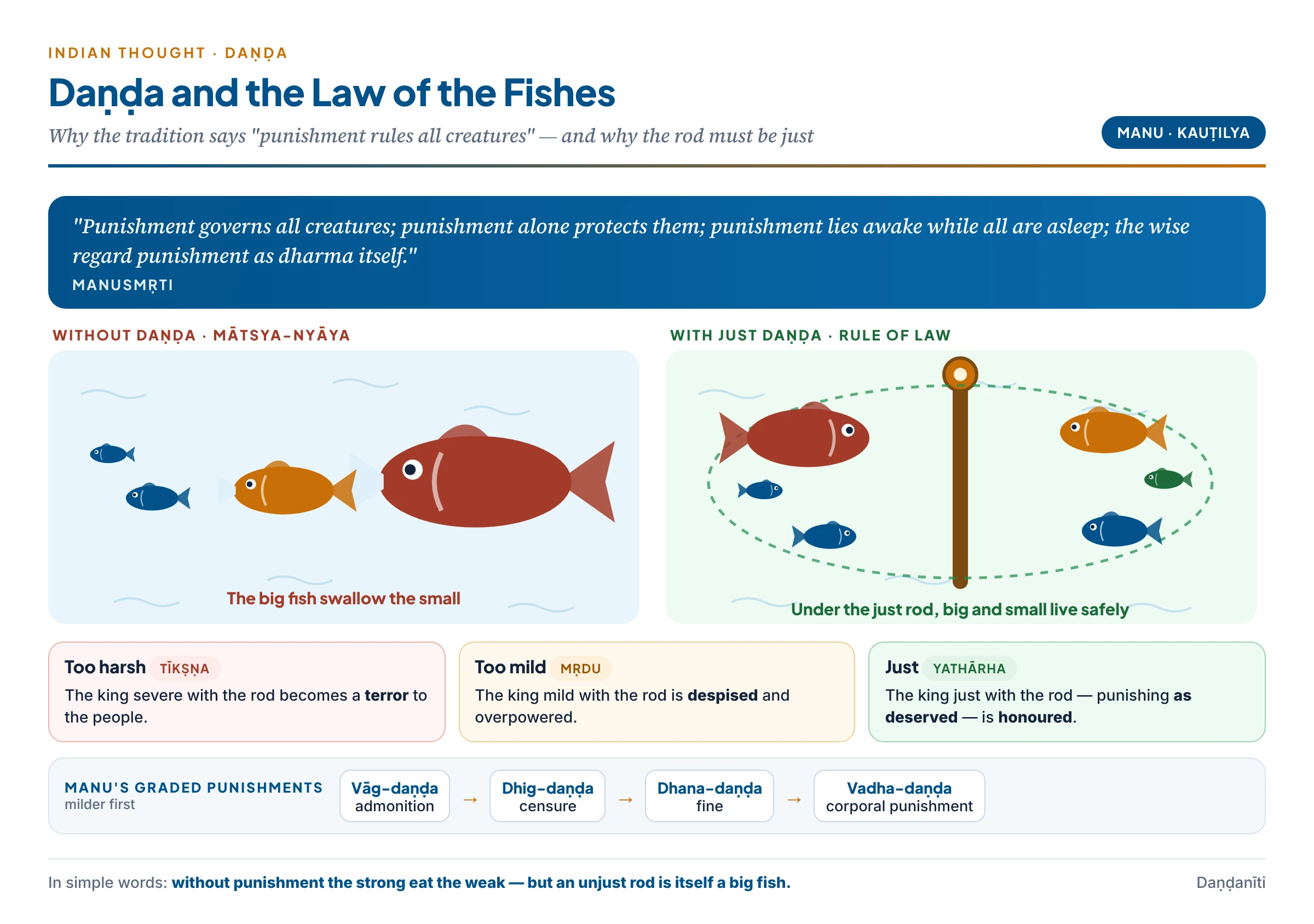
“Punishment governs all creatures; punishment alone protects them; punishment lies awake while all are asleep; the wise regard punishment as Law (dharma) itself.” — Manusmṛti
- Its meaning, line by line:
- “Governs all creatures” — every being, from the subject to the officer, obeys the law mainly through fear of the sanction.
- “Alone protects them” — punishment protects the weak against the strong.
- “Lies awake while all are asleep” — the law keeps watch even when the king and his officers sleep; the thought of punishment restrains people when no one is looking.
- “Punishment is dharma itself” — punishment is not opposed to righteousness; rightly used, it is the moral order in action.
- Mātsya-nyāya — the law of the fishes. If the king did not punish, says Manu, “the stronger would roast the weaker, like fish on a spit”. Kauṭilya’s Arthaśāstra uses the same image: without daṇḍa, the big fish swallow the small; with it, even the weak can stand up to the strong.
- Daṇḍa must be just, not merely strong. The tradition is clear that punishment is a double-edged sword:
- Manu: properly inflicted after due consideration, it makes all people happy; inflicted without consideration, it destroys everything.
- The king must consider the time and place of the offence and the strength and knowledge of the offender before punishing.
- A king who is lustful, partial or deceitful is destroyed by the very punishment he misuses.
- Kauṭilya: a king severe with the rod terrifies the people; mild with the rod he is despised; just with the rod (yathārha-daṇḍa, “punishment as deserved”) he is honoured.
- Graded punishments. Manu lists four stages — admonition (vāg-daṇḍa), censure (dhig-daṇḍa), fine (dhana-daṇḍa), and corporal punishment (vadha-daṇḍa) — to be used in that order, the milder first.
In simple words
Think of a busy traffic junction at midnight. There is no policeman, yet most drivers stop at the red light. Why? Partly habit, but mostly the knowledge that a camera may be watching and a challan may follow. That is what Manu means when he says punishment “lies awake while all are asleep“.
- Interpreting “Punishment rules all creatures” — three readings:
- Deterrent reading — order rests on fear; people obey because they fear the rod (close to Hobbes and Bentham).
- Protective reading — punishment is the shield of the weak; it creates the rule of law in which the weak can live safely (close to Locke).
- Moral reading — punishment is dharma: it restores the moral order disturbed by the crime (close to Kant and Hegel’s retributivism).
- Evaluation of the maxim:
- Its truth: no society has survived without sanctions; law without enforcement is a mere wish.
- Its danger: if fear alone “rules all creatures”, morality is reduced to fear of the stick, and a tyrant can rule by terror in the name of daṇḍa.
- Its limits: fear works only on those who think of consequences; it does little against crimes of passion, despair or fanaticism.
- A higher ideal: the Buddha, the Jainas and Gandhi placed self-discipline above the rod — a society where people do right because they want to, not because they are afraid. The best society needs less punishment, not more.
Indian Connect — When crime begins with poverty
The Buddhist Cakkavatti Sīhanāda Sutta tells the story of a king who failed to give wealth to the needy. Poverty spread; a poor man stole; the king, pitying him, gave him money — so others stole too. The king then began to execute thieves; the thieves armed themselves and began to kill; violence and lying spread through society. The moral: crime grows from neglect of welfare, and harsher punishment alone only escalates it. Over two thousand years before modern criminology, this text linked crime to social conditions — the same insight behind the reformative theory and the welfare State.
- Manu’s differential punishment. The Manusmṛti prescribes different punishments for the same crime according to the offender’s varṇa. In offences such as abuse and assault, the lower-varṇa offender against a higher one is punished far more severely. Modern thinkers, above all Ambedkar, condemned this as graded inequality written into criminal law. The modern principle of equality before law (Article 14) rejects it completely.
Common confusion
Did Manu always punish the higher varṇas more lightly? Not always — and the full picture is more interesting. In offences of insult and violence against higher varṇas, Manu is indeed far harsher on the lower. But for theft, he lays down the opposite rule: a Śūdra’s guilt is eightfold, a Vaiśya’s sixteenfold, a Kṣatriya’s thirty-twofold and a Brāhmaṇa’s sixty-four-fold, because the more one knows, the greater the guilt. Either way, the punishment depends on who the offender is, not only on what he did — and that is exactly what equality before law rejects.
Punishment in Society — Durkheim and Foucault
- Durkheim (social solidarity): punishment is a ceremonial reaffirmation of the collective conscience. When society punishes a murderer, it is really telling its members, “this is who we are; this we will not accept“. The main audience of punishment is not the criminal but the law-abiding majority.
- Foucault (Discipline and Punish, 1975): traced the change from the public spectacle of torture and execution to the quiet discipline of the prison. Modern power, he argued, works by surveillance and normalisation — like Bentham’s Panopticon, a circular prison where inmates can always be watched but never know when. Punishment moved from the body to the soul.
Limits Set by Human Rights
- Only a court, only after a fair trial. Punishment must be pronounced by a judicial authority after a fair trial. Death in police custody and fake encounters are not punishment but crimes by the State, and serious violations of human rights.
- No inhumane punishment. No inhumane act can be justified in the name of punishment — stoning to death, flogging, mutilation. Article 5 of the Universal Declaration of Human Rights forbids “cruel, inhuman or degrading” punishment.
- The undertrial problem. Keeping people in jail for years without trial — sometimes for more than a decade without even charges framed — is a grave infringement of human rights. In India, about 72.6% of all prisoners were undertrials at the end of 2024 (5.1 lakh prisoners in jails at 112.7% occupancy), and most come from poor and marginalised groups.
- Indian constitutional safeguards:
- Article 20 — no punishment under a law made after the act (ex post facto), no double punishment for the same offence, no forced self-incrimination.
- Articles 21 and 22 — no deprivation of life or liberty except by just, fair and reasonable procedure; rights on arrest.
- Supreme Court: Hussainara Khatoon (1979) — speedy trial is part of Article 21; Sunil Batra (1978) — prisoners keep their fundamental rights; D.K. Basu (1997) — guidelines against custodial torture.
- BNSS 2023, Section 479: a first-time undertrial who has spent one-third of the maximum sentence in custody is to be released on bail.
- Does punishment even work? Psychologists point out that the effect of punishment is often short-lived, and people who are punished repeatedly tend to build up resistance to it. So punishments must be made meaningful and effective — aimed at actually preventing and controlling crime, not merely at inflicting pain.
Critical Evaluation
The Abolitionist Challenge — Should State Punishment Be Scrapped?
The 2006 paper asked about “the view that argues that since no existing penal system for crime prevention has adequate justification, state punishment cannot be justified; and therefore, it should be completely abolished”. This is penal abolitionism.
The abolitionist argument:
- State punishment deliberately harms people, so it needs an adequate moral justification.
- Retributivism fails: it cannot show why adding the offender’s suffering to the victim’s suffering makes the world better.
- Deterrence fails: it would allow punishing the innocent or using cruel penalties if they deterred; and the evidence that severe punishment deters is weak.
- Reform fails: prisons rarely reform; “cure” can mean indefinite, paternalistic control.
- Mixed theories only stitch together failed parts.
- So no adequate justification exists, and State punishment should be abolished — replaced by other responses to wrongdoing.
Who holds it and why:
- Moral abolitionists — philosophers who argue that no theory succeeds, so the burden of proof is not met (David Boonin, The Problem of Punishment, 2008).
- Nils Christie: the State “steals the conflict” from victim and offender; they should meet and settle it themselves.
- Anarchists (Kropotkin, Tolstoy): prisons are “universities of crime“; coercion breeds the evils it claims to cure.
- Marxists: criminal law protects property and the ruling class; crime comes from exploitation, and punishment only hides the cause.
- Prison abolitionists (Angela Davis): mass incarceration falls on the poor and racial minorities and is a form of social control.
- Gandhi, in spirit: “an eye for an eye makes the whole world blind”; crime should be met with love and reform, not retaliation.
Proposed alternatives: restitution (offender repays the victim), restorative justice (dialogue and repair — Article 4), treatment (for addiction and mental illness), community supervision, and social reform to remove the causes of crime.
Replies to abolitionism:
- An imperfect justification is not no justification. Each theory captures a real truth (desert, safety, reform); together they can justify a limited institution.
- Without punishment, private vengeance returns — Locke’s problem of everyone being judge in his own case, and Manu’s mātsya-nyāya.
- Restitution cannot cover the gravest crimes. What restitution is there for murder or rape? And a poor offender cannot pay, while a rich one can “buy” his crime.
- Dangerous offenders must be restrained, whatever we call it.
- The abolitionist case is really a case for reform — fewer prisons, shorter sentences, better conditions, more alternatives — not for a society with no sanctions.
In simple words
Imagine a hospital where many operations go wrong. The right response is not to abolish surgery but to train surgeons better, operate less often, and choose gentler treatments where possible. Most thinkers treat abolitionism the same way: a powerful criticism of how we punish, but not a proof that we may never punish.
Critics and Defenders
Criticism — Critics of State punishment
- Abolitionists: no theory gives an adequate justification; the practice should end.
- Christie: the State takes over the conflict and silences victim and offender.
- Kropotkin and Tolstoy: prisons breed crime; coercion corrupts.
- Marxists: criminal law protects the propertied class; punishment hides social causes.
- Foucault: modern punishment is a technique of surveillance and control, not of justice.
- Buddhist and Gandhian ethics: the rod escalates violence; inner discipline and welfare are the real remedies.
Defence — Defenders of State punishment
- Hobbes: covenants without the sword are but words.
- Locke: public punishment by impartial judges replaces partial private revenge.
- Manu and Kauṭilya: without daṇḍa, the strong devour the weak; just punishment protects all.
- Durkheim: punishment reaffirms the shared values that hold society together.
- Hart: punishment can be justified if its aim is prevention and its distribution is limited by guilt and proportion.
- Constitutional democracies: punishment under fair trial, with rights and limits, is a pillar of the rule of law.
Cross-Tradition Comparison
Indian and Western Thought on the Need for Punishment
| Issue | Indian thought | Western thought | Common insight |
|---|---|---|---|
| Why punish? | Without daṇḍa, mātsya-nyāya — the big fish eat the small | Without the sovereign, a “war of all against all” (Hobbes) | Punishment prevents the rule of the strong |
| Who may punish? | The king, as protector of dharma | The State, holding power handed over by the people (Locke) | Punishment must be public, not private |
| Limit on punishment | Just rod (yathārha-daṇḍa); consider time, place, offender | Proportion and necessity (Beccaria) | Excessive punishment is itself injustice |
| Moral status | Punishment is dharma itself (Manu) | Punishment restores right (Kant, Hegel) | Punishment is a moral, not only a practical, act |
| Causes of crime | Neglect of welfare breeds theft and violence (Cakkavatti Sīhanāda Sutta) | Social conditions, strain, inequality (Durkheim, Marx) | Society must remove causes, not only punish effects |
| Higher ideal | Self-discipline, ahiṃsā (Buddha, Mahāvīra, Gandhi) | A society needing little coercion (anarchists, Kant’s moral autonomy) | The best order needs the least punishment |
Indian Connect — From the rod to the Constitution
Classical India gave daṇḍa to the king and made it dharma; but it also bent daṇḍa to varṇa. The Indian Constitution keeps the first idea and rejects the second: punishment is part of the rule of law (daṇḍa protects the weak), but it must be equal for all (Article 14), imposed only by fair procedure (Article 21), and never retrospective or double (Article 20). Ambedkar’s dream was daṇḍa without hierarchy.
Synthesis (Siddhānta)
- Crime is a legal wrong punished by the State; what counts as a crime changes with time and place, so the justice of punishment depends on the justice of the law.
- Punishment has five features — unpleasant, for an offence, on the offender, intentionally imposed by others, by a lawful authority — and carries condemnation and stigma. It differs from revenge by being impartial, rule-governed and proportionate.
- Because punishment deliberately harms, it always needs justification, and the question splits into two: why punish at all, and whom and how much.
- The Indian maxim “Punishment rules all creatures” is true as a statement of necessity: no society survives without sanctions, and daṇḍa protects the weak from mātsya-nyāya. But it becomes dangerous if fear is made the only basis of order. The same tradition insists the rod be just, and its best voices (the Buddha, Gandhi) seek a society that needs the rod less and less.
- The abolitionist challenge fails as a proof that all punishment is unjust, but it succeeds as a warning: punishment must be the last resort, limited by guilt and proportion, humane in method, and joined to social reform that removes the causes of crime.
- Contemporary relevance: overcrowded prisons, undertrials who form nearly three-quarters of all prisoners, custodial deaths, and debates on bail and speedy trial show that in India the main problem is often not too little punishment but punishment without trial.
“Covenants, without the sword, are but words, and of no strength to secure a man at all.” — Thomas Hobbes
Previous Year Questions
- 2008“Punishment rules all creatures, punishment preserves them all.”
- 2007Consider why punishment is generally thought to require justification. In this context, give your critical and comparative account of the main theories of punishment.
- 2006Describe the tension between consequentialist and retributivist theory of punishments. Discuss critically in this context the view that argues that since no existing penal system for crime prevention has adequate justification, state punishment cannot be justified; and therefore, it should be completely abolished.
- 2004Discuss the notion of punishment. Consider in this context the importance and implications of the principle of proportionality of punishment which requires that severity of punishment be proportionate to the seriousness of the crime.