

Humanism; Secularism; Multi-culturalism.
Official Syllabus: Paper II, Section A, Unit 6
Multiculturalism begins from a simple observation and a demanding claim. The observation: most modern societies contain many cultures — groups with different languages, religions, customs, histories and ways of life. The claim: this diversity should not merely be put up with or erased by assimilation; it should be recognised, respected and accommodated in public life and law, because culture matters deeply to who people are. The first is the descriptive sense of multiculturalism, the second its normative sense — and UPSC has asked about this distinction again and again. This article explains the meaning of multiculturalism, the descriptive–normative distinction, the structural characteristics that make a nation multicultural, the models societies use to handle diversity (from assimilation and the melting pot to the salad bowl and interculturalism), the justifications for multiculturalism — including tolerance and coexistence and freedom from domination — and its relation to globalisation. The great theorists (Taylor, Kymlicka, Young, Parekh, Okin) follow in Article 8; evaluation and the Indian case in Article 9.
In simple words
Think of an Indian thali. Dal, sabzi, rice, roti, raita, pickle and sweet sit in separate bowls on one plate. Each keeps its own taste; together they make one meal. Nobody mashes them into a single paste (that would be assimilation), and nobody puts them on different tables (that would be segregation). Multiculturalism wants society to be like a thali — many distinct cultures, one shared plate.
Context & Problem
What Is Culture?
- Culture, in E.B. Tylor’s classic definition (1871), is “that complex whole which includes knowledge, belief, art, morals, law, custom, and any other capabilities and habits acquired by man as a member of society”.
- In multicultural debates, a “culture” usually means a group with a shared way of life — language, religion, ethnicity, history, customs — that gives its members meaning and identity.
Meaning of Multiculturalism
- Core idea. Multiculturalism holds that culture plays a central role in the life of individuals. It recognises cultural plurality and concedes that no culture is inherently superior or inferior.
- Examples of the politics it inspired: Black aesthetics (“Black is beautiful”), the LGBT pride movements, indigenous peoples’ movements, language movements, demands of immigrant religious communities.
- The philosophical assumption. Human beings are not autonomous, culture-free creatures; their rationality itself is part of a culture — we think, choose and value through the languages and traditions we inherit.
- Culture as a link. Culture acts as the link between the individual self and the community.
- Policy implication. In its policies, the state should recognise the existence of various cultures, and cultural plurality should be part of policy formulation — in education, language, law, representation and public symbols.
Multicultural Society vs Multiculturalism (Bhikhu Parekh)
- A multicultural society is a fact — a society containing several cultures.
- Multiculturalism is a normative response to that fact — a view about how such a society should treat its diversity.
- Parekh’s three kinds of diversity:
- Subcultural diversity — people who share the broad culture but differ in particular beliefs or lifestyles (gays and lesbians, alternative lifestyles).
- Perspectival diversity — people who criticise the central principles of the dominant culture and want to reshape it (feminists, environmentalists, religious critics of secular modernity).
- Communal diversity — self-conscious, well-organised communities with their own long-established ways of life (immigrant communities, religious communities, indigenous peoples, national minorities like the Québécois or the Basques).
Multiculturalism is mainly concerned with communal diversity, though it touches all three.
Why Multiculturalism Emerged
- Immigration. Post-war labour migration and the end of empire brought large immigrant populations to Europe, North America and Australia — the growing problem of immigrants needing a place in national life.
- The crisis of the nation-state. European states had been built as nation-states — one people, one language, one culture. With globalisation, migration and minority revival, this fabric was under threat; multiculturalism emerged as a response to this social tension at the level of both policy and philosophy.
- Rights movements. The US civil rights movement, women’s movements, indigenous and gay rights movements demanded recognition, not just formal equality.
- Failure of assimilation. Forced assimilation of indigenous peoples (residential schools in Canada and Australia) produced deep injustice.
- First policies. Canada adopted an official multiculturalism policy in 1971 (later the Canadian Multiculturalism Act, 1988; recognised in the 1982 Charter); Australia followed in the 1970s.
- In short: multiculturalism is an attitude and policy of accommodating diverse cultural groups within the national mainstream of a country.
Core Doctrine
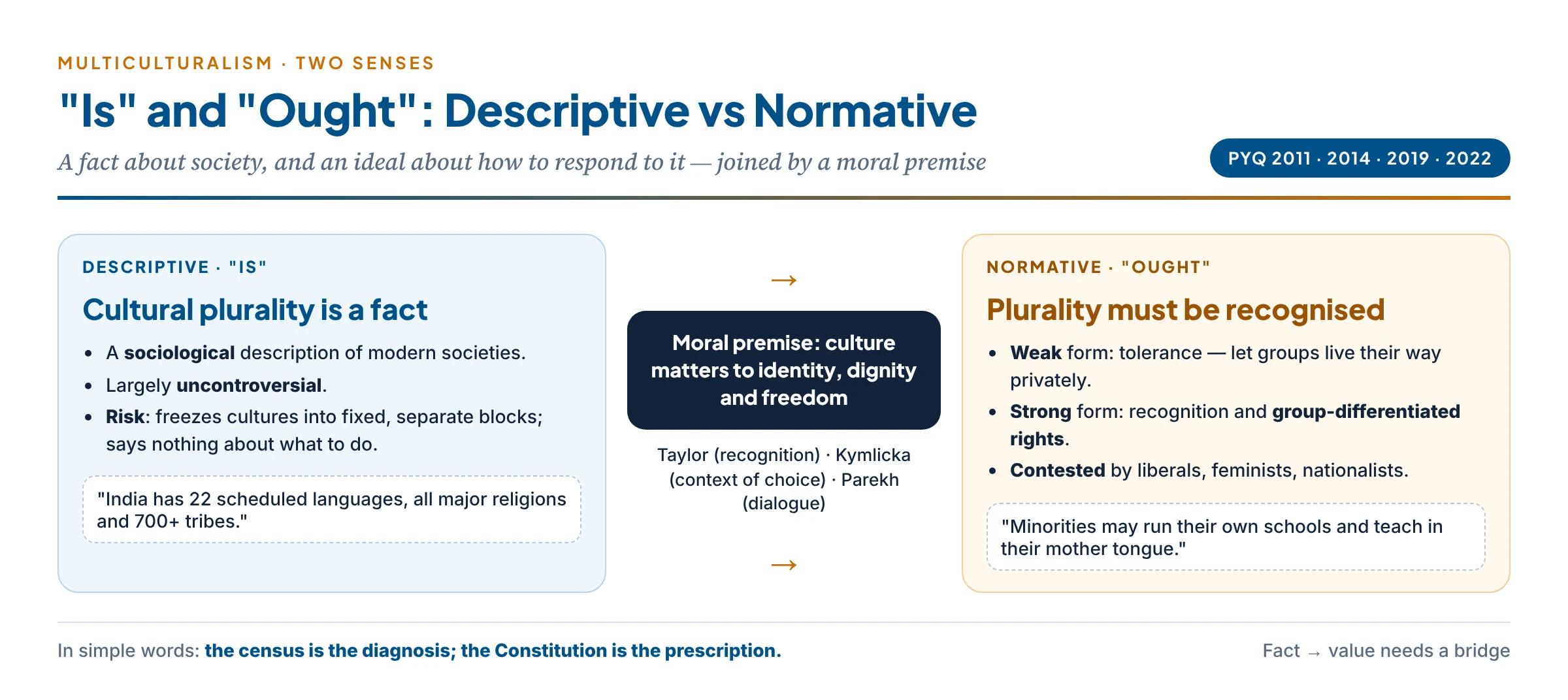
The Descriptive and the Normative Senses
| Point | Descriptive multiculturalism | Normative multiculturalism |
|---|---|---|
| What it says | Cultural plurality is a fact | Plurality must be recognised and respected |
| Kind of statement | “Is” — a sociological description | “Ought” — a moral and political ideal |
| Question | How diverse is this society? | How should the state and society respond to diversity? |
| Example | “India has 22 scheduled languages and many religions” | “Minorities should have the right to run their own schools and use their own language” |
| Controversy | Largely uncontroversial (though which groups count is debated) | Highly contested — liberals, communitarians, feminists and nationalists disagree |
| Who holds it | Anyone describing modern societies | Taylor, Kymlicka, Parekh, Young (with different strengths) |
Strengths and weaknesses of each:
- Descriptive sense.
- Strength: an honest starting point — no society today is culturally homogeneous.
- Weakness: it can freeze cultures into fixed, separate blocks (“essentialism”) when real cultures overlap, change and are internally plural; and the bare fact of diversity tells us nothing about what to do.
- Normative sense.
- Weak version: tolerance — let minorities practise their culture privately.
- Strong version: recognition and group-differentiated rights — public support, exemptions, self-government, special representation.
- Strength: it corrects the hidden bias of “neutral” states that in practice favour the majority culture.
- Weakness: it may entrench group leaders’ power over members, fragment national solidarity, or slide into cultural relativism.
The link between the two. One cannot derive the normative from the descriptive alone (“there are many cultures, therefore all must be equally supported” is a jump). The bridge is a moral premise — that culture is important to human dignity, freedom and identity (Taylor, Kymlicka, Parekh).
In simple words
A doctor’s report says, “This patient has high blood pressure” — that is descriptive. The prescription says, “Take this medicine and walk daily” — that is normative. A census saying “India has many religions and languages” is the report; a Constitution that says “minorities may run their own schools” is the prescription.
Multiculturalism Acts at Two Levels
- The dominant group must show toleration and accommodation towards other cultural groups — in daily life, workplaces, neighbourhoods, media.
- The state must secure equal rights as citizens and due representation in decision-making bodies for all groups.
Parekh’s Three Features of Multiculturalism
- Culture shapes human nature — human beings are culturally embedded; they grow up and live within a culturally structured world.
- Cultural plurality does not mean that some cultures are inherently inferior or superior — each culture is a different system of meaning and vision of the good life, with its own insights and limits.
- Cultures interact with others and get enriched — every culture is internally plural and grows through dialogue with others; no culture is complete in itself.
Models of Managing Diversity
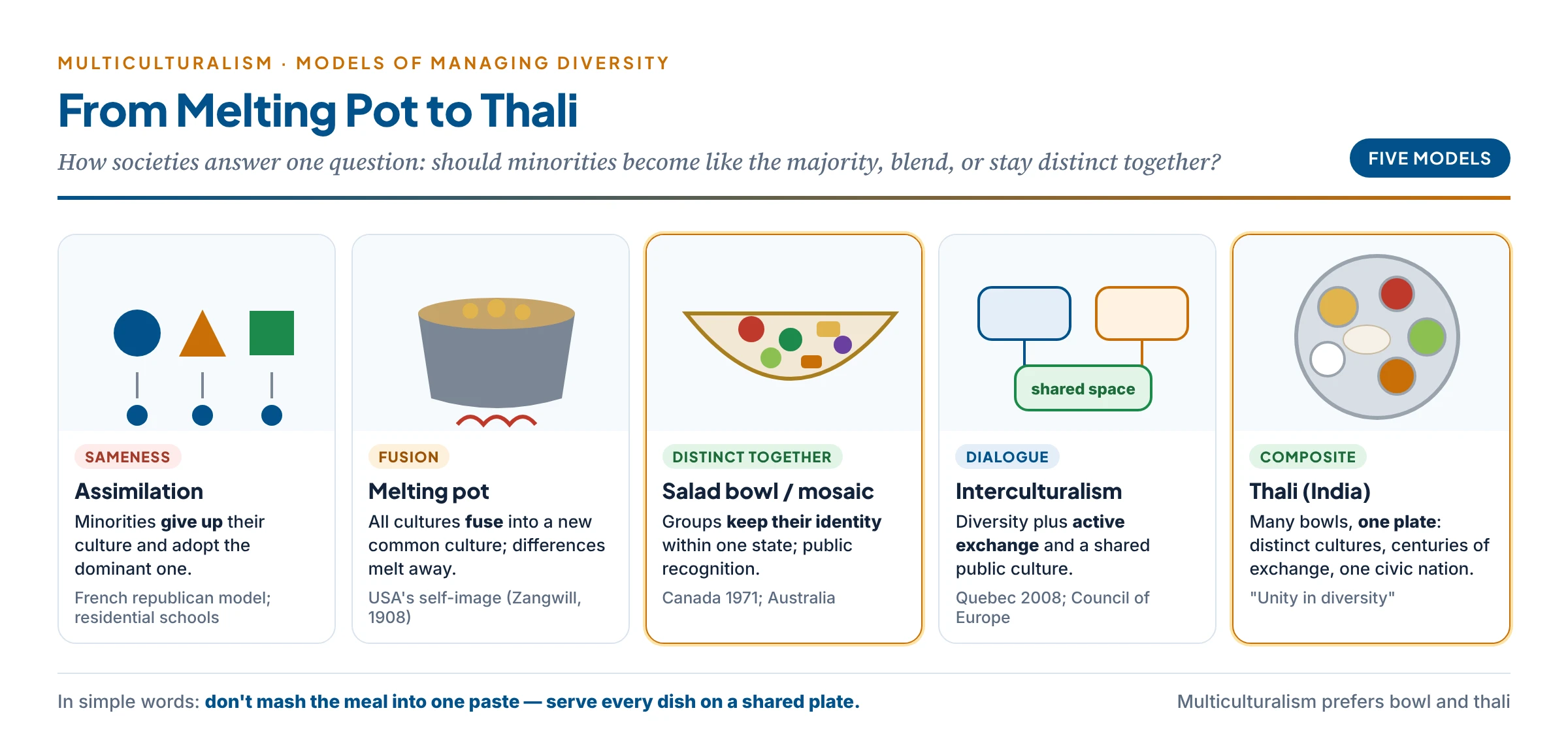
| Model | Image | Idea | Example |
|---|---|---|---|
| Assimilation | “Become like us” | Minorities give up their culture and adopt the dominant one; equality through sameness | French republican model; “Anglo-conformity” in early USA; residential schools for indigenous children |
| Melting pot | A pot where metals fuse | All cultures blend into a new common culture (term from Israel Zangwill’s play The Melting Pot, 1908) | The USA’s self-image |
| Differential exclusion | Guests, not citizens | Migrants admitted for labour but kept outside citizenship | West Germany’s “guest workers” (Gastarbeiter) |
| Multiculturalism | Salad bowl / mosaic | Groups keep their distinct identities within a shared state; public recognition | Canada (1971), Australia |
| Interculturalism | A conversation | Diversity plus active exchange and a shared public culture; dialogue over separation | Quebec (Bouchard–Taylor report, 2008); Council of Europe (2008) |
| Composite culture | Thali / “unity in diversity” | Many cultures with distinct identities and a long history of mutual borrowing, within one civic nation | India |
Common confusion
Is the “melting pot” a multicultural model? No — it is closer to assimilation. In a melting pot, different cultures fuse into one new culture and lose their separate identities. Multiculturalism prefers the salad bowl or mosaic, in which groups keep their distinctness inside a shared whole. The USA called itself a melting pot; Canada deliberately chose the “mosaic” to contrast with it.
Structural Characteristics that Make a Nation Multicultural
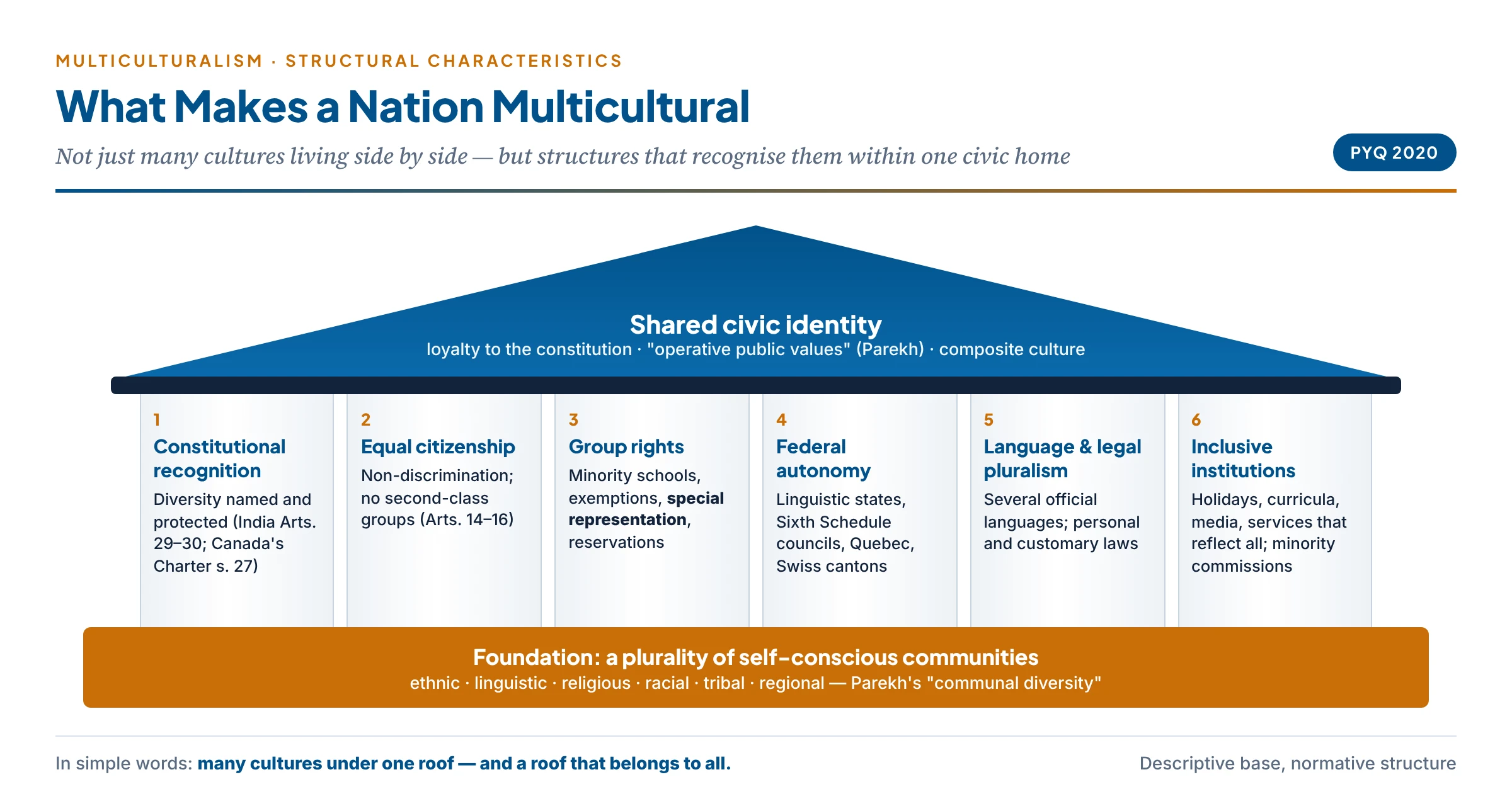
A nation is multicultural not merely because many cultures live in it (descriptive) but when its structures recognise and accommodate them (normative). The key features:
- Plurality of cultural communities — ethnic, linguistic, religious, racial, tribal, regional groups with self-conscious identities (communal diversity).
- Constitutional recognition of diversity — the constitution names and protects cultural plurality (India’s Articles 29–30; Canada’s Charter, s. 27; South Africa’s “rainbow” Constitution).
- Equal citizenship and non-discrimination — no culture’s members are second-class (Articles 14–16).
- Group-differentiated rights — minority educational and cultural rights, language rights, exemptions (Sikh turbans and helmets), special representation (reserved seats).
- Territorial autonomy / federalism — self-government for regional or national minorities (India’s linguistic states and Sixth Schedule councils; Quebec; Switzerland’s cantons; Spain’s autonomous communities).
- Linguistic pluralism — several official languages (India’s Eighth Schedule with 22 languages; Switzerland’s four; South Africa’s twelve).
- Legal pluralism — personal or customary laws for different communities (Indian personal laws; customary law in Nagaland and Mizoram).
- Inclusive public institutions — holidays, symbols, curricula, media and civil services that reflect diversity.
- A shared civic identity — common “operative public values” (Parekh) and loyalty to the constitution that hold the diverse groups together.
- Institutions of dialogue and redress — minority commissions, courts, consultative bodies.
Indian Connect — Indian Connect — India as a structurally multicultural nation
- Plurality: all major world religions; the Eighth Schedule’s 22 languages and hundreds of mother tongues; over 700 Scheduled Tribes; deep regional and caste diversity.
- Structures: Articles 29–30 (minority culture and education), 350A–350B (mother-tongue instruction, a Commissioner for Linguistic Minorities), linguistic reorganisation of states (from 1956), the Fifth and Sixth Schedules (tribal areas and autonomous councils), Articles 371A–371J (special provisions for particular states), personal laws, reservations for SCs and STs.
- Civic glue: the Constitution, fraternity (Ambedkar), “unity in diversity” (Nehru), and a long history of a composite culture (Indo-Islamic architecture, music, Bhakti–Sufi traditions, Hindustani).
Justifications for Multiculturalism
- Preventing disintegration. A multicultural country that fails to cultivate the spirit of multiculturalism may eventually disintegrate — Yugoslavia (1990s), Sri Lanka’s civil war after “Sinhala Only” (1956), the breakaway of Bangladesh after Urdu was imposed on Bengali speakers.
- Social justice through representation. To secure social justice, people belonging to different cultures should be given due representation in decision-making.
- Against majority domination. Without it, the domination of the majority in voting leads to the neglect of minorities’ concerns — e.g. the suppression of coloured races in Western societies, and the way men all over the world tend to oppress women.
- Mutual respect and flourishing. It enables different cultures within a community to flourish and treat each other with mutual respect.
- Recognition and dignity (Taylor) — misrecognition wounds identity.
- Context of choice (Kymlicka) — culture provides the meaningful options that make individual freedom possible.
- Value of diversity (Parekh, Mill) — different cultures are “experiments in living”; each sees what others miss and helps them see their own limits.
- Correcting false neutrality — the “neutral” state usually reflects the majority’s culture (holidays, language, dress codes).
- Freedom from domination and tolerance and coexistence — discussed below.
Tolerance and Coexistence — Ethical Principles behind Multicultural Societies
Meaning of tolerance. Tolerance is putting up with beliefs or practices one disapproves of or dislikes, though one has the power to suppress them. It has three parts: an objection (“I think this is wrong”), an acceptance (“but I will not interfere”) and a limit (“except where it causes serious harm”).
Coexistence is living together peacefully with those who differ — “live and let live” — and, at its best, “live and help live“: cooperation across differences.
Its sources:
- Western: Locke’s Letter Concerning Toleration (1689) — belief cannot be forced; Voltaire; Mill’s On Liberty (1859) — the value of diversity of opinions and “experiments of living”.
- Indian: Ashoka’s Rock Edict XII (“one should honour the sects of others… by honouring them one exalts one’s own sect”); Jaina anekāntavāda (truth has many sides); Akbar’s sulh-i-kul; Kabir and Nanak; Gandhi’s move from tolerance to equal respect.
Michael Walzer (On Toleration, 1997) describes five regimes of toleration — multinational empires (the Ottoman millets), international society, consociations (Switzerland, Belgium), nation-states, and immigrant societies — and a range of attitudes from mere resignation and indifference, through stoic acceptance and curiosity, to enthusiastic endorsement of difference.
The role of tolerance and coexistence in the rise of multicultural societies:
- Precondition of peace. Without minimal tolerance, diversity produces persecution and war (Europe’s wars of religion); tolerance makes coexistence possible.
- Opening for minorities. It allows minority cultures to survive and practise their ways of life.
- Habit of reciprocity. It teaches that one’s own freedom depends on granting freedom to others.
- Humility. It rests on fallibilism — no culture has the whole truth (anekāntavāda; Parekh).
- Stepping stone to recognition. Tolerance is the first stage; multiculturalism moves beyond it to equal respect and recognition (Taylor) and active coexistence — shared festivals, institutions and dialogue.
Limits of tolerance:
- Condescension. Tolerance can imply “I put up with you, though you are wrong” — the tolerated remain inferior (hence Gandhi’s preference for equal respect, and Taylor’s demand for recognition).
- The paradox of tolerance (Karl Popper, 1945): unlimited tolerance of the intolerant may lead to the disappearance of tolerance; a tolerant society may refuse to tolerate those who would destroy it.
- What should not be tolerated — practices that violate basic human rights (sati, untouchability, female genital cutting, honour killing).
In simple words
In a housing society, tolerance is the neighbour who says, “I don’t like your loud festival music, but I won’t complain.” Coexistence is the neighbour who attends your festival, invites you to his, and joins the society committee with you. Multicultural societies begin with the first and grow towards the second.
Religious tolerance in a multicultural, pluralistic society. Religion is often the deepest source of identity and the most explosive source of conflict. Religious tolerance is therefore essential for: (1) peace — preventing communal violence; (2) freedom of conscience for all, including non-believers; (3) equal citizenship — no believer is second-class; (4) dialogue — mutual learning among faiths (inter-faith councils, shared shrines); (5) national unity in diverse states like India. It must be joined to equal respect (not mere endurance) and to limits drawn by human rights.
“Freedom from Domination” as a Justification of Multiculturalism
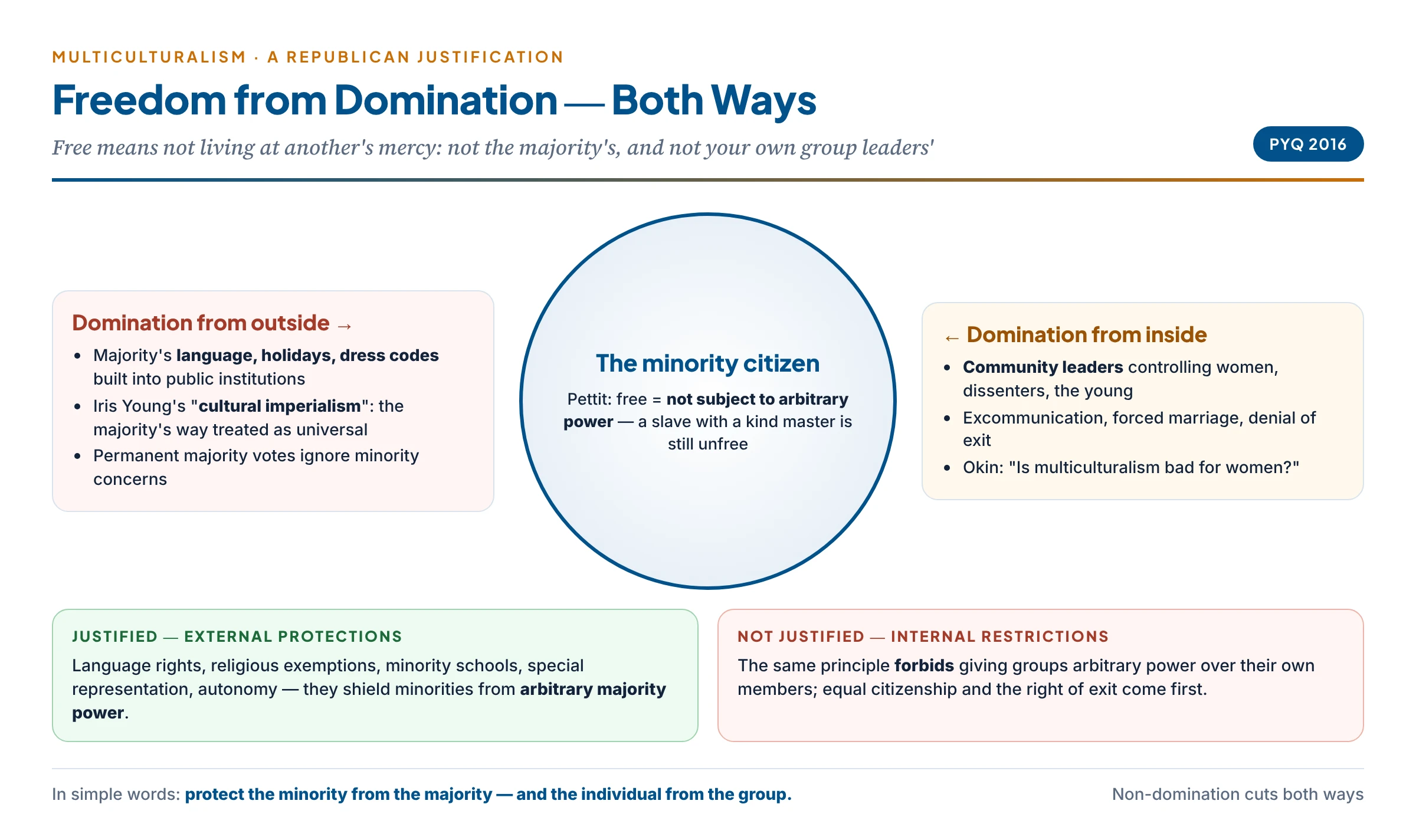
What “freedom as non-domination” means. In the republican tradition (Philip Pettit, Republicanism, 1997), a person is free not merely when no one interferes with him, but when no one has the power to interfere with him arbitrarily. A slave with a kind master is still unfree, because he lives at the master’s mercy.
How it supports multiculturalism:
- Majority norms as hidden domination. When the majority’s language, holidays, dress codes and history are built into public institutions, minorities must live by rules they had no part in making — they are dominated, even if no one is cruel to them.
- Cultural imperialism. Iris Marion Young calls this a “face of oppression“: the dominant group’s experience is treated as universal, and minorities are seen as deviant or invisible.
- Accommodations reduce domination — language rights, religious exemptions, minority schools, special representation and territorial autonomy give minorities a voice and protection against arbitrary majority power.
- Voting power. Multiculturalism prevents the majority from using its numbers to ignore minority concerns permanently.
Reasons for caution:
- Domination within groups. Group rights may give community leaders arbitrary power over their own members — women, dissenters, the young (Okin, Article 8). Non-domination, consistently applied, protects the individual against the group as well.
- Critical republicans (e.g. Cécile Laborde) argue that non-domination supports equal citizenship, exit rights and inclusion in the mainstream more than strong group rights.
- Isolation can dominate too — segregated minorities may be cut off from opportunities in the wider society.
Conclusion. Yes — freedom from domination is a strong justification for multiculturalism, especially for external protections against the majority. But it cuts both ways: the same principle forbids internal restrictions that let groups dominate their own members. Properly understood, it justifies a multiculturalism of equal, non-dominated citizens.
Globalisation and Multiculturalism
How they are related:
- Globalisation creates multicultural societies. Migration, labour mobility, refugees, students and diasporas mix populations — the UN estimated about 281 million international migrants in 2020. Almost every major city is now multicultural.
- Global media and markets carry cultures across borders — Bollywood in Africa, K-pop in India, yoga in the West.
- Globalisation threatens diversity — a global consumer culture spreads the same brands, foods, films and languages (“McDonaldisation”, in George Ritzer’s phrase), and English dominates. Multiculturalism is partly a defence of diversity against this homogenisation.
- Globalisation provokes identity revival — people anxious about losing their identity turn back to religion, ethnicity and nationalism (“Jihad vs McWorld”, Benjamin Barber, 1995; Huntington’s “clash of civilizations”, 1996); multiculturalism must manage these new tensions.
- Global norms — UNESCO’s Universal Declaration on Cultural Diversity (2001) calls cultural diversity “the common heritage of humanity”, and its 2005 Convention protects the diversity of cultural expressions.
How their relationship affects cultural change — three outcomes:
| Outcome | What happens | Example |
|---|---|---|
| Homogenisation | Cultures become more alike; local traditions decline | Global fast food, fashion, English as global language |
| Polarisation (differentialism) | Cultures harden their boundaries in reaction | Religious revivalism, xenophobic nationalism |
| Hybridisation (glocalisation) | Cultures mix and create new forms | Indo-Western fusion music, “McAloo Tikki”, diaspora literature, Hinglish |
- Estrangement and counterculture. Consumerism produces a mass culture of estrangement — people lose their bonds of community and become isolated consumers (estrangement: no longer being on friendly terms with, or part of, a social group). In reaction arise countercultures — movements that reject the dominant consumer culture (the 1960s youth movements, ecological and spiritual movements today).
In simple words
Walk through a mall in Bengaluru: a global coffee chain (homogenisation), a shop selling only “pure traditional” goods and refusing anything foreign (polarisation), and a café serving masala-chai cheesecake to Hinglish-speaking students (hybridisation). Globalisation produces all three at once; multiculturalism tries to keep the mix fair and peaceful.
Is Multiculturalism a Need of Global Society?
Yes, because:
- Diversity is irreversible — migration and communication have made every society plural; the choice is not whether but how to live with diversity.
- Peace — failure to accommodate diversity breeds conflict and disintegration (Yugoslavia, Rwanda, Sri Lanka).
- Justice and dignity — minorities, migrants and indigenous peoples deserve recognition and equal rights.
- Creativity and development — diverse societies innovate (cities, universities, firms); different cultures offer different solutions.
- Global problems need global cooperation — climate change, pandemics and poverty require dialogue among civilisations.
- Against homogenisation — it preserves humanity’s “common heritage” of cultural diversity (UNESCO).
But with conditions:
- Universal human rights as a floor — multiculturalism cannot justify oppression in the name of culture.
- Shared civic values — a global or national society needs common ground, not only difference.
- Interculturalism — exchange and dialogue, not isolated “parallel societies”.
- Cosmopolitanism — Kwame Anthony Appiah’s “universality plus difference“: we owe obligations to all humans, and we value the particular ways of life that give their lives meaning.
Critical Evaluation
Criticisms of Multiculturalism (in brief — developed in Article 9)
- Fragmentation — it may “balkanise” society into separate groups with little in common.
- Relativism — if no culture is superior, how can we condemn oppressive practices?
- Essentialism — it treats cultures as fixed and homogeneous, ignoring internal diversity and change.
- Minorities within minorities — women and dissenters may suffer under group rights.
- Distraction from economic justice — identity politics may displace concern with class and poverty.
- Political backlash — European leaders declared that “multiculturalism has failed” (Merkel, 2010; Cameron, 2011).
Critics and Defenders
Criticism — Critics
- Liberal egalitarians (Barry): equal treatment means the same rules for all; exemptions are unfair.
- Feminists (Okin): group rights can entrench patriarchy.
- Nationalists and assimilationists: a nation needs one common culture.
- Cosmopolitans: cultures are fluid; freezing them into groups limits individuals.
- Republican critics: non-domination requires inclusion, not separation.
- Marxists and egalitarians: recognition distracts from redistribution.
Defence — Defenders and strengths
- Taylor: identity needs recognition; misrecognition is oppression.
- Kymlicka: culture is the context of individual choice; minority rights complete liberalism.
- Parekh: no culture is complete; dialogue among cultures enriches all.
- Young: assimilation projects the dominant group’s norms as universal; difference must be affirmed.
- Pettit-style republicans: accommodations protect minorities from arbitrary majority power.
- History: the failure of assimilation and the disintegration of states that denied diversity.
Cross-Tradition Comparison
Western Multiculturalism and the Indian Tradition of Diversity
| Point | Western multiculturalism | Indian tradition |
|---|---|---|
| Origin | Post-war immigration; rights movements; crisis of the nation-state | Millennia of internal diversity; empires that ruled many peoples |
| Core image | Salad bowl, mosaic | Thali, “unity in diversity”, composite culture |
| Philosophical roots | Hegel’s recognition, liberalism, communitarianism | Anekāntavāda, “Truth is one, the wise call it by many names”, vasudhaiva kuṭumbakam (the world is one family) |
| Political instruments | Minority rights, exemptions, official multiculturalism | Linguistic states, minority rights, personal laws, reservations, Sixth Schedule |
| Main tension | Integration of immigrants; Islam in Europe | Caste, communalism, regionalism, tribal autonomy |
Indian Connect — Indian Connect — the takeaway
- India was a multicultural society long before the word existed; its Constitution is one of the world’s most structurally multicultural — recognising languages, religions, tribes and regions while building one civic nation.
- Indian thought also supplies multiculturalism with epistemic humility (anekāntavāda: every view captures part of the truth) — the same insight Parekh uses for intercultural dialogue.
Synthesis (Siddhānta)
- Descriptively, multiculturalism names a fact — the plurality of cultures in modern societies; normatively, it is an ideal — that this plurality should be recognised and respected; the bridge is the moral claim that culture matters to identity, dignity and freedom.
- A nation is multicultural in the full sense when its structures — constitution, rights, federalism, languages, laws, institutions — recognise diversity within a shared civic identity.
- Tolerance and coexistence are its ethical foundations: tolerance makes coexistence possible; equal respect and recognition make it just; the paradox of tolerance and human rights set its limits.
- Freedom from domination justifies protecting minorities from the majority — and individuals from their own group leaders.
- Globalisation both creates multicultural societies and threatens diversity, producing homogenisation, polarisation and hybridisation; multiculturalism, joined to universal rights and intercultural dialogue, is a need of global society.
- Contemporary relevance.
- Migration and refugees — Europe’s integration debates, India’s own internal migrants and debates on citizenship.
- Language politics — mother-tongue education (National Education Policy, 2020) and debates over Hindi and regional languages.
- Digital globalisation — streaming platforms and social media accelerate hybridisation and polarisation at once.
“Concord alone is commendable, in this sense that all should listen and be willing to listen to the doctrines professed by others.” — Ashoka, Rock Edict XII
Previous Year Questions
- 2024Discuss the role of ethical principles of tolerance and coexistence for the rise of multicultural societies.
- 2022Critically analyze the descriptive and normative aspects of multiculturalism.
- 2020What do you understand by multiculturalism? Explain the structural Characteristics that make a nation multicultural.
- 2020What is the importance of religious tolerance in a multicultural pluralistic society? Justify your answer.
- 2019What are the descriptive and normative perspectives on ideas of multiculturalism?
- 2018What do you understand by multi-culturalism? How are globalization and multi-culturalism related? How does their relationship affect cultural changes?
- 2016Can we consider “freedom from domination” as one of the justifications for multiculturalism? Give reasons for your answer.
- 2015Is multiculturalism a need of global society? Discuss.
- 2014Explain descriptive and normative perspectives on multiculturalism.
- 2011The term ‘multi-culturalism‘ has been used in both a descriptive and a normative sense. Discuss.