

Humanism; Secularism; Multi-culturalism.
Official Syllabus: Paper II, Section A, Unit 6
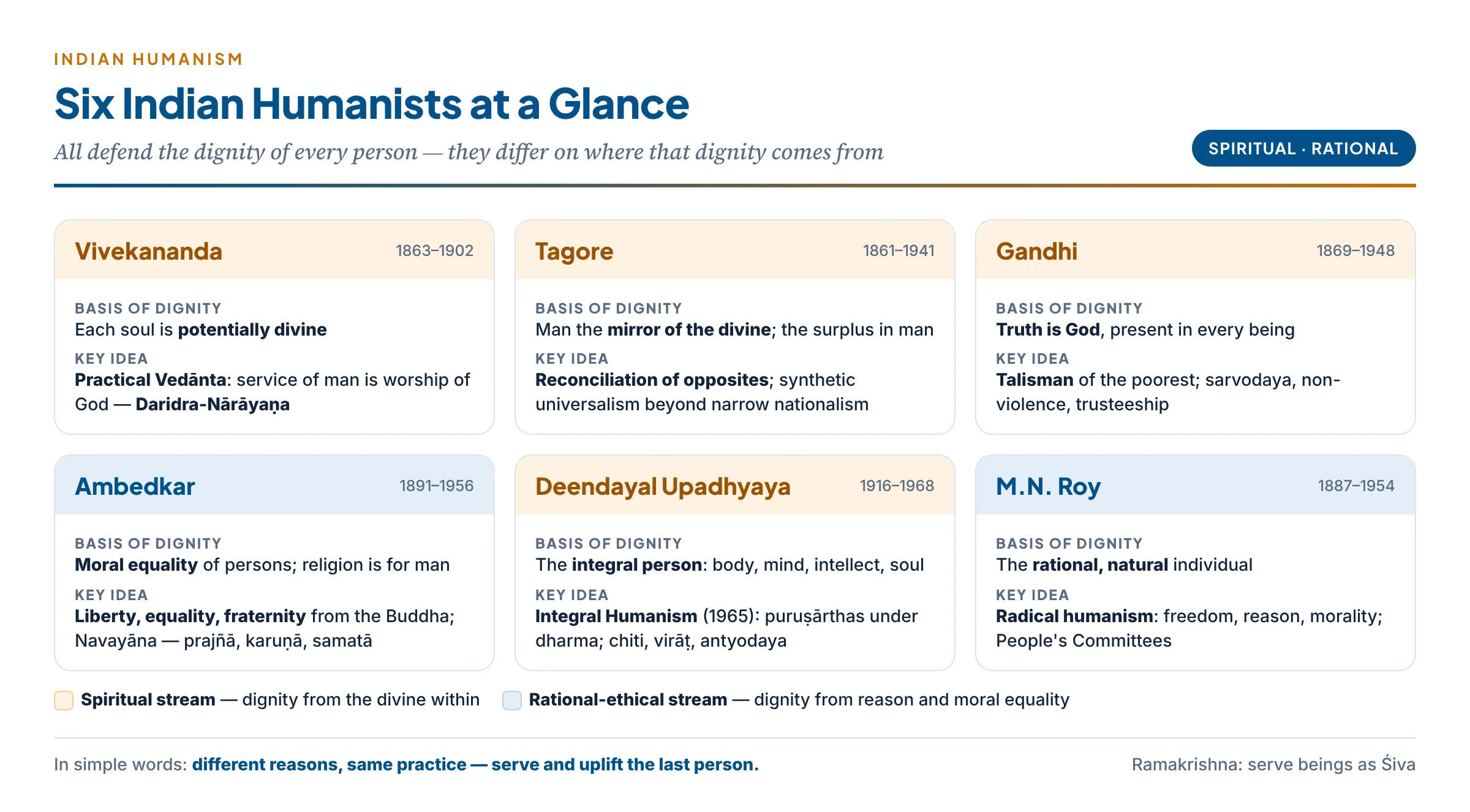
Modern Indian thinkers took the humanist idea of human dignity seriously — but most of them refused to separate it from the spirit. For Vivekananda, every human being is “potentially divine”, so serving man is worshipping God. For Tagore, man is the meeting point of the finite and the infinite, and his humanism is a reconciliation of opposites. Gandhi made the poorest person the test of every policy; Ambedkar built a humanism of liberty, equality and fraternity on the Buddha’s teaching; Deendayal Upadhyaya offered Integral Humanism — an Indian alternative to both capitalism and communism, built on the puruṣārthas and the idea of a nation’s soul (chiti). Against them stands the rationalist line of M.N. Roy (Article 2), for whom freedom is natural, not spiritual. This article explains these Indian humanisms, compares them with Western humanism, and then takes up three evaluative questions: Can humanism be a substitute for religion in present Indian society? Which form of humanism is most relevant today? And is social progress possible without humanism?
In simple words
Two doctors treat poor patients for free in a village. One says, “I do this because every human life is precious and suffering must be reduced.” The other says, “I do this because God lives in every patient, and serving them is my worship.” Both are humanists in what they do. They differ in why they do it. Most Western humanism speaks like the first doctor; most Indian humanism speaks like the second — and asks whether we need to choose at all.
Context & Problem
What Is Distinctive about Indian Humanism?
- Spiritual foundation. Dignity comes from the divine within man (ātman, Brahman), not merely from reason or nature.
- Service as worship. Religion is redefined as service of humanity — “Śiva-jñāne jīva-sevā” (serve living beings, knowing them to be Śiva), as Ramakrishna taught: service to mankind is service to God.
- Synthesis, not rejection. Indian humanists sought to reconcile science and spirituality, East and West, individual and society, rather than choose one side.
- Social reform. It was a response to colonial humiliation, caste, untouchability, the oppression of women and mass poverty — humanism had to mean the uplift of the downtrodden.
- Two streams. A spiritual stream (Ramakrishna, Vivekananda, Tagore, Aurobindo, Gandhi, Deendayal) and a rationalist stream (the Cārvāka in the classical age; M.N. Roy, Periyar and, in its own way, Ambedkar in modern times).
Core Doctrine
Swami Vivekananda — Practical Vedānta
His humanism is a natural corollary of his spiritualism.
- Man is divine. “Each soul is potentially divine; the goal is to manifest this divinity within.” Man is the highest being in creation because he alone attains freedom (mukti).
- Virtue is to be developed. Man is endowed with virtues that he must develop persistently; when he is conceived as the epitome of virtue, he becomes the most valuable asset of the universe.
- Self-legislating man. Man is not bound by any laws except those he makes for himself — a striking parallel to Kant’s autonomy.
- Practical Vedānta. He applied Advaita (non-dualism) to social regeneration: if the same Brahman is in all, then service to man is service to God. He spoke of Daridra-Nārāyaṇa — God in the form of the poor — a term Gandhi later popularised.
- Religion that feeds the hungry. “I do not believe in a God or religion which cannot wipe the widow’s tears or bring a piece of bread to the orphan’s mouth.“
- Duty of the educated. “So long as the millions live in hunger and ignorance, I hold every man a traitor who, having been educated at their expense, pays not the least heed to them.”
- Strength and fearlessness (abhaya) as the supreme virtues; he attacked religious passivity, untouchability (“don’t-touchism”) and priestcraft.
- Spiritual nationalism and Vedāntic socialism. India’s national life rests on spirituality; he foresaw the rule of the Śūdras — the labouring masses — as the next stage of history.
In simple words
If you truly believed that God lived inside the rickshaw-puller, the domestic worker and the beggar at the temple gate, you could not treat them with contempt. Vivekananda’s humanism turns devotion outward: the temple is the human being, and worship is feeding, teaching and healing people.
Rabindranath Tagore — The Religion of Man
Tagore’s humanism also rests on spiritual foundations, set out most fully in The Religion of Man (his Hibbert Lectures at Oxford, 1930), Sādhanā, Personality, Creative Unity and Nationalism (1917).
- Man the mirror of the divine. Each human being is regarded as the mirror of the divine and the culmination of the creative process. The infinite reveals itself not apart from humanity but through it — “the divinity of man and the humanity of God”.
- The surplus in man. Human beings always have a surplus beyond what survival needs — in art, love, sacrifice, science and religion. This surplus shows that man belongs to a universal reality larger than his animal self.
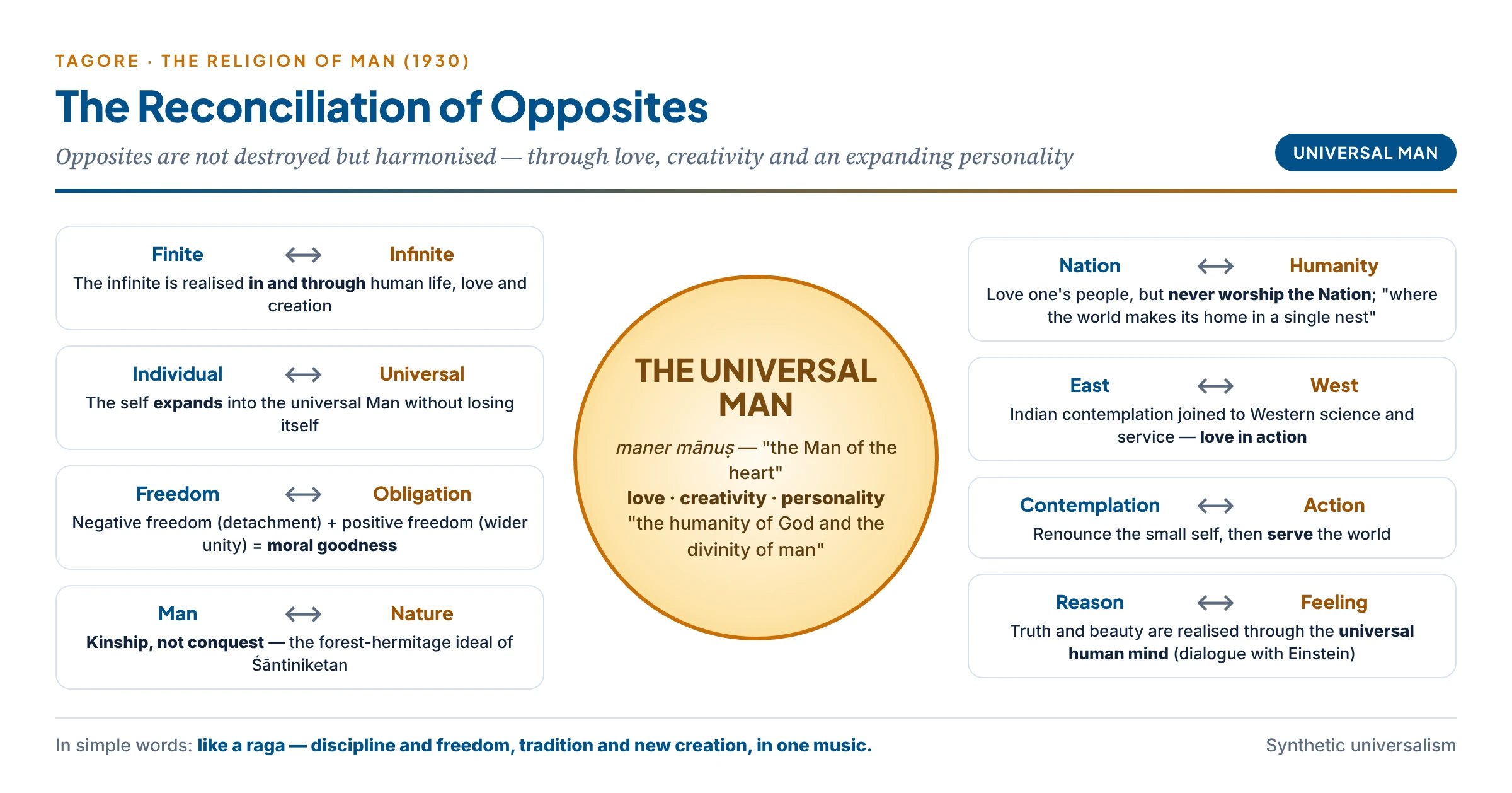
- The Man of my heart. Following the Baul singers of Bengal, Tagore speaks of the “Man of the heart” (maner mānuṣ) — the universal Man within each person. Religion is the effort to realise this universal humanity in oneself.
- Freedom through illumination. The human spirit has long been suppressed by the despotism of governments and other organs of power; it can attain freedom only through mental and moral illumination — education, art and inner growth.
- Compassion as worship. Compassion for the oppressed and the humiliated is a sure way to reach God. In the poem Dhūlā-mandir (the dusty temple), God is not in the closed temple but “where the tiller is tilling the hard ground and the path-maker is breaking stones”.
- Synthetic universalism.
- Political organisation into nations obstructs the mental and moral development of human beings; the “Nation” as an organised machine of power and profit is a danger to humanity.
- To overcome it, each individual should develop his talents by rising above narrow nationalism and entering into a creative relationship with the whole of humanity.
- Human personality should extend to a universal dimension, beyond national borders. His university, Visva-Bharati, took as its motto “where the world makes its home in a single nest” (yatra viśvaṃ bhavaty eka-nīḍam).
The reconciliation of opposites — how it takes place. Tagore’s humanism does not suppress one side of human life for the other; it holds opposites together in a creative harmony. He was a poet, so the reconciliation happens through love, creativity and personality, not through logical proof.
| Opposites | How Tagore reconciles them |
|---|---|
| Finite and infinite | The infinite is realised in and through the finite — in human personality, love and creation; man is “the finite in which the infinite plays” |
| Individual and universal | The individual self expands, through love and creative work, into the universal Man without losing itself |
| Freedom and obligation | Two phases of freedom: negative freedom (detachment from the clutches of nature and selfish desire) and positive freedom (wider and wider relations of unity); moral goodness is the reconciliation of freedom and obligation |
| Man and nature | Not conquest but kinship — the forest-hermitage (tapovana) ideal of Śāntiniketan; nature is the playground of the spirit |
| Nationalism and internationalism | Love for one’s own people, but no worship of the Nation; each culture contributes to one humanity |
| East and West | Indian contemplation and detachment joined to the Western ideal of active service and science — “love in action” |
| Reason and feeling / science and spirit | Truth is human truth; in his 1930 conversation with Einstein, Tagore held that beauty and truth are realised through the universal human mind |
| Tradition and modernity | Revive the living spirit of Indian tradition while welcoming the world’s knowledge; reject dead custom |
In simple words
A great musician practises scales for hours (discipline) and then improvises freely (freedom); he plays his own instrument (individual) in an orchestra (universal); he follows an old raga (tradition) and creates something new (modernity). In good music these opposites do not fight — they make the music. Tagore saw a good human life the same way: opposites become harmony through creativity and love.
Evaluation of Tagore’s humanism:
- Strengths.
- A humanism that is neither godless nor sectarian — a “religion of man” open to all faiths.
- Prophetic critique of aggressive nationalism, written during the First World War; his warning against the “Nation” as a machine of power was vindicated by fascism.
- Ecological — kinship with nature long before environmentalism.
- Educational — Śāntiniketan and Visva-Bharati put his ideas into practice: learning in nature, art, freedom, the meeting of cultures.
- Universalism close to today’s ideals of human rights and cultural dialogue (Bhikhu Parekh’s multiculturalism comes close to Tagore’s synthetic universalism — Article 8).
- Limitations.
- Poetic, not systematic — the reconciliation of opposites is asserted through image and intuition, not argued; critics call it vague.
- Idealistic about politics — in his 1921 debate with Gandhi over non-cooperation, the burning of foreign cloth and the charkha, critics felt Tagore underestimated the need for mass political struggle. Gandhi called him “the Great Sentinel”, but went his own way.
- Elitist reach — his humanism spoke more to the educated than to the masses.
- The rationalist objection — M.N. Roy held that freedom is natural, not spiritual, as Tagore and Aurobindo believed; spiritualism narrows the field of human action.
Mahatma Gandhi — Humanism of Truth and Non-violence
- Truth is God. Gandhi moved from “God is Truth” to “Truth is God” — a formula that even an atheist who seeks truth can accept. Religion for him was ethics — truth, non-violence, service.
- The poorest as the test. His Talisman (1948): “Recall the face of the poorest and the weakest man whom you may have seen, and ask yourself if the step you contemplate is going to be of any use to him.“
- Sarvodaya and antyodaya. The welfare of all, beginning with the last — inspired by Ruskin’s Unto This Last.
- Means and ends. Pure ends require pure means; violence degrades both the victim and the doer.
- Critique of modern civilisation (Hind Swaraj, 1909): industrial civilisation multiplies wants, makes man a slave of machines and destroys the moral self — a humanist critique of techno-materialism.
- Trusteeship — the rich hold surplus wealth as trustees for society; bread labour — everyone should do some physical work.
- Dignity of the “untouchable” — he called them Harijan (people of God) and made the removal of untouchability central to his programme.
B.R. Ambedkar — Humanism of Liberty, Equality and Fraternity
- Religion is for man, not man for religion. A religion that denies human dignity has no claim on human loyalty; hence his rejection of the caste order (Annihilation of Caste, 1936) and his conversion to Buddhism in 1956.
- Navayāna Buddhism — a rational, ethical, this-worldly Buddhism based on prajñā (insight), karuṇā (compassion) and samatā (equality); he set aside rebirth, supernaturalism and ritual.
- “My social philosophy may be said to be enshrined in three words: liberty, equality and fraternity… I have derived them from the teachings of my master, the Buddha.”
- Social democracy. Political democracy (one person, one vote) must rest on social and economic democracy (one person, one value), or it will be blown up by those who suffer inequality.
- Constitutional humanism — the Preamble’s “dignity of the individual” and “fraternity”, and Article 17 abolishing untouchability, are Ambedkar’s humanism made law.
Indian Connect — Indian Connect — two Indian answers to “where does dignity come from?”
- Spiritual answer (Vivekananda, Tagore, Gandhi): every person is sacred because the divine dwells in him.
- Rational-ethical answer (Ambedkar, Roy, Periyar): every person has dignity because he is a thinking, feeling being capable of freedom and moral growth — no theology is needed, and theology has often been used to deny dignity (caste).
- Both answers converge on the same practice: abolition of untouchability, education of the poor, equality of women, service of the last person.
Deendayal Upadhyaya — Integral Humanism (Ekātma Mānava-darśana)
Origin. Set out in four lectures in Bombay in April 1965 and adopted as the guiding philosophy of the Bharatiya Jana Sangh (and later the BJP), Integral Humanism claims to be an indigenous Indian alternative to both Western capitalist individualism and Soviet Marxist collectivism.
1. Critique of Western ideologies.
- Capitalism sees man merely as an economic consumer (homo economicus) driven by self-interest.
- Marxism sees man as a material producer and a member of a class.
- Both are partial — they see only one aspect of man, and both lead to the domination of man (by the market or by the state).
2. The integral (fourfold) human being.
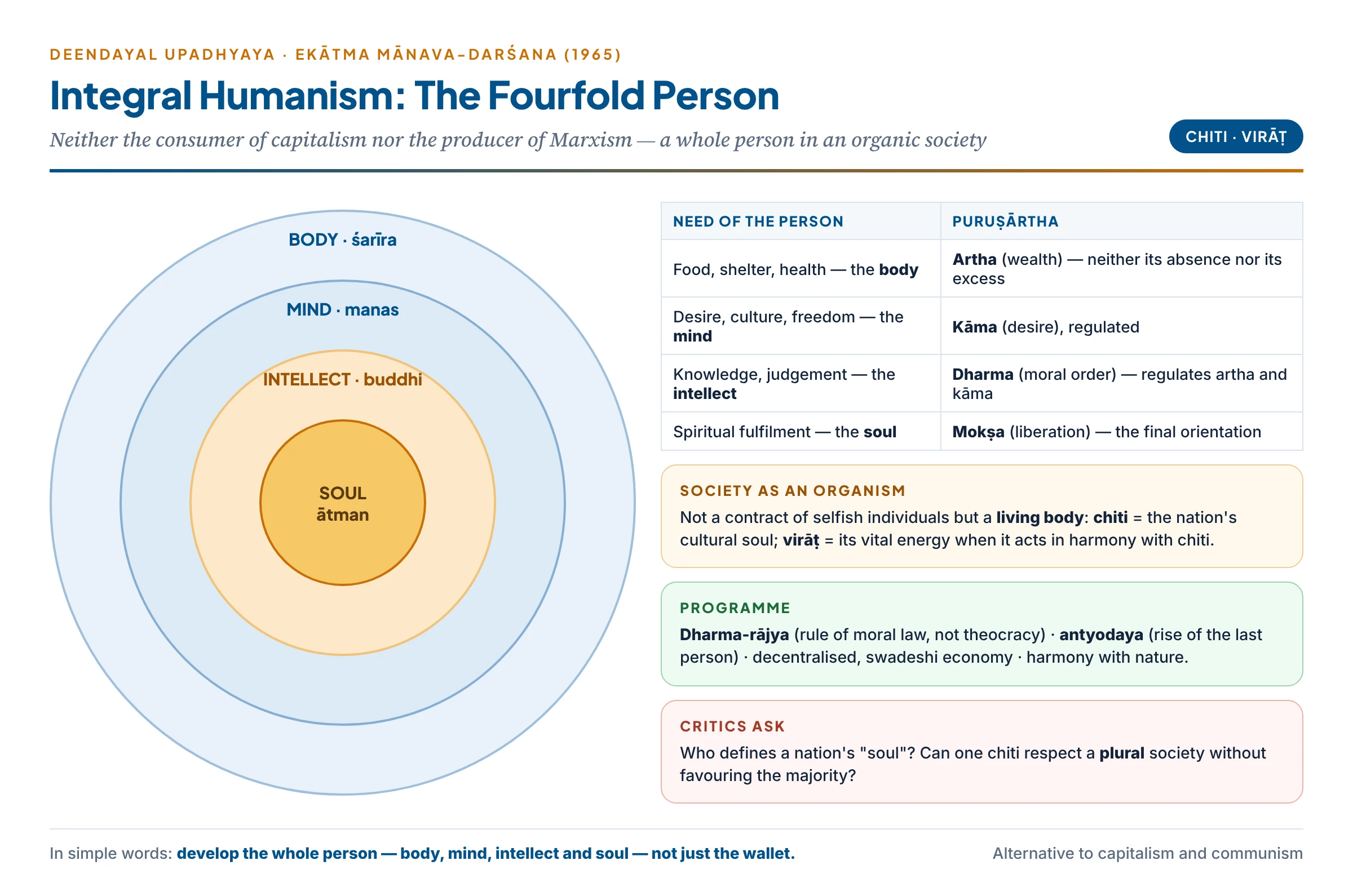
- Man is an integrated unity of four components: body (śarīra), mind (manas), intellect (buddhi) and soul (ātman).
- A balanced society must cater to all four: the body needs food and shelter, the mind needs freedom and culture, the intellect needs knowledge, the soul needs spiritual fulfilment.
3. The puruṣārtha framework.
- The four legitimate human pursuits: dharma (moral and ethical order), artha (wealth and power), kāma (desire and pleasure) and mokṣa (liberation).
- Artha and kāma are essential, but must be regulated by dharma and oriented towards mokṣa. Deendayal warned against both the absence of artha (poverty, which destroys dharma) and the excess of artha (affluence and greed, which also destroy it).
4. Individual and society — organic, not contractual.
- Society is not a contract between selfish individuals; it is an organic whole, like a body whose limbs work in harmony. There is no basic conflict between individual and society, as there is none between hand and body.
In simple words
Think of the human body. The hand does not compete with the stomach; each does its work and the whole body lives. Deendayal saw society the same way — as a living body, not a bargain between strangers. Chiti is like the body’s inner nature, and virāṭ is the energy the body has when it is healthy and in harmony with that nature.
5. Chiti and Virāṭ.
- Chiti — the innate cultural soul, fundamental ethos and character of a nation, comparable to the soul in an individual. Laws and institutions that violate a nation’s chiti cause decay.
- Virāṭ — the collective vital energy that animates a nation when it functions in harmony with its chiti, as prāṇa animates the body.
6. Dharma-rājya, antyodaya and a decentralised economy.
- Dharma-rājya — the rule of dharma (moral law), not of any religious sect; it is not a theocracy. Even the state is bound by dharma.
- Antyodaya — the rise of the last person, the test of development (a Gandhian echo).
- Decentralisation and Swadeshi — small-scale, labour-using, locally rooted production; harmony with nature rather than exploitative industrialism.
Evaluation.
- Strengths: a holistic picture of the person (material and spiritual); a critique of consumerism and of the all-powerful state; emphasis on decentralisation, antyodaya and ecology; rooted in Indian categories.
- Criticisms:
- Conceptual ambiguity of chiti — who decides what a nation’s “soul” is? The idea is hard to define or test.
- Majoritarian risk — in a plural society, a single “national soul” may be identified with the majority culture and used to marginalise minorities.
- Organic theory of society may underplay real conflicts of class, caste and gender, and the individual’s right to dissent.
- Thin economics — the alternative economic model is sketched rather than worked out.
Common confusion
Does “dharma-rājya” in Integral Humanism mean a Hindu theocracy? Not in Deendayal’s own definition. He used dharma in the classical sense of moral and cosmic order — duties, righteousness, justice — and said that dharma-rājya is not rule by any religious community or priesthood; it means that the state too is bound by moral law and must not be arbitrary. Whether in practice a “national soul” can be defined without favouring the majority faith is the real point of debate.
Indian and Western Humanism Compared
| Point | Western secular humanism | Indian spiritual humanism | Indian rationalist humanism |
|---|---|---|---|
| Thinkers | Kant, Russell, Dewey, Manifestos | Vivekananda, Tagore, Gandhi, Deendayal | Roy, Periyar, Ambedkar (ethical Buddhism) |
| Source of dignity | Reason, autonomy, being human | Divinity of the soul | Reason, moral capacity, equality |
| Attitude to religion | Critical, often atheist | Religion as service and universal ethics | Critical of caste-religion; Ambedkar chose an ethical religion |
| Freedom | Political and intellectual | Self-realisation plus social freedom | Natural, rational, social |
| Society | Individual rights | Harmony, duties, organic whole | Equality, fraternity, decentralised democracy |
| Nature | Often mastered | Kinship | Scientific understanding |
Critical Evaluation
Can Humanism Be a Substitute for Religion?
What religion does for people (the test any substitute must pass):
- Gives meaning to life and death.
- Grounds morality and motivates good conduct.
- Builds community and identity.
- Offers consolation in suffering and loss.
- Provides ritual and celebration that mark life’s stages.
- Points to something higher than the self — an ultimate concern.
The case that humanism can replace religion:
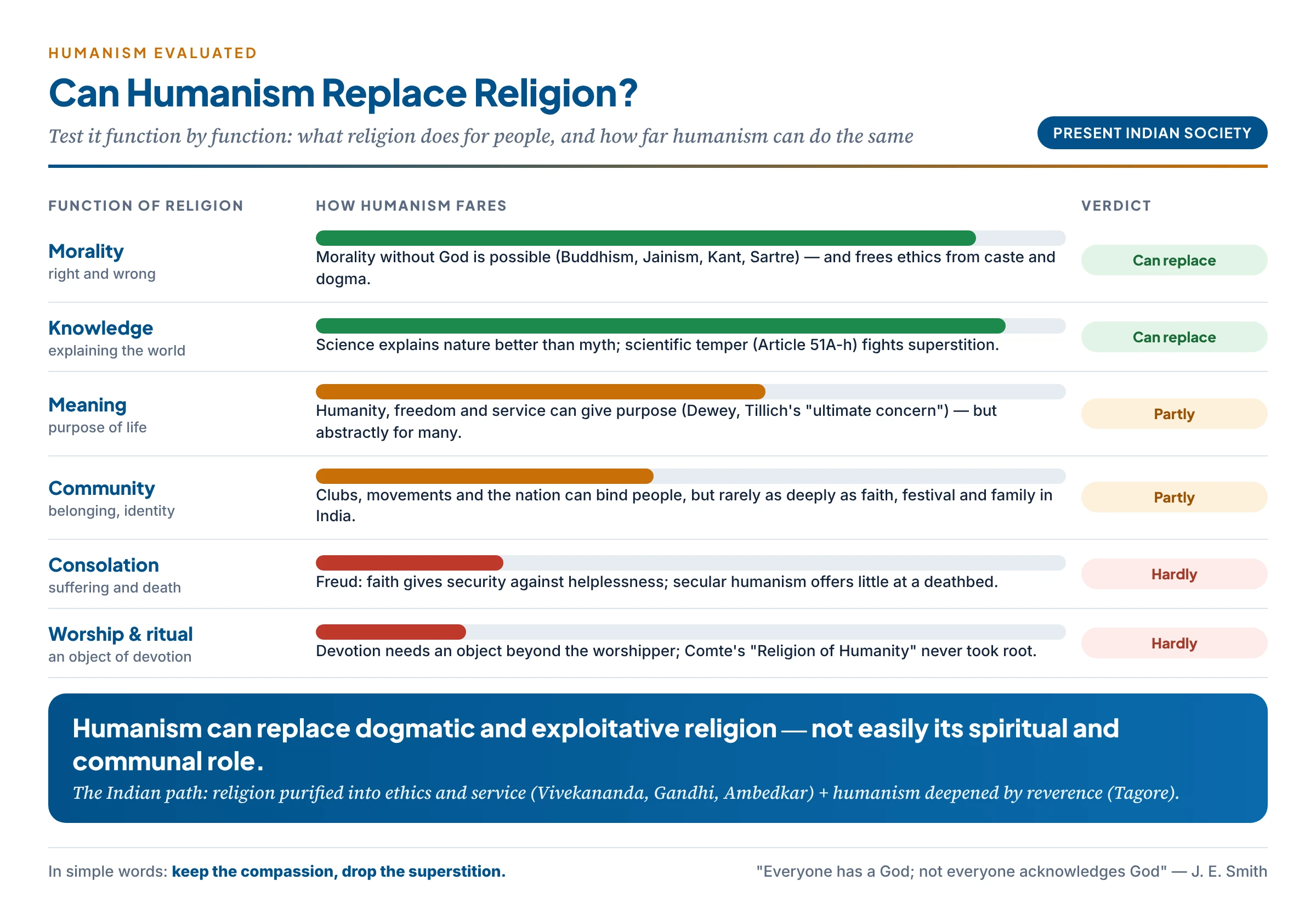
- Morality without God is possible. Humanists, Sartre, Nietzsche, the Jaina and Buddhist traditions all show that one can be moral without belief in a creator God. Grounding morality in God has its own problems: it can make morality depend on fear and reward, freeze moral values, and sanction caste, slavery and the subordination of women.
- Religion without God already exists. If religion is defined broadly as a way of life or “ultimate concern” (Paul Tillich), then humanism, communism and scientism can themselves be religions — the communist treats the classless society as the ultimate, the humanist treats humanity itself as God. John Dewey: “Any total commitment to any pursuit of life as something of infinite value has to be termed religious”; a scientist devoted to truth is no less religious.
- Historical attempts. Auguste Comte’s “Religion of Humanity” (with its calendar of saints of science), Julian Huxley’s “religion without revelation”, humanist ceremonies for naming, marriage and funerals in Europe today.
- In India, humanism (scientific temper, rights, rationalism) is needed against superstition, caste, communal violence and religious exploitation — witch-hunting, human sacrifice, fake godmen. Maharashtra’s anti-superstition law (2013, passed after the murder of rationalist Narendra Dabholkar) and Karnataka’s (2017) reflect this need, as does the duty in Article 51A(h) to develop “the scientific temper, humanism and the spirit of inquiry and reform”.
The case that it cannot:
- Narrow definitions of religion exclude it. For theists like William James, “anything less than theism is no religion at all”; Galloway defines religion as “man’s faith in a power beyond himself“; Martineau as “belief in an ever-living God”. On these definitions humanism (and even Jainism and early Buddhism) cannot be religion.
- Psychological needs. Freud observed that faith gives security and stability in the face of the helplessness caused by the dark workings of nature; secular humanism offers little consolation at a child’s deathbed.
- The devotee needs an object. Devotion requires a distinction between the worshipper and the object of worship; “humanity” is an abstraction few will die or pray for. Comte’s religion of humanity never took root.
- J. E. Smith: “Everyone has a God or gods; not everyone acknowledges God.” When God is removed, something else — nation, party, leader, money — tends to take his place, sometimes with worse results (the “secular religions” of fascism and Stalinism).
- Indian reality. Religion in India is not a private belief that can be removed; it is woven into identity, festival, family and community. Even Ambedkar chose conversion to an ethical religion, not atheism, because he believed society needs religion as a moral bond.
Balanced conclusion.
- Humanism can replace dogmatic, ritualistic and exploitative religion — and should.
- It cannot easily replace the spiritual and communal functions of religion for most people.
- The Indian answer is a convergence: religion purified into ethics and service (Vivekananda, Gandhi, Ambedkar’s Navayāna) and humanism deepened by reverence and compassion (Tagore). God may be accepted as an important feature of religion, but not an essential one: any belief that awakens an all-pervasive attitude of care, leading to a culture of the soul and the welfare of humanity, deserves the name of religion.
Which Form of Humanism Is Relevant Today?
No single humanism is enough; each answered a different danger. A relevant humanism for the present must meet today’s dangers:
| Today’s challenge | What is needed | Which humanism supplies it |
|---|---|---|
| Climate change, ecological collapse | Humanity as part of nature; justice between rich and poor | Ecological humanism, Tagore, Gandhi |
| Consumerism and inequality | Limits to wants; dignity of the poor | Gandhi’s sarvodaya, Deendayal’s antyodaya, Marxist humanism |
| Majoritarianism and identity conflict | Pluralism, dialogue, equal citizenship | Tagore’s universalism, Ambedkar’s fraternity, liberal humanism |
| Caste, gender and racial discrimination | Equal dignity, rights | Ambedkar, Kantian humanism, human-rights humanism |
| Superstition and misinformation | Reason, scientific temper | Scientific humanism, Roy |
| Technology, AI, surveillance | Persons as ends, not data | Kantian humanism |
| Meaninglessness and loneliness | Spiritual depth, community | Vivekananda, Tagore |
A reasonable position: an integral, inclusive and ecological humanism —
- Integral: caring for body, mind, intellect and spirit (Deendayal, Aurobindo), and for material welfare as well as freedom (Marx and Kant).
- Inclusive: dignity for every person regardless of caste, creed, gender and nation (Ambedkar, Tagore), resting on constitutional rights.
- Ecological: humanity within nature, with fairness between rich and poor and towards future generations.
- Rational but not arrogant: scientific temper (Roy, Nehru) joined to humility about human evil.
- Spiritual but not sectarian: open to the “religion of man” (Tagore) without imposing any creed.
Is Social Progress Possible without Humanism?
- Progress in what? If progress means only economic growth or technology, it is possible without humanism — Nazi Germany and Stalin’s Russia achieved rapid industrial and scientific progress while committing atrocities.
- But such “progress” is not social progress. Social progress means improvement in the quality of human life — freedom, health, education, dignity, justice. That is humanist by definition.
- Human development. Amartya Sen’s “development as freedom” and the UNDP’s Human Development Index (1990, Mahbub ul Haq) replaced GDP-centred progress with a humanist measure: what people are able to be and do.
- Inequitable development produces social conflict rather than progress — growth that ignores the last person (Gandhi’s talisman, Deendayal’s antyodaya) breeds unrest.
- Conclusion: material progress is possible without humanism; social progress is not — humanism supplies its goal (human flourishing), its measure (the condition of the weakest) and its limit (no one may be sacrificed as a mere means).
“World Religion is a Spiritualistic and Humanistic Composite”
- The idea. Thinkers like Vivekananda (universal religion), Tagore (religion of man), Radhakrishnan (religion of the spirit) and Gandhi (all religions are true and have a common core of ethics) hoped for a world religion that would combine spiritual experience (the essence common to all faiths) with humanist ethics (service of humanity), leaving aside dogma and ritual.
- For the idea: religions share a moral core (compassion, truthfulness, non-violence) and a mystical core; a globalised humanity needs a shared moral language; humanism without spirit becomes shallow, spirit without humanism becomes escapist.
- Against it: religions make conflicting truth claims (one God, many gods, no God; rebirth or resurrection) that cannot simply be merged; a “composite” religion may be an artificial syncretism belonging to no one; it may also be inclusivist in disguise (other faiths absorbed into one’s own framework).
- Balanced view: a single world religion is unlikely, but a world-ethic combining spiritual depth and humanistic service — the common ground of all faiths and of secular humanism — is both possible and necessary.
Critics and Defenders
Criticism — Critics
- Rationalists (Roy, Periyar): spiritual humanism smuggles back the supernatural and narrows human freedom; dignity needs no God.
- Marxists: Indian spiritual humanism ignores class exploitation and preaches harmony to the oppressed.
- Ambedkarites: spiritual Hinduism coexisted with caste; “God in every man” did not stop untouchability.
- Liberals and minorities: ideas like chiti risk defining the nation by one culture.
- Analytical philosophers: Tagore’s reconciliation of opposites is poetry, not argument.
- Theists: humanism cannot replace religion — it lacks consolation, worship and an object of devotion.
Defence — Defenders and strengths
- Spiritual humanists: dignity grounded in the divine is the strongest dignity — it cannot be voted away.
- Practice: Vivekananda’s and Gandhi’s humanism produced schools, hospitals, the fight against untouchability and the freedom struggle.
- Tagore: his universalism and critique of the Nation anticipated human rights and cultural dialogue.
- Ambedkar: an ethical religion (Navayāna) shows how religion and humanism can be united.
- Integral humanists: a person is more than a consumer or producer; development must serve body, mind and spirit.
- Convergence: secular and spiritual humanisms agree in practice — serve the last person, protect dignity, respect nature.
Cross-Tradition Comparison
Vivekananda, Tagore, Gandhi, Ambedkar, Deendayal and Roy
| Thinker | Basis of dignity | Freedom means | Key method | Distinctive idea |
|---|---|---|---|---|
| Vivekananda | Potential divinity of the soul | Manifesting divinity; fearlessness | Service, education | Daridra-Nārāyaṇa; Practical Vedānta |
| Tagore | Man as mirror of the divine | Negative + positive freedom; universal personality | Education, art, love | Reconciliation of opposites; synthetic universalism |
| Gandhi | Truth (God) in all | Swaraj — self-rule of the self and of the village | Non-violence, satyagraha | Talisman; sarvodaya; trusteeship |
| Ambedkar | Moral equality of persons | Liberty, equality, fraternity | Law, education, organisation, conversion | Navayāna; one person, one value |
| Deendayal | Integral person (body–mind–intellect–soul) | Balanced pursuit of puruṣārthas under dharma | Decentralisation, swadeshi | Chiti, virāṭ, antyodaya |
| M.N. Roy | Rational, natural individual | Biological urge raised to consciousness | Education, People’s Committees | Radical humanism; cooperative economy |
Indian and Western Parallels
| Indian idea | Western parallel | Difference |
|---|---|---|
| Vivekananda: man bound only by laws he makes | Kant: autonomy | Kant’s autonomy is rational; Vivekananda’s is spiritual self-realisation |
| Tagore: surplus in man; self-creation | Pico: man without fixed nature | Pico’s freedom is under God’s ladder; Tagore’s is the play of the infinite in man |
| Tagore: critique of the Nation | Kant’s cosmopolitanism; Einstein’s pacifism | Tagore’s is grounded in a spiritual unity of mankind |
| Gandhi: critique of industrial civilisation | Marx: alienation; Ruskin | Gandhi wants fewer wants, not more production |
| Ambedkar: liberty, equality, fraternity | French Revolution; Dewey (his teacher) | Ambedkar traced the trinity to the Buddha |
| Deendayal: organic society | Hegel, Burke, communitarians | Rooted in dharma and puruṣārthas |
Indian Connect — Indian Connect — the takeaway
- India’s distinctive contribution is a spiritual humanism that turns devotion into social service and refuses the choice between God and man.
- Its rationalist stream (Roy, Periyar, Ambedkar) checks its weaknesses — superstition and caste — so that the Constitution could combine both: freedom of religion (Article 25) with the duty of scientific temper and humanism (Article 51A(h)).
Synthesis (Siddhānta)
- Indian humanism affirms the dignity of every person but usually grounds it in the divine within — Vivekananda’s potential divinity, Tagore’s universal Man, Gandhi’s Truth — while its rationalist voices (Roy, Ambedkar, Periyar) ground it in reason and moral equality.
- Tagore’s reconciliation of opposites — finite and infinite, individual and universal, freedom and obligation, nation and humanity, East and West — is its most creative expression: harmony achieved through love, creativity and personality.
- Integral Humanism offers a holistic picture of the person and a critique of both capitalism and communism, but its idea of a single national soul (chiti) must be reconciled with India’s plurality.
- On religion: humanism can and should replace dogma, superstition and caste-religion; it is less able to replace religion’s functions of meaning, consolation and community. The Indian synthesis — religion purified into ethics, humanism deepened by reverence — is the most realistic path.
- For today: an integral, inclusive, ecological and rational humanism, anchored in constitutional rights and the welfare of the last person, is the form most needed.
- Contemporary relevance.
- Article 51A(h) — “scientific temper, humanism and the spirit of inquiry and reform” — as a citizen’s duty.
- Anti-superstition laws and campaigns against witch-hunting and caste violence.
- Antyodaya and the “last-mile” logic of welfare schemes; the Human Development and Multidimensional Poverty indices as humanist measures of progress.
- Tagore’s universalism against today’s aggressive nationalisms and online hate.
“I do not believe in a God or religion which cannot wipe the widow’s tears or bring a piece of bread to the orphan’s mouth.” — Swami Vivekananda
Previous Year Questions
- 2025How does the reconciliation of opposites take place in the Humanism of Tagore? Evaluate.
- 2021Can humanism be a substitute for religion? Explain and evaluate in the context of the present Indian society.
- 2018What form of humanism do you approve as relevant, in the present-day context? Discuss in detail.
- 2016“World-religion is a spiritualistic and humanistic composite.” Evaluate.
- 2010Is social progress possible without humanism? Examine.