

Phenomenology (Husserl): Method; Theory of Essences; Avoidance of Psychologism.
Official Syllabus: Paper I, Section A, Unit 9
When the phenomenological method has bracketed the world, what does it find? Husserl’s answer has two parts. First, intentionality: consciousness is always consciousness of something — every act of perceiving, remembering, imagining or judging is directed at an object, and every object is given through such acts. Husserl analyses this directedness as a correlation between the noesis (the act) and the noema (the object exactly as it is meant). Second, the theory of essences: by the eidetic reduction and free imaginative variation, phenomenology rises from particular facts to universal essences (eidos, Wesen) — what must belong to any experience or object of a given kind — and grasps them by a direct intuition of essences (Wesensschau). Together these make phenomenology an a priori science of experience, rooted neither in psychology nor in a Platonic heaven, but in the correlation of consciousness and being.
In simple words
You can love your mother, remember your mother, imagine your mother as a young girl, or worry about your mother. Four very different experiences — yet each is about the same person. There is no loving that is not loving someone, no worrying that is not worrying about something. That “aboutness” is intentionality. And notice: you can also imagine a dragon, which does not exist — the imagining is still about something. Consciousness is like an arrow that always points somewhere, even when there is nothing at the place it points to.
Context & Problem
From Brentano to Husserl
- Brentano’s discovery. In Psychology from an Empirical Standpoint (1874), Franz Brentano, Husserl’s teacher, argued that what marks off mental phenomena from physical ones is intentionality — “reference to a content, direction towards an object”. He spoke of the object’s “intentional inexistence” — its existing in the mental act, whether or not it exists outside.
- Husserl’s transformation. Husserl kept the insight but removed the suggestion that the object is a little image inside the mind. The intended object is the thing itself, as it is meant — not a mental picture of it. Intentionality became, for him, the central theme of phenomenology.
- The old problem it answers. Since Descartes, philosophers had pictured the mind as a container of ideas, and then asked how ideas “inside” could match things “outside”. We have no “third eye” to compare the inner picture with the outer thing. Descartes’ certainty of the cogito proved a hollow victory: it left him trapped inside his own mind, needing God to build a bridge to the world.
- The question of essences. Phenomenology claims to be a science, but description of my experiences today would only give facts. To give necessary, universal knowledge, it must reach what holds for every possible experience of a kind — the essence. How can essences be known without falling into empirical generalisation (psychologism) or into belief in Forms in a separate world (Platonism)?
Core Doctrine
1. Intentionality: The Basic Structure of Consciousness
The thesis. “Consciousness is always consciousness of something.” Every mental act — perceiving, thinking, imagining, remembering, judging, desiring, fearing — is inherently directed towards an object.
What “intentionality” does and does not mean:
- Not intention in the ordinary sense. It does not mean a deliberate intention or act of will (“I intend to go to the market”). It means aboutness or directedness of experience.
- No empty container. There is no “empty box” of consciousness into which sensations are poured. Consciousness is essentially relational and outward-directed.
- No objectless consciousness. Knowing is always knowing something; desiring is desiring something (desiring that book); hating is hating something. There are no “intransitive” mental states — even the dread that Kierkegaard described as fear of “nothing” is still the fear of nothing.
- The object need not exist. The object of an act need not exist in reality. One may think of a golden mountain, imagine Sherlock Holmes or fear a ghost. Intentionality covers real, possible, fictional and ideal objects alike.
- Two poles of one structure. Consciousness and its object are inseparable poles of a single experiential structure: consciousness is a stream with a subjective pole (the act, the “I”) and an objective pole (what is intended).
Examples:
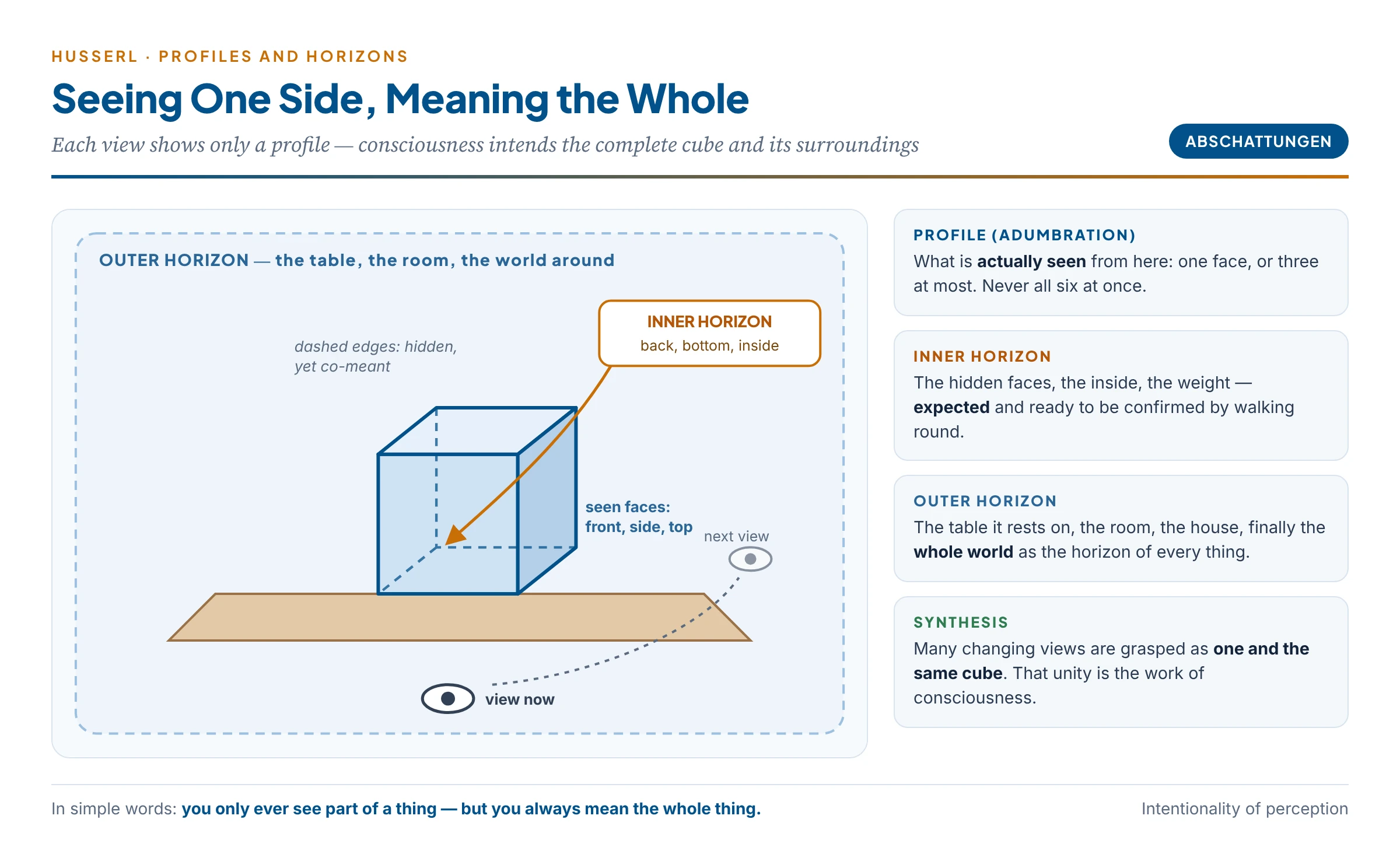
- A cube. I never see all six faces of a cube at once — only one or three. Yet I intend a complete three-dimensional cube; the unseen faces are co-meant. Intentionality explains how perception transcends what is immediately given.
- A childhood home remembered. The house is not physically present, yet it appears meaningfully in memory, intended as “having been“. Intentionality includes the temporal modes of past, present and future.
- Sherlock Holmes. He never existed, yet he is a meaningful object of imagination. Intentionality is not limited to the real.
What intentionality achieves:
- It overcomes the subject–object split. Consciousness is not a closed box facing an alien world; it is already with its objects. The “bridge” problem of Descartes is a false problem, because there is no inside/outside for consciousness: to be conscious is to be related to the world.
- It unifies perception. Through intentionality, many partial aspects are grasped as one thing. A spoken word passes away in a moment, but its meaning is retained and understood.
- It grounds knowledge and objectivity. Because consciousness reaches beyond itself towards objects, it can disclose a shared world. Objectivity is not stamped on experience from outside; it arises through the coherent organisation of intentional acts — across one’s own experiences and among different subjects.
- It distinguishes consciousness from everything else. A stone is not about anything; a mind always is. Intentionality is the mark of the mental.
2. Profiles and Horizons
- Adumbrations. Physical things are never given all at once but only through profiles or adumbrations (Abschattungen) — partial perspectives. A house shows one façade; a coin shows heads or tails.
- Synthesis. Consciousness synthesises these perspectives into the experience of one unified object that stays the same while its appearances change.
- Inner horizon. Every object carries an inner horizon — its unseen sides and features (the back of the tree, the inside of the box) — which are anticipated and could be filled in by further experience.
- Outer horizon. It also carries an outer horizon — its surroundings: the garden around the tree, the room around the table, and ultimately the whole world as the horizon of all horizons.
- Why it matters. Perception is always more than what is strictly seen. To see a thing as a thing is already to expect more of it.
3. Noesis and Noema
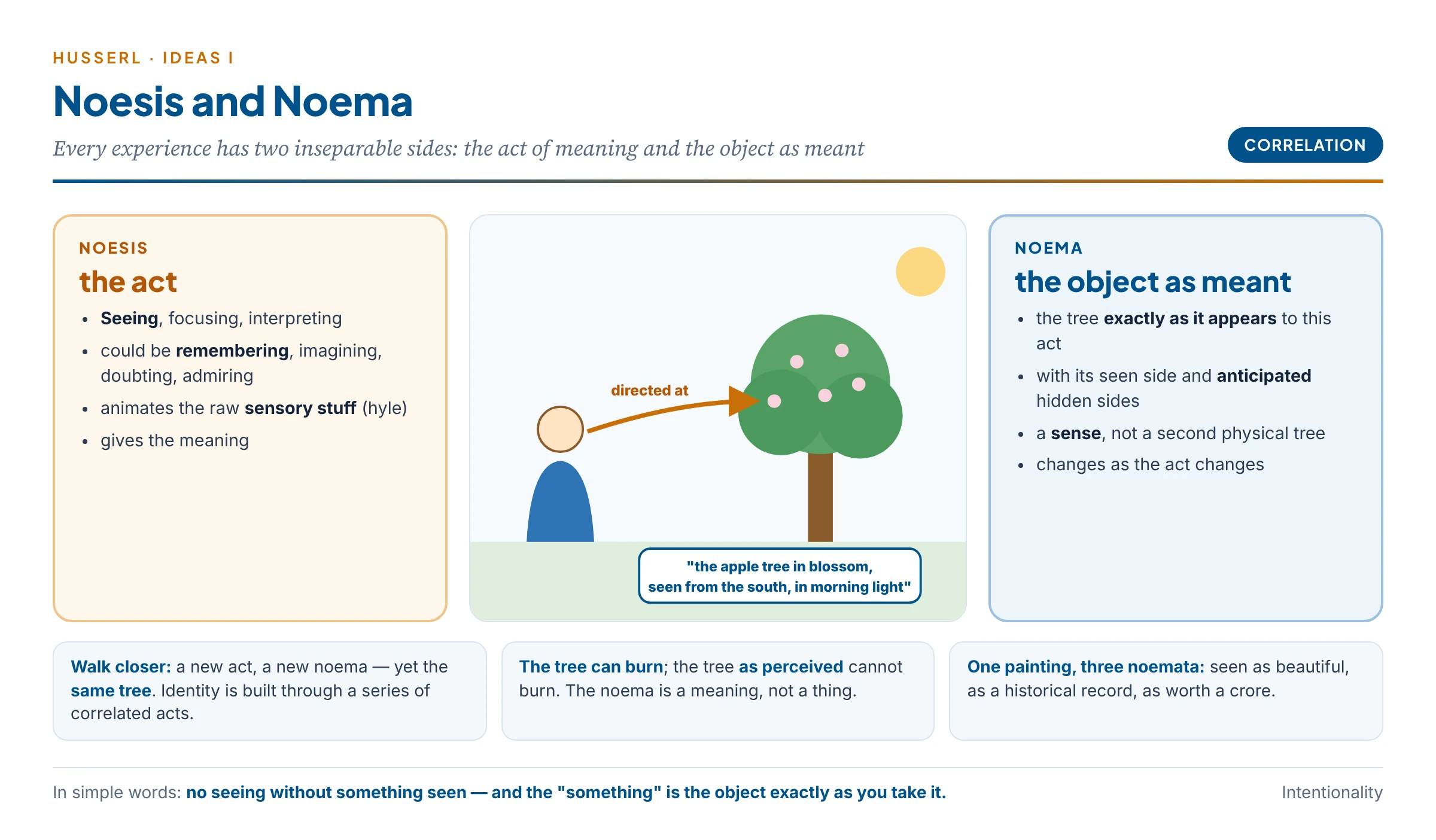
Husserl’s mature analysis of intentionality (in Ideas I) distinguishes two inseparable sides of every experience.
| Side | What it is | Examples |
|---|---|---|
| Noesis (noetic act) | The act of consciousness — the subjective side, the performance of meaning-giving | Perceiving, remembering, imagining, judging, doubting, valuing, loving |
| Noema (noematic correlate) | The object as it is meant in that act — with a particular sense and mode of givenness | “The blooming apple tree, seen from the south side, in the morning light”; “my first day at school, as remembered” |
| Hyle (sensory stuff) | The raw sensory material that the noesis animates and interprets | The changing colour-patches and shades that are taken up as “the side of a tree” |
Key points:
- Inseparable. Every act has an intended object, and every object appears only through a corresponding act. This correlation replaces the old dualism of subject and object with a single relational structure.
- Noesis constitutes noema. The noesis gives meaning; intentionality is what makes meaning determinate. The pattern can be shown as: desire of / hatred of / consciousness of (the quality of the intention) — that book (the object intended).
- Noema is not the physical thing taken apart from consciousness, nor a mental image of it. It is the object precisely as experienced — the thing as meant.
- The burning tree. Husserl’s famous example: a tree in the garden can burn, be cut down or rot. But the perceived tree as such — the noema, the tree as perceived — cannot burn; it has no chemical elements. This shows that the noema is a sense, not a second physical thing.
- Same object, different noemata. The same object can be meant in many ways — perceived, remembered, doubted, wished for — each with a different noema. A painting may be experienced aesthetically (as beautiful), historically (as a document of its age) or commercially (as worth a crore of rupees): three noetic acts, three differently constituted noemata, one canvas.
- Constitution, not creation. Consciousness does not create objects arbitrarily; it organises and synthesises appearances so that objects can be experienced as stable, identical and meaningful. Objectivity emerges through lawful correlations within consciousness.
Illustrations:
- Perceiving a tree. Looking, focusing and interpreting are the noesis; the tree as it appears — visible trunk, shaded side, anticipated hidden aspects — is the noema. If I walk closer, the noesis changes (a new perceptual act) and the noema changes (the tree looks different), yet I understand it as the same tree. The identity of the object is constituted through a series of correlated acts.
- Remembering my first day at school. The act of remembering is the noesis; the remembered event — presented as past, coloured by emotion — is the noema. The noema includes the mode of givenness: “as remembered”.
- Judging that a triangle has three sides. The act of understanding is the noesis; the ideal meaning of the triangle as understood is the noema. Phenomenology analyses not only perception but also ideal and logical objects.
In simple words
Think of a radio. The tuning you do — turning the knob, choosing the station — is like the noesis. The programme you hear, exactly as it comes through to you — a cricket commentary, a song — is like the noema. You never get the programme without tuning; tuning is always tuning to something. And the same broadcast can be heard well or badly, with interest or boredom — different “tunings” of one and the same thing.
4. Meaning-Intention and Fulfilment
- Empty and fulfilled. An intention can be empty — I think of the Taj Mahal while sitting in my room — or fulfilled — I stand before it and see it. In the Logical Investigations Husserl analyses knowledge as the fulfilment of an empty meaning-intention by an intuition.
- Evidence. When what I meant is given in person, exactly as meant, I have evidence — the experience of truth.
- Disappointment. Sometimes the intuition fails to fulfil the intention: I expected a man in the shadows and find a coat on a hook. The intention is disappointed, and I revise it.
- Why it matters. This gives a phenomenological account of truth and error without leaving experience: truth is the match between what is meant and what is given.
5. Can Hallucination Be an Intentional Act?
Husserl’s answer: yes.
- The act is genuinely directed. A person who hallucinates a snake on the floor is really conscious of a snake: his experience is about a snake, is structured like a perception, and has a definite noema — “a snake, coiled, there by the door”. Intentionality does not require that the object exist.
- The noema without the thing. The hallucinated snake has no reality in the room, but the snake-as-meant is fully present as the act’s correlate. Exactly as with imagining Sherlock Holmes or thinking of a golden mountain, the directedness of consciousness remains.
- The epoché helps. After bracketing, the phenomenologist does not need to decide in advance whether the object exists; both veridical perception and hallucination are studied as phenomena.
- How they differ. They differ not in being intentional but in fulfilment: further experience confirms a genuine perception (I can walk round the snake, others see it too, it moves as snakes do) but fails to confirm a hallucination (my hand passes through, nobody else sees it). The difference shows up within the course of experience, through coherence and intersubjective agreement.
- Not an inner picture. Husserl rejects the view that in hallucination we see a mental image instead of a thing. As Sartre later stressed, images are not little pictures “in” the mind; imagining and hallucinating are ways of intending the world.
Common confusion
Since a hallucinated object does not exist, isn’t the hallucination “about nothing” and therefore not intentional? No. For Husserl intentionality is a feature of the act, not a relation that needs an existing thing at the other end. The hallucination has a fully determinate noema — “a snake by the door” — and is directed at it. What it lacks is fulfilment: further experience does not confirm it. “Directed at a snake” is true; “there is a snake” is false. Confusing these two is the root of the mistake.
6. Intentionality and the Meaning of an Object
How does intentionality help us arrive at the meaning of an object?
- Meaning is given through acts. An object’s meaning is not lying ready in the object nor merely invented in the mind; it arises in the intentional relation — through the noetic acts that intend it.
- Synthesis of identity. Through many profiles, over time, consciousness constitutes the meaning “one and the same table“.
- Modes of givenness. The meaning includes how the object is given: as perceived, remembered, imagined, valued — “the tree as seen from here”, “the event as remembered“.
- Horizons. The meaning of a thing always includes what is co-meant — its hidden sides and its context.
- Layers. The same object may carry practical, aesthetic, cultural and theoretical meanings — a flag is cloth, a symbol of the nation and a work of design.
- Intersubjective confirmation. The meaning “objective thing” includes the reference to other possible perceivers: the table is given as something anyone could see and use.
7. Eidetic Phenomenology: From Fact to Essence
- The word. Eidos (Greek) means “form“, “shape“, “that which is seen” — in Plato the eternal Form. Husserl uses eidetic for anything concerning the essence of a thing as opposed to its accidental, empirical features.
- Fact and essence. A fact (Tatsache) is what happens to be the case: this red pen, this morning’s headache. An essence (Wesen, eidos) is what must be the case for anything of that kind, in all possible instances.
- Eidetic phenomenology. Phenomenology is not a collection of reports about particular experiences; it seeks the essential and universal structures of experience — what necessarily belongs to perception, memory, imagination, judgment and value as such. It is an a priori investigation.
- Against the empirical sciences. The empirical sciences, and psychology, deal with contingent facts; phenomenology uncovers a priori structures, valid independently of particular circumstances. The eidetic reduction is the method that allows the passage from the factual to the essential.
8. The Eidetic Reduction and Free Imaginative Variation
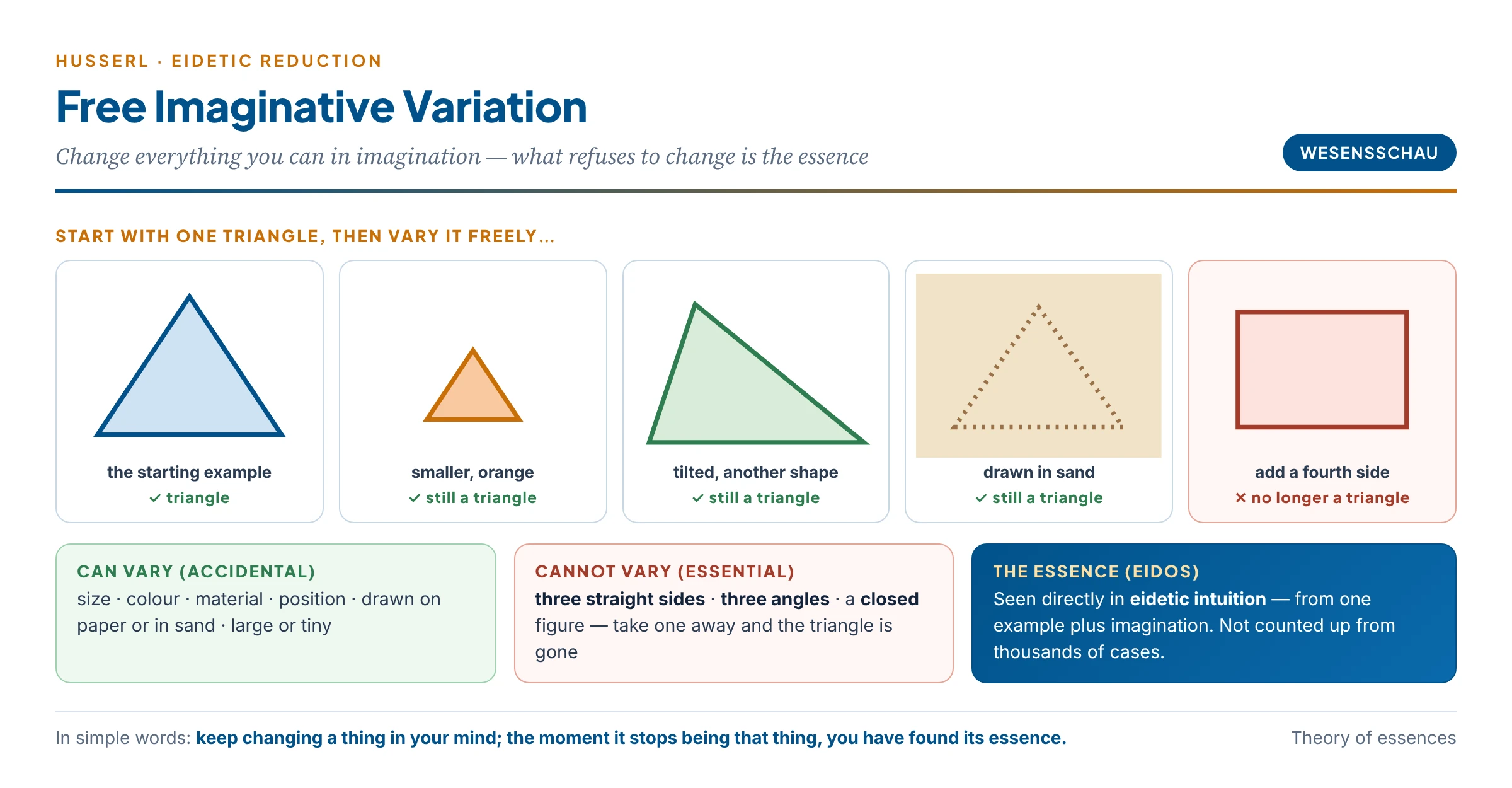
Definition. The eidetic reduction moves from the description of a particular experience or object to the discovery of its essential structure. Its central technique is free imaginative variation (freie Variation in der Phantasie).
The procedure:
- Start with an example — real or imagined: a particular triangle, table, act of promising.
- Vary it freely in imagination — change its colour, size, material, position, context, as far as you can.
- Watch what cannot change — some features can change without the thing ceasing to be what it is; others cannot. If removing a feature destroys the object’s identity as that kind of thing, that feature belongs to its essence.
- Grasp the invariant — what remains the same through all possible variations is the essence, seen directly in an eidetic intuition (Wesensschau).
Examples:
- The essence of a triangle. Imagine it large or small, red or blue, drawn on paper or in sand: these features are contingent. But you cannot imagine a triangle without three sides and three angles. These invariant features make up the essence of triangularity. Phenomenology grasps the universal meaning “triangle”, not any particular one.
- The essence of perception. Perceive a book; vary the lighting, distance and angle. Every possible perception of a physical thing still has three features, which therefore belong to the essence of perception as such, not just to this act of seeing:
- a perspectival presentation — only one side at a time;
- an implicit reference to unseen sides;
- a synthesis uniting many appearances into one object.
- The essence of a promise. Vary the language, culture and ceremony of promising. The essential structure remains: an intention directed to the future, an obligation taken on, and recognition by another. Without these it is no longer a promise.
- The essence of a table (or of an act of justice). Alter colour, material, size — the table survives; remove the flat surface that can bear things and it does not.
Two homely analogies:
- The forensic artist. A police sketch artist draws a face for an eyewitness, adding and removing features — “longer nose… no, thinner lips…” — until the witness says “Yes, that’s the man!” Free variation works in the same way, until the essence “clicks”.
- Sartre’s voyeur. A man peeping through a keyhole suddenly hears footsteps behind him and blushes with shame. In that single experience he grasps that he is seen by another subject and that his body can be objectified by someone else — a direct insight into the essence of “being seen by another”, more immediate than any argument by analogy. Even if the footsteps were only the wind, the essence of the experience has been seen. This is a less technical form of eidetic description.
In simple words
How do you know what makes a cricket bat a cricket bat? Imagine it in different colours — still a bat. Imagine it made of aluminium — hmm, still a bat (though illegal!). Imagine it with no blade, just a handle — now it is a stick, not a bat. Imagine it so small an ant could hold it — a toy bat, still a bat. By changing things in imagination and watching when it stops being a bat, you find what is essential. You did not need to examine thousands of real bats — one example and your imagination were enough.
9. The Nature of Essences
Husserl’s theory of essences says what kind of things essences are and how they are known.
- Directly intuited. Essences are not abstract metaphysical entities in a separate world, nor generalisations collected from many cases. They are directly seen — given in eidetic intuition, “in the same manner as our eyes directly see the shape, size and colour of things”. They are perceived neither by the senses nor by reasoning, but by intuition of a special kind.
- One instance is enough. Early on, Husserl thought, rather like John Locke, that essences are abstracted from many observed objects. Later he rejected this: the essence is given in the object itself, and even one instance — real or imagined — is enough to see it through variation.
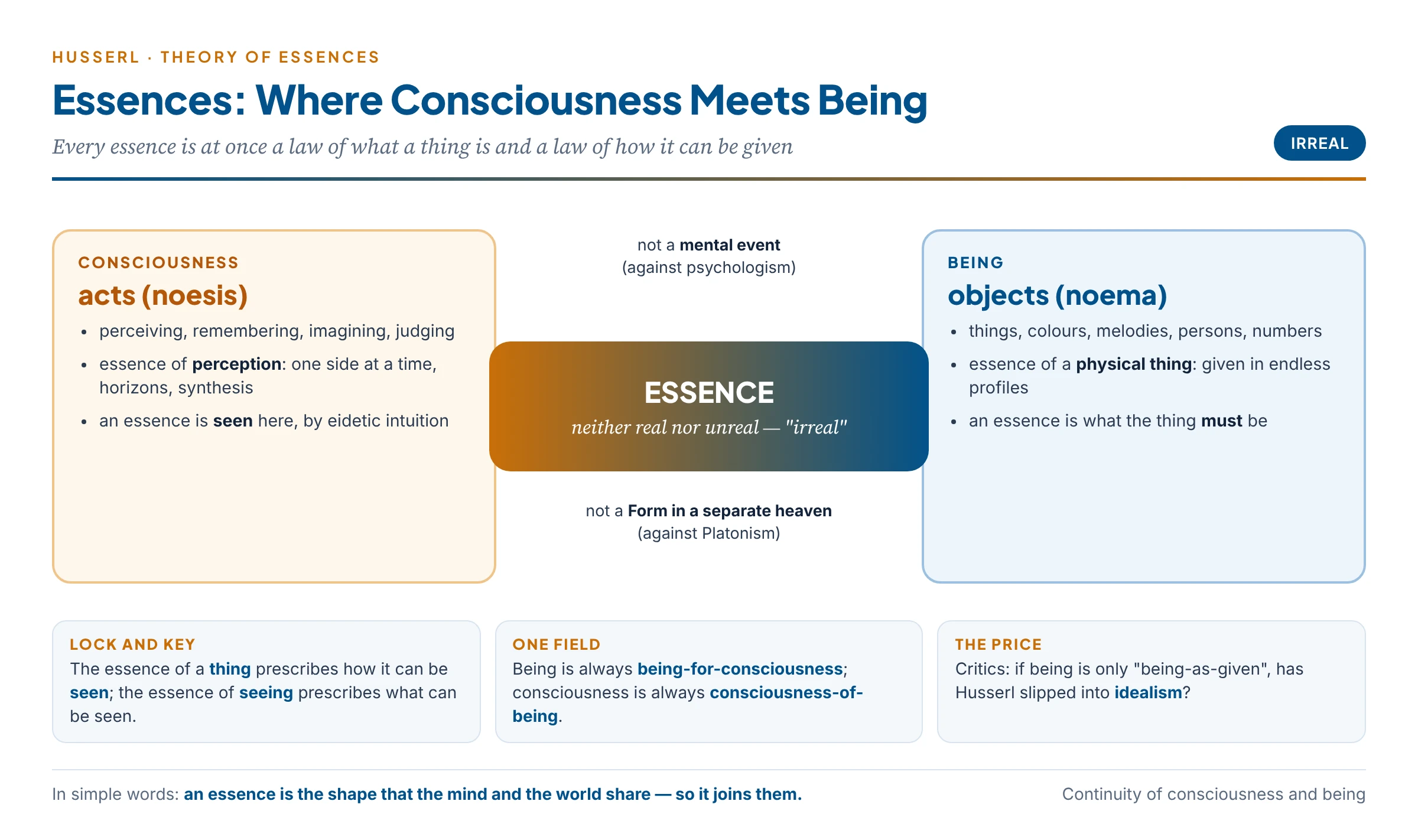
- Like Plato’s Ideas — and unlike them. Essences resemble Plato’s Ideas in being universal, unchanging and knowable a priori. But for Husserl they cannot exist independently of consciousness: they are necessarily correlates of consciousness — though they are not modifications of consciousness either. They are given to consciousness.
- “Irreal”. So Husserl calls essences neither real nor unreal, but irreal. They are meanings, not existing objects. Even when an existing object is destroyed, its meaning persists — the essence “triangle” does not vanish when the chalk triangle is wiped off.
- Neither dependent nor independent. Essences are neither dependent nor independent of consciousness: not dependent, because they are not made by my thinking; not independent, because they exist only as possible objects of intuition.
- Primordial and objective. Being uninfluenced by anything internal (moods) or external (natural facts), essences are primordial. They are original evidence, on the basis of which universality and objectivity can be established.
- The culmination of the method. After detaching from naturalism and psychologism through epoché and reduction, the pure phenomenon that remains — irreducible — is the essence of the thing.
- Eidetic laws. Experience is governed by lawful essential structures — intentionality, temporality (retention–impression–protention), embodiment and intersubjectivity. These are not empirical discoveries but necessary conditions of any conceivable experience.
- Kinds of essence. Husserl distinguishes formal essences (like “object”, “relation”, “number” — studied by logic and formal ontology) from material essences (like “colour”, “sound”, “living body” — the subject of regional ontologies of nature, animal life and spirit). Some truths about material essences are known a priori — for instance, “no colour without some extension“: we cannot imagine a patch of red with no size at all.
- Eidetic sciences. Geometry is the model eidetic science: it studies the essence of spatial shape, not measured fields. Phenomenology is the eidetic science of consciousness.
- Eidetic psychology is not enough. Husserl admitted one could perform an eidetic reduction within the natural attitude and get an “eidetic psychology”. But that would leave the sceptic’s question open — “does what you describe hold in the real world?” Only when combined with the transcendental reduction does eidetic analysis become transcendental phenomenology.
Common confusion
Are Husserl’s essences the same as Plato’s Forms? No, though they are similar. Both are universal, unchanging and known a priori. But Plato’s Forms exist independently, in a separate intelligible world, whether or not any mind knows them. Husserl’s essences are “irreal” correlates of consciousness: they are not in the mind (not mental events) and not in a separate heaven either; they exist as what can be intuited through free variation. Husserl brings essences “down” into experience: they are seen in the things themselves.
10. Why Essences Show a Continuity between Consciousness and Being
Husserl holds that essences are the point where consciousness and being meet. Five lines of thought explain why.
- Essences belong to both sides of the intentional correlation. Every essence has two faces: the essence of the object (what a thing must be — “thing”, “colour”, “melody”) and the essence of the acts in which it is given (what perceiving a thing must be — perspectival, horizonal, synthetic). Through the noesis–noema correlation these fit together exactly: the essence of a physical thing prescribes how it can be perceived (one side at a time), and the essence of perception prescribes what kind of objects it can present.
- To be is to be given in a certain way. For Husserl every kind of being has its own mode of being given. “Physical thing” means “what can be given in endless profiles”; “experience” means “what is given all at once to reflection”. An essence is at the same time a law of being and a law of givenness. So the study of essences is both ontology and phenomenology of consciousness.
- Essences are “irreal” — neither merely mental nor merely external. They are not psychological events (against psychologism), and they are not things in themselves beyond all possible experience (against Kant’s noumenon and against Platonic Forms in a separate heaven). They are the meaningful structures in which being shows itself to consciousness. This “in-between” status is what makes them a bridge.
- Intentionality already joins the two. Consciousness is never shut in on itself; it is of being. And being is never “blank”; it is for consciousness. Essences express the necessary form of this togetherness — the invariant structure of the encounter.
- Transcendental idealism. In Husserl’s later view, all being is being-as-constituted — the sense “real”, “existing”, “objective” is conferred and confirmed in the life of transcendental consciousness. Essences are the rules of this constitution; so the order of being and the order of consciousness turn out to be one continuous field of meaning.
In simple words
Think of a lock and its key. The shape of the key tells you the shape of the lock, and the shape of the lock tells you the shape of the key — each is “written into” the other. Husserl thinks consciousness and being are like this. The essence of a physical thing (to be seen one side at a time) is “written into” the essence of seeing, and the essence of seeing is “written into” the essence of things. Essences are the shape they share — that is why they form a bridge between the mind and what is.
The upshot. Against both realism (being without consciousness) and subjectivism (consciousness without being), essences show that what things are and how they can be experienced are two aspects of one structure. Critics reply that this continuity is bought at the price of idealism: if being is only “being-for-consciousness”, what has become of the independent world?
Critical Evaluation
Objections
- Not all consciousness is intentional. Moods such as vague anxiety, cheerfulness or boredom seem to be about nothing in particular; bodily feelings like a dull ache seem objectless. (Defenders reply that moods colour the whole world — they are about everything at once — and that Husserl’s “hyle” allows non-intentional sensory stuff within intentional acts.)
- The noema is obscure. Is the noema the object itself as meant, or an abstract meaning standing between the act and the object? Followers have read it both ways, which shows the doctrine is unclear.
- Essentialism is too rationalistic. Meanings and experiences are fluid, historically changing and socially constructed; there may be no fixed universal essences of “justice” or “promise”.
- Family resemblance. The later Wittgenstein argued that many concepts — “game” is his example — have no common essence at all, only overlapping similarities like a rope of many fibres. Free variation may find no invariant.
- Existence precedes essence. Sartre and Heidegger hold that, for human beings at least, existence comes first: man has no essence fixed in advance. Essences cannot capture the existing individual.
- Imagination is fallible. Free variation depends on what I can imagine — but limits of my imagination may reflect my psychology, culture or training (people once “could not imagine” non-Euclidean space). This threatens to bring psychologism back.
- “I don’t see it.” Eidetic insight is a seeing; if someone does not see the essence, the phenomenologist can only say “look more closely“.
- Platonism or idealism? Essences seem either too Platonic (timeless entities) or too idealist (dependent on consciousness) — Husserl’s “irreal” status tries to avoid both but is hard to make clear.
Replies
- On moods. Even a mood has its world-directedness: in anxiety the whole world looks threatening. Husserl did not claim that every element of experience is intentional, only every act.
- On fixed essences. Husserl allowed inexact, “morphological” essences (like “notched”, “jagged”, “round” as we see them in everyday things) besides the exact essences of geometry. Not every essence is sharp.
- On fallible imagination. Eidetic claims are open to correction by further variation; the method is self-correcting like mathematics, where a counter-example refutes a claimed theorem.
- On “look more closely”. Seeing an essence is like seeing the point of a proof: often we do see it, and then no further argument is needed.
Critics and Defenders
Criticism — Critics
- Moods and feelings — not every mental state seems to be about something.
- Wittgenstein — many concepts have no common essence, only family resemblance.
- Existentialists — existence precedes essence; essences miss the existing individual.
- Historicists and social constructionists — meanings change with history and society.
- Platonism / idealism charge — “irreal” essences are hard to place.
Defence — Defenders and strengths
- Intentionality — solves the “bridge” problem and is accepted even by Husserl’s critics (Sartre, Heidegger) and by much analytic philosophy of mind.
- Noesis–noema — explains how one object can be meant in many ways.
- Free variation — the ordinary way we test definitions (“could there be a bachelor who is married?”).
- Morphological essences — Husserl did not demand that every essence be exact.
- Essences as bridge — avoids both psychologism and a world of Forms beyond experience.
Cross-Tradition Comparison
Consciousness and Its Object in Indian Philosophy
| Point | Husserl | Nyāya | Yogācāra Buddhism | Advaita Vedānta |
|---|---|---|---|---|
| Is consciousness always “of” something? | Yes — always directed at an object | Yes — every cognition (jñāna) reveals an object (artha-prakāśa); there is no objectless cognition | Consciousness appears as objects, but there is no external object (vijñapti-mātra) | No — pure consciousness (cit) is objectless (nirviṣaya) and self-luminous; objects are superimposed on it |
| Status of the object | Object as meant (noema); existence bracketed | Real, independent external object | Mental construction | Appearance (vivarta) on Brahman |
| Error / hallucination | Intentional act whose intention is not fulfilled | Anyathākhyāti — a real thing is cognised otherwise (silver seen in shell) | Ātmakhyāti — the mind’s own form projected outward | Anirvacanīya-khyāti — the appearance is neither real nor unreal |
| Self-awareness | Reflection on acts; later, inner time-consciousness | Cognition is known by a later cognition (anuvyavasāya) | Cognition is self-aware (svasaṃvedana) | Consciousness is self-luminous (svaprakāśa) |
Essences and Universals: West and India
| Thinker / school | What universals or essences are | How known |
|---|---|---|
| Plato | Forms in a separate, eternal world | Recollection, dialectic |
| Aristotle | Forms in things | Abstraction from particulars |
| Husserl | “Irreal” essences, correlates of consciousness, seen in things | Eidetic intuition through free variation; one instance enough |
| Nyāya–Vaiśeṣika | Jāti (sāmānya) — real, eternal universals inhering in many particulars (cowness in cows) | Perceived directly along with the particular |
| Mīmāṃsā | Ākṛti — the word primarily means the universal form | Through language and perception |
| Buddhism (Dignāga, Dharmakīrti) | No real universals; “cow” means “not non-cow” — exclusion (apoha) | Conceptual construction (vikalpa) |
| Later Wittgenstein | No common essence — family resemblance | Use in language-games |
Indian Connect — Key takeaways
- Nyāya agrees with Husserl that every cognition is of an object — but Nyāya is a realist about that object, while Husserl brackets its existence.
- Advaita disagrees sharply: for Śaṅkara the deepest consciousness is objectless witness, and the object-directed mind (antaḥkaraṇa-vṛtti) is only its surface. Husserl’s “consciousness is always of something” describes, for Advaita, the empirical level only.
- Error theories map onto intentionality: Husserl’s unfulfilled intention is close to Nyāya’s anyathākhyāti, while Yogācāra’s view that the mind projects its own forms is close to the idealist reading critics fear in Husserl.
- On universals, Husserl sits between Nyāya (real universals directly perceived) and Buddhist apoha (no real universals): his essences are directly seen like Nyāya’s jāti, yet exist only as correlates of consciousness.
Synthesis (Siddhānta)
- Intentionality. Consciousness is always of something; there is no inner box, no bridge to build. Every act (noesis) has its object-as-meant (noema), animated from sensory stuff (hyle) and given through profiles and horizons. Intention can be empty or fulfilled — the basis of a phenomenological account of truth and error, and the reason a hallucination is still an intentional act.
- Essences. By free imaginative variation the phenomenologist sees what cannot change without the thing ceasing to be what it is — its eidos. Essences are directly intuited, “irreal”, universal and a priori, known from even one instance, and they make phenomenology a rigorous science of experience.
- The bridge. Because every essence is both a law of being and a law of givenness, essences display the continuity of consciousness and being — avoiding both psychologism and Platonism, at the cost of an idealist tendency.
- Limits. Moods, family-resemblance concepts, historical change and the existing individual all test the reach of intentionality and essences.
- Legacy. Intentionality became the foundation of existential phenomenology and of modern philosophy of mind; free variation survives as the ordinary method of testing concepts and definitions.
- Indian resonance. Nyāya’s object-revealing cognition, Advaita’s objectless witness, Yogācāra’s consciousness-only and Buddhist apoha together map every possible answer to Husserl’s two questions: “Is consciousness always of something?” and “Are there essences?“
“Consciousness is always consciousness of something.” — Husserl
Previous Year Questions
- 2024Why does Husserl think that essences exhibit a kind of continuity between consciousness and being? Discuss.
- 2019Can hallucination be regarded as an intentional act by Husserl? Explain.
- 2011What, according to Husserl, is Intentionality? Discuss its role in arriving at the meaning of object.