

Phenomenology (Husserl): Method; Theory of Essences; Avoidance of Psychologism.
Official Syllabus: Paper I, Section A, Unit 9
The phenomenological method ends in transcendental subjectivity — the transcendental ego, the pure “I” for which the whole world is given as meaningful. This raised three great questions that occupied Husserl’s later work and provoked his successors. Who is this ego, and how does it differ from Descartes’ thinking substance and Kant’s “I think”? If philosophy begins from my consciousness, how can it reach other minds and a shared, objective world (intersubjectivity)? And how is the abstract world of science related to the concrete world of everyday life (the life-world, Lebenswelt)? Husserl’s answers — and the replies of Sartre (consciousness as “nothing”, without any ego inside it) and Heidegger (being-in-the-world instead of a world-bracketing ego) — make up the bridge from phenomenology to existentialism.
In simple words
Imagine a cinema projector in a dark hall. Everything on the screen — the hero, the city, the rain — is lit up by it; but the projector itself is not on the screen. Husserl’s transcendental ego is like that projector: the source for which everything appears, never one more thing among the things that appear. Your empirical ego — your name, body, habits, life-story — is up there on the screen, one of the characters. Sartre’s reply will be: there is no projector-person at all, only the light — consciousness itself, which is “nothing” but a pointing at things.
Context & Problem
The Ego after the Reduction
- Two egos. After the transcendental reduction Husserl distinguishes:
- the empirical (psychological, natural) ego — the human being in the world, with a body, a biography, a character; studied by psychology, biology, sociology;
- the transcendental ego — the pure subject of all acts of consciousness, for which the empirical ego and the whole world are given as phenomena. It is not a thing in the world but the field or pole of all experiencing.
- A change of mind. In the first edition of the Logical Investigations Husserl said he could not find a pure ego in experience — only the stream of acts. By Ideas I (1913) he accepted a pure ego as the identical pole from which every act radiates (“I see”, “I judge”, “I wish”). In the Cartesian Meditations (1931) the transcendental ego becomes richer: a concrete ego with habits, convictions and a history of its own acts, which Husserl, borrowing from Leibniz, calls a monad.
- “A self behind the self.” Popularly put, the transcendental ego is a kind of “self-behind-the-self” — a deeper “I am” than Descartes’, the starting point of all knowledge. Few of Husserl’s followers chose to follow him into these regions; most kept his method and left the transcendental ego behind.
The Danger of Solipsism
- The worry. If everything is “constituted” in my transcendental consciousness, are other persons only meanings in my mind? This is solipsism (“only I exist”) — the charge most often made against Husserl.
- Husserl’s response. The fifth of his Cartesian Meditations is devoted to intersubjectivity: the very structure of experience, he argues, already implies others.
Science and the Lived World
- The crisis. In The Crisis of European Sciences (1936), written as Nazism rose, Husserl diagnosed a crisis of European humanity: the sciences, for all their success, had lost touch with human meaning.
- The cure. Philosophy must recover the life-world — the pre-scientific world of lived experience from which all science arises and to which it must answer.
Core Doctrine
1. The Transcendental Ego
What it is:
- The subject-pole of experience. Every act — seeing, remembering, judging — is lived by an “I”. The transcendental ego is this identical I-pole, present in every act, from which attention “rays out” to objects.
- Not a substance. It is not a thinking thing (as in Descartes). It is the field of intentional acts and their unity.
- Not psychological. It is not the mind studied by psychology, which belongs to the bracketed world; it is that for which the psychological mind is given.
- Not bracketable. Every bracketing is performed by it, so it cannot itself be bracketed. It is the residuum of the reduction — the rock bottom.
- Constituting. It is the source in which all meaning and objectivity — including the meaning “my body”, “my person”, “the world” — are constituted.
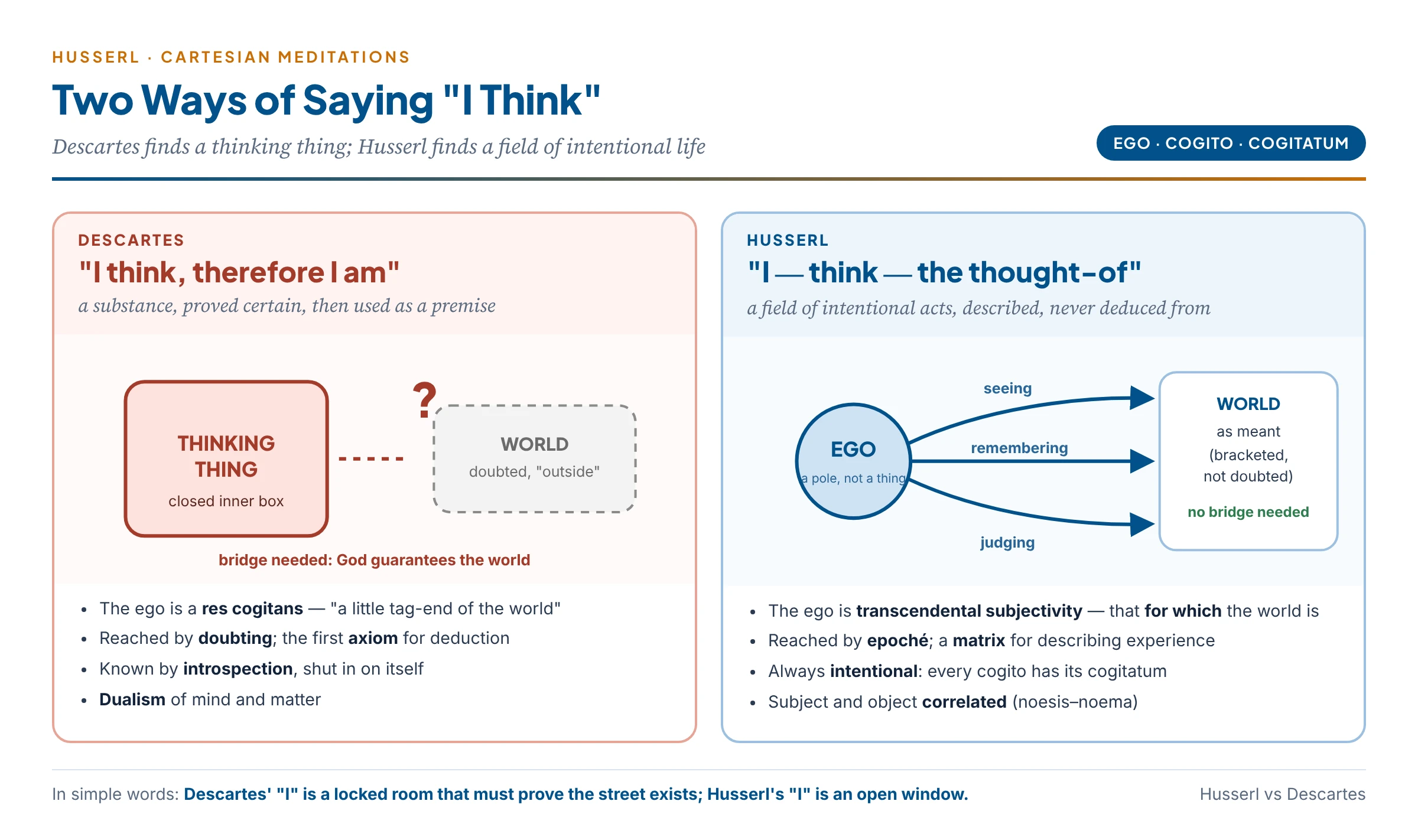
- “I think the thought-of.” Husserl’s formula for the ego’s life is ego–cogito–cogitatum: I — think — what is thought. The ego never exists without its intentional acts, and the acts never without their objects. This is very different from Descartes’ bare “I think, therefore I am”.
- With a history. In the late Husserl the ego has habits: once I have judged something, the conviction stays with me as an abiding possession; my past acts sediment into a style of experiencing. Husserl even speaks of the “genetic” phenomenology of how the ego builds up its world over time.
What it is for:
- It guarantees the unity of the stream of experience — all my acts are mine.
- It is the ultimate foundation of knowledge: the absolutely given starting point that the rigorous science of philosophy needed.
- It explains how the world can be “for me” at all.
Common confusion
Is Husserl’s transcendental ego a soul or a second person hidden inside me? No. It is not a soul-substance (Descartes), not a little observer inside the head, and not another person beside my empirical self. “Transcendental” means “concerning the conditions of possibility of experience“. The transcendental ego is simply me considered as the one to whom everything appears, rather than as one thing in the world. It is the same me, seen from two standpoints: as a human being in the world (empirical) and as the subject for whom there is a world (transcendental).
2. Husserl’s “I Think” Compared with Descartes’
Husserl called Descartes the “genuine patriarch” of phenomenology and named his last major book Cartesian Meditations. But he believed Descartes failed to grasp his own discovery.
Where they agree:
- Both start from zero. Both philosophies begin by setting aside all existing philosophies and beliefs.
- Both seek certainty. Both want an absolute foundation for knowledge, beyond doubt.
- Both start from the ego. Both see the ego as the source of all knowledge.
- Both appeal to intuition. Replying to Gassendi, Descartes said the first knowledge, “I think, therefore I am”, is grasped by intuition, not by syllogism; Husserl says eidetic intuition gives certain knowledge of essences.
Where they differ:
| Point | Descartes | Husserl |
|---|---|---|
| Philosophical aim | Indubitable certainty as the foundation of knowledge | Philosophy as a rigorous science of experience by analysis of consciousness |
| Method | Methodic doubt — doubt all that can be doubted | Epoché and reduction — suspend belief to examine how things appear |
| Starting point | The thinking self: cogito, ergo sum | Intentional consciousness: ego–cogito–cogitatum — consciousness is always of something |
| Nature of the ego | A substance — a thinking thing (res cogitans) | Transcendental subjectivity — not a substance but a field of intentional acts |
| Role of the ego | The first axiom, from which other truths are deduced by logic | A matrix for finding and describing experience; nothing is deduced from it |
| Relation to the world | World doubted, later restored by proving God’s existence | World bracketed and studied as constituted in experience — not proved metaphysically |
| View of consciousness | Self-certifying, known by introspection; a closed inner realm | Intentional and relational, always directed beyond itself |
| Subject and object | Dualism — mind and matter as two substances | Subject and object correlated (noesis–noema) within experience |
| Role of doubt / suspension | Epistemic — to eliminate false beliefs | Methodological — to analyse experience, not to deny reality |
| Objectivity | Guaranteed by God and clear and distinct ideas | Arises through intentional constitution and intersubjectivity |
| Attitude to science | Gives a metaphysical foundation to mathematical science | Criticises science’s objectivism; returns to the life-world as its basis |
| Type of philosophy | Rationalist, foundationalist metaphysics | Transcendental phenomenology — descriptive, not speculative |
| Historical role | Founder of modern philosophy | Re-founder of philosophy; bridge to existentialism |
Husserl’s criticism of Descartes:
- He kept a piece of the world. Descartes treated the ego as a “little tag-end of the world” — a thinking thing, a part of nature that survives doubt — instead of seeing that the ego is that for which the world is.
- He presupposed the natural world. Though he doubted it, he still thought of the mind as a substance inside a natural world, and then needed God to build a bridge back out.
- He jumped to conclusions. Having reached the cogito, he quickly accepted the entities of traditional metaphysics and science — substance, God, extended matter — while Husserl acknowledges only what is immediately given. Descartes also set out with a fixed goal — an absolute metaphysical foundation for the sciences — whereas Husserl treats every goal fixed in advance as one more presupposition to be bracketed.
- He ignored intentionality. He made the ego certain of itself but missed that every cogito has its cogitatum. Because consciousness is always of the world, the “bridge” problem Descartes struggled with does not arise.
- He missed the structure. Having learned from Kant that a theory of consciousness must study its form as well as its content, Husserl criticised Descartes for attending only to the content of thought.
In one line: Descartes’ “I think” is a substance proved certain and then used as a premise; Husserl’s “I think” is a field of intentional life described, never deduced from.
3. Husserl and Kant
- What Husserl took from Kant. The idea of a transcendental inquiry into the conditions of possibility of experience; the need to study the form of consciousness; the view that objectivity is constituted, not simply copied.
- Where he departs.
- No unknowable noumenon. Husserl rejects Kant’s thing-in-itself. What is given in pure intuition is not a veil over a hidden reality; nothing lies “behind” the phenomenon.
- Described, not deduced. Kant’s “I think that must be able to accompany all my representations” (the transcendental unity of apperception) is a formal condition, reached by argument and itself never experienced. Husserl’s transcendental ego is experienced and described in reflection.
- Intuition of essences. Kant allows no intellectual intuition; Husserl claims a direct eidetic intuition of essences.
- No ready-made categories. Kant starts from a fixed table of categories; Husserl studies how meanings are constituted in concrete acts.
4. Intersubjectivity
The problem. If phenomenology begins from subjectivity, how can it account for objectivity and for the existence of other persons?
Husserl’s answer. The very structure of experience implies others.
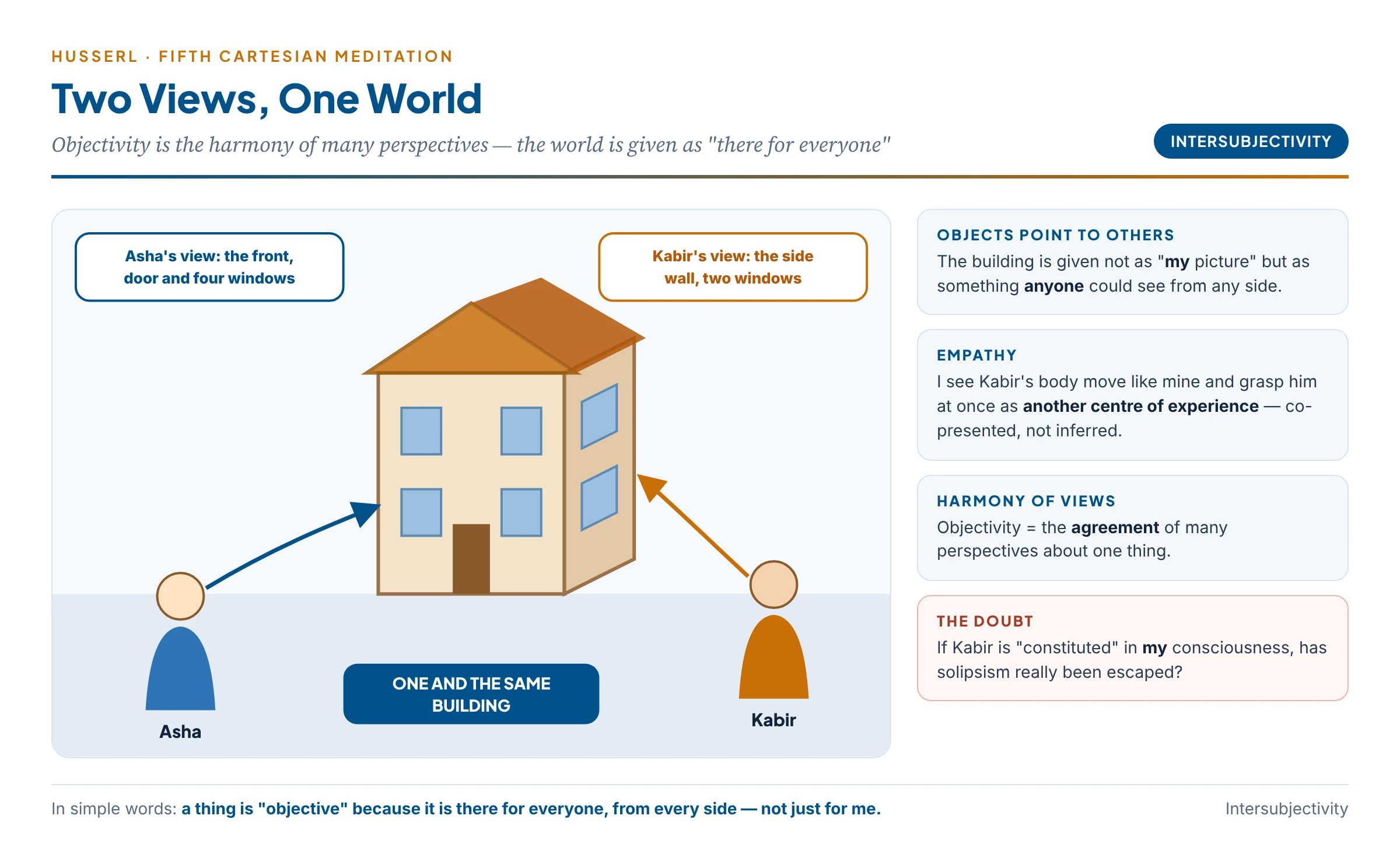
- Objects point to others. We never experience the world as a private field. A table is given not merely as “my perception” but as something others can also see, touch and use. This reference to other possible experiencers is built into the meaning of objectivity itself.
- Empathy. We know other persons through empathy (Einfühlung) — not by literally sharing their experience, which is impossible, but by apprehending their body as the expression of a consciousness like ours.
- Pairing and appresentation. When I see another living body that moves and behaves like mine, my experience “pairs” it with my own body; along with what is directly presented (the body) is co-presented (appresented) another centre of experience — the way the hidden back of a box is co-meant with its front.
- Not argument by analogy. I do not infer “he has a mind like mine” by reasoning; I perceive him straightaway as a person — though his experiences are given to me only indirectly.
- A community of monads. Husserl’s final picture is an intersubjective community of transcendental subjects, who together constitute one objective world — the world “for everybody”.
Examples:
- Someone writing at a desk. I do not see a mere moving body; I see a person thinking, intending, acting purposefully. Their gestures are taken as expressions of consciousness.
- A building seen from two sides. Two people see the same building from different angles; each has a distinct view, yet both mean the same building. Its identity is constituted through the harmony of many viewpoints — objectivity is intersubjective validity.
- Language. Communication presupposes a common world: words refer to things and ideas that others can understand.
Result. Intersubjectivity bridges the gap between transcendental subjectivity and the objective world. Objectivity is neither independent of consciousness nor merely subjective; it arises from a network of mutually related experiencing subjects. Husserl thus tries to avoid solipsism by showing that the constitution of meaning includes reference to others.
Criticisms. Many — Heidegger, the existentialists and later commentators — judged the attempt unsuccessful: if the other is “constituted” in my consciousness, is he not still my meaning? Heidegger answered that our being is being-with (Mitsein) others from the start; Sartre, that the other is revealed not by empathy but by the look — I discover the other’s existence when I am seen and feel shame, as in the case of the voyeur at the keyhole.
In simple words
Ten people stand round a statue in a square, each seeing a different side. Nobody sees the whole statue; yet all of them mean one statue, and they can talk about it, point to it, argue about it. Husserl says the “objectivity” of the statue is exactly this: the fact that it is given as something anyone could see from any side. So objectivity is not a view from nowhere — it is the agreement of all possible views.
5. The Life-World (Lebenswelt)
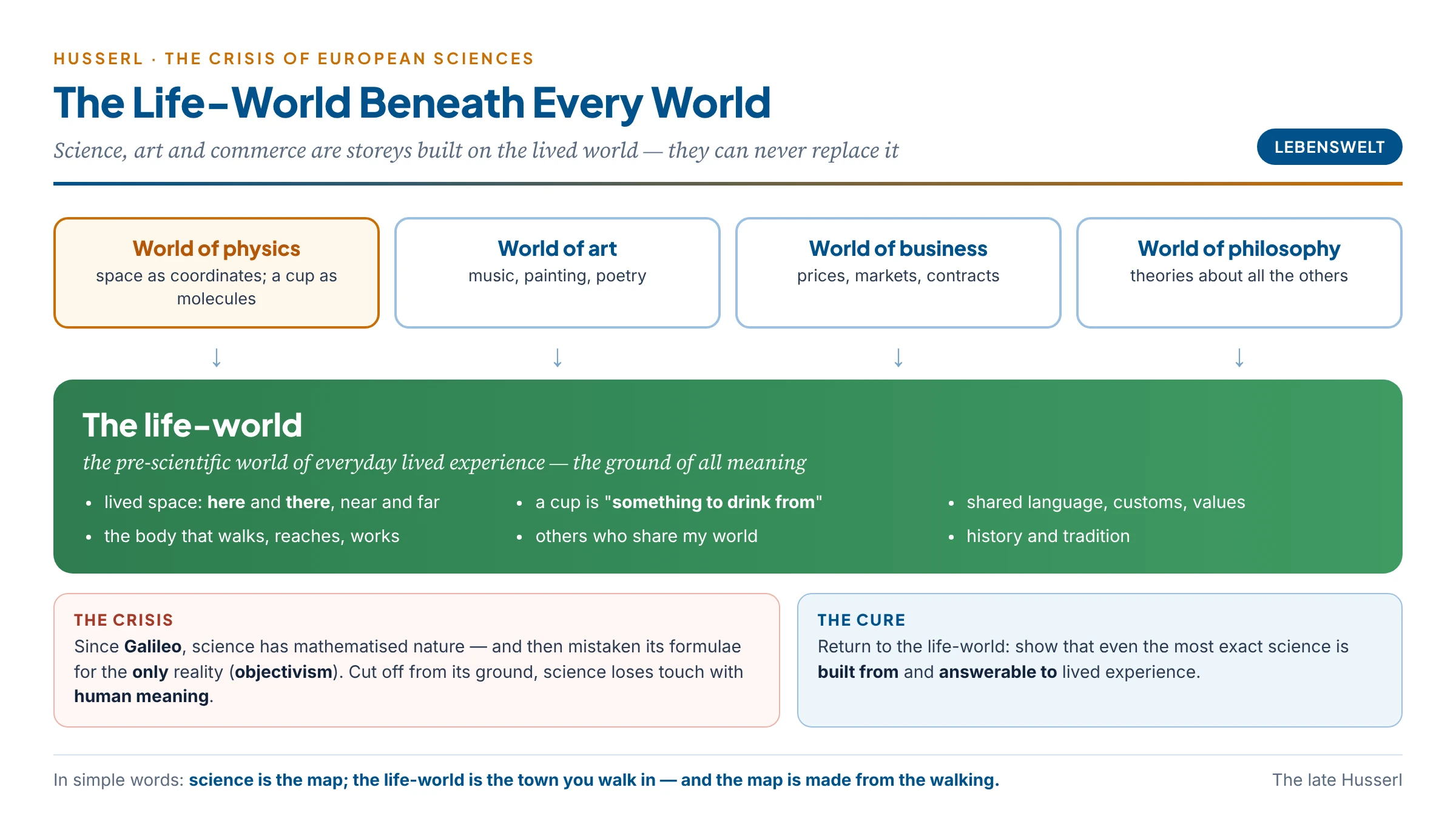
Definition. The life-world is the pre-scientific, everyday world of lived experience — the world as immediately experienced in perception, action, culture and social life — which forms the background and foundation of all knowledge.
Husserl’s argument in the Crisis:
- Galileo’s achievement — and his concealment. Since Galileo, modern science has described nature in mathematical terms — shapes, quantities, formulae. This mathematisation of nature was a magnificent achievement. But Galileo, in Husserl’s phrase, was at once a “discovering and concealing genius“: he discovered mathematical nature and concealed the life-world from which it was abstracted.
- Objectivism. Modern science came to treat its mathematical idealisations (atoms, waves, quanta) as the true reality, and the coloured, warm, meaningful world of experience as “merely subjective”. Husserl calls this error objectivism — mistaking a mathematical substruction for the world itself.
- The forgotten ground. Yet every scientific theory is built on the life-world: scientists measure with instruments they see, read results with their eyes, and discuss them in ordinary language. Science is a superstructure that cannot replace or negate its experiential base.
- The crisis. By forgetting the life-world, modern civilisation severed science from human meaning and ethical purpose. Science can tell us how things work but not what life is for. “We entirely lack a rational science of man and of the human community,” Husserl wrote.
- The cure. Philosophy must return to the life-world as the ultimate ground of meaning and show that all objectivity, even scientific objectivity, is constituted within this prior world of experience.
Examples:
- Space. Physics describes space in geometrical coordinates and measurable distances. Our primary experience of space is lived: we walk through rooms, reach for things, orient ourselves by “here” and “there”, “near” and “far”. This practical space precedes scientific description.
- A cup. A scientist may analyse a cup as a collection of molecules; in the life-world it appears immediately as “something to drink from“, woven into human purposes and cultural practices.
- Worlds upon worlds. The worlds of science, art, business, music, philosophy are all built on top of the lived world; they can never replace or undermine it. For human beings there is ultimately only the lived world on which all other worlds rest.
In simple words
A map app shows your town as a grid of streets, coordinates and kilometres — precise, useful, “objective”. But you first knew your town by walking it: the shortcut behind the temple, the corner where the tea-stall is, the road that feels long in the afternoon heat. The map was made from such walking and is useful only to people who walk. Husserl’s life-world is the walked town; science is the map. The crisis comes when we start believing that only the map is real.
Significance:
- It answers the charge that Husserl ignored history and practice: the life-world is historical, cultural and practical.
- It partly meets Heidegger’s objection that our first relation to the world is practical, not theoretical.
- It deeply influenced Merleau-Ponty, the philosophy of embodiment, social theory (Alfred Schutz, Habermas’s “life-world”) and today’s critiques of technocracy.
6. Sartre: Consciousness as “Nothing” and the Rejection of the Transcendental Ego
Sartre’s debt to Husserl. Jean-Paul Sartre (1905–1980) learned phenomenology from Husserl, kept intentionality and the descriptive method, and called his masterwork Being and Nothingness (1943) “an essay in phenomenological ontology“. In an early essay he praised Husserl for delivering philosophy from the “inner life”: since consciousness is always of something, everything is outside — in the world, among things.
The Transcendence of the Ego (1936–37). Sartre’s first major break with Husserl:
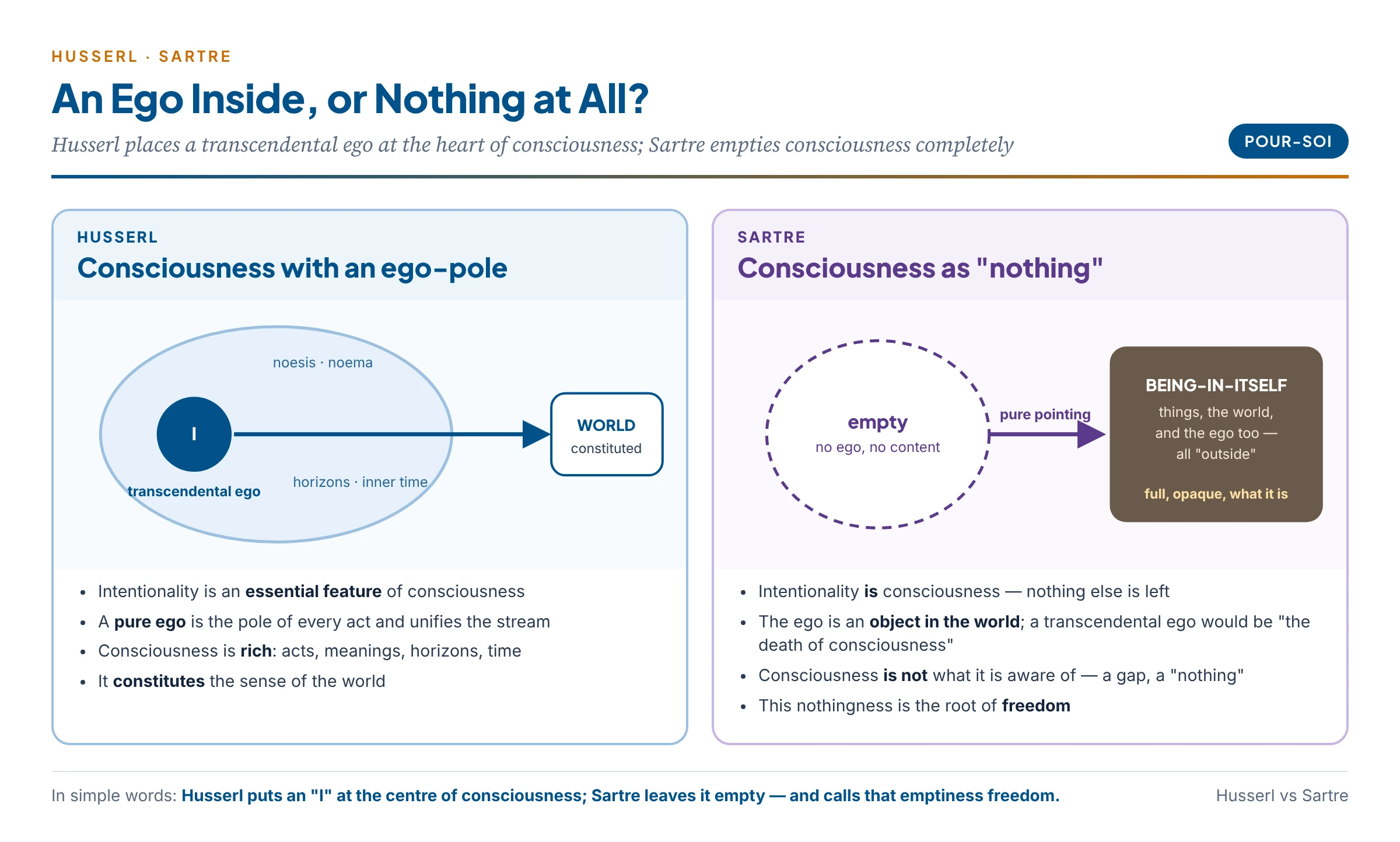
- The ego is not in consciousness. The ego (the “I” and the “me”) is not an inhabitant of consciousness. It is an object — outside, in the world — constituted by reflection, like other people’s egos.
- The transcendental ego is unnecessary. The unity of consciousness is secured by consciousness itself — by its intentional relation to objects and its unifying flow in time. No “I” behind consciousness is needed to hold it together.
- The transcendental ego would be fatal. If there were an ego inside consciousness, it would make consciousness opaque, heavy, thing-like. Sartre called the transcendental ego “the death of consciousness“.
- Consciousness is impersonal. At the basic level consciousness is impersonal and spontaneous — a pure, translucent directedness at things.
Pre-reflective and reflective consciousness.
- Pre-reflective. When I am absorbed in reading, I am conscious of the argument on the page, not of “myself reading”. There is no “I” in this experience.
- Reflective. If someone asks, “What are you doing?”, I reflect and answer “I am reading”. Only now does an “I” appear — as an object of reflection.
- Non-positional self-awareness. Yet the first experience was not unconscious: I was implicitly aware of reading, otherwise I could not answer at once. “Every positional consciousness of an object is at the same time a non-positional consciousness of itself.” Self-awareness is built into every act, without an ego.
- The anaesthetic test. A patient under general anaesthesia has no pre-reflective awareness at all; asked “What did you feel during the operation?” he says “Nothing“. There was no experience to reflect on.
Consciousness as “nothing” (néant):
- Two regions of being. In Being and Nothingness Sartre distinguishes being-in-itself (en-soi) — things, matter: solid, opaque, full, simply what it is — and being-for-itself (pour-soi) — consciousness.
- Consciousness has no content. Because consciousness is wholly directed at objects, it contains nothing of its own — no images, no ego, no stuff. Everything it is conscious of lies outside it. In itself it is a pure emptiness.
- A gap in being. Consciousness is not the object it is conscious of: to be aware of the table is to be not the table. Consciousness is this not — a nothingness, a fissure introduced into the solid fullness of being.
- Never identical with itself. Consciousness is always separated from its past (which it no longer is) and from its future (which it is not yet) by a gap of nothing. Hence Sartre’s paradox: the for-itself “is what it is not and is not what it is“.
- The source of freedom. Because consciousness is not a thing with a fixed nature, nothing determines it; this nothingness is the root of human freedom — man is “condemned to be free“, and “existence precedes essence“.
- Phenomena are absolute. Against Kant, Sartre holds that the appearance of a phenomenon is pure and absolute: there is no hidden noumenon behind it.
How Sartre’s “nothing” differs from Husserl’s consciousness:
| Point | Husserl | Sartre |
|---|---|---|
| Intentionality | An essential feature of consciousness | Is consciousness — consciousness is nothing but its directedness |
| The ego | Transcendental ego — the subject-pole within consciousness, constituting all meaning | No ego in consciousness; the ego is an object in the world, made by reflection |
| Content of consciousness | Rich structures: noesis, noema, hyle, horizons, time-consciousness | No content at all — a pure emptiness, “nothing” |
| Unity of consciousness | Secured by the ego-pole and inner time | Secured by intentionality and the temporal flow — no ego needed |
| Self-awareness | Through reflection on one’s acts | Non-positional, pre-reflective awareness in every act |
| Constitution | Consciousness constitutes the meaning of the world | Consciousness reveals being, which is “in-itself” and does not need constituting |
| Being of the world | Bracketed; being-as-given | Being-in-itself — massive, absurd, contingent (revealed in nausea) |
| Epoché | Central method | Rejected — existence cannot be bracketed |
| Aim | Rigorous science of essences | Existential analysis of freedom, anguish and bad faith |
| Gulf | No gulf between consciousness of the world and of oneself | A wide gulf between being-in-itself and being-for-itself |
Sartre’s criticism of Husserl in short:
- Husserl reified consciousness by putting an ego in it, making it a thing (the “death of consciousness”).
- He brackets even the empirical ego — but for Sartre the self is a project in the world, never outside it.
- His transcendental ego drifts away from the existentialist task: finding authentic existence for the concrete individual.
- His bracketing of existence ignores the “phenomena of being” such as nausea and anguish, which reveal that we exist and need not exist.
Common confusion
When Sartre calls consciousness “nothing”, does he mean consciousness does not exist? No. “Nothing” (néant) means consciousness is not a thing — it has no content, no fixed nature, no ego inside it. It exists, but as a pure directedness towards objects, always other than what it is aware of. This “nothingness” is what makes freedom possible: a thing is fixed by its nature; consciousness, being “nothing”, must choose what it will be.
7. Heidegger: Being-in-the-World against the Transcendental Ego
Heidegger’s debt. Martin Heidegger (1889–1976) was Husserl’s assistant and successor at Freiburg and dedicated Being and Time (1927) to him. He kept the slogan “to the things themselves” but turned phenomenology into fundamental ontology — the study of the meaning of Being.
Why he rejects the epoché and the transcendental ego:
- The question of Being comes first. Western philosophy, Heidegger says, has forgotten Being; it studied beings (things) and mistook Being for a supreme being. The task is to ask what it means to be — and that is done through the being who asks the question: Dasein (“being-there”), the human being.
- Dasein is being-in-the-world. Dasein is not a subject that could first exist and then relate to a world. Its very being is being-in-the-world (In-der-Welt-sein) — a unified, pre-reflective involvement. Dasein and world are inseparable; worldhood belongs to Dasein’s existence.
- The world cannot be bracketed. Since the world is not an object of belief but the horizon of our existing, it cannot be “put out of action”. To try is to turn ourselves into detached spectators — which we never originally are.
- Practical before theoretical. We first meet things as ready-to-hand (zuhanden) equipment — the carpenter’s hammer that “withdraws” in the flow of work. Only when the hammer breaks do we stare at it as a present-at-hand (vorhanden) object with properties. Husserl, like Descartes, took the theoretical, present-at-hand attitude as primary; Heidegger reverses this.
- Care, not consciousness. The being of Dasein is care (Sorge): concern for things, solicitude for others, and concern for its own being — not a pure gaze. Dasein’s being is “an issue for it“.
- Being-with. Dasein is from the start being-with (Mitsein) others; there is no problem of “constituting” other minds from my own consciousness.
- Existence before essence. “The essence of Dasein lies in its existence.” Dasein has no fixed “what” that eidetic intuition could capture; it is a set of possibilities it projects itself into.
- Hermeneutics, not pure description. Every inquiry begins with a pre-understanding of its subject; phenomenology must therefore be interpretation (hermeneutics), not presuppositionless description. There is no “absolute poverty”.
- Temporality. Dasein’s being is grounded in temporality — being-towards-death, thrownness into a past, projection into a future — not in the timeless structures of a pure ego.
In simple words
When a cyclist rides to college, she does not think about pedals, chain or brakes — the bicycle “disappears” into the riding, and she is simply on her way. Only when the chain comes off does the bicycle suddenly appear as a thing with parts to be examined. Heidegger says this is how we are in the world: first busy with things (ready-to-hand), and only sometimes staring at them (present-at-hand). Husserl’s pure ego, gazing at bracketed phenomena, starts from the second, rarer attitude as if it were the first.
Husserl’s reply. Husserl read Being and Time as a relapse into anthropology: a description of one region of beings (man) passed off as fundamental philosophy, still operating inside the natural attitude. He refused to recognise it as genuine phenomenology. Some critics agree that Heidegger changed the subject rather than refuting Husserl; others think Heidegger showed that the pure ego was an abstraction from concrete existence.
8. The Empirical Ego in Sartre and Heidegger versus Husserl’s Transcendental Ego
| Point | Husserl’s transcendental ego | Sartre’s ego | Heidegger’s Dasein / self |
|---|---|---|---|
| Where it is | The subject-pole for which the world is; outside the bracketed world | An object in the world, made by reflection; consciousness itself is impersonal | In the world — Dasein is being-in-the-world |
| What it is | Pure, constituting subjectivity; not a substance | A “transcendent” construction — a unity of states, actions and qualities | A way of existing — care, possibility, projection |
| How known | Transcendental reflection after the reduction | Reflection, which “makes” the ego as its object | Through Dasein’s understanding of its own being; moods such as anxiety |
| Everyday self | — | Prone to bad faith — pretending to be a fixed thing | Usually lost in “the They” (das Man) — the anonymous crowd; inauthentic |
| Authentic self | Reached by method (reduction) | By freely choosing and owning one’s choices without bad faith | By anticipatory resoluteness in facing one’s own death |
| Relation to others | Constituted through empathy | Revealed by the look; conflict | Being-with from the start |
| Essence | Has an eidetic structure | Existence precedes essence | “The essence of Dasein lies in its existence” |
In one line: for Husserl the self that matters is outside the world as its constituting source; for Sartre and Heidegger the self is always in the world — Sartre’s as a constructed object of a nothingness that must choose, Heidegger’s as an existing, caring, mortal being-in-the-world.
9. Merleau-Ponty and the Lived Body
- Maurice Merleau-Ponty (1908–1961) developed the late Husserl’s ideas of the life-world and the body.
- The lived body. Our first intentionality is not the intellectual “I think” but the “I can” of the lived body — an operative intentionality by which the body reaches for, handles and understands things before any reflection.
- The incomplete reduction. “The most important lesson which the reduction teaches us is the impossibility of a complete reduction“: we cannot step outside the world in which we are embodied.
- Middle position. Merleau-Ponty stands between Husserl and the existentialists: he keeps the descriptive method and the life-world, but drops the claim to a world-free transcendental ego.
10. Husserl, Kierkegaard, Heidegger and Sartre at a Glance
| Dimension | Husserl | Kierkegaard | Heidegger | Sartre |
|---|---|---|---|---|
| Central problem | Grounding knowledge as rigorous science; pure consciousness | The existing individual; passionate inwardness; faith | The question of Being | Radical freedom; bad faith; responsibility |
| Starting point | Transcendental ego reached by epoché | The solitary individual before God | Dasein as being-in-the-world | Concrete human existence — existence precedes essence |
| Consciousness | Transcendental intentionality; noesis–noema | Passionate subjectivity | Dasein’s disclosedness through care | Pure nothingness; translucent void (for-itself) |
| Anxiety | Not a theme — methodological neutrality | Dizziness of freedom before sin | Collapse of everyday meaning before death | Anguish of groundless responsibility |
| Way to truth / authenticity | Rigorous reduction to essential structures | Leap of faith | Anticipatory resoluteness before death | Radical choice without bad faith |
Critical Evaluation
Objections to Husserl’s Transcendental Philosophy
- Transcendental idealism. By making all being “being-as-constituted“, Husserl seems to make the world depend on consciousness. His early realist followers left him on this point.
- Solipsism. The fifth Cartesian Meditation’s account of empathy and pairing still constitutes the other in my consciousness; critics find it inconclusive.
- An empty or redundant ego. Sartre: the transcendental ego adds nothing and makes consciousness opaque. Hume and the Buddhists would add: no such self is ever found in experience — Husserl himself could not find it in 1900.
- Worldlessness. Heidegger and Merleau-Ponty: a subject that can bracket the world is an abstraction; real subjects are embodied and in the world.
- Neglect of history and the body in the earlier work — partly corrected by the life-world.
- Unclear unity of the project. Husserl’s views on the ego changed several times (no ego, pure ego, concrete monad), and his followers kept the method but not the ego.
Replies and Strengths
- Idealism of meaning. “Constitution” means sense-giving, not creation; Husserl never denied that the tree is really there.
- The life-world answers the charges of worldlessness and neglect of history, and became one of the most fruitful ideas of the century.
- The ego as a pole, not a thing. Husserl’s ego is not a hidden object but the identity of the “I” in all its acts — something Sartre’s “non-positional self-awareness” itself seems to presuppose.
- Intersubjectivity — Husserl was among the first to see that objectivity itself means “valid for everyone“, and so is essentially social.
- The method survives in every philosophy that criticised it.
Critics and Defenders
Criticism — Critics
- Sartre — the transcendental ego is “the death of consciousness”; consciousness is impersonal, a pure nothingness.
- Heidegger — Dasein is being-in-the-world; the world cannot be bracketed; Being comes before consciousness.
- Merleau-Ponty — a complete reduction is impossible; the lived body comes first.
- Realist phenomenologists — transcendental idealism makes the world depend on consciousness.
- Hume and Buddhism (in spirit) — no permanent self is ever found in experience.
Defence — Defenders and strengths
- Not a substance — Husserl’s ego is a pole and field, not a Cartesian thing.
- Intersubjectivity — objectivity is defined as validity for all subjects.
- Life-world — restores the link between science and lived human meaning.
- Self-correcting — the later Husserl absorbs much of the existentialist critique.
- Legacy — existentialism, hermeneutics, Merleau-Ponty, social theory and today’s phenomenology of mind all grew from him.
Cross-Tradition Comparison
The Self and Consciousness in Indian Philosophy
| Point | Husserl | Advaita Vedānta | Buddhism | Nyāya | Sāṃkhya–Yoga |
|---|---|---|---|---|---|
| Is there a pure self beyond the empirical “I”? | Yes — transcendental ego, distinct from the empirical ego | Yes — sākṣī (witness) / Ātman, distinct from the ego (ahaṃkāra) | No — anattā; the “I” is a construction from the aggregates (skandhas) | Yes — the self (ātman) is a substance, but consciousness is only its adventitious quality | Yes — puruṣa, pure consciousness, distinct from mind and ego (products of prakṛti) |
| Is the self active? | Active — constitutes meaning | Actionless pure witness | — | Knower, doer, enjoyer | Actionless witness |
| Self-awareness | By reflection; later inner time-consciousness | Self-luminous (svaprakāśa) | Consciousness momentary; Yogācāra: self-aware (svasaṃvedana) | Known by a later cognition | Self-luminous |
| Relation to the world | World constituted as meaning | World an appearance on Brahman (vivarta) | World of dependent origination (pratītyasamutpāda) | World real and independent | World real (prakṛti), but not the self |
Indian Connect — Key takeaways
- Husserl’s transcendental ego and Advaita’s sākṣī are both “that which cannot be bracketed” — the witness of all states, distinct from the empirical “I”. But the sākṣī is actionless pure awareness, while Husserl’s ego is active, constituting the sense of the world.
- Sartre’s impersonal consciousness and the Buddhist anattā both deny a self inside consciousness — but Sartre keeps a radically free “nothingness”, while Buddhism dissolves even this into momentary, dependently arising events.
- Sartre’s non-positional self-awareness is close to the Advaita and Yogācāra idea that consciousness is self-luminous — aware of itself without becoming its own object.
- Heidegger’s being-in-the-world has an echo in the Gītā‘s teaching that one cannot exist without action (karma): existence is always engaged.
- Among modern Indian thinkers, K. C. Bhattacharya‘s “subject as freedom” — the subject known only by progressively distinguishing itself from the body, the mind and the object — offers a striking parallel to Husserl’s reductions.
Two Ways of Meeting the Other: Husserl and Sartre
| Point | Husserl | Sartre |
|---|---|---|
| How the other is known | Empathy — appresentation of another consciousness through his body | The look — I discover the other when I am looked at |
| Typical experience | Seeing someone writing at a desk | The voyeur at the keyhole who hears footsteps and blushes |
| Character of the relation | Co-constitution of a common world | Conflict — each tries to make the other an object |
| Result | Intersubjective objectivity | “Hell is other people” (in Sartre’s play No Exit) — the other limits my freedom |
Synthesis (Siddhānta)
- Husserl’s ego. The transcendental ego is not a substance but the pole and field of all intentional life — ego–cogito–cogitatum — for which the world, including my empirical self, is given. It is Husserl’s answer to Descartes, keeping his radical beginning while correcting his substance dualism and his neglect of intentionality.
- Others and objectivity. Through empathy and the harmony of perspectives, objectivity becomes intersubjective validity — Husserl’s attempt to escape solipsism.
- The life-world. Science is a magnificent superstructure on the lived world; forgetting this ground produced the crisis of modern humanity. Philosophy’s task is to reconnect science with meaning.
- The great replies. Sartre kept intentionality but emptied consciousness of every ego, making it a nothingness and so the root of freedom. Heidegger replaced the world-bracketing ego with Dasein as being-in-the-world, and pure description with interpretation. Merleau-Ponty grounded intentionality in the lived body.
- Balance. The transcendental ego and the complete reduction have few defenders today; but the method, intentionality, intersubjectivity and the life-world remain among the most influential ideas of twentieth-century philosophy.
- Indian resonance. The debate between Husserl (a constituting ego), Advaita (a witnessing self), Sartre (consciousness without an ego) and Buddhism (no self at all) re-stages, in modern European terms, the oldest argument of Indian philosophy — ātman versus anātman.
“Every positional consciousness of an object is at the same time a non-positional consciousness of itself.” — Sartre
“The essence of Dasein lies in its existence.” — Heidegger
Previous Year Questions
- 2026Describe Sartre’s notion of consciousness as ‘nothing’. How is it different from Husserl’s notion of consciousness? Discuss.
- 2025How is Husserl’s account of “I think” different from that of Descartes? Critically discuss.
- 2018What is Epoché? How does Heidegger reject this method of phenomenological reduction? Explain Heidegger’s concept of ‘being in the world’ as opposed to the concept of a transcendental ego.
- 2010How is the empirical ego in Sartre and Heidegger different from the transcendental ego in Husserl?
- 2008What is the notion of transcendental ego according to Husserl? How is it different from Sartre’s notion of the ego?