

Later Wittgenstein: Meaning and Use; Language-games; Critique of Private Language.
Official Syllabus: Paper I, Section A, Unit 8
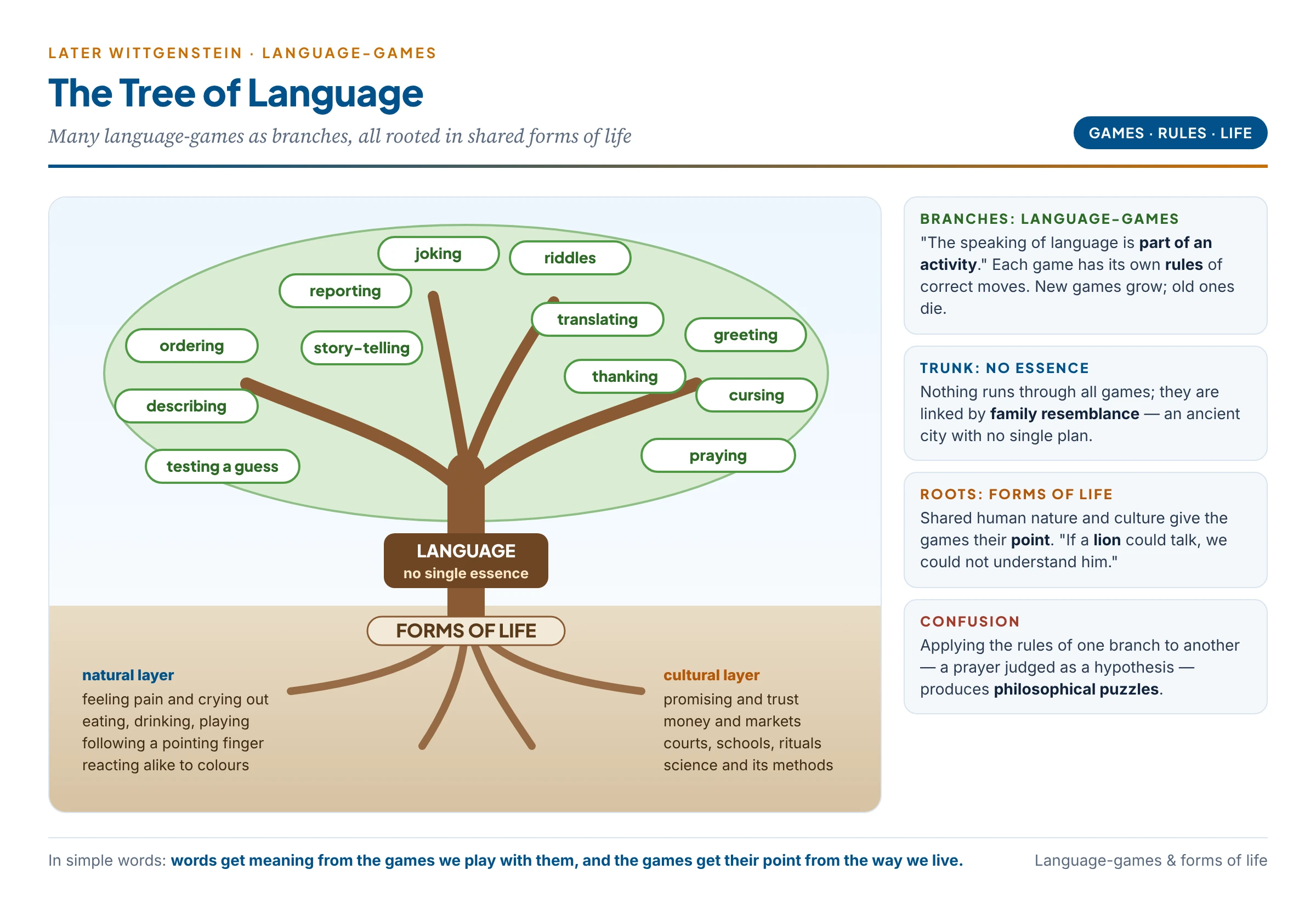
If meaning is use, then the place to study meaning is the activity in which words are used. Wittgenstein’s name for such an activity is a language-game (Sprachspiel): “the speaking of language is part of an activity, or of a form of life“. Language is not one crystal-clear logical system but a large, untidy family of games — ordering, describing, joking, praying, promising — each with its own rules, all rooted in the shared ways of living he calls forms of life (Lebensformen). And what unites these many games is not a common essence but a network of overlapping likenesses, which he calls family resemblance (Familienähnlichkeit).
In simple words
Think of a cricket ball. In a Test match it is bowled, hit and caught; in a street game it may be bowled underarm with a tennis ball and a brick for stumps; in a fielding drill it is only thrown. The same ball does different things because it belongs to different games. Words are like this: their meaning comes from the game in which they are used, and the games themselves belong to a way of life — here, a country that lives and breathes cricket.
Context & Problem
Why Speak of “Games”?
- The old view. In the Tractatus, all language shared one logical form and did one job — picturing facts. Any sentence that pictured no fact was nonsense.
- The new insight. Wittgenstein now saw that language has countless uses, that these uses are woven into actions, and that they have rules without having a single logical form. The comparison with games captures all three points.
- Why the word “game” fits.
- Games are activities — playing chess is something people do, not a picture of something.
- Games have rules — and a move counts as correct or incorrect only by those rules.
- Games are enormously varied — chess, kabaddi, solitaire, hide-and-seek — just as language is.
- Games show family resemblance — there is no single feature common to all games, as there is no single feature common to all language.
- Not trivial. Calling language a “game” does not mean it is a pastime or not serious. Prayer, a court verdict and a marriage vow are language-games too. The word was chosen because games show the same kind of variety and rule-governed activity as language.
Three Senses of “Language-Game”
- Simple invented languages — such as the builders’ language of “Block!”, “Pillar!”, “Slab!”, “Beam!” — which Wittgenstein uses as objects of comparison. They are not rough first sketches of real language “leaving out friction”; they throw light on real language through both similarities and differences.
- Particular activities within a natural language — giving orders, describing an object, telling a joke, praying.
- The whole of language together with the actions into which it is woven: “I shall also call the whole, consisting of language and the actions into which it is woven, the ‘language-game’.“
Core Doctrine
1. What Is a Language-Game?
“Here the term ‘language-game’ is meant to bring into prominence the fact that the speaking of language is part of an activity, or of a form of life.” — Wittgenstein, Philosophical Investigations
Wittgenstein’s own list of language-games:
- Giving orders, and obeying them
- Describing the appearance of an object, or giving its measurements
- Constructing an object from a description (a drawing)
- Reporting an event; speculating about an event
- Forming and testing a hypothesis; presenting the results of an experiment in tables and diagrams
- Making up a story, and reading it; play-acting; singing catches
- Guessing riddles; making a joke, and telling it
- Solving a problem in practical arithmetic
- Translating from one language into another
- Asking, thanking, cursing, greeting, praying
- “Countless” kinds of sentence. How many kinds of sentence are there — assertion, question and command? “There are countless kinds.” And this variety “is not something fixed, given once for all; new types of language, new language-games, as we may say, come into existence, and others become obsolete and get forgotten.”
- The ancient city. “Our language can be seen as an ancient city: a maze of little streets and squares, of old and new houses, and of houses with additions from various periods; and this surrounded by a multitude of new boroughs with straight regular streets and uniform houses.” The new suburbs are the specialised languages of chemistry, calculus and science; the old centre is everyday speech. The city has no single plan and is always growing.
- The logician’s mistake. It is interesting to compare the variety of language-games with what logicians — including the author of the Tractatus — have said about the structure of language. They saw only one kind of sentence, the description of facts.
In simple words
Think of how Indian English keeps growing. A few decades ago nobody “googled” anything, “liked” a photo, or sent a “voice note“; old games such as writing telegrams (“ARRIVING TUESDAY STOP”) have almost disappeared. Language is like Wittgenstein’s ancient city — old lanes in the middle, new colonies on the outskirts, and buildings coming up and coming down all the time.
2. Features of Language-Games
- Embedded in activity. Words are used within actions — building, buying, measuring, worshipping. Speaking is itself doing something.
- Governed by rules. What counts as a correct or incorrect move is fixed by the rules of the game (its internal normativity), not by some external metaphysical reality. Just as rules of chess, football and cards differ, so do the standards of correctness in different discourses.
- Contextual. “A piece in chess has no power outside the rules of chess“; likewise a word has no semantic life outside the game in which it is used. The rules of language are like the rules of games, so saying something is like making a move.
- Plural, with no single essence. There is no “general form” of language; the games are many and are related only by family resemblance (section 6).
- Dynamic. New games arise (scientific jargon, legal terminology, digital idioms); old ones decay and are forgotten.
- Public and learned. Games are learned by training and taking part; they are shared by a community and open to view.
- Not everywhere bounded by rules. Even in tennis there is no rule for how high one may throw the ball when serving, yet tennis is a game with rules. Sometimes “we make up the rules as we go along” — and even alter them as we go along. Rules guide use without settling every possible case in advance.
- Mixing games breeds confusion. Each game has its own rules; if the rules of one game are applied to another, philosophical problems arise — for instance, treating a prayer as a scientific hypothesis, or treating “time flows” as if time were a physical river.
| Utterance | Language-game | What makes a move correct or successful |
|---|---|---|
| “Close the door.“ | Giving an order | The order is obeyed or disobeyed, not true or false |
| “O God, guide us.“ | Prayer | Sincerity, reverence, fitting the practice of worship — not empirical evidence |
| A joke at a wedding | Joking | Tone, timing and shared culture; laughter, not literal truth |
| “Water boils at 100°C at sea level.“ | Science | Measurement, experiment and verification |
| “The accused is guilty.“ | Law court | Evidence, procedure, the judge’s authority |
| “I’m sorry.“ | Apology | Regret shown and accepted |
| “Namaste.“ | Greeting | Fitting the occasion and relationship |
| “Once upon a time…“ | Story-telling | Coherence and interest, not fact |
3. The Significance of Language-Games for the Use Theory of Meaning
The 2014 paper asked about the significance of language-games in the use theory of meaning. The concept does at least seven jobs.
- It locates “use”. “The meaning of a word is its use in the language” — but use is always use in some game. The language-game is the context that gives a word its role.
- It replaces the one logical form. Instead of a single essence of language (the picture theory), there is a plurality of games with different rules.
- It explains the variety of meaning. The same word (“Water!”) can be an order, a warning or an answer because it is a move in different games.
- It explains how meaning is learned. Children learn language by taking part in games — fetching, naming, counting, greeting — not by receiving definitions.
- It shows that meaning is rule-governed. Since games have rules, there is a difference between correct and incorrect use — meaning is normative.
- It provides objects of comparison. Simple invented games (the builders) let us see clearly what is hidden by the complexity of real language.
- It diagnoses philosophical confusion. Many puzzles arise from confusing games — applying the grammar of one activity to another — and are dissolved by noticing which game a word belongs to.
4. Rule-Following: How Can a Rule Guide Us?
Language-games are governed by rules. But what is it to follow a rule? Wittgenstein’s answer is one of the most important — and most debated — parts of the Investigations.
The problem: any rule can be read in different ways.
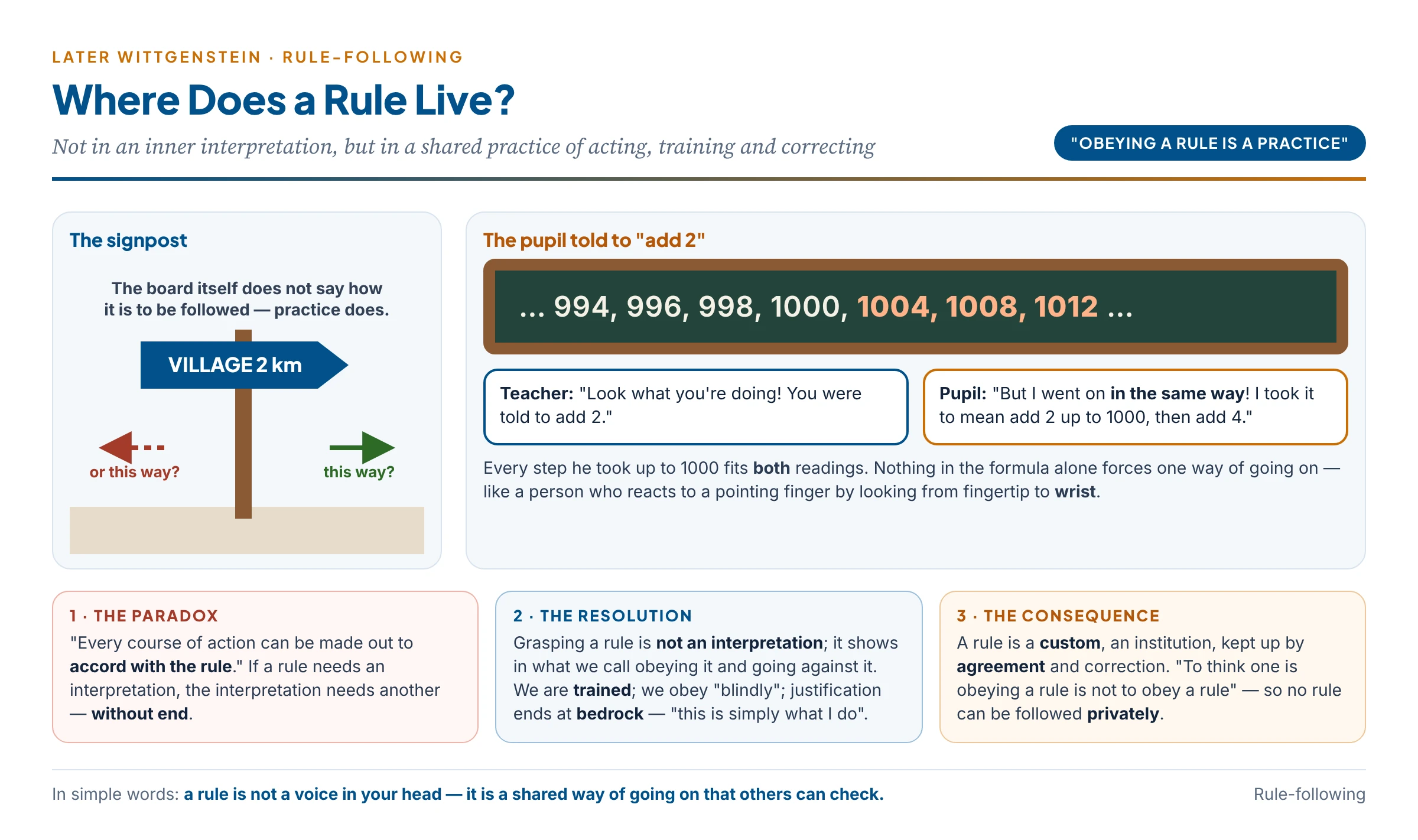
- The signpost. A signpost points the way. But does it tell me to go in the direction of the finger or (one might ask) in the opposite direction? Nothing in the board itself decides. Yet in normal circumstances there is no doubt: “A rule stands there like a signpost” — and it is in order if, under normal circumstances, it serves its purpose.
- The puzzling pupil. A teacher trains a pupil to write the series “add 2” — 2, 4, 6, 8 … — and tests him up to 1000. Then the pupil continues: 1000, 1004, 1008, 1012. We say, “Look what you are doing!” He replies, “But I went on in the same way!” — he understood “add 2” as “add 2 up to 1000, then 4, up to 2000 then 6”. It is as if he naturally reacted to a pointing finger by looking from the fingertip to the wrist instead of in the direction pointed.
- The paradox. “No course of action could be determined by a rule, because every course of action can be made out to accord with the rule.” If every action can be made to fit some interpretation of the rule, then the rule seems to determine nothing.
Wittgenstein’s resolution.
- Grasping a rule is not interpreting it. “There is a way of grasping a rule which is not an interpretation“, but which is shown in what we call “obeying the rule” and “going against it” in actual cases. If every rule needed an interpretation, each interpretation would need another, without end.
- Following a rule is a practice. “Obeying a rule is a practice.” To follow a rule, to make a report, to give an order, to play chess are customs (uses, institutions). “It is not possible that there should have been only one occasion on which only one person obeyed a rule.”
- Training and blind obedience. We are trained to react to rules in a certain way. “When I obey a rule, I do not choose. I obey the rule blindly.” There is no gap to be filled by an inner interpretation.
- Not privately. “To think one is obeying a rule is not to obey a rule. Hence it is not possible to obey a rule ‘privately’: otherwise thinking one was obeying a rule would be the same thing as obeying it.” Here lies the bridge to the private language argument (Article 3).
- Bedrock. Justification must come to an end: “If I have exhausted the justifications I have reached bedrock, and my spade is turned. Then I am inclined to say: ‘This is simply what I do.’“
- Agreement in judgments. “If language is to be a means of communication there must be agreement not only in definitions but also (queer as this may sound) in judgments.” We must agree not only on what a metre is but also, by and large, in our results when we measure.
Everyday examples.
- Learning “add”. A child does not form a private idea of addition; she is trained to continue “2, 4, 6, 8…” as others do, corrected when she goes wrong, and praised when she goes right.
- Learning “red”. Children learn colour words through public correction and agreement (“No, that’s orange — this one is red”), not by attaching the word to a private sensation.
- Why this matters. If rule-following were purely private, there would be no difference between using a word correctly and merely thinking one is using it correctly. Correctness needs a public practice.
In simple words
Consider driving on the left in India. The rule is not a thought in each driver’s head that interprets itself; it exists in practice — in training, in driving tests, in the honks and shouts that greet a driver who goes the wrong way, in the regular flow of traffic. A rule lives in what people regularly do and correct one another for not doing.
Kripke’s sceptical reading.
- The challenge. Saul Kripke turned the pupil example into a radical sceptical paradox. Suppose I have never added numbers as large as 68 and 57. A sceptic asks: how do I know that by “plus” I always meant addition, and not “quus” — an odd rule that gives the same answers as addition for all the sums I have done so far but gives 5 for larger ones? Nothing in my past behaviour or in my mind seems to settle which rule I meant.
- The “sceptical solution”. Kripke concluded that there is no fact about an individual that makes his words mean one thing rather than another. Meaning-talk is justified only by the community: I am said to mean addition because my answers agree with those of other speakers.
- Assessment. Many defenders of Wittgenstein reply that he did not accept the paradox; he used it to show that the picture of rules as interpretations is wrong. Once we see that grasping a rule is a practical ability exercised in a shared practice, the sceptical gap never opens. Kripke’s reading is nonetheless valuable for showing how deep the issue goes.
5. Forms of Life (Lebensformen)
Language-games do not float in the air. They are rooted in forms of life — the shared patterns of human activity, needs, natural reactions, customs and institutions in which speaking has its point.
What a form of life is.
- The phrase. Wittgenstein uses it only a handful of times, but at crucial points: “to imagine a language means to imagine a form of life“; speaking a language is “part of an activity, or of a form of life“; and “what has to be accepted, the given, is — so one could say — forms of life“.
- Two layers.
- Natural (biological) layer — features of our common human nature: we feel pain and cry out, eat and drink, follow a pointing finger, react to colours alike, have similar needs and expressions. “Commanding, questioning, recounting, chatting, are as much a part of our natural history as walking, eating, drinking, playing.“
- Cultural (social) layer — practices and institutions such as promising, money, courts, schools, markets, rituals, science. These differ between societies and change over time.
- Agreement in form of life. “So you are saying that human agreement decides what is true and what is false?” — “It is what human beings say that is true and false; and they agree in the language they use. That is not agreement in opinions but in form of life.” Agreement in form of life is not a vote on what is true; it is the background that makes it possible to say true or false things at all.
- Where justification ends. Forms of life are not justified by anything deeper; they are given. Asked why we count, measure or promise as we do, we eventually reach bedrock: “This is simply what we do.”
The talking lion.
“If a lion could talk, we could not understand him.” — Wittgenstein
- Meaning. Even if a lion uttered English words, its form of life — its needs, reactions, interests and ways of acting — is so unlike ours that its words would have no common footing with our uses. Understanding a language requires sharing (enough of) a form of life.
- The explorer. By contrast, when we come as explorers to an unknown country with a strange language, we can learn it, because “the common behaviour of mankind is the system of reference” by which we interpret it — they too eat, trade, greet, grieve, command and obey.
- Hope and talk. A dog can expect its master to come home — but can it expect him to come the day after tomorrow? “Can only those hope who can talk?” Only those who have mastered a language — and the form of life around it — can hope, plan or promise in these complex ways.
In simple words
Read this sentence to someone who has never seen cricket: “He was given out LBW off a googly, so they took the review.” Every word is English, yet the sentence means almost nothing to him. To understand it he must know the life of cricket — the bowling, the umpire, the appeals, the DRS screen. Words live inside a way of life; without that life they are just sounds.
Examples of forms of life giving words their sense.
- “I promise” has sense only within institutions of trust, obligation and accountability. Without these practices the words would have no force.
- “Guilty” belongs to the courtroom, “homework” to the classroom, “discount” to the marketplace, “blessing” to religious ritual; each word works within the roles, expectations and traditions of its setting.
- “The experiment failed” presupposes the scientific community’s practices of observation, measurement, verification and reporting; outside that framework it loses its methodological significance.
- Greeting, thanking, apologising and joking make sense only within shared human responses and conventions.
- “Life is the best book to understand language.” Since meaning changes with the form of life, the way to understand language is to look at the life in which it is used.
The relationship between language-games and forms of life.
| Point | Language-game | Form of life |
|---|---|---|
| What it is | A particular practice of using words (ordering, praying, measuring) | The wider pattern of living in which such practices are embedded |
| Scale | Many, specific, can be listed | Broad background; partly shared by all humans, partly cultural |
| Role | Gives a word its use and rules | Gives the game its point and makes its rules intelligible |
| Change | New games arise and old ones die | Changes slowly; its natural layer is common to humankind |
| Justification | Moves justified by the game’s rules | Not justified further — “the given” |
| Image | Branches of a tree | Roots of the tree |
- In one line. Language-games are the forms in which language is used; forms of life are what those games are rooted in. A language-game is “part of a form of life“; to understand the game one must understand the life.
- Two readings. Some read “form of life” as the one human form of life — the shared natural history of the species — which is why cross-cultural understanding is possible. Others stress many forms of life — different cultures and practices, each with its own games. Wittgenstein’s remarks support both: a common human base with cultural variety built on it.
6. Family Resemblance (Familienähnlichkeit)
The target: essentialism.
- Essentialism is the doctrine, going back to Socrates and Plato, that if many things are called by one general word, there must be some essence common to all of them — a set of necessary and sufficient conditions that a definition can state. Socrates’ question “What is justice?” demands such a definition; Plato’s Forms are such essences.
- Wittgenstein’s own earlier essentialism. The Tractatus claimed to give “the general form of a proposition” — the single essence of all language.
- The objector’s challenge. The interlocutor complains: you talk of all sorts of language-games but never say what is common to them, what makes them all language. You have let yourself off the hardest part — the essence.
“Don’t think, but look!”
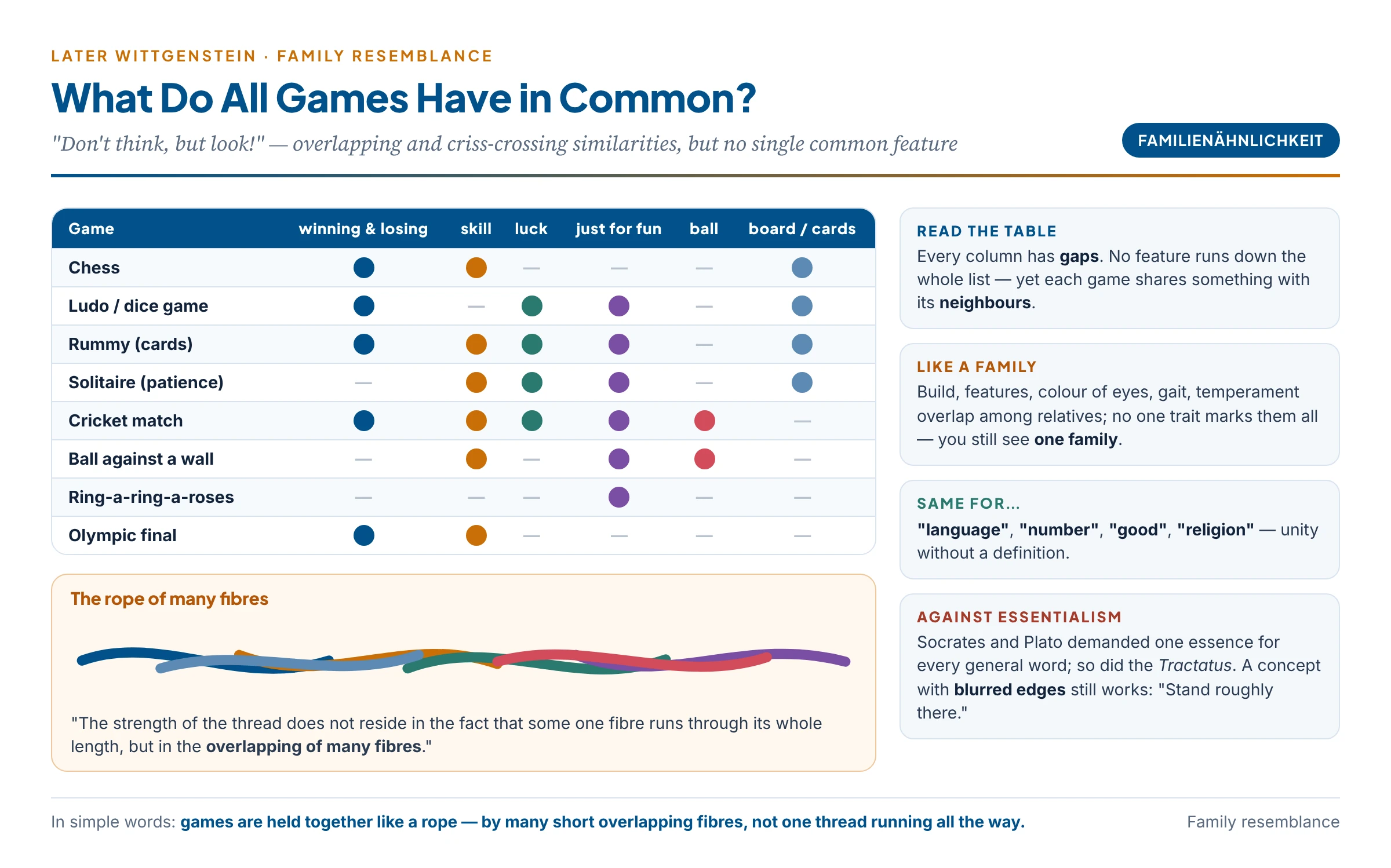
“Don’t say: ‘There must be something common, or they would not be called “games”‘ — but look and see whether there is anything common to all. — For if you look at them you will not see something that is common to all, but similarities, relationships, and a whole series of them at that.” — Wittgenstein
Wittgenstein’s survey of games:
- Board-games (chess, ludo, snakes and ladders) have many relationships with one another.
- Pass to card-games: many correspondences with board-games remain, but many common features drop out and others appear.
- Pass to ball-games: much that is common is retained, but much is lost.
- Are they all “amusing”? Compare chess with noughts and crosses — or with the deadly serious Olympic contests.
- Is there always winning and losing? In solitaire (patience) there is no opponent; when a child throws a ball against a wall and catches it, there is no winning or losing at all.
- Skill and luck. Look at the part played by skill and luck — chess is pure skill, a dice game pure luck, cards a mixture; and the difference between skill in chess and skill in tennis.
- Ring-a-ring-a-roses. Here is the element of amusement, but how many other features — competition, skill, luck — have disappeared!
- Result. “We see a complicated network of similarities overlapping and criss-crossing: sometimes overall similarities, sometimes similarities of detail.“
Why “family resemblance”?
- The family. Members of a family resemble one another in various ways — build, features, colour of eyes, gait, temperament — which overlap and criss-cross. The son has his father’s nose and his mother’s smile; the daughter has her mother’s nose and her grandfather’s walk. There may be no single feature that all of them share, yet you can see they are one family.
- Number. We call something a “number” because it has a direct relationship with several things already called numbers — and this gives it an indirect relationship with others we call the same name.
- The rope.
“We extend our concept of number as in spinning a thread we twist fibre on fibre. And the strength of the thread does not reside in the fact that some one fibre runs through its whole length, but in the overlapping of many fibres.” — Wittgenstein
- Against a trick. If someone says, “There is something common to all — namely the disjunction of all their common properties” (a list of everything any game has), Wittgenstein replies that this is only playing with words. One might as well say, “Something runs through the whole thread — namely the continuous overlapping of those fibres.”
Concepts with blurred edges.
- Sharp boundaries not needed. The concept “game” has no sharp boundary. But that does not make it useless. “Is a blurred photograph a picture of a person at all?” Often a blurred picture is exactly what we need.
- “Stand roughly there.” If I tell someone “Stand roughly there“, pointing to a spot, the instruction works perfectly well although it draws no exact line.
- Boundaries for a purpose. We can draw a sharp boundary when we need one — as when “one pace” is fixed at exactly 75 cm for some measurement — but this is drawing a new boundary for a special purpose, not discovering the hidden essence of the concept.
- Philosophy’s error. Philosophical confusion arises when we demand sharp definitions where ordinary use shows only gradations of similarity, and treat the lack of a definition as a lack of meaning.
Other family-resemblance concepts.
- “Good”: a good man, a good knife, good weather, feeling good, goodwill — related uses, no single essence.
- “Religion”: ritual, belief in God, meditation, moral code, scripture, community, sacred places — no one feature is present in all traditions (some Buddhist schools have no creator God; some tribal religions have no scripture), but together they form a recognisable family.
- “Language” itself: the language-games are related by family resemblance; there is no essence of language.
- “Art”, “democracy”, “poverty”: in each case, cases overlap and criss-cross rather than share one defining mark.
How family resemblance supports “language is a game” (2018).
- “Game” is itself a family-resemblance concept; so is “language”. The comparison holds because both have the same structure — a family of varied activities without a common essence.
- Language-games resemble one another as games do: ordering is like requesting in some ways, requesting like praying, praying like thanking, thanking like greeting — with no one feature running through all.
- This answers the essentialist objection. The demand to say what is “common to all language” rests on an essentialist prejudice; family resemblance shows that unity without essence is possible.
- It frees meaning from definitions. We can use and understand “game” and “language” perfectly well without a definition — meaning is mastery of use, not knowledge of necessary and sufficient conditions.
Common confusion
Does family resemblance mean words have no meaning, or that anything goes? No. Some notes say that since “game” has no definition, its meaning is “vague” or “subjective”. Wittgenstein’s point is the reverse: we use “game” correctly and confidently — we can give examples, recognise new cases, and reject absurd ones (“brushing your teeth is a game” is simply wrong). A concept can be without sharp boundaries and still be perfectly usable; its unity lies in the criss-crossing similarities among the cases, not in a hidden essence.
7. Religion as a Form of Life
Wittgenstein’s ideas about language-games and forms of life had a strong influence on the philosophy of religion.
Wittgenstein’s own attitude.
- Deep seriousness. He took religion very seriously — at one time he even considered becoming a priest — yet he opposed natural theology (proving God’s existence from evidence in nature) and the construction of religious doctrines as quasi-scientific theories. He was more interested in religious practice, symbol and ritual.
- Rituals are not mistaken science. Commenting on anthropological accounts of magic, he argued that rituals — burning an effigy, kissing a picture of a loved one — are not failed causal theories; they express attitudes and give shape to a way of life.
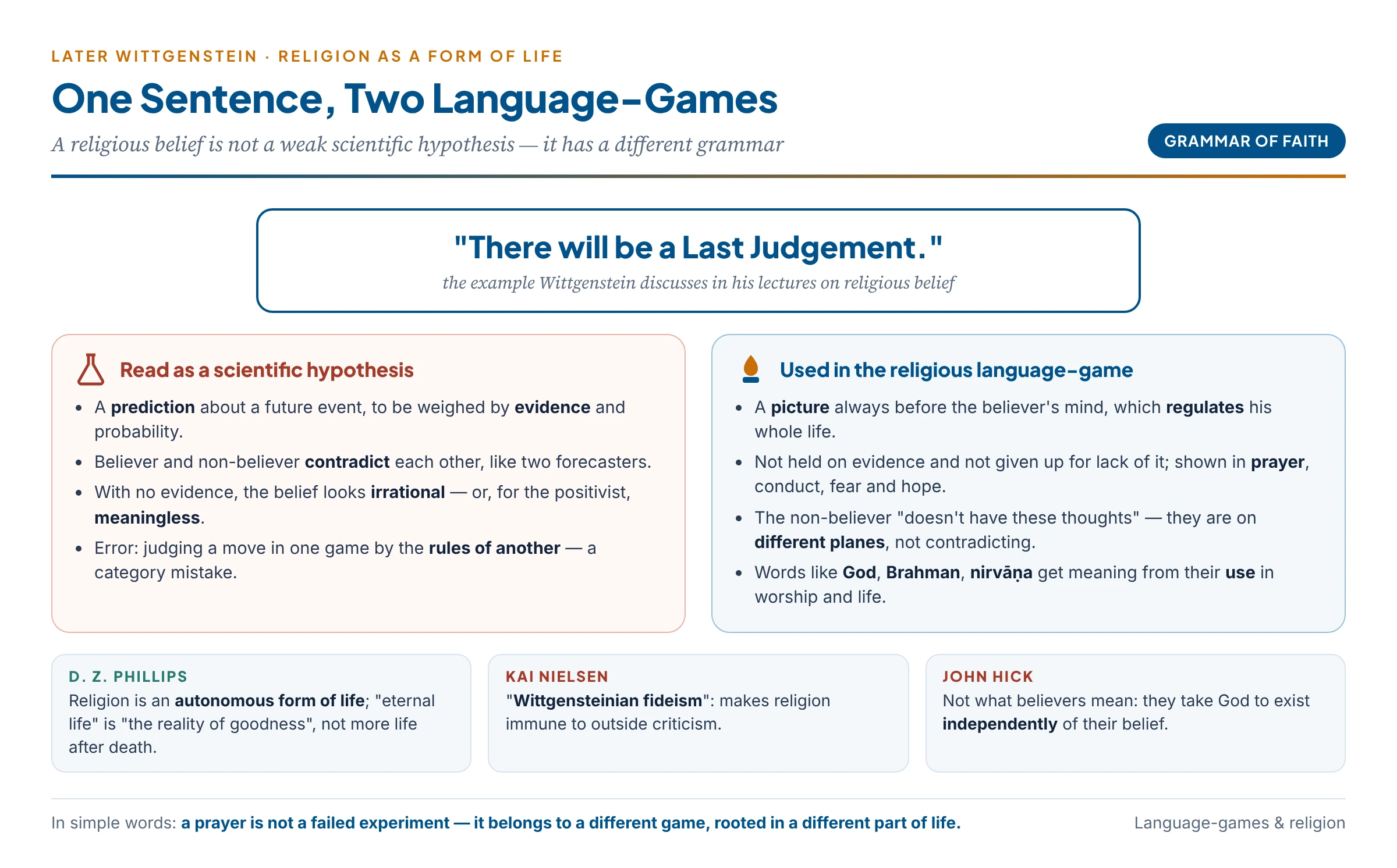
- The Last Judgement. In his lectures on religious belief he imagines a believer who says, “There will be a Last Judgement“, and a non-believer who says, “I don’t believe that.” He notes that they do not contradict each other the way two scientists with rival hypotheses do. The believer’s belief is not held on the basis of evidence and would not be given up for lack of it; it shows itself in how it regulates his whole life — it is a picture always before his mind.
- Use over denotation. In speaking of God, Brahman, nirvāṇa or the Dao, the meaning of the words has more to do with their use in worship, meditation, ethics and community than with denoting an object. “God is omnipotent“, meaningless for the logical positivist, is meaningful within the believer’s context of trust and praise. “God is watching over me” is not a scientific hypothesis but the expression of an attitude and a way of living.
- A grammatical point. Religious language has its own grammar. To judge “God created heaven and earth” as a faulty hypothesis of physics is a category mistake — the error of applying the rules of one language-game (science) to another (worship).
The neo-Wittgensteinian view (D. Z. Phillips and others).
- Religion as an autonomous form of life. Different kinds of language — of religion, of science — constitute different language-games that are the linguistic side of different forms of life. To take part in, say, the Christian or Hindu form of life is, among other things, to use its distinctive language, which has its own internal criteria of truth and falsity.
- No clash with science. Talk of Adam and Eve and the Fall does not clash with the scientific theory that humans did not descend from a single couple, since science is a different game with different criteria.
- Immortality reinterpreted. “He’d sell his soul for money” says nothing about a ghostly substance; it is a moral remark about a man’s integrity. Likewise, for Phillips, “eternal life” is not more life after death but “the reality of goodness” — “not more life, but this life seen under certain moral and religious modes of thought“.
- Religious doctrines are not quasi-scientific. On this view religious doctrines are not hypotheses about hidden facts but expressions of a form of life — of trust, worship, repentance, hope. This is the view examined in the 2011 Paper II question.
Criticisms of this view.
- Wittgensteinian fideism. Kai Nielsen named this approach “Wittgensteinian fideism“: it seems to make religion immune to criticism from outside, so that any belief, however absurd, could shelter inside its own language-game.
- Not what believers mean. John Hick objected that it is not an account of ordinary religious language but a radical reinterpretation: most believers take “God exists” and “there is life after death” to be true claims about reality — God existing independently of human belief. The theory quietly takes away the cosmic claims that religion has always made.
- Games are not sealed. Religious claims overlap with history (did Jesus or the Buddha live?), ethics and science; language-games are not watertight compartments.
- Rival religions. If each religion is a self-contained game, it becomes hard to explain why religions disagree and argue with each other.
- Reply. Defenders answer that the view clarifies the grammar of faith rather than shielding it: religious belief really does differ from hypothesis, and seeing this avoids both the positivist’s dismissal and the fundamentalist’s pseudo-science.
Secular and religious uses of language.
| Point | Secular / scientific use | Religious use |
|---|---|---|
| Typical form | Report, hypothesis, prediction | Prayer, praise, confession, vow, creed |
| Function | Describe and explain the world | Express and shape commitment, worship, moral orientation |
| Evidence | Observation and experiment decide | Not held on evidence, not given up for lack of it |
| Example | “Rain is likely tomorrow.“ | “Thy will be done.” / “Tat tvam asi.“ |
| Mistake to avoid | Treating science as faith | Treating faith as rival science |
- Seeing-as. Wittgenstein’s discussion of the duck-rabbit figure — one drawing seen now as a duck, now as a rabbit — was later used by John Hick to explain how the same world can be experienced by one person as merely natural and by another as the work of God. Religious faith is, on this view, a kind of experiencing-as.
Critical Evaluation
Objections to Language-Games and Forms of Life
- Vagueness of language-games. There are no precise criteria for identifying a language-game, counting them, or fixing their boundaries. Is “science” one game or thousands?
- Reply: the notion is a tool for looking, not a classification scheme; its vagueness matches the reality it describes.
- Vagueness of “form of life”. Wittgenstein hardly explains the term; it is unclear whether it means human nature or culture.
- Reply: both layers matter — a shared natural base and cultural variation on it — and the term is meant to point to the background, not to define it.
- Relativism. If truth and correctness are internal to games and forms of life, there seems to be no standpoint from which to judge between them — every culture’s practices become equally valid.
- Reply: Wittgenstein stresses the common behaviour of mankind; translation and criticism across cultures are possible because forms of life overlap. Moreover, he never says that “human agreement decides what is true” — only that agreement is the background of truth-telling.
- Conservatism. By grounding meaning in existing practices (“This is simply what I do”), Wittgenstein seems to leave no room for criticism of those practices or for conceptual innovation.
- Reply: practices are themselves dynamic — “we make up the rules as we go along” — and criticism of one practice is carried out from within others.
- Rule-following scepticism. Kripke’s sceptic threatens the very idea that rules determine use.
- Reply: rules are grasped in practice, not by interpretation; the sceptical gap arises only on a mistaken picture of rules.
- Innate grammar. Noam Chomsky argued that children acquire language too quickly and creatively for training to explain; they must have an innate grammar.
- Reply: Wittgenstein does not deny natural capacities — forms of life include a natural layer — but meaning still lies in public use.
- Family resemblance is too loose. Everything resembles everything else in some respect; without saying which resemblances count, the idea cannot explain why “game” applies to chess but not to brushing one’s teeth. Some philosophers have even offered a definition of games (for instance, “a voluntary attempt to overcome unnecessary obstacles“).
- Reply: the relevant resemblances are fixed by our practice of extending the concept to new cases; and proposed definitions tend either to fail for some games or to become so general that they fit non-games too.
- Fideism in religion. The language-game view may shield religion from rational criticism (section 7).
Critics and Defenders
Criticism — Critics
- Vagueness: no criteria to identify or count language-games or forms of life.
- Relativism: truth seems internal to each game or culture.
- Conservatism: “this is simply what I do” seems to bless existing practice.
- Kripke: no fact determines which rule I follow.
- Chomsky: training cannot explain creative language learning.
- Essentialists: family resemblance is too loose; definitions are possible.
- Nielsen, Hick: Wittgensteinian fideism shields religion and misdescribes belief.
Defence — Defenders and strengths
- A way of seeing, not a classification: the notions point to real variety.
- Common human behaviour makes cross-cultural understanding possible.
- Dynamic practices: rules change; criticism works from within.
- Practice, not interpretation: rule-following needs no inner fact.
- Natural layer: forms of life include innate human capacities.
- Blurred concepts work: unity without essence is common in language.
- Grammar of faith: separates belief from hypothesis, avoiding both dismissal and pseudo-science.
Cross-Tradition Comparison
Family Resemblance, Universals and Indian Theories
| Point | Nyāya–Vaiśeṣika | Buddhist (Dignāga, Dharmakīrti) | Jaina | Later Wittgenstein |
|---|---|---|---|---|
| What a general word picks out | Individual qualified by a real, eternal universal (jāti), e.g. “cowness” (gotva) | No real universal; meaning by exclusion of the other (apoha) — “cow” = not non-cow | Things have both general and particular aspects (sāmānya–viśeṣa) | Family resemblance; no common essence needed |
| Are all general words names of universals? | No: Udayana lists conditions under which a common feature is not a true universal; such features are imposed properties (upādhi) | No general word names a real universal | Depends on standpoint (naya) | No general word needs a universal |
| Unity of a class | A single real property present in each member | Shared exclusion constructed by the mind | Real similarity along with difference | Overlapping, criss-crossing similarities |
| Attitude to definition | Definitions (lakṣaṇa) by essential marks are central | Definitions are conceptual constructions | Many-sided descriptions (anekāntavāda) | Sharp definitions often neither possible nor needed |
Indian Connect — Key takeaways
- Nyāya and the essentialist objection. Nyāya’s realism about universals (jāti) is the Indian counterpart of the essentialism Wittgenstein attacks. Interestingly, Nyāya itself admits that not every common word names a genuine universal: features like “being a game” would count as imposed properties (upādhi) — a partial agreement with Wittgenstein.
- Apoha and anti-essentialism. The Buddhist apoha theory agrees with Wittgenstein that no real essence stands behind general words, though it explains meaning by exclusion rather than by use and family resemblance.
- Anekāntavāda and many games. Jaina non-absolutism — reality described from many standpoints (naya), each valid in its own context — echoes the idea of many language-games, each with its own standards; but the Jainas hold that the standpoints together approach a real, many-sided truth, while Wittgenstein makes no such metaphysical claim.
- Vyavahāra and forms of life. Nāgārjuna’s insistence that the ultimate cannot be taught without relying on everyday practice (vyavahāra), and Advaita’s level of transactional reality (vyāvahārika satya), both recognise that meaning and truth-talk live within a shared practical life — close to Wittgenstein’s forms of life.
- Dharma as a form of life. Indian religious traditions have long understood themselves less as doctrines than as ways of living (dharma, mārga) — ritual, ethics, devotion and discipline together — which fits the Wittgensteinian view of religion as a form of life.
Language-Games and Western Thinkers
| Thinker | Link with language-games and forms of life |
|---|---|
| J. L. Austin | Speech acts: promising, naming, marrying are actions done in words within conventional procedures |
| Gilbert Ryle | Category mistakes: confusing the logical type of words, e.g. treating “mind” like “body” |
| Logical positivists | One game (science) treated as the only meaningful one — the error Wittgenstein exposes |
| Thomas Kuhn | Scientific paradigms resemble language-games: shared rules and exemplars within a community |
| D. Z. Phillips | Religion as an autonomous form of life with its own grammar |
Synthesis (Siddhānta)
- Language as many games. Language is not one system with one essence but a family of rule-governed activities woven into human action. A word has meaning as a move in such a game.
- Rules as practices. Rules guide us not as inner formulas needing interpretation but as practices sustained by training, correction and agreement; justification ends in “this is simply what we do“.
- Forms of life as roots. Language-games are rooted in forms of life — the natural and cultural patterns of human living. The common behaviour of mankind makes understanding across cultures possible; a talking lion would be unintelligible.
- Unity without essence. Family resemblance shows that concepts like “game”, “language”, “good” and “religion” hold together through criss-crossing similarities, without a definition — a lasting challenge to essentialism from Plato to the Tractatus.
- Limits. The notions are open-ended, raise worries about relativism and conservatism, and, applied to religion, risk fideism. These are real questions, but they do not undo the central insight.
- Contemporary relevance. The ideas shape linguistics, anthropology, sociology of science, artificial intelligence (language as learned use rather than fixed definitions), law (interpreting statutes in their practice) and inter-religious dialogue, where understanding another tradition means understanding its form of life.
“What has to be accepted, the given, is — so one could say — forms of life.” — Wittgenstein
Previous Year Questions
- 2022Establish the tenability of later Wittgenstein’s notion of language as form of life.
- 2018How does the notion of ‘family resemblance’ help Wittgenstein to uphold that ‘Language is a game’? Discuss.
- 2015Bring out the relationship between language games and forms of life.
- 2014Bring out the significance of ‘Language Games’ in Wittgenstein’s Use theory of meaning.
- 2008Wittgenstein’s notion of language-game.
- 2023Discuss Wittgenstein’s view about the non-cognitive nature of religious language.
- 2018In what sense is the secular use of language different from the religious use of language? Discuss.
- 2011Examine the view that religious doctrines are not ‘quasi-scientific’ doctrines but represent a form of life.