

Later Wittgenstein: Meaning and Use; Language-games; Critique of Private Language.
Official Syllabus: Paper I, Section A, Unit 8
In his later philosophy, set out in the Philosophical Investigations (published in 1953, two years after his death), Ludwig Wittgenstein (1889–1951) gave up the idea that a word gets its meaning by standing for an object or for an idea in the mind. His new answer was simple and revolutionary: “the meaning of a word is its use in the language“. To know what a word means is not to have a label in the head but to be able to do things with it — order, ask, warn, pray, count, joke — within shared human activities. This one shift, known as the use theory of meaning, is the root from which language-games, family resemblance and the critique of private language all grow.
In simple words
Think of a ₹500 note. Its value does not lie in the paper or in some picture of a cow you could buy with it; it lies in what you can do with it — pay, save, lend, return. Wittgenstein said the same of words: “Here the word, there the meaning — the money, and the cow you can buy with it. But contrast: money, and its use.” A word is like money: its meaning is its role in our dealings, not a thing standing behind it.
Context & Problem
The Question Every Theory of Meaning Must Answer
A sound like “dog” or a mark like “दूध” is, in itself, just noise or ink. What turns it into a meaningful word? Before Wittgenstein’s later work, philosophers gave three main answers.
| Theory | Meaning of a word is… | Typical holders | Everyday version |
|---|---|---|---|
| Referential (denotation) theory | The object it names | Plato (eternal Forms), Aristotle (substances), Russell, the Tractatus | “Delhi” means the city Delhi |
| Ideational (mentalist) theory | An idea or image in the speaker’s mind | Locke, the British empiricists | “Dog” means my mental picture of a dog |
| Picture theory | A sentence is a logical picture of a possible fact | Early Wittgenstein | “The cat is on the mat” mirrors an arrangement of objects |
| Later Wittgenstein | Its use in a rule-governed human practice | Philosophical Investigations | “Slab!” means what the builder’s helper is trained to do on hearing it |
- The naming model dominates the whole history. Plato thought words must name something unchanging, and since nothing in the visible world is unchanging he placed the Forms in another world. Aristotle found the unchanging named thing in substances. Medieval nominalists said words are names that name nothing real except particulars. The empiricists said words name sense-data or ideas. Pragmatists linked words to actions. Russell, the logical positivists and the early Wittgenstein said the basic words name simple objects that combine into atomic facts.
- What they share. Every one of these theories treats meaning as a thing of some kind — an object, a Form, an idea, a fact — correlated with the word. Wittgenstein’s later work attacks this shared assumption itself.
Wittgenstein’s Own Starting Point
- The early view (Tractatus). Names stand for simple objects; elementary sentences picture possible arrangements of these objects (states of affairs); and the one essential job of language is to state facts. Beneath the untidy surface of ordinary speech, Wittgenstein believed, lay a hidden, crystal-clear logical language that analysis could uncover.
- The later discovery. After his return to Cambridge in 1929 he came to see that this picture fits only a small part of language. Words do countless different jobs; most of them are not names at all; and there is no hidden ideal language below ordinary speech. Ordinary language is “in order as it is“.
- A new method. The Investigations does not build a system. It proceeds by short remarks, examples, imagined simple languages, and a running dialogue with an imagined objector (the “interlocutor”), who voices the tempting philosophical picture that Wittgenstein then takes apart. His constant advice: “Don’t think, but look!” — look at how words are actually used.
In simple words
Imagine trying to understand cricket by studying only the ball. You could weigh it, measure it and describe its stitching, and you would still not know what a no-ball, a wide or a run-out is. Those things exist only within the rules and practice of the game. Wittgenstein says words are the same: study the practice, not just the sound or the thing it seems to point at.
Core Doctrine
1. The Augustinian Picture of Language
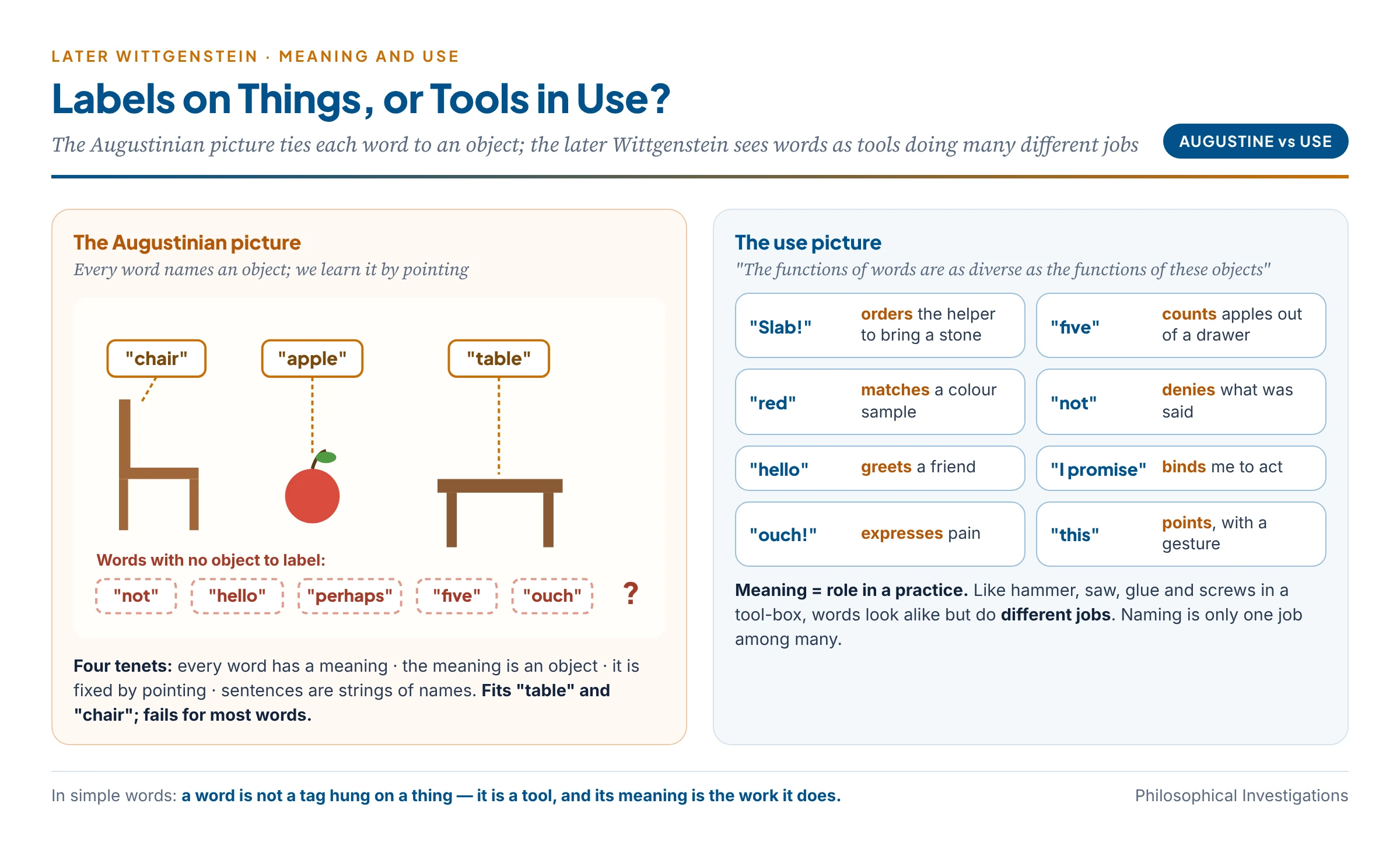
The Investigations opens with a passage from St. Augustine’s Confessions, in which Augustine recalls how he learned to speak as a child: when his elders named an object and moved towards it, he saw that the thing was called by the sound they uttered; their intention was shown by their gestures and expressions — “the natural language of all peoples”. So, little by little, he learned which objects the words stood for and began to use them to express his own desires.
The picture hidden in this passage (Wittgenstein calls it the Augustinian picture of language):
- Every word has a meaning.
- The meaning is an object correlated with the word — the thing the word stands for.
- The link between word and object is set up by ostensive definition — pointing and naming (“This is a chair”).
- Sentences are simply combinations of such names.
- Who holds this picture? Not only Augustine. It underlies Locke’s theory of ideas, Russell’s logical atomism, the logical positivists’ sense-data, and Wittgenstein’s own Tractatus. Augustine is simply the clearest, most innocent statement of it.
- What it fits. It works tolerably for nouns like “table”, “chair”, “bread” and for people’s names. It ignores words like “today“, “not“, “but“, “perhaps“, “five“, “hello“, “ouch“, which name no object at all.
- Wittgenstein’s verdict. The picture is not simply false. It describes “a system of communication; only not everything that we call language is this system“. It is like saying “a game consists in moving objects about on a surface according to certain rules” — true of board games, but not of games in general.
- The five red apples. Wittgenstein imagines sending someone shopping with a slip marked “five red apples“. The shopkeeper opens the drawer marked “apples“, looks up “red” on a colour chart and finds the matching sample, then says the numbers “one, two, three, four, five” aloud, taking an apple from the drawer for each. Three words, and three entirely different procedures: finding a kind of thing, matching a sample, counting. Asked “But what is the meaning of the word ‘five’?”, Wittgenstein answers that no such thing was in question here — only how the word is used. “Explanations come to an end somewhere.“
- Augustine’s hidden assumption. Augustine describes learning a language as if the child, before learning, could already think — as if it already had an inner language and was merely learning new labels for things it already had in mind. “As if the child could already think, only not yet speak.” This assumption of a private inner language prior to public language is exactly what the private language argument (Article 3) later undermines.
2. The Builders’ Language: Words as Moves in an Activity
To show what a language without the Augustinian picture looks like, Wittgenstein imagines the simplest possible language.
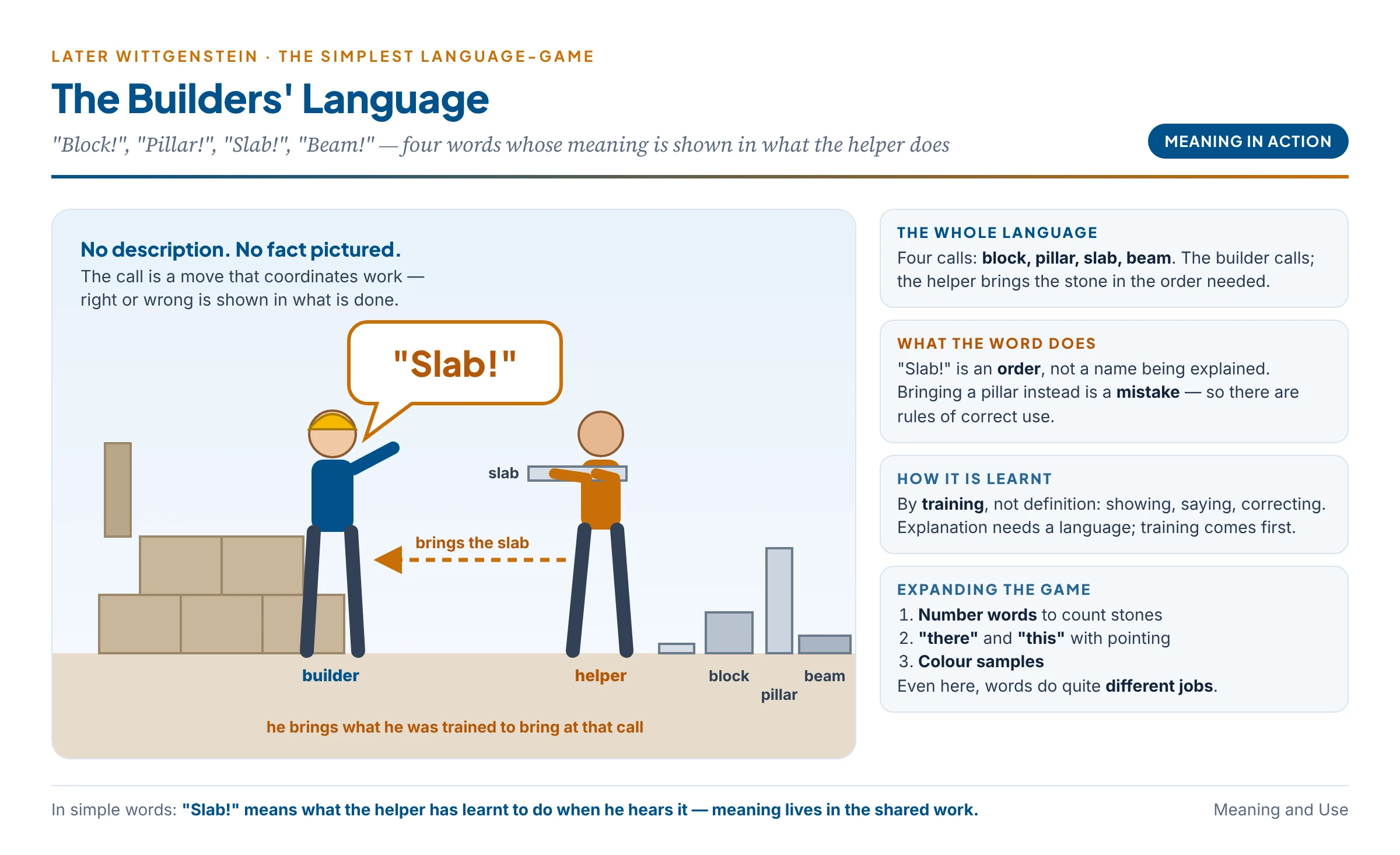
- The scene. A builder is building with stones: there are blocks, pillars, slabs and beams. His assistant must pass the stones in the order the builder needs them. For this they use a language of just four words — “Block!“, “Pillar!“, “Slab!“, “Beam!“. The builder calls out a word; the assistant brings the stone he has learnt to bring at that call.
- Meaning shown in action. Here “Slab!” does not describe anything or report a fact. It works as an order that coordinates action. Its meaning is shown in what the assistant does and in what counts as getting it right or wrong (bringing a pillar when “Slab!” was called is a mistake).
- Teaching is training, not explaining. The assistant learns the language not by being given definitions (he has no language yet in which to receive them) but by training (Abrichtung) — the builder points, says the word, shows what to do, corrects him. Explanation presupposes language; training comes first.
- Is “Slab!” a word or a sentence? Wittgenstein asks whether “Slab!” is short for “Bring me a slab!“. In this primitive language there is no longer form; the call is a complete move in the game. Whether we call it a word or a sentence depends on its role, not on the number of syllables.
- Expanding the game. Wittgenstein then adds number words (“a, b, c, d” used to count), the words “there” and “this” (used with a pointing gesture), and colour samples. Even in this tiny language, the words already do completely different jobs: some pick out kinds of stone, some count, some point, some match colours. Only some of them are anything like names.
- “To imagine a language means to imagine a form of life.” The builders’ calls make sense only within the activity of building — the stones, the trained responses, the purpose of the work. Language is woven into action (developed in Article 2).
3. Why Ostensive Definition Cannot Do the Work
Ostensive definition means defining a word by pointing at an example: “This is red“, “This is called a pencil“. The Augustinian picture treats it as the foundation of all meaning. Wittgenstein shows that it can never stand on its own.
- The “two nuts” example. Suppose I point to two nuts and say “This is called ‘two’.” How is the learner to know what I am naming? He might take “two” to be the name of this group of nuts, of the kind of nut, of their colour, their shape, their position, or even of a point of the compass. Pointing alone is ambiguous in every case.
- “This colour is called sepia.” Even if I add a word — “This colour is called sepia” — the learner must already understand what kind of word “colour” is. The definition helps only someone who already knows what place the new word is to occupy in the language.
- The chess king. Show someone a chessman and say “This is the king“. This tells him something only if he already knows the rules of chess — or at least knows what a piece in a game is — and lacks only the shape of this particular piece. For a person who has never seen any board game, the sentence explains nothing.
- Wittgenstein’s conclusion. “The ostensive definition explains the use — the meaning — of the word when the overall role of the word in language is clear.” Pointing works inside a practice that is already going on; it cannot create meaning from nothing.
- Pointing is itself a practice. Even following a pointing finger is something we must learn and do in agreement with others. Human children naturally look along the finger; a cat looks at the finger itself or reacts at random. Meaning rests on such shared natural reactions.
Common confusion
Did Wittgenstein reject ostensive definition altogether? No. Many notes say Wittgenstein “refuted” or “abolished” ostensive definition. He accepted it as a real and useful practice — we often teach colour words and names by pointing. His point is that pointing cannot by itself give a word its meaning; it works only against a background of training and an already understood role for the word (“this is a number word”, “this is a colour word”). Note also that his example is pointing to two nuts, not two slices of bread.
- Meaning is not the bearer. If the meaning of a name were the object named, then when the object ceased to exist the name would lose its meaning. But when Mr N. N. dies, we say that “the bearer of the name dies, not the meaning of the name“; we can still say “Mr N. N. is dead”. Likewise, if the legendary sword Nothung is broken into pieces, the sentence “Nothung has a sharp blade” does not suddenly become meaningless. So the meaning of a name must be distinguished from its bearer.
- Words with no bearer at all. “This“, “here“, “now“, “five“, “not“, “if” have no object for which they stand, yet they are among the most important words we have.
4. “The Meaning of a Word Is Its Use in the Language”
After clearing away the Augustinian picture, Wittgenstein gives his famous formulation:
“For a large class of cases — though not for all — in which we employ the word ‘meaning’ it can be defined thus: the meaning of a word is its use in the language. And the meaning of a name is sometimes explained by pointing to its bearer.” — Wittgenstein, Philosophical Investigations
How to read the use maxim:
- “A large class of cases — though not for all”. Wittgenstein is careful. He is not offering a universal theory or definition of meaning but a reminder that fits most cases. (He allows, for instance, that we sometimes speak of the “meaning” of a person’s face or of a gesture in another sense.)
- “Use” means rule-governed role. “Use” does not mean how often a word is used, or whatever effect it happens to produce. It means the role the word plays in a practice — the rules for using it correctly, the circumstances in which it is used, the actions and reactions connected with it, and the purpose it serves.
- “In the language”. The use is public — it belongs to a shared language and a community of speakers, not to one person’s private intention.
- Pointing has a place. For proper names, pointing to the bearer is often how the use is explained — but even this is a move within the language, not a foundation outside it.
- What meaning is not. Meaning is not an invisible mental accompaniment of the word, not a Platonic archetype in another world, and not the physical object the word picks out.
- What meaning is. “The meaning of a word is what is explained by the explanation of the meaning.” Ask how we actually explain a word to someone — by examples, by showing how it is used, by correcting misuse — and you have found what its meaning is. Nothing more is hidden.
- Understanding is mastery of a technique. “To understand a language means to be master of a technique.” Understanding a word is a skill — knowing how to use it — shown in what one does. The sign that a pupil has understood a series is not an inner flash but that he can now go on correctly: “Now I can go on!“
- A popular slogan. The advice “Don’t ask for the meaning, ask for the use” sums up this approach. It is a later summary of Wittgenstein’s teaching, not a sentence from the Investigations.
In simple words
Ask a child what “please” means and she will struggle to give a definition. Yet she knows perfectly what it means: she knows when to say it, what it gets her, and what happens if she forgets it. Her knowledge of the meaning is her ability to use the word correctly. That is exactly Wittgenstein’s point.
5. The Tool-box, the Locomotive Cabin and the Chess Piece
Wittgenstein gives several images to show how varied the uses of words are.
“Think of the tools in a tool-box: there is a hammer, pliers, a saw, a screw-driver, a rule, a glue-pot, glue, nails and screws. — The functions of words are as diverse as the functions of these objects.” — Wittgenstein
- The tool-box:
- Nobody would ask “What do all tools do?” and expect one answer such as “they all modify something”. (The rule measures, the glue-pot holds, the nails fasten.) Any single formula would be empty.
- Likewise “every word signifies something” is true only in an empty sense; it hides the differences between the jobs words do.
- A hammer can also serve as a paperweight or even a weapon; a tool’s function depends on how it is used. So does a word’s.
- The locomotive cabin. In the driver’s cabin of a railway engine we see handles that all look alike (naturally, since they are all meant to be handled). But one is the handle of a crank that moves continuously; another of a switch with only two positions, on or off; a third of a brake lever — the harder you pull, the harder it brakes; a fourth of a pump, which works only while moved to and fro. Words too look alike on the page while doing utterly different jobs.
- Clutch and foot-brake. In a car the clutch and the brake pedals look very similar, but the mechanisms they work are entirely different. “The clothing of our language makes everything alike“, and so we overlook the diversity of uses beneath the uniform appearance of words.
- The map. A person without training sees on a map only a mass of lines. To someone who knows how maps are used, some lines are frontiers, some roads, some rivers, some meridians. The lines look similar; their functions differ. Words in a sentence are like this.
- The chess piece. “The question ‘What is a word really?’ is analogous to ‘What is a piece in chess?’” A pawn is not defined by its wood or ivory but by its moves — one square forward (two on its first move), capturing diagonally, becoming a queen on reaching the far side. If a pawn is lost, a button can take its place, and the game goes on unchanged. The meaning of a piece is its role in the game; so is the meaning of a word.
- Naming is only preparation. Naming something is like setting a piece on the board. It is not yet a move in the game. “Nothing has so far been done when a thing has been named.” Only when the name is used — to ask, order, describe — does anything happen in the language-game. This undercuts the Augustinian idea that naming is the essence of language.
- Why traditional disputes arise. Many old puzzles about the universe, mind, time and number arise from forcing the varied uses of words into the single model of the proper name — assuming that “time”, “mind” or “number” must each name a mysterious object, and then asking what kind of object it is.
6. One Word, Many Jobs
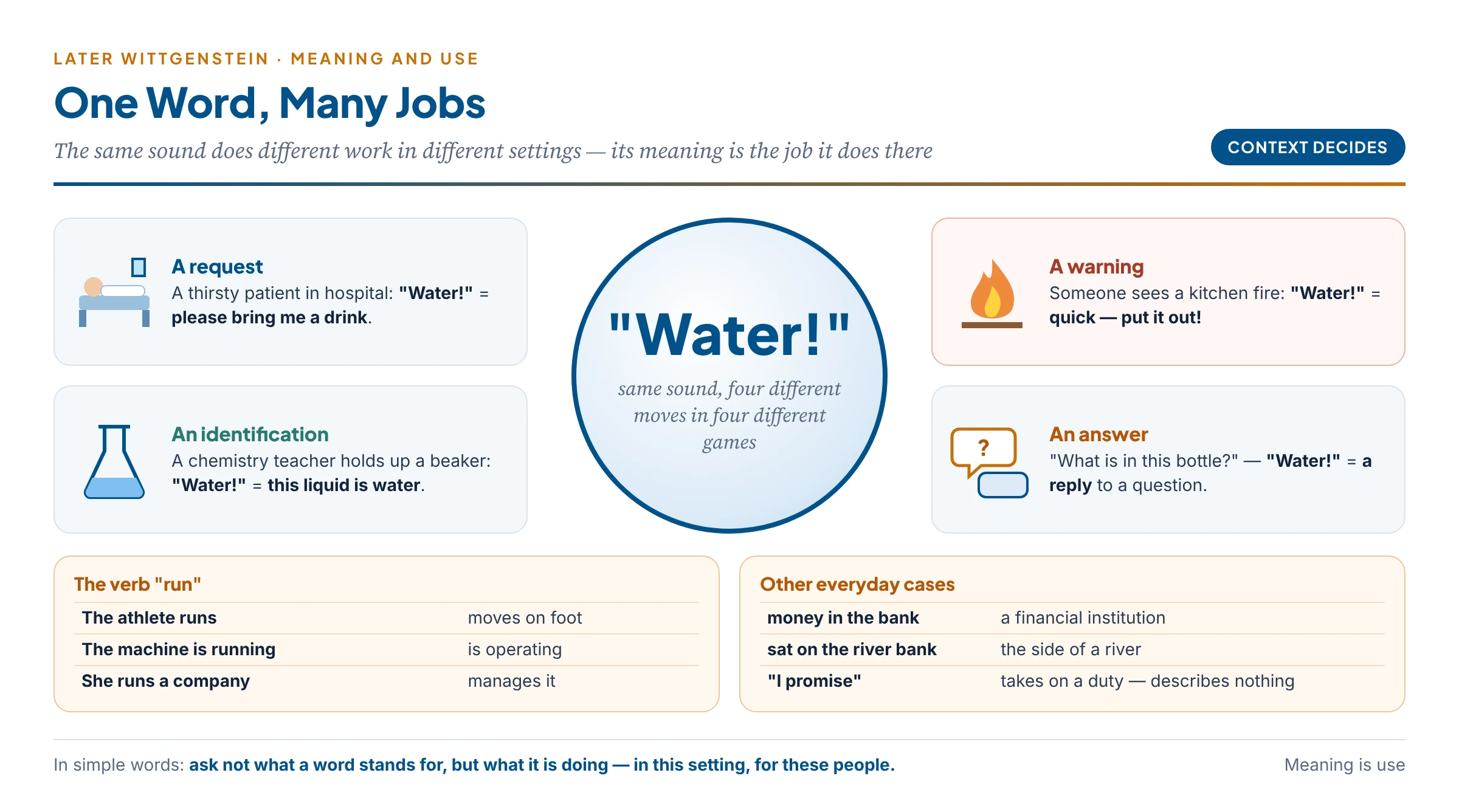
The same word or sentence can do quite different work in different settings. Its meaning is fixed not by the sound but by the job it does there.
| Expression | Setting | Job it does |
|---|---|---|
| “Water!“ | A thirsty patient in hospital | Request for a drink |
| “Water!“ | Someone sees a kitchen fire | Warning or call for help |
| “Water!“ | A chemistry teacher holds up a beaker | Identification of a substance |
| “Water!“ | Answer to “What is this liquid?” | Answer to a question |
| “The athlete runs“ | Sports report | Physical movement |
| “The machine is running“ | Factory | Operation |
| “She runs a company“ | Business news | Management |
| “bank“ | “I deposited money in the bank” / “We sat on the river bank” | Financial institution / side of a river |
| “I promise“ | Said to a friend | Taking on an obligation, not describing one |
- Exclamations. Wittgenstein lists “Water!“, “Away!“, “Ow!“, “Help!“, “No!” and asks: are these all names of objects? Plainly not. Each does its own kind of work.
- “Moses did not exist.” Even a whole sentence can mean different things. It may mean that the Israelites did not have one leader when they left Egypt; or that their leader was not called Moses; or that no one accomplished all that the Bible relates of Moses. What it means depends on which descriptions of Moses the speaker is prepared to give up — and there is no fixed definition settling this in advance. We use the name without a fixed meaning, and this does not make it useless.
- The setting sun. Two friends are driving fast to reach home before dark because their headlights are broken. The driver says, “Bad luck — the sun has just gone down.” The passenger replies with a superior look: “Actually the sun does not ‘go down’; the earth turns on its axis.” His remark is true but does no work in this setting; it is out of place. The driver’s sentence was perfectly in order in its use.
7. Surface Grammar and Depth Grammar
- Two kinds of grammar. Wittgenstein distinguishes the surface grammar of a sentence — its outward form, the way it is put together — from its depth grammar — the actual rules of its use, what one can and cannot sensibly say with it.
- Roses and roads. “All roses have thorns” and “All roads have length” have the same surface grammar. But their depth grammar differs: we can easily imagine a rose without thorns (and must check each rose to know), while a road without length is not a discovery we might make — it is ruled out by the very use of the word “road”. The first is an empirical statement; the second expresses a rule of grammar.
- Pain and pin. “I have a pin” and “I have a pain” look alike. But I can show you the pin, lose it, lend it; none of this makes sense for the pain. The similar form tempts us to treat a pain as a little private object that I “have” (Article 3).
- “Mean” and “understand”. The verbs “mean” and “understand” have the same surface grammar as “say” and “breathe“, so we expect them to name processes going on at the time. When we cannot find a bodily process, we invent a ghostly mental one (section 8).
- Grammar shows what kind of thing something is. “Essence is expressed by grammar.” To learn what kind of thing a pain, a number or God is, we should look at the grammar of the words — what it makes sense to say about them — not search for a hidden object.
In simple words
“I have a car” and “I have a headache” are built the same way. But you can sell your car, park it and lend it to a friend; try doing that with your headache! The sentences look alike on the surface; the rules for using them are completely different. Philosophical confusion starts when we let the surface fool us.
8. Can Words Be Viewed as Ideas in the Mind of the Speaker?
The 2026 paper asked whether words can be viewed as the ideas in the mind of the person who uses them. This is the ideational or mentalist theory of meaning, and the later Wittgenstein is its most powerful critic.
The theory stated.
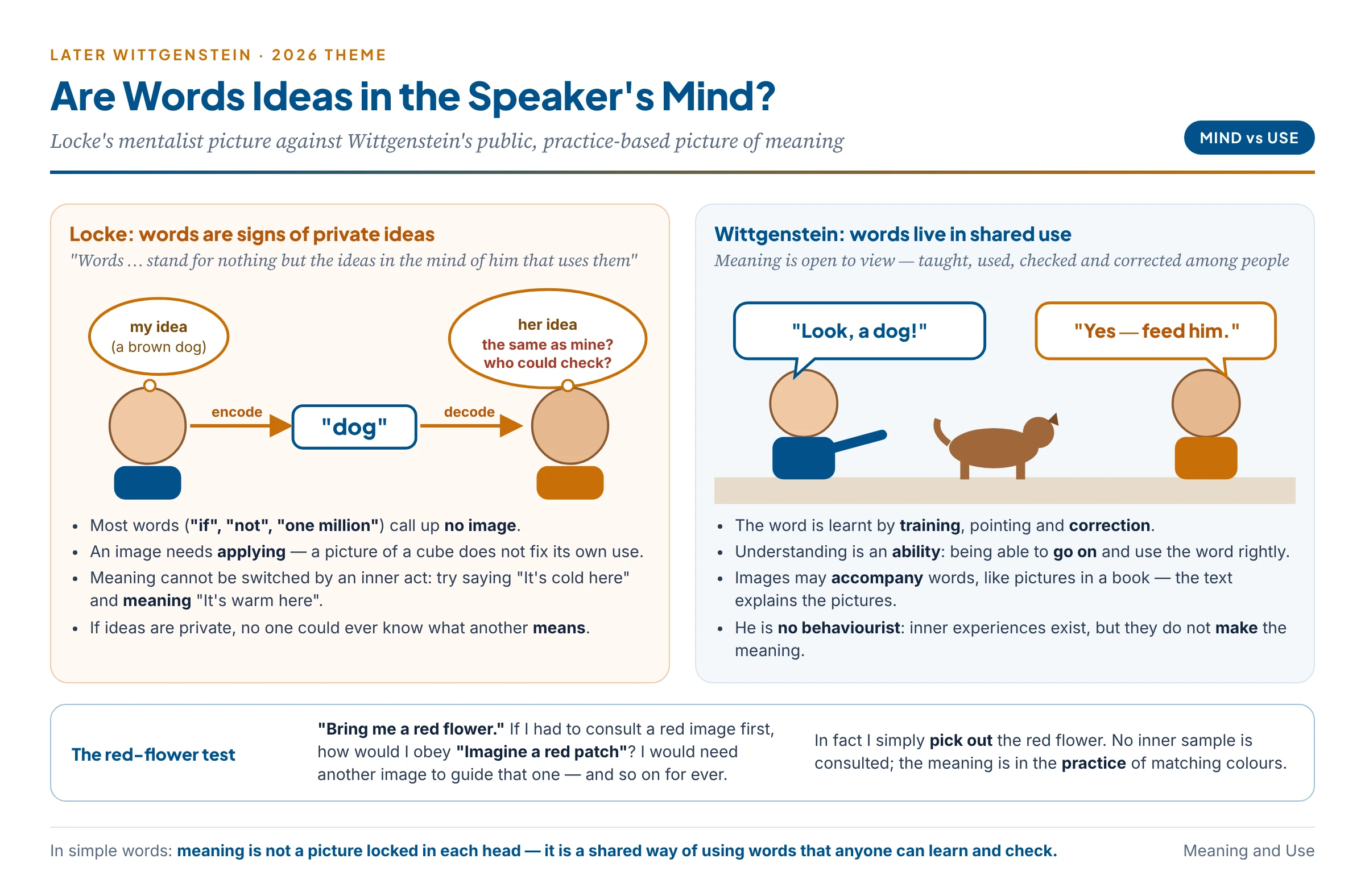
- Locke’s classic version. “Words, in their primary or immediate signification, stand for nothing but the ideas in the mind of him that uses them.” A word is a sign of an idea; the idea in turn represents a thing. Communication is a kind of translation: the speaker turns his private ideas into public sounds, and the hearer turns the sounds back into his own ideas.
- Its appeal. It seems obvious that when I say “dog” I “have something in mind”, and that I understand you only if the same idea arises in my mind. Many modern cognitive theories keep a version of this picture, with an inner “language of thought”.
Wittgenstein’s objections.
- Images are neither necessary nor sufficient. For most words — “the“, “if“, “not“, “impossible“, “one million” — there is no image at all, yet we understand them perfectly. And having an image is not enough: a person may have a vivid image while using a word wrongly.
- The red flower. Suppose that to obey “Bring me a red flower” I must first call up a red image and then compare flowers with it. Then how would I obey the order “Imagine a red patch“? I would need yet another image to guide me in forming that one — and so on without end. In fact we pick out the red flower directly; no inner sample is consulted.
- An image does not fix its own application. Suppose the word “cube” brings a picture of a cube into my mind. The picture could still be applied in different ways — to a cube, but also, with a different method of projection, to a triangular prism. Something in the mind does not tell me how to use it; only the practice of applying words settles what is correct. So the inner idea cannot be what meaning consists in.
- Meaning is not a process accompanying the words. If meaning were an inner process running alongside speech, it should be possible to perform it without the words. Try it: you will find yourself saying the sentence silently. And it would be absurd to think that alongside every public utterance a private one runs in exact step — what if the two slipped out of step and the meaning of one word got attached to the next?
- Meaning cannot be switched by an inner act. Wittgenstein’s experiment: “Say ‘It’s cold here’ and mean ‘It’s warm here’.” You cannot do it just by an act of will, because meaning is not an inner act we attach to words at pleasure; it depends on the established use of the words.
- Words without meaning, meaning without words. Furious with a difficult relative, I may mutter “I wish he would drop dead!” — but I do not mean it. I may hum a Russian folk-song in my head, enchanted by its sound, without knowing what a single word means. So uttering words — aloud or in the mind — is not the same as meaning or understanding them.
- Understanding is not a mental state with duration. A pain can last for an hour or come and go; it makes no sense to say that my understanding of the word “cube” was interrupted for a moment while I sneezed. Understanding is shown in an ability — in being able to go on, to apply, to explain — and the criteria for it are in what one does.
- Images serve the words, not the other way round. Images often do pass through our minds when we talk. But they are like the pictures in an illustrated book: it is the text that tells us what the pictures show, not the pictures that tell us what the text means.
- Private ideas would make communication impossible. If the meaning of “dog” were an idea in my mind and only I could inspect it, then I could never know whether your idea matched mine — and neither could you. Meaning would become private, and language a set of private languages. This is precisely the idea that the private language argument shows to be incoherent (Article 3).
What Wittgenstein does not deny.
- He is not a behaviourist. He does not deny that there are mental images, feelings and inner processes — we can recite a poem in our head or picture a friend’s face. He denies only that these constitute the meaning of words.
- The grammar trap. We think meaning must be a mental process because the verbs “mean” and “understand” look like verbs of activity. When no physical process can be found, we postulate an incorporeal one in a mysterious mental medium. Wittgenstein calls this a grammatical illusion.
Answer in brief. Words cannot be viewed as ideas in the speaker’s mind. Ideas may accompany words, but meaning lies in the public, rule-governed use of words within shared activities — something open to view, taught, learned and corrected among people.
9. Rules and Correct Use
If meaning is use, what makes a use correct? Wittgenstein’s answer, developed fully in Article 2, is that use is governed by rules — but rules of a special kind.
- Rules are not inner formulas. Following a rule is not a matter of consulting a formula or an image in the mind, since any formula could be interpreted in different ways (the pupil asked to “add 2” who writes 996, 998, 1000, 1004 thinks he is going on “in the same way”).
- Rules are practices. “Obeying a rule is a practice.” A rule exists where there is a regular use, training, correction and agreement in how people go on — like a custom or an institution.
- Correctness is public. Children learn to use “red” or “add” through public correction and agreement with others, not by attaching words to private sensations. Without this, there would be no difference between using a word correctly and merely thinking one does — the theme of the private language argument (Article 3).
10. Why Wittgenstein Turned from Picture to Use
The reasons for the shift are discussed fully in Article 4. In brief:
- Language has many functions. The picture theory fits only fact-stating sentences; ordering, asking, thanking, cursing, greeting and praying picture nothing.
- Most words are not names. The search for simple objects named by simple names failed; “simple” and “complex” turned out to depend on context.
- The colour problem. “This patch is red” and “This patch is blue” cannot both be true — yet the Tractatus required elementary sentences to be independent of one another. The logical system began to unravel.
- Ordinary language is in order. There is no hidden ideal language beneath ordinary speech. The “crystalline purity” of logic was a requirement he had imposed, not a result of investigation.
- The challenge of his friends. The economist Piero Sraffa made a Neapolitan gesture of contempt — brushing the underside of his chin with his fingertips — and asked, “What is the logical form of that?” The gesture plainly had meaning, but it pictured no fact. Together with Frank Ramsey’s criticisms, this helped convince Wittgenstein that meaning lies in use within a form of life.
Critical Evaluation
Strengths of the Use Theory
- It fits the variety of language. It accounts naturally for orders, questions, greetings, prayers, jokes and promises, not just descriptions.
- It dissolves the “mental object” puzzle. Meaning is no longer a ghostly thing in a private mind; it is open to view in practice. This undercuts Cartesian mentalism.
- It explains learning. Children learn words by training and taking part in activities, exactly as the use theory predicts.
- It respects ordinary speech. Ordinary language needs no logical reform; philosophy must describe its workings rather than replace it.
- It explains philosophical confusion. Problems arise when words are taken out of their normal use and forced into the model of names.
Objections and Replies
- “Use” is too vague. Critics say “use” covers everything — grammar, context, purpose, effect — and so explains nothing; there is no precise criterion of what counts as the use of a word.
- Reply: Wittgenstein never claimed to offer a theory. “Use” is a reminder of where to look; its vagueness matches the real variety of language.
- Meaning and use come apart. A word can be misused while its meaning stays fixed; and in a reference letter, “His handwriting is excellent” has a perfectly literal meaning while its use is to give faint praise. So meaning cannot simply be use.
- Reply: by “use” Wittgenstein means rule-governed use in the language, not every occasional or clever employment. Misuse is identified against the rules of use; faint praise trades on the standard use of the words.
- Truth conditions and new sentences. Many philosophers hold that the meaning of a sentence is given by the conditions under which it would be true, built up from the meanings of its parts. This explains how we understand new sentences never heard before; a list of uses cannot. (Chomsky adds that from a finite set of rules speakers produce an unlimited number of new sentences.)
- Reply: stating truth conditions is one use among many (the descriptive language-game). Commands, questions and prayers have no truth conditions but still have meaning. Mastery of a language is mastery of a technique that includes going on to new cases.
- Mathematical and computer languages. These seem to have fixed, context-free meanings.
- Reply: they are themselves language-games with very strict rules; the meaning of “plus” is fixed by the practice of calculating. Even here meaning is shown in correct use.
- Quine: indeterminacy. Quine argued that even within one context, behaviour never fixes a unique translation of a word — the use leaves meaning indeterminate.
- Reply: Wittgenstein agrees that no inner or outer fact fixes meaning beyond our practice; for him this is no scandal, because agreement in practice is all that meaning ever needed.
- Kripke’s sceptic. Saul Kripke read Wittgenstein’s remarks on rules as a sceptical paradox: nothing in my past use or my mind settles that by “plus” I meant addition rather than some strange rule that gives the same answers up to now and different ones later. Meaning rests only on community agreement.
- Reply: many defenders say Wittgenstein’s real point is the opposite — that a rule is grasped in practice, not by an interpretation, so the paradox arises only if we assume meaning must be an inner fact (Article 2).
- Abstract and theoretical words. How does “use” explain words like “electron“, “infinity” or “justice“, which are far from everyday activities?
- Reply: these too have uses — in theories, experiments, calculations, law courts — and their meaning is learned by mastering those practices.
- Does it lose touch with reality? If meaning is use, does language still reach out to the world?
- Reply: the practices in which words are used are already worldly — building with slabs, buying apples, measuring roads. Language does not float free of the world; it is woven into our dealings with it.
Critics and Defenders
Criticism — Critics
- Vagueness: “use” is no precise criterion; no theory is given.
- Meaning vs use: literal meaning and occasional use differ (faint praise, misuse).
- Truth-conditional semantics: meaning is truth conditions built from parts; explains new sentences.
- Chomsky: linguistic creativity needs rules beyond lists of uses.
- Quine: use leaves meaning indeterminate.
- Kripke: no fact settles what rule I follow; meaning rests on community assertion.
Defence — Defenders and strengths
- Not a theory but a reminder: “for a large class of cases”.
- Rule-governed use: misuse and faint praise presuppose standard use.
- Many language-games: truth conditions belong to one game; orders and prayers have none.
- Mastery of a technique: going on to new cases is part of use.
- Anti-mentalism: frees meaning from private inner objects.
- Learning and practice: matches how children actually acquire language.
Cross-Tradition Comparison
Meaning as Use and Indian Theories of Word-Meaning
Indian philosophers of language — the Mīmāṃsakas, Naiyāyikas, the grammarian Bhartṛhari and the Buddhists — debated for centuries how words get meaning and how children learn it. Several of their positions are strikingly close to the later Wittgenstein.
| Question | Indian view | Later Wittgenstein |
|---|---|---|
| How is word-meaning learnt? | Mīmāṃsā and Nyāya: chiefly from usage of elders (vṛddha-vyavahāra) — the child watches an elder say “Bring the cow” (gām ānaya) and a younger man bring it; then “Tie the horse” (aśvam badhāna); by substituting and removing words (āvāpa–udvāpa) the child works out what each word does | The builders: “Slab!” learnt by training within an activity; meaning shown in action |
| Primary unit of meaning | Prābhākara Mīmāṃsā (anvitābhidhāna-vāda): words convey meaning only as already connected with other words in a sentence, and chiefly with something to be done (kārya) | Words have meaning only as moves in a language-game; naming alone is not yet a move |
| Words first, then sentence? | Bhāṭṭa Mīmāṃsā (abhihitānvaya-vāda): words first convey their separate meanings, which are then joined | Close to the Augustinian picture: sentences as combinations of names |
| Is the sentence prior? | Bhartṛhari: the sentence (vākya) is the real unit; meaning flashes as a whole (pratibhā); word-meanings are abstractions from it | The sentence in its use is the unit; words have meaning in the context of the game |
| Do words name real essences? | Nyāya: common nouns refer to individuals qualified by a real universal (jāti), e.g. “cowness” | No common essence needed; family resemblance (Article 2) |
| Buddhist view | Apoha (Dignāga, Dharmakīrti): words do not name real universals; they work by excluding what is other | Agrees that no real essence stands behind general words |
| Relation of word and meaning | Mīmāṃsā: the word–meaning relation is eternal (autpattika); Nyāya: it is fixed by convention (saṅketa) | Fixed by practice and agreement in a form of life; neither eternal nor arbitrary |
Indian Connect — Key takeaways
- Vṛddha-vyavahāra is a language-game. The Mīmāṃsā account of a child learning “bring the cow” by watching the elders’ commands and actions is almost exactly Wittgenstein’s builders’ game: meaning is grasped through use in action, not through definitions.
- Prābhākara and the use theory. The Prābhākara claim that words are meaningful only as connected with something to be done (kāryānvita) parallels Wittgenstein’s view that language is first of all action-guiding — orders, requests, instructions.
- Bhāṭṭa and Augustine. The Bhāṭṭa view that words first mean things separately and are then strung together resembles the Augustinian picture of sentences as combinations of names that Wittgenstein attacks.
- Bhartṛhari’s holism. Bhartṛhari’s priority of the sentence and his view that all cognition is shot through with language echo Wittgenstein’s denial of a pre-linguistic inner language of thought.
- Key difference. Mīmāṃsā holds the word–meaning relation to be eternal and the Veda authorless; Wittgenstein makes meaning entirely human and historical — rooted in practices that can change.
Western Links
- Frege’s context principle. Frege taught that a word has meaning “only in the context of a sentence“. Wittgenstein widens the context from the sentence to the whole language-game and form of life.
- Austin’s speech acts. J. L. Austin, developing the same insight at Oxford, showed that in saying “I promise“, “I name this ship” or “I do” (in a marriage), we do something rather than describe something. This is the use theory applied to performative utterances.
- Ryle’s category mistakes. Gilbert Ryle, influenced by Wittgenstein, showed how treating “mind” like the name of a hidden thing produces the “ghost in the machine” — a classic case of being misled by surface grammar.
Synthesis (Siddhānta)
- The core claim. A word means what it does in the life of those who use it. Meaning is not a thing — an object, a Form, an idea or a fact — but a role within a rule-governed, shared practice.
- What it overturns. The Augustinian picture of words as names; the mentalist picture of words as signs of private ideas; and Wittgenstein’s own picture theory, which made fact-stating the essence of language.
- Its limits. The use maxim is a reminder, not a complete theory; it leaves room for truth-conditional analysis within the descriptive language-game, and it raises hard questions about rules that later critics such as Kripke pressed.
- Its lasting value. It turned philosophy towards ordinary language, inspired speech-act theory, reshaped philosophy of mind and religion, and offered a powerful method for dissolving confusion: before asking “What is X?“, ask “How is the word ‘X’ actually used?“
- Indian resonance. Indian theories of learning meaning through elders’ usage, the Prābhākara link of words with action, and Bhartṛhari’s sentence holism show that the insight that language lives in practice was reached independently in India many centuries earlier.
“Every sign by itself seems dead. What gives it life? — In use it is alive.” — Wittgenstein
Previous Year Questions
- 2026Can words be viewed as the ideas in the mind of the person who uses them? Answer with reference to the philosophy of later Wittgenstein.
- 2023What were the main reasons that led Wittgenstein to shift from picture-theory of meaning to use-theory of meaning? Critically discuss.
- 2017What is Wittgenstein’s picture theory of meaning? What are his reasons for giving up this theory and suggesting the use theory of meaning?
- 2014Bring out the significance of ‘Language Games’ in Wittgenstein’s Use theory of meaning.
- 2011“Meaning of the word lies in its use“. Explain in detail.