

Logical Positivism: Verification Theory of Meaning; Rejection of Metaphysics; Linguistic Theory of Necessary Propositions.
Official Syllabus: Paper I, Section A, Unit 7
Logical positivism set out to make philosophy the handmaid of science: to clear away metaphysics, build a unified language of science on the firm ground of observation, and leave philosophy the modest task of logical clarification. Within about twenty-five years the programme had collapsed — not because its enemies refuted it from outside, but largely because its own best minds found that it could not be stated consistently. The verification principle could not pass its own test (self-refutation); every wording of it either excluded science or readmitted metaphysics (Isaiah Berlin, Alonzo Church, Carl Hempel); the observational foundation dissolved into private sense-data or revisable “protocols” (Otto Neurath); Karl Popper showed that science runs on falsification, not verification; W. V. O. Quine demolished the analytic–synthetic distinction and the reductionism behind verification; and later Wittgenstein showed that meaning is use, not verification. Yet the movement left a permanent mark: clarity, testability and the philosophy of science as we know it.
In simple words
Imagine a club rule: “Only rules approved by a vote of members are valid.” Someone asks: “Was this rule approved by a vote?” If not, by its own standard it is invalid. The verification principle has the same problem: “Only statements that are analytic or verifiable are meaningful” is itself neither analytic nor verifiable. The rule that was meant to judge everything cannot pass its own judgement.
Context & Problem
From Strict Positivism to Logical Empiricism
The movement was never fixed; it evolved under pressure from its own problems.
- Phase one — Schlick’s strict verificationism (late 1920s). Meaning = method of verification; a sharp anti-metaphysical stance; philosophy as clarification, not discovery. Problem: universal laws and theoretical entities cannot be conclusively verified.
- Phase two — Carnap’s refinement (1930s). Logical analysis, protocol sentences, indirect verification, then confirmation instead of verification, and the linguistic theory of necessity. This is the shift from rigid logical positivism to the more flexible logical empiricism.
- Phase three — Ayer’s systematisation (1936–1946). Verification as a criterion of factual significance, the strong/weak distinction, and a clear, popular statement that spread the doctrine in the English-speaking world.
- Phase four — decline (1940s–1950s). Criticisms — self-refutation, the failure of every formulation, Popper, Quine, later Wittgenstein — ended strict positivism. By 1967 John Passmore could write that logical positivism “is dead, or as dead as a philosophical movement ever becomes“.
The Three Positivists Compared
| Dimension | Moritz Schlick (foundation) | Rudolf Carnap (logical refinement) | A. J. Ayer (systematisation) |
|---|---|---|---|
| Historical role | Founder; gave the original insight | Technical developer; made the doctrine logically sophisticated | Interpreter and populariser for the English-speaking world |
| Main aim | Define meaning through verification; eliminate metaphysics | Reconstruct scientific language logically; refine verification | Present a clear, workable criterion of meaning |
| View of philosophy | Clarification of meaning, not discovery of facts | Logical analysis of language and scientific concepts | Analytic activity that removes pseudo-problems |
| Verification theory | Meaning = method of verification (strict view) | Indirect verification and confirmation | Criterion of factual significance |
| Type of verification | Verifiability in principle | Direct vs indirect; degrees of confirmation | Strong vs weak |
| Problem faced | Too strict — excludes scientific laws and theories | Adjusting theory to fit science | Simplifying without losing rigour |
| Treatment of science | Meaningful because empirically grounded | Meaningful via confirmation and system relations | Meaningful through weak verification |
| Rejection of metaphysics | Unverifiable → meaningless | Pseudo-statements violating logical syntax | Metaphysics and theology cognitively meaningless |
| Theoretical entities | Tension: hard to justify the unobservable | Meaning fixed by role in the theoretical system | Accepted if testable in principle |
| Necessary propositions | Non-empirical but meaningful (not fully explained) | Necessity = linguistic conventions within a framework | Analytic tautologies; necessity verbal |
| Method | Empirical grounding of meaning | Logical reconstruction of scientific language | Clear formulation and application |
| Tone | Foundational, programmatic | Technical, formal | Direct, critical, accessible |
| Direction | Begins strict verificationism | Turns it into logical empiricism | Makes it widely known |
| Key contribution | Linked meaning with verification | Replaced strict verification with confirmation | Made the principle influential |
| Limitation | Overly rigid empiricism | Highly technical and complex | Oversimplified; open to criticism |
| Legacy | Set the agenda for analytic philosophy | Shaped philosophy of science and language | Spread logical positivism globally |
Core Doctrine
1. Philosophy as Handmaid to Science: The Programme
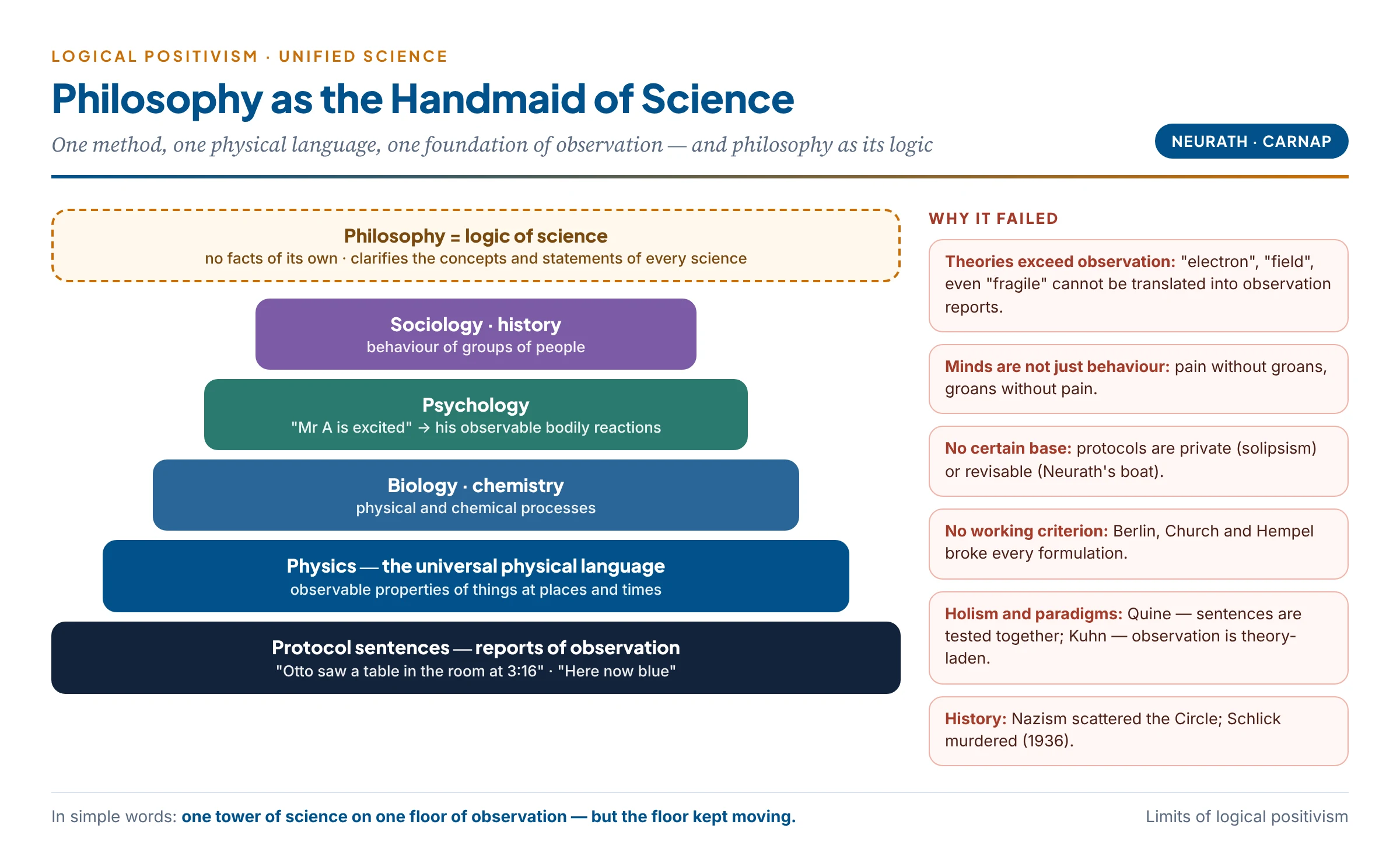
UPSC (2026) asked how the logical positivists tried to make philosophy a handmaid to science and to establish a unified language of science — and why the project failed. The programme had five parts.
- Philosophy loses its own subject matter. In the Middle Ages philosophy was called the handmaid of theology; in modern times it had been called the “queen of the sciences“. The positivists denied that philosophy has any first-order domain of facts. All factual questions belong to the sciences; philosophy becomes a second-order activity — the logic of science, the clarification of scientific concepts and statements. “Philosophy is to science what grammar is to language.“
- The scientific conception of the world. The Circle’s 1929 manifesto, “The Scientific Conception of the World“, announced two aims: unified science and the logical analysis of concepts. It rejected any deep knowledge beyond science: “In science there are no ‘depths’; there is surface everywhere.“
- Unified science (methodological monism). Physics, biology, psychology and the social sciences differ in subject matter but not in method: all rest on observation, testing and logical inference. The idealist and historicist claim that the human sciences need a special method (understanding or Verstehen instead of explanation) was rejected.
- A single language: physicalism. Otto Neurath and Rudolf Carnap proposed that every meaningful statement of every science can be translated into one universal language — the physical-thing language, which speaks of observable properties of objects at places and times. Carnap’s paper “The Physical Language as the Universal Language of Science” (1931) argued this in detail.
- Biology in terms of physical and chemical processes.
- Psychology in terms of bodily behaviour: “Mr A is excited” means, roughly, that his body shows certain observable reactions (raised pulse, fast breathing, agitated movements, certain answers to questions). This is logical behaviourism.
- Sociology in terms of the behaviour of groups of people.
- Building the edifice. Carnap’s The Logical Structure of the World (Aufbau, 1928) tried to construct all concepts step by step from a basis of elementary experiences; later he switched to a physical basis. The Circle organised International Congresses for the Unity of Science (1934–1941) and launched the International Encyclopedia of Unified Science (editor-in-chief Neurath, co-editors Carnap and Charles Morris).
- The vision in one sentence. A single, logically ordered, observation-based language of science, with philosophy as its grammarian — and no room left for metaphysics.
2. The Foundation Problem: The Protocol-Sentence Debate
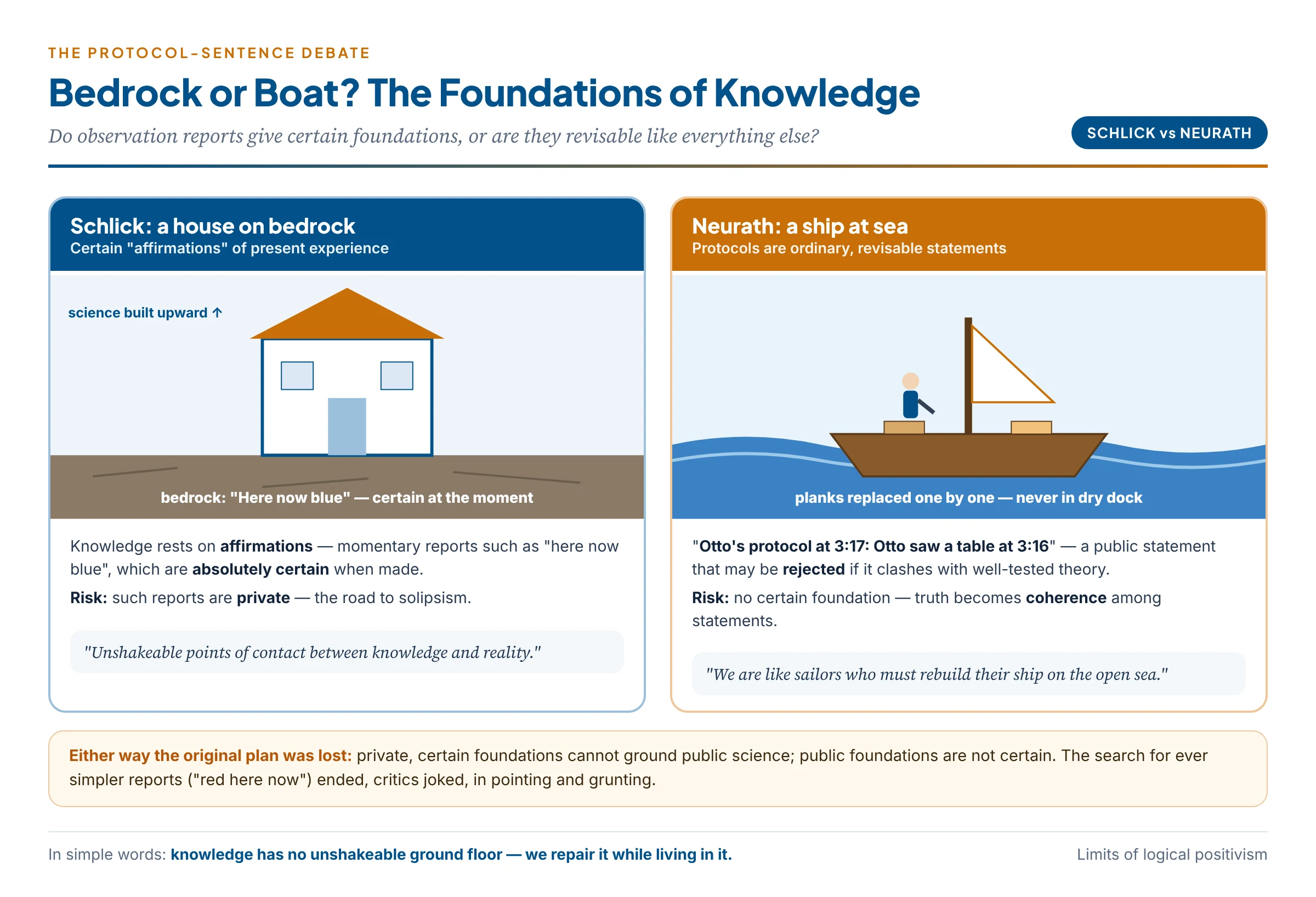
Every science was to rest on protocol sentences — the basic reports of observation. But what exactly are they? The question split the Circle.
- Schlick: certain foundations. Schlick held that knowledge rests on “affirmations” (Konstatierungen) — momentary reports of present experience, such as “Here now blue“, which are absolutely certain at the moment they are made. They are the “unshakeable points of contact” between knowledge and reality.
- Neurath: no foundations, only a boat. Neurath replied that protocol sentences are ordinary statements in the physical language, like “Otto’s protocol at 3:17: Otto saw a table in the room at 3:16“, and are revisable like any other. A protocol that conflicts with a well-supported theory may be rejected. His famous image: “We are like sailors who must rebuild their ship on the open sea, never able to dismantle it in dry-dock and reconstruct it from the best materials.“
- Carnap: tolerance. Carnap eventually treated the choice of protocol language as a convention — decided by usefulness.
- The regress of certainty. In seeking indubitable foundations, positivists moved from protocol sentences (“Moritz Schlick perceived red at 3:03 p.m. in room 301“) to ever thinner reports (“Red here now“). But even “red” goes beyond the moment (it classes the experience with other red ones), and “here now” written down is not the same as the moment it points to. Critics joked that the only fully certain report would be pointing and grunting — which says nothing.
- Why it mattered. If protocols are private experiences, science loses its public character (solipsism). If protocols are revisable public statements, science has no certain foundation — and verification becomes a matter of coherence among statements, not comparison with reality. Either way, the original picture of meaning built up from certain observation was lost.
In simple words
Think of how a dictionary is built. You might hope to define every word using a few “basic” words that need no definition. But look up any basic word, and the dictionary defines it using other words — round and round. Neurath said science is like that: no sentence is a final bedrock; we keep repairing the whole book while we read it, the way sailors repair a ship without ever reaching dry dock.
3. Why the Unified-Science Project Failed
- Theoretical terms could not be translated. Scientific terms like “electron“, “field“, “gene” — and even everyday dispositional terms like “soluble” or “fragile” — could not be defined in observation terms. Carnap’s “reduction sentences” gave only partial meaning (“if placed in water, it dissolves” says nothing about sugar never put in water). Theories carry surplus meaning beyond any finite set of observations.
- Psychology resisted behaviourism. “I have a toothache” does not mean “my body behaves in such-and-such a way” — an actor can show the behaviour without the pain, and a stoic can have the pain without the behaviour. Logical behaviourism was abandoned.
- The foundations dissolved. The protocol-sentence debate showed there were no certain observation statements to build on (section 2).
- No adequate criterion of meaning. Every formulation of the verification principle failed (sections 5–6). Without a criterion, the boundary between science and metaphysics could not be drawn by logic alone.
- Holism. Quine showed that statements are tested together, not one by one, and that there is no sharp line between meaning and fact (section 9). The idea of translating each statement into its own observational content collapsed.
- History of science. Thomas Kuhn’s The Structure of Scientific Revolutions (1962) showed that science changes through paradigm shifts, that observation is shaped by theory, and that rival paradigms may not share a neutral observation language. Ironically, Kuhn’s book was published as a volume in the positivists’ own Encyclopedia of Unified Science series.
- The human sciences. History, sociology and anthropology study meaningful actions, intentions and cultures, which many argued need interpretation, not just observation of behaviour.
- Philosophy refused to be only a handmaid. Critics argued that the positivists deprived philosophy of its traditional functions — surveying knowledge as a whole, deciding what counts as valid knowledge, reflecting on values and meaning of life — and overvalued science, forgetting that philosophy had been called the science of sciences.
- History itself. Nazism scattered the Circle; Schlick was murdered (1936); Neurath died in exile (1945). In America, the movement merged into a broader philosophy of science and lost its sharp anti-metaphysical edge.
4. The Self-Refutation Problem
The most famous internal criticism.
- The principle. “A statement is meaningful if and only if it is analytic or empirically verifiable.“
- Is it analytic? No. Its denial — “Some meaningful statements are neither analytic nor verifiable” — is not self-contradictory. It is not true by the meaning of “meaningful” in ordinary language; metaphysicians use “meaningful” differently.
- Is it empirically verifiable? No. No observation or experiment could show that all meaningful statements are analytic or verifiable.
- So by its own test it is meaningless. “To say that metaphysics is nonsense is itself nonsense.“
- Ayer’s reply — a definition, not a claim. In the 1946 Introduction, Ayer said the principle is not an empirical hypothesis but a definition (or a methodological rule) — a proposal to use “factually meaningful” in a certain way. It need not pass its own test, any more than a rule of grammar needs to be grammatical.
- The counter-reply. If it is only a proposal, the metaphysician is equally free to propose a different rule that allows metaphysics. Critics such as A. C. Ewing and Brand Blanshard pressed this: an arbitrary convention cannot eliminate anything. Ayer added that the principle is supported by its fit with how science and common sense actually use “meaningful” — but then it becomes a disputable claim, not a neutral rule.
- Waismann’s later turn. Friedrich Waismann, once Wittgenstein’s spokesman in the Circle, later wrote “How I See Philosophy” (1956), defending philosophy as vision — seeing the world in a fresh way — rather than a mere test of meaning.
5. Too Narrow for Science: The Dilemma of Every Formulation
| Kind of scientific statement | Example | Problem for verification |
|---|---|---|
| Universal laws | “All metals expand when heated” | Cannot be conclusively verified by any finite set of observations |
| Existential claims | “There is a particle with this mass somewhere” | Verifiable but not falsifiable |
| Mixed claims | “For every substance there is some solvent” | Neither conclusively verifiable nor falsifiable |
| Theoretical terms | “Electrons have negative charge” | Not observable; only indirect links |
| Dispositions | “This glass is fragile” | About what would happen, not what does |
| History | “Ashoka ruled in the 3rd century BCE” | Past events cannot be observed now |
| Statements nobody could check | “A big hydrogen-bomb war would wipe out humanity” (Russell) | Meaningful, yet no one would remain to verify it |
- Carnap’s confirmation runs into trouble too. In Carnap’s mathematical theory of confirmation, a universal law covering infinitely many cases receives a degree of confirmation of zero, however much evidence supports it — an embarrassing result.
- Carl Hempel’s verdict (1950). In “Problems and Changes in the Empiricist Criterion of Meaning“, Hempel surveyed every proposal and showed that each was either too strict (excluding universal laws, dispositions or theories) or too liberal (letting in sentences the positivists regarded as nonsense). He concluded that cognitive significance is a matter of degree, depending on a statement’s place in a whole theory, and that no simple criterion could work.
- Passmore’s warning. “Throw metaphysics into the fire and science goes with it; try to retain science, and metaphysics enters through the back door.“
6. Berlin and Church: Nonsense Through the Back Door
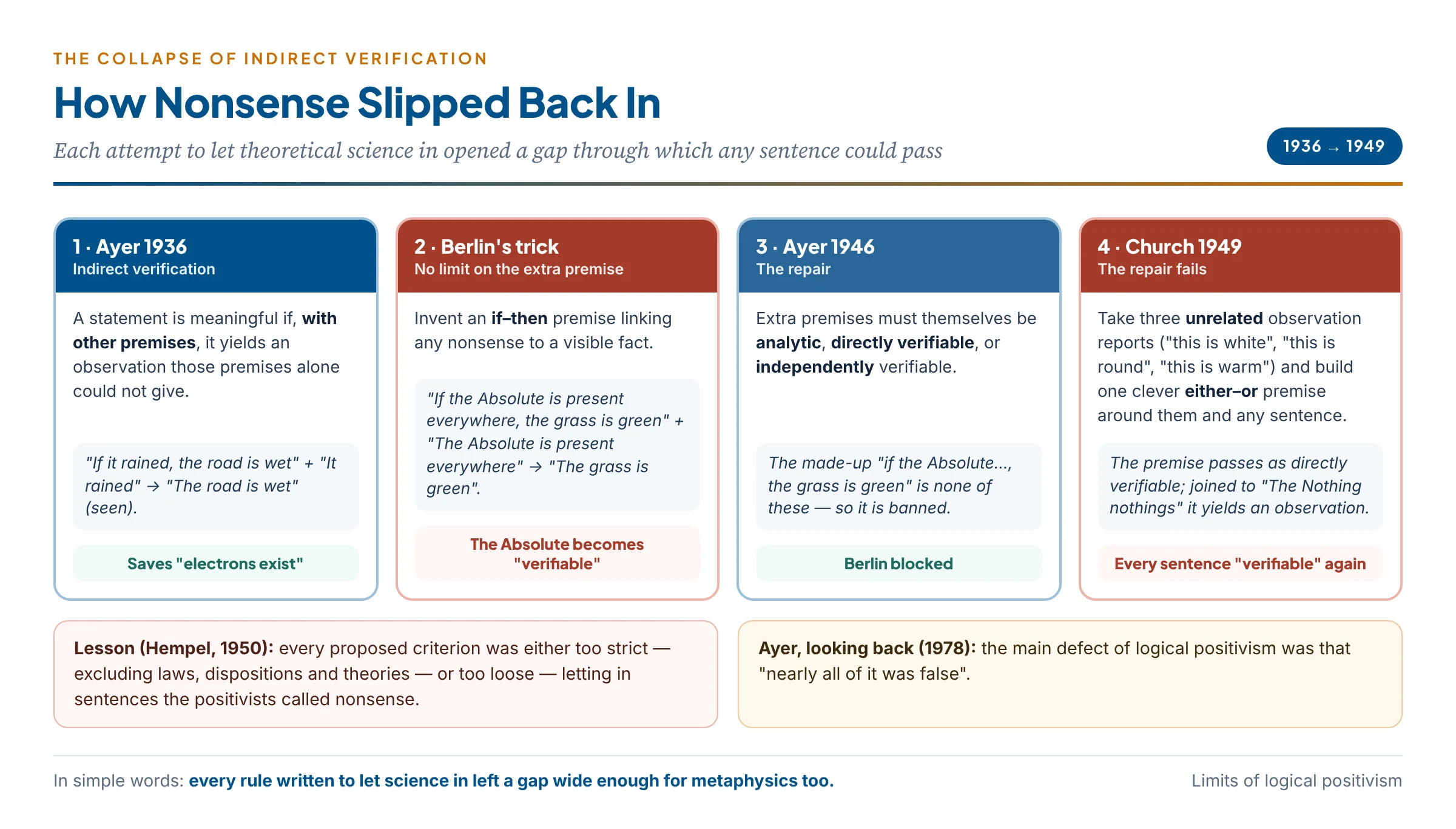
Ayer’s indirect verification (Article 1) was meant to let theoretical science in. Its critics showed that it let everything in.
- Isaiah Berlin’s objection. Ayer’s 1936 definition placed no restriction on the “other premises” used to derive an observation. So take any metaphysical sentence and add a suitable “if–then” premise:
- “If the Absolute is present everywhere, then the grass is green.” “The Absolute is present everywhere.” Therefore “The grass is green” — directly observable. So “the Absolute is present everywhere” counts as indirectly verifiable.
- Similarly: “If the soul is mortal, then coal is black” — and “the soul is mortal” becomes “verifiable”.
- The “if–then” premise does the work; the metaphysical sentence rides along. Every sentence whatever becomes meaningful — the criterion rules out nothing.
- Ayer’s repair (1946). The extra premises must themselves be analytic, directly verifiable, or independently shown to be indirectly verifiable. “If the Absolute is present everywhere, the grass is green” is none of these, so Berlin’s trick is blocked.
- Alonzo Church’s objection (1949). In a short review, the logician Alonzo Church showed that even the repaired criterion fails. In plain words:
- Take three ordinary observation reports that have nothing to do with each other — say, “This is white“, “This is round“, “This is warm“.
- Using only these three reports and any sentence you like (say, “The Nothing nothings“), build one long, cleverly arranged “either … or …” premise.
- This premise passes Ayer’s test for being directly verifiable: combined with one of the observation reports it yields another observation report.
- Because it is directly verifiable, it is an allowed extra premise. And combined with the nonsense sentence, it yields the third observation report — so the nonsense sentence counts as indirectly verifiable.
- The trick works for every sentence, and for its denial too. Ayer’s repaired criterion still rules out nothing.
- Ayer’s admission. Ayer accepted that he could not give a flawless formulation of the principle. Asked by Bryan Magee in a 1978 television interview what the main defect of logical positivism was, he answered: “Well, I suppose the most important of the defects was that nearly all of it was false.“
In simple words
A school says: “Only students with a valid pass may enter.” A clever boy writes on a slip, “This slip is a valid pass if the guard is wearing a cap.” The guard is wearing a cap — so he enters. The school tightens the rule: “The slip must itself be signed by someone who has a valid pass.” A cleverer boy then gets three unrelated students to sign a slip worded so cleverly that it counts as signed by valid pass-holders. Berlin was the first boy, Church the second — and any visitor could now walk in.
7. Strong Verification, Basic Propositions and Solipsism
- Lazerowitz’s point. “Strong” and “weak” are paired terms; if nothing is strongly verifiable, “weak” verification has no contrast (Article 1). Ayer’s answer was to admit basic propositions — reports of present experience — as strongly verifiable.
- The cost: privacy. A basic proposition (“I see a red patch now“) is verified only by my experience, which no one else can share. If all meaning traces back to such private reports, each person’s language refers ultimately to his own sensations — the road to solipsism, and the very opposite of Schlick’s demand for public, intersubjective checking. Critics accused Ayer’s acceptance of strong verification of making verification completely dependent on the knower.
- The physicalist escape. Neurath and Carnap tried to escape by making the basis physical (public objects at places and times). But then the basis was no longer certain, and psychology had to be squeezed into behaviourism (section 3).
8. Karl Popper: Falsifiability and the Problem of Demarcation
Karl Popper worked in Vienna and discussed with the Circle but was never a member; his Logic of Scientific Discovery (1934) became the sharpest critique of the movement.
- Two problems confused. The positivists confused the problem of meaning (what is meaningful vs meaningless) with the problem of demarcation (what is science vs non-science). Popper was interested only in the second.
- Falsifiability, not verifiability. A theory is scientific if it could be refuted by some possible observation — if it forbids something. “All swans are white” can never be verified, but a single black swan (found in Australia) refutes it. Science advances by bold conjectures and attempted refutations, not by piling up confirmations.
- The asymmetry. No number of white swans proves “all swans are white”; one black swan disproves it. Verification of universal laws is impossible; falsification is possible.
- Pseudo-science. Theories that explain everything and can be refuted by nothing — Popper’s examples were some versions of psychoanalysis and astrology — are not scientific, however often they are “confirmed”.
- Metaphysics is meaningful. Non-scientific does not mean meaningless. Metaphysical ideas — Greek atomism, the idea that the Earth moves, field theories — were untestable when proposed but inspired later science. Metaphysics can be rationally criticised and fruitful.
- Popper’s own limits. Popper’s criterion has problems too: existential statements (“there is a black swan”) are verifiable but not falsifiable; and scientists often protect a theory by adjusting auxiliary assumptions rather than giving it up (a point Quine and Kuhn pressed).
In simple words
A fruit-seller says, “All my mangoes are sweet.” You taste one hundred sweet mangoes — still no proof; the hundred-and-first may be sour. But one sour mango settles it: the claim is false. Popper says science works like the customer looking for the sour mango: a good theory sticks its neck out, saying what should never happen, and survives only as long as nobody finds the counter-example.
9. Quine: The Two Dogmas and Holism
In “Two Dogmas of Empiricism” (1951), W. V. O. Quine attacked the two assumptions on which logical positivism stood.
- First dogma — the analytic–synthetic distinction. The notion of “analytic” (true by meaning) cannot be made clear without going round in a circle through “synonymy” and “necessity” (Article 3). There is no sharp line between truths of meaning and truths of fact.
- Second dogma — reductionism. The belief that each meaningful statement can be translated into a statement about immediate experience, and so be verified on its own. This dogma is “the foundation of the verification theory of meaning“.
- Quine’s holism. “Our statements about the external world face the tribunal of sense experience not individually but only as a corporate body.” When a prediction fails, logic tells us only that something in our web of beliefs must change — not which statement.
- No statement is immune; any can be kept. “Any statement can be held true come what may, if we make drastic enough adjustments elsewhere”; and no statement — not even a law of logic — is immune to revision.
- The whole is verified, not the parts. It is the whole of science (or language) that meets experience. Individual sentences have no separate “verification conditions” — so the verification theory, which assigns each sentence its own method of verification, collapses.
- Quine’s objections to the verification theory (summary).
- It rests on reductionism, which is false.
- It assumes each sentence has its own empirical content; in fact only large bodies of theory do.
- It assumes the analytic–synthetic split, which cannot be drawn.
- Its criterion of meaning therefore cannot separate science from metaphysics: the boundary between “speculative metaphysics and natural science” is blurred.
- Quine remains an empiricist. Quine keeps two cardinal principles: all evidence for science is ultimately sensory, and meaning must be explained through sensory evidence and use. He is an empiricist without the dogmas — a “radical” empiricist.
- Metaphysics returns as science generalised. For Quine, questions about what exists are settled by our best overall theory: we are committed to whatever our best science needs (numbers, sets, physical objects). Metaphysics becomes continuous with science; philosophy and science differ only in generality, not in kind.
10. Later Wittgenstein: Meaning Is Use
- The picture theory abandoned. In Philosophical Investigations, Wittgenstein rejected his own early view that language pictures facts — the very view the positivists had built on. “Language is the picture of reality” became, for him, a superstition.
- Language has many uses. Language is like a toolbox — hammer, saw, glue, screws — with words serving many purposes: giving orders, asking, thanking, cursing, praying, telling jokes, reporting. Stating facts is only one of these language-games.
- Meaning is use. “For a large class of cases … the meaning of a word is its use in the language.” To understand “God is omnipotent” we look at its role in a believer’s form of life — prayer, worship, trust — not at a method of sense-verification.
- Object is not meaning. The object a word stands for is the bearer of the name, not its meaning; when Mr N. N. dies, the bearer dies, not the meaning of his name.
- Against the ideal language. The positivists hoped for a single, logically perfect language of science. Wittgenstein argued that ordinary language is in order as it is, and that philosophical problems arise when language “goes on holiday” — they are dissolved by looking at actual use, not by imposing one criterion.
- Result. The verification principle becomes, at best, a description of one language-game — empirical science — wrongly imposed on all the others.
11. Other Standard Criticisms
- Sentence vs proposition. A proposition is, by definition, what a sentence says and can be true or false; it cannot be “meaningless”. Only sentences can be meaningful or meaningless. The positivists talked of “meaningless propositions“, which is confused.
- Too narrow a notion of experience. Only sense experience counts; moral, aesthetic, religious and intuitive experience are ignored, though many think they are genuine sources of insight.
- Emotivism destroys ethics. If “slavery is wrong” only expresses a feeling, moral reasoning, justice and human rights lose their rational basis (Article 2).
- Mechanical view of knowledge. Knowledge is reduced to observation and logic, neglecting imagination, creativity and interpretation — all vital to science itself.
- Pragmatic value of metaphysics and religion. Ideas of God, soul and the other world give consolation, purpose and orientation to millions; dismissing them ignores real human needs for an interpretive framework of life.
- Elimination instead of explanation. The positivists dismissed metaphysical questions rather than explaining why people persistently ask them.
- A short-lived doctrine. Its rigid criteria could not accommodate the complexity of scientific practice and of language.
Common confusion
Did Popper offer falsifiability as a new criterion of meaning? No. Many notes say “Popper replaced the verification theory of meaning with a falsification theory of meaning“. Popper insisted that falsifiability is a criterion of demarcation — it separates science from non-science — not a criterion of meaning. For Popper, metaphysics is meaningful, often important, and open to rational criticism; it is simply not empirical science.
12. What Survived: The Significance of Logical Positivism
- A turning point. It redefined philosophy as logical and linguistic clarification rather than metaphysical speculation — the “linguistic turn” of twentieth-century philosophy.
- Philosophy of science. Confirmation theory, the analysis of explanation (Hempel), the structure of theories, the logic of testing — the whole discipline grew from the Circle’s work.
- Analytic philosophy. Its demand for clarity, precision and argument shaped analytic philosophy even among its critics (Quine, Popper, Strawson).
- Logic and language. Carnap’s work on formal languages influenced semantics, linguistics and even computer science (formal languages and programming).
- A critical tool. “What would count as evidence?” and “What would count against it?” remain the first questions to ask of any claim — scientific, political, commercial or religious.
- Enlightenment values. In the 1920s and 1930s the Circle defended reason, science and public argument against the irrational ideologies that led to fascism.
- Positive achievements in their own words. They emphasised the importance of logic and epistemology, curbed the spread of “imaginary theories“, and affirmed the potential of human endeavour to solve human problems.
Critical Evaluation
Critics and Defenders
Criticism — Critics
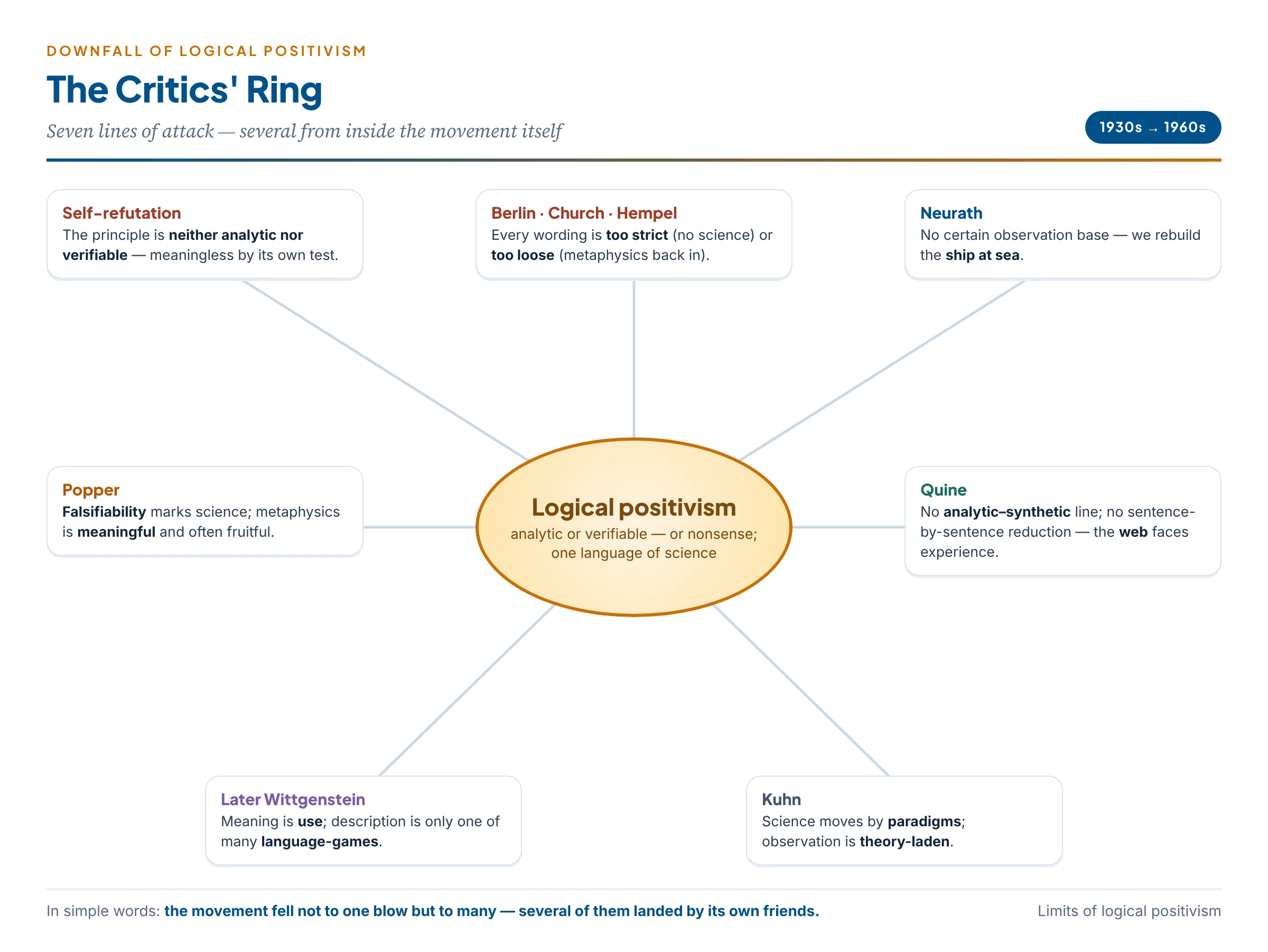
- Self-refutation: the principle is neither analytic nor verifiable.
- Berlin, Church, Hempel: no formulation keeps science in and metaphysics out.
- Neurath: no certain observational foundation — only a ship rebuilt at sea.
- Popper: science runs on falsification; metaphysics is meaningful and fruitful.
- Quine: no analytic–synthetic line; statements face experience as a whole.
- Later Wittgenstein: meaning is use; language has many games.
- Kuhn: science changes by paradigms; observation is theory-laden.
Defence — Defenders and strengths
- Ayer: the principle is a definition, judged by its usefulness.
- Carnap: tolerance — choose frameworks for their fruitfulness.
- Hempel: significance is a matter of degree within theories — a refined, not abandoned, empiricism.
- Neurath’s wing: a pragmatic, holistic empiricism untouched by most objections.
- Lasting method: clarity, testability and public evidence remain the standard of rational inquiry.
A Balanced Judgement
- The programme failed as a theory of meaning. No precise, self-consistent criterion separating sense from nonsense was ever found.
- It succeeded as a method of criticism. The demand that claims be clear and answerable to evidence became part of the common sense of science and philosophy.
- It was self-correcting. Much of the decisive criticism (Neurath, Carnap’s revisions, Hempel, Quine — a former visitor to the Circle) came from within or near the movement. Its decline is a model of honest revision.
Cross-Tradition Comparison
Is Cārvāka Philosophy Positivistic?
UPSC (2024) asked whether the Cārvāka (Lokāyata) school of India is positivistic. The answer: partly — in its empiricism and anti-metaphysics, but not in its method.
| Point | Cārvāka | Logical positivism |
|---|---|---|
| Source of knowledge | Perception alone (pratyakṣam evaikam pramāṇam) | Experience for facts; logic for analytic truths |
| Inference | Rejected: the universal relation (vyāpti) cannot be known by perception of all cases | Accepted: deductive logic certain; induction gives probability |
| Testimony / scripture | Rejected; Vedas the work of self-serving priests | Rejected as a source of factual knowledge |
| God, soul, heaven, rebirth | Do not exist (they are unperceived) | Meaningless to assert or deny |
| Self | Consciousness arises from matter (bhūtacaitanyavāda); the self is the living body (dehātmavāda) | No metaphysical self; statements about mind analysed into experience or behaviour |
| Ethics | Pleasure (kāma) and wealth (artha) are the only goals | Emotivism: moral talk expresses feeling |
| Method | Ontological denial — a materialist metaphysics | Linguistic analysis — elimination, not denial |
| Attitude to science | Practical worldliness (lokavyavahāra) | Philosophy as handmaid of science |
Indian Connect — Key takeaways
- Similarities. Both trust perception, distrust scripture and priestly authority, and reject God, soul, heaven, rebirth and mokṣa as unverified. Both are this-worldly and, in their age, liberating critiques of dogma. In this sense Cārvāka is India’s closest proto-positivism.
- Differences. Cārvāka denies transcendent entities — “there is no soul, no other world” — which is itself a metaphysical (materialist) claim; the positivist would call it as meaningless as its opposite. Cārvāka rejects inference altogether (or, in its refined form, accepts only inference about perceivable things), while positivists build on logic and probable induction.
- Verdict. Cārvāka is positivistic in spirit (empiricist, anti-metaphysical) but metaphysical in content (materialism) and narrower in method (no logic of science). It is better called a radical empiricism and materialism than logical positivism.
- Other Indian echoes. The Buddha’s silence on unanswerable questions (Article 2), Nyāya’s check of truth by successful action (Article 1) and Nāgārjuna’s dissolution of all views share the positivist distrust of speculation, but each places it within a framework aimed at liberation, not at a unified science.
Logical Positivism and Its Successors
| Point | Logical positivism | Popper | Quine | Later Wittgenstein | Kuhn |
|---|---|---|---|---|---|
| Unit of meaning / testing | Single sentence | Single theory, tested by attempted refutation | Whole web of belief | Use in a language-game | Paradigm |
| Test of science | Verification / confirmation | Falsifiability | Overall fit with experience | — | Puzzle-solving within a paradigm |
| Analytic–synthetic | Sharp | Accepted | Rejected | Grammar vs experience | — |
| Metaphysics | Meaningless | Meaningful, not science | Continuous with science | Grammar on holiday | Part of paradigms |
| Observation | Neutral foundation | Theory-laden but decisive | Periphery of the web | — | Theory-laden |
Synthesis (Siddhānta)
- Why it collapsed. Logical positivism collapsed because its central principle could not justify itself, could not be formulated without letting metaphysics in or shutting science out, rested on an observational foundation that dissolved under scrutiny, and depended on two dogmas — the analytic–synthetic split and reductionism — that Quine dismantled. Popper, Wittgenstein and Kuhn added that it had misdescribed both science and language.
- Why its project of a unified language failed. Science does not reduce to one observation language: theories carry meaning beyond observation, minds are not just behaviour, observation is shaped by theory, and the human sciences need interpretation. Philosophy, too, refused to become merely science’s grammarian.
- Why it still matters. It taught philosophy to ask what claims mean and how they could be tested; it created the philosophy of science; and its spirit of clarity, public evidence and anti-dogmatism remains indispensable — perhaps more than ever in an age of misinformation.
- The Indian view. Indian epistemology, with its many pramāṇas, never accepted that sense-perception exhausts knowledge; the collapse of positivism vindicates the wider Indian view that knowledge has several valid sources, while the positivist critique remains a useful reminder that every claimed source must be open to examination.
“Throw metaphysics into the fire and science goes with it; try to retain science, and metaphysics enters through the back door.” — a critic’s summary of the positivist dilemma
Previous Year Questions
- 2026How did the logical positivists try to make philosophy a handmaid to science and establish a unified language of science? Why did their project fail? Discuss.
- 2024Do you think Cārvāka’s philosophy is positivistic in nature? Give reasons and justifications for your answer.
- 2018How do the logical positivists show that metaphysical sentences are meaningless? Can their verification theory of meaning account for the meaningfulness of all scientific sentences? Discuss.
- 2017What are the two dogmas of empiricism that Quine attacks? What are his arguments against what he calls the second dogma?
- 2014Are empirical statements conclusively verifiable? Discuss the limitations of ‘verification theory of meaning’.
- 2014How far are Quine’s arguments in ‘two dogmas of empiricism’ justified? Discuss.
- 2011Discuss the limitations of verification theory.
- 2009What are Quine’s objections with regards to the verification theory of meaning?