

Logical Positivism: Verification Theory of Meaning; Rejection of Metaphysics; Linguistic Theory of Necessary Propositions.
Official Syllabus: Paper I, Section A, Unit 7
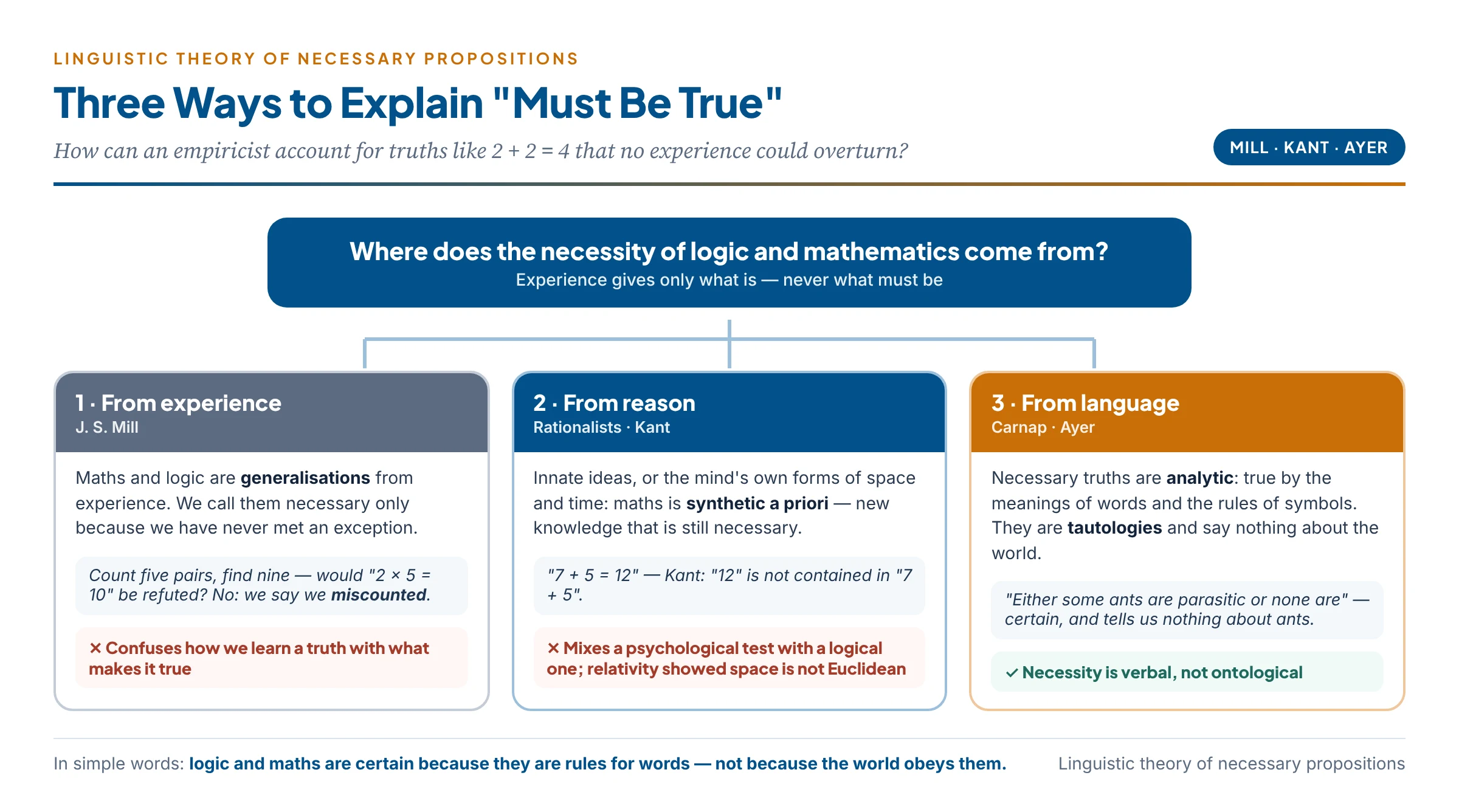
Every empiricist faces one hard question: if all knowledge of the world comes from experience, and experience only ever tells us what is the case, how can we know truths that must be the case — “2 + 2 = 4“, “A triangle has three sides“, “Nothing can both be and not be“? These are necessary propositions: their denial is not merely false but impossible. The logical positivists answered with the linguistic theory of necessary propositions: necessary propositions are analytic — true by virtue of the meanings of words and the rules of language — and therefore tautologies that say nothing about the world. Their necessity is “verbal, not ontological“: it belongs to language, not to reality. This answer let the positivists keep the certainty of logic and mathematics while remaining empiricists about facts, reject both J. S. Mill’s view that mathematics is a set of very well-confirmed generalisations and Kant’s synthetic a priori, and leave metaphysics no hiding place.
In simple words
In chess, “a bishop moves diagonally” is always true — no game anywhere will ever show a bishop moving straight and still being a bishop. But this is not because chess players have observed thousands of bishops and found a law of nature. It is true because it is a rule of the game: it tells you what “bishop” means in chess. The positivists say “2 + 2 = 4” and “All bachelors are unmarried” are like this — rules for using words and symbols, not discoveries about the world.
Context & Problem
Three Pairs of Terms
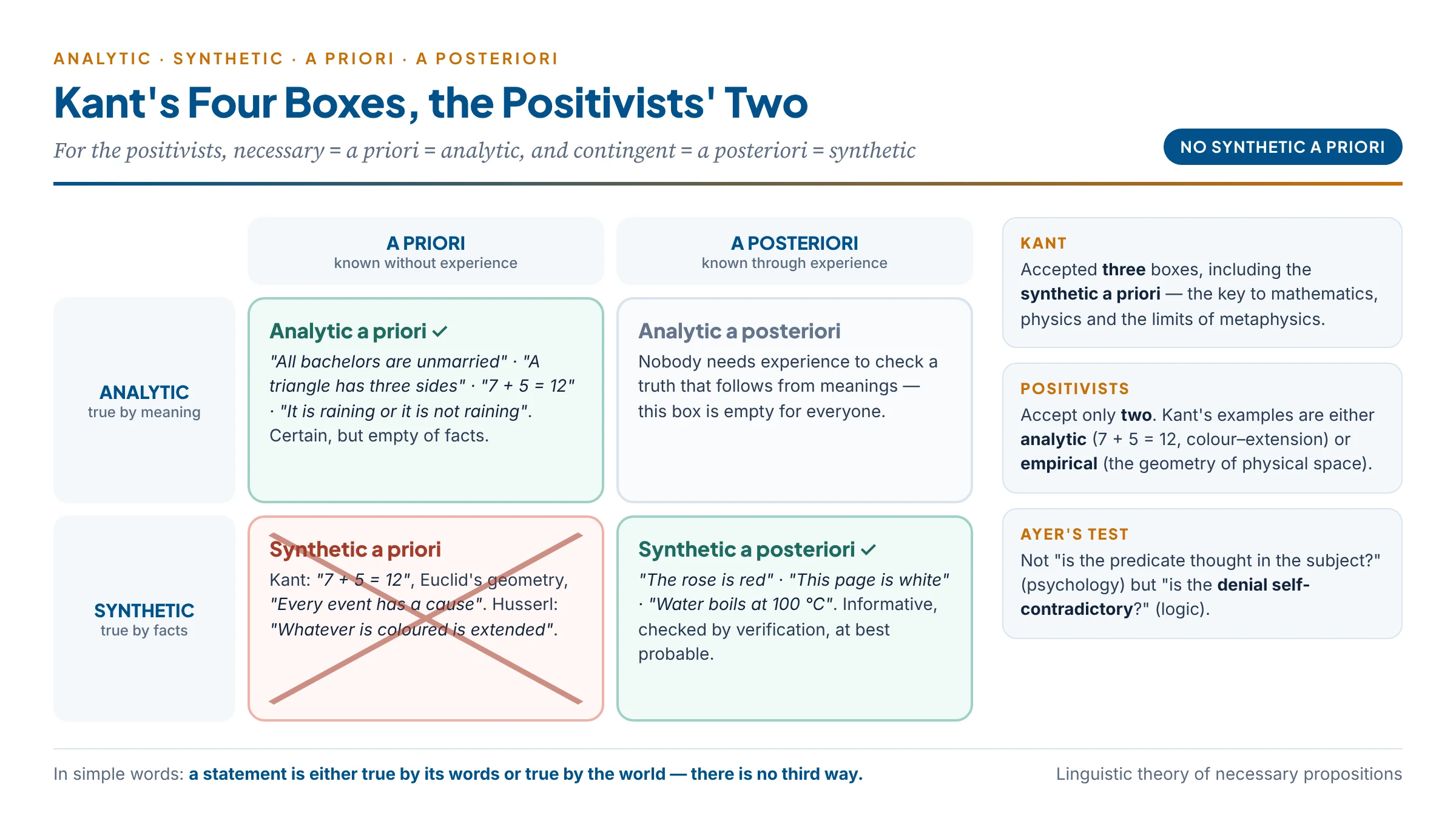
Before the theory makes sense, three pairs of terms must be kept apart. The positivists’ whole point is that they line up exactly.
- Necessary vs contingent (about truth). A necessary truth could not have been false (“A square has four sides“). A contingent truth happens to be true but could have been otherwise (“Delhi is the capital of India“).
- A priori vs a posteriori (about knowledge). Known a priori = known without relying on experience (“7 + 5 = 12“). Known a posteriori = known through experience (“Water boils at 100 °C“).
- Analytic vs synthetic (about meaning). Analytic = true or false by the meaning of the words (“All bachelors are unmarried“). Synthetic = its truth depends on how the world is (“The rose is red“).
- The positivist equation. Necessary = a priori = analytic, and contingent = a posteriori = synthetic. There is no fourth or mixed case.
The Empiricist Dilemma
- The empiricist thesis. All factual knowledge comes from sense experience.
- What experience gives. Experience is always of particular, changing things. It can tell us that this swan is white, never that every possible swan must be. Even the best evidence gives only probable knowledge.
- What logic and mathematics give. “2 + 2 = 4“, the Pythagorean theorem and the law of non-contradiction seem universal, certain and necessary. No experiment could ever overturn them.
- The crisis. If all knowledge comes from experience, where does this necessity come from? Rationalists had used the certainty of mathematics as proof that reason alone can know reality — Plato’s Forms, Descartes’ clear and distinct ideas, Spinoza’s geometric method. If empiricism could not explain mathematics, the door to rationalist metaphysics stayed open.
Three Possible Answers
Faced with necessary propositions, there are only three options.
| Answer | Origin of the truth | Basis of its validity | Who held it | Positivist verdict |
|---|---|---|---|---|
| Empirical | Experience | Experience — generalisation with no known exception | J. S. Mill | Rejected: confuses origin with validity |
| Rational / synthetic a priori | Reason (innate ideas, or the mind’s own forms) | Reason’s insight into reality | Rationalists; Kant (synthetic a priori) | Rejected: no synthetic a priori exists |
| Linguistic | May begin with experience | Meaning of words and rules of language | Logical positivists (Carnap, Ayer) | Accepted |
Core Doctrine
1. Against Mill: Mathematics Is Not a Very Well-Tested Generalisation
- Mill’s view. John Stuart Mill, a thorough empiricist, held that the truths of logic and mathematics are inductive generalisations from experience. We call “2 + 2 = 4” necessary only because we have never met an exception. In principle, future experience could refute it.
- Ayer’s first objection — confusing origin and validity. Mill was right that our knowledge begins with experience — a child learns to add with fingers and marbles. But it does not follow that the truth of “2 + 2 = 4” depends on experience. How we come to learn a truth (its origin) is one question; what makes it true (its validity) is another.
- Ayer’s second objection — no experience could refute it. Ayer’s example: suppose I count what I take to be five pairs of objects and find that they number only nine. I do not conclude that “two times five is ten” has been refuted. I conclude that I miscounted, or that I took one object to be two, or that one object vanished while I was counting. Mathematical propositions are immune to empirical refutation; we use them to correct our observations, not the other way round.
- The astronomer. An astronomer counts seven planets in one region and five in another but finds only eleven in all. She does not announce that “7 + 5 = 12” is falsified; she looks for the hidden or miscounted body. A real empirical generalisation (“All swans are white“) would give way to a counter-example; “7 + 5 = 12” never does.
- Conclusion. A truth that no possible experience could refute is not an empirical generalisation. Its necessity must come from somewhere else.
| Kind of statement | Origin | Validity (what makes it true) | Example |
|---|---|---|---|
| Synthetic a posteriori | Experience | Experience | “There is a cup on the table” |
| Analytic a priori | May begin with experience | Definitions and rules of language — no observation needed | “All bachelors are unmarried”, “7 + 5 = 12” |
In simple words
You may have learnt “red means stop” by watching cars at a crossing. That is how the knowledge started. But “a red signal means stop” is not true because cars stop — it is true because it is the traffic rule. If a car jumps the signal, you do not say the rule has been refuted; you say the driver broke it. Ayer says Mill mixed up learning a truth with what makes it true.
2. Against Kant: There Is No Synthetic a priori
- Kant’s claim. Kant (Unit 4) argued that mathematics and the foundations of physics are synthetic a priori: they add to our knowledge (synthetic) yet are necessary and known without experience (a priori). His famous example: in “7 + 5 = 12“, the concept “12” is not contained in the concept “7 + 5”; we must construct the sum in pure intuition (time). Geometry rests on the pure intuition of space; physics on the categories such as causality.
- Ayer’s diagnosis — two criteria mixed up. Kant gave two tests of analyticity and slid between them:
- A psychological test — a judgement is analytic if the predicate is already thought in the subject (“All bodies are extended“: in thinking “body” I already think “extended”).
- A logical test — a judgement is analytic if its denial is self-contradictory (“A triangle is a three-sided figure“: to deny it is a contradiction).
- Why the difference matters. By the psychological test, “7 + 5 = 12” looks synthetic, because when I think “7 + 5” I may not be consciously thinking “12”. But by the logical test it is analytic: to deny “7 + 5 = 12” while keeping the meanings of the symbols is self-contradictory. Ayer rejects the psychological test — what someone happens to be thinking is irrelevant to truth — and keeps only the logical test. Then “7 + 5 = 12” is analytic.
- Too narrow a definition. Kant defined analyticity only for subject–predicate judgements (“predicate contained in subject”). But many necessary truths are not of this form: “If A is taller than B and B is taller than C, then A is taller than C“; “If it is raining, then it is raining“. The logical test covers them; Kant’s does not.
- “12” adds nothing. For the positivists, “12” does not add anything to “7 + 5”; it is just another expression for the same number, by the rules of arithmetic. The feeling of learning something new is psychological, not logical.
- Science against Kant. Kant took Euclidean geometry to be synthetic a priori truth about space. But non-Euclidean geometries were developed in the 19th century, and Einstein’s relativity showed that physical space is not Euclidean on large scales. So the “necessary” geometry of space turned out to be either a pure mathematical system (analytic, true by its axioms) or an empirical theory of physical space (synthetic, testable — and in this case false). Nothing is left for the synthetic a priori.
- Postulations. The positivists added that Kant’s categories and pure intuitions of space and time are his own postulations, not discoveries — another form of metaphysics.
Common confusion
Is “The rose is red” a “synthetic a priori” statement for the positivists? No. Some notes write “if truth or falsity is decided on the basis of experience then it is synthetic a priori — e.g. ‘Rose is red’, ‘Gold is white'”. That is a slip. A statement decided by experience is synthetic a posteriori. The positivists recognise only two kinds: analytic a priori (“All bachelors are unmarried”, “7 + 5 = 12”) and synthetic a posteriori (“The rose is red”). The synthetic a priori is exactly the class they deny.
3. The Positivist Solution: Necessary Propositions Are Analytic
- Definition. A proposition is analytic when its validity depends solely on the definitions of the symbols it contains; synthetic when its validity is determined by the facts of experience.
- All necessary propositions are analytic. Logic, mathematics and definitional truths are all analytic. Their truth is fixed by meaning alone, so no observation is needed to establish them, and none can refute them.
- Examples.
- “All bachelors are unmarried” — “unmarried” is part of what “bachelor” means.
- “A triangle has three sides” — part of the definition of “triangle”.
- “2 + 2 = 4“, “7 + 5 = 12” — follow from the definitions and rules of arithmetic.
- “A red rose is red” — repeats in the predicate what the subject already says.
- “Either it is raining or it is not raining” — true by the meanings of “either”, “or” and “not”, whatever the weather.
- The two-way rule. For the positivists, all analytic statements are a priori and all a priori statements are analytic; all synthetic statements are a posteriori and all a posteriori statements are synthetic. This is the whole map of meaningful discourse.
4. Tautologies: Certain Because They Say Nothing
- Wittgenstein’s insight. In the Tractatus, early Wittgenstein showed that the truths of logic are tautologies: they are true whatever the facts are, and so they say nothing about the facts. The Vienna Circle extended this from logic to mathematics.
- Ayer’s example. “Either some ants are parasitic or none are.” I know this is true — yet it gives me no information at all about ants. It would be true in any possible world, which is exactly why it tells me nothing about this one.
- Certainty is bought at the price of emptiness. Synthetic statements are informative but uncertain; analytic statements are certain but uninformative. No statement is both certain and informative about the world — which is precisely why metaphysics, which claims certain knowledge of reality, is impossible.
- No existence follows. “All giants are giants” does not imply that any giant exists. “All bachelors are unmarried” does not tell us whether any bachelor exists. Analytic truths are about how we use words, not about what there is.
- Not “trivial” in the sense of useless. Calling them tautologies does not mean they are silly or obvious. “91 × 79 = 7189” (Ayer’s example) is a tautology, yet few of us can see its truth at a glance. Analytic truths can surprise us, because our minds cannot take in all the consequences of our own definitions at once. Ayer remarked that a being whose intellect was infinitely powerful would take no interest in logic and mathematics — he would see at a glance everything that his definitions implied.
In simple words
“Tomorrow it will either rain or not rain.” A weather forecaster who says this can never be wrong — and is completely useless. You still don’t know whether to carry an umbrella. That is a tautology: guaranteed true because it excludes nothing. A real forecast, “It will rain tomorrow“, risks being wrong — and that risk is exactly what makes it informative.
5. Necessity Is Verbal, Not Ontological
“The principles of logic and mathematics are true universally simply because we never allow them to be anything else.” — A. J. Ayer
- The core claim. The necessity of logic and mathematics is linguistic (verbal), not ontological (a feature of reality). Necessary propositions record our determination to use words in a certain fashion. Necessity belongs to language, not to the world.
- Why denying them is a contradiction. To deny “All bachelors are unmarried” while keeping the meaning of “bachelor” is to contradict yourself — to break the very rules you are using. That is all their necessity amounts to.
- They are rules, not reports. Necessary propositions function as rules for the use of language rather than as factual assertions. They clarify relationships between symbols; they do not describe objects.
- Their use. Though they say nothing about the world, they are indispensable: they serve as rules of inference and calculating devices that let us move from one empirical statement to another without losing truth. If I know that there are 5 apples in one bag and 7 in another, arithmetic lets me infer, without counting again, that there are 12 — the arithmetic adds no fact; it transforms facts I already have.
- Logic and mathematics as scaffolding. They are not a description of the structure of the world (as Plato or Descartes thought), but the formal framework within which empirical statements are made — the scaffolding of science.
- Empiricism saved. Now the empiricist can say: all knowledge of fact comes from experience; logic and mathematics are certain only because they are not knowledge of fact. Rationalism loses its strongest example.
6. Carnap: Linguistic Frameworks and Conventions
- Choosing a language is choosing its rules. For Carnap, when we adopt a language system — arithmetic, formal logic, a geometry — we adopt along with it rules that decide which statements count as valid within that system. Logical and mathematical truths express these rules.
- “2 + 2 = 4”. It is necessarily true because of the definitions and operational rules of arithmetic, not because anyone has observed pairs of objects.
- Geometry as the key example. Within the framework of Euclidean geometry, “The angles of a triangle add up to 180 degrees” is necessarily true — it follows from Euclid’s axioms. In a non-Euclidean framework (the geometry of a curved surface, like the Earth’s), the angles of a triangle add up to more than 180 degrees, and different necessary truths hold. Necessity depends on the chosen framework, not on metaphysical facts.
- Principle of tolerance. Carnap’s later principle: “In logic, there are no morals.” Everyone is free to build his own logical framework; the question is not which is “true” but which is useful for a given purpose — a practical choice.
- Internal vs external questions. Within a framework, “Is there a prime number greater than 100?” is a meaningful internal question answered by the framework’s rules. But “Do numbers really exist?” asked from outside any framework is a pseudo-question — the old metaphysical dispute between Platonists and nominalists dissolves into a choice of language.
- Conventions and their limits. Carnap’s view is often called conventionalism: logical truths are true by convention. (Quine attacked this — see Critical Evaluation.)
In simple words
In India we drive on the left; in the USA they drive on the right. Neither rule is “true to the nature of roads” — each is part of a system of traffic rules, and inside each system it is necessary (break it and you are driving wrongly by definition). Carnap thinks logic and geometry are like this: inside a chosen framework their truths are necessary; which framework to adopt is a practical choice of usefulness.
7. Necessary and Empirical Propositions Distinguished
UPSC has asked how necessary propositions differ from empirical ones and how necessary propositions are justified.
| Point | Necessary (analytic) proposition | Empirical (synthetic) proposition |
|---|---|---|
| Example | “All bachelors are unmarried”; “7 + 5 = 12” | “The page is white”; “Water boils at 100 °C” |
| Truth depends on | Meanings and rules of language | Facts of experience |
| Known | A priori | A posteriori |
| Denial | Self-contradictory | Possible, merely false |
| Certainty | Certain | At best probable (except basic propositions) |
| Information about the world | None — a tautology | Informative |
| Can experience refute it? | Never — we blame the observation | Yes |
| Justified by | Analysis of meaning; proof by rules from definitions | Verification by observation |
- How a necessary proposition is justified. Not by observation and not by rational insight into reality, but by analysis: we show that its denial contradicts the definitions of its terms, or we derive it step by step from definitions and axioms using logical rules. Justification is internal to language.
- How an empirical proposition is justified. By verification — observations that make it certain (basic propositions) or probable (everything else).
8. “All Objects Are Either Red or Not Red” vs “This Page Is White”
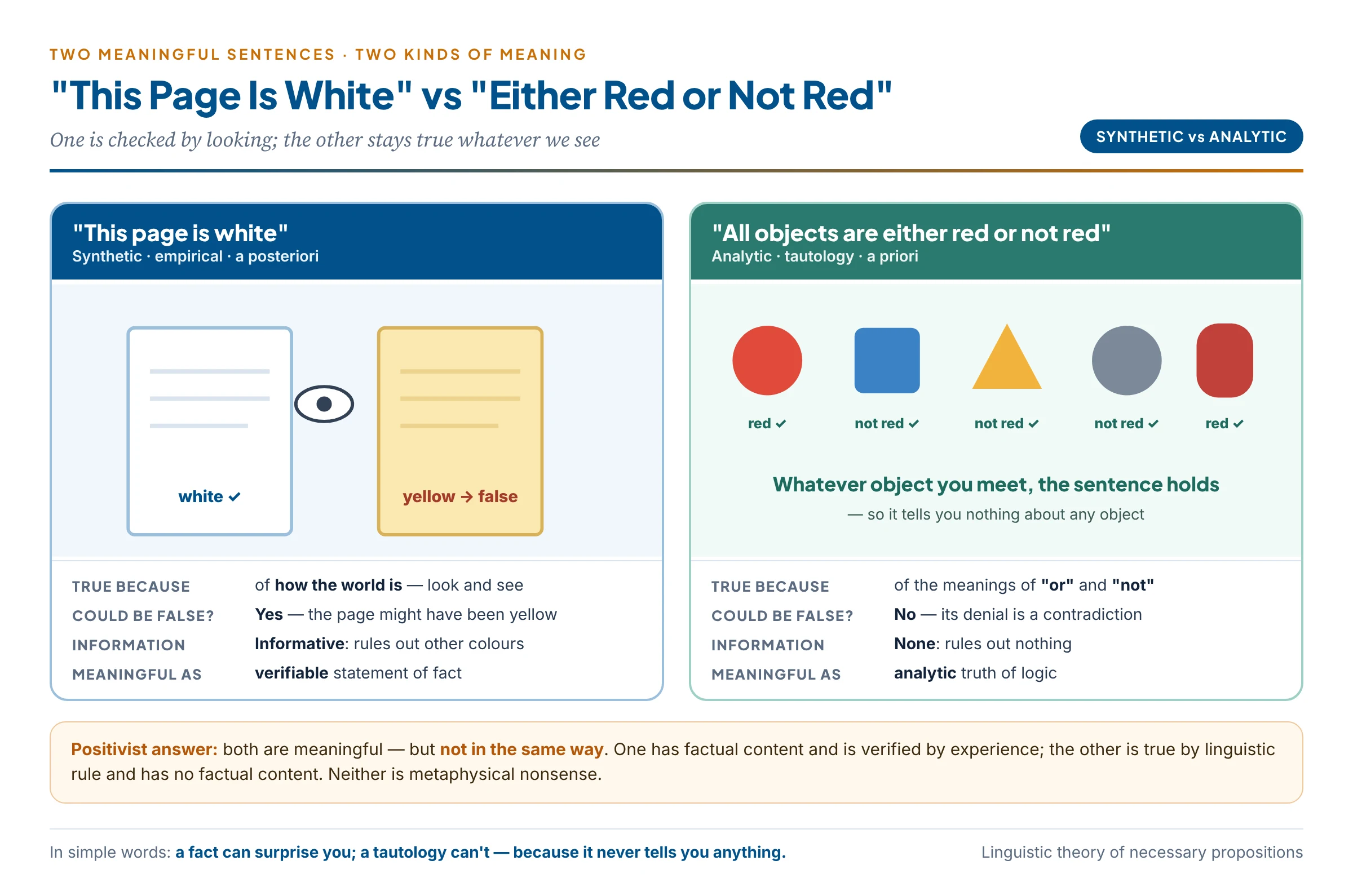
UPSC asked whether these two sentences are meaningful in the same way. For the positivists both are meaningful, but in quite different ways.
- “This page is white” — synthetic and empirical. Its truth depends on how things are: look at the page and you can see. It could have been false (the page might be yellow). It is meaningful because it is verifiable; it is informative because it rules out some possibilities.
- “All objects are either red or not red” — analytic, a tautology of the form “everything either has a property or lacks it”. Its truth follows from the meaning of “or” and “not” (the law of excluded middle). No observation is needed, and none could refute it: whatever colour any object has, the sentence stays true. So it rules out nothing and tells us nothing about objects or colours.
- Same or different? Both are meaningful — so the positivist does not class the tautology with metaphysical nonsense. But the first has factual (cognitive) content, verified by experience; the second has no factual content and is true by linguistic rule. Hence they are meaningful in different ways: one informs, the other formalises.
- The deeper point. This pair shows the positivists’ two-source theory of meaning: a sentence earns meaning either by being analytic or by being verifiable — the two branches of Hume’s fork, restated in linguistic terms.
- A critic’s twist. Quine would say that even the law of excluded middle is revisable: some versions of quantum logic and intuitionist mathematics give it up. If so, “red or not red” is not true by meaning alone; it is just very deeply embedded in our system of beliefs.
9. “Whatever Is Coloured Is Extended”
UPSC asked whether this sentence satisfies the positivist criterion of meaningfulness. It is a famous hard case, because it looks necessary but not definitional.
- The challenge. We cannot imagine a colour that is not spread out over some area or surface. Yet “extended” does not seem to be part of the definition of “coloured” the way “unmarried” is part of “bachelor”. Similar examples: “Nothing can be red and green all over at the same time“; “Every tone has a definite pitch“.
- Husserl’s view. Edmund Husserl and the phenomenologists (Unit 9) held that such sentences express a material (factual) a priori: necessary connections between essences (colour and extension) grasped by intuition of essences. They are synthetic (about the content of experience) and yet a priori — a direct challenge to positivism.
- Schlick’s reply (1930, “Is There a Factual a priori?”). Schlick argued that such sentences are analytic after all. Their necessity comes from the rules for using colour words: the grammar of “coloured” allows it to be applied only to surfaces or regions, so “a colour without extension” is not a strange fact but a meaningless combination of words. Such propositions are “of purely conceptual nature” — tautological and formal. They contain no knowledge of fact and cannot found a special science of essences.
- So does it satisfy the criterion? Yes — as an analytic statement. It is meaningful, but it says nothing about the world; it records how we use the words “coloured” and “extended”. It does not need to be verified, and no observation could refute it.
- Objections.
- Not derivable from definitions. “Red” and “coloured” cannot be defined in words at all (only shown by pointing), so it is hard to see how “coloured implies extended” follows from definitions. The positivists had to stretch “analytic” to cover “rules of use” in general.
- Wittgenstein’s own trouble. The colour-exclusion problem (“red and green all over”) was what made Wittgenstein abandon the Tractatus view that all necessity is truth-functional logic (1929). If the founder of the theory could not handle colours, the positivist claim was less secure than it looked.
- A phenomenologist’s reply. The fact that the words are used this way may itself reflect a real structure of experience — so the linguistic theory may have the order of explanation backwards.
10. Philosophy’s Own Statements Are Analytic
- What philosophy is. If all necessary truths are analytic and all factual truths belong to science, then philosophy — which proves nothing about facts — consists of analytic activity: clarifying the meanings and logical relations of words.
- Ayer’s position. The propositions of philosophy are linguistic: they do not describe the behaviour of things but express definitions or the formal consequences of definitions. Philosophy is a department of logic.
- Consequence. The linguistic theory and the elimination of metaphysics support each other: once necessity is shown to be verbal, a metaphysician cannot claim that reason alone reveals necessary facts about reality.
Critical Evaluation
Quine’s “Two Dogmas of Empiricism” (1951)
W. V. O. Quine (Unit 11) attacked the theory at its root by rejecting the analytic–synthetic distinction itself.
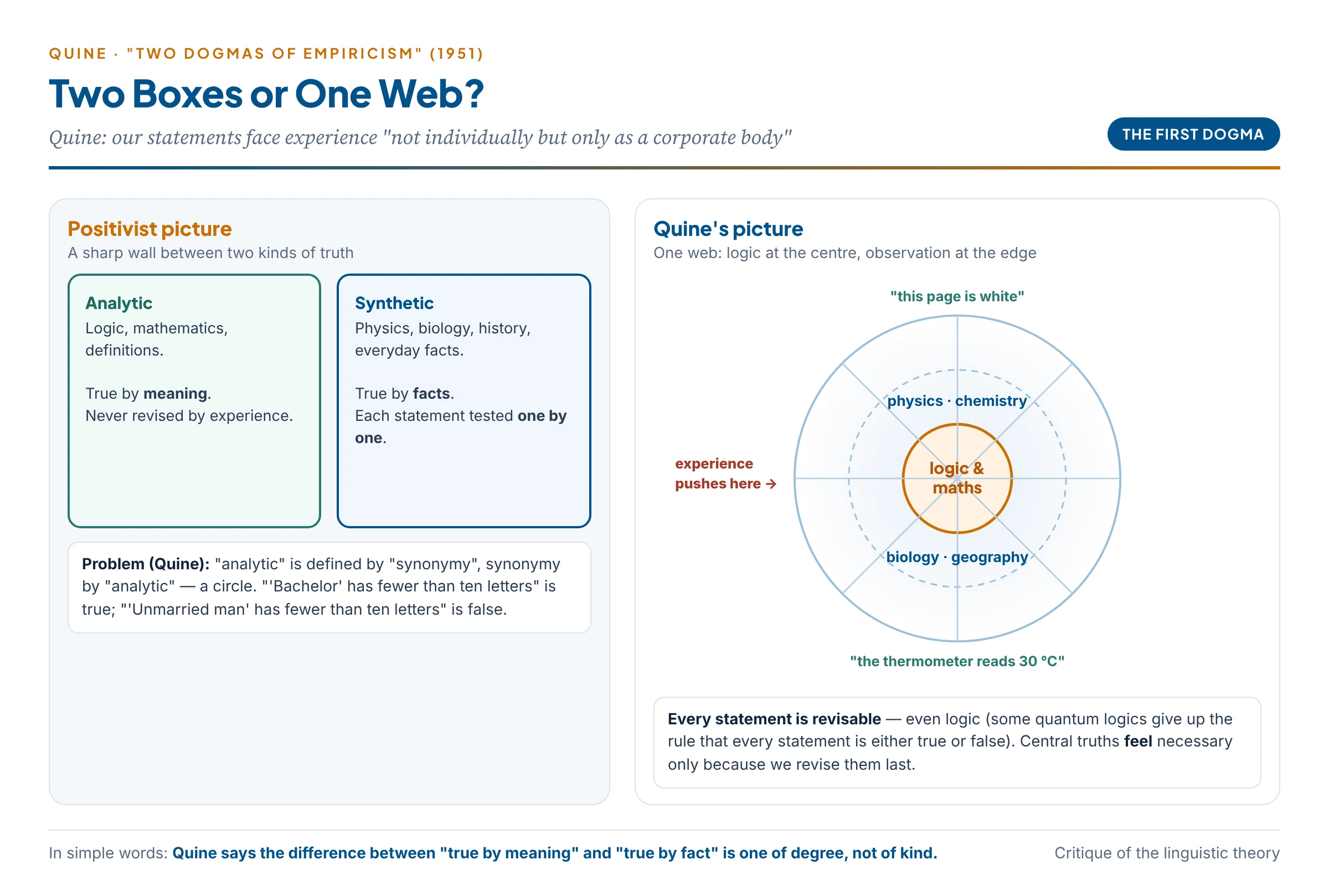
- The circle of “analyticity”. An analytic truth is said to be true “by meaning” — e.g. “No bachelor is married” becomes a logical truth when “bachelor” is replaced by its synonym “unmarried man”. But what is synonymy? Two expressions are synonyms if they can be swapped without changing truth — yet some swaps fail: “‘Bachelor’ has fewer than ten letters” is true, while “‘Unmarried man’ has fewer than ten letters” is false. Every attempt to define synonymy ends up appealing to necessity or analyticity again. The notions go round in a circle; analyticity has never been made clear.
- No statement is immune to revision. Even laws of logic and mathematics can be revised under enough pressure from experience: some quantum logics drop the law of excluded middle; non-Euclidean geometry replaced Euclid as the geometry of physical space. Analytic statements are only relatively secure, not absolutely. As in an army, the commander is safest — but if the largest part of the army is defeated, even the commander is affected.
- A difference of degree, not of kind. Every statement has both a linguistic and a factual component; “analytic” statements simply have more of the linguistic, “synthetic” ones more of the factual. (Carnap himself, in some formulations, spoke of a ratio of verbal to factual elements.)
- The web of belief. “Our statements about the external world face the tribunal of sense experience not individually but only as a corporate body.” Knowledge is a web: logic and mathematics lie near the centre, observation reports at the edge. When experience conflicts with the web, we may adjust anything — but we prefer to adjust the edge, which is why mathematics feels necessary.
- Truth by convention fails. In an earlier paper (“Truth by Convention“, 1936) Quine argued that logical truths cannot all be true by convention: to draw the infinitely many consequences of any convention, we already need logic — so logic cannot be created by conventions.
Defenders: Grice and Strawson, “In Defense of a Dogma” (1956)
- A distinction we all use. H. P. Grice and P. F. Strawson replied that a distinction which everyone draws consistently in practice cannot be empty just because it is hard to define formally.
- Their example. Compare: “My neighbour’s three-year-old child understands Russell’s mathematical logic” and “My neighbour’s three-year-old child is an adult.” The first is false, but we can imagine evidence that would surprise us. The second is false in a different way: no evidence could make it true, because “three-year-old” and “adult” exclude each other by meaning. We grasp the difference at once.
- Shared by other disciplines. Not only philosophers but lawyers, mathematicians and linguists rely on the distinction.
- Synonymy cannot be abandoned. If there were no synonymy, we could never say that two sentences mean the same — and then talk of meaning itself would collapse. An informal analytic–synthetic distinction must be kept.
Other Objections (Pūrva-pakṣa)
- Why does “empty” mathematics fit the world so well? If mathematics is just linguistic convention, why does it predict the motion of planets and electrons so precisely? The physicist Eugene Wigner called this “the unreasonable effectiveness of mathematics“. A purely verbal theory seems unable to explain it.
- Gödel’s incompleteness (1931). Kurt Gödel, himself a young member of the Vienna Circle, proved that any consistent formal system rich enough for arithmetic contains true statements that cannot be proved within it. So mathematical truth outruns any given set of rules — it cannot simply be “truth by the rules we adopted”. (Carnap tried to accommodate this by separating analyticity from provability.)
- Necessary truths about the world. Later philosophers, notably Saul Kripke (1970s), argued that some truths are necessary yet known only a posteriori: “Water is H2O” or “Hesperus is Phosphorus” (the evening star is the morning star). If water is H2O, it could not have been anything else — yet chemists had to discover it. This breaks the positivist equation necessary = a priori = analytic.
- Conventions cannot be changed at will. If logical necessity were merely verbal, we could make “2 + 2 = 5” true by changing our rules. The positivist replies that we would then only be using the symbols differently; the truth expressed by “2 + 2 = 4” under our rules would remain. Critics answer that this concedes something non-conventional — the logical relations between meanings.
- The theory may be self-undermining. Is “All necessary propositions are analytic” itself analytic or empirical? If analytic, it is a mere stipulation; if empirical, it could be false.
Replies and Strengths
- A powerful empiricist answer. The theory explains the certainty of logic and mathematics without innate ideas or intuition of essences, and without Mill’s implausible claim that “2 + 2 = 4” could be refuted tomorrow.
- Fits the history of geometry. Carnap’s frameworks account well for the discovery of non-Euclidean geometries: geometry as a pure system is analytic; geometry as a theory of physical space is empirical.
- Formal languages. In artificial languages — computer programming, formal logic — analytic truth by stipulated rules is perfectly clear. The theory captured something real about formal systems.
- Lasting distinction. Despite Quine, most philosophers still use some version of the analytic–synthetic distinction, at least informally, as Grice and Strawson urged.
Critics and Defenders
Criticism — Critics
- Quine: “analytic” is circular; no statement is immune to revision; knowledge is a web.
- Quine: logic cannot be true by convention, since conventions need logic to apply.
- Gödel: mathematical truth outruns any set of rules.
- Wigner: empty tautologies cannot explain mathematics’ success in physics.
- Kripke: some necessary truths (“Water is H2O”) are known a posteriori.
- Husserl: “coloured implies extended” is a necessity of essences, not of words.
Defence — Defenders and strengths
- Ayer: necessity is verbal; no experience can refute “7 + 5 = 12”.
- Carnap: frameworks and tolerance explain rival geometries and logics.
- Schlick: colour truths are rules for using colour words.
- Grice and Strawson: the analytic–synthetic distinction is used by everyone and cannot be empty.
- Formal systems: in stipulated languages, truth by rules is undeniable.
Cross-Tradition Comparison
Necessary Truths East and West
| Thinker / school | Two kinds of truth? | Source of necessity | Example |
|---|---|---|---|
| Leibniz | Truths of reason vs truths of fact | Principle of contradiction (reason) | “A triangle has three sides” |
| Hume | Relations of ideas vs matters of fact | Comparison of ideas | “Three times five is half of thirty” |
| Kant | Analytic, synthetic a posteriori, synthetic a priori | Forms of intuition and categories | “7 + 5 = 12” |
| Logical positivists | Analytic a priori vs synthetic a posteriori only | Rules of language | “Either some ants are parasitic or none are” |
| Quine | No sharp line | Centrality in the web | Even logic is revisable |
| Dharmakīrti (Buddhist logic) | Inference from identity (svabhāva) vs from causation (kārya) | Identity of nature | “This is a tree, because it is a śiṃśapā“ |
| Bhartṛhari (grammarian) | — | All cognition is interwoven with language | “There is no cognition without words” |
Indian Connect — Key takeaways
- Dharmakīrti’s svabhāva-anumāna comes close to analytic inference: “This is a tree because it is a śiṃśapā” (a kind of tree) — the conclusion follows from the very nature (meaning) of the reason, not from observing cases. His kārya-anumāna (“there is fire because there is smoke“) is causal and empirical. The positivists’ split between analytic and empirical has an echo here.
- Bhartṛhari held that “there is no cognition in the world that is not accompanied by words” — language shapes all knowledge. This shares the positivists’ linguistic turn, but Bhartṛhari drew a metaphysical conclusion (śabda-brahman, the Word as ultimate reality) that the positivists would call nonsense.
- Mīmāṃsā held that the relation between a word and its meaning is eternal (autpattika) and not man-made — the opposite of the positivists’ conventionalism, for which meanings are fixed by human rules.
- Navya-Nyāya built a precise technical language of definitions (lakṣaṇa), testing each for being too wide (ativyāpti), too narrow (avyāpti) or impossible (asambhava) — an Indian tradition of logical analysis of language that, like Carnap’s, sought to remove confusion by precise rules.
Synthesis (Siddhānta)
- What the theory achieved. The linguistic theory gave empiricism its strongest defence against rationalism: the certainty of logic and mathematics no longer proves that reason can know reality, because that certainty is bought by saying nothing about reality. It explained why mathematical truths cannot be refuted by counting, and why there seemed to be no room for Kant’s synthetic a priori.
- Where it was shaken. Quine showed that the line between meaning and fact is not as sharp as the theory needs; Gödel showed that mathematical truth outruns rules; Kripke showed that necessity and a priori knowledge can come apart; Wigner’s puzzle shows that “empty” mathematics fits the world remarkably well.
- What survives. In its moderate form the theory remains influential: the truths of formal logic and of stipulated systems are true by their rules, and much of what passes for deep necessity is indeed conceptual — a matter of how we use words. The analytic–synthetic distinction survives as a useful, informal tool, as Grice and Strawson argued.
- The balanced verdict. Necessary propositions are partly linguistic — they depend on our concepts — but the fact that our concepts fit the world and constrain each other points to something more than arbitrary convention. Both Kant (structures of the mind) and the positivists (structures of language) were right that necessity is not simply read off the world; neither fully explained why the world is so obliging.
“Either some ants are parasitic or none are.” — Ayer’s example of a truth that tells us nothing about ants
Previous Year Questions
- 2024Is the sentence “All objects are either red or not red” meaningful in the same way as “This page is white” is, according to the logical positivists? Discuss with arguments.
- 2019Explain Quine’s arguments against synthetic analytic distinction.
- 2018How does Quine show that the notion of synthetic a priori judgement as discussed by Kant is a metaphysical article of faith? Give reasons your answer.
- 2017Does the sentence ‘whatever is coloured is extended’, satisfy the criterion of meaningfulness proposed by the logical positivists? Explain.
- 2016Discuss Quine’s attack on the analytic-synthetic distinction.
- 2013Distinguish necessary from empirical proposition. How is necessary proposition justified? Explain.
- 2010Are necessary propositions linguistic by nature? Discuss in the light of logical positivism.