

Kant: Possibility of Synthetic a priori Judgments; Space and Time; Categories; Ideas of Reason; Antinomies; Critique of Proofs for the Existence of God.
Official Syllabus: Paper I, Section A, Unit 4
An antinomy (Greek anti, against + nomos, law) is a conflict between two laws — here, between two conclusions that reason proves with equal force, although they contradict each other. Kant shows that when reason tries to know the world as a whole — its extent in space and time, its ultimate parts, its causal origin and its ground of existence — it produces four antinomies. Each has a thesis and an antithesis: the world has a beginning, and it has none; everything is made of simple parts, and nothing is; there is freedom, and there is none; there is a necessary being, and there is none. Both sides can be “proved.” For Kant this deadlock is not a curiosity but a symptom: reason has treated the world of appearances as if it were a thing in itself. Once we see that the world is only a system of phenomena, the first two conflicts dissolve (both sides are false) and the last two are settled (both sides can be true, of different realms). The antinomies thus give an indirect proof of transcendental idealism and make room for freedom.
In simple words
Two lawyers argue a case. The first proves the accused was in Delhi on the night of the crime; the second proves he was in Mumbai. Both arguments look flawless. A wise judge does not pick a winner — she asks whether both lawyers have assumed something false, for instance that there is only one person of that name. Kant is that judge. When reason “proves” both that the world had a beginning and that it had none, the trouble lies not in either proof but in a hidden assumption both share — that the world as a whole is a thing that exists complete in itself, waiting to be measured.
Context & Problem
Where the Antinomies Arise
- Rational cosmology. Of the three Ideas of reason (soul, world, God), the cosmological Idea concerns the world as the absolute totality of appearances. The discipline that claims to know it by pure reason is rational cosmology.
- The engine. Reason’s principle: “If the conditioned is given, the whole series of its conditions — and so the unconditioned — is given.” Applied to appearances, it demands the complete series of conditions in space, time, composition, causation and dependence.
- When does pure reason enter the antinomies? When it applies the categories beyond possible experience to the world as a whole, and treats that whole as if it were given — complete in itself — like a thing in itself. Just as the immortal soul cannot be known, the world as a whole, being supra-sensible (never given in any one experience), cannot be known. The mind nevertheless tries to know the totality of nature, trespasses its limits, and falls into transcendental illusion.
- Why “antithetic.” In the paralogisms reason produced a one-sided illusion (in favour of the soul). In cosmology it produces a two-sided illusion: thesis and antithesis are each supported by arguments that seem conclusive. Kant calls this the “antithetic” of pure reason.
The Four Cosmological Ideas
Following the four headings of the categories, reason seeks four kinds of absolute totality:
- Quantity → absolute completeness of the composition of the world (in space and time).
- Quality → absolute completeness of the division of a given whole (its ultimate parts).
- Relation → absolute completeness of the origination of an appearance (the series of causes).
- Modality → absolute completeness of the dependence of existence of the changeable (contingent and necessary).
Core Doctrine
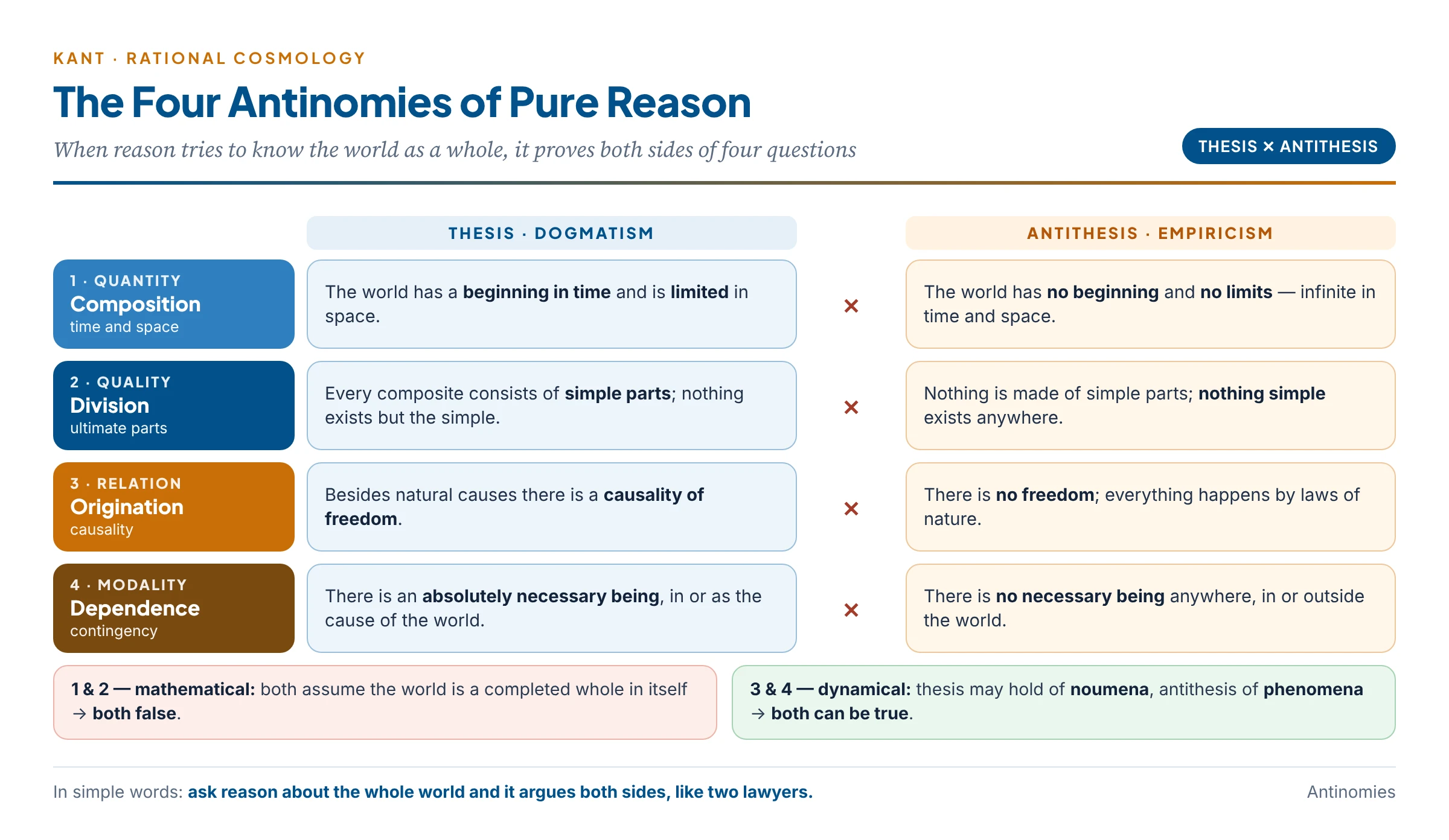
1. The Four Antinomies
| Antinomy (heading) | Problem | Thesis | Antithesis |
|---|---|---|---|
| First (Quantity) | Composition — extent in time and space | The world has a beginning in time and is limited in space | The world has no beginning and no limits in space; it is infinite in both |
| Second (Quality) | Division — ultimate parts | Every composite substance consists of simple parts; nothing exists but the simple or what is composed of it | No composite thing consists of simple parts; there exists nowhere in the world anything simple |
| Third (Relation) | Origination — causality | Causality according to laws of nature is not the only causality; we must also assume a causality of freedom | There is no freedom; everything happens solely according to laws of nature |
| Fourth (Modality) | Dependence — necessity | There belongs to the world, as its part or cause, an absolutely necessary being | There is no absolutely necessary being anywhere, either in the world or outside it as its cause |
2. How the Antinomies Are Constructed
- Indirect proofs. Each side is proved not directly but by refuting the other (reductio ad absurdum): assume the opposite and show it leads to an impossibility. Because each side’s refutation of its rival is convincing, each side seems proved.
- No formal fallacy. There is no logical slip in the arguments themselves; both thesis and antithesis are formally valid and argued “with equal show of reason.” Yet they are opposed and inconsistent — which shows the fault lies in a shared premise.
- The arguments in outline:
First antinomy — beginning and limits:
- Thesis argument. Suppose the world had no beginning. Then up to this present moment an infinite series of states would have elapsed — been completed. But an infinite series can never be completed by successive addition. So the world must have a beginning. (Similarly, an infinite world in space could never be thought as a completed whole, so it must be limited.)
- Antithesis argument. Suppose the world had a beginning. Then before it there was empty time, in which nothing existed. But in empty time no moment differs from any other, so nothing could have a reason to arise at one moment rather than another. So the world has no beginning. (Similarly, a limited world would be bounded by empty space, a relation to nothing — absurd; so the world is unlimited.)
Second antinomy — simple parts:
- Thesis argument. If composite things were not made of simples, then, if we removed all composition in thought, nothing at all would remain. But composition is only a relation; there must be something composed. So composites consist of simple parts.
- Antithesis argument. Every part of a material thing occupies space; space is infinitely divisible; so every part has further parts. Nothing simple exists in the world — and no experience could ever show a simple part.
Third antinomy — freedom and natural causality:
- Thesis argument. If everything happened only by laws of nature, every event would presuppose an earlier cause, without end. Then the series of causes would never be complete, and nothing would happen with a sufficient cause. So we must assume an absolute spontaneity — a causality of freedom that begins a series by itself.
- Antithesis argument. A free cause would begin a series without being determined by any previous state. This breaks the law of causality, destroys the unity of experience and leaves nature lawless. So there is no freedom; everything is determined.
Fourth antinomy — a necessary being:
- Thesis argument. The world contains a series of changes; every change is conditioned by something earlier. The whole series presupposes something unconditioned — an absolutely necessary being — as its part or cause.
- Antithesis argument. A necessary being in the world would contradict the contingency of every member of the series; a necessary being outside the world, as its cause, would have to begin to act in time — and so would belong to the series of appearances after all. So there is no necessary being anywhere.
In simple words
The first antinomy can be tried at home. Ask, “Did time have a beginning?” If yes, ask, “What was happening one minute before it began?” — the question seems absurd, so perhaps time had no beginning. If no, ask, “Then has an endless amount of time already finished passing to bring us to today?” — that also seems absurd. Your mind swings between two answers and can rest in neither. That swinging is what Kant calls an antinomy.
3. The Interests Behind Each Side
- Thesis = dogmatism (the side of Plato): it supports a beginning, simple substances, freedom and a necessary being.
- Practical interest — morality and religion depend on freedom, a simple soul and a first cause.
- Speculative interest — it lets reason grasp the whole chain of conditions and complete its system.
- Popularity — common sense likes a firm starting point.
- Antithesis = empiricism (the side of Epicurus): it supports an endless world, infinite divisibility, no freedom and no necessary being.
- Speculative interest — it keeps the understanding on the solid ground of experience, always seeking further conditions, never resting on a supersensible stopping point.
- But it appears to undermine morality and religion.
- What the antinomies do for us. Though we cannot decide in favour of either side theoretically, the conflict serves functions:
- It guards and furthers the practical interest of man (morality, religion).
- It furthers speculative interest, pushing inquiry on.
- It offers psychological comfort and religious consolation — the thesis is popular and comforting.
- Above all, it shows the limits of knowledge and proves that rational cosmology is impossible.
- The sceptical method. Kant lets the two sides fight in order to find the point of misunderstanding — not to doubt everything (scepticism), but to discover where reason has gone wrong. This is critique, not mere doubt.
4. The Resolution: Transcendental Idealism as the Key
- The shared mistake. Both sides assume that the world as a whole is a thing in itself — a complete totality given independently of our experience, which must be either finite or infinite, either divisible to simples or endlessly divisible.
- Kant’s diagnosis. The world is a system of appearances (phenomena), structured by space, time and the categories. Appearances exist only in the regress of experience — in our going on to further conditions. The totality of appearances is never given as a whole; it is only set as a task (aufgegeben).
- Once this is seen, the contradictions dissolve — but in two different ways.
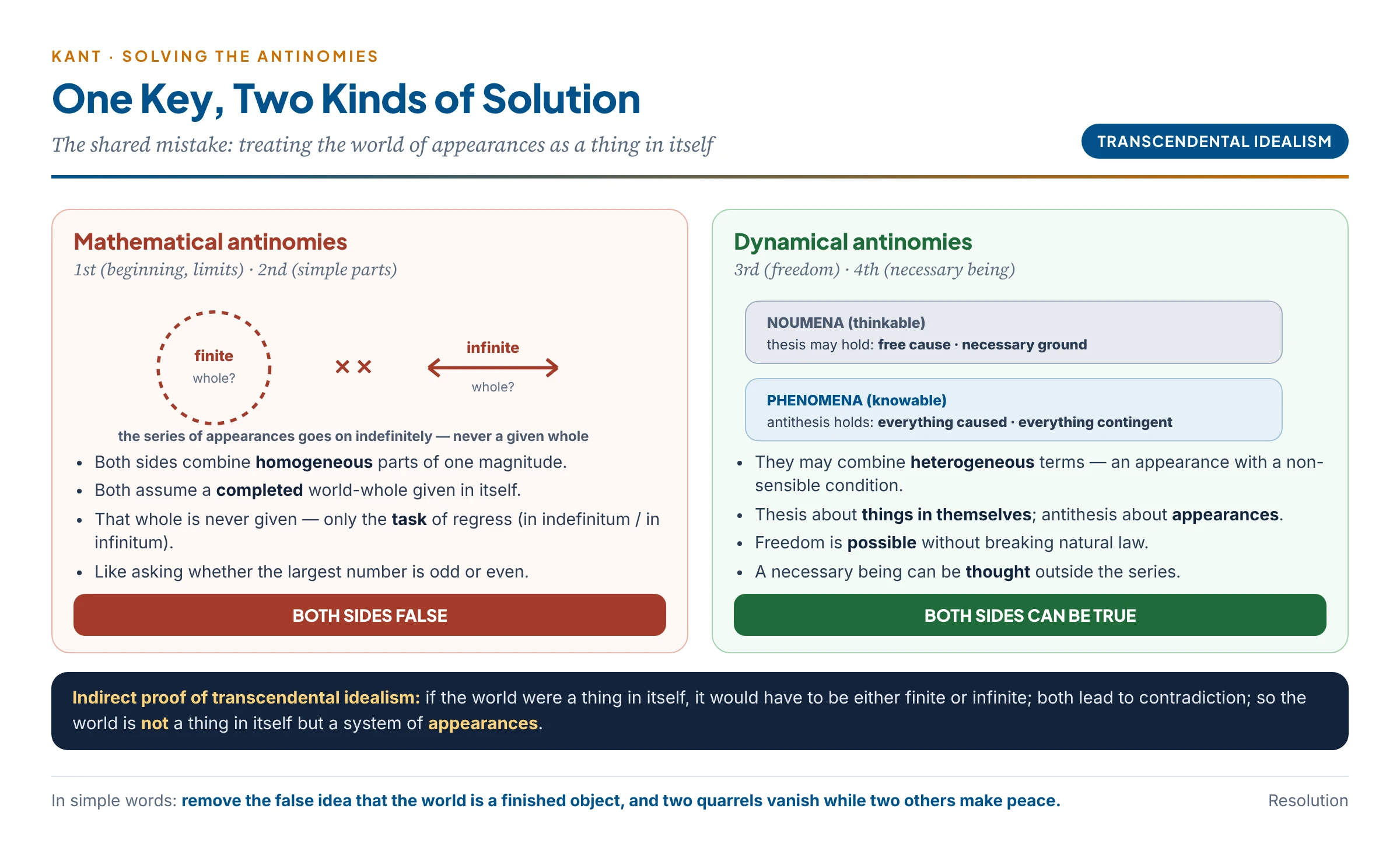
Mathematical antinomies (first and second) — both sides false.
- They deal with magnitude — combining homogeneous things (parts of space, parts of time, parts of matter).
- Thesis and antithesis are like two people arguing whether a square circle is round or square: both presuppose something impossible — a completed whole of appearances — so both are false.
- The world is neither finite nor infinite as a given whole. The regress in time and space goes on indefinitely (in indefinitum): we can never reach a first moment or an outer edge, yet we are never given an actually infinite whole either.
- Matter is neither composed of simples nor given as an actually infinite collection of parts; it is divisible without end (in infinitum) as a task of division, but never given as fully divided.
- Their opposition is only apparent — a “dialectical” opposition, not a real contradiction.
In simple words
Ask: “Is the largest number odd or even?” One person argues it must be odd, another that it must be even — and each can refute the other (“add one and you get a bigger number of the other kind”). Both are wrong, because there is no largest number. Kant says the same of “Is the world finite or infinite?” Both answers assume that the world as a whole is a completed thing that has a size. It is not; it is a series we can always extend. So both answers fall together.
Dynamical antinomies (third and fourth) — both sides can be true.
- They deal with existence and causal dependence, which may combine heterogeneous terms — an appearance with a condition that is not an appearance.
- So the thesis may hold of noumena (things in themselves) and the antithesis of phenomena, without contradiction.
- Third antinomy. Every event in the phenomenal world is causally determined (antithesis true for phenomena). But the same agent may also be considered as a noumenon — a thing in itself, outside time — whose intelligible character can be a free cause of the series of appearances (thesis possibly true for noumena). A human action is determined as an event in nature and may yet be free as the deed of a rational will.
- Fourth antinomy. Within the world, every thing is contingent; there is no necessary being among appearances (antithesis true for phenomena). But there may be a necessary being outside the whole series of appearances, as its intelligible ground (thesis possibly true of the noumenal) — though this can be thought, not known.
- Kant gives each side its due while limiting the domain over which each claim holds.
Common confusion
Does Kant say the antinomies are all solved in the same way? No. A common mistake is to say “Kant shows both sides are true” (or “both are false”) for all four.
- In the mathematical antinomies (first and second), both sides are false — they share the false assumption of a completed world-whole.
- In the dynamical antinomies (third and fourth), both sides may be true — the thesis for noumena, the antithesis for phenomena.
The difference comes from what is being combined: homogeneous parts of one magnitude (mathematical) or heterogeneous conditions of existence (dynamical).
5. The Third Antinomy and Human Freedom
- Why it matters most. The third antinomy is crucial for ethics. If the antithesis were simply true, there would be no moral responsibility: praise, blame and “ought” would have no meaning.
- Two standpoints on one person.
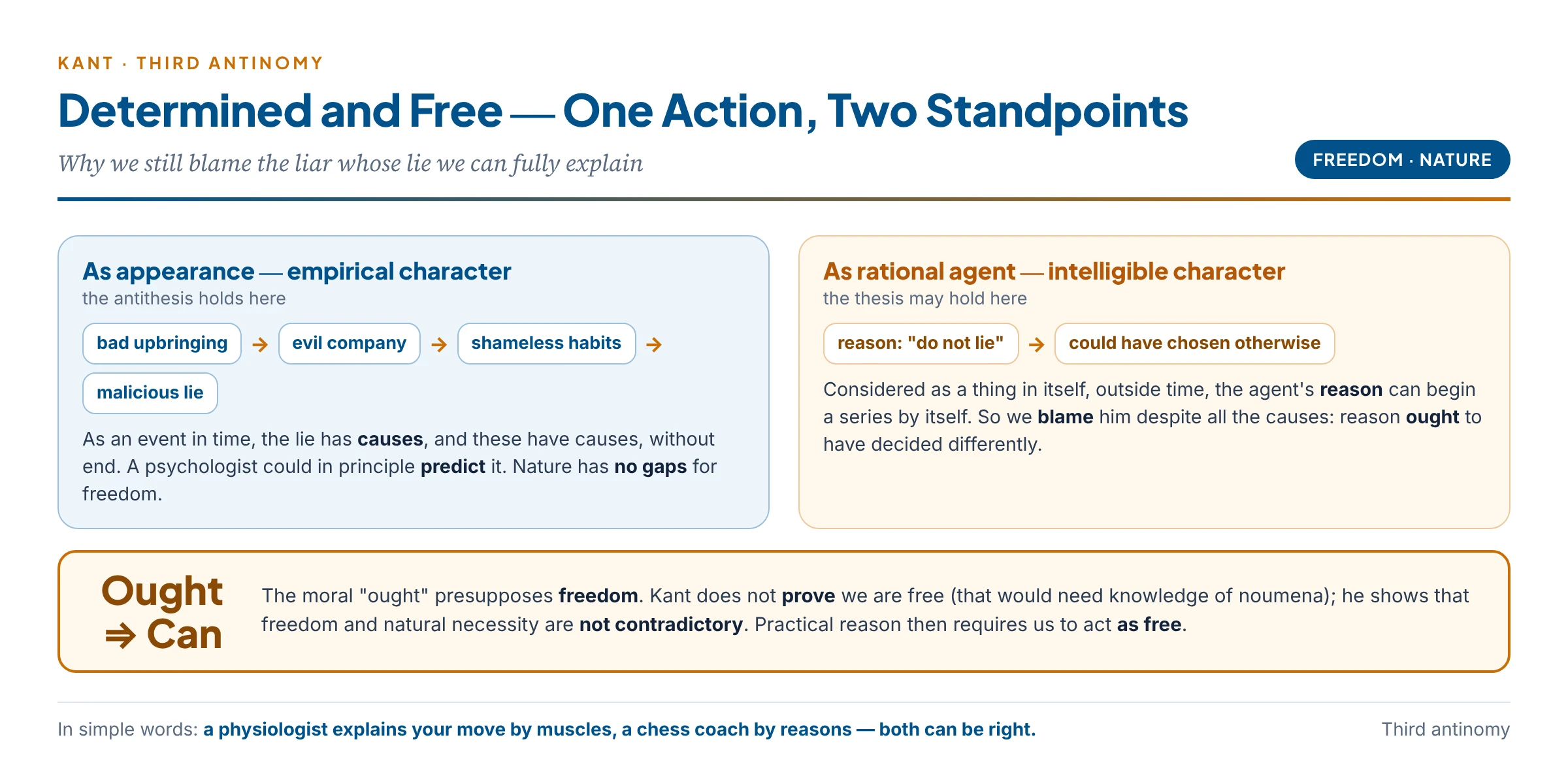
- Empirical character — as an appearance, my action is an event in time, caused by my desires, upbringing and circumstances. A psychologist could in principle predict it.
- Intelligible character — as a rational being, considered as a thing in itself, I am the author of my actions, and reason can begin a series of events by itself.
- The example of the malicious lie. A man tells a malicious lie that causes confusion. We can trace its causes — bad education, evil company, a shameless nature. Yet we still blame him, because we judge that reason could and should have determined his conduct otherwise. “Ought implies can“: the moral “ought” presupposes freedom.
- What the solution achieves. Kant does not prove that we are free (that would require knowledge of noumena). He shows that freedom and natural necessity are not contradictory — freedom is possible. Practical reason then shows that we must regard ourselves as free when we act.
In simple words
Watch a chess player move her bishop. A physiologist can explain the move completely: nerve signals, muscle contractions, the arm’s motion — a chain of causes. A chess coach explains the same move differently: she moved the bishop because it protected her king. The second explanation does not cancel the first; they describe one event from two standpoints. Kant says human actions are like this: fully caused as events in nature, yet open to judgment as free choices of reason.
6. Are the Antinomies a Natural Culmination of the Phenomena–Noumena Distinction?
- In one sense, yes.
- The antinomies arise precisely because reason ignores the distinction — treating appearances as things in themselves.
- They are resolved only through the distinction (mathematical: both false; dynamical: both true of different realms).
- Kant even treats them as an indirect proof of transcendental idealism: if the world were a thing in itself, it would have to be either finite or infinite; both options lead to contradiction; therefore the world is not a thing in itself, but appearance. The antinomies confirm the distinction drawn in the Aesthetic and Analytic.
- In another sense, no.
- The antinomies are not deduced from the distinction; they spring from reason’s own demand for the unconditioned, which is natural and would arise in any rational being.
- Kant presents them as an independent discovery — he said it was the antinomy of pure reason that first woke him from his dogmatic slumber and drove him to the critique of reason, to remove the “scandal” of reason contradicting itself.
- Balanced view. The antinomies are best seen as the point where the phenomena–noumena distinction proves its worth: reason’s self-contradiction is the problem, the distinction is the solution, and the success of the solution is evidence for the distinction.
7. What the Antinomies Teach
- Rational cosmology is impossible. No knowledge of the world as a whole can be had by pure reason.
- Limits of knowledge. Our knowledge is confined to phenomena; questions about the totality of the world have no theoretical answer.
- The regulative use of the cosmological Idea. We should treat the series of conditions as never complete — always searching for a further cause, a smaller part, an earlier state — but never claim to have reached the end. This keeps science open.
- Room for freedom and faith. By showing that freedom and a necessary being are at least thinkable, the antinomies prepare the ground for the postulates of practical reason.
Critical Evaluation
Criticisms
- Hegel — antinomies everywhere. Kant found only four antinomies and treated contradiction as a sign of error. Hegel replies that every concept, thought through, passes into its opposite; contradiction is not a defect of reason but the life of thought and reality — the dialectic. Kant’s “tenderness for things” made him put the contradiction in reason rather than in the world.
- Weak proofs. Critics (beginning with Schopenhauer) argue that some of the proofs are sophistical — especially the thesis of the first antinomy, which assumes that an infinite past cannot have “elapsed.”
- Modern mathematics. The theory of infinite sets (Cantor) shows that actual infinities are coherent; an infinite past series is not obviously impossible. This weakens the thesis arguments.
- Modern cosmology. Big Bang cosmology speaks of a beginning of the observable universe, and physics debates whether space is finite or infinite. Critics say these are empirical questions, not insoluble antinomies.
- Freedom unexplained. The “two standpoints” solution makes freedom possible only by placing it in an unknowable noumenal realm; critics find this an evasion — how can a timeless self act in time?
- Dependence on idealism. The resolution works only if we accept transcendental idealism; a realist can reject the premise and seek other solutions.
Replies and Defences
- Kant’s real target is not the details of each proof but the structure of reason’s demand for completeness, which still produces deep puzzles (the beginning of time, the ultimate constituents of matter, free will and determinism).
- Science has not closed the questions. Physics can describe a hot dense early state, but whether time “began” or what came “before” remains philosophically unresolved — just as Kant predicted.
- Free will debates today still turn on the compatibility of agency with causal determinism; Kant’s two-standpoint view remains a major option.
- Value of method. The sceptical method — letting opposing views fight to find the shared error — is a lasting model of philosophical critique.
Critics and Defenders
Criticism — Critics
- Hegel: contradiction is everywhere and productive; Kant’s four are too few and wrongly placed in reason.
- Schopenhauer and others: some proofs (esp. the first thesis) are sophistical.
- Cantor’s set theory: actual infinity is coherent.
- Modern cosmology: beginning and extent of the universe are empirical questions.
- Compatibilists and naturalists: noumenal freedom is an evasion.
Defence — Defenders and lasting value
- The antinomies expose reason’s drive for completeness that still breeds puzzles.
- The beginning of time and free will remain philosophically unresolved.
- The two-standpoint account of freedom is still a live option in ethics.
- The sceptical method — finding the shared hidden premise — is a model of critique.
- The antinomies give independent support to the limits of knowledge.
Cross-Tradition Comparison
Unanswerable Questions in Buddhism, Mādhyamika and Jainism
| Point | Kant’s antinomies | The Buddha’s unanswered questions (avyākṛta) | Nāgārjuna’s catuṣkoṭi (four-cornered negation) | Jaina syādvāda |
|---|---|---|---|---|
| Questions | Is the world finite or infinite in time and space? Are there simple parts? Is there freedom? Is there a necessary being? | Is the world eternal or not? Finite or infinite? Is the soul the same as the body? Does the Tathāgata exist after death? | Is X existent, non-existent, both, or neither? | Every assertion is true only “in some respect” (syāt) |
| Response | Both sides false (mathematical) or true of different realms (dynamical) | Silence — the questions do not lead to liberation and rest on wrong assumptions | All four alternatives rejected — the concepts lack own-being (śūnyatā) | Opposed predicates hold from different standpoints (naya) |
| Lesson | Reason oversteps experience; knowledge limited to phenomena | Speculative metaphysics is fruitless; the path matters | Conceptual thought cannot grasp ultimate reality | Reality is many-sided (anekānta) |
Indian Connect — Key takeaways
- The Buddha’s avyākṛta questions are almost the same as Kant’s first antinomy — whether the world is eternal or not, finite or infinite. Both thinkers refuse a theoretical answer, though the Buddha’s reason is soteriological (the questions do not lead to liberation) while Kant’s is epistemological (they exceed possible experience).
- Nāgārjuna’s dialectic resembles Kant’s mathematical solution: every alternative fails because the concept under discussion has no fixed, independent nature — as for Kant the world-whole is not a given thing.
- Jaina syādvāda resembles Kant’s dynamical solution: opposed claims can both be true when each is limited to its own standpoint — as Kant limits freedom to noumena and necessity to phenomena.
Synthesis (Siddhānta)
The antinomies are the moment where reason, trying to know the world as a whole, contradicts itself. Following the four headings of the categories, it proves with equal force that the world has and has not a beginning and limits, that it does and does not consist of simple parts, that there is and is not freedom, and that there is and is not a necessary being. The proofs are indirect, each refuting the other; there is no slip in logic, so the fault must lie in a shared assumption — that the world of appearances is a thing in itself, given as a completed whole. Transcendental idealism removes the assumption. In the mathematical antinomies both sides fall, because the world-whole is never given; in the dynamical antinomies both sides can stand, because the thesis can hold of noumena and the antithesis of phenomena. The result is an indirect proof of transcendental idealism, the impossibility of rational cosmology, and — most importantly — the possibility of freedom alongside natural necessity.
Hegel turned Kant’s four contradictions into the universal dialectic; mathematics and cosmology have reshaped the first two conflicts. Yet the questions Kant set out — whether time began, what matter is ultimately made of, whether we are free in a law-governed world — remain at the frontier of thought, and his lesson stands: when reason contradicts itself, look for the hidden premise both sides share.
- Cosmology: debates about the beginning of the universe and the infinite still echo the first antinomy.
- Physics of matter: the search for ultimate particles meets Kant’s question of infinite divisibility.
- Free will: the compatibility of responsibility with neuroscience and determinism is the third antinomy in modern dress.
- Indian thought: the Buddha’s silence and the Jaina many-sided view offer illuminating parallels.
When reason proves both yes and no, the fault lies not in the proofs but in the question both proofs take for granted.
Previous Year Questions
- 2022How does Kant construct antinomies to illustrate the illusory tendencies of pure reason? Explain and examine the antinomies presented by Kant.
- 2020When does Pure Reason enter into the realm of Antinomies according to Kant? Is Kant’s notion of Antinomies of Pure Reason a natural culmination of his distinction between Phenomena and Noumena? Give reasons in favour of your answer.
- 2013What is an antinomy? Describe the major antinomies discussed by Kant.