

Kant: Possibility of Synthetic a priori Judgments; Space and Time; Categories; Ideas of Reason; Antinomies; Critique of Proofs for the Existence of God.
Official Syllabus: Paper I, Section A, Unit 4
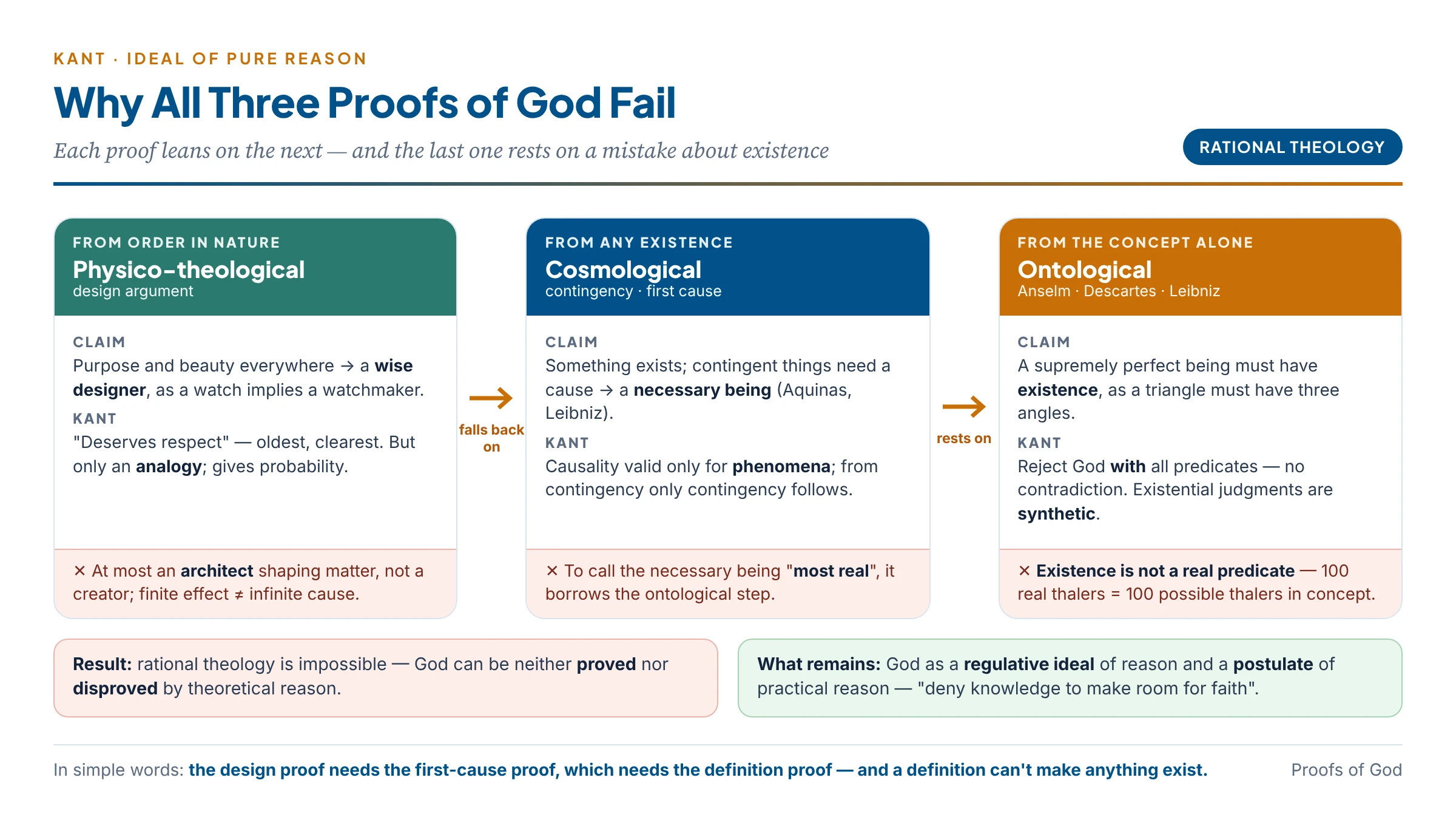
The last part of Kant’s Transcendental Dialectic examines rational theology — the attempt to prove the existence of God by pure reason. Reason forms the Idea of a most real being (ens realissimum) that contains all reality and is the ground of everything possible. Kant shows that there are only three possible theoretical proofs of such a being — the ontological (from the mere concept), the cosmological (from the existence of any world at all) and the physico-theological or design argument (from the order of nature) — and that all three fail. The ontological proof fails because “existence is not a real predicate“; the other two fail because they extend causality beyond experience and finally depend on the ontological proof. Yet Kant is no atheist. Theoretical reason can neither prove nor disprove God. In the Critique of Practical Reason he restores God — together with freedom and immortality — as a postulate of practical reason, required by the moral demand for the highest good, where virtue and happiness are united. “I had to deny knowledge in order to make room for faith.”
In simple words
Suppose you draw a detailed plan of a house — rooms, doors, windows, a garden. The plan can be perfect in every detail, but no amount of improving the drawing will make a house stand on the land. Whether the house exists is decided by going to the plot and looking, not by examining the plan. The ontological argument tries to build God’s existence out of the plan — the concept of a perfect being. Kant replies: existence is not one more line on the drawing; it is the question of whether anything corresponds to the drawing at all.
Context & Problem
The Ideal of Pure Reason
- From Idea to Ideal. An Idea of reason is a concept of the unconditioned; an Ideal is an Idea thought as a single individual thing. Reason, seeking the complete determination of everything possible, forms the Ideal of a being that contains the sum of all reality — the most real being (ens realissimum), the original being, the being of all beings.
- Hypostatised and personified. Reason first treats this Ideal as a real object (hypostasis), then as a personal being with understanding and will — the God of theology.
- The error. The Ideal is useful as a regulative principle — it guides the understanding towards systematic unity. The error arises when it is used constitutively, as a claim to know that such a being exists.
- Why the question matters. God was the keystone of rationalist metaphysics (Descartes used God to guarantee knowledge of the world; Leibniz used God to explain pre-established harmony). If God cannot be proved, the whole edifice of dogmatic metaphysics loses its support.
Only Three Possible Proofs
Kant argues that speculative reason has only three paths to God:
- Physico-theological proof — starts from determinate experience: the order, purpose and beauty of the world → a wise designer.
- Cosmological proof — starts from indeterminate experience: the bare fact that something exists (a contingent world) → a necessary being.
- Ontological proof — abstracts from all experience and argues a priori from the concept of a supremely perfect being → its existence.
- Kant examines them in reverse order, because the design argument leads to the cosmological, and the cosmological rests on the ontological: if the ontological proof fails, the others fall with it.
Core Doctrine
1. The Ontological Argument and Kant’s Refutation
The argument in its classical forms:
- Anselm — God is “that than which nothing greater can be conceived.” Even the fool who denies God has this concept in his mind. But a being that exists in reality as well as in the mind is greater than one that exists only in the mind. So if God existed only in the mind, a greater being could be conceived — a contradiction. Therefore God exists in reality.
- Descartes — God is the supremely perfect being. Existence is a perfection. So existence belongs to the essence of God as necessarily as the property that its three angles equal two right angles belongs to a triangle, or as a valley belongs to a mountain. A God who lacked existence would be a supremely perfect being lacking a perfection — a contradiction.
- Leibniz — adds that we must first show that the concept of a most perfect being is possible (free of contradiction); since perfections are simple positive qualities, they cannot conflict, so the being is possible — and therefore actual.
- “Ontological” — from ontos, being: the argument derives existence from the very essence or idea of God, as the three sides of a triangle follow from the idea of a triangle.
Kant’s objections:
- Necessity of a judgment is not necessity of a thing.
- “A triangle has three angles” is necessary — if a triangle is posited. But if I reject the triangle together with its three angles, there is no contradiction.
- Similarly, “God is omnipotent” is necessary if God is posited. But if I say “There is no God,” I reject the subject with all its predicates — and no contradiction arises, for nothing is left to contradict.
- The trouble arises only when we accept the subject (God) and deny one of its predicates (existence), and compare this with the triangle. If we reject subject and predicate together, there is no problem.
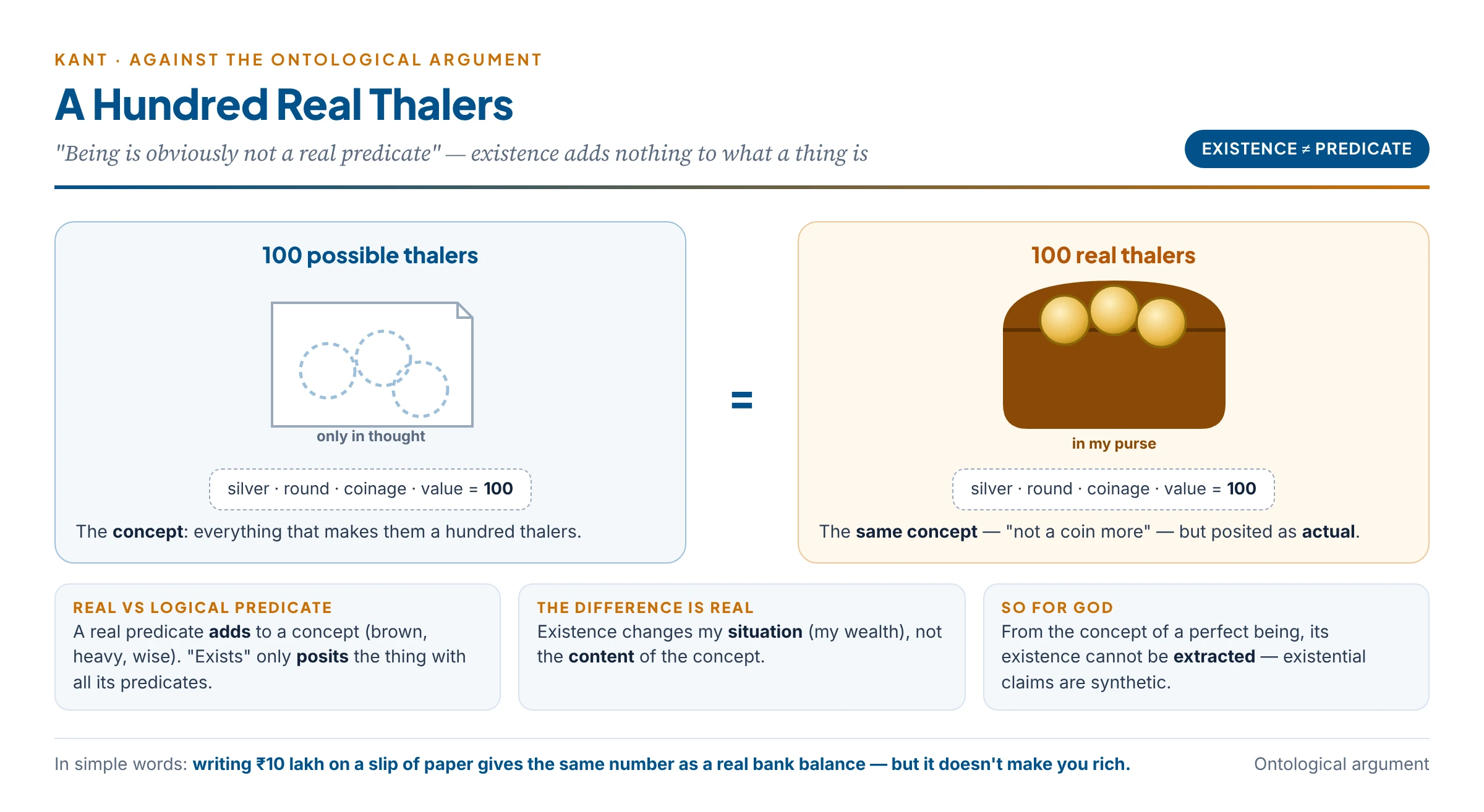
- Existence is not a real predicate.
- A logical predicate can be anything that can stand in the predicate place of a sentence — even “exists.”
- A real predicate (a “determination”) is a concept that adds something to the concept of a subject and enlarges it — “brown,” “heavy,” “wise.”
- “Being” is obviously not a real predicate. In “God is omnipotent,” the little word “is” adds no new predicate; it only posits the predicate in relation to the subject (the copula). In “God is” or “There is a God,” I add no new predicate to the concept of God; I posit the subject itself, with all its predicates, as an object that corresponds to my concept.
- Existence is not a quality like colour or taste, but the positing of a thing with all its qualities — a precondition for having any characteristics in the actual world.
- The hundred thalers. “A hundred real thalers do not contain the least coin more than a hundred possible thalers.” The concept is exactly the same in both cases — otherwise my concept would not express the whole object, and the thing that existed would not be the one I thought of. But my financial position is very different: the real thalers are in my pocket. Existence makes a difference to my situation, not to the content of the concept.
- All existential propositions are synthetic.
- If “God exists” were analytic, the predicate “existence” would already be contained in the subject; then either we have assumed existence in the concept (and the proof is a tautology — begging the question, petitio principii), or we have learnt nothing.
- If it is synthetic, then its denial involves no contradiction — and the argument collapses.
- Every reasonable person must admit that existential propositions are synthetic. So the ontological argument wrongly treats existence as analytic.
- Existence is known only through experience. For objects of the senses, existence is known by connection with perception according to empirical laws. For objects of pure thought, there is no means of knowing existence at all. God, being beyond all possible experience, can never be shown to exist by the theoretical use of reason.
- Concept ≠ reality. “One cannot define something into existence.” Mere thought of a thing cannot bring it into existence — “if thoughts were things, beggars would ride horses”; if we could think things into existence, all of us would be kings. The concept of God remains a concept, however hard we think about it.
“A man might as well expect to become richer in knowledge by mere ideas as a merchant to better his position by adding a few noughts to his cash account.” — Kant
In simple words
Write “₹10,00,000” on a slip of paper and put it in your wallet. The number on the slip is exactly the same as the number on a real bank balance of ten lakh rupees — not one rupee less. Yet you are not richer. The difference between the slip and the money is not in the number but in whether real money corresponds to it. Kant says existence is like that: it is not part of what a thing is (its concept) but the fact that something real answers to the concept.
2. Kant’s Criticism of the Cartesian Formulation
- Descartes’ version treats existence as a perfection and compares God with the triangle and the mountain–valley.
- Kant’s replies to each element:
- Existence is not a perfection, because it is not a real predicate at all; it adds nothing to the concept of a perfect being. So the premise “existence is a perfection” is false.
- The triangle comparison misleads. The geometer’s necessity is conditional: if there is a triangle, it has three angles. Descartes’ argument at most shows: if a supremely perfect being exists, it exists necessarily — not that it does exist.
- Mountain and valley. Descartes himself saw that from “no mountain without a valley” it follows only that mountain and valley go together if there are any — not that any mountain exists. Kant presses the point: the same holds of God and existence.
- Begging the question. If “existence” has been put into the concept of God, the conclusion merely takes it out again — a tautology, not a proof.
- Clear and distinct ideas do not reach existence. However clear the idea of God may be, existence requires a synthetic connection with something given — which pure thought cannot supply.
Common confusion
Did Kant claim to prove that God does not exist? No. Kant refutes the proofs, not God. His point is that theoretical reason cannot decide the question either way: the arguments of the atheist, who claims to know there is no God, are just as dogmatic as those of the rational theologian. God remains a possible object of thought — a “flawless ideal” — whose existence can be neither proved nor disproved, and which practical reason later has good grounds to accept by faith.
3. The Cosmological Argument and Kant’s Refutation
The argument:
- “If anything exists, an absolutely necessary being must also exist. Now I myself, at least, exist. Therefore an absolutely necessary being exists.”
- The minor premise is from experience (something exists); the major premise infers from the contingent to the necessary.
- Aquinas gave classical forms — from motion (first mover), from efficient causes (first cause) and from contingency. Leibniz grounded it in the principle of sufficient reason: the series of contingent things needs a sufficient reason outside the series, which can only be a necessary being.
Aquinas’ argument from the contingency of the world (the “third way”):
- We find in nature things that are possible to be and not to be — they come into being and pass away (contingent things).
- What can not-be, at some time is not. If everything were contingent, then at some time nothing would have existed.
- But if at one time nothing existed, nothing could have begun to exist (nothing comes from nothing), and even now nothing would exist — which is plainly false.
- So not everything is contingent; there must be something necessary.
- Every necessary thing either has its necessity from another or from itself. An infinite regress of necessary things caused by others is impossible.
- Therefore there must be a being necessary in itself, which gives necessity to others — and “this all men call God.”
In simple words
Picture a long goods train: each wagon is pulled by the wagon in front of it. However many wagons you add — a hundred, a million — none of them can move unless there is an engine that pulls without being pulled. That is the cosmological argument’s picture: contingent things are wagons, God is the engine. Kant’s reply: every coupling we can ever inspect connects wagon to wagon. The “engine” lies beyond anything we can observe, and the rule “every wagon is pulled by something” was learnt from wagons — we have no right to use it to prove a quite different kind of thing outside the train.
Kant’s objections:
- Illicit transition from experience to transcendence. The argument begins with experience (contingency) but ends with a being beyond all possible experience. The principle of causality — “everything contingent has a cause” — is valid only within the sensible world (phenomena); it has no meaning beyond it.
- From contingency only contingency follows. Within experience, a contingent thing points only to another contingent cause; we can never reach the opposite — a necessary being — by following causes.
- The infinite series. The argument rejects an infinite series of causes as impossible. But while we cannot complete such a series in experience, it does not follow that the series must end in a first cause outside the world.
- The “nest of dialectical presumptions.” Kant lists the hidden steps:
- Inferring from the contingent to a cause outside the sensible world.
- Inferring from the impossibility of completing an infinite series of causes to an actual first cause.
- Reason’s false self-satisfaction in thinking it has completed the series by simply dropping all conditions.
- Confusing the logical possibility of a concept (that it is not self-contradictory) with the real possibility of a thing.
- Hidden dependence on the ontological argument. Experience can take us at most to “some necessary being.” To say what this being is, the argument asks: which concept is that of a being whose existence is necessary? Only the concept of the most real being (ens realissimum). So it concludes: “the necessary being is the most real being.” But if that is true, then “the most real being is a necessary being” — i.e. its essence implies its existence — which is exactly the ontological argument, already refuted. The cosmological proof “borrows the very step it claimed to avoid.”
- Only one feature of the world. It attends to just one feature — contingency — and even that is not seriously examined if the sole aim is to reach a necessary being.
- “Necessary being” is problematic. Necessity properly belongs to propositions (truths of logic and definition), not to things. Of any existing thing we can always imagine it not existing. “If God is necessary, He is not a being; if He is a being, He is not necessary” — some later critics even call “necessary being” as self-contradictory as a square circle.
“Unconditioned necessity, which we so indispensably require as the last bearer of all things, is for human reason the veritable abyss.” — Kant
- The abyss of necessity. We cannot avoid thinking of a being that says to itself, “I am from eternity to eternity; outside me there is nothing except what is through my will” — and then asking, “But whence then am I?” Here everything gives way beneath us.
4. The Physico-theological (Teleological) Argument and Kant’s Refutation
The argument:
- The world shows everywhere order, purpose, variety and beauty, down to its smallest parts.
- This purposive order is foreign to the things themselves; it must have been imposed by an intelligent cause.
- So there exists a sublime and wise cause of the world — working through freedom and intelligence.
- Analogy: as a watch implies a watchmaker, a pot a potter, so the world implies a world-maker.
Kant’s respect. “This proof always deserves to be mentioned with respect. It is the oldest, the clearest, and the most in conformity with the common reason of mankind.” It strengthens belief and directs inquiry; Kant does not wish to belittle it — only to deny that it is a demonstration.
Kant’s objections:
- Merely analogical. It rests on the analogy of human art (mechanic and machine, potter and pot). It has no force of demonstration; it yields probability, not certainty.
- At most an architect, not a creator. It can show at most a world-architect who shapes pre-existing material, not a creator who produces matter itself. An architect presupposes the reality of matter — so God would be limited by it, whereas God must be infinite and create matter out of himself.
- Proportion. A cause can be inferred only as proportionate to its effect. The world is great, but we can never infer from it an infinite, all-perfect being — only a very powerful and wise one.
- It needs the other proofs. To reach an absolutely necessary, all-sufficient being, it must leap from the empirical to the cosmological argument, and thence to the ontological. “The physico-theological proof rests on the cosmological, and the cosmological on the ontological.”
Further objections often added (largely from Hume):
- Disorder and evil — the world is full of blemishes, ugliness and suffering; the argument emphasises harmony one-sidedly.
- Chance order — the order of the world may have arisen by permutations and combinations of elements over endless time, without external machinery.
- Many designers — great works are usually made by many hands; the argument cannot show there is only one designer.
- Anthropomorphism — it models the whole of reality on human needs and purposes; and mechanism sits uneasily with the freedom and spiritual creativity valued in religion.
Common confusion
Did Kant reject the design argument mainly because the world contains evil and disorder? No. That objection belongs mostly to Hume (and to the problem of evil). Kant’s own objections are more structural: the argument is only an analogy, reaches at most an architect rather than a creator, cannot infer an infinite cause from a finite world, and must finally fall back on the cosmological and ontological proofs. Kant treats the design argument with respect as the most natural to human reason — it simply is not a proof.
5. Kant’s Overall Conclusions on Rational Theology
- All speculative proofs of God fail — ontological, cosmological and physico-theological all exceed the legitimate limits of pure reason.
- Existence cannot be established by concepts alone — no logical or analytic reasoning yields existential claims.
- The categories are limited to experience — causality, necessity and substance apply only to phenomena, not to a transcendent being.
- God is not an object of knowledge but an Idea of reason — a regulative ideal that guides the search for systematic unity, not a constitutive object of cognition.
- Rational theology (dogmatic metaphysics) is impossible.
- But God cannot be disproved either. The atheist and deist are just as dogmatic as the theologian. God remains a “flawless ideal,” which “concludes and crowns the whole of human knowledge.”
- Denial of knowledge is not denial of faith. By limiting knowledge, Kant protects rational faith from dogmatic metaphysics — and from dogmatic unbelief. “It is necessary to believe in God, but not so necessary to prove him.”
6. The Moral Argument: God as a Postulate of Practical Reason
- The primacy of practical reason. Pure (theoretical) reason can establish knowledge of phenomena alone. Practical reason — reason as it determines the will — deals with what ought to be and reaches into the noumenal. Where the two meet, practical reason has primacy.
- Morality as a fact. The moral law — the categorical imperative, “act only on that maxim which you can at the same time will to be a universal law” — is given to us as a fact of reason. If morality must be accepted, all the conditions that make it possible must be granted as valid.
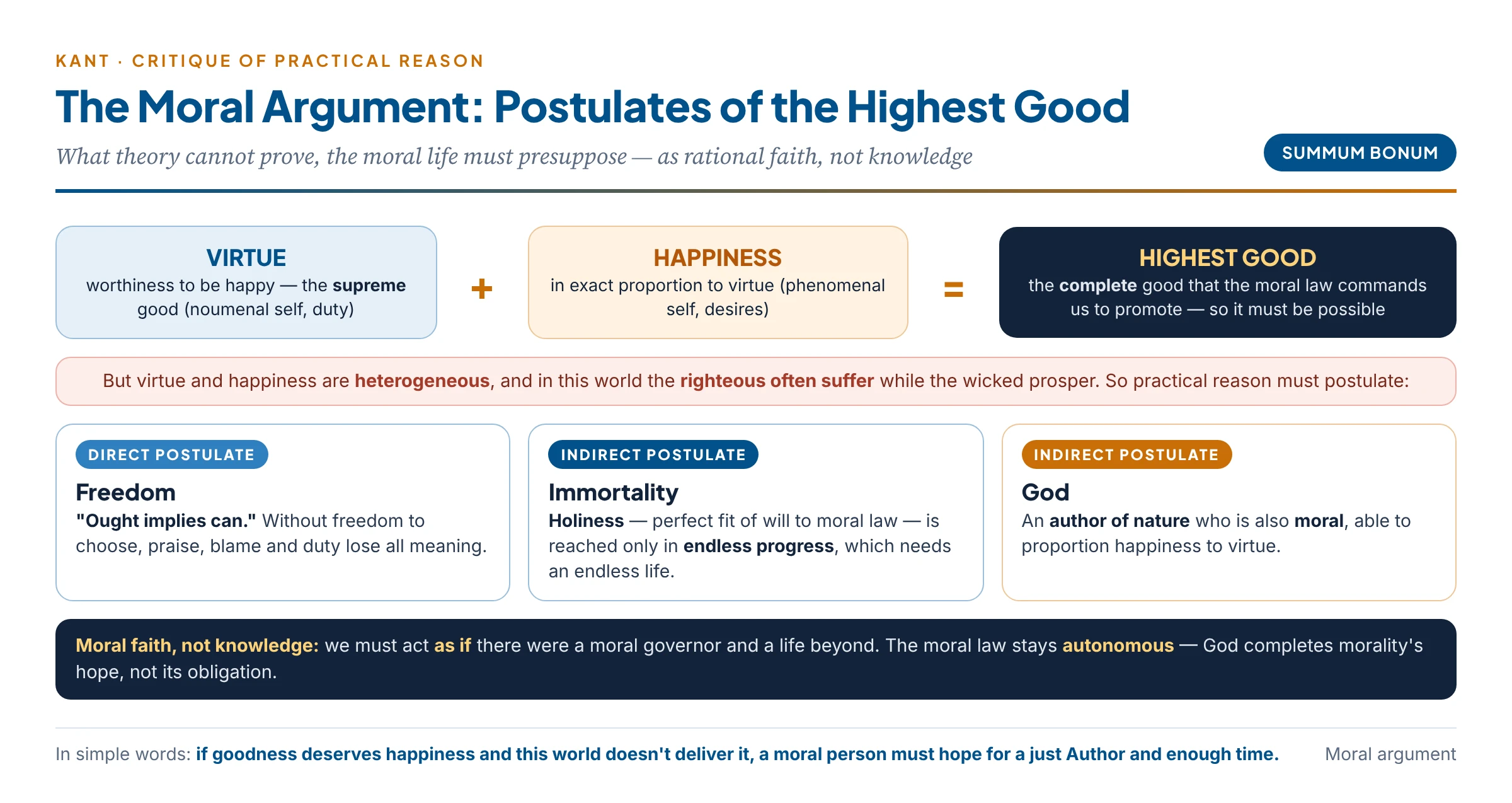
- The highest good (summum bonum).
- Virtue — worthiness to be happy — is the supreme good (bonum supremum): unconditioned, never to be traded for anything.
- But the complete good (bonum consummatum) is virtue crowned with happiness in exact proportion to it.
- Practical reason commands us to promote the highest good; what we are commanded to promote must be possible.
- Why happiness and virtue need a third thing.
- Virtue and happiness are heterogeneous: virtue belongs to the noumenal self (a will acting from duty), happiness to the phenomenal self (satisfaction of desires). They cannot be connected analytically (as Stoics and Epicureans tried).
- A synthetic connection would require one to be the cause of the other. But in actual life the virtuous are not rewarded — the righteous often suffer while the wicked flourish. Nature does not proportion happiness to virtue.
- It is a moral demand that the just must not remain in misery. So we must postulate “a being distinct from nature, which is at the same time its cause and which contains the ground of the exact agreement of happiness with morality” — an author of both our phenomenal and noumenal nature: God.
- The three postulates:
- Freedom of the will — the most important and direct postulate. The categorical “ought” implies that we can choose between courses of action; if we were not free, every act would be determined, there would be no room for praise or blame, and “ought” would have no meaning.
- Immortality of the soul — the moral law commands holiness (perfect conformity of the will to the moral law), which no finite being achieves in any moment of its existence. It can be reached only in an endless progress, which presupposes the endless existence of the same rational being — an infinite series of life in which the senses are completely overcome. Immortality is “an inseparable corollary of an a priori unconditionally valid practical law.”
- Existence of God — the guarantor of the proportion of happiness to virtue in the highest good.
- Direct and indirect postulates. Freedom is a direct postulate of morality; immortality and God are indirect postulates, because the moral law is autonomous — it does not depend on them for its authority, only for the possibility of its final object.
- Moral faith, not knowledge. The existence of a moral governor is a moral necessity, not an objective fact known by theory. It is a rational faith (Vernunftglaube): we must act as if there were a moral governor who will unite virtue with happiness, and as if there were a life beyond. Kant’s moral argument does not “prove” God in the theoretical sense but posits God as necessary for a coherent, rational moral life.
- “Kant’s version of the law of karma.” The demand that happiness be proportioned to virtue — and that moral striving continue beyond one life — is often compared to the Indian law of karma.
- Later formulation. Some later thinkers (C. S. Lewis, W. L. Craig) gave the moral argument a different form: objective moral values require a transcendent foundation. Kant’s version is different: God is required not as the source of moral law but as the condition of the highest good.
In simple words
Imagine a school where the best-behaved, hardest-working students regularly get the lowest marks, and cheats get the highest. You would feel that something is badly wrong — that the system ought to reward merit. If you are sure that it ought to, you must also believe that there is some examiner who will set it right in the end. Kant’s moral argument has this shape: we are certain that goodness deserves happiness; this world does not deliver it; so a moral person must hope for — and rationally believe in — a just Author of the world and a life long enough for the account to be settled.
7. Religion and Morality: Moral Autonomy vs Religion as the Source of Morality
- Kant’s inversion. Traditional theology based morality on religion — right is what God commands. Kant reverses the order: morality does not depend on religion; religion depends on morality.
- Morality is autonomous. The moral law is given by reason itself — the will is a law-giver to itself (autonomy). A moral act must be done for the sake of duty.
- Heteronomy. If I act morally because God commands it, or to win heavenly reward and avoid punishment, my will is determined by something outside reason — this is heteronomy, and the action loses moral worth (it becomes a hypothetical imperative: “if you want heaven, do this”).
- Yet morality leads to religion. Through the idea of the highest good, morality inevitably leads to religion: religion is “the recognition of all our duties as divine commands” — not as sanctions that make them duties, but as laws of a free will that are also the will of a holy God.
- How autonomy conflicts with religion as a source of morality.
- Divine command theory says actions are right because God commands them. Then morality is arbitrary (God could have commanded cruelty) — or, if God commands them because they are right, rightness is independent of God. This is the Euthyphro dilemma (Plato): “Is the pious loved by the gods because it is pious, or pious because it is loved?”
- Fear and reward corrupt moral motive into prudence.
- Conflict cases. If a voice claiming to be God commanded something clearly immoral — as in the story of Abraham commanded to sacrifice his son Isaac — Kant says one should doubt that the command comes from God, for we can be more certain that killing an innocent son is wrong than that a voice is divine. Kierkegaard later answered with the “teleological suspension of the ethical” — faith may rise above universal morality — which shows the sharpness of the conflict.
- Plural religions give conflicting commands; autonomous reason offers a universal standard by which religious commands themselves can be judged.
- Kant’s resolution. No genuine conflict arises if religion is understood within the bounds of reason: God is the moral ideal and guarantor of the highest good, not the external author of duties. Moral autonomy is the test of true religion.
- Are God and religion necessary presuppositions of morality?
- For the foundation of morality — no. Duty binds by reason alone; an atheist can know and do his duty (Kant’s own example of the righteous man, such as Spinoza, who is convinced there is no God).
- For the completion of morality — yes, in a sense. Without God and immortality, the highest good would be impossible and moral effort might seem futile; such a person may fall into despair or give up the final end. So God is a presupposition of morality’s hope, not of its obligation.
- Grounds for an atheist’s morality. Reason (the categorical imperative), human dignity (treat humanity always as an end, never merely as a means), sympathy, social contract and humanist ideals — all available without belief in God.
8. Criticisms of the Moral Argument
- It does not prove God. It shows at most that belief in God is useful or required for a certain hope — not that God exists. A need is not evidence.
- Wishful thinking. The demand that virtue be rewarded may be only a wish; Freud would call it wish-fulfilment.
- Smuggling in happiness. Kant insists that duty must be done for its own sake, yet the highest good brings happiness back as a reward — critics (e.g. Schopenhauer) see a return of eudaemonism.
- Morality as cultural conditioning. Some argue that moral commands are products of society and culture, not signs of a rational or divine order.
- Which values? There is deep disagreement about what moral values a God would endorse.
- Morality without God. Jains and Buddhists follow strict ethical codes (non-violence, compassion) without a creator God; secular ethics shows morality can exist without divine reward.
- The Euthyphro problem remains for any attempt to make God the ground of morality.
- Empirical premise. The claim that the good are more miserable than the wicked is an empirical generalisation, and Kant’s assumption that the universe must be rational (proportioning happiness to virtue) “later became a bone of contention.”
- Psychological booster. Critics say Kant’s God becomes a psychological booster and moral governor rather than the living God of religion.
Critical Evaluation
Responses to Kant’s Critique of the Proofs
- Frege and Russell gave “existence is not a predicate” a logical form: “exists” is not a first-order property of things but a quantifier (“there is at least one x such that…”). So “God exists” is not of the form “God is F” and cannot be true by definition. Russell’s theory of descriptions (“The present king of France is bald”) shows how sentences can be meaningful without their subject existing.
- Gaunilo (Anselm’s contemporary) had already parodied the argument: by the same reasoning, the most perfect island must exist. Anselm replied that only a necessary being has existence in its concept.
- Aquinas objected that we do not know God’s essence, so we cannot argue from it.
- Hegel defended the ontological argument: the hundred thalers are a finite thing whose concept and existence are separable, but God is precisely the being whose concept includes being; to treat God like a hundred thalers is a category mistake.
- Modal versions (Malcolm, Plantinga): necessary existence, unlike mere existence, is a perfection; if a maximally great being is possible, it exists in every possible world. Critics reply that these escape Kant only by assuming the possibility in question.
- Cosmological replies. Defenders argue that the cosmological argument needs only that a necessary being exists, not that we know its full essence — so it need not collapse into the ontological; and some modern versions (Kalam: whatever begins to exist has a cause; the universe began) use scientific cosmology.
- Design replies. Darwin’s theory of natural selection removed much of the force of biological design arguments; fine-tuning arguments have revived the debate at the level of physical constants.
Critics and Defenders
Criticism — Critics of Kant’s position
- Hegel: God is the unity of concept and being; the thalers analogy does not apply to God.
- Modal ontologists (Malcolm, Plantinga): necessary existence is a perfection.
- Cosmological defenders: the argument need not borrow from the ontological proof.
- Critics of the moral argument: a moral need is not a proof; happiness re-enters ethics as a reward.
- Kierkegaard: faith may suspend universal morality — autonomy is not the last word.
Defence — Defenders and lasting value
- Frege and Russell: existence is a quantifier, not a property — Kant was right.
- Most philosophers accept that no a priori proof of God’s existence succeeds.
- Kant ended dogmatic theology without falling into dogmatic atheism.
- Moral autonomy became the basis of modern ethics and human rights.
- Kant’s move from proof to practical faith shaped modern liberal theology and religious ethics.
Cross-Tradition Comparison
Proofs of God and Morality in Indian Philosophy
| Point | Kant | Nyāya | Mīmāṃsā, Jaina, Buddhist critics | Śaṅkara (Advaita) |
|---|---|---|---|---|
| Can reason prove God? | No theoretical proof; God a postulate of practical reason | Yes — Udayana’s proofs: from effects (kāryāt), from the combination of atoms (āyojanāt), from the support of the world (dhṛti), from the Veda’s authority, etc. | No — Kumārila, Jainas and Buddhists reject inferences to a creator (the world need not be an effect; a maker need not be one, eternal or omniscient) | No — Brahman cannot be established by reasoning (tarka-apratiṣṭhānāt, reasoning has no firm footing); known only through śruti and realisation |
| Kind of argument nearest to | — | Kant’s cosmological and design proofs | Kant’s and Hume’s criticisms | Kant’s limit of theoretical reason |
| God and moral order | God guarantees happiness proportioned to virtue (summum bonum) | Īśvara dispenses the fruits of karma (adṛṣṭa), which is unconscious and needs an intelligent guide | Mīmāṃsā: apūrva (unseen potency) produces results without God; Jainas and Buddhists: karma works by itself | Īśvara as karma-phala-dātā at the empirical level |
| Source of moral law | Autonomous reason | Veda (authored by Īśvara) | Mīmāṃsā: eternal, authorless Veda (dharma known by injunction); Buddhists/Jainas: insight and discipline | Dharma from śruti; ethics preparatory to knowledge |
Indian Connect — Key takeaways
- Nyāya’s proofs for Īśvara — especially kāryāt (“the world is an effect, so it has an intelligent maker”) — face the same objections Kant raised against the cosmological and design arguments: causality is extended beyond experience, and an inferred maker need not be one, eternal or omniscient.
- The Nyāya argument that karma needs Īśvara to dispense its fruits is strikingly close to Kant’s moral argument: both hold that moral desert and happiness are joined only through an intelligent ground. Mīmāṃsā’s apūrva shows the alternative — a moral order that works without God.
- Śaṅkara, like Kant, denies that reason can prove the ultimate; but where Kant turns to practical faith, Śaṅkara turns to śruti and direct realisation (anubhava).
- Jaina and Buddhist ethics — rigorous morality without a creator — illustrate Kant’s claim that moral obligation does not depend on God.
Synthesis (Siddhānta)
Kant’s critique of rational theology is the last and most famous blow against dogmatic metaphysics. Reason forms the Ideal of a most real being, and tries to prove its existence in three ways. The ontological proof fails because existence is not a real predicate — a hundred real thalers contain no more in their concept than a hundred possible ones; existential judgments are synthetic, and rejecting God with all his predicates involves no contradiction. The cosmological proof — including Aquinas’ argument from contingency — fails because it extends causality beyond experience, cannot reach a necessary being from contingent things, and finally identifies the necessary being with the most real being, smuggling in the ontological proof. The physico-theological proof, worthy of respect, yields only a probable architect, not a necessary creator, and in the end leans on the other two. Rational theology is therefore impossible — but so is dogmatic atheism.
What theoretical reason cannot know, practical reason may believe. The moral law commands the highest good; since nature does not join virtue and happiness, a moral agent must postulate freedom, immortality and God — objects of rational faith, not of knowledge. Kant thereby reverses the old order: morality is autonomous and does not rest on religion; rather, religion rests on morality. Later logic vindicated “existence is not a predicate,” and modern ethics adopted autonomy; critics still ask whether a moral need can justify belief, and whether Kant’s God is more than a moral postulate. But the settlement he proposed — limit knowledge to make room for faith, and judge religion by the moral law — has shaped philosophy of religion ever since.
- Philosophy of religion: debates on proofs of God still start from Kant’s three categories and his objections.
- Ethics and law: moral autonomy and human dignity underpin secular constitutions and human-rights thinking.
- Interfaith ethics: judging religious commands by universal moral reason offers a common ground among plural faiths.
- Science and religion: Kant’s separation of theoretical knowledge from practical faith is one classic model for their peaceful coexistence.
Reason cannot climb to God by proofs; it can only walk towards him by duty.
Previous Year Questions
- 2026Discuss Aquinas’ argument from the contingency of the world to prove the existence of God.
- 2026How does the issue of moral autonomy conflict with conception of religion as a source of morality? Critically discuss.
- 2024Critically examine Kant’s objections against the ontological argument for the existence of God.
- 2024Present an exposition of ontological proof for the existence of God along with its criticism.
- 2021Explain how Cartesian formulation of ontological argument is criticised by Kant.
- 2021Give a critical account of moral argument to prove the existence of God.
- 2020Is the ontological proof for the existence of God by St. Anselm logical? Discuss.
- 2018Does the concept of God entail the existence of God? Examine from the perspective of ontological argument.
- 2015Examine the ontological and cosmological arguments in favour of existence of God.
- 2014Discuss the ontological argument for the existence of God, and show its merits and demerits.
- 2014Can it be self-contradictory to accept the idea of God but deny the existence of God?
- 2013Discuss two main objections against the cosmological argument. Are theists able to answer these satisfactorily?
- 2012Can God’s existence be proved with cogent and convincing rational arguments?
- 2010Why does Kant say that existence is not a predicate?
- 2009Comment on Kant’s objections against the ontological argument for the existence of God.
- 2008Different versions of ontological arguments and Kant’s critique of these arguments. Critical note.
- 2006Explain Kant’s criticism of the proofs for the existence of God. Short Notes.
- 2003Are God and religion necessary presuppositions of morality? Elucidate your answer following Kant. Also consider critically in this context the possible grounds of morality for an atheist.
- 2000State and examine Kant’s criticism of the proofs for the existence of God.