

Hegel: Dialectical Method; Absolute Idealism.
Official Syllabus: Paper I, Section A, Unit 5
Georg Wilhelm Friedrich Hegel (1770–1831) gave modern philosophy its most famous method: the dialectic (Dialektik). For Hegel, the dialectic is not a debating trick or a technique of argument. It is the way thought and reality themselves move. Every idea, every form of life and every stage of history is one-sided; its one-sidedness produces an opposite; and the clash of the two is resolved in a richer whole that cancels, preserves and lifts up both. The dialectic answers a question that troubled philosophy from Parmenides to Kant: how can a rational, intelligible reality also be a world of change, conflict and growth? Hegel’s reply is that change is driven by contradiction, and that contradiction, rightly understood, is not the enemy of reason but its engine.
In simple words
Think of a child learning to walk. First the child stands — a confident but shaky position (thesis). Then the child falls — the standing has “negated itself” because it was unbalanced (antithesis). But the fall is not wasted: the child learns balance from it, and the next attempt is a step, which includes both standing and falling in a new, controlled movement (synthesis). Walking is, in a sense, a controlled fall. Hegel says all development is like this: a stage breaks down from its own weakness, and the breakdown teaches the next, higher stage. Nothing valuable is lost; it is kept in a better form.
Context & Problem
Hegel’s Life and Works
- Life. Born in Stuttgart (1770); studied theology and philosophy at the Tübingen seminary alongside Schelling and the poet Hölderlin; worked as a private tutor; taught at Jena, edited a newspaper at Bamberg, headed a school at Nuremberg, then held chairs at Heidelberg and Berlin (from 1818), where he became the most influential philosopher of his time; died in Berlin in 1831.
- Major works. Phenomenology of Spirit (1807), Science of Logic (1812–16), Encyclopaedia of the Philosophical Sciences (1817), Philosophy of Right (1820), and lectures on the philosophy of history, aesthetics, religion and the history of philosophy.
- A totalising thinker. Hegel read all earlier philosophy as stages of one developing truth and tried to include rather than reject his predecessors. He was hailed in his lifetime as the national philosopher of Germany.
- Influence. Marx’s materialist dialectic, Kierkegaard’s and the existentialists’ protests, the Frankfurt School, British idealism (Green, Bradley, Caird) and modern theories of history and society all grew from engagement with Hegel.
What “Dialectic” Means
- The word. From the Greek dialektikē — the art of discussion or dialogue, where truth emerges through question, objection and reply.
- Basic idea. Understanding reality through opposition (negation) and the interaction of ideas. In Hegel, a concept develops by running into its own limits, and this leads to a deeper and more comprehensive concept.
- A long history before Hegel:
- Zeno of Elea showed that the ordinary belief in motion and plurality leads to contradictions — a negative dialectic that refutes the opponent.
- Socrates and Plato used dialogue: a definition is proposed, tested, refuted and refined. Hegel saw hints of his own method in Plato’s Parmenides, where “the one” and “the many” turn out to imply each other.
- Kant used “dialectic” for the logic of illusion — the contradictions into which reason falls when it goes beyond experience.
- Fichte and Schelling began to use triadic, self-developing patterns of thought.
- Hegel turned dialectic into a positive method and a description of reality itself.
- Hegel’s verdict on the earlier forms. An argument that only shows a contradiction and then stops ends in scepticism — in empty nothing. One must wait for some new idea to appear from outside, and then refute that too. Hegel wants a dialectic in which the contradiction itself produces the next step.
Kant as the Starting Point
- Reason’s natural tendency. Kant showed that human reason naturally asks ultimate questions: Does the world have a beginning in time? Is everything caused, or are we free?
- Antinomies. When reason answers such questions it produces pairs of equally strong but opposite conclusions — it can “prove” that the world had a beginning, and with equal force that it had none.
- Kant’s reading. The contradiction does not show that reality is contradictory. It shows the limits of human reason: reason goes wrong when it treats the Ideas of world, soul and God as if they were objects of experience. Such contradictions must be checked and restrained, not celebrated.
- Why this matters for Hegel. Kant had discovered contradiction at the heart of reason, but read it negatively. Hegel takes the same discovery and reads it positively.
What Hegel inherits from Kant:
- Reason itself produces oppositions. Contradiction is not an accident of careless thinking.
- The “understanding” is not enough. Thinking in fixed, separate categories cannot grasp living reality.
- Concepts are active. Kant showed that concepts like cause and substance shape experience rather than passively copying it; Hegel takes concepts seriously as forces in thought.
- A triadic habit. Kant arranged his whole system in threes — three faculties (knowing, willing, feeling) and three Critiques (the Critique of Judgment can be read as a synthesis of the first two); three parts of the first Critique (Aesthetic, Analytic, Dialectic); three Ideas of reason (world, soul, and God as the synthesis of outer and inner); and categories in which the third unites the first two (unity + plurality = totality). This habit gave Hegel a strong hint for his triads.
From Kant’s Dialectic to Hegel’s
- Kant found the problem, not the solution. Hegel respects Kant’s critical philosophy but thinks it stops too early. Where Kant says “here reason must halt”, Hegel says “here reason must advance“.
- The decisive change. For Kant, a contradiction is a sign of error and a limit; for Hegel, it is a sign of incompleteness and the starting point of development.
- Reality is not static. If reality were a set of fixed things, contradiction would be fatal. But reality is a process; in a process, opposition is what moves things forward.
- Thought and being. Hegel also rejects Kant’s unknowable thing in itself. If what is real must be thinkable, then the laws of thought are also the laws of reality, and the dialectic becomes both a logic of thought and a logic of being (the critique of the thing in itself is treated fully in the next article on Absolute Idealism).
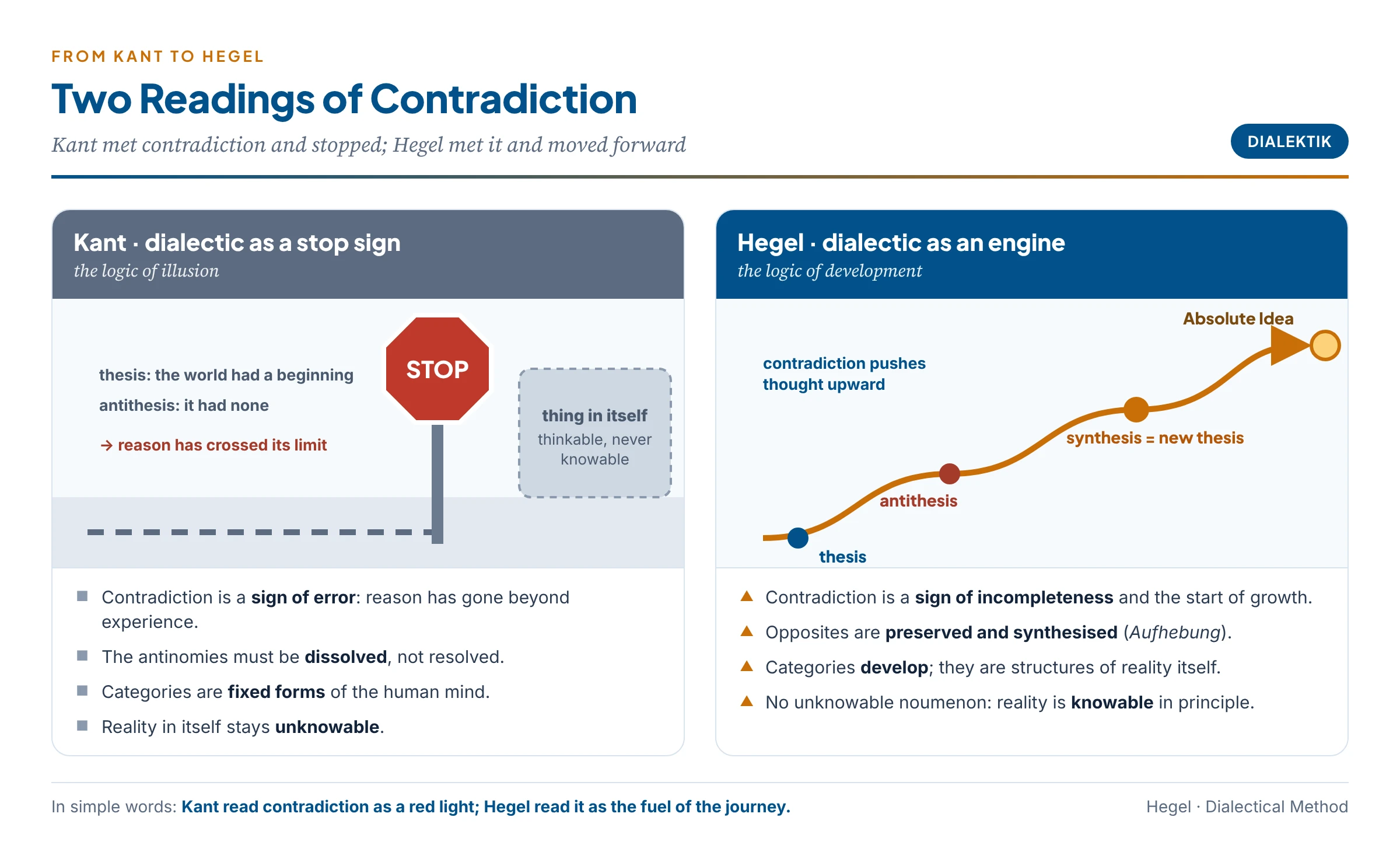
| Point | Kant | Hegel |
|---|---|---|
| What dialectic reveals | Illusion (Schein) of reason | Truth of reality |
| Meaning of contradiction | Reason has crossed its limits | Thought and reality are moving forward |
| What to do with antinomies | Dissolve them; keep reason within experience | Preserve and synthesise the opposites |
| Thing in itself | Exists but remains unknowable | No unknowable noumenon; reality is knowable |
| Status of categories | Fixed forms of the human mind | Self-developing structures of reality |
| Attitude to reason | Modest, self-limiting | Confident; reason can know the Absolute |
Core Doctrine
1. Dialectic as the Inner Logic of Reality
- Not a technique. Dialectic is not a method of debate imposed on a subject from outside. It is the inner logic of reality, through which everything develops and becomes intelligible.
- Every concept has limits inside it. When we think something in a pure, abstract way, we soon find that it leads to its opposite. The opposition is not brought in from outside; it arises from the concept itself.
- Immanent, not external. Change happens because of contradictions within a thing:
- A social institution collapses not merely because of an outside attack but because its own principles have become inconsistent with lived reality.
- A concept develops because it cannot fully explain what it claims to explain.
- Universal. The same movement runs through logic, nature, consciousness, society, history, art, religion and philosophy. Hegel uses it to explain economy, polity and religion alike.
- Necessary, not accidental. Because the movement is rational, there is no place for chance in it. The stages “deduce themselves” by inner necessity; no external factor drives them.
In simple words
A wooden boat with a small leak does not sink because an enemy attacks it; it sinks because of the weakness inside it. Hegel thinks ideas, institutions and civilisations are like this. A rigid caste of priests, a monarchy that denies all rights, or a theory that cannot explain its own facts — each carries its own leak. History does not need an outside villain to change them; their inner contradiction does the work.
2. The Three Moments of Every Concept
Hegel describes the movement of thought in three “moments” — not three separate parts, but three sides of every concept and of everything true:
- Understanding (Verstand) — the moment of fixity. A concept is taken as a stable, clear-cut determination: “this is X and nothing else”. It gives precision but is one-sided.
- Dialectical or negatively rational moment — the moment of instability. The one-sidedness comes to the surface, and the fixed determination passes over into its opposite. Hegel calls this self-sublation.
- Speculative or positively rational moment — the moment of unity. Reason grasps the unity of the opposites and the positive result that comes out of their conflict.
These three moments are the source of the popular formula:
- Thesis — a concept or state of affairs is posited; it presents a limited truth.
- Antithesis — its internal contradiction pushes it to negate itself; the opposite emerges and shows the incompleteness of the first. The antithesis is derived from the thesis itself, not brought from outside.
- Synthesis — the opposition is not simply cancelled but sublated. The synthesis is not the arithmetic sum of the two; it transcends both and draws out the truth of each.
- The spiral continues. The synthesis becomes a new thesis, which meets its own antithesis, and so on — until a fully concrete synthesis is reached in which no contradiction remains: the Absolute Idea.
Common confusion
Did Hegel describe his own method as “thesis–antithesis–synthesis”? Hardly ever. The three terms come from Fichte and were popularised by later writers summarising Hegel. Hegel himself speaks of the abstract, the negative (dialectical) and the concrete (speculative), and of sublation and determinate negation. The triad is a useful classroom simplification, but it should not be applied mechanically: even sympathetic interpreters such as Stace admit that some of Hegel’s “triads” are forced, a few have four terms, and one section has only two. What matters is the immanent contradiction and its sublation, not a three-step formula.
3. The First Triad: Being, Nothing, Becoming
The Science of Logic begins with the most abstract thought possible and shows the dialectic at work in its simplest form.
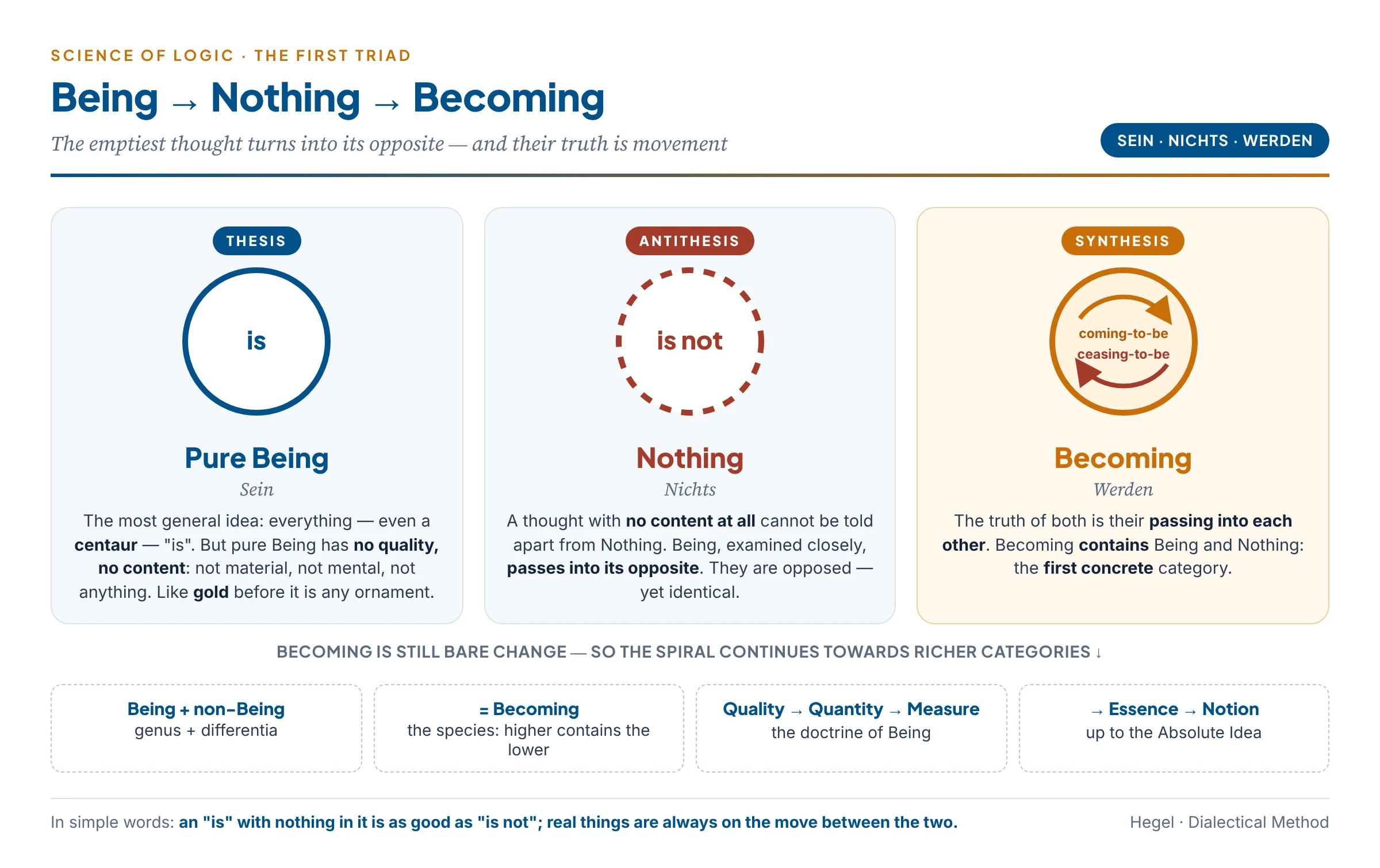
- Why begin with Being? Every idea presupposes a more general idea: we cannot think “man” without “animal”, or “animal” without “creature” — but not the other way round. The most general idea of all is Being (Sein), the bare “is-ness” of things. A thing may not be material, heavy or round; it may even be a fiction like a centaur or Pegasus; yet we can still say that it is in some sense. So Being is the first category, presupposed by every other — substance, cause and all the rest.
- Pure Being is empty. Being in general is not any particular being — not material, spiritual, human, wise or wicked being. Just as gold is not yet an ear-ring, a bangle or a chain, pure Being has no quality, no content, no determination. It can only be described as “not this, not that” — in Vedāntic language, neti neti.
- Thesis → antithesis. A thought with no content at all is indistinguishable from Nothing (Nichts). Pure Being, examined closely, passes into its opposite. Being and Nothing are opposed — and yet identical, since both are completely empty.
- Synthesis. The mind cannot rest in this contradiction. The truth of Being and Nothing is their passing into each other — Becoming (Werden). To become is to go from not-being to being (coming-to-be) or from being to not-being (ceasing-to-be).
- Becoming contains both. Becoming is a kind of being — we can say it is — but a being that constantly denies itself: pure movement. It is the first concrete concept of the Logic, because it has the two earlier moments inside it.
- This is the “first triad”. It shows the dialectic in its purest form: contradiction does not destroy thought; it pushes it forward. Becoming in turn is still very abstract — bare change, not mechanical, chemical or organic change — so it calls up a new antithesis, and the categories grow more concrete until the Absolute, “the fullest, richest and most concrete” category, is reached.
Genus, differentia, species — why Plato’s ladder could not be climbed down:
- Plato’s method of abstraction. Plato reached higher Ideas by dropping details. Man is a “rational animal”; drop the differentia “rational” and you rise to “animal”; drop “animal” and you rise to “creature”, and finally to Being.
- The problem. You can climb up this ladder, but you cannot climb down. To deduce “man” from “animal” you need the differentia “rational” — but you threw it away on the way up. The empty genus cannot give back what was removed.
- Hegel’s solution. In the first triad, the opposite of Being — non-Being — acts as the differentia that Being itself contains. Being (genus) + non-Being (differentia) = Becoming (species). The higher idea contains the seed of the lower, so the lower can be deduced from it. This is why Hegel’s ideas are concrete, not abstract.
4. Negation: “Every Negation Is Determination”
- Negation is the motor. For Hegel, negation or contradiction is the basis of all motion, progress, development and growth. “Negation is the very life of this universe.”
- Spinoza reversed. Spinoza said “every determination is negation”: to say what a thing is (“this is a table”) is to say what it is not (not a chair, not a desk, not a tree). Hegel reverses the point: every negation is also a determination. Negation is never bare, empty denial — it produces a new, definite quality.
- Determinate negation (bestimmte Negation). When a position breaks down, the result is not “nothing in general” but the negation of that particular position, and so it has a definite content. The failure of sense-certainty, for example, does not leave us with nothing; it leaves us with perception, which corrects precisely what sense-certainty lacked.
- Negation of negation. The antithesis negates the thesis; the synthesis negates the antithesis — and so restores, at a higher level, what was true in the thesis. “It is only by the negation of negation that the existence of any object is established.”
- Spinoza’s contrast. For Spinoza, negation limits and diminishes; for Hegel, negation enriches. That is why Spinoza’s universe is static and Hegel’s is developing.
Common confusion
Who said “every determination is negation” — Spinoza or Hegel? The idea comes from Spinoza, who wrote in a letter that “determination is negation” (determinatio negatio est); Hegel made it famous in the form omnis determinatio est negatio and then reversed it. Spinoza’s point is that to define a thing is to limit it, so the infinite substance can have no determinations. Hegel’s point is that negation is productive: “every negation is determination”. Many notes mix the two up. Remember: Spinoza — determination is negation (limit); Hegel — negation is determination (new content).
5. Aufhebung — Sublation
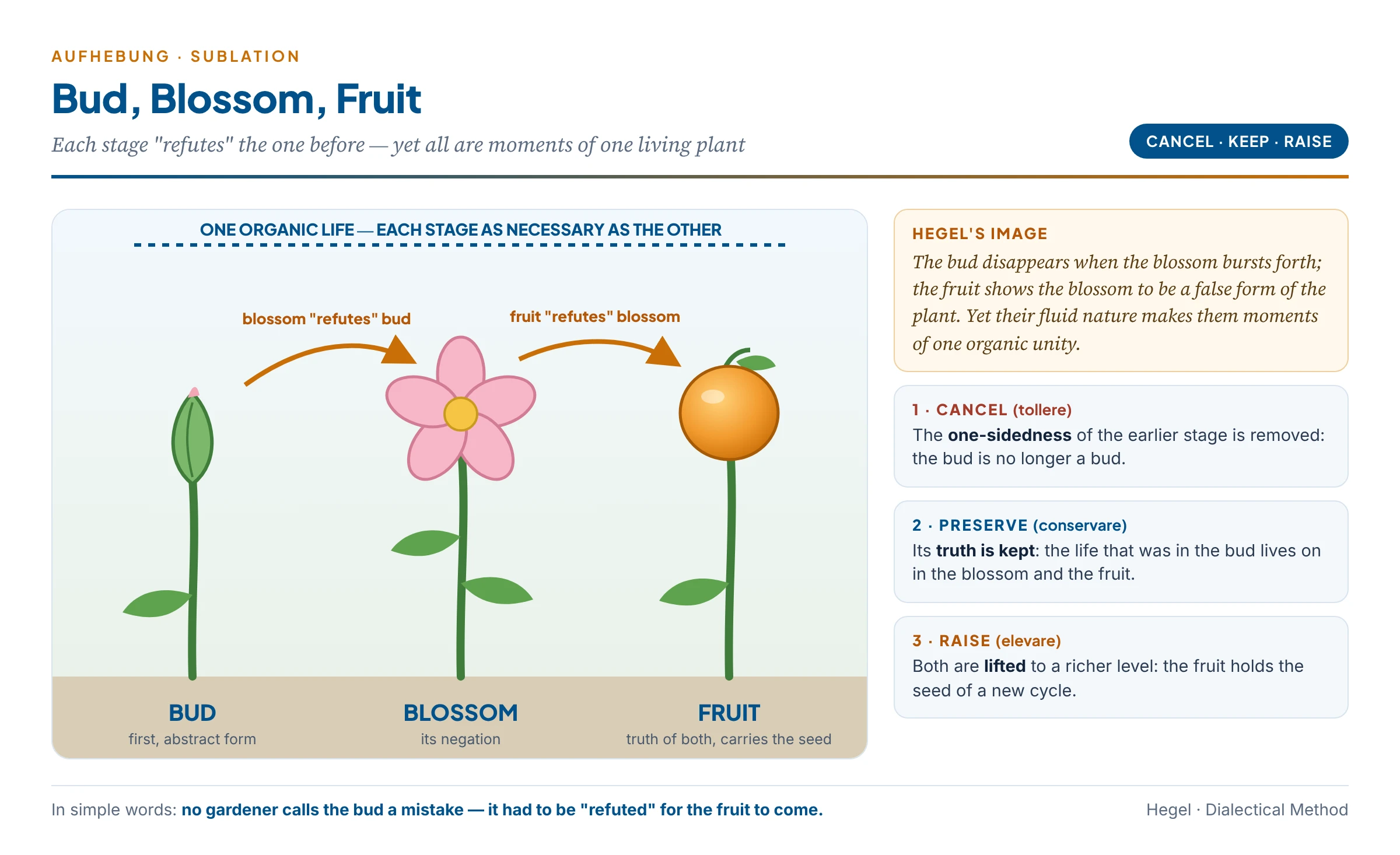
The German verb aufheben has three everyday meanings, and Hegel uses all three at once:
- To cancel or abolish (Latin tollere) — the one-sidedness and limitation of thesis and antithesis is removed.
- To preserve (conservare) — the positive, essential truth in each is kept.
- To lift up (elevare) — both are raised to a higher, richer level of truth.
- Cumulative, not destructive. Every new stage contains the rational essence of all earlier stages. Nothing true is lost.
- Higher contains lower, lower contains higher. The higher category contains the lower explicitly (Becoming openly contains Being and Nothing); the lower contains the higher implicitly (Being already carries Becoming in it, or Becoming could not have been deduced from it).
- Resultant and emergent. In the language later used by Lloyd Morgan, the synthesis is not only a summation (resultant) of its moments; it is also something new (emergent) — as when hydrogen and oxygen combine into water, which has properties neither gas had.
In simple words
Think of the bud, the blossom and the fruit — Hegel’s own image. When the blossom opens, the bud disappears; one could say the blossom “refutes” the bud. When the fruit comes, the blossom in turn looks like a “false” form of the plant. Yet no gardener thinks the bud was a mistake. Each stage is necessary for the next, and the fruit carries in it the life of both. That is Aufhebung: the earlier stage is cancelled, kept and raised at the same time.
6. Contradiction and Movement: “Movement Is Contradiction Itself”
- Hegel’s claim. “Contradiction is the root of all movement and vitality; it is only in so far as something has a contradiction within it that it moves, has an urge and activity.”
- Why movement involves contradiction. Zeno argued that a moving arrow is, at each instant, at one place — so it never moves. Hegel replies that motion means a body is in this place and at the same time not in it; it is here and not-here at once. Motion is the existing contradiction. Ordinary logic, which freezes the arrow into separate instants, cannot capture motion; dialectical reason can.
- Life as contradiction. A living body is constantly dying and being renewed; it remains itself through change. Desire, urge and striving are all a tension between what a thing is and what it is not yet.
- The sense of “contradiction”. Hegel uses the word more widely than formal logic. In logic, contradiction means complete exclusion (“A and not-A”). In Hegel it often means difference, tension or opposition within a unity: anything that differs from A stands in opposition to A, and this opposition is the source of development.
- Whole reality is a process. “The True is the whole” — and the whole is not a finished block but a self-developing movement.
7. Identity-in-Difference: “All Identity Is Identity and Difference”
- Abstract identity. The law of identity of formal logic says A is A. Taken by itself, this is empty — “a plant is a plant” tells us nothing. Abstract identity excludes all difference and so cannot explain change: if A is only A, how can a seed ever become a tree?
- Concrete identity. Real identity contains difference within it. The oak is the same being as the acorn, yet different from it; a person at sixty is the same person as at six, yet changed in almost every respect. Identity that persists through difference is the only identity that real things have.
- Difference requires identity. Two things can differ only if they share something: we can compare a pen and a pencil (both writing tools) but not a pen and a camel in any useful way. Difference presupposes a common ground.
- Key concept. Hegel’s key idea is identity-in-difference, or difference-in-identity. Reality is neither pure identity (Spinoza’s one without the many) nor pure difference (Leibniz’s many without the one); it is a unity that holds its differences within itself.
- Examples in the system:
- Being and Nothing are opposed yet identical (both empty).
- Existence and reality are opposed (existence is passing, reality eternal) yet share Being.
- One and many, nature and culture, individual and society — the aim of Hegel’s metaphysics is to show the unity of such opposites.
In simple words
A river is a good picture of identity-in-difference. The Ganga at Haridwar and the Ganga at Varanasi is “the same river”, yet not a single drop of water is the same, and its width, speed and colour all differ. If you insisted on abstract identity (A = A, the same water), there would be no river at all — only a pond. The river is its changing; its identity lives in its differences.
8. Dialectic versus Formal Logic and Mathematical Deduction
- Two levels of thinking. Hegel distinguishes the understanding, which works with fixed and separate concepts, from speculative reason, which grasps concepts in their movement and unity.
- Formal logic and mathematics belong to the understanding. They give precision, fixity and definiteness, and are valuable at the beginning of philosophy. But:
- They are static. A triangle, once defined, never grows into anything else. The principle “A is A, and A can never become not-A” suits a frozen world, not an evolving one. That is why Spinoza, who used the geometrical method, could never explain how finite modes come out of infinite substance.
- They are dogmatic. Deduction starts from axioms taken as “self-evident”. But self-evidence explains nothing: why these axioms and not others? Why so many and no more?
- They are one-sided. By attending to one aspect of a situation, understanding gains clarity but produces warring opposites — Parmenides’ unchanging One against Heraclitus’ flux, mechanism against teleology, materialism against idealism — which it cannot reconcile.
- Speculative reason reconciles. The dialectic takes up these opposed one-sided views and shows them to be complementary moments of a larger truth. Parmenides’ Being and Heraclitus’ Becoming are united in the very first triad.
- Linear versus implicative system. Descartes reasons in a straight line: from an indubitable first truth, step by step, in the manner of geometry. Hegel’s system is implicative: each phase is shown to imply all the rest, and the mutual support of all parts, free of inconsistency, proves the truth of the whole.
| Point | Understanding (formal logic) | Speculative reason (dialectic) |
|---|---|---|
| Basic law | Identity: A is A | Identity-in-difference |
| Attitude to opposites | Either–or | Both–and, as moments of a whole |
| Concepts | Fixed, separate | Moving, interrelated |
| Suits | A static world (a triangle) | A developing world (a seed becoming a tree) |
| Starting point | Axioms taken as self-evident | No assumption; the content develops itself |
| Form of system | Linear chain (Descartes) | Self-returning circle |
9. Does Hegel Deny the Law of Contradiction?
- The charge. If Being “is” Nothing and A “must become” not-A, Hegel seems to break the most basic rule of logic. Karl Popper argued that accepting contradictions would make nonsense of all reasoning and science (from a contradiction, anything follows).
- The reply. Hegel does not abolish the law of contradiction:
- No one can rest in a contradiction. That is exactly why the dialectic moves on — the synthesis exists to resolve the contradiction. Hegel himself could not accept Kant’s antinomies as final; he sought their resolution.
- The dialectic is ontological, not formal. “A becomes not-A” is not a rule of abstract inference but a description of growth: a seed does not remain a seed.
- Different levels. The contradiction belongs to the level of the understanding; its resolution is stated at the higher level of speculative reason. Just as Russell solved the liar paradox (“a Cretan says all Cretans are liars”) by separating levels of language, Hegel’s dialectic is a higher-order comment on the one-sided statements of the understanding.
- Formal logic is not wrong but partial. It remains valid within its sphere; it is sublated, not discarded.
10. The Dialectic of Consciousness
In the Phenomenology of Spirit, Hegel traces the dialectic through the growth of consciousness:
- Sense-certainty — consciousness believes that immediate sensation (“this, here, now”) gives the richest and truest knowledge. But “this”, “here” and “now” are universals that apply to everything; what seemed immediate is mediated by language and concepts. Sense-certainty fails.
- Perception — it takes things as objects with many properties (salt is white, cubical, tart). But how can one thing also be many? Perception breaks down.
- Understanding — it looks behind appearances for forces and laws.
- Self-consciousness — consciousness turns to itself and discovers that it needs recognition from another self-consciousness (the master–slave dialectic, treated in the article on history and the state).
- Reason and Spirit — consciousness finally recognises itself in the world: “reason is all reality”.
Three levels of knowledge (a simpler version of the same ascent):
- Common or sensory knowledge — objects are seen as separate and distinct.
- Ideational or scientific knowledge — we look past differences to general laws connecting objects.
- Philosophical knowledge — objects are seen as expressions of one complete Idea; here reason knows ultimate reality.
11. The Great Triads of the System
The triadic movement appears on every scale; whole series of triads fall within larger triads.
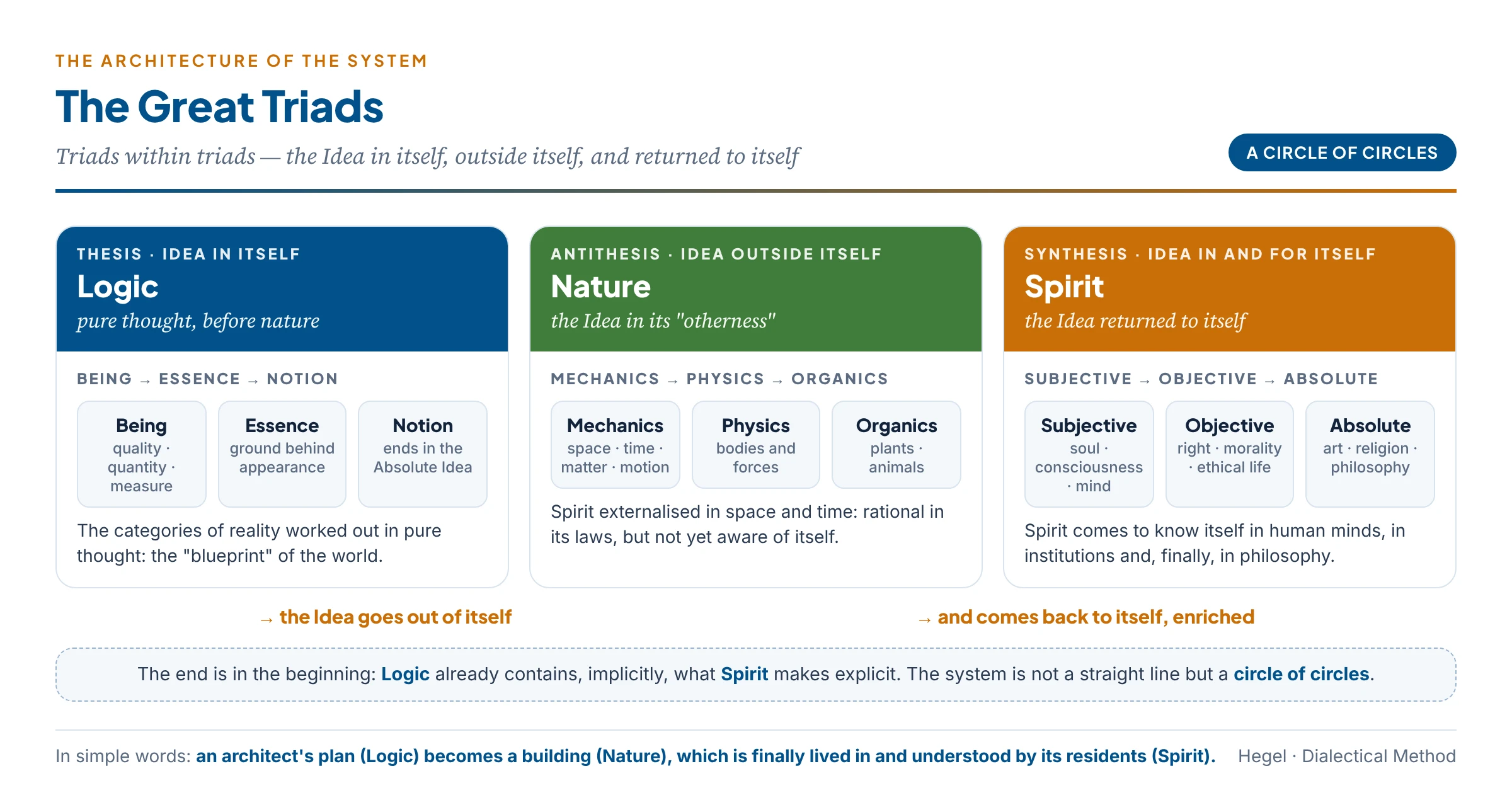
- The system as a whole: Logic (the Idea in itself) → Nature (the Idea outside itself, its “otherness”) → Spirit (the Idea in and for itself, returned to itself).
- Within Logic: Being (quality → quantity → measure) → Essence (the hidden ground behind appearance) → Notion or Concept (Begriff), culminating in the Absolute Idea.
- Within Nature: Mechanics (space, time, matter, motion) → Physics → Organics (plants, animals).
- Within Spirit: Subjective Spirit (the individual mind) → Objective Spirit (law, morality, ethical life) → Absolute Spirit (art → religion → philosophy).
- In the life of Spirit: spirit-in-itself (undisturbed unity) → spirit positing its “other” (nature and life) → spirit returning to itself in self-consciousness.
- In history: freedom → conflict → reconciliation.
12. The End Is in the Beginning: The Absolute as Being and as Becoming
- The first is also the last. The higher categories contain the lower explicitly; but the lower also contain the higher implicitly. Being already contains Becoming (otherwise Becoming could not be drawn out of it), and, in the same way, Being implicitly contains all the later categories up to the Absolute. Conversely, the Absolute explicitly contains Being and everything after it.
- A circle, not a line. Hegel describes his science as “a cycle returning upon itself, wherein the first is also the last, and the last first”. His system is “a circle of circles“. As in a drama, the first scene already holds the last, and the last scene reveals the meaning of the first.
- The Absolute as Being is the Absolute as Becoming. The first definition of the Absolute — “the Absolute is pure Being” — is the poorest. It at once proves to be “the Absolute is Nothing”, and their truth is “the Absolute is Becoming“. So the Absolute is not a static block that is and then, separately, changes: its very being is its becoming. The Absolute is self-development — a process in which what is implicit at the beginning becomes explicit at the end.
- Implicit to explicit. Hegel compares this with Aristotle’s form, which is the reason of a thing’s changes: the end (the oak) is logically prior to the beginning (the acorn). The Absolute is “in itself” at the start (Logic), “outside itself” in Nature and “in and for itself” in Spirit. The beginning contains the end implicitly; the end contains the beginning explicitly.
- Process essential to result. It is impossible to reach the truth except by going through all the steps. A result without its development is a corpse; the result together with its becoming is the living whole.
In simple words
A mango seed already “contains” the mango tree — not as a tiny tree hidden inside, but as a programme of growth. You could say the tree is the seed made explicit, and the seed is the tree not yet unfolded. Hegel says the Absolute is like this: to call it “Being” is to name the seed; to call it “Becoming” is to name its growth; and these are the same reality, described at the start and in its unfolding.
Indian Connect
- Sāṅkhya’s satkāryavāda (the effect pre-exists in the cause) and pariṇāmavāda (real transformation) also hold that development is the unfolding of what was implicit: the mango tree from the mango seed, curd from milk. Hegel’s “end contained in the beginning” is a rational, spiritual version of the same idea — but in Sāṅkhya the evolver (prakṛti) is unconscious, while in Hegel it is Spirit coming to know itself.
- Sri Aurobindo’s involution–evolution is even closer: what evolves (mind, supermind) was first involved in matter, so evolution is the return of Spirit to itself.
13. The Role of the Dialectic in Realising Truth
- “The True is the whole.” Truth is not found in isolated propositions or facts but in the whole system of relations. Every partial truth is true only as a moment of the whole.
- How dialectic gets us there:
- It begins without assuming the Absolute; it simply examines how thought develops. This keeps philosophy from being dogmatic.
- It exposes the limits of every partial view and so prevents us from mistaking a part for the whole.
- Through negation and sublation it preserves what is true in each view — development is cumulative.
- It moves from the abstract to the concrete, from poorer to richer concepts, revealing the rational order inside reality.
- It ends in a system whose parts all support one another; this coherence is the test of truth.
- “Thinking God’s thoughts after him.” Hegel claims that, through the dialectic, the human mind can understand the world as God understands it — because in human philosophy the Absolute comes to know itself.
- Coherence, not correspondence. Truth for Hegel is not the match between an isolated idea and an isolated fact, but the systematic coherence of the whole — the view later defended by the British idealists.
14. How the Dialectical Method Leads to Absolute Idealism
- Reality is a process. The dialectic shows that every concept and every form of life is constantly developing. Reality is not dead matter but a living process.
- Contradiction is necessary. Contradiction is a feature of reason and of reality — a break from static metaphysics.
- Development is cumulative. Negation and sublation preserve what is rational at each stage.
- From abstract to concrete. Pure Being leads to Becoming, simple consciousness to self-consciousness; the gradual enrichment shows that reality has an internal rational order.
- Categories of thought are categories of being. As concepts develop, they reveal the structure of reality itself, so the gap between thought and being disappears.
- No unknowable reality. If reason can follow reality’s development through its contradictions, then reality is knowable in principle; Kant’s thing in itself has no place.
- The goal is Spirit. The dialectic ends in the Absolute Idea, which externalises itself as Nature and returns to itself as Spirit; reality is shown to be spiritual, rational and free.
Dialectic is the path; Absolute Idealism is the destination. Hegel reaches idealism not by assuming it but by following the logic of thought to its end.
15. Is Dialectic Only the Art of Refutation?
A famous definition says that “the dialectical method simply consists of challenging every typical attitude or belief by rendering its partisan claims logically ridiculous”. How far does this fit Hegel?
- It fits the negative dialectic. Zeno made the belief in motion look absurd; Socrates exposed the confident definitions of his partners; Kant’s antinomies made speculative metaphysics look ridiculous. In India, Nāgārjuna’s method of prasaṅga (reducing every opponent’s view to absurdity) does the same.
- It captures one moment of Hegel’s dialectic — the second, negatively rational moment, where every one-sided, “partisan” claim is shown to undermine itself.
- But it misses the essential. For Hegel, refutation that ends in nothing is scepticism, not dialectic. The negation is determinate: it yields a new, richer position that keeps what was valid in the refuted one. The partisan claims are not made ridiculous and thrown away; they are corrected and preserved as moments of a larger truth.
- Conclusion. The definition describes the dialectic of the understanding; Hegel’s dialectic of speculative reason challenges every partial view in order to complete it, not merely to defeat it.
Critical Evaluation
Objections to the Dialectical Method
- Marx — idealism upside down. Marx accepted the method but rejected its subject matter: Hegel’s dialectic moves ideas, whereas the real movement is that of material and economic life. “With him it is standing on its head. It must be turned right side up again, if you would discover the rational kernel within the mystical shell.”
- Moore and Russell — speculative and pluralist objections. The realists argued that reality is many independent things, not one system; relations are external, not internal; and analysis does not falsify its object. Hegel’s dialectic, they said, is speculation without logical rigour.
- Findlay — illumination, not proof. Even a sympathetic interpreter like J. N. Findlay thought Hegel was wrong to present dialectical necessity as deductive necessity. The passage from one category to the next is a creative insight — like suddenly seeing a puzzle-picture in a new way — and is “necessary” only in the loose sense in which a work of art develops necessarily.
- Stace — forced triads. Many triads are artificial: the deduction of the family or of the stages of art does not follow strictly; some “triads” have four members.
- Popper — nonsense and false prophecy. If contradictions are accepted, any conclusion follows; and the dialectic of history encourages the belief that history can be predicted, which Popper linked to totalitarian thinking.
- Unverifiable and obscure. The Absolute Idea cannot be tested by any experience; critics said Hegel made “the mystery more mysterious”. Logical positivists dismissed such talk as meaningless.
- Selective use of history. Hegel is accused of choosing historical facts that fit his scheme and ignoring those that do not.
- Kierkegaard and Sartre — no room for the individual. A necessary, self-moving dialectic leaves no place for free choice; the existing individual is swallowed by the system.
- Husserl — an unexamined assumption. Hegel assumed, without ground, that the dialectical method can reveal everything.
In simple words
Findlay’s objection can be pictured with a detective story. When you reach the last chapter, everything earlier suddenly “fits”, and you feel the ending was inevitable. But the clues did not logically force that ending; the author chose it, and the feeling of necessity comes afterwards. Critics say Hegel’s dialectic gives this kind of satisfying, backward-looking necessity — real insight, but not mathematical proof.
Replies and Defences
- Hegel keeps the law of contradiction. The dialectic moves precisely because no one can rest in contradiction; Popper’s criticism attacks a position Hegel did not hold.
- Not predictive but retrospective. Hegel never claimed the dialectic predicts the future. “The owl of Minerva spreads its wings only with the falling of the dusk” — philosophy understands a form of life after it has matured. The charge of false prophecy applies to some followers, not to Hegel.
- Descriptive, not a Procrustean bed. The triads are found by reflecting on actual developments in thought, history and art, and then seen to fit them; empirical events are illustrations, not inputs to a formula.
- A method that changed the human sciences. Since Hegel, dialectical thinking has been used to study history, society, art, religion and the history of philosophy itself.
- Marx’s own tribute. Even in inverting Hegel, Marx kept the dialectical method as Hegel’s lasting achievement.
Critics and Defenders
Criticism — Critics
- Marx: an idealist dialectic standing on its head; real development is material.
- Moore and Russell: reality is plural; relations are external; speculation without rigour.
- Findlay and Stace: dialectical “necessity” is insight, not deduction; many triads are forced.
- Popper: accepting contradiction ruins logic; historicist prophecy.
- Kierkegaard and Sartre: the system swallows the free individual.
- Positivists: the Absolute is unverifiable and meaningless.
Defence — Defence and lasting value
- Law of contradiction kept: the synthesis exists to resolve contradiction.
- Retrospective, not predictive: the owl of Minerva flies at dusk.
- Ontological, not formal: it describes growth, not abstract inference.
- Determinate negation: refutation that produces a richer position — a real advance on scepticism.
- Fertile method: used across history, sociology, art and religion; kept even by Marx.
- Explains change: the first logic built for an evolving world.
Cross-Tradition Comparison
Hegel’s Dialectic and Indian Dialectical Traditions
| Point | Hegel | Nāgārjuna (Mādhyamika) | Jaina Anekāntavāda | Advaita Vedānta |
|---|---|---|---|---|
| Method | Thesis → antithesis → sublation | Prasaṅga: reduce every view to absurdity | Syādvāda / saptabhaṅgī: seven-fold predication | Adhyāropa–apavāda: superimpose, then negate |
| Nature of negation | Determinate, productive | Purely critical; no thesis of its own | Each view true from a standpoint | Neti neti removes false attributes |
| Goal | Absolute Idea / Spirit (concrete) | Śūnyatā — emptiness of all views | Integration of partial truths | Nirguṇa Brahman (beyond all predicates) |
| Change and history | Real and essential | Dependent origination; no self-nature | Real (pariṇāma) | Appearance (vyāvahārika) |
| What is preserved? | Every moment kept in the whole | Nothing held as ultimate view | Every standpoint kept as partial | Partial truths cancelled (bādha) |
Indian Connect — Key takeaways
- Nāgārjuna’s dialectic is the negative moment made absolute: it shows every view to be self-contradictory but refuses any synthesis. Hegel would call it scepticism; a Mādhyamika would reply that Hegel’s “Absolute” is one more view to be emptied.
- The Jaina anekāntavāda is closest to Hegel’s identity-in-difference: a pot is permanent as clay and impermanent as a form; truth is many-sided. But the Jaina keeps standpoints side by side, whereas Hegel arranges them in a rising order that ends in one complete truth.
- Advaita’s bādha (sublation) cancels the lower truth (the snake is seen to be a rope and disappears); Hegel’s Aufhebung preserves the lower in the higher. The rope-snake is simply false for Śaṅkara; for Hegel even a partial truth is a necessary stage.
- Pure Being as neti neti: Hegel’s starting point resembles the Upaniṣadic description of Brahman, but Hegel treats it as the poorest category, while the Upaniṣads treat it as the highest.
Hegel’s Dialectic and Other Western Dialectics
| Point | Zeno / Socrates | Kant | Hegel | Marx |
|---|---|---|---|---|
| Use | Refute an opponent; refine a definition | Expose the illusions of reason | Reveal the self-development of reality | Explain material and social change |
| Outcome | Aporia (perplexity) or a better definition | Limits of knowledge | Absolute Spirit | Classless society |
| Subject of the movement | Arguments | Reason’s Ideas | Concept / Spirit | Matter / modes of production |
Synthesis (Siddhānta)
Hegel’s dialectical method is his answer to the oldest problem of metaphysics: how to reconcile Being and Becoming, the unity of the rational with the restlessness of the real. Earlier thinkers used opposition either to refute (Zeno, Socrates, Nāgārjuna) or to set limits (Kant). Hegel used it to build: every one-sided position contains its own negation; the clash is resolved by sublation, which cancels the one-sidedness, keeps the truth and lifts it higher; and the process moves from the emptiest category, pure Being, through Becoming and countless richer forms, to the Absolute Idea, in which the end is seen to have been present in the beginning. Contradiction is thus not a scandal for reason but “the root of all movement and life”.
The method has real weaknesses. Its “necessity” is often insight rather than proof; its triads can be forced; and in Hegel’s hands it seemed to justify whatever history produced. Yet its central insight has lasted: things are understood only in their development, their relations and their oppositions, and partial views are best treated not as simply false but as moments of a fuller truth.
- Social science and history: dialectical analysis of conflict — between classes, ideas or institutions — shaped Marx, the Frankfurt School and modern sociology.
- Dispute resolution: good negotiation looks for a position that preserves the legitimate core of both sides, rather than declaring one side simply wrong — a practical form of Aufhebung.
- Science: theories are rarely discarded wholesale; Newton’s mechanics survives as a special case within relativity — a scientific example of a lower truth preserved in a higher.
- Personal growth: crises and failures, understood dialectically, become stages of maturity rather than mere losses.
Contradiction is not the death of thought but its pulse: what cannot rest in itself must move, and in moving it becomes more fully what it is.
Previous Year Questions
- 2026Explain Hegel’s idea that the concept of the Absolute as being is the concept of the Absolute as becoming as a process of self-development.
- 2022What is the dialectical method in the philosophy of Georg Wilhelm Hegel? How does this method help in realizing the Absolute? Discuss.
- 2021Discuss Hegel’s Dialectical method. Explain how his dialectical method leads him to the Absolute Idealism.
- 2019What is the role of dialectics in realizing the truth in Hegel’s philosophy?
- 2017Elaborate Hegel’s dictum: “All identity is identity and difference.”
- 2013Comment: “Movement is contradiction itself.” Examine, in this context, Hegel’s dialectical method.
- 2012Explain Hegelian dialectical method and show how it is useful in explaining the historical development process.
- 2007Hegel’s Dialectical method. Short Notes.
- 2006Critically discuss Hegel’s Dialectical method. Short Notes.
- 2002Hegel’s Dialectical Method. Short Notes.
- 1997“The Dialectical method simply consists of challenging every typical attitude or belief by rendering its partisan claims logically ridiculous.” Notes.
- 1990Hegel’s Dialectical method. Notes.