

Kant: Possibility of Synthetic a priori Judgments; Space and Time; Categories; Ideas of Reason; Antinomies; Critique of Proofs for the Existence of God.
Official Syllabus: Paper I, Section A, Unit 4
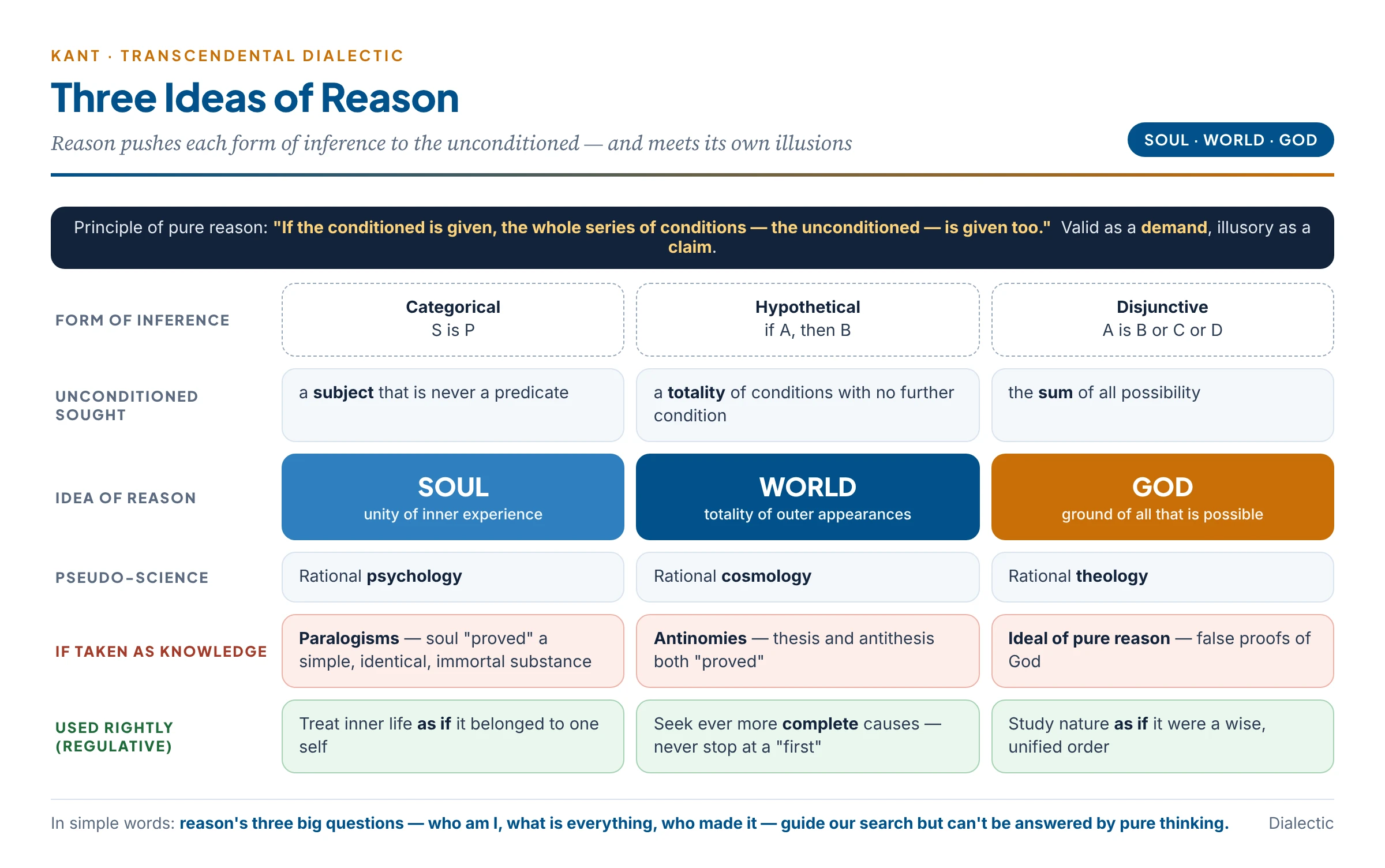
After showing how knowledge of nature is possible, Kant turns to the third and highest faculty — reason (Vernunft). The understanding links appearances by categories, but every such link is conditioned: each event has a cause, which has a cause, and so on. Reason is never satisfied with this chain; it demands the unconditioned — the complete whole of conditions. From this demand arise three Ideas of reason: the soul (the absolute unity of the thinking subject), the world (the totality of appearances) and God (the being that contains the ground of all possibility). No sensible intuition can ever correspond to them, so they yield no knowledge. When reason nevertheless treats them as objects, it falls into transcendental illusions — the paralogisms about the soul, the antinomies about the world, and the ideal of a God proved by pure reason. Yet the Ideas are not worthless: used regulatively, they guide the understanding towards ever greater unity of knowledge, and they open the way to practical faith.
In simple words
A child keeps asking “why?” — Why does it rain? Because clouds cool. Why do clouds cool? Because air rises. Why does air rise? … Every answer leads to another question. Grown-ups often say, “There must be a final answer behind all this — a first cause, a whole picture, a someone who arranged it.” That longing for a last answer is what Kant calls reason. It is natural and useful — it keeps science asking — but when it claims to have found the last answer by thinking alone, it makes mistakes that look like knowledge.
Context & Problem
“Knowledge … Ends with Reason”
- Three levels of the mind. “All our knowledge begins with the senses, proceeds thence to the understanding, and ends with reason.”
- Sensibility gives intuitions in space and time.
- Understanding unifies intuitions by categories into judgments.
- Reason unifies the judgments of the understanding by principles — it seeks the highest unity of all our knowledge.
- Understanding thinks, reason infers. Just as the understanding unifies sensations, reason unifies the operations of the understanding itself. “We infer with reason just as we think with understanding.”
- Two uses of reason.
- Logical use — drawing conclusions from premises (syllogisms), abstracting from content.
- Real (pure) use — producing concepts and principles of its own, which do not come from sense or understanding.
- The principle of pure reason. “If the conditioned is given, the whole series of its conditions — and so the unconditioned — is also given.” This principle is valid as a demand (look for the conditions!) but illusory as a claim (the unconditioned is out there and known).
How Reason Forms Its Three Ideas
- Kant’s derivation. As the categories were derived from the forms of judgment, the Ideas are derived from the forms of syllogism (inference). There are three kinds of syllogism, and reason, pushing each to its unconditioned end, reaches three Ideas:
| Form of inference | The unconditioned sought | Idea of reason | Pseudo-science it produces | Illusion |
|---|---|---|---|---|
| Categorical (S is P) | A subject that is never a predicate | Soul — absolute unity of the thinking subject | Rational psychology | Paralogisms |
| Hypothetical (if A, then B) | A presupposition that presupposes nothing further | World — absolute totality of the series of conditions of appearances | Rational cosmology | Antinomies |
| Disjunctive (A is B or C or D) | An aggregate of all possible predicates | God — the being of all beings, ground of all possibility | Rational theology | Ideal of pure reason (false proofs of God) |
- In simpler terms. The Idea of the soul is the totality of inner experience; the Idea of the world is the totality of outer things; the Idea of God is the union of both — the highest condition of everything thinkable.
- Ideas vs categories. A category applies to objects of possible experience. An Idea is a concept of reason to which no object can be given in experience — it transcends all possible experience.
Core Doctrine
1. Transcendental Illusion
- Definition. A transcendental illusion is a systematic and unavoidable tendency of pure reason to apply its Ideas beyond the limits of possible experience, mistaking subjective necessities of thought for objective knowledge of reality.
- Three features.
- Natural — rooted in the very structure of reason, not in carelessness.
- Unavoidable — it cannot be eliminated by logic alone; it persists even after it is exposed.
- Correctable only by critique — we cannot stop the appearance, but we can stop being deceived by it.
- Different from ordinary errors.
- A logical illusion (a fallacy) disappears once we notice it.
- An empirical illusion (a stick looking bent in water) is caused by misuse of the senses.
- A transcendental illusion is like an optical illusion: knowing that the moon is not really larger at the horizon does not stop it from looking larger. Reason keeps presenting the soul, the world-whole and God as if they were objects.
- The root of the illusion. Understanding deals only with conditioned phenomena; reason seeks ultimate explanations. The illusion arises when regulative Ideas (rules for seeking) are treated as constitutive truths (descriptions of objects). Reason trespasses its limits and gets pseudo-knowledge — a situation Kant also calls a form of agnosticism about supersensible realities.
- The task of the Dialectic. Not to destroy reason but to discipline it: metaphysics is limited, not destroyed.
In simple words
Stand between two railway lines and look ahead: the rails seem to meet at the horizon. You know perfectly well they never meet — yet they go on looking as if they do, however long you stare. Transcendental illusion is like that. Even after Kant shows that the soul, the world-whole and God cannot be known by pure reason, reason goes on presenting them as if they were objects waiting to be known. Critique cannot remove the appearance; it only stops us from being fooled by it.
Common confusion
Are Kant’s “Ideas of reason” the same as Hume’s “ideas” or Plato’s “Ideas”? No.
- For Hume, an “idea” is any faint copy of an impression in the mind — the idea of red, the idea of a horse.
- For Plato, Ideas (Forms) are eternal realities existing independently, known by the intellect.
- For Kant, an Idea of reason is a concept of the unconditioned produced necessarily by reason — soul, world, God — to which no object in experience can ever correspond. It is neither a copy of experience (Hume) nor a known reality (Plato), but a rule and goal for thinking. Kant borrowed Plato’s word deliberately, because the Idea points beyond experience — but he denied that it gives knowledge of anything beyond.
2. The Paralogisms of Pure Reason (Rational Psychology)
- Empirical vs rational psychology.
- Empirical psychology studies feelings, emotions, thinking and willing as they appear in introspection. These are phenomena in time, within the legitimate use of the categories. But it never gives knowledge of a permanent self — “we never catch the permanent self at any time” (Hume was right here).
- Rational psychology is not content with this. It wants to know the permanent, eternal, free and essential self — the soul — by pure reason alone, from the single premise “I think.”
- What a paralogism is. A paralogism is a formally invalid syllogism. A transcendental paralogism is one that has a transcendental ground — something in the nature of reason constrains us to draw the invalid conclusion. The bold attempt to know the supersensible self is bound to yield invalid conclusions.
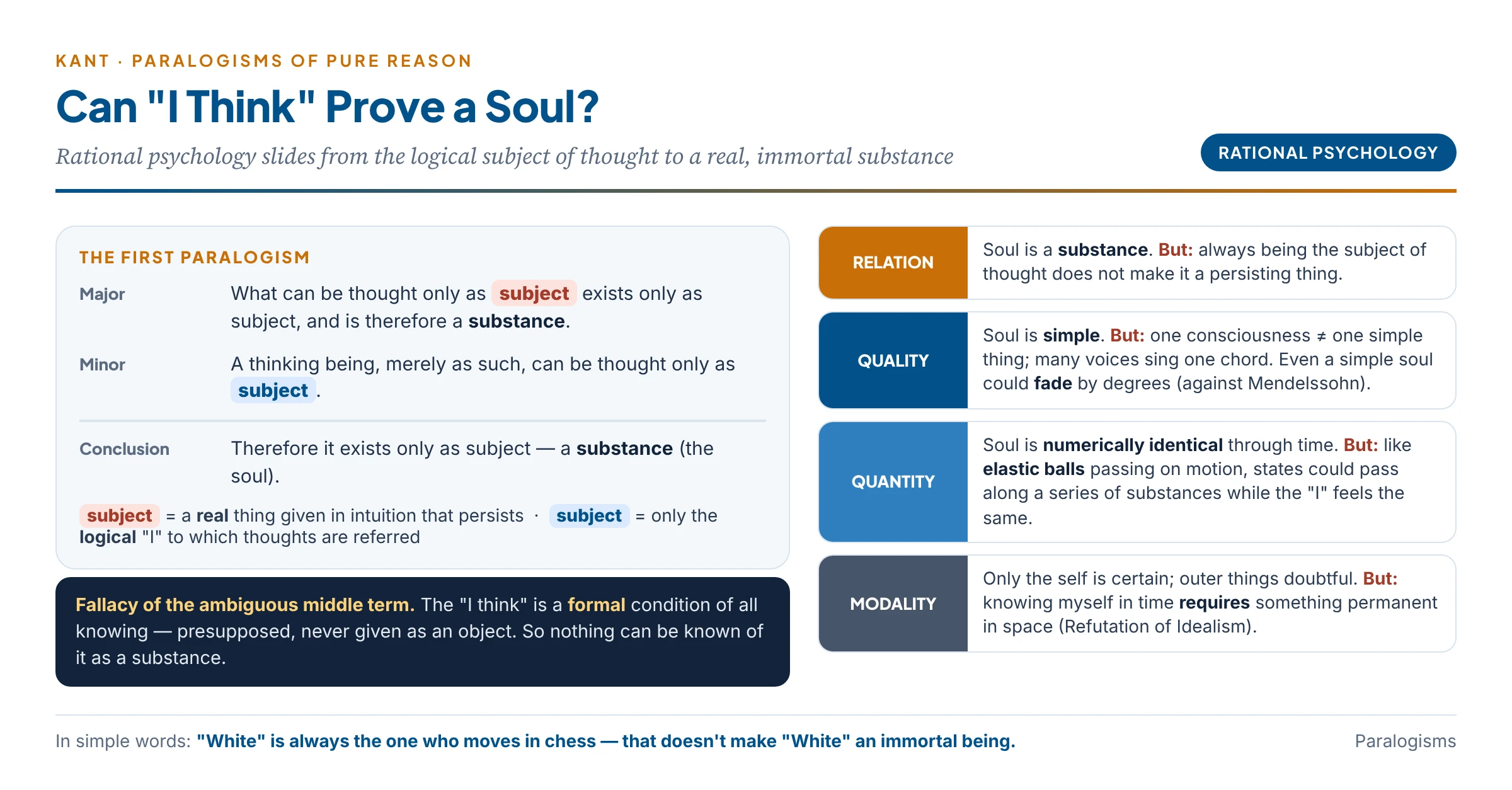
- The four paralogisms. Following the four headings of the categories, rational psychology makes four claims about the soul:
| Heading of categories | Claim of rational psychology | What it is supposed to prove |
|---|---|---|
| Relation | The soul is a substance — I am aware of myself as a subject, never as a predicate | The soul is a thing that exists in itself |
| Quality | The soul is simple — not composed of parts | It is incorruptible (cannot fall apart) |
| Quantity | The soul is numerically identical — one and the same through all the different times in which it exists | Personality — the same person across time |
| Modality | The soul is in relation to possible objects in space — only the self is immediately given; all outer things are merely inferred | The soul is independent of matter; outer things are doubtful |
- The conclusions rational psychology draws. Putting these together, it concludes that the soul is an immaterial, incorruptible, personal substance, distinct from and independent of the body — and therefore immortal. These are the classical proofs of personal immortality (Plato, Descartes, Mendelssohn).
Common confusion
Which category heading does each paralogism belong to? Many notes list them as “Quantity — the soul is a substance; Quality — simple; Relation — identical through time; Modality — independent of matter.” The correct matching (in Kant’s own “topic” of rational psychology) is:
- Relation → the soul is a substance;
- Quality → the soul is simple;
- Quantity → the soul is numerically identical (one, not many) through time;
- Modality → the soul’s relation to possible objects in space (only the self is certain; outer things are doubtful).
Substance belongs under relation (substance–accident), and identity as “one, not many” belongs under quantity (unity–plurality).
3. Where the Paralogisms Go Wrong
- The ambiguous middle term. Consider the first paralogism:
- What can be thought only as subject (never as predicate) exists only as subject and is therefore a substance.
- A thinking being, considered merely as such, can be thought only as subject.
- Therefore it exists only as subject — that is, as a substance.
- The word “subject” changes meaning. In premise 1 it means a real subject — a thing given in intuition that persists. In premise 2 it means only the logical subject of thought — the “I” to which all my thoughts are referred. The syllogism commits the fallacy of an ambiguous middle (a “fallacy of figure of speech”).
- The “I think” is formal, not an object.
- The transcendental unity of apperception is the indispensable a priori condition of knowing anything — but it is not an empirical fact and not an object of knowledge.
- The “I” that accompanies all my representations is presupposed in every act of knowing, so it can never itself be known as an object. “Through this I … nothing further is represented than a transcendental subject of thoughts = X.”
- There can be no proper knowledge of anything unless it is given in perception — and the permanent self is never so given.
- Each paralogism diagnosed.
- Substance — from the fact that “I” is always the logical subject of my thoughts, it does not follow that I am a substance; we have no intuition of a permanent soul to which the category could apply.
- Simplicity — the unity of consciousness (one “I” thinks the thought) does not prove that the thinking thing is simple. Many things might together produce one thought, as many voices sing one chord.
- Identity — the consciousness of being the same “I” across time is only a formal condition. Kant’s illustration: an elastic ball striking another passes on its whole motion; imagine a series of substances, each passing on its states and consciousness to the next — the last would be “conscious” of all earlier states as its own, yet would not be the same substance. So felt identity of the “I” does not prove identity of a soul-substance.
- Ideality of outer relation — the claim that only the self is certain and outer objects are doubtful (Descartes’ “problematic idealism“) is refuted: in the Refutation of Idealism Kant argues that my consciousness of my own existence in time already requires something permanent in space outside me. Inner experience depends on outer experience, not the other way round.
- Mendelssohn’s proof of immortality. Moses Mendelssohn argued that a simple soul cannot perish by decomposition, and cannot suddenly vanish either, since there is no moment between existing and not existing. Kant replies that even if the soul were simple, its consciousness has an intensive magnitude — a degree — which could fade gradually to nothing (like a light dimming), without any parts falling apart. So simplicity would not prove immortality.
- Kant’s conclusion. Any statement about a permanent self gained by pure reason is either a tautology (“the thinking I is the subject of thinking”) or a paralogism. Rational psychology is impossible as a science. But this also cuts the other way: materialism cannot prove that the soul is mortal or merely material. The question is left open for faith — and Kant himself believed in an immortal soul on moral grounds.
In simple words
Think of a chess game. Every move is recorded as “White moves pawn to e4,” “White takes knight.” White is always the subject of the moves, never what is moved. Does it follow that “White” is a thing — an immortal, simple being? No: “White” is just the position from which moves are made; any player could fill it. Kant says the “I” in “I think” is like this — the subject-place of all my thoughts. That it is always the subject tells us how thinking is organised, not what kind of thing, if any, does the thinking.
4. Kant’s Criticism of Descartes’ View of the Self
- Descartes’ claim. From “I think, therefore I am” (cogito ergo sum), Descartes concluded that “I” am a thinking substance (res cogitans) — simple, indivisible, really distinct from the body, and known more certainly than the body.
- Kant’s objections:
- The cogito gives thinking, not a thinker known as substance. “I think” shows that thinking goes on; it does not show a permanent thinking thing. At most the cogito gives “something that thinks,” not a substance with known properties.
- The knower cannot be the known. The self is the subject of all knowledge; if it were made an object, it would become a mere object among others — and another subject would be needed to know it.
- Self-knowledge is only of appearance. I know myself only through inner sense, under the form of time — as I appear to myself, not as I am in myself.
- “I think” is an empirical proposition containing “I exist,” but existence here is only that of an indeterminate something, not of a substance.
- Problematic idealism refuted. Descartes thought the self is known immediately and outer things only by inference. Kant argues the reverse dependence: consciousness of my existence in time presupposes permanent things in space.
- Mind–body dualism is not proved. Since neither the soul as substance nor matter as thing-in-itself is known, the Cartesian separation of two substances goes beyond possible knowledge.
- What Kant keeps from Descartes. The “I think” really is the starting point of knowledge — but as a formal unity of consciousness (transcendental apperception), not as a metaphysical substance.
5. How Descartes’ Cogito Shaped Hume and Kant
- Descartes → Hume. Descartes made the self the foundation of certainty. Hume took up the challenge empirically: look inward for that self. He found “nothing but a bundle of perceptions” — no impression of a substantial “I.” So the cogito, by placing the self at the centre, prompted Hume’s sceptical dissolution of it.
- Descartes → Kant. Kant accepts that every experience is accompanied by an “I think,” but turns Descartes’ substantial self into a transcendental, formal condition of experience. He agrees with Hume that the self is never found as an object, and with Descartes that a unifying “I” is presupposed — a synthesis of the two.
- Kant’s transcendental philosophy as the outcome. The cogito’s legacy is thus double: it made subjectivity the starting point of philosophy (which Kant’s Copernican Revolution completes) and it made the nature of the self a central problem (which Kant settles by distinguishing the transcendental “I” from the empirical self and from the noumenal soul).
6. The Antinomies and the Ideal (in Brief)
- Antinomies (rational cosmology). When reason applies the categories to the world as a whole, it proves both thesis and antithesis with equal force — that the world has a beginning and that it has none; that it is made of simple parts and that it is not; that there is freedom and that there is not; that there is a necessary being and that there is not. Just as the immortal soul cannot be known, the world as a whole, being supra-sensible, cannot be known. (Treated fully in the next article.)
- Ideal of pure reason (rational theology).
- The Ideal is not merely an Idea but an ideal: the Idea of a single individual being that contains the sum of all possibility — the most real being (ens realissimum), popularly known as a personal God.
- It seems even farther removed from objective reality than the Ideas of world and soul.
- Reason, demanding totality, forms the idea of a being containing all reality as the ground of all possibility. The error arises when this regulative idea is hypostatised (treated as a real thing) and personified.
- The traditional proofs of God’s existence — ontological, cosmological, physico-theological — rest on this mistake. (Treated fully in the last article of this unit.)
7. The Regulative Use of the Ideas
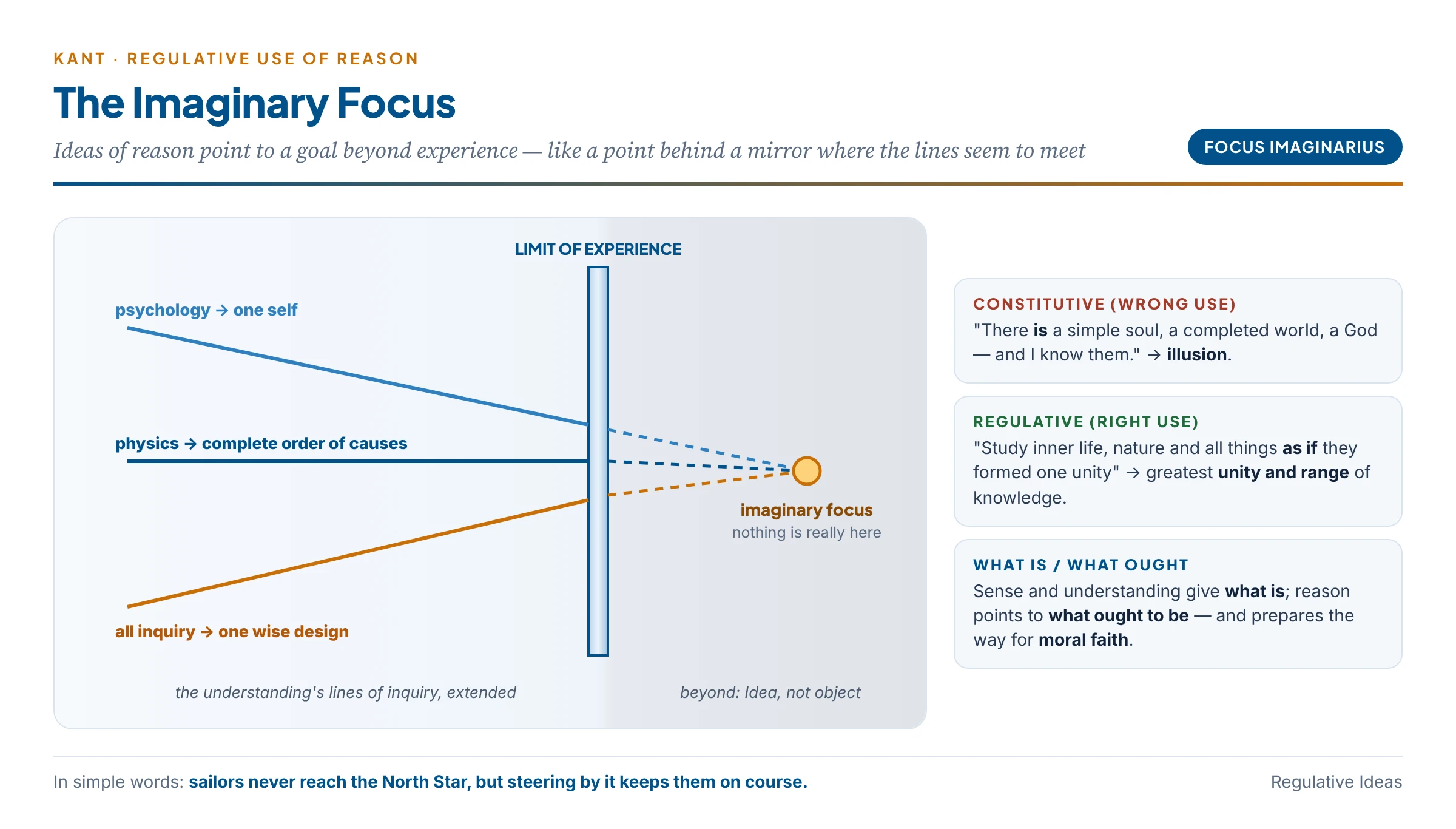
- Constitutive vs regulative.
- A constitutive principle tells us what an object is and so gives knowledge (the categories, applied to intuitions).
- A regulative principle tells us how to seek — it directs the understanding towards systematic unity, without claiming that any corresponding object exists.
- The “as if” (als ob). We should study inner life as if it belonged to one simple, persisting self; nature as if its series of causes formed a complete whole; and all things as if they were the work of a supreme, wise designer — without asserting that these objects exist.
- The imaginary focus. Kant compares an Idea to a focus imaginarius: in a mirror, lines of sight seem to meet at a point behind the glass. There is nothing there, yet the illusion is useful — it lets us see objects behind our back. Likewise the Ideas point to a goal that lies beyond experience, which helps the understanding extend its knowledge to the greatest possible unity and range.
- The functions of the three Ideas:
- Idea of the soul (psychological Idea) — gives unity to inner experience; seeks the absolute unity of the subject behind all mental states; guides psychology to treat mental phenomena as belonging to one subject; regulates self-understanding and personal identity.
- Idea of the world (cosmological Idea) — gives unity to outer experience; seeks the complete totality of causal conditions in nature; guides science towards systematic completeness and the search for laws, connections and explanations — while forbidding us to stop at any “first” cause.
- Idea of God (theological Idea) — gives systematic unity to all knowledge; represents the highest condition of possibility; serves as an ideal of complete order and purposiveness, guiding reason to unify all domains of knowledge — and paves the way for faith in morality and religion.
- Further roles.
- The Ideas are limiting concepts beyond which we must not venture in theory.
- They point out the ideal of knowledge — the highest unity of which reason is capable — and guide the understanding to wider knowledge.
- Sense and understanding guarantee the actual — “what is“; reason points to “what ought to be.”
- They prepare room for faith: in the Critique of Practical Reason, freedom, immortality and God return as postulates of moral reason.
In simple words
A North Star guides sailors. They will never reach it, and it gives them no information about the sea itself — the waves, the currents, the depth. But by steering towards it, they keep a steady course and do not go in circles. The Ideas of soul, world and God are reason’s North Stars. They are not places we can land on (no knowledge), but directions that keep our search for knowledge orderly and complete.
8. Hume’s Account of “Ideas of Reason” and Kant’s Response
- Hume. Reason, for Hume, deals only with relations of ideas and matters of fact; it has no power to reach beyond experience. The great metaphysical notions — soul, substance, necessary connection, the world as a whole, God as first cause — are not given by any impression. Hume explains them by imagination, association and custom: the self is a bundle, substance a collection of qualities united by imagination, necessity a felt expectation. Natural belief, not reason, carries us beyond experience; abstract metaphysics should be “committed to the flames.”
- Kant’s response.
- He agrees that the soul, the world-whole and God cannot be known — no intuition corresponds to them.
- He disagrees about their origin: they are not loose products of association but necessary concepts that reason must form when it seeks the unconditioned. That is why the illusions are natural and unavoidable, not mere mistakes of imagination.
- He distinguishes what Hume ran together: substance and causality are categories (objectively valid for experience), while soul, world and God are Ideas (no objects in experience).
- He gives them a positive role: regulative in science, practical in morality — where Hume left only custom and natural belief.
9. Immortality: Not Known, but Postulated
- Theoretical reason cannot prove the soul’s immortality — the arguments of rational psychology are paralogisms. Nor can it disprove it.
- Practical reason must postulate it: the moral law commands holiness — complete fitness of the will to the moral law — which no finite being reaches in any moment of its life. It can be reached only in an endless progress, which presupposes the endless existence of the same rational being — the immortality of the soul.
- So a rational “understanding” of immortality is possible not as knowledge but as a rational faith grounded in morality. (See the last article in this unit.)
Critical Evaluation
Criticisms
- Hegel — reason is not merely regulative. Kant reduces reason to a guide that can never reach truth. For Hegel, the contradictions reason meets are not illusions but the motor of thought; reason can grasp the Absolute. Kant stops where philosophy should begin.
- The “as if” is unstable. If we must think nature as if designed and the self as if simple, the Ideas seem to smuggle back the very metaphysics Kant rejected. Either they are true (and known) or they are fictions (and why should fictions guide science?).
- The derivation is artificial. Deriving exactly three Ideas from three forms of syllogism looks as contrived as deriving twelve categories from twelve judgments.
- The self is left mysterious. Kant tells us what the self is not (a known substance) and that it must be (as “I think”), but not what it is. Critics find the “transcendental subject = X” an empty placeholder.
- Personal identity. Some argue that the felt continuity of consciousness, together with memory, is what personal identity consists in; Kant’s elastic-ball example shows only that substance-identity is not proved, not that personal identity is unknowable.
Replies and Defences
- The critique of rational psychology is widely accepted. Few philosophers today think that the unity of consciousness proves a simple, immortal soul; Kant’s diagnosis — confusing the logical subject with a real substance — is regarded as decisive. Strawson praised the Paralogisms as the most successful part of the Dialectic.
- Regulative principles are real features of science. Scientists do seek the simplest, most unified theory, and do treat nature as if it were orderly — without proving that it is. Kant explains why this is rational.
- Modern neuroscience and philosophy of mind find no single “seat” of the self; the self appears as a unity of functions — close to Kant’s formal “I think.”
- Balanced outcome. Kant shows that neither spiritualism (soul proved immortal) nor materialism (soul proved mortal) can be demonstrated — leaving room for moral faith without dogma.
Critics and Defenders
Criticism — Critics
- Hegel: reason can know the Absolute; contradiction is productive, not illusory.
- Fictionalist reading: “as if” Ideas are useful fictions — or smuggled metaphysics.
- Rationalists (Descartes, Mendelssohn): the unity of consciousness shows a simple soul.
- Empiricists: the transcendental “I” is an empty postulate.
- Critics of the derivation: three Ideas from three syllogisms is artificial.
Defence — Defenders and lasting value
- The logical subject ≠ real substance diagnosis is still accepted.
- Strawson: the Paralogisms are the strongest part of the Dialectic.
- Regulative principles describe how science really works — seeking unity and completeness.
- Kant blocks both dogmatic spiritualism and dogmatic materialism.
- The self as a formal unity of functions fits modern cognitive science.
Cross-Tradition Comparison
The Self in Kant and Indian Philosophy
| Point | Kant | Nyāya | Buddhism (Anātmavāda) | Advaita Vedānta |
|---|---|---|---|---|
| Is the self known as a substance? | No — the “I think” is formal; soul-substance is a paralogism | Yes — ātman is a substance, inferred from desire, aversion, effort, pleasure, pain and cognition | No — only a stream of momentary aggregates (skandhas) | The self (Ātman) is pure consciousness, not a substance among others |
| How is unity of experience explained? | Synthesis under transcendental apperception | Qualities inhere in one ātman; memory proves a lasting knower | Causal continuity (santāna) of moments | The witness (sākṣī), self-luminous, presupposed in all knowing |
| Can the self become an object? | Never — the knower cannot be the known | Known by inner perception (mānasa pratyakṣa) as “I” | No self to become an object | Never an object; known only as the subject itself |
| Immortality | Not provable; postulated by practical reason | Eternal soul | Rebirth without a permanent soul | The Self is eternal; liberation is its realisation |
Indian Connect — Key takeaways
- Kant’s paralogisms and Buddhist anātmavāda both deny that we can find or prove a permanent soul; but Kant keeps a formal “I think” that the Buddhists replace by the continuity of moments.
- Kant and Advaita agree that the self is the subject that can never become an object. But for Advaita this witness (sākṣī) is the highest reality, directly realised; for Kant it gives no knowledge of what the self is in itself.
- Nyāya’s inference of the soul from desire, effort and memory is exactly the kind of argument Kant calls a paralogism — moving from the unity of mental life to a substance behind it.
- The Buddha’s silence (avyākṛta) on whether the self and the world are eternal anticipates Kant’s verdict that such questions exceed what reason can decide (see the next article).
Synthesis (Siddhānta)
Reason is the faculty of completion. Not content with conditioned knowledge, it forms three Ideas of the unconditioned — soul, world and God — from the three forms of inference. No intuition ever corresponds to them; when reason treats them as objects, it produces transcendental illusions that are natural, unavoidable and correctable only by critique. In rational psychology the illusion takes the form of paralogisms: from the purely logical subject “I think,” reason infers a real substance that is simple, identical and independent of matter — and so immortal. Kant exposes the shift in the middle term, the elastic-ball objection to identity and the fading-degree objection to Mendelssohn, and thereby refutes Descartes’ claim to know the soul as a thinking substance — while also refuting the materialist claim to know it is mortal.
The Ideas survive, however, in a new role. As regulative principles — imaginary foci, North Stars of inquiry — they drive the understanding towards systematic unity: one subject of inner life, a complete order of nature, an intelligible whole of all things. And in practical reason they return as postulates of moral faith. Kant thus answers both the dogmatist and the sceptic: the soul, world and God cannot be known, but reason’s need for them is neither an accident of association (Hume) nor a proof of their existence (Descartes) — it is the deepest expression of reason itself.
- Philosophy of mind: the distinction between the subject of experience and any object found in experience remains central to debates on consciousness.
- Philosophy of science: the search for unified theories expresses Kant’s regulative ideal of systematic unity.
- Religion and ethics: Kant’s move from theoretical proof to practical postulate shaped modern theology’s emphasis on faith and moral experience.
- Intellectual humility: the lesson that the most natural questions may lie beyond knowledge guards against dogmatism in every field.
The “I think” accompanies every thought, but it is the eye that sees — never a thing it sees.
Previous Year Questions
- 2026How does Hume account for ideas of reason? How does Kant respond to Hume’s views in this regard? Critically discuss.
- 2016Examine Kant’s criticism on Descartes’ view of Self.
- 2012How does Descartes’ ‘cogito ergo sum’ affect Hume and Kant’s transcendental philosophy? Explain.
- 2008Possibility of rational understanding of immortality and liberation. Critical notes.
- 1999Kant’s idea of Reason. Notes.